




Abstract
Prior research demonstrates that a number of cultural factors—including politics and religion—are significantly associated with anti-vaccine attitudes. This is consequential because herd immunity is compromised when large portions of a population resist vaccination. Using a nationally representative sample of American adults that contains a battery of questions exploring views about vaccines, the authors demonstrate how a pervasive ideology that rejects scientific authority and promotes allegiance to conservative political leaders—what we and others call Christian nationalism—is consistently one of the two strongest predictors of anti-vaccine attitudes, stronger than political or religious characteristics considered separately. Results suggest that as Americans evaluate decisions to vaccinate themselves or their children, those who strongly embrace Christian nationalism—close to a quarter of the population—will be much more likely to abstain, potentially prolonging the threat of certain illnesses. The authors conclude by discussing the immediate implications of these findings for a possible coronavirus disease 2019 (COVID-19) vaccine.
In 2019, the Centers for Disease Control and Prevention confirmed 1,282 cases of measles across 31 states, the largest number reported in the United States since 1992. The vast majority of these cases were among those who were not vaccinated against the disease (CDC 2020). The outbreak prompted renewed debate over the extent to which governments should require parents to vaccinate their children, particularly whether state governments should continue allowing religious exemptions (Villa 2019). Although public opinion polls show that the vast majority of Americans believe that children should be vaccinated in order to attend school, a sizable minority of Americans (about 17 percent) believe that parents have a right to choose. Notably, more than 20 percent of white evangelical or black Protestants (more than any other group), 25 percent of political conservatives (compared with only 9 percent of liberals), and 20 percent of Republicans (compared with only 12 percent of Democrats) believe that “parents should be able to decide not to vaccinate their children, even if that may create health risks for other children and adults” (Hefferon and Funk 2020; Kennedy 2017; Pew Research Center 2017). Suspicion toward vaccines is not due just to cultural conservatism or partisanship, however. For example, black and Hispanic Americans (compared with whites) and those with lower educational attainment, less scientific knowledge, and little trust for science or scientists are also more likely to feel that the risks of vaccines outweigh the benefits (Hefferon and Funk 2020; Pew Research Center 2017).
We propose that a particular ideological view unites many of these patterns to shape contemporary anti-vaccination (often called anti-vaxx) sentiment in the United States. Although the anti-vaccine skepticism of racial minorities has its own unique sources in the historical abuses suffered at the hands of medical professionals (O’Donnell 2020; Washington 2008), we propose that the anti-vaccination skepticism of white evangelical Protestants, political conservatives, and antiscience Americans is an ideological view that seeks to return an exclusivist religious traditionalism into the public sphere and grant epistemic primacy to community authorities—what we and others call “Christian nationalism” (Gorski 2017; Whitehead and Perry 2020). Building on recent research documenting Christian nationalism’s connection to antiscience skepticism, lower levels of scientific knowledge, and susceptibility to conspiracy theories (Perry, Whitehead, and Grubbs 2020, forthcoming-a; Baker, Perry, and Whitehead 2020a), we theorize that Christian nationalism is powerfully associated with a variety of indicators of anti-vaccination sentiment, net of other relevant correlates. We test this theory using recent data from a nationally representative sample of American adults that contains measures on a variety of attitudes toward vaccines as well as a tested measure of Christian nationalist ideology.
Our findings reveal that Christian nationalism is the second strongest predictor of general anti-vaxx attitudes (only behind identifying as black), even when accounting for traditional measures of religious commitment or political conservatism. Christian nationalism strongly predicts Americans’ skepticism toward the trustworthiness of doctors and pharmaceutical companies, an elevated assessment of the risks involved, misinformation about the link between vaccines and autism, and belief in parents’ ultimate authority to withhold vaccines from their children. Because vaccinations are such a vital method of preventive medicine to protect populations from disease, and vaccination rates of 96 percent to 99 percent are necessary to preserve herd immunity and prevent outbreaks of extremely contagious diseases such as measles (Hussain et al. 2018), our findings provide critical insight into ideological sources of contemporary suspicion toward or outright rejection of vaccination. We conclude our study by discussing potential implications for understanding the current coronavirus disease 2019 (COVID-19) pandemic in light of the possible arrival of a COVID-19 vaccine.
Background
Vaccination in the United States
One of the most consistent sociodemographic predictors of vaccine uptake and acceptance in the United States is race. Research consistently demonstrates that, compared with whites, black populations are much less likely to receive vaccines (Constantine and Jerman 2007; Galbraith et al. 2016; Webb et al. 2018) or trust the government and health care providers such as pharmaceutical companies (Allen, de Jesus et al. 2012; Allen, Othus et al. 2010; Galbraith et al. 2016; Lee et al. 2016; Washington 2008), with some variability within Hispanic populations. There is some evidence, however, that racial differences are declining for some vaccines over time (Burdette et al. 2017). Lack of knowledge about various vaccines can be vital to explaining various racial gaps (Burdette, Gordon-Jokinen, and Hill 2014; Galbraith et al. 2016) as well as distrust connected to historical abuses by medical professionals, as in the Tuskegee experiments (O’Donnell 2020; Washington 2008).
Although other sociodemographic and ideological predictors of Americans’ attitudes toward vaccines overlap in ways specific to black and Hispanic Americans (e.g., misinformation about vaccines, lack of trust in medical authorities), they often come from different tributaries. For example, Americans who are more religious by various indicators are more likely to delay vaccination (Callaghan et al. 2019; Rosen et al. 2017), possibly because of a lack of trust in experts (Streefland et al. 1999), a lack of knowledge about various vaccines (Birmingham et al. 2019), or concerns about moral issues related to whether the vaccine requires cell lines derived from an aborted fetus (Pelčić et al. 2016; Wombwell et al. 2015) or that vaccination would indirectly promote premarital sex as in the HPV vaccine (Shelton et al. 2013). Similarly, Americans who are more politically conservative, either by ideology or by party affiliation, tend to hold greater skepticism toward vaccines and to be more likely to delay update (Callaghan et al. 2019; McCoy 2020), also because of lower levels of trust in government and experts (Baumgaertner, Carlisle, and Justwan 2018; Kahan et al. 2010; Mesch and Schwirian 2015). Relatedly, libertarians are also more likely to reject vaccinations, primarily because they believe that individuals should have the right to choose (Rossen et al. 2019).
Religious and political conservatism are prominent among factors predicting anti-vaxx sentiment because they often reflect a skepticism toward science in favor of more traditional sources of epistemic authority as well as more conspiratorial, individualist, and hierarchical thinking (Buckman et al. 2020; Callaghan et al. 2019; Hornsey, Harris, and Fielding 2018; Jochman et al. 2018; Quinn and Lewin 2020). These findings dovetail with the broader research on religious conservatism and skepticism toward science writ large (Baker 2012; Ecklund and Scheitle 2018; Evans 2018; Gauchat 2012; Noy and O’Brien 2018; O’Brien and Noy 2015; Tom 2018). Building on this research, we propose that an important—but thus far overlooked—explanation for polarization on vaccine attitudes is Christian nationalism, an ideology that connects ideological conservatism and libertarianism, trust in tribal authority, and antiscience skepticism (Perry, Whitehead, and Grubbs forthcoming-b; Baker et al. 2020a).
Christian Nationalism in the United States
Christian nationalism is a cultural framework—a collection of myths, symbols, narratives, and value systems—that seeks to elevate an ethnotraditional, identitarian version of Christianity with American civic culture (Gorski 2017; Whitehead and Perry 2020). Americans who embrace Christian nationalism want to see their particular expression of Christianity privileged in the national identity, public policies, and sacred symbols. One of the primary concerns of Christian nationalism is to draw boundaries around who is truly American, defining who “we” are as a nation and defending “our” status privilege over the identified “they.” 1 Consequently, the term “Christian” in “Christian nationalism” becomes a dog whistle, including assumptions about nativism, white racial identity, and cultural-political orientation but also implying white supremacy, xenophobia, and masculine-authoritarian control (Davis 2019; McDaniel, Nooruddin, and Shortle 2011; Perry and Whitehead 2015; Perry, Whitehead, and Davis 2019; Perry et al. 2020; Sherkat and Lehman 2018; Shortle and Gaddie 2015; Whitehead and Perry 2019, 2020). 2
Importantly, recent research also demonstrates that Christian nationalism is not located within any particular religious tradition but has diffused across American culture (Delehanty, Edgell, and Stewart 2019; Whitehead and Perry 2020). Although majorities of white and black Christians—be they evangelical, mainline, or Catholic—embrace Christian nationalism to some extent, it is not only localized within those religious institutions. The cultural framework of Christian nationalism is also influential among Americans who rarely attend services, do not affiliate with religious organizations, or worship in non-Christian religions (e.g., Braunstein and Taylor 2017; Stroope et al. forthcoming). The scope of Christian nationalism’s influence extends beyond those who are devoutly religious and is critical to consider when examining public opinion on contemporary political attitudes and behaviors.
Beyond the boundary-enforcing elements within Christian nationalism, recent research has also begun to identify both libertarian and populist elements within Christian nationalism, particularly those that are connected with resistance to media recommendations around disease (Perry et al. forthcoming-b), science skepticism (Baker et al. 2020a), and placing trust in strongman leaders (Whitehead, Perry, and Baker 2018). These elements likely connect Christian nationalism to Americans’ views on vaccinations.
Theorizing Christian Nationalism and Anti-vaccine Attitudes
Previous research shows that Christian nationalist ideology is strongly associated with perceiving society in terms of hierarchical relationships directed by a sacralized traditionalism ostensibly connected to Christianity (Whitehead and Perry 2020). Given this commitment to the sacralized order, Christian nationalism is central to explaining Americans’ polarized views toward science and scientists. Recent work by Baker et al. (2020a) demonstrates that Christian nationalism is one of the strongest predictors of Americans’ belief that scientists are hostile to faith, that creationism should be taught in public schools, and that our country relies too much on science over religion. Because science represents a competing epistemic authority, Americans who embrace Christian nationalism oppose its encroachment on public life, particularly in areas they see as morally consequential. Baker et al. (2020a) showed that their findings support claims that “conflicts about ‘science and religion’ are primarily issues about status politics” (p. 17; see also Evans 2018). Christian nationalism is a central cultural mechanism linking politics, religion, and opposition to science. Furthermore, Americans who embrace Christian nationalism are much less likely to support federal intervention to solve collective action problems (Perry et al. forthcoming-b; Whitehead, Schnabel et al. 2018). Rather, they believe that only by upholding the “moral” fabric of the country can the United States ensure social and economic stability.
Christian nationalism is also linked to libertarian populist attitudes that might incline Americans to disregard the recommendations of mainstream media and scientists regarding diseases. Perry et al. (forthcoming-b) showed that when they are asked questions about government-mandated lockdown restrictions in response to COVID-19, Christian nationalism is one of the leading predictors that Americans will prioritize individual liberty or the economy rather than protecting the vulnerable. Similarly, preliminary analyses by Perry et al. (2020) showed that Christian nationalism predicted that Americans would be less likely to take precautionary steps to protect others from infection.
Last, Christian nationalism powerfully predicts allegiance to Donald Trump, who promises to defend traditional Christian values (Baker, Perry, and Whitehead 2020b; Whitehead, Perry et al. 2018). Although we could not speak to the direction of the association, Trump has for years promoted anti-vaxx arguments to millions via Twitter (Hornsey et al. 2020; Novella 2015). Trump’s skepticism toward vaccines both during the 2016 election and afterward raised serious concerns from medical professionals (Schwartz 2017). And experimental work by Hornsey et al. (2020) showed that Trump voters were more concerned about vaccines than others, more conspiratorial in their thinking, and particularly responsive to Trump’s previous anti-vaxx tweets.
Given that Christian nationalism is a powerful predictor of antiscience skepticism connected to its claims for epistemic authority, libertarian populism, and confidence in Trump, we anticipate that Christian nationalist ideology will be powerfully associated with Americans’ views on a variety of vaccine-related questions, even after accounting for the traditionally strong influences of race, religion, politics, and other correlates.
Data
To explore this relationship, we analyze nationally representative data from the 2019 wave of the Chapman University Survey of American Fears (CSAF). Collected annually since 2014, the CSAF documents a wide variety of social, political, and psychological fears among the American public (Baker et al. 2020a, 2020b). The surveys were developed through the Earl Babbie Research Center at Chapman University and collected by Social Science Research Solutions (SSRS) using a nationally representative online Probability Panel of participants. Participants in the SSRS Probability Panel are recruited randomly from the SSRS Omnibus survey, which is completed weekly using a dual-frame, random-digit-dialing sampling frame. In 2019, the response rate for the typical Omnibus survey was 5 percent, although most Probability Panel participants were recruited in previous years, when response rates were slightly higher (about 7 percent to 8 percent). In all, 2,438 potential respondents from the panel were recruited. Data collection took place from August 7 until August 26, 2019, with a final n of 1,219, resulting in an overall cooperation rate of 53 percent. The data and following analyses are weighted to match demographic benchmarks in the U.S. population on the basis of gender, age, education, race/ethnicity, region, and civic engagement. The total margin of error for the estimation of population parameters of the American public was ±3.8 percent. This data source is ideal because it contains extensive measures of Christian nationalism, vaccine ideology, and the necessary political, religious, and sociodemographic controls, a rarity in nationally representative samples of the American public.
Measures
Dependent Variables
The 2019 CSAF asked seven different questions concerning attitudes about vaccines: “Vaccines cause autism,” “Negative side-effects from vaccines are very common,” “Doctors and drug companies are not honest about the risks from vaccines,” “People should have the right to decide whether to vaccinate their children,” “Kids today are given too many vaccines,” “Vaccines help protect children from serious diseases,” and “The benefits of vaccines are greater than the risks.” Possible response options included “strongly agree,” “agree,” “disagree,” and “strongly disagree,” and stronger disagreement (anti-vaccine sentiment) equated to higher values. We reverse-coded the final two questions. We then created an overall anti-vaccine scale that ranges from 0 to 21. Each of the measures loaded onto a single factor, with all factor loading scores exceeding .69. The Cronbach’s α coefficient for the scale is .88, suggesting strong internal reliability.
Independent Variable of Interest
Although there have been several measures of Christian nationalism (see Whitehead and Perry 2020), with each performing similarly on various topics, our measure is a scale constructed from measures repeatedly asked in surveys such as the Baylor Religion Survey and the Public Discourse and Ethics Survey (Perry et al. 2020, forthcoming-a; Whitehead, Perry et al. 2018). This scale typically includes five level-of-agreement questions using the same statements (with factor loading scores in parentheses): “The federal government should declare the United States a Christian nation” (.66), “The federal government should advocate Christian values” (.83), “The federal government should enforce strict separation of church and state” (reverse coded; .85), “The federal government should allow prayer in public schools” (.77), and “The federal government should allow religious symbols in public spaces” (.85). Each question had Likert-type disagree/agree response options ranging from “strongly disagree” to “strongly agree.” Higher scores indicated greater agreement with Christian nationalist ideology. The index ranges from 0 to 15 and had good internal reliability, with a Cronbach’s α coefficient of .86.
Control Measures
We include several control measures known to be associated with anti-vaccine attitudes (Buckman et al. 2020; Callaghan et al. 2019; Hornsey et al. 2018; Jochman et al. 2018; McCoy 2020; Quinn and Lewin 2020). Our political control measures include political conservatism (1 = “extremely liberal” to 7 = “extremely conservative”) and political party (Republican [reference category], independent, or Democrat). Our religion control variables include biblical literalism, religious service attendance (1 = “never attend” to 9 = “several times a week”) and religious tradition. The religious tradition categories include Protestant (reference category), Catholic, other Christian, Jewish, other religion, no religion, atheist, and agnostic. Sociodemographic controls include age (in years), gender (female), married, race/ethnicity (white, black, Hispanic, Asian, and other race), region (Northeast, Midwest, South [reference category], and West), size of place (urban vs. nonurban), education (1 = less than high school to 7 = postgraduate degree), and income (1 = less than $20,000 to 9 = $150,000).
Plan of Analysis
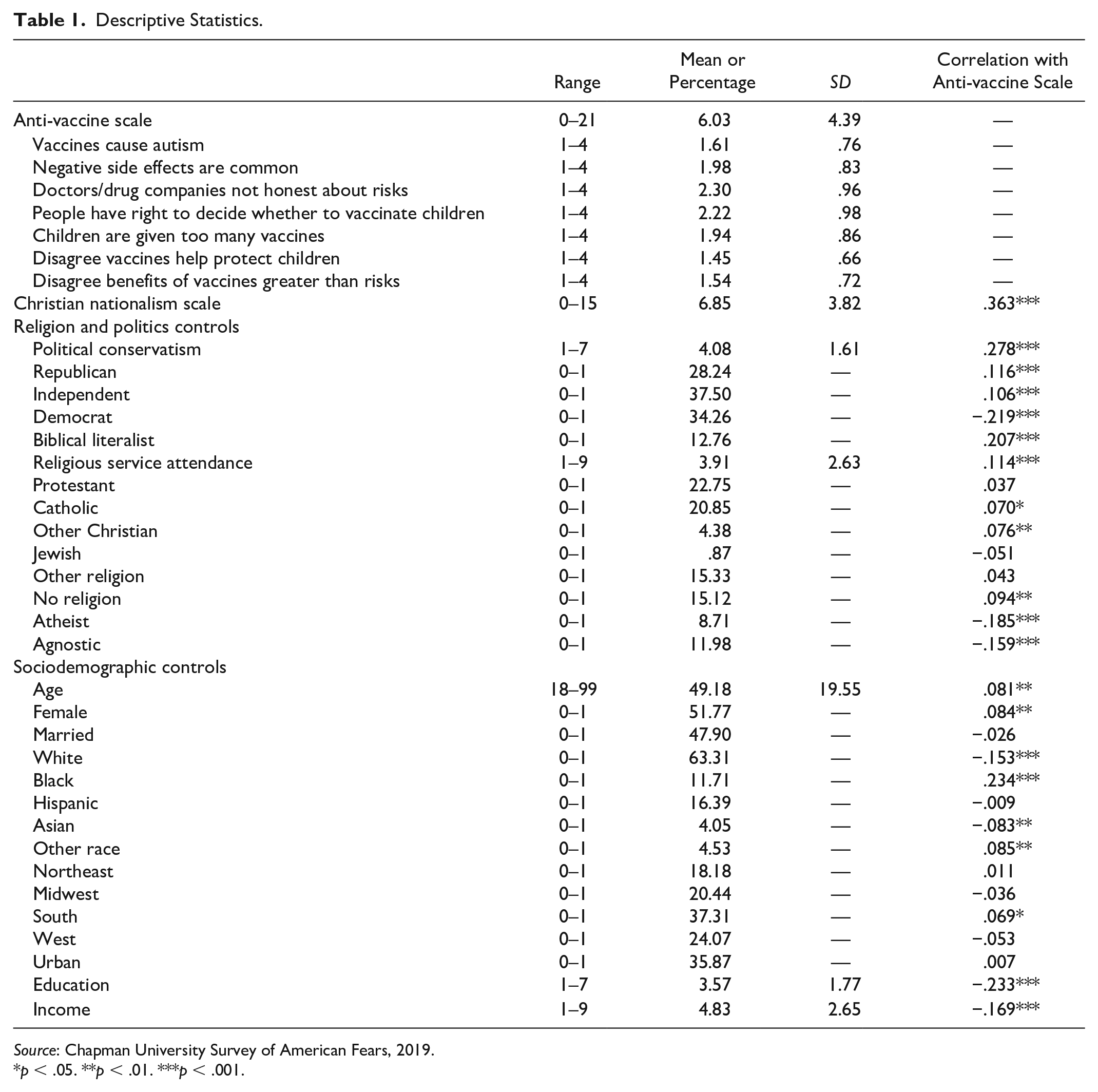
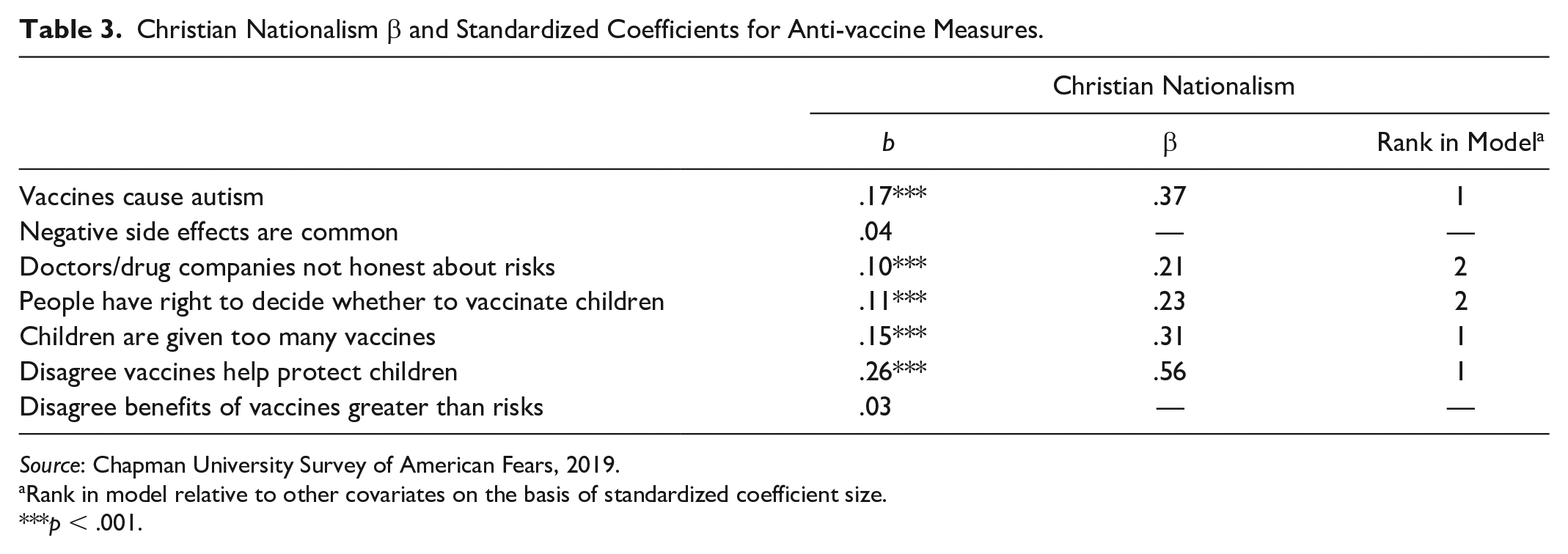
Table 1 presents descriptive statistics and bivariate correlations between each covariate and the anti-vaccine scale. Table 2 presents three ordinary least squares (OLS) regression models: the first with sociodemographic covariates only, the second with all of the religion and politics controls in addition to the sociodemographic controls, and the final full model that includes our measure of Christian nationalism. 3 In Table 3 we show the unstandardized and standardized logistic regression coefficients for the Christian nationalism scale for each of the seven anti-vaccine measures that make up the anti-vaccine scale. 4 Finally, in Figure 1 we present the mean scores for the anti-vaccine scale for each level of Christian nationalism. We then graph the predicted values for the anti-vaccine scale at each level of Christian nationalism when all other covariates are held to their means.
Descriptive Statistics.
Source: Chapman University Survey of American Fears, 2019.
p < .05. **p < .01. ***p < .001.
Anti-vaccine Attitudes Scale by Christian Nationalism.

Source: Chapman University Survey of American Fears, 2019.
Note: Republican, Protestant, white, and South serve as reference categories. β = standardized coefficient.
p < .05. **p < .01. ***p < .001.
Christian Nationalism β and Standardized Coefficients for Anti-vaccine Measures.
Source: Chapman University Survey of American Fears, 2019.
Rank in model relative to other covariates on the basis of standardized coefficient size.
p < .001.

Christian Nationalism and Predicted Values and Mean Scores for Anti-vaccine Attitudes Scale.
Results
In Table 1 we see clear evidence that Christian nationalism (r = .363, p < .001) is significantly associated with anti-vaccine attitudes. It is the strongest correlation out of all other covariates. It is important to note that the various politics and religion controls are also significantly correlated.
In Table 2, model 1, we see that older adults and black and Hispanic Americans in comparison with whites have much more negative views about vaccines. Americans with higher levels of income and education, however, are less anti-vaccine. Model 2 includes the religion and politics control variables. Political conservatives, biblical literalists, and (compared with Protestants) Catholics, other Christians, and those with no religion score higher on the anti-vaccine scale. Democrats, compared with Republicans, exhibit much more positive attitudes toward vaccines. The sociodemographic measures remain largely unchanged except that age and income are no longer significantly associated, while women are now significantly more anti-vaccine than men.
Table 2, model 3, represents our full model. Even after accounting for various religious, political, and sociodemographic characteristics, Christian nationalism is significantly and positively associated with anti-vaccine attitudes (β = .22, p < .001) and is the second strongest predictor in the model, following the difference between black and white Americans (β = .27). Figure 1 graphs the predicted values on the anti-vaccine scale for each value of Christian nationalism. Americans at mean levels of Christian nationalism score almost 2 points higher on the scale (11.46 vs. 9.70) than Americans at the lowest levels of Christian nationalism. Those Americans who embrace Christian nationalism most strongly score 2 points higher (13.47) than Americans at mean levels (11.46) and close to 4 points higher than Americans at the lowest levels (9.70). 5 We also find that when including Christian nationalism, the standardized effect for political conservatism is reduced by almost half, and the difference between Democrats and Republicans is reduced by one third. Once we account for Christian nationalism, biblical literalism is no longer significantly associated with anti-vaccine attitudes. The sociodemographic covariates from model 2 maintain similar associations in model 3.
Table 3 shows that Christian nationalism is significantly and positively associated with each of the constituent measures of the anti-vaccine scale, save two. 6 Across the five models in which Christian nationalism is significantly associated with the dependent variable, it is the strongest predictor in three models and the second strongest predictor in the other two models. We share these findings (see full models in Appendix Table 1) to demonstrate that Christian nationalism is consistently one of the most important predictors of anti-vaccine attitudes, whether we focus on particular views or when combining those views into a scale as we did previously. Similar to the full model predicting the anti-vaccine scale in Table 2, the difference between black and white Americans is consistently the strongest or second strongest predictor of anti-vaccine attitudes. This follows much current research highlighting the importance of race (Freimuth et al. 2017; Jamison et al. 2019). An interaction term between race and Christian nationalism was nonsignificant, indicating that the effect of Christian nationalism is similar across racial/ethnic groups.
Discussion and Conclusion
Using a nationally representative sample of American adults, we demonstrate that Christian nationalism is significantly associated with anti-vaccine attitudes in the United States. Americans who desire to see their particular expression of Christianity privileged in the public sphere are more likely to hold beliefs such as the following: “Vaccines cause autism,” “Doctors and drug companies are not honest about the risks of vaccines,” “People have the right to decide whether or not to vaccinate their kids,” “Kids are given too many vaccines,” and “Vaccines do not help protect children from dangerous diseases.” Even when we account for political ideology, religiosity, and a host of sociodemographic measures, Christian nationalism is consistently one of the most important predictors. This finding underscores the importance of culture, particularly “public expressions of religion” (Delehanty et al. 2019), when explaining Americans’ actions and beliefs pertaining to vaccination and the medical community.
We propose that Americans who embrace Christian nationalism are anti-vaccine primarily for three reasons. First, they are much more likely to distrust science and scientists, perceiving science as a threat to a traditional epistemic and moral order (Baker et al. 2020a). This tends to be to the detriment of any reliance on institutionalized science or federal intervention to solve collective action problems, including public health crises such as a pandemic (Whitehead, Schnabel et al. 2018). Second, Christian nationalism is also linked to libertarian populist attitudes that incline Americans to ignore the recommendations of scientists and the mainstream media regarding infectious diseases. Recent studies demonstrate that Americans who embrace Christian nationalism routinely prioritize individual liberty and the economy rather than protecting vulnerable populations. Third, Christian nationalism has bound millions of Americans to an avowed defender of Christian cultural and political influence, Donald Trump, who has repeatedly circulated anti-vaxx arguments to millions, which studies show are efficacious in their influence on his followers (Hornsey et al. 2020).
Beyond Christian nationalism, several other findings deserve mention. First, race is consistently an important predictor of anti-vaccine attitudes. The differences between black Americans and whites are the strongest predictor in our full model. The effects of the fraught history of institutionalized medicine, vaccines, and the African American community are still with us today (Washington 2008). It is no accident that whites are more likely to implicitly trust federal institutions that recommend vaccination, whereas black Americans not only trust the government less but also distrust its motives (Freimuth et al. 2017; Jamison et al. 2019; Washington 2008). The differences between Hispanics and whites, as well as those of another race and whites, are also consistently significant. These findings underscore the continuing importance of race when examining vaccine attitudes.
Furthermore, political conservatism and identifying as Republican are associated with anti-vaccine attitudes, even when accounting for Christian nationalism. Prior research shows that similar processes are potentially at work. Political conservatives have over time become more skeptical of science and scientific expertise, especially regarding vaccines (Buckman et al. 2020; Hornsey et al. 2018; Jochman et al. 2018). We also find that Catholics and Americans who do not affiliate with a religious tradition are significantly more likely than Protestants to hold anti-vaccine beliefs even after accounting for Christian nationalism, religiosity, and politics. Future research must continue to examine the overlap between cultural frameworks, religion, and politics in understanding the racial differences in anti-vaccine attitudes.
As COVID-19 infections continue to surge throughout the United States, many politicians and the Americans they represent look with hope toward a vaccine to end the pandemic. Although the data we use in our analyses cannot speak to COVID-19 vaccine attitudes directly, our findings demonstrate that Christian nationalism, a cultural framework that is broadly influential across the United States (Delehanty et al. 2019; Whitehead and Perry 2020), presents a significant challenge to the possibility of widespread acceptance of a COVID-19 vaccine. As we demonstrate, Americans who embrace Christian nationalism are much more likely to question the efficacy and safety of vaccines, to believe that doctors and drug companies are dishonest about vaccine risks, and to believe that it should be up to individuals to choose whether to vaccinate or not. The implications of these findings are clear: even with the existence of a COVID-19 vaccine in the future, a substantial subset of Americans will likely view it with suspicion and resist receiving it.
Evans and Hargittai (2020) found that broad swaths of the American public—Republicans and independents, conservative Protestants and Catholics, working-class men—tend to be less trusting of scientists’ ability to understand the spread of COVID-19, to believe that scientists’ values are inconsistent with their values, or both. Although they did not examine vaccine attitudes directly, their work underscores the difficulty science might face in garnering widespread acceptance and use of a vaccine. A May 2020 Yahoo News/YouGov coronavirus poll showed that 19 percent of Americans would refuse the coronavirus vaccine and that 26 percent were undecided (Romano 2020). The extant research on Americans’ attitudes toward vaccines in general supports these findings, showing that the wide acceptance of a new COVID-19 vaccine is questionable at best (Horne et al. 2015).
Recent research on Americans’ COVID-19 behaviors and Christian nationalism clearly illustrates the distrust of science and rejection of its recommendations by those who embrace Christian nationalism. Perry et al. (2020) showed that higher levels of Christian nationalism incline Americans to reject behaviors associated with limiting the spread of COVID-19 (frequent hand washing, wearing masks, limiting social interactions) and increasingly engage in incautious behaviors (eating in restaurants, gathering with 10 or more people). Christian nationalism, as they explain, connects a disregard for scientific expertise with a conception of America as God’s chosen people. Consequently, scientists’ and health experts’ recommendations for behavioral changes to limit the risk for COVID-19 infection are flatly rejected. These findings taken in concert with what we demonstrate above—that embracing Christian nationalism is strongly associated with anti-vaccine attitudes—underscore the plausibility that many Americans who embrace Christian nationalism will likewise resist receiving a vaccine for COVID-19, just as they were more likely to reject public health recommendations concerning COVID-19.
Again, one clear limitation of our study is that the data were collected before the pandemic, so we were unable to examine attitudes toward a COVID-19 vaccine directly. Although a question about a COVID-19 vaccine would be ideal, the index we use in this study is certainly instructive and provides an important signal regarding how Americans will react if and when a COVID-19 vaccine is made available. We implore researchers currently collecting data to account for Americans’ attitudes toward a possible COVID-19 vaccine as well as their views toward Christian nationalism. Given these findings, it is clear that future researchers will need to account for Christian nationalism to explicate Americans’ responses to a COVID-19 vaccine.
To conclude, it is likely that Christian nationalist ideology will serve as a significant barrier to a substantial minority of Americans’ voluntarily receiving a COVID-19 vaccination, should one become available. This is in combination with Trump’s consistent downplaying of the COVID-19 threat (Holden 2020) and research showing that Christian nationalists are already disinclined to follow expert recommendations on distancing and mask wearing (Perry et al. 2020). These various realities could have the negative consequence of delaying herd immunity and prolonging the existential threat of the virus for those living not only in the United States but worldwide. Politicians, policy makers, health care experts, and the general public must acknowledge these barriers in order to plan an effective response.
Footnotes
Appendix
Christian Nationalism and Anti-vaccine Measures.

| Vaccines Cause Autism | Negative Side Effects Are Common | Doctors/Drug Companies Not Honest | Right to Decide to Vaccinate | Children Given Too Many Vaccines | Disagree Vaccines Protect Children | Disagree Benefits of Vaccines Outweigh Risks | ||||||||
|---|---|---|---|---|---|---|---|---|---|---|---|---|---|---|
| β | OR | β | OR | β | OR | β | OR | β | OR | β | OR | β | OR | |
| Christian nationalism | .37*** | 1.19 | .08 | — | .21*** | 1.11 | .23*** | 1.12 | .31*** | 1.16 | .56*** | 1.30 | .07 | — |
| Religion and politics | ||||||||||||||
| Political conservatism | −.07 | — | .12 † | 1.14 | .02 | — | .17** | 1.21 | .07 | — | −.01 | — | .16 † | 1.20 |
| Independent | −.07 | — | −.06 | — | −.10* | .68 | .22*** | 2.31 | .06 | — | .16 | — | .20* | 2.15 |
| Democrat | −.26** | .37 | −.14* | .58 | −.17** | .52 | .05 | — | −.04 | — | −.02 | — | .03 | — |
| Biblical literalist | .13* | 1.99 | .03 | — | .12** | 1.95 | −.13** | .50 | .04 | — | −.05 | — | −.04 | — |
| Religious service attendance | .09 | — | −.04 | — | .08 † | 1.06 | .04 | — | .04 | — | −.38*** | .77 | −.10 | — |
| Catholic | .11 | — | .21*** | 2.58 | .14** | 1.90 | −.05 | — | .04 | — | .30* | 3.78 | .11 | — |
| Other Christian | .16** | 3.98 | .12** | 2.86 | .07† | 1.79 | −.04 | — | .09* | 2.18 | −.02 | — | −.05 | — |
| Jewish | .09 | — | .08* | 5.23 | .06 | — | .01 | — | .01 | — | .12 | — | −.62 | — |
| Other religion | .21*** | 2.86 | .11* | 1.74 | .06 | — | .01 | — | .03 | — | .24* | 3.43 | .11 | — |
| No religion | .32*** | 5.07 | .18*** | 2.48 | .19*** | 2.61 | .04 | — | .09 | — | .22* | 3.05 | .18* | 2.44 |
| Atheist | .17† | — | .10† | 1.93 | .09† | 1.82 | −.13* | .43 | .04 | — | .15 | — | −.01 | — |
| Agnostic | .10 | — | −.04 | — | .17*** | 2.59 | −.09† | .59 | −.03 | — | −.36 | — | .03 | — |
| Demographics | ||||||||||||||
| Age | −.06 | — | .05 | — | .05 | — | .02 | — | .00 | — | −.31** | .97 | .09 | — |
| Female | .11† | — | .09* | 1.40 | .04 | — | −.03 | — | .05 | — | .04 | — | −.01 | — |
| Married | .00 | — | .01 | — | −.01 | — | .02 | — | −.02 | — | −.11 | — | −.24*** | .41 |
| Black | .34*** | 6.79 | .39*** | 9.13 | .23*** | 3.63 | .26*** | 4.29 | .27*** | 4.60 | .16* | 2.52 | .18** | 2.78 |
| Hispanic | .07 | — | .14** | 2.00 | .13** | 1.88 | .04 | — | .11* | 1.72 | .10 | — | −.06 | — |
| Asian | .01 | — | .02 | — | .01 | — | .01 | — | .01 | — | .12 | — | .07 | — |
| Other race | .05 | — | .11** | 2.59 | .05 | — | .09* | 2.14 | .05 | — | .16* | 4.11 | .15*** | 3.75 |
| Northeast | .12* | 1.77 | .12** | 1.80 | .01 | — | .03 | — | .10* | 1.62 | .22** | 2.81 | −.02 | — |
| Midwest | −.01 | — | −.08† | .70 | −.07† | .74 | .01 | — | −.09† | .66 | −.20† | .40 | −.13† | .55 |
| West | −.02 | — | −.06† | .76 | .02 | — | .02 | — | .12* | 1.65 | −.14 | — | −.05 | — |
| Urban | .01 | — | −.01 | — | −.03 | — | −.03 | — | .03 | — | .27** | 2.74 | .03 | — |
| Education | −.08 | — | −.18 | — | −.09* | .91 | −.08† | .92 | .01 | — | −.11 | — | .03 | — |
| Income | .08 | — | −.01** | 1.00 | −.06 | — | −.05 | — | .06 | — | .09 | — | −.06 | — |
| Intercept | −4.37*** | −2.46*** | −1.57** | −2.28*** | −3.98*** | −4.44*** | −3.94*** | |||||||
| PRE | .178 | .156 | .110 | .141 | .111 | .262 | .131 | |||||||
| n | 1,206 | 1,206 | 1,206 | 1,206 | 1,206 | 1,205 | 1,205 | |||||||
Source: Chapman University Survey of American Fears, 2019.
Note: Republican, Protestant, white, and South serve as reference categories. β = standardized coefficient; OR = odds ratio.
p < .10; *p < .05. **p < .01. ***p < .001.
1
 :28–32) found that “Ambassadors,” those Americans who strongly embrace Christian nationalism, are on average 54 years old, are female (55 percent), are white (70 percent), have a high school education (39 percent), live in the South (50 percent), are Evangelical Protestant (55 percent), attend church several times a month (48 percent), and identify as Republican (56 percent).
2
There is clearly important overlap between Americans who subscribe to Christian nationalism and “white nationalists.” The latter term is in some ways a more specific category with reference to overt white supremacy and nativism without any explicit reference to the religious beliefs of the person holding those views. Christian nationalism, by comparison, foregrounds “Christianity” as the primary concern, while using religion as a proxy for other markers of group membership, which can also include race, ethnicity, citizenship, and nativity. With regard to racial attitudes, Christian nationalists are more likely to subscribe enthusiastically to “color-blind” forms of racism, whereas white nationalists would be more unapologetic in their prejudice because they would feel less need to cloak it in religious language (see ).
3
To assess possible multicollinearity issues, we checked variance inflation factors for the OLS models. No variance inflation factor exceeded 3, well within the generally accepted range.
4
As a robustness check, we also ran OLS regression analyses using the full set of response categories for each question. The results were substantively identical: Christian nationalism was a significant predictor for the first, second, third, fourth, fifth, and sixth measures. It was the strongest predictor in the sixth model and the second strongest in the first, third, fourth, and fifth models.
5
Using the margins program in R, we tested whether the predicted values we discuss here are significantly different from one another. They indeed are.
6
When we maintain the full set of response categories for each anti-vaccine measure and use OLS regression modeling techniques, the Christian nationalism measures is a significant predictor in six out of the seven models (see note 4).