




Abstract
Previous cross-national research on the link between immigration and the welfare state has focused exclusively on the relationship between the size of a country’s foreign-born population and support for redistribution, neglecting that people vary in their responses to immigration. In this article, the authors revisit the progressive’s dilemma by testing its theoretical proposition—that immigration and welfare are incompatible—in two novel ways. First, the authors conduct an individual-level analysis that demonstrates that, for most Europeans, supporting both immigration and welfare is unlikely. Second, the authors assess whether country-level immigration is associated with the salience of different immigration-welfare attitudes but find little evidence that immigration measured at the country level produces the most exclusive attitudes.
One of the major challenges facing European welfare states is “how to maintain and strengthen the bonds of solidarity in ethnically diverse societies” (Banting 2005:98). In Europe, immigration is often seen as the greatest threat to national welfare states, and the notion that diversity undermines the solidarity required to maintain popular support for the welfare state has become a commonly expressed fear, especially among social progressives, who see both immigration and a robust welfare state as essentially good. For that reason, this theoretical tension between immigration and a redistributive welfare state is often called the “progressive’s dilemma” (Goodhart 2004; Koopmans 2010; Wolfe and Klausen 1997) or the “new liberal dilemma” (Kumlin and Rothstein 2010; Newton 2007; Reeskens and van Oorschot 2012). Although this term, progressive’s dilemma, originates from an existential concern among social progressives that immigration and the welfare state are not easily combined, in empirical research the term commonly refers to the hypothesis that immigration undermines support for the welfare state (Brady and Finnigan 2014; Reeskens and van Oorschot 2012) or, less commonly, that multiculturalism undercuts support for the welfare state (Banting et al. 2006; Koopmans 2010). Our use of the term, therefore, is practical and consistent with its most common usage in previous sociological research. 1
Although the causal mechanisms involved remain largely theoretical, the progressive’s dilemma is usually portrayed as a two-stage argument. First, diversity corrodes trust, and second, lack of trust diminishes solidarity, which leads to a decrease in welfare state support because people do not want to redistribute resources to people they do not trust and with whom they do not identify (Banting and Kymlicka 2006). This type of argument is not new. The idea that society requires some form of collective identity is a central tenet of political philosophy (e.g., Cederman 2001; Dahl 1989; Weiler 1999). According to John Stuart Mill ([1861] 1975), ethnic homogeneity is vital to the existence of free and democratic institutions, as a common nationality facilitates sympathy, loyalty, and cooperation among coethnics. Baldwin (1990) maintained that demographic homogeneity facilitated the emergence of universal welfare states in the Scandinavian countries and Britain—that “social insurance, especially of a solidaristic bent, was only possible given a certain degree of homogeneity” (p. 196). 2 Indeed, Dahl (1996:642) claimed that in a homogeneous group, “egoism merges indistinguishable with altruism”; yet, “as the group expands in numbers, as homogeneity declines, and as conflicting interests increase,” advancing others’ interests becomes less likely.
Given these theoretical expectations, a flurry of scholarship has sought to understand the progressive’s dilemma by examining the relationship between immigration-generated ethnic diversity and popular support for social welfare cross-nationally. This body of research begins with the hypothesis that we should see a negative relationship between objective measures of immigration and support for redistribution, or that welfare state support should decrease when ethnic heterogeneity increases. Results from cross-national analyses of European welfare attitudes, however, provide little support for the expectation that immigration reduces support for social welfare (Brady and Finnigan 2014; Burgoon, Koster, and van Egmond 2012; Crepaz 2008; Hjerm and Schnabel 2012; Mau and Burkhardt 2009; Mewes and Mau 2012), suggesting that there is no progressive’s dilemma (practical or existential) after all.
We argue that this conclusion is premature because of how previous cross-national research has approached testing the progressive’s dilemma’s theoretical propositions. We argue that the so-called generic hypothesis (Brady and Finnigan 2014) derived from the progressive’s dilemma—that there is a negative relationship between a country’s share of immigrants and welfare state support—is misleading because individuals differ greatly in their responses to immigration. In other words, previous studies have not considered the role of subjective reactions to immigration when analyzing the relationship between objective measures of immigration and support for social welfare.
Thus, in this article, we question the “generic hypothesis,” which assumes a linear relationship between objective immigration-generated ethnic diversity and individual-level support for redistribution across countries. We argue that there is more than one way to think about immigration and welfare, which has consequences for how we first conceptualize and then operationalize these variables and the relationship between them. We hypothesize that distinct attitudinal profiles, which reflect different ways of thinking about immigration and welfare, exist and vary in their salience both within and across countries. We expect that some—but not all—of these profiles are consistent with the idea that immigration and a redistributive, universal welfare state are incompatible. Then, we test the hypothesis that objective immigration is what drives the prominence of these different attitudinal configurations cross-nationally.
To do this, we conduct two analyses. The first is an individual-level analysis of the key elements of the immigration-welfare nexus, in which we examine individuals’ attitudes toward redistribution, immigration, and immigrants’ social rights to see if attitudes cluster together in ways that point to distinct attitudinal profiles. Revealing such attitudinal patterns is critical if we are to understand the complexity of the hypothesized link between diversity and the welfare state. We focus in particular on evidence of profiles that are consistent with the progressive’s dilemma or, in other words, evidence that supports the notion that support for immigration is incompatible with support for redistribution. Once we have identified different attitudinal profiles, our second, country-level analysis investigates the relationship between objective immigration and the prevalence of these attitudinal clusters. We do this by plotting the sizes of attitudinal clusters in each country against various measures of objective immigration. We conclude with a discussion of our results and identify directions for future research.
Immigration and Welfare Attitudes
Much of the previous research on the relationship between ethnic diversity and the welfare state comes from analyses of the United States. Scholarship on the American case reveals a negative relationship between racial and ethnic heterogeneity and welfare attitudes. Studies consistently show that diversity undermines support for social welfare (Fox 2004; Gilens 1999; Luttmer 2001). Related research finds a negative relationship between ethnoracial heterogeneity and social expenditure (Alesina, Baqir, and Easterly 1999, 2000; Hero 1998). Furthermore, scholars argue that this diversity impeded the development of working-class solidarity (Lipset and Marks 2000), contributed to the development of the liberal American welfare state (Quadagno 1994), and accounts for approximately 50 percent of the variation between American and European welfare state institutions (Alesina and Glaeser 2004).
Given recent, unprecedented rates of immigration to and subsequent ethnic diversity in European countries (Castles and Miller 2003), social scientists have asked whether the American pattern will be replicated in Europe (Eger 2010; Larsen 2011; Putnam 2007). Cross-national research on European attitudes, however, yields little evidence of a negative relationship between objective measures of immigration and support for social welfare (Brady and Finnigan 2014; Burgoon et al. 2012; Crepaz 2008; Hjerm and Schnabel 2012; Mau and Burkhardt 2009; Mewes and Mau 2012). 3 This has led some scholars to conclude that immigration is not systematically related to attitudes about welfare in Europe (e.g., Crepaz 2008) or, more recently, that future research must move beyond the generic model (Brady and Finnigan 2014). Agreeing with the latter, we argue that the reason for diverging empirical results between the United States and Europe is not necessarily because a relationship between immigration and welfare state support does not exist in Europe but instead because the generic hypothesis derived from the progressive’s dilemma fails to account for the complexity of the immigration-welfare nexus.
This shortcoming manifests itself empirically in two ways. First, by focusing exclusively on the relationship between country-level measures of immigration and individual attitudes, previous cross-national research has conflated rates of immigration with attitudinal responses to immigration. We find this especially problematic given that attitudes regarding immigration do not always depend on actual rates of immigration to or the size of the immigrant population in a country. A review of cross-national research on anti-immigrant sentiment suggests a weak relationship between the size of an immigrant out-group and attitudes (Ceobanu and Escandell 2010:322). This may be in part because country-level measures of immigration are often unrelated to individuals’ perceptions of immigration (Herda 2010). In fact, research on European attitudes shows that individuals’ estimations of out-group size do a better job explaining anti-immigrant sentiment than objective country-level measures of immigration (Hjerm 2007; Schlueter and Scheepers 2010; Semyonov et al. 2004; Strabac 2011).
Second, and more importantly, previous cross-national research has not explicitly considered the other attitudes central to this story: attitudes concerning immigration and immigrants’ social rights. Related research, however, indicates that other attitudes are relevant. Scholarship on ethnic diversity and welfare attitudes has specified a number of mechanisms theoretically responsible for the relationship between immigration and support for the welfare state: in-group bias (Eger 2010), deservingness (van Oorschot 2000, 2006), reciprocity (Alesina, Glaeser, and Sacerdote 2001:226; Habyarimana et al. 2009; Rothstein 1998:142), or trust (Alesina and La Ferrara 2000). In each case, these accounts specify why immigration should reduce support for welfare. For instance, immigration reduces support for social welfare because immigrants do not contribute to or are perceived as benefiting disproportionately from the welfare state (i.e., reciprocity). Or immigration reduces support for social welfare because individuals prefer to allocate resources to members of in-groups versus out-groups (i.e., in-group bias). Yet because the mechanism responsible remains largely theoretical, previous research has relied on these accounts mostly as heuristic models. 4
Nevertheless, the existence of various theoretical accounts suggests that there may be a number of ways these attitudes are related. We argue that the relationship between objective immigration and popular support for the welfare state depends on how people understand these issues. Attitudes toward redistribution, attitudes toward immigration, and attitudes toward immigrants’ social rights are all part of this immigration-welfare nexus. Indeed, whether immigration depresses support for social welfare should depend on what individuals think about immigration in general. Some individuals ardently oppose immigration, and others favor an open immigration policy, while others fall somewhere in between. If someone opposes immigration, it is easier to see how the relationship between the presence of foreigners and one’s support for the welfare state would be negative. Yet if someone is indifferent to immigration or takes a pro-immigration stance, why should the presence of immigrants necessarily decrease his or her support for the welfare state?
To our knowledge, there are no cross-national analyses that explicitly model the relationship between opposition to immigration and support for the welfare state. However, studies show that negative stereotypes about racial and ethnic minorities, which are related to prejudicial attitudes (Allport 1954), affect attitudes about welfare. Gilens (1995, 1999) found that white Americans oppose welfare because they think African Americans prefer to depend on social welfare rather than work. The perception that blacks are lazy is the strongest predictor of believing that welfare recipients are undeserving, and the perception that welfare recipients are undeserving and the perception that blacks are lazy are the largest and second largest predictors of opposition to social welfare expenditure. Larsen (2011) showed that stereotypes about immigrants from non-Western countries affect Northern Europeans’ attitudes about social welfare at least as much as stereotypes about African Americans’ work ethic affect Americans’ attitudes.
In addition to attitudes regarding immigration, whether objective immigration erodes support for social welfare should also depend on attitudes about the universality of social rights, specifically immigrants’ right to welfare state benefits. Countries differ in their approaches to immigrants’ social rights, and this varies even within welfare state regimes (Sainsbury 2012). Thus, it is important to assess attitudes about immigrants’ access to the welfare state, because country policies affect whether “redistribution” means redistribution for natives only, citizens only, or all residents including immigrants. Theoretically, native-born individuals may prefer to limit social rights to the native-born population only, or they may prefer to extend benefits to immigrants upon arrival in the country. Alternatively, native-born individuals may prefer that immigrants receive benefits only after they have contributed to the welfare state via taxes or become naturalized citizens. We argue that these attitudes concerning immigrants’ relationship to the welfare state should matter for both attitudes toward immigration and redistribution.
Social science research provides insight into the various rationales underlying these different attitudes toward immigrants’ social rights. Psychological research on in-group bias, or the tendency to favor one’s own group, shows that people prefer to allocate resources to members of their own groups versus out-group members (Brewer 1979; Tajfel et al. 1971; Turner 1975). Thus, native-born individuals who believe that immigrants should never receive welfare benefits exhibit in-group bias. Research on altruism, or care and concern for others that is not conditional on reciprocal behavior, shows that this response may be generalized to include the plight of an entire group of people, such as the poor (Hoffman 2000). Therefore, individuals who believe that immigrants should receive benefits upon arrival in a new country or soon thereafter—regardless of whether immigrants have worked or paid taxes—exhibit altruism.
A third research area related to social rights is reciprocity. According to this perspective, people are more likely to show concern for, assist, or cooperate with people who have been helpful, caring, or cooperative in the past (Trivers 1971). Although originally a concept in sociobiology and evolutionary psychology, political scientists and economists have since argued that it is rational to contribute to the welfare of only those who also contribute to yours; therefore, if people believe that welfare recipients only take from and do not contribute to the welfare state, there is rational reason not to support the institution (Alesina et al. 2001:226; Rothstein 1998:142). And experimental research demonstrates that reciprocity (Fehr and Gächter 2000), or traits that signal the likelihood of reciprocity (Habyarimana et al. 2009), contributes to the provision of public goods. Thus, individuals who believe immigrants’ social rights should be conditional on paying taxes or naturalizing favor reciprocity.
Indeed, the question at the heart of the progressive’s dilemma—are immigration and the welfare state incompatible?—should depend on other attitudes, specifically what people think about immigration and immigrants’ social rights. Recent research on European attitudes supports this idea indirectly. Emmenegger and Klemmensen (2013) found that different types of motivations (e.g., self-interest vs. egalitarianism) moderate the relationship between support for immigration and redistribution. We contend that people hold qualitatively distinct ideas about welfare, immigration, and the relationship between the two. We see attitudes toward immigration, immigrants’ social rights, and redistribution as clusters of attitudes, each with an internal logic. It is also likely that certain attitudinal configurations may be more prominent in some countries than others. For instance, in a country where social rights are not universal, native-born individuals may not perceive immigrants as free riders or as a financial drain on the national welfare state. Thus, individuals may take a pro-immigration stance while opposing redistribution. In contrast, in a country with high rates of immigration and a strong welfare state, opposition to immigration may be negatively associated with support for immigrants’ social rights as well as negatively associated with support for redistribution.
We do not treat these examples as illustrations of competing theories. Rather, we hypothesize that qualitatively different sets of attitudes coexist, between and within countries. Thus, we design cross-national research to reveal clusters of attitudes rather than test for particular linear relationships. In light of psychological research that shows individuals strive to maintain consistency in attitudes and related behaviors (Festinger 1957; Heider 1946) as well as public opinion research that finds an internal logic to individuals’ beliefs and attitudes (Feldman 1988, 2003), we hypothesize that distinct attitudinal profiles exist and reflect different understandings of the relationship between heterogeneity and welfare. This expectation may sound obvious, but it runs counter to the dominant hypothesis tested in previous cross-national research.
In this article, we rely on both survey and country data to analyze the relationship between immigration and welfare in two novel ways, first at the individual level and then at the country level. In our first analysis, we use latent class analysis (LCA) and data from the European Social Survey (ESS) to examine individuals’ attitudes toward immigration, redistribution, and immigrants’ social rights in concert. We posit that if diversity and solidarity are difficult to reconcile, certain attitudinal profiles should exist—where the probability of supporting both immigration and redistribution will be low. Evidence of their incompatibility would be either that individuals support immigration but not redistribution or that individuals support redistribution but not immigration. Although the latter is not emphasized in previous empirical research, opposing immigration while supporting redistribution for coethnics is certainly an example of this tension. Hence, nativist attitudes regarding immigrants’ social rights would also indicate that immigration and welfare are difficult to reconcile.
Our results reveal a number of different clusters with unique attitudinal profiles, which vary considerably among countries. Therefore, in our second analysis, we revisit the generic hypothesis derived from the progressive’s dilemma to test if objective immigration at the country level is related to the prominence of these immigration-welfare attitudes cross-nationally. We do this by plotting the sizes of attitudinal clusters in each country against various measures of objective immigration.
Data and Methods
To reveal different combinations of attitudes toward redistribution, immigration, and immigrants’ social rights across Europe, we use data from the fourth round of the ESS (European Social Survey 2008/2009), a biennial international survey focusing on the political attitudes and behaviors of Europeans. All interviews were conducted in 2008 and 2009. We analyze 41,931 Europeans’ attitudes in the following 24 countries 5 : Belgium (n = 1,722), Bulgaria (n = 1,649), Cyprus (n = 1,116), the Czech Republic (n = 1,830), Denmark (n = 1,508), Estonia (n = 1,513), Finland (n = 2,123), France (n = 1,993), Germany (n = 2,603), Greece (n = 1,956), Hungary (n = 1,374), Ireland (n = 1,739), Latvia (n = 1,730), the Netherlands (n = 1,711), Norway (n = 1,514), Poland (n = 1,458), Portugal (n = 1,925), Romania (n = 1,471), Slovakia (n = 1,577), Slovenia (n = 1,189), Spain (n = 2,316), Sweden (n = 1,687), Switzerland (n = 1,683), and the United Kingdom (n = 2,252).
For the following analyses, we rely on three variables that capture the key elements of the immigration-welfare nexus. To capture redistributive preferences, we use a variable that asks respondents to what extent they agree or disagree that “the government should take measures to reduce income differences.” Responses vary from 1 to 5, where 1 = “agree strongly,” 2 = “agree,” 3 = “neither agree nor disagree,” 4 = “disagree,” and 5 = “disagree strongly.” To distinguish between respondents who support redistribution and those who do not, we collapse this measure into a dichotomous variable, where a score of 1 captures respondents who “agree strongly” and “agree,” and all other responses are recoded as 0.
To measure attitudes toward immigration, we use two questions that ask respondents to what extent they support immigrants coming to their country, specifically immigrants who are different in some regard. The first asks whether “their country should allow people from poorer countries outside Europe to come and live here,” and the second asks whether “their country should allow people from racial/ethnic groups different from the majority.” For both questions, scores range from 1 to 4, where 1 = “allow many,” 2 = “allow some,” 3 = “allow a few,” and 4 = “allow none.” We recode this variable to distinguish between respondents who articulate opposition to immigration (“allow a few” or “allow none” = 0) and those who take a pro-immigration stance (“allow some” or “allow many” = 1). Individuals who are supportive of one type of immigrant but not the other are recoded as opposing immigration, as we find it difficult to consider those individuals as being pro-immigration more generally.
Finally, to capture attitudes toward immigrants’ social rights, we rely on a question that asks, “Thinking of people coming to live in [country] from other countries, when do you think they should obtain the same rights to social benefits and services as citizens already living here?” 6 Responses are 1 = “immediately on arrival,” 2 = “after living here for a year, whether or not they have worked,” 3 = “only after they have worked and paid taxes for at least a year,” 4 = “once they have become a citizen,” and 5 = “they should never get the same rights.” We collapse this variable on the basis of the different ways scholars understand attitudes toward immigrants’ social rights. To distinguish among those who want to grant immigrants social rights, those who want to exclude immigrants from obtaining social benefits, and those who only want to grant immigrants the same social rights once they have contributed to the welfare state or accepted the responsibilities of citizenship, we construct a trichotomous variable. Respondents who prefer the extension of social rights immediately or after a year regardless of tax contributions receive a score of 1. Respondents who prefer that immigrants receive benefits only if they have paid taxes or naturalized receive a score of 2. Those who believe that immigrants should never have the same rights receive a score of 3. Hence, our variable consists of three distinct categories: (1) those who want to exclude immigrants from receiving social benefits (i.e., in-group bias); (2) those who want to grant immigrants equal rights to social benefits provided they meet certain conditions, such as investing in the welfare state via taxes or becoming a citizen (i.e., reciprocity); and (3) those who want to grant immigrants equal social rights regardless of whether they meet certain conditions (i.e., altruism).
To identify different attitudinal profiles within and across European countries, we use LCA, which is appropriate for revealing latent clusters of individuals who share similar characteristics on a given set of categorical indicators (McCutcheon 1987). One of the benefits of LCA is that it does not require the assumption of linearity. This is especially useful to us, because we are looking for clusters of attitudes and only want to distinguish respondents who hold a particular attitude from those who do not. Furthermore, LCA does not require us to specify causality among our variables a priori. We think it is important to note that regression analyses of cross-sectional data, on which previous research in this area relies, cannot speak to causal order either, even if results are typically interpreted as if they can. Thus, we do not sacrifice power by our choice of method.
To analyze the clusters cross-nationally, we use country as a covariate. 7 This approach is widely considered suitable for cross-national and cross-cultural research (e.g., Kankaras, Moors, and Vermunt 2011; McCutcheon and Hagenaars 1997). This method ensures that the inherent characteristics or meaning of each particular cluster is equivalent across countries. Meanwhile, cluster sizes are allowed to vary across countries, making it possible to obtain country-specific cluster sizes, further enabling cross-national comparison. In other words, this approach ensures the comparability of the clusters cross-nationally, while allowing country-specific cluster sizes to vary across countries (Edlund 2007). 8 For this analysis, we use the software Latent GOLD (Magidson and Vermunt 2001; Vermunt and Magidson 2000).
To revisit the generic hypothesis that objective immigration affects attitudes, we rely on demographic data from Eurostat. 9 We make exhaustive use of available cross-nationally comparative measures and rely on number of standardized variables to test for this relationship: percentage foreign born, percentage non–European Union foreign born, percentage foreign born from low-development countries outside Europe, and inflows of foreign-born individuals. 10
Results
In this section, we present the results from an LCA of attitudes toward redistribution, immigration, and immigrants’ social rights across 24 European countries. We identify and distinguish between clusters that share similar characteristics in terms of the item response probabilities. We focus in particular on whether the clusters display characteristics that are consistent with the progressive’s dilemma, whereby supporting both immigration and redistribution is unlikely. We then report cluster sizes across countries (i.e., the probability of belonging to a particular cluster given a respondent’s country). Finally, we use scatterplots to investigate the relationship between immigration and attitudinal cluster sizes across countries.
To identify distinct attitudinal profiles, we use LCA to analyze the three attitudinal variables that make up the immigration-welfare nexus. LCA generates a number of different solutions with varying numbers of clusters. Postestimation statistics determine which solution fits the data the best. Lower L2 and Bayesian information criterion (BIC) statistics are indicative of better fitting or representative models (Raftery 2001). For the one-cluster model, the L2 statistic reflects the maximum association between manifest variables that can be explained by any given latent class model (i.e., number of classes or clusters) and thus constitutes the baseline model against which all other models are evaluated. Therefore, although the model with the lowest negative BIC should be selected, it should also have a substantial decrease in L2 compared with the baseline model.
Table 1 reports L2 and BIC statistics for various solutions. The model with the lowest BIC is the five-cluster solution. Moreover, compared with the one-cluster model, the five-cluster solution reduces L2 by approximately 94 percent. This statistic does not improve much with the six-cluster solution, a further indication of model fitness. Thus, we identify five different attitudinal profiles, suggesting that the immigration-welfare nexus is more complex than previously assumed.
Model Fit Measures for One-cluster Model and Five-cluster Model with Adjacent Models.

Note. BIC = Bayesian information criterion.
Table 2 reports cluster sizes and the probability of particular responses for each of the three attitudinal variables within each cluster. Put simply, these are the probabilities that an individual holds a particular attitude given that he or she belongs to that cluster. Although five clusters are identified, the sizes of these clusters differ in the pooled sample; cluster numbering (1–5) indicates their rank order with regard to size. Thus, an individual from any of the 24 European countries in the sample has a .27 probability of belonging to the largest cluster and a .11 probability of belonging to the smallest cluster (cluster 5). Put differently, cluster 1 constitutes 27 percent of the European sample, while cluster 5 represents 11 percent.
Cluster Sizes and Item Response Probabilities, by Cluster.

Description of Clusters
Cluster 1, which represents 27 percent of the pooled sample, provides evidence of the progressive’s dilemma, whereby support for immigration and redistribution is unlikely. Respondents unequivocally favor redistribution (.99), and attitudes toward immigrants’ social rights are mostly reciprocal (.86). However, respondents are twice as likely to oppose immigration (.69) than to support it, indicating that for most, redistribution and immigration are seen as incompatible.
Cluster 2, which comprises a quarter of the European sample, also provides evidence that immigration and welfare are difficult to reconcile. Here, the probability of opposing immigration is very high (.95), and compared with the other clusters, the probability of exhibiting in-group bias is highest (.26). In fact, the cluster that comes in second in this regard (cluster 4) has a probability of merely .03. Nevertheless, the odds of supporting reciprocal social rights for immigrants already residing in the country are .69. Finally, being in cluster 2 means that one is very likely to support redistribution (.84).
In cluster 4, there is a high probability of opposing both immigration and redistribution. The likelihood of supporting redistribution is virtually nonexistent (.01), while the probability of opposing immigration is .66. Attitudes toward immigrants’ social rights are mainly reciprocal (.88), indicating that respondents want immigrants already residing in one’s country to contribute to the welfare state before receiving social rights. This cluster does not provide clear evidence of the progressive’s dilemma, because for members of this cluster, there does not appear to be a trade-off between immigration and welfare; instead, they are supportive of neither.
A very different pattern emerges in cluster 3, which constitutes 22 percent of the sample. Attitudes toward immigration and redistribution are both positive. The probability of being pro-immigration is .87, and the probability of being pro-welfare is .71. This suggests the absence of the hypothesized tension between ethnic diversity and solidarity. However, the probability of preferring reciprocal social rights for immigrants is extremely high (.98). Hence, the subjective logic in this cluster appears to be that immigration and welfare are both fine, as long as immigrants contribute to the welfare state in the form of working, paying taxes, and/or naturalizing.
In the fifth and smallest cluster, attitudes are by far the most inclusive, toward immigration (.93) and immigrants’ social rights (.89). Support for immigration and for extending social rights to immigrants unconditionally (i.e., altruism) is much stronger than in any of the other clusters. Moreover, the probability of being pro-welfare is .70. This combination of attitudes indicates that a minority of respondents does not find universal social welfare and immigration incompatible.
In summary, the results of this analysis demonstrate that attitudes about immigration, welfare, and immigrants’ right to social welfare are related. In particular, the relationship between subjective reactions to immigration and support for redistribution appears to drive the formation of these different attitudinal clusters. Although support for redistribution appears high, most respondents do not favor immigration or universal social rights for immigrants. We interpret these results to mean that, for most Europeans, support for both immigration and welfare is unlikely. 11 Thus, at the individual level, we find evidence of the progressive’s dilemma.
Cross-country Differences in Cluster Sizes
Although the attitudinal profile of each cluster is identical across countries, the probability of being in one cluster versus another varies cross-nationally. By making country a covariate, we get information about the probability of belonging to a specific cluster given that the respondent lives in a particular country. Reported in Table 3 in rank order, country-specific cluster sizes indicate the prevalence of each combination of attitudes across Europe countries. In each column, the line further distinguishes between countries where the size of the cluster is above the European average from those where the size of the cluster is below average; thus, we not only see the distribution of clusters within and across Europe but also in how many countries attitudinal clusters are especially salient.
Country-specific Cluster Sizes, by Cluster.
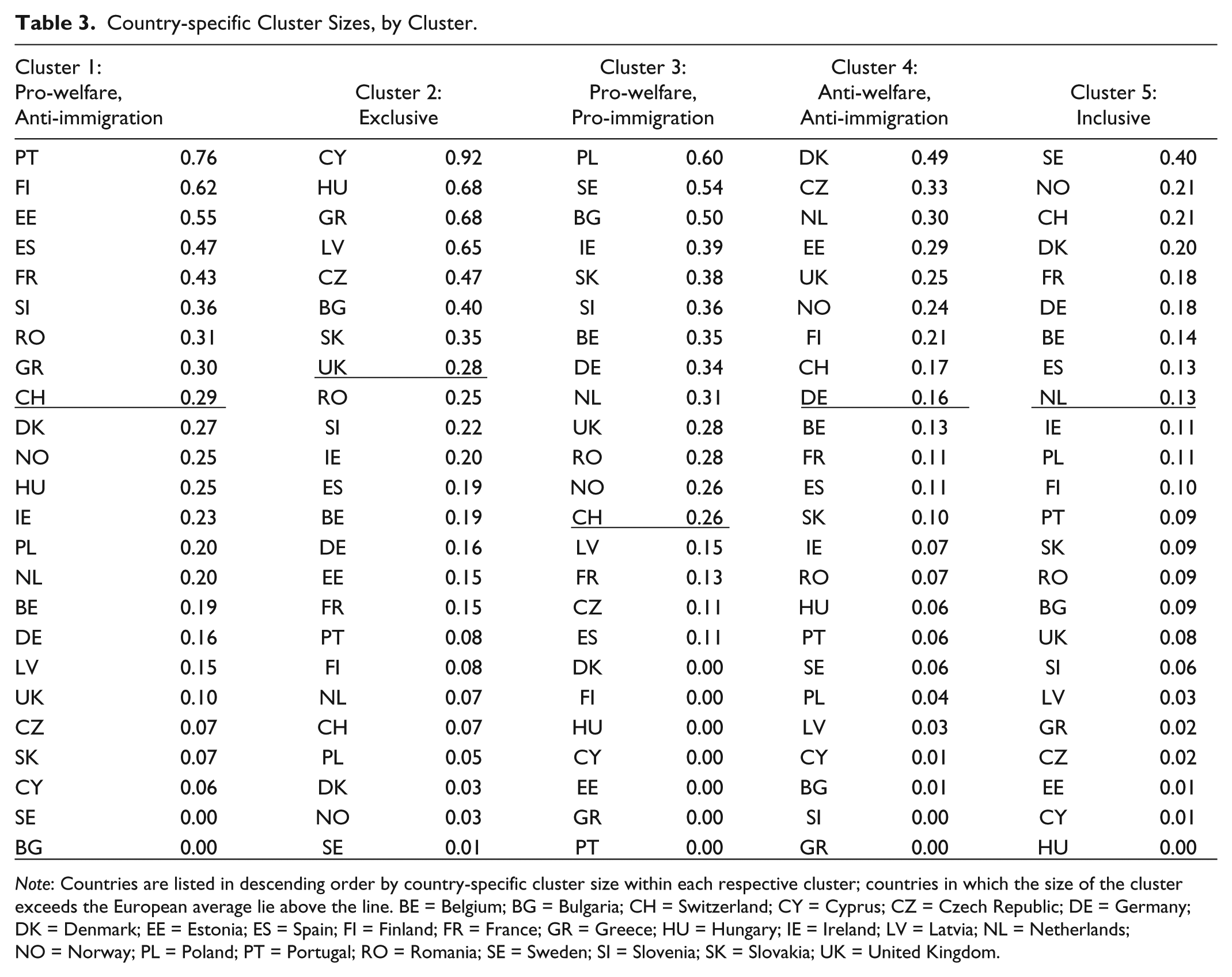
Note: Countries are listed in descending order by country-specific cluster size within each respective cluster; countries in which the size of the cluster exceeds the European average lie above the line. BE = Belgium; BG = Bulgaria; CH = Switzerland; CY = Cyprus; CZ = Czech Republic; DE = Germany; DK = Denmark; EE = Estonia; ES = Spain; FI = Finland; FR = France; GR = Greece; HU = Hungary; IE = Ireland; LV = Latvia; NL = Netherlands; NO = Norway; PL = Poland; PT = Portugal; RO = Romania; SE = Sweden; SI = Slovenia; SK = Slovakia; UK = United Kingdom.
We find substantial cross-country variation in all the clusters. The probability of being anti-immigration and pro-welfare (cluster 1) is high in countries such as Portugal (.76), Finland (.62), Estonia (.55), Spain (.47), France (.43), and Slovenia (.36), whereas it is low in countries such as the Czech Republic (.07), Slovakia (.07), and Cyprus (.06) and virtually nonexistent in Sweden and Bulgaria. A total of nine countries are above average with regard to the size of this cluster. Although it constitutes only 14 percent of the pooled sample, the probability of being both anti-immigration and anti-welfare (cluster 4) is also above average in nine countries: Denmark (.49), the Czech Republic (.33), the Netherlands (.30), Estonia (.29), the United Kingdom (.25), Norway (.24), Finland (.21), Switzerland (.17), and Germany (.16). This combination of attitudes does not exist in Slovenia or Greece.
Yet although cluster 2 is one of the largest in Europe, there are only a handful of countries where these attitudes dominate: Cyprus (.92), Hungary (.68), Greece (.68), and Latvia (.65). The vast majority of respondents in these countries simultaneously hold anti-immigrant and pro-welfare attitudes, and 26 percent articulate in-group bias, meaning that they believe immigrants should never receive the same social rights as native-born residents. However, for two-thirds of Europe, the odds of holding these attitudes are below average and extremely rare in countries such as Denmark (.03), Norway (.03), and Sweden (.01).
Representing 22 percent of the pooled European sample, the probability of being both pro-welfare and pro-immigration (cluster 3) is above average in 13 countries and is especially high in Poland (.60), Sweden (.54), and Bulgaria (.50). This attitudinal profile is absent in 7 countries: Denmark, Cyprus, Estonia, Finland, Greece, Hungary, and Portugal. Cluster 5, or the inclusive cluster, constitutes only 11 percent of the European sample, but 9 countries are above average in this regard, with Sweden at the top (.40). The probability of belonging to the cluster in which the majority simultaneously support redistribution, immigration, and universal social rights is below 10 percent for respondents in half of the countries.
Interestingly, we observe some similarities between the countries that rank higher and lower for clusters 2 and 5. The probability of holding inclusive attitudes (cluster 5) is greatest in the social democratic Scandinavian countries of Sweden, Denmark, and Norway, as well as in the conservative welfare states of Switzerland, Germany, and France. The probability of holding inclusive attitudes is smallest in the Mediterranean countries, Greece and Cyprus, and a number of Eastern European countries. Meanwhile, the probability of holding exclusive attitudes, or opposing immigration and exhibiting in-group bias, is largest in Greece, Cyprus, and the Eastern European countries of Hungary, Latvia, the Czech Republic, Bulgaria, and Slovakia. This attitudinal profile is virtually nonexistent in Sweden, Norway, and Denmark.
Taken together, the results show striking cross-country differences in cluster sizes and demonstrate that several types of attitudes coexist within single countries. For example, although Danes are some of the least likely to hold the most exclusive attitudes (.03) and are much more likely to hold inclusive attitudes (.20), they are also the most likely to oppose both immigration and welfare (.49) and some of the least likely to support both immigration and welfare (.00).
To better capture differences within and across countries and show the extent to which there is a tension between supporting both welfare and immigration, we report the distribution of clusters by type of attitudes within each country. Figure 1 displays different attitudinal configurations within individual countries in single bars. The patterned sections of the country-specific bars represent the sizes of the attitudinal profiles as a share of each country. Green bars represent the clusters in which attitudes are consistent with the progressive’s dilemma (clusters 1 and 2), while the clusters characterized by pro-redistribution and pro-immigration attitudes (clusters 3 and 5) are blue and the anti-redistribution, anti-immigration cluster (cluster 4) is pink. We present the countries in rank order according to the total size of clusters 1 and 2, for which the probability of supporting both immigration and welfare is lowest.

Distribution of clusters (Cs) within countries.
Figure 1 demonstrates that within-country differences are substantial and that immigration-welfare attitudes within individual countries differ considerably across countries. In 10 countries, attitudes inconsistent with the progressive’s dilemma are actually most prominent. In only 1 country, Denmark, are anti-redistribution and anti-immigration attitudes dominant. In the remaining 13 countries, we find that attitudes consistent with the progressive’s dilemma are most prevalent. In 12 of these countries, for the majority, there is evidence of tension between supporting both immigration and redistribution.
In summary, we find that Europeans hold qualitatively different ideas about immigration and welfare across as well as within countries. The majority of these attitudes are consistent with the progressive’s dilemma (52 percent), whereby individuals tend to support redistribution but not immigration. Although pro-immigration, anti-redistribution attitudes are theoretically possible and would also be consistent with the notion that immigration and welfare are difficult to reconcile, we do not find evidence of this configuration in our European sample. However, we do find pro-redistribution and pro-immigration attitudes (33 percent) and anti-redistribution and anti-immigration attitudes (14 percent).
Revisiting the “Generic Hypothesis”
According to the generic hypothesis derived from the progressive’s dilemma, immigration itself negatively affects welfare state attitudes. In this section, we move beyond this formulation and ask instead whether immigration is related to the prevalence of different attitudinal configurations. In other words, we assess if objective immigration is associated with how people think about redistribution, immigration, and immigrants’ social rights instead of only redistributive preferences. To do this, we plot objective measures of immigration against cluster sizes in each country. Additionally, we combine dilemma clusters 1 and 2 and plot them against immigration. We rely on demographic data from Eurostat, and, as previously mentioned, we use a number of measures of immigration to test the relationship.
We report correlations for country-specific cluster sizes and these country-level measures of immigration in Table 4. Most of our measures of objective immigration appear unrelated to the cluster sizes. However, when we assess the relationship between country-specific cluster sizes and the proportion of immigrants from non-European countries with low social and economic development, we find significant correlations for the most exclusive and inclusive clusters. This measure of immigration is the variable that, in all likelihood, best captures the size of the immigrant population that is economically disadvantaged and/or perceived as culturally different, so it is unsurprising that it has the strongest relationship with the prevalence of some clusters. Figure 2 illustrates these relationships and reports R2 values for each of the five clusters as well as the combined pair of clusters consistent with the progressive’s dilemma at the individual level (clusters 1 and 2).
Correlations between Country-level Attitudinal Cluster Sizes and Country-level Measures of Immigration.
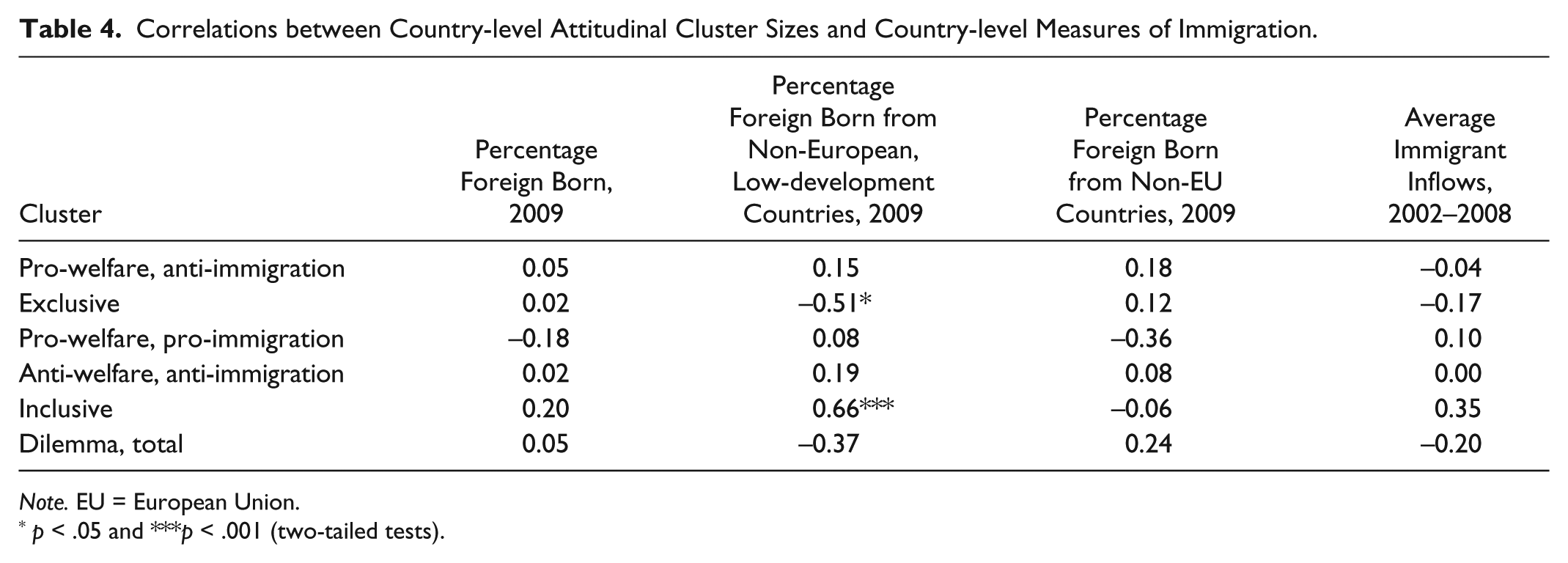
Note. EU = European Union.
p < .05 and ***p < .001 (two-tailed tests).

Scatterplots of country-specific cluster sizes (y-axis) and percentage foreign born from non-European, low-development countries (x-axis).
These results demonstrate that country-level immigration alone does not drive attitudes indicative of the progressive’s dilemma. As indicated by the R2 values of 0.26 for cluster 2 and 0.43 for cluster 5, the size of the foreign-born population from low-development, non-European countries does in fact appear to be related to the most exclusive and the most inclusive attitudes, but not in the direction predicted by the progressive’s dilemma. The proportion of immigrants from low-development countries is positively correlated with the size of the inclusive cluster and negatively correlated with the size of the exclusive cluster. This means that the greater the percentage of immigrants, the more likely attitudes are inclusive and the less likely attitudes are exclusive. Although the R2 statistic for the relationship between percentage foreign born and memberships in clusters 1 and 2 combined is .14, the direction of the relationship indicates that in countries with larger shares of immigrants from low-development countries outside Europe, people are less likely to hold exclusive and/or anti-immigration and pro-welfare attitudes. Thus, we find no support for hypothesis that objective, country-level immigration automatically leads to the dominance of exclusionary attitudes.
In Appendix A, we report multilevel models of the individual-level probability of belonging to each cluster. These models reveal the same pattern. The size of the foreign-born population from non-European, low-development countries is negatively associated with the likelihood of belonging to the exclusive cluster and positively associated with the probability of belonging to the inclusive cluster. These models also reveal that welfare state spending is unrelated to the probability of belonging to any of the attitudinal clusters. At the individual level, education level and occupational skill level appear to play an important role.
Conclusions
According to the progressive’s dilemma, ethnic diversity and solidarity are difficult to reconcile. In recent years, a number of studies have tested this theory by examining the relationship between country-level measures of immigration and individual-level attitudes toward social welfare. This cross-national research has produced little evidence of a negative, linear relationship between these variables, and scholars have interpreted these results to mean that there is no progressive’s dilemma at all—or, in other words, that immigration-generated ethnic diversity need not depress popular support for European welfare states. However, we argue that this conclusion is premature.
In this article, we move beyond the generic hypothesis derived from the progressive’s dilemma—that there is a negative relationship between a country’s share of immigrants and support for a redistributive welfare state—and posit instead that there is more than one way of understanding the immigration-welfare nexus. We hypothesize that distinct attitudinal profiles, which reflect different ways of thinking about immigration and welfare, exist and vary in their salience both within and across countries. Using LCA and data from the ESS, we examine attitudes toward redistribution, immigration, and immigrants’ social rights. Our results reveal five attitudinal clusters that vary in size, nature, and prominence across 24 European countries. The two largest of these clusters provide evidence of the progressive’s dilemma, demonstrating that for more than half of Europe, being both pro-redistribution and pro-immigration is unlikely. Furthermore, in half of the countries, the majority of respondents hold attitudes indicative of the tension between supporting both a liberal immigration policy and a redistributive, universal welfare state. Thus, by showing that immigration attitudes and welfare attitudes are related at the individual level, our results stand in stark contrast to previous cross-national research.
However, findings from our country-level analysis are consistent with previous cross-national research. Our results show that objective immigration, measured at the country level, does not automatically lead to exclusionary or anti-welfare attitudes and that the most exclusive attitudes are especially prominent in countries with relatively less immigration.
This finding is also consistent with previous research on anti-immigrant sentiment that finds a weak relationship between country-level measures of immigration and negative attitudes toward immigrants (for a review, see Ceobanu and Escandell 2010). Moreover, it is consistent with research that finds that the presence of immigrants may actually reduce out-group antipathy (Pettigrew and Tropp 2008; Schneider 2008). And it is also possible that immigrants, to the extent that they can, select into more welcoming countries and avoid those known to be more hostile to immigrants. Nevertheless, it is also likely that, because country-level measures of immigration are crude indicators of individuals’ perceptions of immigrants (Herda 2010), these statistics may not be meaningful in cross-national analyses of individual-level reactions to immigration. For this reason, we are cautious in our interpretation of our country-level results.
Furthermore, in light of other empirical research, we cannot conclude that objective immigration itself plays no role in these attitudes. Previous research on Sweden—which happens to be the country where being pro-immigration, pro-welfare, and pro–universal social rights is most likely—demonstrates that regional variation in the percentage of the population that is foreign born is associated with anti-immigrant sentiment (Hjerm 2009) 12 and less support for social expenditure (Dahlberg, Edmark, and Lundqvist 2012; Eger 2010). Thus, it is likely that the distribution of immigrants within countries, in addition to other economic (Burgoon et al. 2012), political (Eger and Valdez 2015; Schmidt and Spies 2013), and institutional factors (Kumlin and Rothstein 2010), help explain these attitudes. Case studies are especially important for understanding this within-country variation in attitudes, and the current research demonstrates that there is plenty of this type of variation to explain.
This research contributes to the literature in several important ways. First, our results demonstrate that the progressive’s dilemma—or the tension between supporting a liberal immigration policy and a redistributive welfare state—is real. For the majority of Europeans, immigration and welfare appear incompatible. Second, by adopting a categorical approach to analyzing the immigration-welfare nexus, we reveal that multiple and qualitatively different attitudinal profiles exist. Interestingly, our findings show that individuals in different countries often view the immigration-welfare nexus similarly. Moreover, we demonstrate that these different profiles coexist within the same country. Our results underscore the complexity of this political issue and serve as a reminder that members of the same country often understand social problems in very different ways.
Armed with these new insights, future research should focus on the determinants of cluster membership or, put more generally, what explains how individuals view the immigration-welfare nexus. Given the considerable variation in cluster sizes within and between European countries, both cross-national analyses and single-country case studies will be necessary. Qualitative methods and rich interview data will also be important for gaining a deeper understanding of the latent psychology underlying these profiles. In this article, we conceptualize the immigration-welfare nexus as qualitatively distinct combinations of attitudes. And we suspect that explaining variation in these configurations may also require a categorical approach. Indeed, it is possible that different combinations of social policies or other social conditions are responsible for cross-national variation in immigration-welfare attitudes. More research is necessary.
Footnotes
Appendix
Multilevel Models of Immigration-welfare Attitudes.

| Pro-welfare, Anti-immigration |
Exclusive |
Pro-welfare, Pro-immigration |
Anti-welfare, Anti-immigration |
Inclusive |
|||||||||||
|---|---|---|---|---|---|---|---|---|---|---|---|---|---|---|---|
| b | SE | Sig. | b | SE | Sig. | b | SE | Sig. | b | SE | Sig. | b | SE | Sig. | |
| Constant | 0.094 | 0.181 | 0.460 | 0.199 | * | 0.372 | 0.179 | * | 0.090 | 0.116 | −0.016 | 0.060 | |||
| Individual level | |||||||||||||||
| Age | 0.003 | 0.000 | *** | 0.002 | 0.000 | *** | −0.001 | 0.000 | −0.003 | 0.000 | *** | −0.001 | 0.000 | ||
| Age2 | 0.000 | 0.000 | *** | 0.000 | 0.000 | * | 0.000 | 0.000 | 0.000 | 0.000 | *** | 0.000 | 0.000 | ||
| Female | 0.016 | 0.002 | *** | 0.006 | 0.002 | ** | 0.001 | 0.002 | −0.026 | 0.002 | *** | 0.003 | 0.003 | ||
| Immigrant | 0.012 | 0.004 | ** | −0.048 | 0.004 | *** | −0.006 | 0.005 | −0.026 | 0.005 | *** | 0.068 | 0.005 | *** | |
| Ethnic minority | 0.010 | 0.005 | −0.038 | 0.005 | *** | 0.011 | 0.006 | * | −0.018 | 0.006 | ** | 0.035 | 0.006 | *** | |
| Cohabit with partner/spouse | −0.004 | 0.003 | 0.001 | 0.002 | *** | −0.002 | 0.003 | 0.011 | 0.003 | *** | −0.007 | 0.003 | * | ||
| Education level (reference = upper secondary) | |||||||||||||||
| Less than lower secondary | −0.004 | 0.004 | 0.029 | 0.004 | *** | −0.008 | 0.005 | −0.008 | 0.005 | −0.010 | 0.005 | * | |||
| Lower secondary | 0.010 | 0.003 | ** | 0.015 | 0.003 | *** | −0.010 | 0.004 | ** | −0.009 | 0.004 | * | −0.006 | 0.004 | * |
| Postsecondary nontertiary | −0.014 | 0.008 | −0.026 | 0.007 | *** | 0.021 | 0.008 | * | 0.012 | 0.008 | 0.008 | 0.008 | |||
| Tertiary education | −0.042 | 0.003 | *** | −0.040 | 0.003 | *** | 0.020 | 0.003 | *** | 0.022 | 0.003 | 0.040 | 0.004 | ||
| Occupational skill (reference = medium) | |||||||||||||||
| Low | 0.008 | 0.003 | * | 0.014 | 0.003 | *** | −0.006 | 0.003 | −0.016 | 0.003 | *** | 0.000 | 0.003 | ||
| High | −0.022 | 0.003 | *** | −0.029 | 0.003 | *** | 0.011 | 0.003 | *** | 0.022 | 0.003 | *** | 0.018 | 0.003 | *** |
| No occupation | −0.005 | 0.004 | −0.011 | 0.004 | ** | −0.008 | 0.005 | 0.001 | 0.005 | 0.024 | 0.005 | *** | |||
| Unemployed | 0.013 | 0.005 | * | 0.017 | 0.005 | ** | −0.001 | 0.006 | −0.025 | 0.006 | *** | −0.005 | 0.006 | ||
| Union | 0.015 | 0.003 | *** | 0.001 | 0.003 | 0.007 | 0.003 | −0.036 | 0.003 | *** | 0.014 | 0.003 | *** | ||
| Country level | |||||||||||||||
| % foreign born from non-European, low-development countries | 0.032 | 0.075 | −0.164 | 0.083 | * | 0.056 | 0.074 | 0.007 | 0.048 | 0.069 | 0.025 | ** | |||
| Social expenditure, % of GDP | 0.003 | 0.009 | −0.007 | 0.010 | −0.006 | 0.009 | 0.006 | 0.006 | 0.004 | 0.003 | |||||
Sources. European Social Survey 4.1 and Eurostat.
Note. The dependent variable is the individual-level probability of being in each cluster. Values range from 0 to 1. Occupational skill is based on the Erikson-Goldthorpe-Portocarero class scheme (Erikson, Goldthorpe, and Portocarero 1979). We collapse this scale into categories to reflect the skill levels (low, medium, or high) of the respondents’ occupations. Respondents who do not report occupations are coded as such. GDP = gross domestic product; Sig. = significance.
Level 1 N = 40,866; level 2 N = 24.
p < .05. **p < .01. ***p < .001.
Acknowledgements
We would like to thank Jason Beckfield, Daniel Béland, Michael Hechter, Edgar Kiser, Jan Mewes, Steven Pfaff, and anonymous reviewers for their comments and suggestions. This research was presented at the 2015 annual meeting of the American Sociological Association.