




Abstract
Redistribution is one of the fundamental characteristics of developed societies. While societal redistribution between working and non-working citizens has been studied intensively, redistribution in terms of family has been analysed mainly as private redistribution. In this contribution, we study societal redistribution in terms of family by systematically analysing its regulation and simulating its results. We map family-related redistribution in Europe by analysing to whom financial resources are granted (benefits) and from whom resources are demanded (obligations) to identify the degree and logic of family-related redistribution. We compare 68 family forms in 27 European countries based on the micro-simulation model EUROMOD. The findings show that there are clear country-clusters of redistribution in terms of family. They differ, though, as to benefits and obligations. The degree of redistribution reveals that in most countries, societal redistribution is highest towards low-income, single-parent families and lowest towards low-income family forms without children.
Introduction
The analysis of societal redistribution is one of the central issues of sociological and welfare state research, and many valuable contributions have identified its principles, mechanisms, and effects (Barr, 2001; Esping-Andersen, 1990; Esping-Andersen and Myles, 2009; Hills, 2004; Korpi and Palme, 1998). The major principle investigated so far is that of work, focussing on redistribution of resources between the currently working and currently non-working population (such as unemployed persons and pensioners). In addition, the market, residency, the taxpayer, and the family have been identified as major redistributive principles. The concretization of these general principles of redistribution is to be found in the redistributive regulations. And depending on the concrete content and set-up of these regulations, social groups are addressed differently (Esping-Andersen, 1990). Inherent in redistributive regulations, thus, are specific social inequalities, which was one of the major messages of Esping-Andersen’s epoch-making study Three Worlds of Welfare Capitalism. The lines of inequalities set in redistributive regulations are what we call redistributive logics. And the different countries vary in both the major principles of redistribution and the concretization of them in terms of regulations that translate into redistributive logics.
Redistribution and inequality in terms of family, though, has mainly been addressed as a side-effect of the other redistributive principles and their regulation (see, for example, Mahler and Jesuit, 2006) since family has mainly been conceptualized, in terms of redistribution, as a sub-institution of society in which a second-level, private redistribution takes place. Family, though, has always been a redistributive principle on the institutional level of society as well; that is, there has always been societal redistribution in terms of family that has been regulated explicitly (Marshall, 1964) and addresses the various family forms differently by prioritizing redistribution towards some family forms and not to others.
In this contribution we will identify how European welfare states differ in their redistributive logics in terms of family. We will map the different societies’ redistributive logics in terms of family by studying family-related redistributive regulations for a great variety of family forms; these refer to marital status, children, income levels and different forms of couples’ income distribution. We examine the redistributive regulations for 27 European countries by means of the tax-benefit microsimulation model EUROMOD and its Hypothetical Household Tool (HHoT). The next section reviews the current knowledge of family-related redistribution. After setting out our methodological approach, we will present the main empirical findings. The last part offers a discussion of our results and concludes.
State of the art
Societal redistribution has always been one of the fundamental characteristics of developed societies (Esping-Andersen and Myles, 2009; Marshall, 1964). In its effects, it corrects, creates or exacerbates inequalities that result from, for example, market mechanisms. Three decades ago a new debate was sparked off over the principles and logics of redistribution by the seminal work The Three Worlds of Welfare Capitalism (Esping-Andersen, 1990; see Powell et al., 2020). With its central concepts – decommodification and stratification – major differences in societal redistribution were identified among developed societies, which resulted in the characterization of clusters of countries. The original three clusters have meanwhile been extended to five, as broadly accepted in current literature (see Daly, 2020; Ferragina and Seeleib-Kaiser, 2011). The approach of the original and following studies, though, focusses on the individual, understood as a labour market participant or even an ‘average production worker’. Family as an own redistributive principle of welfare states has never been taken systematically into account.
Feminist scholars criticize this narrow perspective on redistribution that ignores differences between the countries in terms of family and gender (Lewis, 1992; O’Connor, 1993; Orloff, 1993). Arguing that societal redistribution either reinforces existing gender relations or transforms them, they developed the concept of defamilialization. It aimed to shed light on family as a gender issue to understand in how far societal redistribution makes individuals financially independent from the family, enabling them to enjoy a ‘socially acceptable standard of living’ (Lister, 1994) or ‘well-being’ (McLaughlin and Glendinning, 1994). The focus of defamilialization studies, also the latest ones, has been on societal redistribution to support the economic independence of women who provide unpaid care work (e.g. Bambra, 2004), or on ‘freeing’ women and especially mothers from unpaid care work to allow them to fully participate on the labour market (Esping-Andersen, 1999; Korpi, 2000). And despite its different focus, the grouping of countries that defamilialization studies identify strongly corresponds to that identified in decommodification studies (Lohmann and Zagel, 2016). This ‘general consensus in the field on the basis of the gender-oriented typologizing [. . .] that the countries of the EU cohere into five main groupings in terms of their family/gender model’ (Daly, 2020: 40) raises the expectation that also our investigation will reaffirm this grouping.
It has been shown, though, that countries differ in the redistribution to different family forms. There are, for example, differences in the income support to lone-parent families (Bradshaw and Finch, 2002; Van Lancker et al., 2015), to income-dependent partners (interpreted as a relic of the former ‘male breadwinner’ regime) (Montanari, 2000), or in rights granted on the grounds of marital status (Christl et al., 2021). The results of these studies show, first, that redistribution in terms of family has been used to privilege certain types of families, and second, that in shifting the research focus from redistribution in terms of workers to redistribution in terms of family, societies might be clustered quite differently (Shaver and Bradshaw, 1995). A systematic comparative analysis of redistribution in terms of family, though, is still lacking.
With regard to defamilialization as the key concept for the study of social orders with regard to family (Lohmann and Zagel, 2016), there are several reasons why it is unsuitable for studying societal redistribution in terms of family. First, defamilialization applies a one-dimensional perspective on the family while the analysis of redistribution needs to differentiate between family forms as shown in the last paragraph. Hence we expect societal redistribution to (greatly) differ across family forms within a society (Naldini and Long, 2017; Saraceno, 2018). Second, defamilialization studies in general aim to identify “real world variations of familialism” (Leitner, 2003: 354), and consequently are interested in policy outcomes (Esping-Andersen, 1999; Leitner, 2003; Lohmann and Zagel, 2016). Although this research has provided valuable insights into welfare regulations, the concrete analyses combine them with policy outcomes (e.g. the enrolment rates of children in public childcare). Outcomes, though, are affected by numerous other factors such as production regimes, culture, and preferences (Pfau-Effinger, 2004), as well as implicit family policies, that is, family-related effects of non-family-focussed policies (Kamerman, 2010), while we aim to identify redistribution as purely regulated and intended. Hence defamilialization indicates effects of overall societal differences rather than those of redistribution as stipulated in social regulations.
In addition, societal redistribution manifests itself in two forms: financially supporting and financially obliging. This has been broadly discussed with regard to other redistributive principles, mostly in terms of particular patterns of behaviour that are conceptualized as (financially) contributing and that determine access to and levels of benefits (Clasen and Clegg, 2007). In terms of family the financial support contains particular family-related benefits, that is, entitlements to additional benefits, derived rights, or tax deductions (e.g. Van Lancker and Van Mechelen, 2015). The financial obligations, again, include family-related obligations to provide financial support to family members, for example, institutionalized as means-tests, and restrict access to and levels of benefits based on the financial situation of a claimant’s family. With this, the redistributive regulations related to family as a redistributive principle add to family income, on one hand, and decrease it, on the other. This two-foldedness of family-related redistribution goes rather unheralded in the literature. Efforts to consider also obligations (Daly and Scheiwe, 2010; Frericks et al., 2016; Millar and Warman, 1996; Saraceno, 2004) have not figured in the major analyses of redistribution.
A variety of research discusses the instruments and the degree of redistribution, the latter often in terms of generosity. It has been shown that societies differ in the level of generosity – and, in terms of family, in the composition of child-benefit packages – providing either universal or means-tested rights by means of social benefits or taxation (Daly and Ferragina, 2018; Ferrarini et al., 2012; Van Lancker and Van Mechelen, 2015). Other studies (Bahle, 2008; Saraceno, 2011; Thévenon, 2011) help us understand the relevance of family in redistribution in various perspectives, but, again, by focussing on outcomes rather than regulations. We, though, follow the distinction of Marchal and Van Lancker (2019) between the ‘intended’ redistribution, on one hand, and the ‘observed’, on the other. While the first is connected with the assessment of designs of the overall set-up or specific regulations of the welfare state, the latter analyse their outcomes. With the analysis of the redistributive logics of welfare states as manifested in their regulations, we consequently contribute to comprehending the intended redistribution.
In this article, we aim to take the research on societal redistribution with regard to family further in identifying and mapping redistributive logics in terms of family. We do so by (1) measuring the extent of intended redistribution in various welfare states, taking into account both additional benefits and obligations; (2) identifying differences in the ways various types of family are addressed in the regulations; and (3) clarifying whether the country-cluster consensus will be reaffirmed also in studying societal redistribution in terms of family.
Methodology
Before presenting the methodological approach, we clarify the concepts and terminology used in this article. As introduced above, we refer to family as a redistributive principle when considering it part of societal redistribution. With the term redistributive logics, we mean how family forms are differently prioritized in the national regulations on redistribution. And while expecting to observe family as a redistributive principle in all countries, the redistributive logics in terms of family will differ depending on a country’s concrete regulations; to study them we do a regulation analysis using a static (micro)simulation of different family forms. Redistributive logics are assessed by means of reference points (single individuals with no family) to which we compare the different family forms (details below). We use a broad definition of family, according to which ‘the family is increasingly defined as a community of responsibility and care that extends beyond the boundaries of household, marriage, kinship, and even parenthood’ (Schneider and Kreyenfeld, 2021: 5). Societal regulations on redistribution reflect this definition so that it is necessary to consider also childless couples as families.
To study the complexity of family with regard to redistribution as regulated, we differentiate between family forms along four dimensions: the presence of dependent children, marital status, the distribution of paid work among partners, and the adult persons’ income level. With these dimensions we are referring to acknowledged discussions in redistribution research (Korpi, 2000). To study the distribution of paid work we consider the adults’ position within or outside the labour market in four different income combinations: the so-called absence-of-breadwinner model describes a family with two adults who are both not employed but rely on benefits; the dual-earner model consists of a family with two adults who are both active in the labour market and earn exactly the same market income; the supplementary-earner family features both adults’ activity on the labour market but at an unequal distribution of income; and finally, the single-earner family model describes a family with only one adult earning the family income.
With regard to the dimension of income level, previous redistribution research has often used the income level of the average production worker (Esping-Andersen, 1990; Kuitto, 2018) as a means of identifying redistributive logics. However, in that way we cannot distinguish whether and to what degree the intended redistribution varies among family forms that earn different incomes. To consider differences in families’ income level(s), we study family forms in which the adult person(s) have no market income, half the average income, average and double the average income. Combining the dimensions of income distribution and income level results in the following family forms: the absence-of-breadwinner model with both partners earning no market income, the single-earner model with one partner earning half the average, average and double the average income, the supplementary-earner model with the partners earning half the average and average income, double the average and average income, and double the average and half the average income, and finally the dual-earner model with both partners earning half the average, average or double the average income. We also study single-parent family forms with the adult earning no market income, half the average, average, and double the average income.
Furthermore, we include the dimension of dependent children as crucial for understanding the family as the redistributive principle and for analysing variation (e.g. Bradshaw and Finch, 2002). By including families with one or two dependent children aged 11–15 years, we aim to reveal the general redistributive logics in terms of family. We have deliberately excluded younger children who are subject to a large number of exceptions and specific regulations, and are affected by regulations on care and education. As these cannot be sufficiently applied in modelling with EUROMOD as the tool for our analysis (see below), including younger children is beyond the scope of this article and a limitation of the study. As the last dimension we consider whether couples are married or not. In total, we analyse 68 family forms. This admittedly large number is necessary to detect the most prominent redistributive logics in terms of family. By analysing only a few forms of family, as was the case in previous studies, many logics may remain undiscovered.
As a next step, we need to design an appropriate tool to identify the redistributive logics of family-related redistribution. For this, we set the single individual as our reference point, that is, a person without a (legally identified) partner or child, and for whom no family-related redistribution applies. Since our family members differ on four income levels (as explained above), we differentiated also four variations of this reference person; four 0 points are therefore set with respect to their market income. In other terms, the market income before redistribution serves as our starting point, that is, as the ‘counterfactual’ (Shaver and Bradshaw, 1995). We include explicit family policies only to gain a clear picture of redistributive logics as regulated, also interpreted as the ‘intended redistribution’ (see above). To measure the degree of redistribution as stipulated in regulations, we simulate the net disposable income since it includes the effects of all family-related redistributive regulations, for example, social insurance contributions (with health insurance particularly family-related), means-tested benefits, child benefits, in-work benefits, and fiscal welfare (particularly regulations on income tax) (Dingeldey, 2001; Ferrarini et al., 2012; Titmuss, 1958) (for calculation formula, see Figure 1).
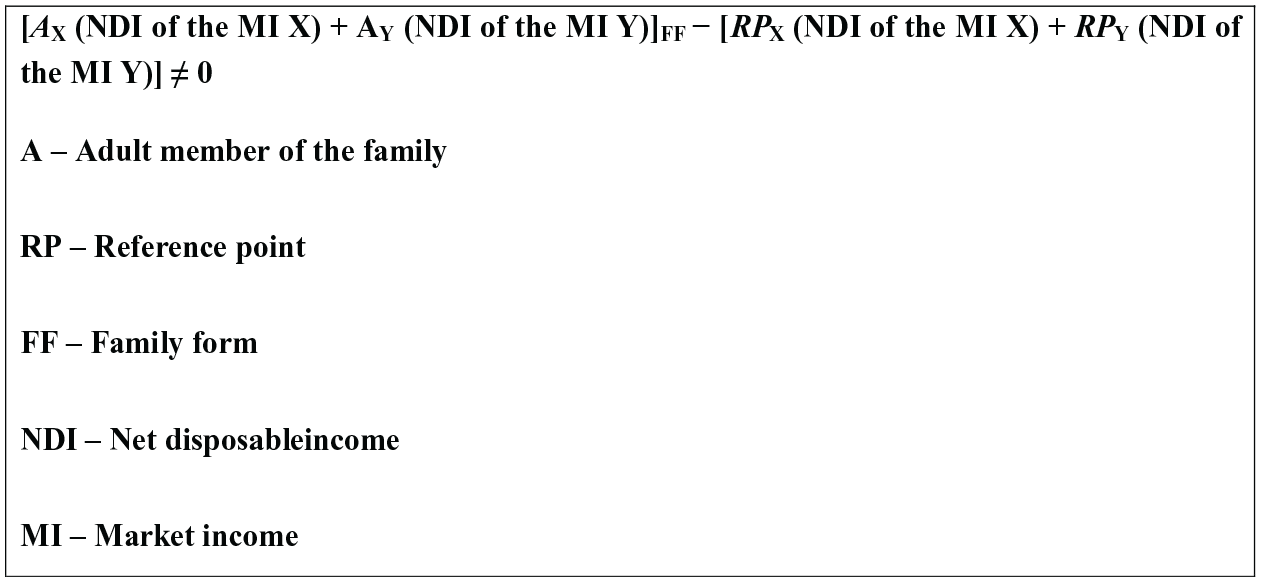
Calculation formula for redistribution in terms of family.
To exemplify the calculation, we show here the simulated redistribution for a childless, cohabitating, dual-earner family with double the average (market) income in Portugal (based on EUROMOD output data for the year 2020) which is €3012 per adult per month. To do this, first we calculate the net disposable income of both adults in the family, which according to EUROMOD output data is €817 for the first adult and €2681 for the second adult, resulting from joint taxation, comprising €3498 as the total net disposable income per month of the family. Second, we calculate the net disposable monthly income of two single individuals of the same market income as the adults in the family (i.e. both individuals having a double-average market income), which according to the output data from EUROMOD is €1965 each. The total net disposable income of two single individuals, which we need for our comparison, equals €3930 per month. In this way we see that the net disposable income of the officially recognized couple (family) is lower than that of the two individuals, that is, family-related redistributive regulations decrease the family’s disposable income by 11%.
We operationalize family-related redistribution by the degree to which a family’s resources are raised or lowered in comparison to the reference point(s). If the difference between the net disposable income of a family form and its reference point is positive, there is redistribution towards the family (i.e. family-related support is, in total, higher than family-related obligations). This may be attributed to direct support in the form of, for example, child benefits, or to indirect increases in the net disposable income by means of exemptions from paying compulsory social insurance contributions for family members. If the difference between the net disposable income of a family form and its reference point is negative, regulations demand resources from the family (i.e. family-related obligations are, in total, higher than family-related support). By this, regulations decrease the family’s income below that of the reference points, as for instance, when families or individuals within a family are legally obliged (upon means-testing) to financially support a family member before that person can be entitled to public support, or when higher income tax or social insurance contributions are applied in comparison to the reference points. In short, by analysing the differences between the net disposable income of the reference point(s) and the family forms, we are able to identify family-related redistribution, and by differentiating the affected family forms and the degree of difference, we can identify the family-related redistributive logics in the study countries.
To calculate these redistributive differences we used the tax-benefit microsimulation model for the European Union EUROMOD (version I3.0 +) and its HHoT, a tool quite adequate to our investigation as it comprehensively includes regulative data, accounts for interactions between parts of the tax-benefit system, and allows the study of the effects of regulations on the incomes of the various family forms (more about the model in Sutherland and Figari, 2013). EUROMOD covers the full range of regulations on taxes, benefits and social insurance contributions, and these regulation data are created and continuously updated by country experts. In the simulations, these regulation data are then applied to the 68 family forms with the help of HHoT. For our analysis we use the most recent available data – those for 2020.
Aiming at a broad country comparison, we study 27 European countries; Slovenia could not be included for technical reasons.
Findings
In this section, we present the empirical findings on how family as a principle of redistribution is currently regulated in the various European countries. First, we analyse family-related redistribution by studying which family forms are granted financial resources (support) and which are obliged to provide financial resources (obligations). Second, we show the extent of family-related redistribution to identify the family form(s) most financially advantaged by the countries’ redistributive regulations.
Cross-national differences in the provision of family-related support
In terms of family-related support, three main areas of difference in the regulation of redistribution can be distinguished; these are in the granting of resources to families with a child/children; in differentiating benefits based on marital status; and in granting additional (child-unrelated) resources to couples with either an income-dependent or working partner. Countries substantially differ in applying these logics, and while some apply only one of them (e.g. granting rights to families with children), others combine them, resulting in very different simulated incomes of the families concerned. We can distinguish seven differently combined redistributive logics in our study countries (see Figure 2).
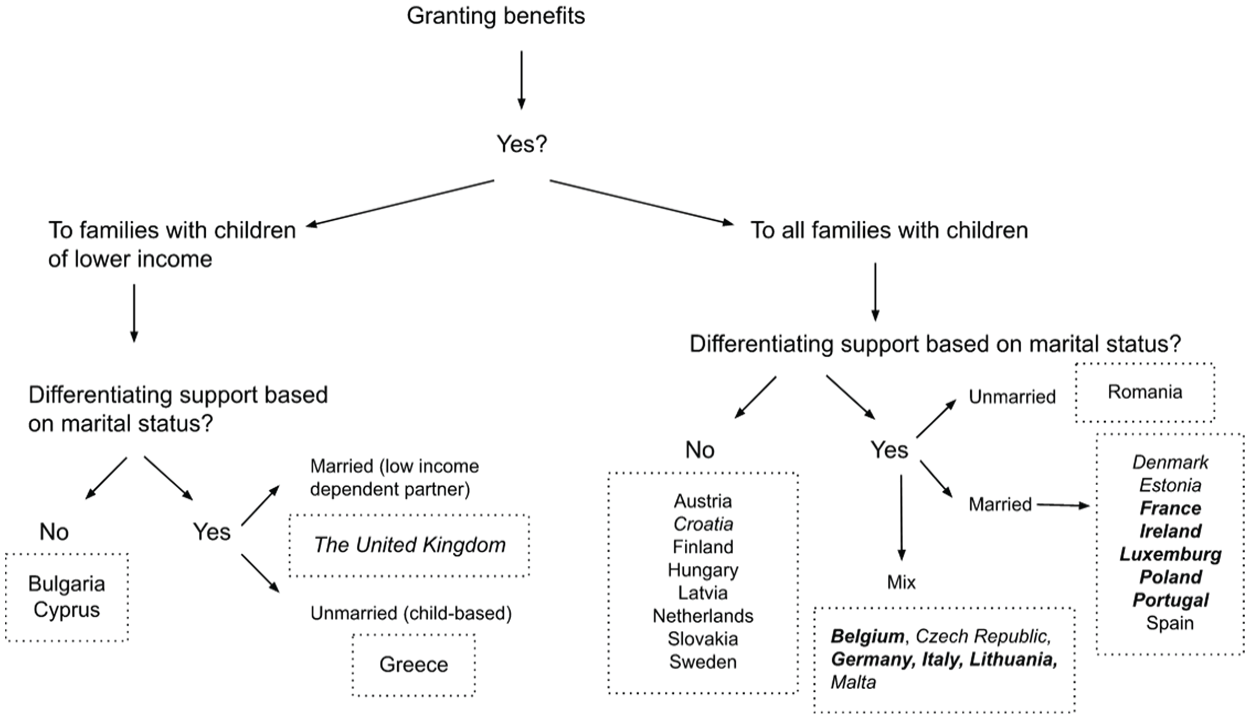
The granting of family-related benefits in international comparison.
First, countries grant child-related benefits to families which include direct transfers, tax allowances or deductions. Indeed, no current European society leaves families with children financially unsupported. Countries differ however in this support and can be divided in this regard into two groups. The major group consists of countries that support all families with children independently of the family’s income. A small group of countries (Bulgaria, Cyprus, Greece, and the United Kingdom), instead, support mainly low-income families.
The second logic observed relates to differences in the granting of benefits based on marital status. Unlike child-related benefits, there is substantial variation in this among the countries. Most of the countries show no differences in redistributive regulations across married and unmarried family forms (Austria, Bulgaria, Croatia, Finland, Hungary, Latvia, the Netherlands, Slovakia, and Sweden). Eight countries though show, due to differences in income taxes, at least partial or even substantial support of married family forms (Denmark, Estonia, France, Ireland, Luxemburg, Poland, Portugal, Spain, and the United Kingdom), while two countries (Greece and Romania), through means-tested benefits, support unmarried family forms instead. The last cluster of countries provides benefits to both married and unmarried families, which depends on income or income-distribution level (Belgium, the Czech Republic, Germany, Italy, Lithuania, Malta, and Spain). Four of these countries (Germany, Italy, Lithuania, and Spain) substantially support, on one hand, single-earner married families of lower income and, on the other hand, unmarried working couples of higher income that are, because of regulations, financially better off than their married counterparts. This has been a result of differently applied income taxation, and in the case of high-income working families in Italy, also non-means-tested benefits.
The third redistributive logic, which relates to the previous one, concerns the granting of rights to a partner. These benefits are unrelated to children, so that also childless families can qualify. In 15 of our countries benefits are granted to families with income-dependent partners (see Figure 2, countries in italics). Granting resources to partners active on the labour market is less prevalent, being found in nine study countries only (see Figure 2, countries in bold).
Cross-national differences in family-related obligations
The second aspect of redistribution in terms of family is manifested in family-related obligations that result in a decreased family income in comparison to the reference point(s). This decrease is based on the loss of entitlements to social assistance or the demand to pay compulsory health insurance contributions despite the partner’s income-dependent status (as observed in Germany for non-married couples). In addition, the family income is reduced also by higher income tax (Portugal) or lower in-work benefits (France).
Also here, the main differences in the regulation of redistribution can be distinguished. These are, first: the obligation to provide financial resources is connected with the income distribution in the family; and second: similar to support, the obligations differ in relation to the marital status. Figure 3 illustrates that the combination of these differences results in a total of nine redistributive logics. Three countries (Belgium, Ireland, and Sweden) have no obligations in their redistributive regulations on families. The in-depth investigation of the other countries reveals that financial obligations are mostly imposed on families consisting of one (single-earner model) or two income-dependent adults (absence-of-breadwinner model). The Czech Republic, Denmark, and Latvia are societies, which demand financial support only from single-earner families. The majority of countries impose obligations also on families with no breadwinner and whose net disposable income – gained from means-tested benefits – is decreased in comparison to the reference points. In other words, these families are less entitled to resources than two single individuals, and thus, family-related redistribution leads to a lower subsistence level for families. There are also countries which demand resources from (usually high-income) families where both adults are active in the labour market (France, Lithuania, Malta, the Netherlands, and Portugal). These differences are due to family-related regulations on income tax, in-work benefits, and health insurance.
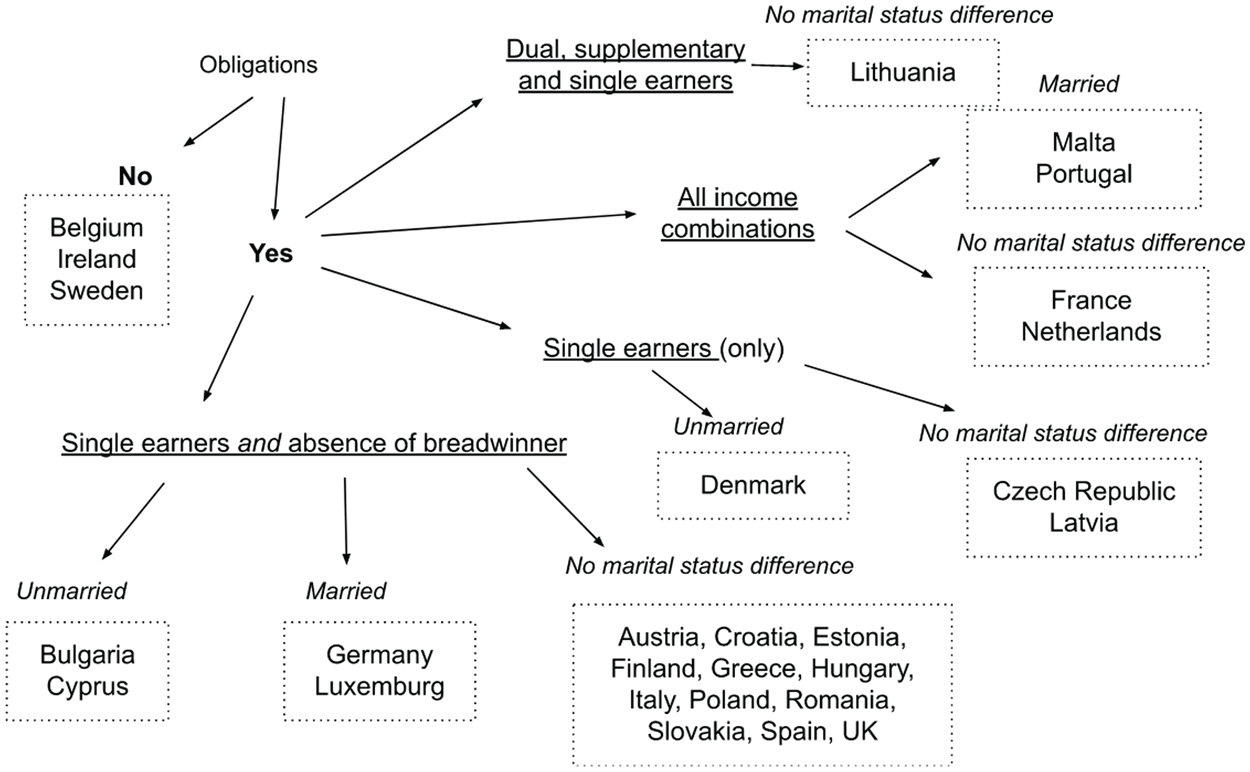
Family-related obligations among 27 European countries.
In some countries, obligations are more disadvantageous for some family forms than for others. In fact, Germany, Luxemburg, Malta, and Portugal impose stronger obligations on unmarried family forms than on married ones. This ‘unmarried-penalty’ is usually a result of the interplay of several regulations (such as means-tested benefits and social insurance contributions). In other countries, instead, unmarried family forms are more advantaged in terms of obligations than married ones, as in Bulgaria, Cyprus, and Denmark. The latter two do so not by lowering the degree of obligations on the unmarried, but simply by applying obligations only to married families, whereas unmarried family forms are granted entitlements to public income-maintenance.
So far, we have provided evidence that family-related redistribution consists of several redistributive logics in which different family forms, in the end, either receive resources or are obliged to provide them. We identified seven country clusters with particular redistributive logics towards family support, and nine clusters with particular redistributive logics in terms of family obligations; with the exception of Bulgaria and Cyprus that are both in one cluster for benefits and obligations, the clusters differ, though, in their country composition.
Degree of redistribution
In this part we focus on the extent of family-related redistribution in the interplay of support and obligations. To investigate the various aspects of family-related redistribution, such as those affecting the income of various families differently, we decided to examine the degrees of redistribution in terms of (1) the overall extent, that is, by considering all 68 family forms of our study; (2) the difference in the degree of redistribution between single parents (with two children), couple family forms (with two children) and childless families; (3) the difference in redistribution between family forms with the same family income but different income distribution among the partners; and finally, (4) the difference between family forms with the highest and lowest (analysed) market income.
The overall extent of family-related redistribution
To map the degrees of family-related redistribution we first identify the average degree of redistribution in all our 68 family forms. It is measured as the share of transfer income averaged across the 68 family forms (note: excluding reference points). The lowest average degree of redistribution is that of Cyprus with 7.5% and the highest, in Poland, reaching 35%. As Figure 4 shows, family-related redistribution is less pronounced in South-European countries – for example, Greece, Italy, and Spain – where redistribution ranges between 8% and 10%. Bulgaria and Denmark are in this group, too. Many countries show a moderate level of redistribution ranging from 10% to 12% (in Croatia, Finland, France, Malta, Slovakia, and the United Kingdom), and from 12% to 14% (in Austria, the Czech Republic, Luxemburg, the Netherlands, Portugal, and Sweden). The last group represents countries with the most pronounced degrees of family-related redistribution. Here we find Belgium, Estonia, Germany, Ireland, Latvia and Lithuania with redistribution from 14.5% to 18%. Romania (22%) and Poland (35%) show the overall highest degree of redistribution in terms of family.
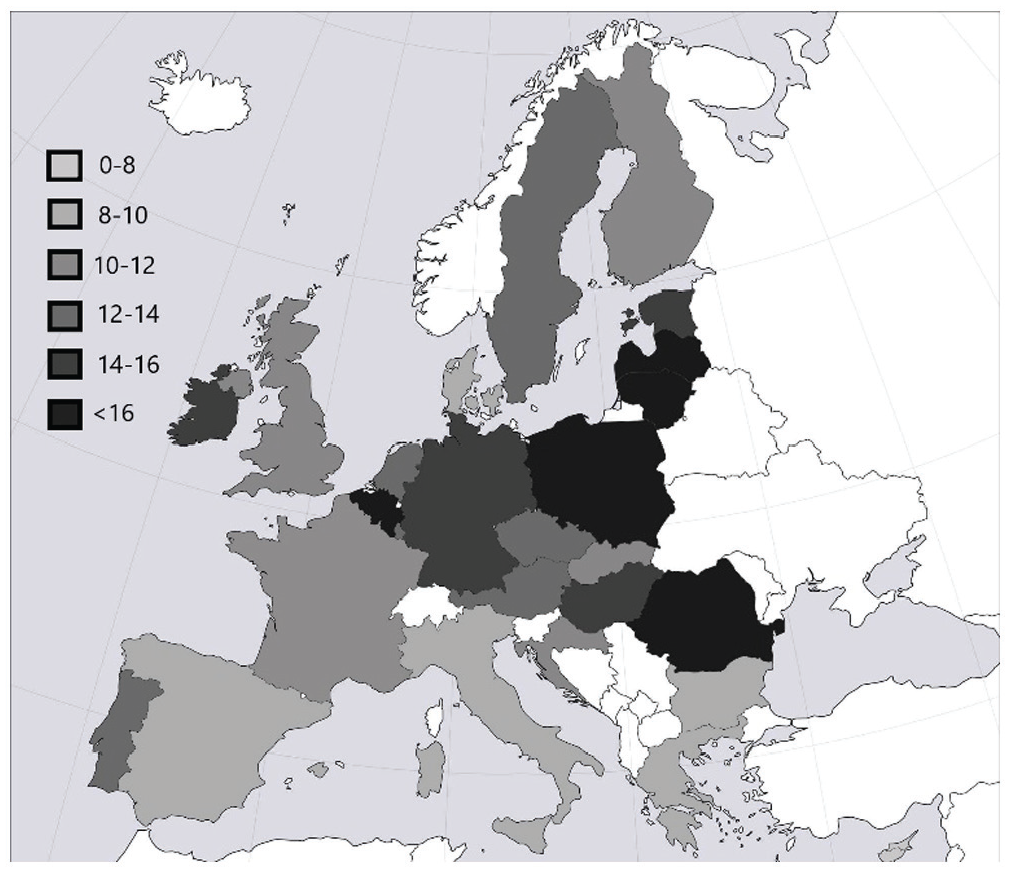
Average degree of family-related redistribution among all family forms (values in %).
Childless families versus families with children
As the next aspect of our mapping, we compare the average degree of redistribution between the childless family forms, couple family forms with two children, and single-parent families with two children. As shown in Figure 5, all our study countries show the highest degree of redistribution towards single parents. For this family form, the average degree of redistribution in most countries ranges from 35% to 60%. The Czech Republic, Estonia, Germany, Hungary, Latvia, Poland, and Romania even exceed this value, with the last two, substantially. However, we find South-European countries – Cyprus, Italy, Malta, and Spain – with relatively low degrees of redistribution to this family form, varying between 23% and 25%.
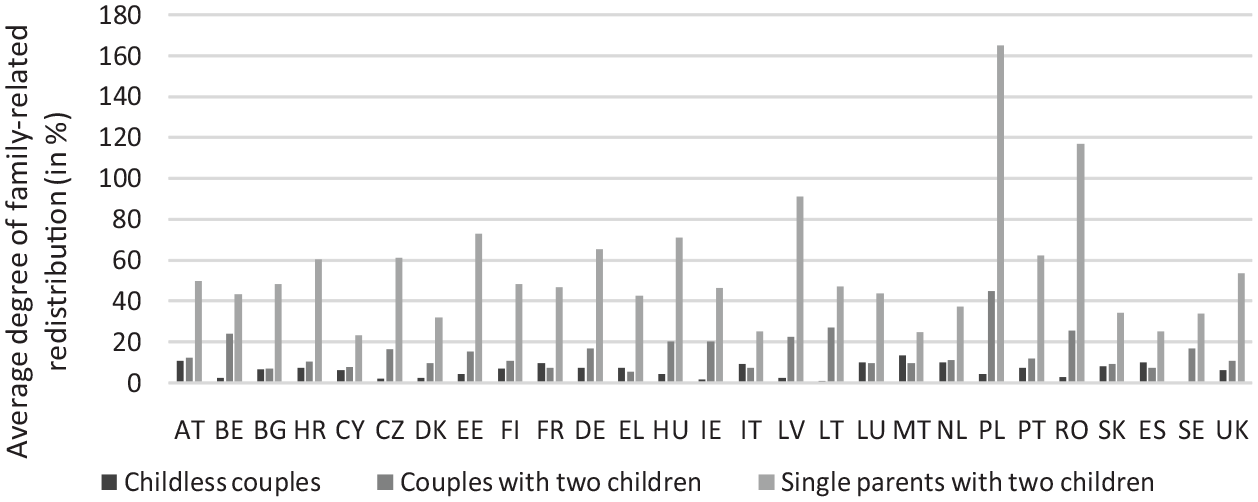
Average degree of redistribution to childless families and families with children (values in %).
The degree of redistribution towards the couple family forms is much lower. In only a few countries does this value exceed 20% (e.g. in Belgium, Latvia, Lithuania, Poland, and Romania). Again, it is the South-European countries (Cyprus, Greece, Italy, Spain), as well as Bulgaria and France, that in comparison redistribute the least (less than 8%).
The lowest degree of redistribution is found in childless family forms. Some countries show an average degree of redistribution towards these family forms of, more or less, 10%, such as in Austria, France, Malta, and Spain. Interestingly, these countries, except for Austria, redistribute the least towards families with children. The lowest degree of redistribution (below 2%) we find in the Czech Republic, Ireland, Lithuania, and Sweden. And, while the degree of redistribution is, in general, lower towards childless families than towards couple families with two children, there are also exceptions. France, Greece, Italy, Luxemburg, Malta, and Spain show a higher degree of redistribution towards childless families than towards couples with children.
Family forms with the same market income
Our assumption that redistribution towards the family depends on the family form can also be tested by comparing the degree of redistribution between family forms with the same market income. Here, we compare for illustration dual-earner families with half the average income, single-earner families with average income (thus family forms with exactly the same market income) and supplementary-earner families with average and half the average income (a family form with similar market income). Figure 6 shows that there are often quite substantial differences in the degree of redistribution among these three family forms. The most pronounced difference, exceeding 10 percentage points, is found in Belgium, Cyprus, Finland, Italy, Malta, the Netherlands, Slovakia, and Spain. Other countries such as Bulgaria, Croatia, Estonia, Latvia, Portugal, Romania, and Sweden show differences of less than 3%. In none of our countries though have we found the same extent of redistribution towards these forms of family (though Latvia is close to it).
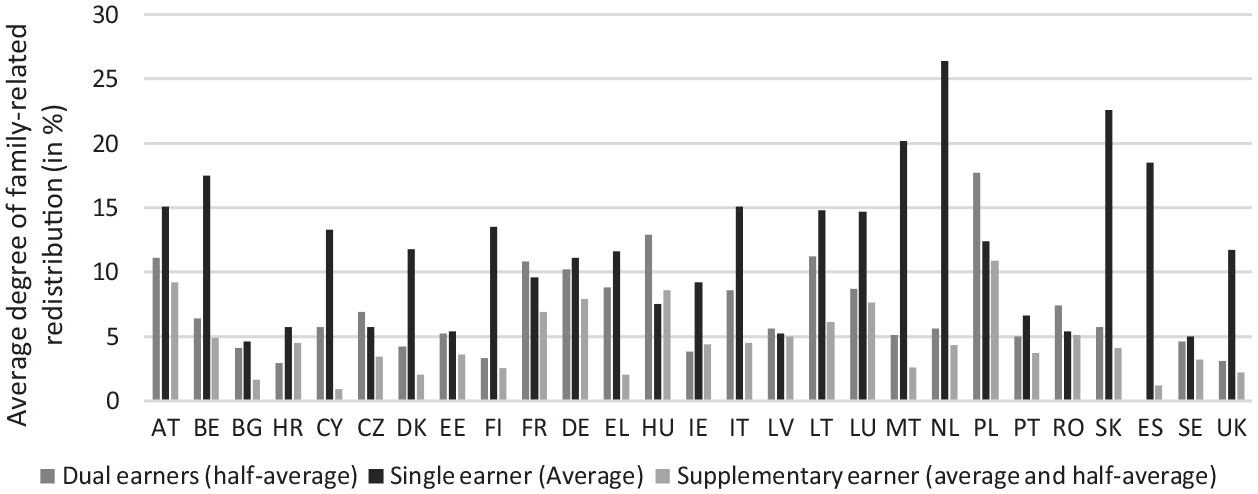
Average degree of redistribution to families with the same or a similar market income (values in %).
Most of the countries show a similar redistribution pattern. The highest degree of redistribution is towards single-earner families, followed by dual-earner and supplementary-earner families respectively. There are, however, exceptions: the Czech Republic, France, Latvia, Poland, and Romania show the highest degree of redistribution towards dual earners, followed by single and supplementary earners. Croatia, Ireland, and Spain, again, show the highest redistribution towards single earners, followed by supplementary earners and dual earners. In Hungary, redistribution is highest towards the dual earners and the lowest towards single earners.
Family forms with the highest and lowest (analysed) market income
While in the previous parts we investigated the differences in the degree of redistribution on the horizontal level, here we have a closer look into redistributive logics on the vertical level by comparing the degree of redistribution towards family forms of the highest (dual earners with double the average income) and the lowest (single earners with half the average income) market income we analysed (Figure 7).
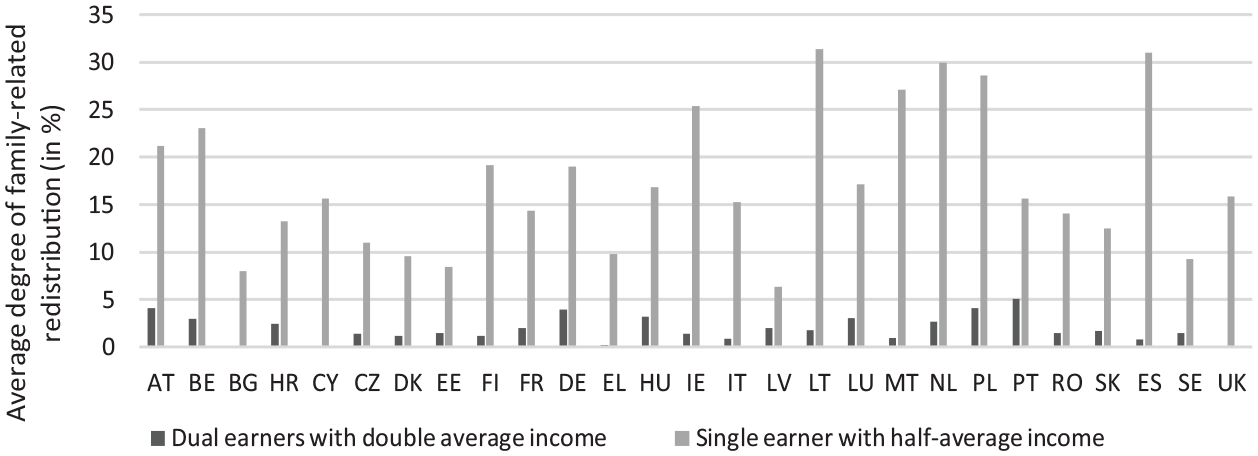
Average degree of redistribution to families with the highest and lowest market incomes (values in %).
In all our study countries we observe across these family forms considerable differences in the degree of redistribution. That is, redistribution ranges between 6% and 31% for single earners but does not exceed 5% for dual earners. For single earners, in countries such as Lithuania, the Netherlands, Poland, and Spain there is very extensive family-related redistribution, while in Bulgaria, Denmark, Estonia, and Latvia, it is comparatively low-level. Redistribution towards dual earners forms different clusters. Here, Austria, Germany, Poland and Portugal stipulate comparatively high levels of redistribution, while Bulgaria, Cyprus, Greece, and the United Kingdom have no redistribution or at negligible levels.
Redistribution towards whom?
After having identified the overall degree of redistribution we now analyse in how far the regulations translate into an increase or decrease in the family income in comparison to the reference points. We identify the family forms whose net disposable income, due to family-related regulations, proportionally increase or decrease the most in comparison to the income of the reference points.
The family form with the proportionally most increased net disposable income in almost all our study countries is the single parent with two children and no market income. Only in Ireland and Sweden is this the single parent of two children with half the average income instead of none. We observe (see Figure 8) that the income of this family form strongly varies between the countries, ranging from 140% (Italy) to 615% (Poland) of the reference point’s income. In general, income also increases substantially for other single-parent/single-earner/absent-breadwinner couple family forms with one or two children.
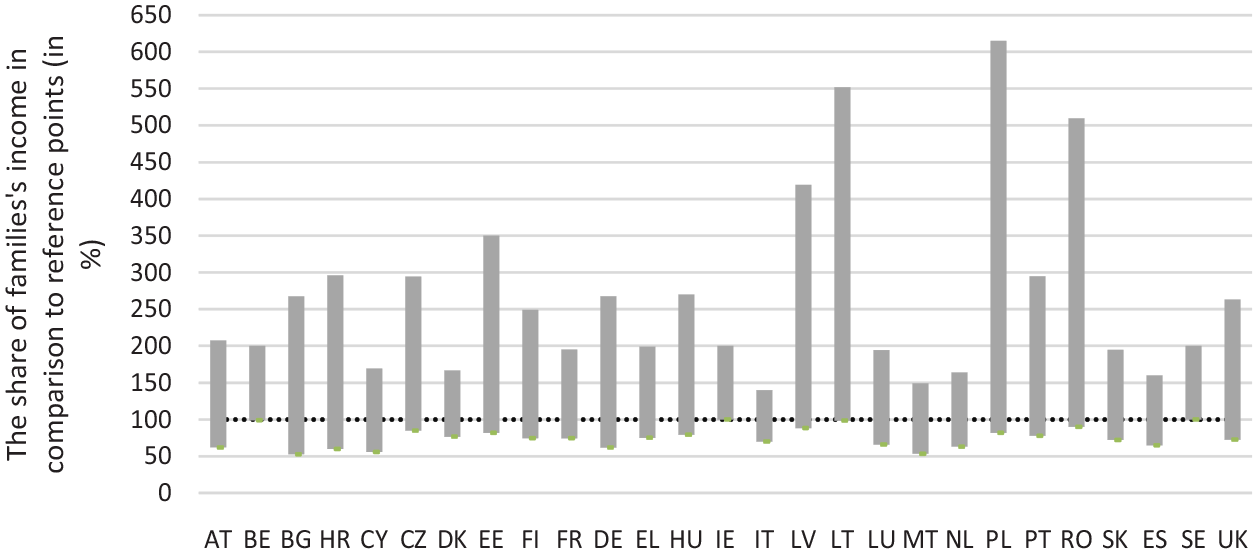
The most increased and decreased incomes of family forms in comparison to reference points (values in %).
As assumed, family-related redistribution also results in a decrease in the net disposable income of many family forms. In all study countries this is the case for family forms with no children, mostly in the single-earner and absent-breadwinner family forms, but there are also cases where the net disposable incomes of dual earners or supplementary earners are decreased, as in Belgium, Lithuania, Malta, and the Netherlands, and quite substantially also in France and Portugal. In addition, the net income of many single-earner and absent-breadwinner family forms with one or two children are decreased by family-related redistribution.
The net disposable income decreases proportionally most for childless families, as already mentioned. Yet, countries differ in this regard as to the form of this childless family, and five clusters can be distinguished. The income of childless family forms decreases most for single earners of half the average income in Austria, Cyprus, the Czech Republic, Estonia, Finland, Germany, Hungary, Latvia, Luxemburg, the Netherlands, and Portugal, of average income in Denmark and Slovakia, or of double the average income in Lithuania, for absent-breadwinner family forms in Bulgaria, Croatia, France, Greece, Italy, Malta, Poland, Romania, Spain, and the United Kingdom, and for dual earners of half the average income in Belgium. In many of these countries, for example, Austria, Bulgaria, Croatia, Cyprus, Germany, Malta, the Netherlands, and Spain, the net disposable income of such families equals or is lower than 65% of those of the reference points (see Figure 8).
Discussion and conclusion
Redistribution is one of the fundamental characteristics of developed societies. Family-related redistribution has tended to be neglected in favour of redistribution associated with employment status, such as unemployment compensation or retirement pensions. This has resulted in a still very limited understanding of societal redistribution in terms of family. Our study has contributed to closing this research gap by mapping redistribution in terms of family as regulated in 27 European countries. Using the tax-benefit microsimulation model for the European Union EUROMOD with its HHoT, we simulated the net disposable incomes of 68 family forms and compared them with the combined incomes of single persons without family as our reference points. This has revealed new insights into family-related redistribution.
While redistribution research usually focusses on redistribution as adding to families’ income, we have distinguished between family-related redistribution in terms of financial support to the family, and financial obligations imposed on the family. With this, not only the stipulated increase in a family’s income is considered, but also the legislated decrease in a family’s income by means of means-tests and other forms of obligations. We identified seven country clusters with particular redistributive logics towards family support, and nine clusters with particular redistributive logics in terms of family obligations; with one exception (Bulgaria and Cyprus), the country clusters, though, did not match each other – in other words, country clustering differs in regard to family-related redistribution as to whether it results from the study of support or obligations. In addition, neither correspond to any established country clustering (Daly, 2020; Esping-Andersen, 1990; Kaufmann, 2002; Thévenon, 2011). For example, in the largest country clusters, both in terms of benefits and obligations, we find countries which are Nordic, liberal, continental, South European, and East European, and countries redistribute quite differently, depending on the family form. This indicates a much greater variation between the countries in terms of redistribution than previously assumed.
These specific social inequalities could only be revealed under consideration of all relevant redistributive regulations, and by accounting for their interplay. The in-depth analysis of the role of family-related regulations shows that the differences among the family forms are mostly attributable to the differently applied taxation and means-tested benefits. Analyses aiming to reveal these social inequalities by studying only particular regulations cannot show the whole story of redistribution.
Our investigation shows, however, that there are also commonalities between the countries: In all countries, families with children receive benefits, although some provide such benefits mainly only to family forms of low income. Another commonality is that almost all European countries oblige their citizens to financially support an income-dependent partner.
We also analysed the overall extent of family-related redistribution. By taking the interplay of support and obligations into account, the data show that all European countries, including those characterized as familializing by default (such as Portugal), redistribute towards the family to a high degree (Saraceno and Keck, 2010). Family-related redistribution affects almost all forms of family, and some fundamentally. So far, in the debate on societal redistribution, family has been mainly treated as affected by redistribution, but not as a redistributive principle in its own right. Our analysis highlights the relevance of studying family as a redistributive principle.
In addition, we asked which family forms redistribution is mainly directed at. In all countries the degree of redistribution is highest towards families with the lowest income. Redistribution is also highest in single-parent and single-earner family forms with children, and lowest in (childless) families with the highest income.
Our results also reveal that the income of many family forms is decreased by family-related regulations – in comparison to the reference points – either because the level of obligations exceeds the level of benefits, or because they are obliged to provide financial resources without being granted any. The decrease in the net income is most pronounced in low-income family forms with one or two dependent adult family members (here also, when one or two children are included), but a decrease in the net income has been found for high-income family forms too. This observation of the decrease in income holds for a wide range of countries including Denmark and Finland that are known for their strong focus on income security and equality (Kvist et al., 2012), as well as France, a country widely understood to be very family-supportive (Saraceno, 2016).
To sum up, the innovative methodological approach of our study has resulted in new and in part unexpected insights into family-related redistribution as stipulated in the countries’ redistributive regulations. There are of course also limitations to new approaches. While we take into account the very different redistributive regulations, and our study has therewith a broader scope than most studies on societal redistribution, the focus is on financial transfers as regulated; in-kind benefits, another major source of societal support to families, could not be included in this analysis for methodological reasons, as explained. Nor did we measure separately the degree of redistribution in benefits and obligations, which could have provided further interesting insights but was not included here due to data issues and space concerns. We have nonetheless contributed to a better understanding of family as an underestimated redistributive principle of European societies, provided new insights into the redistributive logics in the study countries as regards family, and thereby advanced the ongoing analysis of redistribution in terms of theory, methodology, and empirics.
Footnotes
Acknowledgements
The results presented here are based on EUROMOD version I3.0+. Originally maintained, developed, and managed by the Institute for Social and Economic Research (ISER), since 2021 EUROMOD has been maintained, developed, and managed by the Joint Research Centre (JRC) of the European Commission in collaboration with EUROSTAT and national teams from the EU countries. The authors are indebted to the many people who have contributed to the development of EUROMOD. The results and their interpretation are the authors’ responsibility.
Declaration of conflicting interests
The authors declared no potential conflicts of interest with respect to the research, authorship, and/or publication of this article.
Funding
The authors disclosed receipt of the following financial support for the research, authorship, and/or publication of this article: This paper is a result of the research project FaSo (‘The relevance of family for social rights in international comparison: between family allowances and legally obliged family solidarity’) which is financed by the German Research Foundation (DFG).
