




Abstract
Introduction
China's rapidly aging population has intensified demands on the healthcare system, particularly for complex elderly and critical care, creating an urgent need for a highly skilled nursing workforce. The five-year consistent nursing program, which admits junior high school graduates and provides over 8 months of clinical practice before higher vocational enrollment, represents a crucial training pathway. However, the psychological foundations—specifically academic self-efficacy (ASE), learning engagement (LE), and professional identity (PI)—of first-year students in this program remain inadequately studied, despite their importance for developing clinical competence in geriatric care.
Objectives
This study aimed to investigate the interrelationships and mediating mechanisms between ASE, LE, and PI among first-year students in China's five-year nursing program, with the goal of informing training optimization for elderly and critical care.
Methods
This cross-sectional study enrolled 321 first-year nursing students who completed validated questionnaires measuring PI, LE, and ASE. Bias-corrected bootstrapping mediation analysis (5,000 samples, 95% CI) was performed to test the hypothesized model, with only-child status as a covariate.
Results
Participants demonstrated moderate-to-high levels of all three constructs. Correlation analysis revealed ASE was strongly positively correlated with LE (r = 0.806, p < 0.001) and moderately with PI (r = 0.566, p < 0.001), while LE showed a significant positive correlation with PI (r = 0.654, p < 0.001). Mediation analysis confirmed LE fully mediated the ASE-PI relationship, with a significant indirect effect (β = 0.569, 95% CI [0.420, 0.749]) and a not significant direct effect (β = 0.089, p = 0.309).
Conclusion
These findings identified learning engagement as a crucial mechanism through which academic self-efficacy enhances professional identity. Educational interventions should simultaneously strengthen students’ academic confidence and actively promote learning engagement through tailored clinical training and simulated scenarios to develop nurses who are better prepared for China's aging-related healthcare challenges.
Introduction
China's demographic structure is shifting rapidly towards an older population, with profound implications for healthcare systems: in 2024, individuals aged 65 and older accounted for 15.6% of the population (220.23 million), while those aged 60 and above reached 310.31 million (22.0% of citizens) (National Bureau of Statistics of the People's Republic of China, 2024). This shift increases the complexity of patient care—especially for critically ill elderly patients—demanding a nursing workforce that is both larger and more competent. As a critical talent pipeline integrating basic and advanced vocational education, China's five-year consistent nursing education plays a pivotal role in addressing this demand. However, existing research on the core psychological foundations of its students:professional identity (PI), learning engagement (LE), and academic self-efficacy (ASE), remains insufficient. Most studies focus on undergraduate or three-year vocational nursing students, overlooking the unique developmental context of five-year consistent learners and thereby hindering the development of targeted training strategies.
Against this backdrop, cultivating nursing PI has become a core priority. PI is a cornerstone of medical education (Sternszus et al., 2020), critical for nurses’ career development, transition to practice, and the profession's foundational identity. This construct refers to an individual's perception of themselves within a profession or the collective identity of the profession (Browne et al., 2018), and its conceptualization still requires further investigation (Çöplü & Tekinsoy Kartın, 2019). For five-year consistent students, who will be central to China's aging-response workforce, PI directly impacts their professional competence and career stability. However, how to foster it through key psychological constructs like ASE and LE remains understudied.
This gap is particularly critical given the unique characteristics of five-year consistent nursing education. Adopting a “3-year secondary + 2-year higher vocational” model, it admits junior high school graduates and follows a progressive training philosophy of early clinical exposure, frequent clinical practice, and repeated clinical encounters. During the 3-year secondary stage, students complete at least 8 months of comprehensive clinical internship, with most obtaining the Nurse Practitioner Qualification Certificate before entering higher vocational studies. In the higher vocational phase, students complete one year of specialized theoretical study followed by 32 weeks of position-oriented comprehensive clinical internship to enhance professional competence. Unlike traditional nursing students, who typically enroll around age 18 with delayed clinical exposure, the study participants were exposed to clinical practice much earlier, representing a distinct developmental trajectory unexamined in existing literature. Nursing PI evolves dynamically through such educational and clinical experiences (Maginnis, 2018; Pullen, 2021). For five-year consistent students, this developmental process may rely more heavily on clinical instructors’ guidance and LE due to their earlier entry into clinical settings and continuous training pathway, with personal and professional factors also influencing PI development (Philippa et al., 2021),as students’ internalization of nursing's intrinsic values into their PI is fundamental for quality patient care and the profession's future (Nocerino et al., 2020). Beyond individual development, a strong PI is critical for nurses’ well-being and workforce stability (Gao et al., 2022; Kabeel & Mosa Eisa, 2017; Pizziconi et al., 2021), while barriers like overlooked professional status and distrust in nursing knowledge hinder its positive formation (Mousazadeh et al., 2019). Therefore, it is critical to estimate nursing students’ professional identity during their education (Gusar et al., 2021), a necessity that is particularly pronounced for this group, whose earlier entry into nursing education and integrated training make their professional identity more malleable and receptive to intervention.
Review of Literature
Existing global and domestic research has established a theoretical basis for the interactions between PI, ASE, and LE, but highlights a critical oversight: the unique characteristics of five-year consistent nursing students have been completely ignored. Emerging research confirms these bivariate relationships. ASE refers to a student's belief in their ability to complete academic tasks (Chen et al., 2020), shaping their academic choices and learning strategies (Greco et al., 2022). Internationally, an Indian study reported a strong positive correlation between PI and self-efficacy (r = 0.489) (Mukherjee et al., 2024), while a Jordanian qualitative study highlighted the influence of clinical instructor qualities (Shudifat et al., 2024). Domestically, similar bivariate explorations have been conducted in nursing education, with studies verifying mediating effects among these constructs but adopting different research designs (e.g., treating PI as the independent variable) or measurement tools (e.g., using the general self-efficacy scale) (Liao et al., 2024; Zou et al., 2024). Yet, it remains unclear whether these correlations, and the potential mediating pathways linking them, are applicable to five-year consistent nursing students, who gain early clinical experience during secondary vocational education and face distinct developmental challenges in their critical transition phase.
Building on this identified gap, the present study drew on Bandura's social cognitive theory (Bandura, 1986; de la Fuente et al., 2023) and focused on first-year students at the higher vocational stage of China's five-year consistent nursing program. This theory posits that personal beliefs (e.g., self-efficacy) influence behavior (e.g., engagement), which in turn shapes outcomes (e.g., identity)—providing a solid foundation for exploring the three constructs’ interrelationships. Unlike traditional nursing programs, where these relationships have been well-documented, the interplay between ASE, LE, and PI among five-year consistent nursing students—who experience unique early clinical exposure—lacks targeted investigation. Findings from older, traditional cohorts thus cannot be reliably extrapolated to this distinct group, further underscoring the study's necessity.
There is growing global interest in diverse vocational nursing pathways, yet the psychological mechanisms underpinning professional identity in such models remain insufficiently understood. By empirically testing a mediation model in which learning engagement serves as the link between academic self-efficacy and professional identity, within the context of China's five-year vocational nursing program, this study provides a nuanced case study and empirical insights to inform international efforts to optimize training pathways and support novice nurses’ development. Moreover, the findings have important implications for promoting the stable and healthy development of the nursing profession and are likely to be of interest to those in other settings who run similar training programs or are considering the need to implement alternative teaching models for nursing.
Aims and Hypotheses
The study aimed to: (1) describe current levels of professional identity (PI), academic self-efficacy (ASE), and learning engagement (LE) among first-year higher vocational students in the five-year consistent nursing program; (2) examine the interrelationships between these three variables; (3) test a theoretical model in which LE mediates the relationship between ASE and PI.
Based on Bandura's social cognitive theory, we hypothesized that:
The theoretical model of the study is presented in Figure 1.
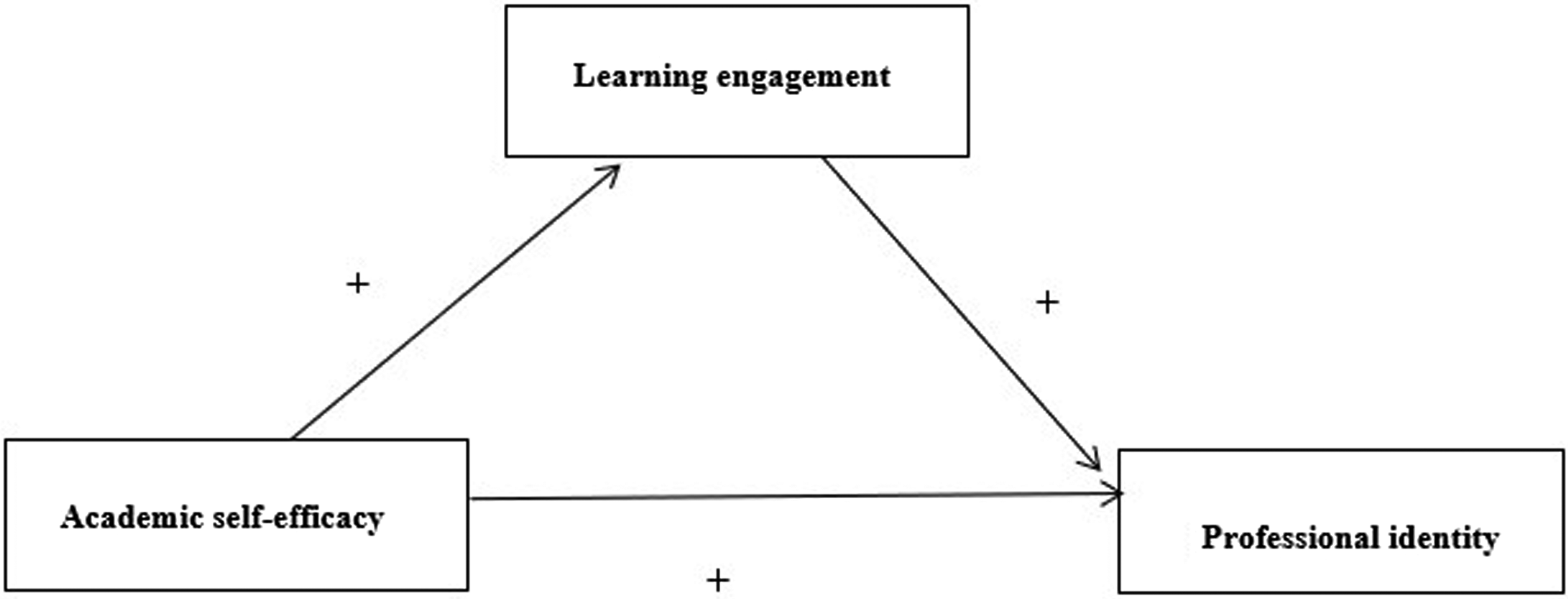
Hypothetical model.
The findings were expected to fill the population-specific gap in nursing education research and provide targeted insights for optimizing training in this unique program.
Methods
Design
A descriptive cross-sectional design was adopted to explore the mediating role of learning engagement between academic self-efficacy and professional identity among first-year nursing students in the five-year consistent program. This design was selected for its efficiency in collecting data from a large sample within a short period. The study was implemented through anonymous online questionnaires, with data collected at a single time point to ensure consistency and feasibility.
Participants
This study's sample consisted of first-year students in the five-year consistent higher vocational nursing program at Ningbo College of Health Sciences (NCHS), a public vocational college in Ningbo, Zhejiang Province. Each September, approximately 400 first-year students join the program, which follows a “three docking and three integration” talent training model—emphasizing early clinical exposure, progressive practical training, and alignment with nursing job requirements.
An a priori power analysis was conducted using G*Power 3.1.9.2 to determine the sample size required for testing the proposed mediation model. The analysis was configured for a linear multiple regression (Fixed model, R2 increase) test, appropriate for assessing the variance explained by adding a mediator (Faul et al., 2009). Parameters were set with a significance level (α) of 0.05, a statistical power (1−β) of 0.95, and a small effect size of f2 = 0.05. The analysis indicated a minimum sample size of 262 participants. To account for potential invalid responses (estimated at 10%) and ensure stable estimation for the mediation model, a convenience sampling method was adopted: six intact classes of first-year students (comprising 345 students in total) were selected as the sampling units (based on consistent curriculum schedules and administrative feasibility for data collection). Participants had the right to voluntarily participate in or withdraw from the survey without any negative consequences, and informed consent was obtained from all participants prior to questionnaire completion.
This sampling method has limitations: the sample was recruited from a single institution (NCHS), which may restrict the generalizability of the findings. However, NCHS's leading position in Zhejiang's vocational nursing education ensures the sample's typicality, providing valuable insights for similar 5-year consistent nursing programs.
Inclusion Criteria
First-year students enrolled in the higher vocational phase of the five-year consistent nursing program (i.e., having completed the 3-year secondary vocational stage);
Voluntarily participated in the study and provided confirmation of electronic informed consent after reading the study introduction on the survey landing page;
Having completed the required ≥8 months of clinical internship in accordance with the secondary vocational stage training program, prior to entering higher vocational education.
Exclusion Criteria
Having temporarily suspended schooling at the time of data collection;
Invalid questionnaire responses, including: uniform answers to all items, or excessively rapid completion.
Measures
Data were collected using a battery of questionnaires, including a general information sheet and three validated scales: the Nursing Students’ Professional Identity Questionnaire, the College Students’ Learning Engagement Scale, and the Academic Self-Efficacy (ASE) Questionnaire. All participants who provided informed consent completed these measures.
The General Information Sheet collected demographic data, including participants’ age, gender, number of siblings, and family residence location (urban/rural). Due to practical constraints, socioeconomic status and prior academic performance, potential confounding variables in the relationships between the study constructs, were not included in the demographic assessment; this limitation is further acknowledged and discussed in the study's Limitations section. Three validated Chinese scales were used to measure key constructs, with good psychometric properties in previous studies and the current sample:
Responses were rated on a 5-point Likert scale (1 = “strongly inconsistent” to 5 = “strongly consistent”), with item 12 reverse-scored and a total possible score of 105 (higher scores = stronger professional identity). Previous validation confirmed good structural validity (via exploratory/confirmatory factor analysis), internal consistency (Cronbach's α = 0.827), and split-half reliability (0.842), supporting its widespread use in Chinese nursing education. Cronbach's α was 0.945 in the present study.
Data Collection
Data collection was conducted in September 2022. To ensure data authenticity, objectivity, and participant autonomy, an anonymous online questionnaire was administered via the Wenjuanxing platform, a widely used and validated online survey tool in China. The survey landing page detailed the study purpose and guaranteed anonymity, confidentiality, and the right to withdraw. Questionnaire links were distributed to the 345 first-year students from the 6 selected classes. Electronic informed consent was obtained from all participants before they could access the questionnaire items.
A total of 328 students voluntarily completed and submitted the questionnaires (voluntary participation rate = 95.07%). Following the predefined exclusion criteria, invalid questionnaires were removed, including those with uniform responses to all items and those completed in less than 3 min (this threshold was determined based on response time data, where over 90% of valid responses took 8–12 min to finish). Finally, 321 valid questionnaires were retained for subsequent statistical analysis (effective rate = 97.9%).
The study was approved by the Medical Ethics Committee of Ningbo College Health Sciences on March 20, 2021 (Approval No.: NBWS-017) and was conducted in accordance with the Declaration of Helsinki and relevant national ethical guidelines.
Statistical Analysis
Statistical analyses were performed using the SPSSPRO online platform. Continuous data are presented as mean ± standard deviation (x̄ ± s). Group comparisons for demographic variables (e.g., only-child status, family residence) were conducted using independent samples t-tests or one-way ANOVA, as appropriate. Bivariate relationships between key variables were examined using Pearson correlation analysis, which revealed significant positive correlations (all p < 0.01).
The mediation hypothesis (academic self-efficacy → learning engagement → professional identity) was tested using a simple mediation analysis on the SPSSPRO online platform, with 5,000 bootstrap samples to generate bias-corrected 95% confidence intervals (CIs). The results supported a complete mediation model, as the direct effect of academic self-efficacy on professional identity was no longer significant after adjusting for the mediator. Statistical significance was defined as p < 0.05, with mediation confirmed if the 95% bootstrap CI for the indirect effect did not include zero.
Only-child status was included as a covariate in the model, as it was the only demographic variable found to be significantly associated with both professional identity and learning engagement in preliminary univariate analyses (see Results: Single-Factor Analysis).
Results
Sample Characteristics
In this study, the average age of nursing students was 18.72 ± 0.76 years. The sample comprised 302 girls (94.08%) and 19 boys (5.92%), with 130 only children (40.50%) and 191 participants with siblings (59.50%). The vast majority (n = 320, 99.69%) had passed the Nurse Qualification Examination. A total of 207 participants (64.49%) reported part-time work experience; additionally, 120 participants (37.38%) had engaged in major-related social practice.
Scores of Academic Self-Efficacy, Professional Identity, and Learning Engagement
The total score for professional identity was 60.371 ± 10.56. Among its dimensions, the highest scores were observed for social modeling (3.765 ± 0.862) and social comparison and self-reflection (3.717 ± 0.667), followed by professional self-image (3.583 ± 0.721), benefits of retention and risks of turnover (3.417 ± 0.735), and the lowest score for independence of career choice (3.265 ± 0.573).
The total score for learning engagement was 70.277 ± 11.16, with dimension scores as follows: cognitive engagement (25.168 ± 4.068), emotional engagement (24.062 ± 4.237), and behavioral engagement (21.047 ± 3.560).
The total score for academic self-efficacy was 74.679 ± 9.00, with learning ability self-efficacy at 38.078 ± 6.247 and learning behavior self-efficacy at 36.601 ± 3.765 (Table 1).
The Total Scores and Scores of Each Dimension of Professional Identity, Learning Engagement, and Academic Self-Efficacy of First-Year Nursing Students in Five-Year Integrated Nursing Program.

Single-Factor Analysis
No significant differences in professional identity, learning engagement, or ASE were observed across gender, family residence, part-time experience, major-related social practice, or parents’ educational background (all p > 0.05). Age was not associated with group differences and thus excluded from further analysis. The only significant finding was that:
Only-child students scored significantly higher than non-only-child students on both professional identity (p = 0.007**, Cohen's d = 0.31) and learning engagement (p = 0.032*, Cohen's d = 0.245) (Table 2).
Single-Factor Analysis of Professional Identity, Learning Engagement and Academic Self-Efficacy of First-Year Nursing Students in Five-Year Integrated Nursing Program.

Note: For two-group comparisons (e.g., gender), effect size is reported as Cohen's d; for multi-group comparisons (e.g., parents’ education), effect size is Partial η2. P values are from independent-samples t-test (two groups) or one-way ANOVA (multi-groups).
Correlation Analysis
Correlation analysis revealed significant positive relationships among the key variables (Table 3). Specifically, academic self-efficacy was strongly correlated with learning engagement (r = 0.806, p < 0.001) and moderately correlated with professional identity (r = 0.566, p < 0.001). Likewise, learning engagement demonstrated a moderate-to-strong positive correlation with professional identity (r = 0.654, p < 0.001).
Correlations among Professional Identity, Learning Engagement, and Academic Self-Efficacy.

*Note: N = 321. *p < 0.05, **p < 0.01.
Mediation Analysis: Learning Engagement as a Mediator
With only-child status as a covariate (Table 4), the total effect of ASE on professional identity was significant (β = 0.658, p < 0.001). Specifically, ASE was significantly and positively associated with learning engagement (Path a: β = 1.019, p < 0.001), and learning engagement was further significantly and positively associated with professional identity (Path b: β = 0.558, p < 0.001). The indirect effect of ASE on professional identity via learning engagement was significant (β = 0.569, 95% bias-corrected Bootstrap CI = [0.420, 0.749]), whereas the direct effect of ASE on professional identity was not significant (Path c’: β = 0.089, p = 0.309).
Mediation Analysis of Learning Engagement on the Relationship Between Academic Self-Efficacy and Professional Identity (Controlling for Only-Child Status).

Note: N = 321. The model included only-child status as a covariate; its coefficients are omitted for clarity. Unstandardized coefficients are reported. Bootstrap sample size = 5,000. The indirect effect is significant, while the direct effect is non-significant.
The indirect effect accounted for 86.5% of the total effect (0.569/0.658), indicating that learning engagement played a full mediating role in the relationship between ASE and professional identity (Figure 2).

The Influence of academic self-efficacy on professional identity through learning engagement.
Discussion
Professional Identity of First-Year Students in Five-Year Consistent Higher Vocational Nursing Education: Current Status and Key Influencing Factors
The observed moderate level of professional identity (PI) among these five-year consistent nursing students may be linked to their unique educational trajectory, which encompasses early clinical exposure during secondary vocational studies, the subsequent challenges of curriculum transition to higher vocational education, and distinct cohort characteristics. This trajectory and student profile collectively impact the “ASE→LE→PI” mediating mechanism on a group level: the ≥8 months of clinical practice during secondary vocational studies is a critical period for role transformation and PI shaping, and while it served as a foundational experience for skill development, the clinical tasks at this stage are primarily basic and routine, with limited progression in complexity, which may gradually diminish students’ enthusiasm and learning engagement (LE). Meanwhile, their psychological and social immaturity, resulting from admission directly after junior high school, weakens academic self-efficacy (ASE) in professional role exploration and undermines career planning awareness, leaving it lower than that of three-year vocational and undergraduate nursing students who enroll at an older age. Over time, students’ enthusiasm for clinical tasks that are primarily basic, routine, and lack progressive complexity gradually declines. This directly impairs LE (the core mediating variable in our ASE→LE→PI model), thereby impeding the positive transmission from ASE to PI and ultimately constraining professional identity development. International studies have documented that clinical stressors such as emotional labor and high work intensity can undermine nursing students’ professional engagement (García-Rivas et al., 2024). This study additionally clarifies the role of LE as a key mediator in this association.
Clinical instructors play a pivotal role in mitigating this decline. Studies have shown that clinical instructors are the most important role players in clinical settings, as they are key to helping students develop professional identity and gradually adapt to professional nursing roles (Haghighat et al., 2019). Clinical placements involve educators, facilitators, and role models, all of whom contribute to the development of nursing students’ professional identity (Maginnis, 2018). Further international research offers two complementary insights: nursing students perceive clinical instructors’ role modeling as a core driver of professional identity formation, and mentors with a bachelor's degree plus 4–5 years of post-registration experience deliver the most effective preceptorship (Mhango et al., 2021; Shudifat et al., 2024).In this study, the score for social modeling ranked the highest among all PI dimensions, bolstered by the role modeling of clinical instructors and nursing seniors, while the score for career choice autonomy was the lowest due to students’ immature self-awareness and limited career exploration; this finding underscores the pivotal role of role modeling in shaping students’ professional perceptions and reinforces the cross-cultural consistency of this factor in nursing education.
Univariate analysis revealed that only-child nursing students had higher professional identity and learning engagement than non-only-child students. This may be related to the stronger family social support (including spiritual support and happiness) available to only-child students, which is known to enhance career attitudes and mitigate anxiety, thereby fostering well-being and professional development (García-Rivas et al., 2024; Yang et al., 2022). In the context of our identified mediation model, this stronger support likely contributes to higher PI primarily by directly enhancing students’ learning engagement (LE), which is the key mediating variable. For non-only-child students, targeted social support (e.g., peer mentorship, academic counseling) may help narrow this gap by similarly bolstering the factors that influence LE and, consequently, PI.
However, this finding should be interpreted cautiously due to the small number of male nursing students in this study, which limits generalizability. Future studies should recruit larger and more gender-balanced samples to verify potential gender differences.
From Mechanism to Practice: Curriculum and Instructional Strategies to Strengthen the ASE→LE→PI Pathway
Building on the identification of learning engagement (LE) as the pivotal mediator, the observed moderate level of LE presents a clear intervention target. To systematically strengthen the “ASE→LE→PI” pathway, curriculum and instructional reforms must directly address the factors that compromise its efficacy.
This mechanism underscores that academic self-efficacy's positive impact on professional identity is contingent on active learning engagement, aligning with the unique educational context of five-year consistent nursing students, where early clinical practice and integrated training prioritize the translation of personal beliefs into practical learning behaviors.
First, optimizing curriculum design to avoid content overlap is essential to protect the mediator (LE). Should such overlap occur across different stages, it may not only fail to engage students but also act as a chronic academic stressor. Therefore, curricular integration must prioritize a sequential progression that aligns with students’ progressive development and ranges from foundational secondary-level knowledge to advanced higher-vocational clinical competencies, thereby minimizing the chronic stressor that degrades the mediator (LE) upon which the pathway depends.
Second, methods such as simulation and standardized patient interactions offer two targeted benefits: (1) they provide mastery experiences that directly build students’ confidence in their clinical abilities, thereby strengthening ASE at the pathway's origin; and (2) by replicating real-world clinical scenarios and patient communication contexts, they enhance the cognitive and emotional relevance of learning, which fosters the sustained behavioral and emotional investment that constitutes high LE.
Finally, cultivating a civil and supportive learning climate is critical for sustaining both ASE and LE. Conversely, academic incivility, such as disrespectful or dismissive instructor behavior, poses a direct threat to this supportive climate. It undermines student-instructor trust and students’ self-belief, thereby impairing ASE. Rajagopal et al. (2024) found that such uncivil behaviors (e.g., negative attitudes, emotional disturbances) reduce student-faculty trust and lower academic productivity. Their work emphasizes the need for targeted training: both faculty and clinical mentors should master respectful communication and effective guidance to counteract these negative dynamics.
This targeted training fosters the interpersonal conditions for ASE and LE to thrive, ensuring the “ASE→LE→PI” pathway operates in a reinforcing context, where classroom teachers and clinical mentors jointly support a cohesive learning experience.
Theoretical Implications of Full Mediation: Linking to Bandura's Social Cognitive Theory
The finding that learning engagement fully mediates the ASE-PI relationship aligns with Bandura's social cognitive theory, offering key theoretical insights into this specific student cohort.
For five-year consistent nursing students, who enter the program at a relatively young age (around 15) with immature psychological development, academic self-efficacy (ASE) is an abstract perception of one's academic ability. It cannot be directly translated into a stable professional identity (PI); instead, it needs to be manifested through concrete learning behaviors.
Learning engagement serves as a critical intermediary in this process: it converts general confidence in academic competence into tangible learning experiences, such as active participation in clinical skill training, cognitive investment in theoretical courses, and emotional connection with patient care scenarios. These practical experiences enable students to verify their abilities and internalize nursing professional values, which are fundamental to forming PI.
This explains why no direct ASE-PI effect was observed: without active learning engagement, academic self-efficacy remains disconnected from the practical experience of nursing, failing to foster a sense of professional belonging. Thus, the results extend Bandura's framework by emphasizing that for young vocational students with early clinical exposure, learning engagement is not merely a mediator but an essential pathway linking self-efficacy to professional identity.
Looking ahead, future cross-cultural studies could further clarify the universal vs. context-specific factors influencing nursing students’ professional identity, helping to determine whether the central role of learning engagement extends to nursing education models with different clinical exposure timelines or curriculum structures.
Strengths and Limitations
Strengths
Focus on an understudied population, filling gaps in nursing education research
Align with aging society needs, responding to talent cultivation priorities
Against the backdrop of China's accelerating population aging, the five-year higher vocational nursing program serves as a key source of grassroots nursing talents. This study provides targeted evidence for optimizing training programs, directly supporting efforts to meet nursing talent demands in an aging society.
Rigorous methodological design ensuring reliability
This study adopted localized scales with excellent psychometric properties (Cronbach's α ranging from 0.898 to 0.967 for all scales) and constructed a mediation model grounded in Bandura's Social Cognitive Theory, providing a solid theoretical and measurement foundation for analyzing large-sample data (N = 321).
Limitations
This study has several limitations that warrant acknowledgment. First, the use of convenience sampling from a single institution (Ningbo College of Health Sciences) limits the generalizability of our findings. No random sampling was performed; the convenience sample may have been skewed toward more motivated and engaged students, which could lead to overestimation of ASE and PI levels. Furthermore, potential confounding variables, such as socioeconomic status and prior academic performance, were not controlled for. Moreover, the study included only first-year students, whose professional identity is still developing and may become more realistic in later clinical years; thus, results may not reflect changes over time. The sample was restricted to the five-year consistent nursing program, so findings cannot be generalized to traditional four-year undergraduate nursing students or those in other regions of China. Future multi-center studies involving diverse geographic and institutional settings are needed to enhance representativeness, and incorporating these key confounders would strengthen the validity of the findings.
Second, this study's cross-sectional nature precludes causal inferences regarding the relationships among ASE, learning engagement, and professional identity. Reverse causation is also plausible. Strong professional identity may promote learning engagement, rather than engagement leading to identity. Thus, the observed full mediation effect should be interpreted as associative only, not causal. Longitudinal or experimental designs tracking students across the entire five-year program are essential to establish causality and confirm the temporal stability of this mediating mechanism.
Third, the measurement tools, while demonstrating good reliability in our sample, were developed within the Chinese cultural context, and their cross-cultural validity has not been established. To facilitate international comparison, future research should undertake a rigorous process of cross-cultural adaptation and validation of these instruments for use in other populations.
Fourth, all data were collected via self-reported questionnaires, which may introduce response bias. For instance, students might overreport their learning engagement or professional identity to meet perceived professional expectations, which could reduce the objectivity of the results.
Fifth, external environmental factors—including faculty support, peer influence, and family socioeconomic status—were not included in the analytical model. These variables may moderate the mediating pathway among academic self-efficacy, learning engagement, and professional identity, and future studies should incorporate them to build a more comprehensive theoretical model.
Implications for Practice
Colleges and universities should strengthen the cultivation of ASE among five-year consistent nursing students through the following measures: (1) Encourage students to participate in social practices and technological innovation activities to enhance their intrinsic learning motivation; (2) Provide targeted academic guidance, psychological counseling, and cognitive interventions for students facing academic difficulties; (3) Standardize the dual tutor system by prioritizing mentors with relevant academic backgrounds and clinical experience, and ensure they deliver targeted clinical teaching guidance and model professional behaviors during rotations—leveraging the well-documented positive impact of role modeling on students’ ASE and professional identity.
Conclusion
This study reveals that first-year nursing students in China's five-year consistent higher vocational education model exhibit a moderate level of professional identity, which is closely linked to their learning engagement and academic self-efficacy. Crucially, learning engagement fully mediates the relationship between academic self-efficacy and professional identity. This underscores that fostering students’ belief in their academic capabilities can enhance their professional identity primarily by increasing their investment in learning. The findings highlight the need for comprehensive educational reforms targeting curriculum alignment, clinical teaching quality, and targeted support systems to ultimately strengthen the professional identity of future nurses.
Footnotes
Acknowledgments
We thank all research participants who participated and contributed to data collection.

Ethics Statement
This study was approved by the medical ethics committee of Ningbo College of Health Sciences on March 20, 2021 (NBWS-017). All participants provided electronic informed consent after being fully informed of the study purpose, anonymity, confidentiality, and the right to withdraw at any time. All methods were carried out in accordance with the Declaration of Helsinki and relevant national ethical guidelines.
Author Contributions
The authors designed the study, conceived the manuscript, collected and analyzed data, drafted the initial manuscript, and substantially contributed to interpreting results. Subsequent tasks included reviewing, editing, revising, and providing critical commentary to finalize the manuscript.
Funding
The author disclosed receipt of the following financial support for the research, authorship, and/or publication of this article: This work was supported by the Zhejiang Provincial Public Welfare Project of China, (grant number LGF22H250007).
Declaration of Conflicting Interests
The authors declare that the research was conducted in the absence of any commercial or financial relationships that could be construed as a potential conflict of interest.
Data Availability Statement
All data generated or analyzed during this study are included in this published article.