




Abstract
Introduction
Ethical competence is part of all health-care professionals’ general competence. It relates to moral issues and is based on the professionals’ knowledge, skills, and attitudes for coping with ethical dilemmas. Ethics education aims to increase nursing students’ and nursing graduates’ ethical self-confidence. Previous research has found many gaps in ethical education content and poor understanding of how these gaps affect graduates.
Objectives
This study aims to evaluate an advanced education workshop held in the nursing department in Max Stern Yezreel Valley College aimed at strengthening the self-perceptions of ethical competence, to address the above gap, by raising students’ self-efficacy when coping with ethical dilemmas.
Methods
The effectiveness of the workshop for nursing students was evaluated using the Generalized Self-Efficacy Scale and at three points in time: before the workshop, after the workshop, and after graduation.
Results
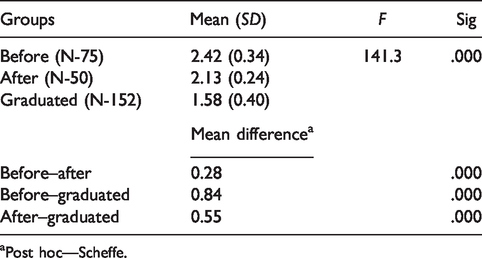
Statistically significant differences were found in overall self-efficacy: before the workshop (mean of 2.42), after the workshop (mean of 2.13), and for graduates (mean of 1.58) with p < .000 on a scale ranging from 1 to 5 (1 indicating high self-efficacy). Mean scores for students’ evaluation after the workshop and for graduates were 7.8 and 7.25, respectively, on a scale ranging from 1 to 10, where 10 indicates high self-efficacy. Graduates presented a high mean score regarding their ability to cope with ethical dilemmas when compared with other nurses working with them (mean of 7.4, on a scale ranging from 1 to 10).
Conclusion
Levels of self-efficacy with regard to coping with ethical dilemmas increased over time, suggesting that the workshop strengthened the self-perception of ethical competence for nursing students and graduates.
Introduction
Nurses frequently cope with ethical dilemmas in daily care. They are expected to make ethical decisions and demonstrate high ethical competence. Ethical competence can be achieved when nurses gain knowledge of ethical principles, which in turn, leads them to ethical responses and behaviors (Gallagher, 2006). Previous studies have emphasized the importance of ethics education in achieving ethical competence (Bahrieni et al., 2017; Calder, 2015; Numminen & Leino-Kilpi, 2007; Park et al., 2012; Yoshikawa et al., 2010; Yoshioka & Kaneko, 2019).
Despite the positive relationship between ethics education and high levels of ethical competence, Hoskins et al.’s (2018) literature review found many gaps in the extant ethical education content and in the findings regarding the impact of ethics education programs on graduates. Moreover, in the field of micro-ethics, which Krautscheid and Brown (2014, p. 519) defined as “the everyday ethical decisions that practicing nurses make in the context of common or routine clinical situations,” it was found that upon making ethical decisions, ethics-educated nurses failed to recall the knowledge they had previously obtained (Erdil & Korkmaz, 2009; Hoskins et al., 2018).
The nursing school at Max Stern Yezreel Valley College initiated an advanced ethics workshop in order to raise nursing students’ ethical competence while attempting to fill the gaps in current ethics education programs.
Literature Review
Studies from 2019 describe educational programs that employ different teaching and learning strategies to raise nursing students’ ethical competency. DeSimone (2019), for example, found that adding teaching-learning activities designed to build moral courage values in both the classroom and clinical settings, promoted nursing students’ ethical competence. Similarly, Polczynski et al. (2019) found that nursing students’ ethical decision-making skills improved after the implementation of a campus-wide ethics program. In their examination of the effect of debate-based and lecture-style ethics education on the moral sensitivity and moral judgment of nursing students, Kim & Park (2019) found that the program was effective in raising ethical decision-making capabilities and moral judgment.
Ethics education was found to be effective when based on a contemporary pedagogical approach (Trobec & Starcic, 2015) in which case analysis (Kalaitzidis & Schmitz, 2012), group discussions (Dinç & Görgülü, 2002; Lin et al., 2010), and simulations (Gropelli, 2010; Tuxbury et al., 2012; Vanlaere et al., 2010) were integrated in lectures. This approach enables students to make ethical decisions, albeit in virtual contexts (Davis et al., 2006). Moreover, ethical case studies from the field of clinical nursing help practitioners analyze ethical dilemmas and acquire tools for decision making (Hsu, 2011).
Purpose
This study aims to evaluate an advanced ethics education workshop and to conduct a follow-up evaluation of the competency of nursing students and graduates in coping with ethical dilemmas. Drawing on self-efficacy theory, self-efficacy was evaluated among three groups at three points in time: (a) Nursing students prior to the advanced workshop, and after they had completed a course on the fundamentals of ethics; (b) at the end of the workshop in the 4th year; and (c) among graduates who had participated in the advanced workshop as students. Coping with ethical dilemmas means that students and graduates can analyze ethical dilemmas, solve problems, and make ethical decisions.
Methods
Description of the Advanced Workshop
The curriculum of the nursing faculty of 4th year is comprised of 19 nursing credits, in 2 consecutive semesters and over 7 months (see Table 1). All students must have completed 140 credit points in 3 years of nursing clinical and theoretical courses.
The Curriculum for the Nursing Program—4th Year Mandatory and Elective Courses: 19 Credits.

Note. Numbers inside parentheses are the number of credits awarded per course. GCP = Good Clinical Practice.
aClinical nursing course.
The current workshop was designed by the teaching committee of the nursing department.
It utilized several pedagogical axes listed here:
The ethical axis—dealing with the principles of ethical thinking, values, and the guiding principles of ethical thinking. The theoretical axis—theories that explore ethical dilemmas, a model for the resolution of ethical dilemmas. The personal axis—emotional positions and a sense of the ability to cope with ethical dilemmas. Professional experience—the encounter with an ethical issue that raises a dilemma.
The following ethical principles and values constituted the theoretical foundation and framework for discussion in the group:
Key values in nursing are as follows:
Safeguarding human dignity and rights. Integrity and truthfulness. Benevolence and not causing harm. Maintaining autonomy. Taking responsibility. Equality, justice, and decency. Preserving privacy and secrecy. Nondiscrimination and nonlabeling, respecting diversity.
These ethical principles are supplemented by additional practice facilitated by a model for resolving ethical dilemmas.
Workshop Program
Two meetings: Focused on the ethical story. The students submitted texts in writing to the lecturer and received feedback. One meeting: Theoretical background. Two meetings: Individual consultations and nine meetings: Student presentations of ethical dilemmas.
Students and graduates were expected to draw on both the Nursing Ethical Code (Israeli Nurses Association, 2004) and the Patients’ Right Law and the ethical decision-making models and tools they acquired and practiced in the advanced workshop (e.g., Wagner’s tool; see Wagner, 1985).
Presentation and Discussion on Ethical Dilemmas
In class, groups of four students each presented an ethical dilemma using practical demonstrations such as film, role play, simulation, and narratives.
Each meeting was divided into five parts as follows:
Presenting the story. Analyzing the story and identifying the dilemmas. Theoretical-factual background. Proposed solutions, costs, and benefits. What the student takes away from the meeting for coping with the next dilemma.
Open-mindedness, acceptance, and nonjudgmental reception of the story were emphasized. This enabled exposure and sharing without fear of critique.
At the end of the workshop, each student was asked to write a personal paper on the story they presented and to analyze it according to the principles acquired in the workshop.
The article included describing the story, identification of the dilemma/s, suggestions for solutions, choosing the solution, benefits, and cost of the chosen solution.
During the Workshop
Students shared personal stories they had experienced during their clinical training in hospital departments or community clinics. Each story needed to present an ethical problem.
The workshop ended with a round of sharing insights (check-out) in which students summarized the insights and sense of competency that they had gained in the meeting. Emphasis was put on the level of generalization beyond the concrete event.
The workshop’s structure—which involves construction on the one hand and provides space and openness in which complex content can be raised on the other—formed a progressive and active framework for dealing with ethical dilemmas. This was reflected in the rise in the students and graduates’ feeling of capability to cope with ethical issues, which are so common in the health-care system. Table 2 summarizes the description of the workshop.
Advanced Workshop Content Description.

Theoretical Foundation
The theoretical rationale for the advanced workshop is based on Constructivist Theory, which states that knowledge is “temporary, non-objective, developmental, internally constructed, and socially and culturally mediated” (Reeves & Hedberg, 2003). To construct opinions, values, and beliefs, individuals use their knowledge and newly gained information.
The advanced workshop aimed to strengthen self-perceptions of ethical competence by raising the students’ self-efficacy in coping with ethical dilemmas. Bandura (1977) defined self-efficacy as an individual’s belief in their ability to achieve certain outcomes by operating in a certain way. Accordingly, high levels of self-efficacy facilitate the individual’s ability to cope with complicated situations. In other words “beliefs people hold about their own capabilities can predict their behavior in a particular context” (Bandura, 1997, p. 3).
The Generalized Self-Efficacy Scale is an important tool for evaluating the impact of education on the improvement of health-care workers’ behavior and competence (Doyle et al., 2011). The working hypothesis of this study is that students and graduates’ self-efficacy can predict their competency in the ethics domain.
Based on Bandura’s (1986) finding that self-efficacy is a predictor for students’ achievements across academic areas and levels; we assume that after the advanced workshop, nursing students and graduates’ beliefs regarding their capabilities to cope with ethical dilemmas will predict their ethical reactions and behaviors. Previous research in the field of ethics also found that nursing students’ choices, efforts, and determination to cope with and solve ethical dilemmas depend on their ethical self-efficacy (C. A. Laabs, 2012; Pajares & Urdan, 2006). Moreover, previous studies found that high levels of self-efficacy are positively correlated with years of experience in nursing (Pajares & Urdan, 2006; Soudagar et al., 2015).
Survey Process
Design and Sample
In this cross-sectional study, a Google Docs anonymous self-administered online software questionnaire was distributed via the workshop website. The study was initially intended to be a paired study; however, given that less than 10 students agreed to be assigned a personal identifier, it was decided to analyze the data independently. The same questionnaire was distributed on the first day of the advanced workshop to all 4th-year students who studied in the years 2014 to 2016, 1 month after they completed the workshop, and in 2019 after the students had graduated (via email). Student response rates were 31% before the workshop, 20% after, and 62% of graduates.
The questionnaire was based on a version of the Generalized Self-Efficacy Scale (Chen et al., 2001) originally developed by Sulmasy et al. (1990) for the evaluation of medical residents’ ethical confidence, and which over the years, demonstrated high and consistent internal reliability (over 0.80 in various different studies). In this questionnaire, self-efficacy assessment included three dimensions such as magnitude, strength, and generality (Bandura, 1977). Magnitude referred to the difficulties individuals face in changing their behaviors, strength related to their certainty in their ability to take action, and generality referred to levels of self-efficacy and positive attitudes toward these behaviors overtime. In prior studies, the questionnaire was found reliable with a Cronbach alpha of.87 and its content was found to be valid with high predictability (Chen et al., 2001). The Hebrew translation has been used since 1998. Additional content validity was obtained by consulting researchers at the Max Stern Yezreel Valley College.
The questionnaire consisted of 17 statements on 2 main topics: (a) Personal ability–behaviors (magnitude and strength), for example: “Usually, when I face an ethical problem related to work, I do not leave it until I reach a solution” and “Usually, I give up and do not complete steps or actions related to dealing with an ethical dilemma at work.” (b) Belief in one’s general ability to cope with ethical dilemmas (generality), for example: “I trust myself when dealing with an ethical dilemma” or “I believe that there is nothing can be done when the task of dealing with an ethical dilemma is too complex.”
Respondents were requested to rate their level of agreement on a scale of 1 to 5 (1 = totally disagree [high self-efficacy] and 5 = fully agree [low self-efficacy]). Aggregated mean variables represented the overall self-efficacy of students before and after the advanced workshop and of graduates.
Two questions were added to the questionnaire distributed to students after the advanced workshop and graduates that evaluated general self-efficacy in relation to the workshop: “In your opinion, to what degree on a scale of 1–10 (1 = very little and 10 = very much) did the workshop contribute to your ability to generally cope with ethical dilemmas?” and “On a scale of 1–10, to what degree, after the workshop, do you feel more comfortable coping with ethical dilemmas?” Four additional questions were added to the graduates’ questionnaire pertaining to (a) frequency of encountering situations involving ethical dilemmas, (b) duration of employment as a nurse, (c) field of work (hospital/community), and (d) self-comparison with other nurses—“On a scale of 1–10, to what degree do you feel that you are able to cope with ethical dilemmas, compared to the other nurses working with you?” All questionnaires queried sociodemographic variables including gender, age, marital status, religiosity, ethnicity (Jews/Arabs), and working status.
Ethical Considerations
The Max Stern Yezreel Valley College Review Board approved the study (Ethics Committee reference number: 2018-32 YVC EMEK). To ensure confidentiality and evaluation reliability, students and graduates were informed as to participation being voluntary and anonymous and were asked to sign a consent form. The instructor informed students about the advanced workshop evaluation process before answering the questionnaire. Subsequently, on the last day of the workshop, they met again to talk about the aims and educational values of the advanced workshop evaluation.
Statistical Analysis
T tests and analysis of variance determine the differences between self-efficacy before and after the advanced workshop, and after graduating. analysis of variance assessed the factors associated with self-efficacy. SPSS 21.0 was used for data analyzes and p < .05 was considered to be significant.
Results
Nursing Students
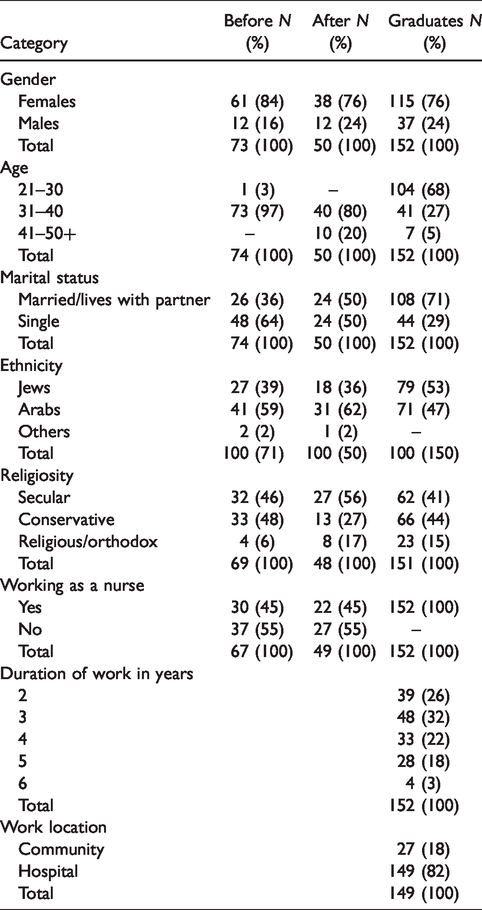
A total of 127 students answered the questionnaire, 79% before the advanced workshop and 52% after. Most were single females between 21 and 30 years old. Students belonged to two ethnic groups, Arabs and Jews; more Arab students answered the questionnaire before and after the advanced workshop. Few participants in the before and after advanced workshop groups were religious, and 45% of students worked in the health system (Table 3).
Demographic Characteristics of the Students and Graduates.
Graduates
A total of 152 nurses answered the questionnaire, most of whom were females, married, and aged 21 to 30. In addition, 53% were Jews of which 15% were religious, and 85% either traditional or secular. All participants reported that they were working as nurses, mostly in hospitals. On average, graduates had been working for 3.4 years. Table 3 shows the demographic characteristics.
A combined mean score was computed for the questions representing the overall self-efficacy variable and the two self-efficacy dimensions—personal ability-behavior, and belief in the ability to deal with ethical dilemmas. The data analysis revealed higher levels of overall self-efficacy after the advanced workshop than before the advanced workshop. The mean score was even higher for the graduates; differences between the three groups (before, after, and graduates) were statistically significant. The results are presented in Table 4.
Analysis of Variance Results on Significant Differences in Overall Self-Efficacy in Coping With an Ethical Dilemma—Before (First Time Point) and After (Second Time Point) the Advanced Workshop, and Among Graduates (Third Time Point).
aPost hoc—Scheffe.
Significant differences were found between the two dimensions of self-efficacy (personal ability-behaviors and ability to cope with ethical dilemmas), and among the three groups (before, after, and graduates). Results are presented in Table 5.
Analysis of Variance Results of Each Dimension of Self-Efficacy, Personal Ability-Behaviors and Belief in Ability Before (First Time Point) and After (Second Time Point) the Advanced Workshop, and of Graduated Nurses (Third Time Point).

aPost hoc—Scheffe.
Mean scores were higher for students after the advanced workshop compared with graduates regarding their ability to cope with ethical dilemmas. In addition, when asked about their level of comfort in coping with ethical dilemmas, students after the workshop and graduates presented higher mean scores compared with students before the workshop (Table 6).Among the three groups, no significant relationship was found between overall self-efficacy and individual self-efficacy and belief in abilities to cope with ethical dilemmas relative to sociodemographic variables, except for marital status. Married graduates reported higher levels of overall self-efficacy (r = –.203, p < .012).
Means, Standard Deviations, and T test—Evaluation of the Advanced Workshop Among Students (After) and Graduates.

Discussion
Self-Efficacy and Coping With Ethical Dilemmas
This study aimed to conduct a follow-up evaluation of nursing students and graduates’ competency in coping with ethical dilemmas employing a modified version of the Generalized Self-Efficacy Scale.
The results indicate that the students’ self-efficacy in coping with ethical dilemmas increased after the advanced workshop and after graduating. While graduates presented lower scores regarding the contribution of the advanced workshop to their ability to cope with ethical dilemmas compared with scores after the workshop, they still felt comfortable and were more able to cope with ethical dilemmas compared with other nurses who worked with them.
The results indicate that the advanced workshop had a positive effect on the students and graduates’ ability to “bring out the ethical practice (behaviors)” (Gallagher, 2006), enhance their competence perception, and strengthen their ability to cope with ethical dilemmas. As noted, self-efficacy is one’s belief in their ability to generate a particular outcome. Nursing students and graduates’ self-efficacy caused them to feel more confident in coping with ethical dilemmas, which entails the ability to analyze ethical dilemmas, solve problems, and make ethical decisions.
Ethics Education
The described advanced workshop is part of the ethics education curriculum of the nursing school at Max Stern Yezreel Valley College. It aims to provide additional knowledge and tools to those acquired by students’ through their clinical training. Previous research has emphasized the importance of ethics education in achieving ethical competence, increasing nurses’ confidence (Grady et al., 2008; Wocial, 2008), and reducing the number of moral stress incidents (Lang, 2008).
Previous studies also found that the growing complexity of health-care systems has increased the exposure of nursing students to ethical dilemmas in clinical practice (see e.g., Erdil & Korkmaz, 2009). In addition, facing an ethical dilemma often results in moral distress among nurses, thereby negatively impacting them and their patients (Godfrey & Smith, 2002; C. A. Laabs, 2005, 2007; C. Laabs, 2011). The inclusion of ethical education in the nursing curriculum is important, not just for students but also for educators. Epstein & Carlin (2012) demonstrated that ethics education enables educators to better understand their students’ perspectives on ethical issues. Further research is recommended among educators.
Contemporary Pedagogical Approach
For more than a decade, nursing education has employed narrative pedagogy (Brown et al., 2008; Swenson & Sims, 2000). Narrative pedagogy includes reflecting on everyday practices and context, and it forges in students a better understanding of the health-care system’s policies and structures (Doane et al., 2004). The effective integration of clinical narratives in the curriculum is contingent on their veracity, that is, to what extent do they simulate real-life situations. Using real-life clinical narrative stories, as described in the “ethics-in-the-round” approach (Hutchinson et al., 2014), provides students with opportunities to discuss situations based on clinical experiences, thus improving their ethics education and competence. The described advanced workshop is based on the contemporary pedagogical approach in ethics education in which case analysis, group discussions, and simulations are integrated in lectures (Dinç & Görgülü, 2002; Gropelli, 2010; Kalaitzidis & Schmitz, 2012; Lin et al., 2010; Tuxbury et al., 2012; Vanlaere et al., 2010). From the results of this study, it appears that the contemporary pedagogical approach contributes to the increase in self-efficacy among students and graduates.
Israeli Nurses Association Code of Ethics and Israeli Patients’ Rights Law
The Israeli Nurses Association Code of Ethics (2004) and the Israeli Patients’ Rights Law (Israeli Parliament, 1996) present a set of ethics, values, and guidelines for students and professionals. Practicing the code and law principles can provide additional value to the advanced workshop and may contribute to raising levels of self-efficacy. Beckett et al. (2007) found that while codes may be instructive as to appropriate ethical behaviors, in fact, professionals do not always follow them. Therefore, researchers suggest that educators play a crucial role in educating nursing students on ethical values and principles (Calhoun & Strasser, 2005; Leners et al., 2006).
Professional Experience and Self-Efficacy Coping With Ethical Dilemmas
Professional experience in the field of nursing raises levels of self-efficacy in coping with ethical dilemmas (Pajares & Urdan, 2006; Soudagar et al., 2015). The graduates in the study, who had already been working for 2 to 6 years, reported high levels of self-efficacy in coping with ethical dilemmas. However, the data analysis did not find any relationship between self-efficacy and duration of employment as a nurse. This result can be explained by the fact that most of the graduates had limited experience and had worked for no more than 3 years. Further research on the correlation between self-efficacy and years of practical experience is needed.
Limitations
This study has several limitations. First, it measured perceptions of ethical competence using a modified version of the standardized self-efficacy questionnaire as opposed to other studies in which different instruments were used. For example, in their review of 17 published studies on health-care professionals’ ethical competence, Koskenvuori et al. (2019) found that all of the authors of quantitative studies developed their own instruments. The use of the standardized self-efficacy questionnaire may not be as suitable as any one of these designated instruments. Second, this study constitutes a case study from a single nursing school. It is recommended to expand the research to other nursing schools in Israel and abroad. A third possible limitation is acquiescence bias, which is defined as providing affirmative answers regardless of the question (Rammstedt et al., 2010). One of the methods used to overcome this bias was presenting items in a binary fashion, with explanations at both ends of the scale (Hinz et al., 2007).
To conclude, the advanced workshop is likely to promote the effectiveness of nursing students’ ethics education and enhance their self-efficacy in coping with ethical issues as students and nurses in the health-care system. It can provide an additional educational tool that complements the basic ethics educational courses in nursing schools.
Footnotes
Authors’ Note
All authors have read and approved this manuscript and participated in collecting the data and analyzing it.
Declaration of Conflicting Interests
The author(s) declared no potential conflicts of interest with respect to the research, authorship, and/or publication of this article.
Funding
The author(s) received no financial support for the research, authorship, and/or publication of this article.
