




Abstract
Introduction
Belongingness is a crucial psychological construct that profoundly affects nursing students’ clinical learning experiences, motivation, and integration within healthcare teams. The Belongingness Scale–Clinical Placement Experience (BES-CPE) has been extensively verified across several contexts, however a validated Arabic version has not been available for application in Jordanian nursing education.
Objective
Translate, culturally adapt, and psychometrically assess the Arabic BES-CPE among undergraduate nursing students in Jordan.
Methods
A cross-sectional design was utilized. The sample included 404 second-, third- and fourth-year undergraduate nursing students. The BES-CPE underwent translation and adaptation through forward-backward translation methodology. Both item-level and scale-level content validity indices were calculated. Construct validity was evaluated by confirmatory factor analysis (CFA) and exploratory factor analysis (EFA) with principal component analysis and Varimax rotation. Internal consistency was assessed via Cronbach's alpha. Group comparisons were performed using independent-samples t-tests and a one-way analysis of variance.
Results
The CFA provided a less-than-satisfactory fit for the tested models. EFA identified a clean three-factor structure, accounting for 44.81% of the total variance, which is consistent with the original model. Some variation in item distribution was observed, leading to the renaming of two subscales better to reflect their content: Interpersonal Connection and Social Inclusion. The Efficacy subscale remained unchanged. The Arabic BES-CPE exhibited high internal consistency (Cronbach's α = .92). Male students scored significantly higher than females on the overall BES-CPE scale and all subscales. Fourth-year students showed significantly higher Interpersonal Connection scores compared to second- and third-year students (p = .02).
Conclusion
The Arabic BES-CPE is a valid and reliable tool for evaluating nursing students’ sense of belonging during clinical placements. It is culturally suitable and may facilitate the establishment of inclusive clinical learning environments in Arabic-speaking populations.
Keywords
Introduction
Belongingness, defined as the experience of feeling accepted, respected, and valued by others, is recognized as a fundamental need that shapes motivation, learning, and well-being. Studies in psychology emphasize the “need to belong” as essential to human well-being, influencing cognition, emotion, and behavior (Allen et al., 2022; Baumeister & Leary, 1995, 2017). In nursing education, where clinical placements immerse students in real healthcare teams, belongingness is particularly important. Students who feel they “fit in” are more engaged and less anxious, whereas those who feel excluded struggle to learn effectively (Levett-Jones & Lathlean, 2008). The sense of belonging has been linked to increased motivation, which plays a vital role in academic achievement and retention (Allari et al., 2023; Pedler et al., 2021). The development of self-concept and professional values is a key factor in belongingness (Squire et al., 2024), and nursing students have been reported to possess appropriate levels of professional values (Abu-El-Noor et al., 2023).
Review of Literature
Nursing theorists argue that belongingness is a prerequisite for clinical learning (Levett-Jones et al., 2009). Qualitative studies have shown that students across Australia and the United Kingdom emphasize the importance of feeling part of a team for their learning and confidence in placements. Conversely, a lack of support or inclusion can lead to feelings of alienation and reduced engagement (Levett-Jones & Lathlean, 2008). Researchers have linked belongingness to positive educational outcomes, such as higher academic achievement, self-esteem, and self-efficacy among nursing students (Singer et al., 2022). Students who feel accepted by nurses and instructors during clinical practice report greater confidence and a stronger sense of professional identity (Ashktorab et al., 2015). Recognizing this, nursing faculty are encouraged to foster inclusive placement environments, as intentional, supportive interactions significantly improve students’ sense of belonging (Sedgwick, 2013).
To study belongingness quantitatively, Levett-Jones et al. (2009) developed the Belongingness Scale–Clinical Placement Experience (BES-CPE), a 34-item instrument that captures students’ emotional and social integration during clinical placements. This self-report questionnaire consists of statements rated on a five-point Likert scale. Factor analysis confirmed the BES-CPE's three dimensions: Esteem, Connectedness, and Efficacy. Each subscale demonstrated strong internal consistency (α ≥ .80), and the full 34-item scale had an α of .92 (Levett-Jones et al., 2009). Subsequent studies have used the BES-CPE to document levels of belongingness across diverse student populations and settings, further supporting its validity (Poole et al., 2023; Qureshi et al., 2019; Singer et al., 2023).
Since its inception, the BES-CPE has been translated and adapted across cultures and professions, consistently confirming its original three-domain structure and high reliability. For example, Ashktorab et al. (2015) translated the BES-CPE into Persian for Iranian nursing students, yielding a 32-item version with excellent reliability (overall α = .92, with subscale alphas of .85, .86, and .80) (Ashktorab et al., 2015). Similarly, Kim and Jung (2012) evaluated a Korean version, which maintained the three-factor structure and demonstrated high reliability (Cronbach's α = .90). A translated version was tested in Canada, which showed that accelerated students had lower scores than traditional students, suggesting that the scale can capture meaningful group differences (Sedgwick, 2013). These adaptations reinforce the scale's applicability beyond the original context.
Other adaptations include those by Poole et al. (2023) for Doctor of Physical Therapy students in the United States and by Qureshi et al. (2019) for UK medical students. Both studies supported the three-factor solution and reported high internal consistency. Despite cultural and professional differences, all adaptations reaffirm the BES-CPE's conceptual robustness (Supplemental Material Table 1 summarizes key findings from several global adaptations).
An Arabic adaptation of the BES-CPE was reported by Albloushi et al. (2022) in Saudi Arabia. This version involved substantive modifications to reflect local experiences. The resulting instrument is therefore not a direct translation of the original BES-CPE; instead, it is a context-tailored tool. For example, some added items may capture cultural or educational factors specific to the Gulf context. The publication does not detail the exact item changes, and attempts to obtain the full questionnaire from the authors were unsuccessful. Given these modifications, the Saudi version likely measures additional constructs beyond the original three domains. From a cultural standpoint, the Gulf context (Saudi Arabia) differs from the Levant (Jordan, Lebanon, Syria, etc.) in social norms, educational systems, workforce homogeneity, and clinical training practices. Beyond the Saudi study, research on belongingness in Arab nursing programs is scarce, highlighting the need for a validated tool in the Jordanian context.
Nursing education in Jordan follows international standards, and curricula emphasize theoretical knowledge, lab skills, simulation, and extensive clinical training. Clinical placements are an essential component, beginning as early as the second year of study and continuing throughout the program in diverse healthcare settings, including public hospitals, university-affiliated hospitals, private hospitals, military hospitals, and primary health care centers. Such placements are essential for developing professional identity, critical thinking, and confidence in clinical decision-making (Mahasneh et al., 2021). Clinical supervision, inclusivity in the clinical environment, and a perceived sense of belonging play a crucial role in achieving students’ learning outcomes (Levett-Jones & Lathlean, 2008). Some qualitative reports suggest that Jordanian students face challenges related to belongingness during placements, including difficulties integrating into clinical teams (Mahasneh et al., 2021). However, systematic measurement tools are lacking. This represents a clear gap: Without a culturally adapted, validated instrument, educators cannot accurately assess Jordanian students’ sense of belonging or track interventions to improve it.
Recognizing the foundational theory that belongingness is essential for learning (Levett-Jones & Lathlean, 2008), failing to measure it properly leaves a blind spot in educational assessment. For Jordanian nurse educators, having a valid BES-CPE will enable them to identify students who feel disconnected and to implement supportive strategies promptly. Therefore, this study aims to adapt and validate the BES-CPE for the Jordanian context, specifically to: (1) Assess content validity of the translated scale via expert review; (2) examine construct validity; and (3) assess reliability (internal consistency) of the total scale and subscales. The study also describes the students’ belongingness scores and tests for differences by gender and academic year (second, third, fourth).
Methods
Phase 1: Content Validity Index and Expert Review
Design and Sample
This phase utilized a cross-sectional design to establish the content validity of the BES-CPE. The original BES-CPE was translated into Arabic in accordance with standard procedures. Two independent bilingual translators (fluent in English and Arabic) performed forward translation. Discrepancies were resolved by consensus with a third translator. A separate bilingual translator then back-translated the Arabic version into English to check for conceptual equivalence with the source. Next, a panel of two nursing education experts reviewed the Arabic items for relevance, clarity, and cultural appropriateness. They rated each item's relevance to the construct of belongingness. Based on their feedback, minor wording adjustments were made to ensure clarity in the Jordanian context. These steps mirror recommended practices for translating psychometric instruments as outlined by Wild et al. (2005).
Instrument
The BES-CPE, originally developed by Levett-Jones et al. (2009), consists of 34 items rated on a 5-point Likert scale (1 = Never true to 5 = Always true) reflecting the respondent's feelings and experiences during clinical placements. Higher scores indicate a greater sense of belongingness. A Content Validity Index (CVI) was computed from the experts’ ratings.
Data Collection
The content validity of the Arabic version of the BES-CE was evaluated by a panel of six experts who held doctoral or master's degrees in nursing and had at least 10 years of experience in clinical nursing education and nursing research. The experts were specifically selected for their familiarity with the Jordanian healthcare system and student learning environments.
Both Item-level CVI (I-CVI) and Scale-Level CVI (S-CVI) were calculated. The panel of experts was asked to rate the relevance of each item on the scale to the measured domain on a 4-point Likert scale (Polit & Beck, 2017; Yusoff, 2019). The degree of relevance was rated as follows: 1=“the item is not relevant to the measured domain”, 2=“the item is somewhat relevant to the measured domain”, 3=“the item is quite relevant to the measured domain”, 4=“the item is highly relevant to the measured domain” (Yusoff, 2019). The I-CVI was calculated based on the proportion of experts who rated items as 3 or 4. The S-CVI (averaging) was calculated by dividing the sum of I-CVI by the total number of items (Polit & Beck, 2017). According to Polit and Beck (2017), items with an I-CVI ≥ 0.78 are acceptable, and S-CVI/averaging ≥ 0.90 is considered excellent in terms of content validity.
Phase 2: Validation Study with Nursing Students
Design and Sample
The validation study recruited 404 undergraduate nursing students enrolled at a Jordanian public university.
Instrument
The online Arabic BES-CPE and a brief demographic questionnaire were used by members of the research team to collect data. The online form included instructions for answering items while reflecting on their most recent clinical placement.
Data Collection
The study was advertised through the Faculty of Nursing's social media student groups. All eligible students (second, third, and fourth years) were invited to participate by answering the online Arabic BES-CPE. The responses were uploaded directly to the researcher's cloud drive. Participation was voluntary and anonymous. The data collection process took place between June and August 2025.
Ethical Approval
Ethical research standards were followed. No personal identifiers were collected. Participation was voluntary, anonymous, and free of coercion, and completion of the questionnaire indicated consent to participate. Respondents were informed that their data would be used solely for academic purposes and may add value to the literature. Ethical approval was obtained from the Institutional Review Board (Al Hussein Bin Talal University).
Statistical Analysis
Data analyses were conducted using Mplus version 8.3 ( Muthén and Muthén, 1998–2017), and SPSS (version 23.0, SPSS Inc., Chicago, IL, USA). In confirmatory factor analysis (CFA), five indices were evaluated to assess the model fit, including Chi-squared statistics (Χ2), Comparative Fit Index (CFI), Tucker–Lewis Index (TLI), Root Mean Square Error of Approximation (RMSEA), and Standardized Root Mean Square Residual (SRMR). A low, non-significant Χ2 value indicates a good fit of the model to the data (Kline, 2023). CFI and TLI values of ≥ 0.90 and ≥ 0.95 indicate a reasonable and good fit, respectively (Bentler, 1990; Hu & Bentler, 1999). RMSEA is considered reasonable if ≤0.08 and good fit if ≤0.06 (Hu & Bentler, 1999). The SRMR values < 0.08 indicate a good fit (Hu & Bentler, 1999).
Descriptive statistics were computed for all items and total scores after reverse-coding items 10, 14, 22, and 26. Then, CFA was initially attempted; however, the model fit indices were inadequate. All tested models yielded a significant number of modification indices required to achieve an acceptable fit. Model respecification based on modification indices should be theoretically supported (Xiong et al., 2025). Following Schmitt's (2011) recommendation, it is reasonable to conduct an exploratory factor analysis (EFA) when CFA models show poor fit and the suggested modification indices are theoretically unsupported. Given the exploratory nature of first-time validation in this cultural context and the fact that this study represents the first investigation in Jordan and neighboring countries to examine the BES-CPE's factor structure, a subsequent EFA was conducted to better understand the factor structure in this new cultural and educational setting. Principal Component Analysis (PCA) with varimax rotation was conducted to extract factors. Factors with eigenvalues greater than 1 were retained, and items loading ≥0.30 on a factor were considered significant (Levett-Jones et al., 2009). Kaiser–Meyer–Olkin (KMO) measure and Bartlett's test of sphericity were computed to confirm sampling adequacy and item intercorrelation. Internal consistency reliability was evaluated via Cronbach's alpha for the overall scale. Item-total correlations and the effect of deleting any item on the alpha were also examined to ensure all items contributed meaningfully. Group and academic differences were explored. Total belongingness scores (and subscale scores) were compared by gender using independent-samples t-tests, and by year of study (second, third, fourth years) using one-way analysis of variance (ANOVA).
Results
Phase 1: Content Validity Findings
The expert panel provided ratings, resulting in an I-CVI of 0.83–1.00 and an S-CVI of 0.95, indicating excellent content validity for the Arabic version of BES-CE.
Phase 2: Demographic Characteristics of Participants
A total of 404 undergraduate nursing students were enrolled in the study. Participants included second-, third-, and fourth-year students with recent clinical placement experience, ensuring they could meaningfully respond to the placement-based items. The study participants comprised 275 females (68.1%) and 129 males (31.9%). Most participants were in the fourth year (60.6%), followed by the third year (32.4%) and the second year (6.9%) of their studies. The mean age was 22.4 ± 3.4 years. Furthermore, the intensive care unit was the most common last place of clinical training for students (31.9%), while the emergency room was where students reported the highest sense of belonging (41.9%) (Supplemental material Table 2).
Descriptive Statistics
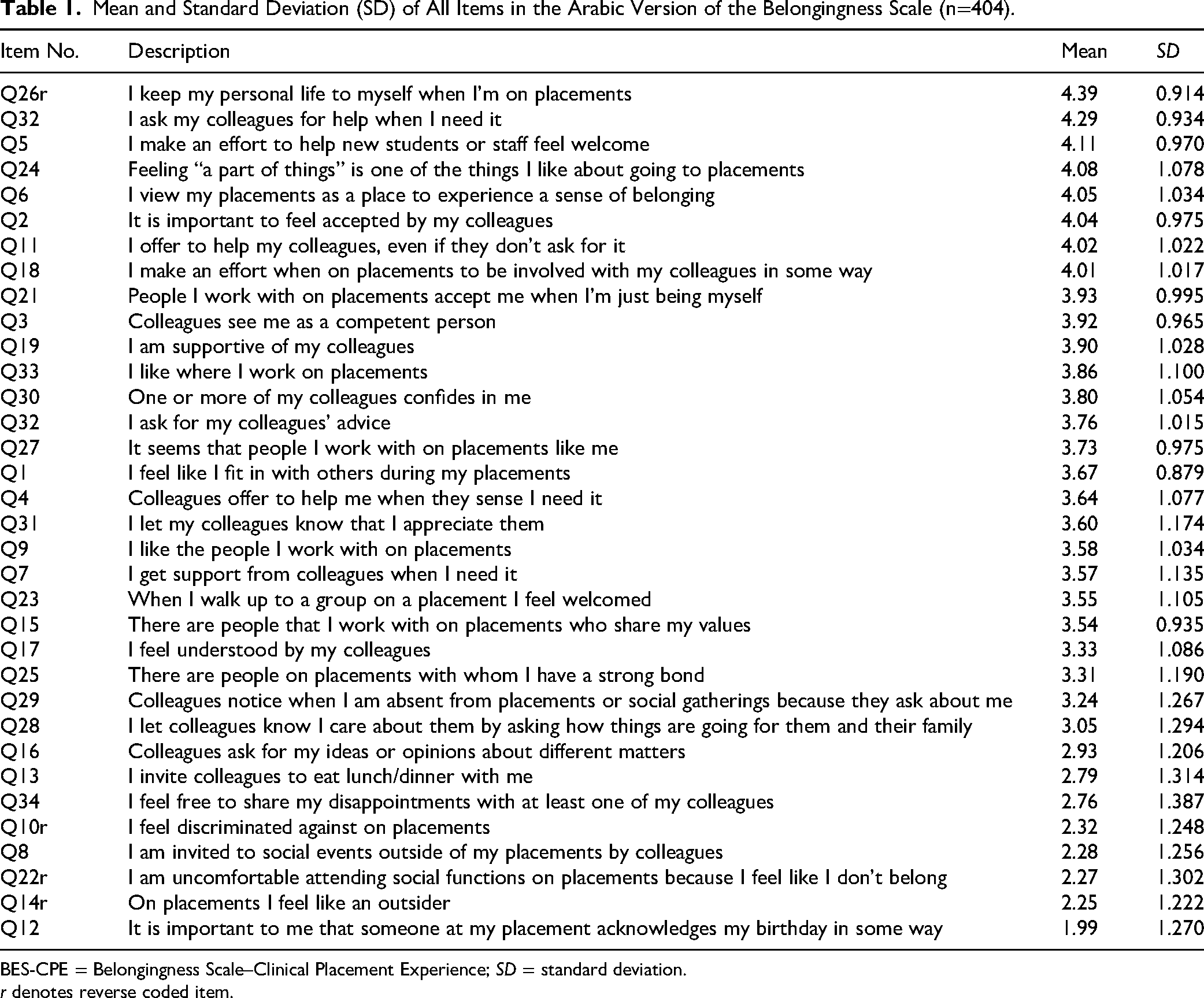
Mean and Standard Deviation (SD) of All Items in the Arabic Version of the Belongingness Scale (n=404).
BES-CPE = Belongingness Scale–Clinical Placement Experience; SD = standard deviation.
r denotes reverse coded item.
CFA Results
Comparison of fit Indices of Confirmatory Factor Analysis (CFA) Models as Proposed by Previous Studies (n = 404).
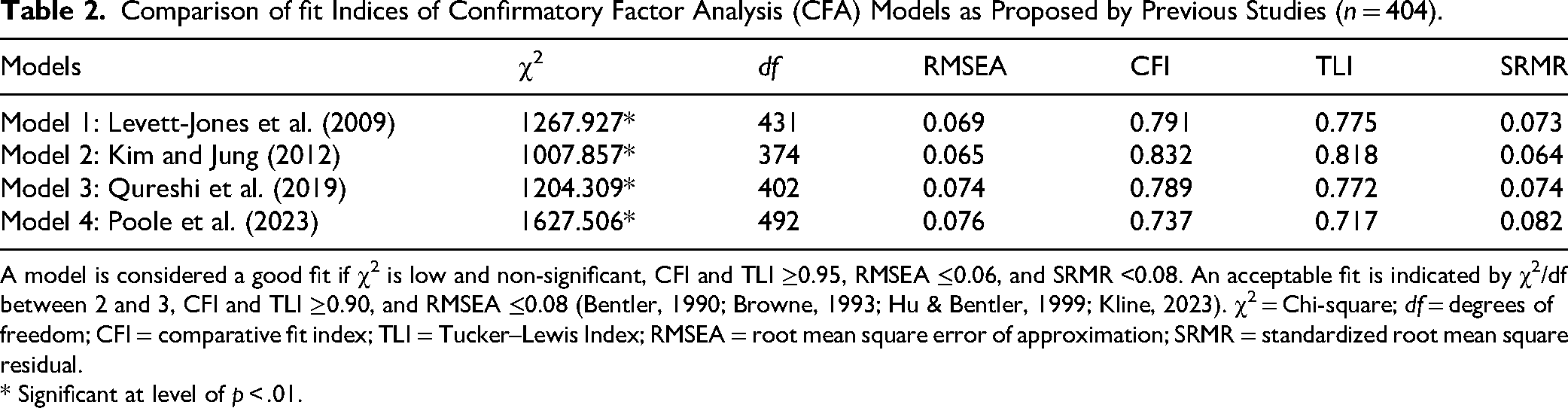
A model is considered a good fit if χ2 is low and non-significant, CFI and TLI ≥0.95, RMSEA ≤0.06, and SRMR <0.08. An acceptable fit is indicated by χ2/df between 2 and 3, CFI and TLI ≥0.90, and RMSEA ≤0.08 (Bentler, 1990; Browne, 1993; Hu & Bentler, 1999; Kline, 2023). χ2 = Chi-square; df = degrees of freedom; CFI = comparative fit index; TLI = Tucker–Lewis Index; RMSEA = root mean square error of approximation; SRMR = standardized root mean square residual.
* Significant at level of p < .01.
Several modification indices (i.e., error correlations) were suggested by Mplus software. However, these modifications were not implemented due to a lack of theoretical justification. According to Xiong et al. (2025), modifications should be considered only if they are theoretically justified. The original model, as proposed by Levett-Jones et al. (2009), is presented in Supplemental Figure 1 to show the nature of the model misfit. Although several factor loadings were moderate to strong, some items showed low loadings (< 0.4). Moreover, some error variances were large, and the correlations among latent factors were very high (>0.8), indicating overlap among constructs. In light of these findings, an EFA was conducted to explore the underlying structure of the Arabic version of BES-CPE in Jordan.
Exploratory Factor Analysis Results
An EFA employing PCA with varimax rotation was performed to evaluate the construct validity of the Arabic version of BES-CPE. The KMO measure and Bartlett's Test of Sphericity were used to assess the appropriateness of the data for analysis. The KMO value was 0.924, indicating that the data are adequate for EFA. Generally, a KMO value above 0.6 is acceptable, and a value above 0.8 indicates that the sampling is adequate (Shrestha, 2021). Bartlett's test of sphericity was significant (p < .005), indicating that the correlation between items and data is suitable for EFA. Three factors were extracted, with eigenvalues exceeding 1, accounting for 44.81% of the total variance. Items with loadings of 0.30 or greater were preserved. Factor 1 encompassed 15 items, Factor 2 consisted of 11 items, and Factor 3 comprised 6 items. Item number 21, “People I work with on placements accept me when I’m just being myself” and item number 31, “I let my colleagues know that I appreciate them,” showed cross-loadings across Factors 1 and 2, as shown in Table 3. The quantity of extracted factors corresponded with the original structure (Levett-Jones et al., 2009). These findings confirm the three-factor structure of the Arabic version of the BES-CPE. However, the item distribution varied; therefore, two emerging subscales were renamed to reflect their item content better. Factor 1 was renamed “interpersonal connection,” and Factor 3 was renamed “social inclusion,” whereas Factor 2 included all the items representing “efficacy” in the original BES-CPE and therefore was not renamed. Cross-loading items 21 and 31 were distributed for best fit under factor 1 and factor 2, respectively.
Factor Loadings for Items of the Arabic Version of the Belongingness Scale–Clinical Placement Experience (BES-CPE).

The scree plot below shows the eigenvalues obtained from the EFA. There is a dramatic decrease in eigenvalues from the first to the third factors, followed by a marked stabilization of the curve, which indicates the presence of the elbow at the third factor. Using the Kaiser's criterion of a model being suitable if factors have eigenvalues of 1 or higher, it appears that three interpretable factors need to be extracted, since the model accounts for only marginally more variance thereafter (Figure 1).
Scree plot of eigenvalues obtained from the exploratory factor analysis (EFA).
Reliability Analysis
The internal consistency reliability of the Arabic version of the BES-CPE was satisfactory, with a Cronbach's alpha of .92. The effect of each item on reliability was analyzed, and the results showed that none had a significant effect when deleted. The Cronbach's alpha for the interpersonal connection subscale (items 1, 3, 4, 6, 7, 8, 9, 16, 17, 21, 23, 25, 27, 28, 29, 30) was .90; for the efficacy subscale (items 2, 5, 11, 15, 18, 19, 20, 24, 26, 31, 32, 33) was .85; and for the social inclusion subscale (items 10, 12, 13, 14, 22, 34) was .76.
These findings confirm that the interpersonal connection subscale has a very high reliability coefficient, followed by a good reliability coefficient for the efficacy subscale, and the social inclusion subscale has an acceptable to good reliability value. Overall, the three scales have adequate internal reliability for measuring their respective intended constructs in the Arabic version of BES-CPE.
Discriminant Validity
The discriminant validity, as shown in Table 4 below, indicates that the square roots of the average variance extracted are larger than all the correlations among the factors, except for a slightly high correlation between interpersonal connection’ and social inclusion. However, all of these values are still larger than their corresponding off-diagonal elements, indicating satisfactory discriminant validity among the distinct factors.
Discriminant Validity Matrix.

Group Comparisons
Independent-samples t-tests revealed statistically significant differences between males and females across the overall BES-CPE scale and its subscales (p-values < .05), as shown in Table 5.
Comparison of Overall BES-CPE Scale and Subscales by Gender.

One-way ANOVA showed no significant differences in overall BES-CPE scores, social inclusion, or efficacy subscale scores among second-, third-, and fourth-year students (p-value > .05). However, for the interpersonal connection subscale, there was a significant difference among the three groups of students (p-value = .02). Post hoc analysis further indicated that the fourth-year students reported a statistically significantly higher mean score on the interpersonal connection subscale than second and third-year students, as shown in Table 6.
Comparison of the Overall BES-CPE Scale and Subscales by the Academic Level of the Students.

BES-CPE = Belongingness Scale–Clinical Placement Experience; SD = standard deviation.
*p-value < .05 is statistically significant.
Discussion
The Arabic version of the BES-CPE exhibited robust psychometric properties. The results affirm the construct validity and reliability of the Arabic version of the BES-CPE within the Jordanian context. The study initially conducted a CFA utilizing previous models from Levett-Jones et al. (2009), Kim and Jung (2012), Qureshi et al. (2019), and Poole et al. (2023) (Kim & Jung, 2012; Levett-Jones et al., 2009; Poole et al., 2023; Qureshi et al., 2019). Nevertheless, the model fit indices for all four CFA models were below acceptable levels on multiple indicators (CFI and TLI), despite good SRMR for the first three models and satisfactory SRMR for the fourth model, as well as RMSEA and χ2 tests. As a result, EFA was performed using optimal psychometric validation techniques to investigate the true factor structure of the Jordanian dataset. This method is warranted due to the lack of prior validation in Jordan and potential cultural and contextual disparities. The EFA is an appropriate method during the initial validation phases, particularly when evaluating a translated instrument within a novel population. This investigation demonstrated that the data satisfied the prerequisites for factor analysis (KMO = 0.924; significant Bartlett's test of sphericity), yielding a clear three-component solution from the EFA. Therefore, EFA was a suitable approach to investigate underlying structures without imposing a predetermined model on culturally distinct data.
The EFA identified a three-factor structure that aligned with the original structure proposed by Levett-Jones et al. (2009). Similarly, three-factor structures were identified in the psychometric validations performed by Ashktorab et al. (2015) in Iran, Kim and Jung (2012) in Korea, Poole et al. (2023) in United States and Qureshi et al. (2019) in United Kingdom (Ashktorab et al., 2015; Kim & Jung, 2012; Poole et al., 2023; Qureshi et al., 2019), Additionally, Poole et al. (2023) performed a validation study with DPT students in the US and eliminated one item following the CFA, while maintaining the original three factors (Poole et al., 2023). Similarly, Qureshi et al. (2019) eliminated four items in their adaptation for medical students (Qureshi et al., 2019). Kim and Jung (2012) employed the scale to investigate self-directed learning among advanced practice nursing students and removed no items (Kim & Jung, 2012). Ashktorab et al. (2015) performed a validation study among Iranian nursing students and eliminated two items (Ashktorab et al., 2015).
The EFA in the Jordanian context revealed some differences in item distribution. Factor 1 included items from the esteem and connectedness subscales. Emerging themes from these items are being supported, accepted, connected, and feeling a sense of belonging; therefore, this factor was relabeled as interpersonal connection to reflect the item content. Factor 2 included all the original items representing the efficacy subscale, along with some additional items such as feeling competent, capable, being involved in learning, and being confident in the placement environments. Factor 3 included items reflecting feelings of being part of the team, being able to confide in team members, socializing with them, and not experiencing discrimination in placements. Therefore, this subscale was relabeled as social inclusion to capture its emerging meaning better.
In the current study, items 21 (“People I work with on placements accept me when I’m just being myself”) and 31 (“I let my colleagues know that I appreciate them”) exhibited cross-loading. Similarly, cross-loading and poor correlation were also observed in the original study by Levett-Jones et al. (2009) for items 6, 12, and 22; no items were removed, and all 34 items were retained (Levett-Jones et al., 2009). This suggests that although the overall factor structure remains intact, item performance may differ marginally across environments, disciplines, and cultures. Furthermore, the initial research performed in Australia and the UK demonstrated high internal consistency for the overall scale (α = .92) (Levett-Jones et al., 2009). The current investigation demonstrated similar reliability, with a total scale Cronbach's alpha of .92, reaffirming the robustness of the BES-CPE in its Arabic translation. Similarly, Ashktorab et al. demonstrated high internal consistency in their Persian version (α = .92) (Ashktorab et al., 2015). Kim and Jung (2012), Poole et al. (2023), and Qureshi et al. (2019) also demonstrated high internal consistency (α = .91, α = .93, and α = .86), respectively (Kim & Jung, 2012; Poole et al., 2023; Qureshi et al., 2019).
Independent-samples t-tests indicated statistically significant differences in overall BES-CPE scores and subscale scores between male and female students, with male students reporting higher scores than female students. This contradicts the findings of Checa and Oberst (2022), Sedgwick (2013), and Tellhed et al. (2017), who indicated that gender does not substantially affect belongingness (Checa & Oberst, 2022; Sedgwick, 2013; Tellhed et al., 2017). The findings of this study may indicate contextual or cultural dynamics in Jordanian nursing education, in which traditional gender roles and expectations may shape students’ perceptions of inclusion and support.
One-way ANOVA and subsequent post hoc analyses indicated that fourth-year students had significantly higher scores on the interpersonal connection subscale than second- and third-year students. However, no significant differences were found in overall belongingness, social inclusion, and efficacy scores across academic levels. Previous research, such as that by Bonney et al. (2014) and Sedgwick (2013), has shown that students develop greater comfort and integration within clinical teams as they accumulate experience and attain seniority (Bonney et al., 2014; Sedgwick, 2013). The original study by Levett-Jones et al. (2009) also reported that sense of belongingness increased with experience among nursing students (Levett-Jones et al., 2009). The findings of this study are consistent with these studies: As senior students progress, their connectivity with peers and staff improves, leading to enhanced interpersonal connections.
Moreover, the configuration of the Arabic version of the BES-CPE among Jordanian nursing students shows variations in item distribution across the three factors compared with prior research (Ashktorab et al., 2015; Kim & Jung, 2012; Poole et al., 2023; Qureshi et al., 2019). Item number 21 “People I work with on placements accept me when I’m just being myself” and item number 31 “I let my colleagues know that I appreciate them” exhibited cross-loadings across factor 1 and 2. This overlap indicates that these items simultaneously encompass multiple aspects of belongingness. However, it would be reasonable to assume they primarily represent the concepts of interpersonal connection and efficacy. An individual's perception of acceptance by peers is a fundamental component of relational bonds and thus reflects interpersonal connection. Expressing appreciation can empower individuals by reinforcing their sense of efficacy. In contrast to the initial factor assignment by Levett-Jones et al. (2009), the item allocations in the Jordanian data demonstrate localized interpretations of respect, collaboration, and social cohesiveness. These subtleties underscore the influence of cultural and institutional norms on the prominence and significance of items.
In addition, items indicative of personal disclosure, emotional expressiveness, or informal social interaction may be perceived differently in Jordan compared to Western contexts. Item number 26 “I keep my personal life to myself when I’m on placements” attained the highest mean score, indicating students’ inclination to uphold professional boundaries in the clinical environment. This was closely followed by item 32 “I ask my colleagues for help when I need it,” indicating that seeking practical support is normalized and valued within the clinical setting. Correspondingly, reduced scores on aspects like feeling of exclusion or having birthdays recognized; item number 14 “On placements I feel like an outsider” and item number 12 “It is important to me that someone at my placement acknowledges my birthday in some way,” respectively indicate that social rituals prevalent in Western contexts may be of lesser significance in Jordanian clinical training settings. However, some students reported feelings of exclusion that were relatively less pronounced.
Furthermore, items indicative of structural support and mentorship, such as “I get support from colleagues when I need it” or “I feel understood by my colleagues,” exhibited strong loading and attained moderate to high mean scores, suggesting that although emotional belongingness may be less explicitly articulated, professional support and collaboration are esteemed elements of the clinical learning environment. The item-level variances partially align with the findings of Levett-Jones et al. (2009); the items with the highest and lowest scores varied across investigations. These disparities likely indicate cultural and contextual variations in the perception and expression of belongingness within clinical environments.
The results demonstrate that the Arabic version of the BES-CPE is dependable and effectively measures the fundamental components of belongingness among Jordanian nursing students. This stability is crucial for forthcoming research, curriculum development, and interventions designed to improve clinical placement experiences. However, variations in item distribution necessitated relabeling two subscales based on item content. Despite these modifications, the Arabic version maintains conceptual alignment with the original BES-CPE framework. The renamed interpersonal connection subscale includes items from the original esteem and connectedness subscales, while social inclusion captures elements of team integration and acceptance. The efficacy subscale retained its original label and item composition. Therefore, researchers can meaningfully compare overall belongingness scores with prior validation studies (Ashktorab et al., 2015; Kim & Jung, 2012; Poole et al., 2023; Qureshi et al., 2019) and interpret subscale findings in relation to the original framework, recognizing that the renamed subscales represent culturally adapted groupings of the same underlying theoretical constructs. This approach maintains the psychometric integrity of the instrument while enhancing its cultural relevance for Jordanian nursing students.
Strengths and Limitations
This study has limitations. Convergent validity was not assessed, as other related measures were not included. The sample consisted solely of nursing students from a single cultural and educational setting, potentially impacting the generalizability of the findings to other healthcare fields or geographical areas. Subsequent research should investigate the psychometric properties of the scale in larger, more heterogeneous samples, including additional health professionals. In the current study, EFA was conducted to explore the factor structure of the Arabic version of the BES-CPE among nursing students in Jordan. Given that this study is the first in Jordan to explore the BES-CPE factor structure, we recommend that future studies conduct a CFA in an independent sample in Jordan to confirm the factor structure identified in the current study. Future research with a longitudinal design can investigate temporal changes in belongingness and its correlation with outcomes such as academic success, burnout, and clinical competence. Qualitative follow-up research may yield enhanced understanding of item interpretation and contextual significance.
Implications for Practice
The successful validation of the Arabic version of the BES-CPE holds significant implications for nursing education in Jordan and other Arabic-speaking nations. Programs could conduct assessments of belongingness to monitor changes in students’ sense of belonging as they progress through their academic levels. Identifying students who feel disconnected could help implement supportive strategies in a timely manner. Detection of potential gender differences in belongingness could help design more targeted clinical training programs to ensure gender equity in education. This instrument enables educators and clinical supervisors to systematically assess students’ sense of belonging during clinical placements, facilitating prompt identification of individuals who may be at risk of social isolation or emotional detachment. Using this information, tailored interventions such as peer mentoring, improved orientation, or training for clinical preceptors in inclusive supervision can be implemented to enhance students’ integration and learning experiences. Furthermore, the scale can serve as an assessment instrument in curriculum development, helping institutions evaluate the effectiveness of measures designed to promote inclusive and supportive clinical learning environments. The findings further substantiate the need for faculty development programs that highlight the essential role of belongingness in student welfare, motivation, and retention.
Conclusion
This research constitutes the inaugural psychometric assessment of the Arabic version of the BES-CPE among Jordanian undergraduate nursing students. The findings indicated that the Arabic BES-CPE is a valid and reliable tool for evaluating students’ perceptions of belongingness during clinical placements. The use of the Arabic version of the BES-CPE will support continuous quality improvement and promote sustainability in education during clinical placement. The Arabic version of the BES-CPE demonstrated strong internal consistency, as evidenced by a Cronbach's alpha of .92, indicating high reliability. Item analysis indicated that no single item adversely affected overall reliability, hence reinforcing the scale's robustness.
The findings further validated the tool's three-factor structure; however, some discrepancies in item distribution were noted, prompting the renaming of two subscales to reflect their content better. These disparities are likely due to cultural norms and professional expectations within Jordanian clinical environments, particularly regarding emotional display and informal social interaction. Additionally, the research examined disparities in belongingness among groups. Statistically significant differences were found between male and female students, with male students reporting higher overall belongingness and subscale scores than females. This indicates that perceptions of support and inclusion in clinical placements may differ by gender, suggesting the need to address possible inequalities. Notable differences were observed across academic levels, with fourth-year students reporting a higher level of interpersonal connection than second- and third-year students. This finding highlights the developmental aspect of belongingness and the significance of clinical exposure and experience in cultivating confidence and professional identity among senior students. The Arabic version of the BES-CPE provides a culturally pertinent and psychometrically robust instrument for assessing belongingness in clinical education. It has significant potential to inform educational methods and improve student experiences in Arabic-speaking healthcare training settings.
Supplemental Material
sj-docx-2-son-10.1177_23779608261431019 - Supplemental material for Validity and Reliability of the Arabic Belongingness Scale–Clinical Placement Experience Among Nursing Students
Supplemental material, sj-docx-2-son-10.1177_23779608261431019 for Validity and Reliability of the Arabic Belongingness Scale–Clinical Placement Experience Among Nursing Students by Mona A Al Nsour, Mohammad H Bani Khaled, Nedal Alfasfos, Adlah Hamlan, Amal IA Askar and Hani Nawafleh in SAGE Open Nursing
Supplemental Material
sj-pdf-3-son-10.1177_23779608261431019 - Supplemental material for Validity and Reliability of the Arabic Belongingness Scale–Clinical Placement Experience Among Nursing Students
Supplemental material, sj-pdf-3-son-10.1177_23779608261431019 for Validity and Reliability of the Arabic Belongingness Scale–Clinical Placement Experience Among Nursing Students by Mona A Al Nsour, Mohammad H Bani Khaled, Nedal Alfasfos, Adlah Hamlan, Amal IA Askar and Hani Nawafleh in SAGE Open Nursing
Supplemental Material
sj-docx-4-son-10.1177_23779608261431019 - Supplemental material for Validity and Reliability of the Arabic Belongingness Scale–Clinical Placement Experience Among Nursing Students
Supplemental material, sj-docx-4-son-10.1177_23779608261431019 for Validity and Reliability of the Arabic Belongingness Scale–Clinical Placement Experience Among Nursing Students by Mona A Al Nsour, Mohammad H Bani Khaled, Nedal Alfasfos, Adlah Hamlan, Amal IA Askar and Hani Nawafleh in SAGE Open Nursing
Footnotes
Acknowledgements
The work was solely done by the authors.
ORCID iDs

Ethical Approval
Ethical approval was obtained from the Institutional Ethics Committee of Al Hussein Bin Talal University, under approval number KT/32/525, dated 22/7/2025.
Informed Consent
A description of the study objectives and rights of the participants was provided at the beginning of the survey, followed by an online consent statement that was mandated to be checked before the questionnaire was filled out. Participants were informed that their participation was voluntary and confidential and that data would only be used for research purposes.
Funding
The authors received no financial support for the research, authorship, and/or publication of this article.
Declaration of Conflicting Interests
The authors declared no potential conflicts of interest with respect to the research, authorship, and/or publication of this article.
Data Availability Statement
The data file can be freely accessed at Mendeley Data https://doi.org/10.17632/9zn3cv9th8.2.
Supplemental Material
Supplemental material for this article is available online.
References
Supplementary Material
Please find the following supplemental material available below.
For Open Access articles published under a Creative Commons License, all supplemental material carries the same license as the article it is associated with.
For non-Open Access articles published, all supplemental material carries a non-exclusive license, and permission requests for re-use of supplemental material or any part of supplemental material shall be sent directly to the copyright owner as specified in the copyright notice associated with the article.
