




Abstract
Introduction
Despite the increasing global presence of male nurses, enrollment of male students in nursing programs remains low due to cultural, financial, and professional barriers. In Jordan, particularly in the southern region, male nursing student representation does not reflect national demographics or the number of registered male nurses.
Objective
This study aimed to explore male nursing students’ motivations and perceived barriers to selecting nursing as a career and examine the influence of cultural norms on their decision and satisfaction.
Method
A mixed-methods study was conducted using a self-administered questionnaire and face-to-face semistructured interviews with male nursing students at South Jordan. Data were analyzed to identify common motivators, barriers, and cultural influences.
Results
The leading motivator for choosing nursing as a profession was the desire to help others. The least cited reason was uncertainty about career options. The most prominent barrier identified was concern regarding salary and economic stability, whereas the least influential factor was the belief that nursing is a profession more suited to females. Participants in the qualitative component reported choosing nursing because of social expectations, its humanitarian and caring nature, job security, and financial incentives. They also identified barriers such as limited role recognition and low social prestige; however, they placed greater value on the profession's intrinsic features than on external social pressures.
Conclusion
Economic factors and traditional gender roles continued to limit male participation in the nursing profession in South Jordan. To increase gender diversity in the profession, educational institutions and policymakers should consider financial incentives, scholarship programs, supportive academic and clinical environments, and targeted public awareness campaigns that highlight the vital role of male nurses.
Keywords
Introduction
Nursing remains one of the most gender-stereotyped professions globally, historically dominated by women and often perceived as a female-only career path. While the role of men in nursing is gradually expanding, male nurses still represent a minority in the healthcare workforce. This gender imbalance has implications not only for workforce diversity but also for the quality and inclusivity of patient care, particularly for male patients who may prefer or feel more comfortable with gender-congruent caregivers. According to the World Health Organization (2024), approximately 33% of the global nursing workforce comprised of males, reflecting a modest yet underrepresented presence. The proportion of male nurses varied widely across regions—ranging from 14% in the United States to as low as 1% in China, where male nurses were perceived as ancillary staff (Bartfay & Bartfay, 2017). In Europe, countries such as Austria and Italy reported slightly higher representation of male nurses (Russell et al., 2016; Stievano et al., 2017), while others, such as Turkey, reported that female nurses believed that male nurses could make a positive contribution to the profession (Dağcı et al., 2023). Such disparities suggest that cultural norms, societal attitudes, and health system structures may influence male participation in the profession.
In Jordan, nursing remains highly gendered, with cultural perceptions viewing it as unsuitable for men. This was similar to other cultures where male nursing students reported a lack of mentorship, few visible role models, and limited social support from faculty and peers (Sarhan Eldesokey Genedy et al., 2020; Seamark & Gabriel, 2018). These challenges were compounded by social stigma and strained interactions in clinical placements, particularly in female-dominated hospital units (Alzghoul et al., 2021; McDowell 2018).
However, alongside these barriers were important motivators that influenced male students’ choice to enter nursing. Altruism, job security and stability, and professional growth were frequently cited as positive drivers over the years (Chan et al., 2014; Gao et al., 2020). Gao et al. (2020) found that over 75% in China chose nursing for better job opportunities and stability. Understanding both the motivators and barriers was essential to developing targeted strategies that foster gender diversity and support the recruitment and retention of male nurses. Therefore, this study aimed to explore male nursing students’ perspectives on joining the nursing profession, focusing on the factors that encourage or discourage their entry into nursing and how cultural context shapes their educational and clinical experiences.
Review of Literature
Nursing has traditionally been considered a female-dominated profession (Gavine et al., 2020; Hand and Reid 2022; O’Lynn, 2012). According to the U.K. Nursing and Midwifery Council (2015), male nurses accounted for 11% of the nursing workforce in the United Kingdom, a figure that slightly decreased to 10.9% by 2022. Similarly, the Nursing and Midwifery Board of Ireland (2022) reported a modest increase in male registrants from 10% in 2012 to approximately 11% in 2022. In Australia, the proportion of male nurses remained below 11% in 2021 (Nursing and Midwifery Board of Australia, 2021).
Globally, gender stereotypes continued to dissuade men from entering nursing (Palazzo & Erickson, 2022). Despite efforts to promote gender diversity, male representation remained low—10.9% in Australia, 9% in Canada, 11.4% in the United Kingdom, 9.6% in Ghana (Agbeko et al., 2021) and 9.1% in the United States (Kaur et al., 2023). Kaur et al. (2023) found that men who entered the nursing profession often exhibited high levels of empathy and compassion. However, gender stereotypes persist, with women still the majority in the profession. For instance, Bartfay and Bartfay (2017) reported that more than 90% of female nursing students still associate the profession primarily with women, linking nursing to traditionally feminine qualities such as caring and nurturance. In the Jordanian context, cultural norms continue to discourage male participation in nursing by reinforcing the belief that characteristics such as strength and assertiveness are incompatible with caregiving roles (Shoqirat & Abu-Qamar, 2015). The literature indicated that male students may choose to enter nursing for financial, personal, or professional reasons (Noordien et al., 2020), or because they want to help people (Gavine et al., 2020; Harding et al., 2018; Kluczyńska, 2017; Twomey & Meadus, 2016). Researchers have also identified personal motivators for entering the nursing profession, such as encouragement from family members, friends, and other key people, some of whom also worked as nurses (DeVito, 2016; Harding et al., 2018; McKenna et al., 2016). Male nursing students also saw relatives who were nurses as role models, encouraging them to choose nursing (Harrison, 2021).
Some motivators for pursuing careers in nursing included professional considerations such as job advancement, diverse opportunities across nursing specialties, job security due to the critical global shortage of nurses, and a desire to advance health care (Lyu et al., 2022). Rajacich et al. (2014) also found that students were satisfied with nursing because they valued the extrinsic rewards (i.e., pay, vacation, and benefits); control and responsibility, and opportunities for professional development.
Despite several motivating factors encouraging men to enter nursing, persistent barriers limit male participation. Recent studies have consistently identified cultural and societal challenges that discouraged men from pursuing nursing careers (Alharbi et al., 2019; Carrillo-Garcia et al., 2013; Turan et al., 2021). These barriers were often rooted in gender stereotypes, traditional beliefs, and created bias associated with working in a female profession. Male nursing students were frequently facing discrimination in clinical settings and were also influenced by societal expectations and rigid gender roles (Al-Tawfiq et al., 2013).
One of the most notable barriers occurred in settings like gynecology and obstetrics, where female patients often express a preference for female nurses (Al-Tawfiq et al., 2013; Alzghoul et al., 2021; Twidwell et al., 2022). In these contexts, male students were likely to be refused by female patients or even discouraged by female staff (Admi et al., 2018; Chan et al., 2014; Gavine et al., 2020; Shoqirat & Abu-Qamar, 2015; Yaseen et al., 2021). As a result, male students frequently report feelings of isolation and neglect, especially during obstetric placements (Sayman, 2015). These challenges were not limited to reproductive health; male students also reported difficulties in pediatric or female-dominated medical units, where patient and caregiver preferences favored female nurses (Martínez-Morato et al., 2021). The general perception that nursing is inherently nurturing and therefore feminine continues to reinforce the false belief that men are less suitable for the profession.
Cultural norms further contributed to the stigma that male nursing students face in clinical environments. Research showed that male students often receive limited support from female instructors, leading to perceptions of inadequate training and reduced competency compared to their female peers (Abudari et al., 2016; Chan et al., 2014). Additionally, male students received less emotional and academic support from female clinical supervisors (Ashkenazi et al., 2017; Seamark & Gabriel, 2018; Twidwell et al., 2022). Some researchers argued that male mentors and faculty members—particularly in Arab countries—may lack the necessary experience to support and motivate male students. For example, a study conducted in Saudi Arabia found that faculty lacked the training and strategies to encourage male nursing students (Banakhar et al., 2021).
In Jordan, men accounted for approximately 30% of the nursing workforce, totaling around 31,500 nurses. A report from the local Nursing and Midwifery Council (2018) indicated that male nurses expressed satisfaction with their roles. However, it also emphasized the need for greater efforts to challenge gender-based stereotypes and promote inclusivity. Complementing these findings, Al-Zein and Al-Khawaldeh (2015) reported that over one-third of male nursing students in Jordan chose the profession out of personal interest. Many preferred roles in administrative or specialized units, such as intensive care, where gender sensitivities were perceived to be less pronounced.
Patient preferences played a crucial role in shaping male nurses’ professional experiences and satisfaction. In Jordan, studies have shown that male patients preferred receiving care from male nurses (AlSamhori et al., 2023). Addressing cultural perceptions and public awareness was essential to strengthening the role of male nurses and enhancing the quality of care. While some progress has been made, the number of male nursing students has remained insufficient, particularly in regions like Jordan, where gender-segregated care or patient preferences further discourage male participation (AlSamhori et al., 2023).
The literature highlighted the urgent need to address the global shortage of male nurses and implement strategies to attract men to the profession (Oliver & Care, 2019). Therefore, this study aimed to explore male nursing students’ motivations and perceived barriers to selecting nursing as a career and examine the influence of cultural norms on their decision and satisfaction.
Method
Design
This study employed a mixed-methods, sequential, explanatory design, integrating quantitative and qualitative methods across two distinct phases. In the first phase (quantitative), a structured questionnaire was administered to identify male nursing students’ general perspectives on motivators and barriers to entering the nursing profession.
The questionnaire was initially developed by Twomey and Meadus (2016) with a Cronbach's alpha of .73 and subsequently adapted and translated into Arabic using Brislin's (1970) model of translation and back-translation. It was also pilot tested with ten students to ensure clarity across cultures and languages. The questionnaire contained four sections (61 items total) addressing demographics, motivators (19 items), barriers (25 items)—(not at all–somewhat important–moderately important–very important), professional perceptions (seven items), and satisfaction (seven items), using a 4-point Likert scale and binary responses. Reliability testing of the adapted version yielded Cronbach's alphas of .92 (overall), .89 (motivators), and .91 (barriers). The survey was then distributed electronically via university email systems, with the option to complete it in Arabic or English. Follow-up reminder emails were sent 2 weeks later to increase the response rate (Booker et al., 2021).
In the second phase (qualitative), semistructured interviews were conducted with a purposive sample of survey respondents to gain in-depth insights into their experiences. This design was chosen to enhance understanding by using qualitative data to elaborate on quantitative results, providing a richer, more comprehensive picture of the research problem. Students were interviewed, with each lasting 20–30 min, and were asked about reasons for choosing nursing, perceived barriers, cultural perceptions, and satisfaction with the profession (Cui et al., 2021). The interviews were recorded, transcribed, and translated into English. The interview questions were developed based on a literature review, expert consultation, and pilot testing. Consent was obtained before interviews, and participants were informed of their rights and confidentiality.
The study was conducted across five nursing schools in South Jordan. These institutions were selected to ensure a diverse representation of student experiences and to account for variations influenced by institutional culture. Male students from all academic years were invited to participate.
Research Questions
This study was designed to answer the following questions: (a) What motivators and barriers influence male nursing students’ decision to pursue nursing? (b) To what extent do they value the profession and recommend it to others?, and (c) How do cultural norms impact their professional satisfaction and career decisions?. Addressing these questions can inform targeted strategies to increase male participation in nursing education and workforce development.
Sample
The study targeted male nursing students enrolled in undergraduate programs. For the quantitative phase, a minimum of 200–250 participants were targeted as the sample size for the study. This number was estimated based on a review of prior similar studies (Bhagavathula et al., 2020; O'Lynn, 2012). Participants were recruited and accessed through the Dean's office of nursing colleges approached. The researcher coordinated with the office members to distribute the invitation and the link to the online questionnaire. This approach was selected as easy and gave wide access to participants across the included colleges. For the qualitative phase, 10 participants were purposively selected from the survey respondents. Convenience and stratified sampling techniques were employed to ensure diversity in responses, year of study, and university affiliation.
Inclusion and Exclusion Criteria
Eligible participants were current male nursing students in any year of study and were willing to participate in the study voluntarily. Students in both public and private universities were included to ensure diverse representation. Students were excluded if they were not currently registered, had graduated or withdrawn from the program. These criteria were established to maintain the relevance and quality of data collected from the target participants.
Institutional Review Board
The Research Ethics Committee in Al-Hussein Bin Talal University approved the study and provided approval number (REC13/208/2022). All participants were informed that responding to the survey would be considered consent. Securing data storage and voluntary participation addressed ethical issues such as confidentiality, anonymity, and data protection, and all were presented in the questionnaire introduction. All participants’ identities were coded during the analysis and publication process.
Statistical Analysis
Quantitative data were analyzed using Statistical Package of Social Science (SPSS v.21). Descriptive statistics (percentages and frequencies) were used for categorical variables. Qualitative data were analyzed thematically using Miles and Huberman (2020) framework. This involved initial familiarization, coding, and identification of emerging themes. Themes were derived deductively (from interview guide topics) and inductively (from participant narratives). Data saturation was determined when no new themes emerged from subsequent interviews. Two experts in the field reviewed findings to ensure the validity and then triangulated quantitative findings for validation and elaboration.
Qualitative data analysis and reporting were adhered to Consolidated Criteria for Reporting Qualitative Research guidelines to ensure transparency and rigor in qualitative reporting, including sampling rationale, data collection procedures, researcher reflexivity, and verification of results (Walsh et al., 2020). The qualitative data provided in-depth responses to the following research questions: (a) To what extent did male nursing students in Jordan value nursing and would recommend it to their friends?, (b) How did cultural values (personal, social, and organizational) influence students’ selection and satisfaction with nursing?
The demographic profile of interviewees and representative quotes were integrated into the results to support thematic analysis and comprehensively address the study questions. To enhance the analysis's trustworthiness, multiple researchers were involved; independent coding was used, and Consensus discussions of responses were held to resolve any discrepancies.
Results
Sample Characteristics
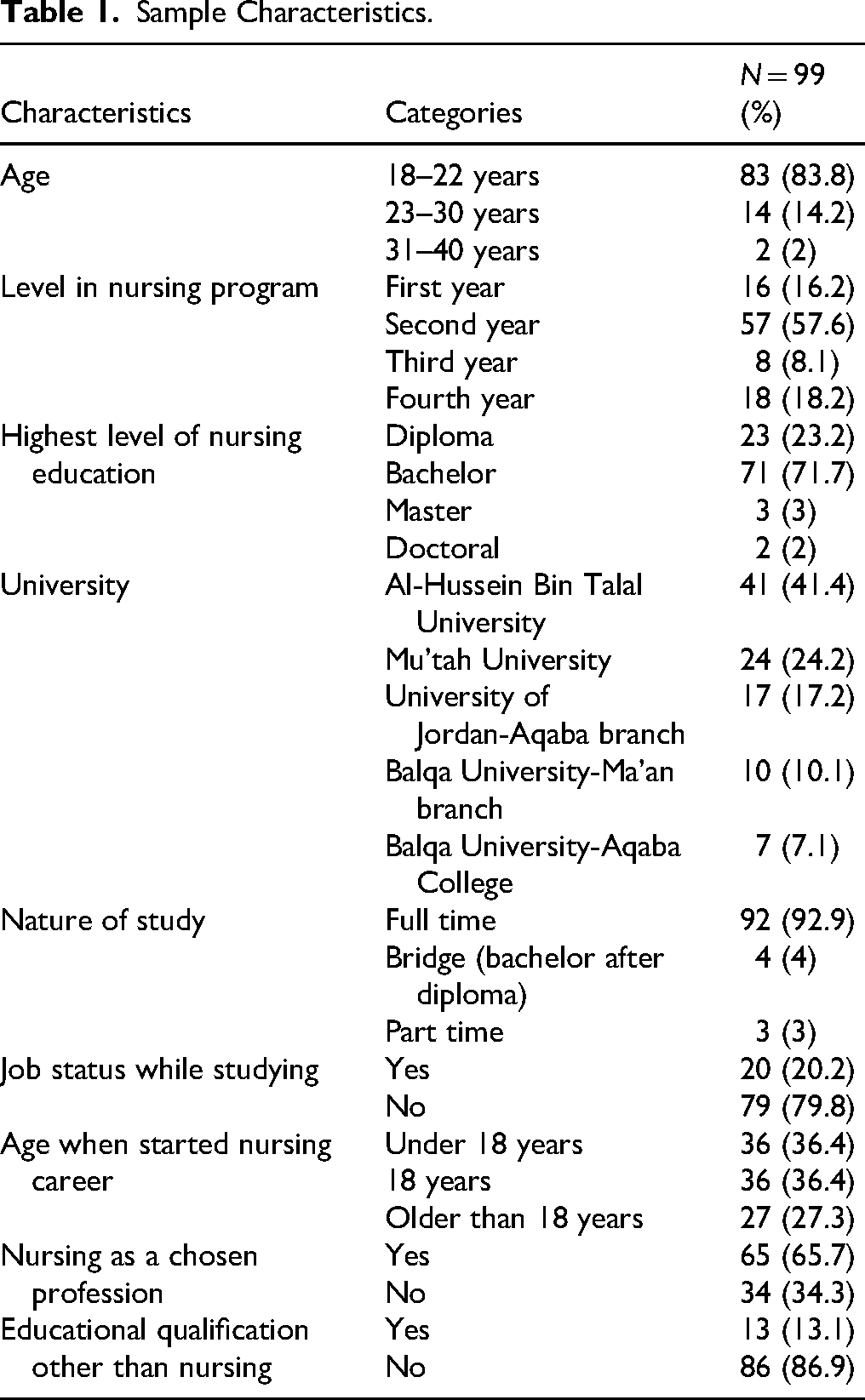
Two hundred thirty-one male nursing students enrolled in nursing programs at five universities were invited to participate. Ninety-nine (43%) responded to the questionnaire. Of those who responded, 41(41.4%) were from Al-Hussein Bin Talal University, 24 (24.2%) from Mu’tah University, 17 (17.2%) from the University of Jordan-Aqaba branch, 10 (10.1%) from Balqa University—Ma’an branch, and seven (7.1%) from Balqa University—Aqaba College. More than 71.7% were at the bachelor's degree level, with 57.6% in Year 2 and 92.9% studying full-time. Table 1 shows more details about sample characteristics.
Sample Characteristics.
Research Questions Results
Quantitative Results
Motivators for Choosing Nursing
The five top motivators cited were a desire to help people, job security and financial benefits, desire to work in a supportive environment and ability to make a meaningful contribution in society. The five least common motivators were family/friends, nurses, free education, unsure of career choice, the nearest university from residence and upgrading education.
Table 2 shows the motivators for choosing the nursing profession.
Motivators for Choosing Nursing.

Barriers to Choosing Nursing
Despite strong motivations, students also expressed concerns about the cultural and social barriers that discouraged males from pursuing nursing as a profession. Several students described feelings of burnout and doubts about remaining in nursing, often related to gender-based stigma or societal expectations. Although these perspectives were more subtle in this excerpt, earlier interviews referenced a lack of male role models, limited social support, and tension with societal norms that perceive nursing as a female profession.
Table 3 shows more details about these barriers.
Barriers to Choosing Nursing.

Although economic status and salary were motivators for male students to choose nursing, they were also identified as the main barriers. Those who considered salary a motivator would leave nursing if they could achieve a similar financial status in another profession.
Satisfaction With Nursing as a Profession
Regarding students’ satisfaction with nursing as a profession, more than 71% of the students in the study reported being satisfied with their career choice. They decided to become nurses (69%) after seeking information related to nursing (54.5%). Moreover, most students indicated that they would choose nursing again if given the opportunity to choose a profession (60.6%) and that they would recommend the profession to their male friends and encourage them to pursue it (56.6%). The least agreement among the students was on the item “My society encourages nursing as a profession” (41.4%), with the same rate was also not satisfied with the profession (41.4%). Table 4 shows their satisfaction with nursing as a career choice.
Satisfaction With Nursing as a Profession.

Qualitative Results
The qualitative phase of this study explored male nursing students’ experiences, motivations, and barriers in choosing nursing as a profession, as well as their satisfaction with that choice. Thematic analysis of the interview data revealed three main themes: (a) Motivators to Enter Nursing, (b) Barriers and Cultural Constraints, and (c) Satisfaction and Commitment to the Profession.
Theme 1. Motivators to Enter Nursing
Students consistently identified helping others as the primary reason for entering nursing. This altruistic motivation reflected a deep appreciation for the human aspect of nursing:
Oh ya, it is my opinion; I like the human side in the profession … to be more explicit, I like to help others and found nursing was the best choice to achieve this purpose. (AQT-MTH)
Another reason, which would be here, is the job security, so I will find a job once I graduate…. (IBN-AHU)
Salary was much better than other professions, so this is why I chose nursing … I know one who is 30 years old – not a nurse, not married, which is definitely due to his financial condition. (KMR-MTH)
Hospitals mostly offer accommodation for nurses, which may help save money … these accommodations are also closer to the job site, and it saves time from returning home. (RKD-AQB)
In nursing, I will have a high chance to continue my master's and PhD degrees…”
(RKD-AQB)
“I can develop professional skills through this field with academic development, especially since I have the ambition to go forward and pursue my postgraduate studies in nursing…. (AQT-MTH)
Theme 2. Barriers and Cultural Constraints
The most prominent barriers reported by participants were cultural norms, gender stereotypes, and misconceptions about the nursing profession. Students felt constrained by societal expectations that framed nursing as a female-only profession:
The cultural norms here pose challenges. In our family- and tribe-based society, where women are deeply respected and protected, it is considered inappropriate for a male to provide care for a female. (FNS-AHU)
The main barrier for me is that people know the nurse as a doctor's assistant and cannot do anything on their own, but sometimes when the nurse is confident, and doctors are dealing well, everything will be fine…. (RKD-AQB)
With all these barriers, I would not choose nursing as a profession if the time were back for me to choose…. (MHT-AHU)
Theme 3: Satisfaction and Commitment to the Profession
Despite the challenges, many students expressed satisfaction with their career choice and a willingness to recommend nursing to others. Their decision to pursue nursing was described as thoughtful and personally meaningful:
I would advise my friends to go for nursing, although it is not easy and needs more concentration than other programs, such as medical labs or imaging. (SQS-AHU)
I think yes, I would choose it even with cultural and social barriers … I was able to study another topic, but I preferred nursing. (NFL-MTH)
Discussion
This study explored the perspectives of male nursing students in South Jordan regarding their motivations and barriers to entering the nursing profession, and how cultural values influenced their satisfaction and choice.
Motivators for Choosing Nursing
The results indicated that male nursing students were satisfied with their decision to enter the nursing profession. The main motivators included helping people, job availability and security, financial benefits, the ability to contribute meaningfully to society, and opportunities for professional development. These motivators were consistent with global evidence where altruism and job security have consistently been reported as central motivators for male nursing students in contexts such as Canada, South Africa, and New Zealand (Harding et al., 2018; Noordien et al., 2020; Twomey & Meadus, 2016). Moreover, the appeal of financial benefits and the opportunity to pursue higher education while working were also cited in previous research as key reasons for male nursing students to perceive nursing as both a stable profession and the way to further academic development and growth (Powers et al., 2018; Rajacich et al., 2014).
Although nursing was rated by most participants (79.8%) as a female-dominated profession, they still rated it as the least influential barrier, possibly because they considered this a feature of the profession rather than a factor to discourage them from joining it. This was clear when these participants expressed their interest in career advancement and perceived nursing as a stepping-stone toward career progression, with their intentions to pursue postgraduate education, which, from their perspective, bridges the gap between theory and practice to enhance evidence-based practice. This finding was consistent with Al-Zein and Al-Khawaldeh (2015), who reported that over one-third of male students viewed nursing as a long-term profession that provided them with opportunities for professional development. Similarly, research from Ghana and China also supported these findings and reported that male nurses valued nursing not only for its economic and social contributions, but also for its ability to offer a role of specialization and leadership for nurses (Gao et al., 2020).
Barriers to Choosing Nursing
Despite these positive motivators, male nursing students continued to encounter barriers such as gender issues and stereotypes, societal misconceptions, and a lack of role models for male nursing students. Participants reported facing societal expectations and stereotypes that labeled nursing as inappropriate for men. Cultural norms, especially within tribal and conservative communities, reinforced the idea that caregiving roles are unsuitable for males. These findings were consistent with earlier studies that documented widespread stigma and gender bias in the nursing profession (Al-Tawfiq et al., 2013; Twidwell et al., 2022). These challenges were seen as factors that may influence nurses’ ability to fully commit to the profession, self-confidence, satisfaction, and their retention in the profession (Gao et al., 2020). Other significant barriers were economic concerns, such as inadequate salary and uncertain financial growth, which were repeatedly mentioned. Interestingly, while financial gain was cited as a motivator, the same students acknowledged that these benefits might not be sufficient to retain them in the long-term profession. This duality highlights the complexity of financial incentives in nursing career decisions. Furthermore, students also felt that male nurses were often viewed as physician assistants rather than professionals. These perceptions not only influenced their professional identity but also created additional emotional and social challenges during clinical training.
In conclusion, the findings of this study were consistent with the global evidence. They showed that male nursing students were motivated by a variety of factors, either intrinsic or extrinsic, with their ambition for academic and professional development shaping their higher professional trajectories. However, gender-related barriers demand focused educational, societal, or organizational interventions. Educational interventions may be offered in schools where programs may be implemented to connect male students with male nurses. Societal interventions can be implemented through public awareness campaigns aimed at changing nursing and promoting it as a gender-neutral profession. Finally, healthcare institutions can introduce organizational interventions to enhance gender diversity in recruitment and professional development. Addressing these challenges comprehensively will help improve the recruitment and retention of male nursing students.
Strengths and Limitations
This study addressed a critical gap in the literature by exploring the motivations and barriers specific to male nursing students in South Jordan. It offered culturally contextualized insights into how social norms and cultural expectations influence males’ decisions to pursue nursing as a career.
Using a mixed-methods design enhanced the rigor and depth of the study by combining quantitative and qualitative data. This approach allowed a more nuanced understanding of participants’ experiences and perceptions. Findings from this study had the potential to inform future policy development and targeted interventions to increase gender diversity in the nursing profession in South Jordan.
Despite these strengths, the study had some limitations. The sample size for the quantitative phase was limited to 99 participants, and qualitative data saturation was achieved after interviewing 10 participants. However, these figures reflect the small number of male nursing students in the southern region of Jordan. As such, the generalizability of the findings may be limited. Future research involving a larger and more diverse sample across multiple regions could strengthen external validity.
Implications for Practice
Based on the study's findings, several strategies were recommended to enhance nursing practice by recruiting and retaining male nursing students. These include, first, recruitment initiatives that implement multifaceted campaigns that challenge gender stereotypes and promote nursing as a viable and respected career choice for men. This effort should involve collaboration with educators, healthcare providers, community leaders, and media outlets. Second, religious leaders and faith-based institutions and centers can also play a pivotal role in reshaping society's perception of nursing as honored and compatible with cultural and spiritual values, helping to normalize men's participation in this field. Third, education at the early stages of school can also play an important role in introducing nursing models into the curriculum and textbooks, which may gradually shift the perceptions of young people and their families toward choosing nursing for their university education.
Inclusive Educational Environments: Develop institutional policies and practices that address gender-specific challenges and foster inclusive, supportive learning and clinical environments. This can also involve local health centers, nongovernmental services (NGOs) and community organizations through workshops, open days, and seminars highlighting contributions of nurses. Besides that, it also recommended establishing mentorship opportunities and peer support networks, such as male nursing student groups, conferences, and professional development workshops. And finally, conducting additional qualitative research with healthcare providers and nursing administrators to explore practical strategies that support male nursing students and help reshape perceptions of nursing as a profession.
Conclusion
Male nursing students in this study identified meaningful motivators for choosing nursing, while also highlighting substantial barriers, many of which were rooted in societal and cultural norms. Addressing these challenges requires targeted recruitment strategies, enhanced institutional support, and inclusive policies that promote gender diversity within the profession. Collaboration among educators, healthcare providers, policymakers, and community leaders is essential to advancing these efforts. Engaging respected community figures, including religious and social leaders, may further help reshape public perceptions and encourage men to view nursing as a viable and respected career path. Such initiatives can contribute to a more gender-balanced workforce, enhance cultural sensitivity, and improve the overall quality of patient care. Promoting men's participation in nursing strengthens the healthcare system and demonstrates a broader commitment to equity, diversity, and inclusiveness within the profession.
Footnotes
Acknowledgments
We would appreciate Al-Hussein Bin Talal University for approving and supporting this research study. We also extend our sincere thanks to all nursing students for their valuable time in participating and sharing their experiences voluntarily in the study. Our gratitude further goes to the teaching staff in this University for allowing students the time needed to complete questionnaires.

Ethics Approval and Consent to Participate
Al-Hussein Bin Talal University approved the study dated August 16th, 2022, with approval number (208/2022). In the invitation letter, all participants were informed that their participation in the study would constitute their consent. Securing data storage and voluntary participation addressed ethical issues, including confidentiality, anonymity, and data protection, all of which were outlined in the introduction section of the questionnaire.
Consent for Publication
Informed consent was obtained from individual participants who provided data for this publication. All authors in this publication also gave their consent for the publication of this article. Authors and participants were aware that all given data were coded and published, while all efforts were made by researchers to ensure anonymity, confidentiality and privacy were assured.
Funding
The authors disclosed receipt of the following financial support for the research, authorship, and/or publication of this article: The study was funded through paid sabbatical leave granted to the researcher for conducting this research study, which was considered a form of financial support (Al-Hussein Bin Talal University [Grant No. 2022/208]).
Competing Interests
All authors and coauthors declared there are no competing interests that relate to the content of this study and might influence any parts of the research. There are no financial, professional, or personal relationships that might have any possible impact on this research.
Availability of Data and Materials
Datasets generated during this study were stored in a locked cabinet accessible only to the corresponding author on reasonable request. This dataset will be disposed of in accordance with the institution's data retention and disposal guidelines.
Declaration of Using AI Technologies
Grammarly was used to edit the language in the writing process during the preparation phase. However, the content was reviewed and edited by researchers, and full responsibility was taken for the content of the publication.