




Abstract
Keywords
Implications for Knowledge Transfer
Professional experience placement, often a point at which attrition occurs for many nursing students, can be a time when students face intersectional challenges such as regionality, gender, age, first in family to attend university,
and low socio-economic status. The geographical consequences of regional professional experience placement often result in students experiencing a physical and cognitive disconnect with their university, impeding academic success and diminishing the benefit of the experience. The digital map application provided geographical and visual information about the placement sites, and single-click access to information about availability of living accommodations, scholarships, public transport, public libraries,
free Wi-Fi locations, mental health support, and First Nation support. Survey results were suggestive that the map application reduced learners’ perceived stress (personal, family, and/or financial) and supported students in staying connected to their theoretical learning while attending clinical placement.
Pre-licensure nursing programmes include requirements that students undertake work-integrated learning experiences, referred to as “clinical placement” or “professional experience placement” (McKinnon et al., 2019). Successful completion of professional experience placement is a key factor for students’ progress through their pre-licensure nursing programme and subsequent registration as a nurse (Levett-Jones et al., 2015).
Professional experience placement can be a time when students face intersectional challenges, such as regionality, gender, age, first in family to attend university, and low socio-economic status. Professional experience placement is often the point at which attrition occurs for many nursing students (Eick et al., 2012). In programmes where students are studying from a regional, rural, or remote location, there is additional complexity involved with the logistics of planning for and attending professional experience placement, including the additional costs involved and the need to travel away from home for long periods of time (Regional Education Expert Advisory Group, 2019).
The majority of pre-licensure nursing students in Australia are mature-aged (Grant-Smith & Gillett-Swan, 2017). Students are most often studying in the full-time mode, living in regional, rural, or remote areas, need to work to finance their studies, are from low socio-economic backgrounds, and are likely to hold family carer responsibilities (Grant-Smith & Gillett-Swan, 2017). Compared with metropolitan areas, average student incomes in regional localities are relatively low, with around 19% of students reporting that they go without meals at least once per week due to financial hardship (Grant-Smith & de Zwaan, 2019a).
Professional experience placements in regional areas often involve experiences where students are required to travel away from home and pay for additional accommodation, quickly becoming a situation of potential stress (Grant-Smith & de Zwaan, 2019a). In addition, students who attend professional experience placements away from home may not have access to the technologies and resources required to complete the ongoing academic work that is required alongside the professional experience placement, impacting negatively on academic achievement and success and generating significant additional stress (Sheridan et al., 2019). The geographical consequences of regional professional experience placement often result in students experiencing a physical and cognitive disconnect with their university, impeding academic success and diminishing the benefit of the professional experience placement (Sheridan et al., 2019).
Universities across the world acknowledge the complexities involved in professional experience placements (Grant-Smith & Gillett-Swan, 2017). With a shortage of 4.5 million nurses by 2030 (Boniol et al., 2022), improving student retention, including through supporting the professional experience placement experience, is essential. The authors hypothesised that a digital map application (app) would aid students’ transition between home life and professional experience placement.
As part of a Higher Education Participation and Partnership Program project focused on increasing student retention, the pre-licensure nursing programme at a regional university in Australia partnered with their spatial analysis unit to create an innovative digital map app. The app provided geographical information about the professional experience placement hospitals, clinics, and other sites. In addition, single-click access to information about the following were included: type of site, visual images of the site, information about the availability of onsite/on campus/subsidised or other available accommodations, internal and external scholarship information specific to the geography and site type, public transport options including direct links to bookings, public library locations, free Wi-Fi hotspots, bulk billing health organisations, online and face-to-face mental health support, and First Nation-specific support. Importantly, the map app included specific support for regional, rural, and remote placements through the University Department of Rural Health, a place where students could access a range of support, including academic support, internet, and a physical space to continue their learning while away from home.
Methods
Through an online survey, this research aimed to identify whether a customised digital map app reduced students’ self-perceived stress, promoted ongoing connection with theoretical learning, and facilitated more reliable access to internet technology. The map app was introduced course-wide, then students undertaking the second and third year of the course were invited to participate in the research. This was to ensure the responses could consider the level of support offered prior to the availability of the map application. The map application was available to all students enrolled in the course and accessible through their Learning Management System. Online surveys were used, as these are accessible to many participants while engaging a flexible and broad scope (Polit & Beck, 2017). This research aimed to answer these research questions:
Does the map app reduce learners’ perceived stress (personal, family, and/or financial) when planning for and whilst attending a clinical placement? Does the map app support nursing students in staying connected to their theoretical learning while attending clinical placement?
The survey questions were compiled by the researchers based on the research questions. The survey design aligns with the scope of the research questions, using both a Likert scale and open-ended questions. Both open-ended and closed questions allowed for participants to explore their experiences using the map app, and the quantitative methods used a descriptive cohort design to measure the impact of the app. The survey was disseminated at the end of the academic session, after students had attended their professional experience placement. The survey asked participants to compare their past professional experience placement experiences with their experience during the professional experience placement using the map app.
Second- and third-year Bachelor of Nursing students were recruited over two university sessions using homogeneous purposive sampling. The demographics of students who participated reflect the overall demographics of nursing students in Australia; 66% of participants were over the age of 30, and 71% lived in a regional, rural, or remote location (Grant-Smith & de Zwaan, 2019b). Students who used the map app to plan for and attend their professional experience placement were invited to complete an online survey. Participation was voluntary and ethics was approved by the university's Human Ethics Committee (Document H19324).
To reduce the risk of coercion, no member of the research team with responsibilities for teaching the cohort were involved in the recruitment of participants, and participants were informed that the survey was anonymous and not a compulsory requirement of their course. Participants who decided not to use the map app to plan for or attend their professional experience placement were excluded. A total of 47 participants elected to participate in the survey, a response rate of 48.9% of the total eligible student cohort; this sample size is considered statistically meaningful by Polit and Beck (2017). Quantitative analysis used the Exact Wilcoxon-Pratt Signed Rank Test (Pratt, 1959; Polit & Beck, 2017), and the Kruskal-Wallis Rank Sum Test (Kruskal & Wallis, 1952; Polit & Beck, 2017) to further analyse the data in accordance with specific demographics, including age. Statistical Package for the Social Sciences was used to support data analysis.
Ethical Considerations
The Charles Sturt University Human Research Ethics Committee provided ethical approval for this research (H19324). A Participant Information Sheet was provided as the landing page for the survey link. Participants were informed that their participation was completely voluntary, anonymous, and had no impact on their subject grades. Participants were also informed that because of the anonymised data, they would not be able to withdraw their responses once the survey was submitted. Participants were informed in the PIS that their consent to participate in the research was implied from their decision to click “start” on the survey.
Participants were assured that their data would be collected and stored in accordance with the Australian Code for the Responsible Conduct of Research, Australian Privacy Principles and the Privacy Act (National Health and Medical Research Council, 2020), and the university's Research Data Management policy. The anonymised data is stored in password protected files on a password protected computer. The computer maintains appropriate firewall protections including up to date malware protection. Data will be destroyed in 7 years in accordance with the university digital data storage requirements (National Health and Medical Research Council, 2020).
Results
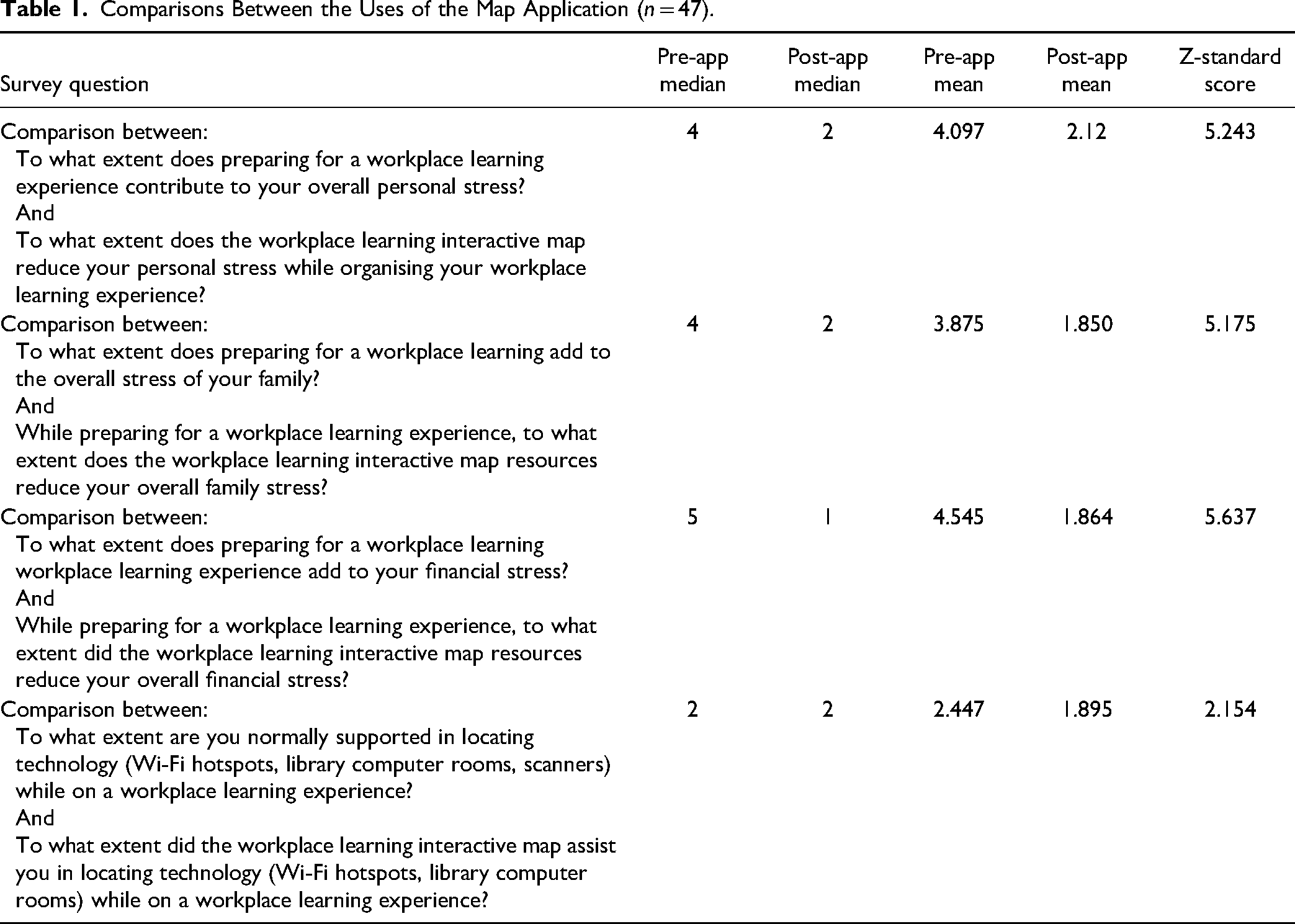
In line with the survey design, the results were calculated from scales using a Likert score with 1 = strongly disagree to 5 = strongly agree.
The survey completion rate was 100%. In Table 1, several questions tested for suggestive difference using the Exact Wilcoxon-Pratt Signed Rank Test (Pratt, 1959; Polit & Beck, 2017) showed a suggestive difference between pre- and post-intervention response rates. This indicates that the map app contributed to improving the student experience of self-reported personal, financial, and family stress, and to locating technology for theoretical learning while attending professional experience placement.
Comparisons Between the Uses of the Map Application (n = 47).
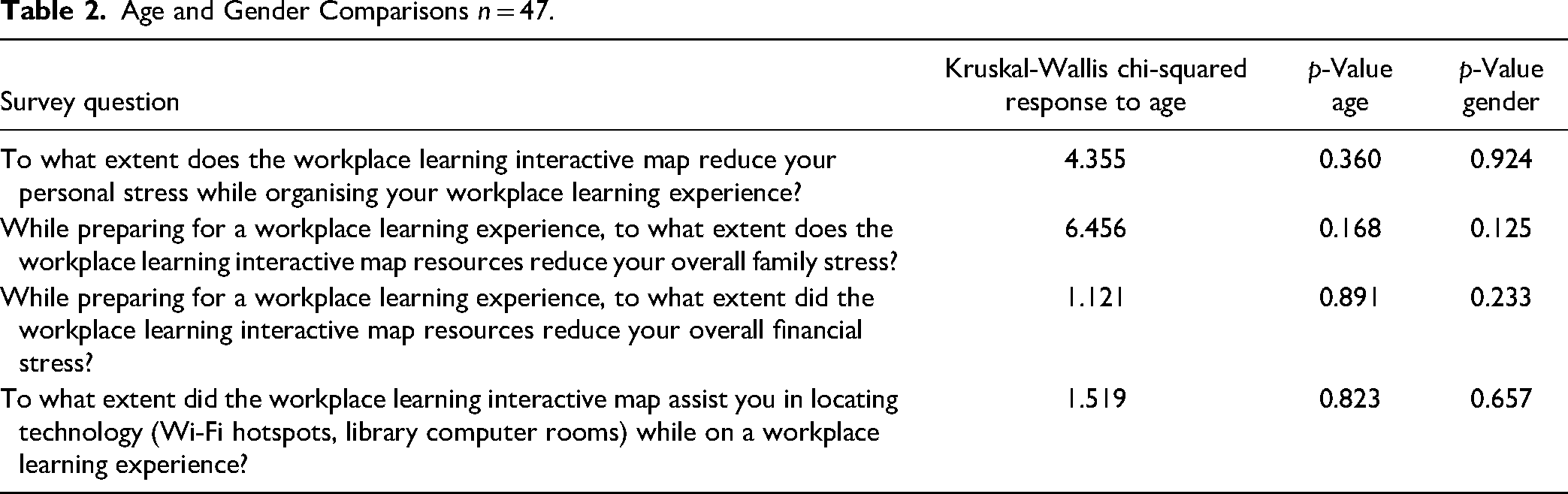
To further explore the impact of the map app, the survey results were also compared against age and gender (see Table 2) using the Kruskal-Wallis Rank Sum Test Kruskal & Wallis, 1952; Polit & Beck, 2017) to determine overall difference significance. This was because the researchers wanted to explore the impact of age on the experience of stress, given that most nursing students were mature-aged. Differences between age groups or gender groups were not statistically significant or suggestive, suggesting the map app's effectiveness was not dependent on or more responsive to a specific gender or age bracket.
Age and Gender Comparisons n = 47.
Discussion
The purpose of this article was to determine the impact of a digital map app on nursing students’ stress while preparing for and attending professional experience placement. The survey results indicated a suggestive shift in two main areas:
Reducing stress (personal, family, and financial) while attending a professional experience placement and Supporting participants’ ability to remain connected with their academic studies through information technology.
Reducing Stress While Attending a Professional Experience Placement
Professional experience placements can occur across large geographical distances and require costs associated with travel, accommodation, childcare, and time away from paid employment (ANMAC, 2019; Regional Education Expert Advisory Group, 2019). According to Grant-Smith and de Zwaan (2019b), health concerns and stress account for approximately 50% of the reasons that students, particularly in regional areas, are withdrawing from their nursing degree. In this research, there was a suggestive difference between pre- and post-intervention response rates, indicating that the map app contributed to improving the student experience of self-reported personal, financial, and family stress. Interestingly, there was not a statistically significant or suggestive difference between the experience of stress across age or gender groups. This suggests that the map app's effectiveness was not dependent on or more responsive to a specific gender or age bracket.
Reducing student stress levels results in a better student experience and leads to better performance during the professional experience placement, which facilitates learning (Ching et al., 2020; Lepiani-Díaz et al., 2023). Mazalová et al. (2022) found that supporting students’ fit with the clinical learning environment, encouraging reflection, and encouraging flexible use of personal and external resources were strategies associated with reduced student stress. This research provides an additional strategy for higher education providers to consider.
There is currently a strong focus in the literature on the stressors that originate within the professional experience placement environment, distinct from the student's life outside of study (Andrew et al., 2022). Family pressure and placement poverty are known to impact student stress, wellbeing, achievement, and attrition (Andrew et al., 2022) and this research shows that this stress can be reduced by supporting students with digital information about their professional experience placement location, along with information important to their health, wellbeing, and studies. These findings propose one strategy for universities in Australia and other developed nations with similar student demographics to implement in order to address student stressors both inside and outside of study. Wider recommendations to governing bodies when addressing financial stress include revising the way nursing students are financially supported during the professional experience placement (Andrew et al., 2022).
Remaining Connected With Academic Studies While on a Professional Experience Placement
Poor-quality internet connectivity, either because of location or financial constraints, has been identified as a prohibitive barrier to success for regional students (Stone & Davis, 2020). Attending professional experience placement, particularly in rural and remote areas, poses challenges including access to reliable and high-speed internet, and access to academic and administrative support within the course. These challenges are known to contribute to student attrition (Regional Education Expert Advisory Group, 2019).
Whilst attending professional experience placements, students require ongoing access to the technologies and resources required to complete the academic work that is required alongside the professional experience placement. Where this is not available or not sufficient, there is a negative impact on the academic achievements and success experienced by students (Sheridan et al., 2019). Information in the map app about University support in the local geographical area, such as Country Universities Centres, can assist in providing high-speed internet connections for students, as well as opportunities for students to interact with other students in the local area and with learning skills advisors (Australian Government Department of Education, 2023).
Limitations and Strengths
Survey designs are generally descriptive and host a number of limitations in their design (O’Connor, 2022). This study was limited to one regional university, and the results may not be transferable to other universities and disciplines across the world. In addition, the map app was designed to facilitate the needs of regional students, and therefore the impact and translation may not be a consideration for all pre-licensure nursing students. Although purposive sampling was the most logical way to access data, it means the sample was not representative: students who were the most motivated to use this type of digital application were represented in the sample. While the research findings have limited generalisability, other universities and disciplines could use the concept of this application to compile information specific to their professional experience placement locations.
Conclusion
Overall, this study contributed to the literature in valuable ways. Through this study we have evidenced a way in which universities can reduce students stress around professional experience placement, as well as support their ongoing academic connection and success while participating in professional experience placement. This research opens exciting opportunities for other universities and other disciplines that use work-integrated learning opportunities to explore the impact a digital map app can have on their students’ experience. An extension of this project will include longitudinal research to explore the longer-term impact on student retention.
Footnotes
Declaration of Conflicting Interests
The authors declared no potential conflicts of interest with respect to the research, authorship, and/or publication of this article.
Funding
The authors received no financial support for the research, authorship, and/or publication of this article.

Author Biographies