




Abstract
Background
Academic tripping, the phenomenon of students underperforming relative to their capabilities, presents a significant challenge in nursing education. Psychological factors such as self-control, fear of failure (atychiphobia), and learned helplessness are theorized to play a critical, yet underexplored, role in this process.
Aim
This study aimed to investigate the interrelationships between self-control, fear of failure, and learned helplessness among first-year nursing students who have experienced academic tripping.
Methods
A cross-sectional, exploratory design was employed with 370 first-year nursing students from two Egyptian universities, selected via convenience sampling. Participants completed validated Arabic versions of the Performance Failure Appraisal Inventory (PFAI), Learned Helplessness Scale (LHS), and Brief Self-Control Scale (BSCS). Pearson's correlation coefficient (r), ANOVA, and t-tests were used to analyze bivariate relationships and group differences. A path analysis was conducted to model the direct and indirect effects between the core variables.
Results
Participants reported moderate levels of learned helplessness (M = 44.12, SD = 5.32), self-control (M = 34.84, SD = 7.13), and fear of failure (M = 69.64, SD = 20.10). A significant negative correlation was found between self-control and learned helplessness (r = −0.235, p < .001). Path analysis revealed that self-control exerts a significant direct effect on reducing learned helplessness (β = −0.097, p = .005) and a stronger indirect effect by mitigating negative failure appraisal (β = −0.533, p < .001), which in turn predicts helplessness (β = 0.085, p < .001). Study hours and the presence of an academic tripping plan were also significantly associated with better psychological outcomes.
Conclusion
The findings demonstrate that self-control is a pivotal protective factor against learned helplessness, operating both directly and indirectly through its reduction of catastrophic failure appraisal. This suggests that interventions designed to enhance self-regulatory capacities and reframe cognitive appraisals of failure may be effective in breaking the cycle of academic tripping and fostering resilience among novice nursing students.
Keywords
Introduction
Academic pursuits can be challenging, and nursing education is no exception. Nursing students often face a multitude of stressors and obstacles that can impact their academic performance and overall well-being (Amin et al., 2025b; Atta et al., 2025; El-Sayed et al., 2025a). The academic tripping phenomenon, a complex and multifaceted issue, is considered a challenge by university decision-makers who are constantly seeking solutions. Students who fall short of their colleagues’ academic achievement or whose education level is lower than their IQ or academic performance are said to be engaging in academic tripping (Yagoub et al., 2023).
This study is particularly significant as it focuses on first-year nursing students, a population that is especially vulnerable to academic challenges due to the demanding nature of their programs. By exploring the interplay of self-control (SC), atychiphobia, and learned helplessness (LH), the findings aim to provide insights that can inform interventions aimed at improving academic resilience and mental health among these students. This research could contribute to the development of more effective educational strategies and support systems within nursing programs, ultimately enhancing student outcomes and well-being.
Numerous elements influence this phenomenon, including factors related to the student and their internal environment, aspects associated with the academic system and educational environment, and broader external influences (Amin et al., 2025a; El-Hamid EL-Sayed Salem et al., 2025). A more comprehensive analysis of these factors reveals that academic tripping can stem from a combination of psychological, social, and systemic issues, necessitating a multifaceted approach to support students effectively (Yagoub et al., 2023).
Review of Literature
One of the internal factors is SC, which refers to the ability to regulate one's thoughts, feelings, and actions, and is essential to academic success (Duckworth et al., 2019). Nursing students must exhibit SC to manage competing demands, such as coursework, clinical placements, and personal commitments. However, maintaining SC can be challenging, as nursing programs are known for their rigorous curriculum and high-stakes assessments (Rezakhani Moghaddam et al., 2020).
In the context of nursing education, nursing students’ effectiveness and performance are greatly influenced by their capacity for SC. Regulating one's impulses, emotions, and behaviors is crucial for nursing students, as they frequently encounter demanding academic coursework, rigorous clinical rotations, and high-stress situations in healthcare settings (El-Sayed et al., 2025b; Jiang et al., 2023). Therefore, understanding the factors that influence SC among nursing students is essential for promoting their academic success and preparing them for the challenges of the nursing profession.
Moreover, nursing students, due to the demanding nature of their profession, may experience heightened levels of atychiphobia, defined as an intense and persistent fear of failing in achievement-related situations (Jagriti, 2022; Morsy et al., 2025). This fear manifests as a strong desire to avoid failure due to the overwhelming shame and disgrace associated with it (Conroy & Metzler, 2003). Atychiphobia can be understood as a combination of cognitive and emotional responses, leading individuals to perceive failure not merely as a setback but as a reflection of their self-worth. This fear can be debilitating, causing significant anxiety and avoidance behaviors that impede academic performance. In essence, atychiphobia creates a cycle of apprehension where the fear of failure can hinder the very performance students strive to achieve, resulting in procrastination and disengagement (Elliot & Sheldon, 1997).
Previous research in the literature has shown that nursing students often encounter challenges due to their tendency to procrastinate on academic assignments (Hayat et al., 2020). While low fear of failure may inspire students to develop new abilities and academic performance techniques, high levels of fear can also hinder their capacity to perform well in their educational pursuits (Nsiah, 2017). Atychiphobia can manifest as an intense fear of making mistakes, receiving poor grades, or not meeting expectations. This fear can harm nursing students’ confidence, motivation, and willingness to take risks in their learning journey. The fear of failure can create a cycle of avoidance and procrastination, hindering students’ ability to engage with their studies and reach their academic potential fully (Alabduljabbar et al., 2022). Furthermore, atychiphobia can also lead to LH, a psychological state in which individuals perceive their actions as futile and believe they have no control over the outcomes of their efforts (Junuthula, 2022).
LH can undermine the ability to accept failure and erode confidence in one's future performance. When individuals experience LH, they often struggle to recognize their potential for success, which can reinforce a negative cycle of self-doubt and decreased motivation (Azizi et al., 2023). People who suffer from LH tend to underestimate their worth, experience worry, frustration, and sadness, react to stress inefficiently, have suicidal thoughts, and display negative emotions like intense rage and hatred toward others (Yoon, 2015). In nursing education, LH can lead to a passive approach to learning, reduced effort, and decreased resilience when faced with challenges. Nursing students who feel helpless may be more prone to academic disengagement and are at risk of developing mental health issues, such as anxiety and depression (Azizi et al., 2023).
Theoretical frameworks such as social cognitive theory (Bandura, 1986) highlight the role of SC in education and performance. In this context, academic tripping serves as the primary outcome variable influenced by both SC and atychiphobia. According to this theory, SC is influenced by personal factors (e.g., self-efficacy beliefs), environmental factors (e.g., social support), and behavioral factors (e.g., goal-setting and self-monitoring) (Figure 1). Moreover, theoretical perspectives on fear and anxiety, such as the cognitive-behavioral model (Beck, 1975), can provide insights into understanding atychiphobia. This model proposes that atychiphobia may be affected by negative cognitive biases, such as catastrophic thinking (e.g., anticipating severe consequences of failure) and excessive self-criticism. Addressing atychiphobia among nursing students may involve strategies such as cognitive restructuring, exposure therapy, and building a supportive learning environment (Qwark, 2022).

Theoretical Framework of the Study.
Understanding the complex interplay between SC, atychiphobia, and LH among novice nursing students is essential for educators, mentors, and support providers. By recognizing these psychological factors that can hamper academic success, interventions can be designed to promote self-regulation, resilience, and a positive learning environment. Therefore, the current study aimed to examine the relationship between SC, atychiphobia, and LH as they relate to academic tripping among novice nursing students.
Research Hypotheses
Methods
Research Design
A cross-sectional, exploratory design employed the Strengthening the Reporting of Observational Studies in Epidemiology (STROBE) checklist over a two-month period from February to April 2024.
Setting
This study was proudly conducted at the esteemed Mansoura and Alexandria University, a leading institution in the field and affiliated with the Ministry of Higher Education in Egypt. The faculty's credit for its undergraduate and graduate programs provided a solid structure for this study, a testament to its academic excellence.
Sample Size Calculation
Utilizing G*Power software (version 3.1.9.7; Faul et al. 2009), a sample size of 344 students was calculated using a linear multiple regression model. The parameters were based on previous studies by Alkhazaleh and Mahasneh (2016) and Sabry Abd El-Salam et al. (2022). To achieve a statistical power of 0.96 with a type I error rate of 0.05, an effect size of 0.25, and 14 predictors (including nine demographic variables and three independent variables), the required sample size followed Cohen's (2013) recommended guidelines. The sample size was increased to 370 to account for attrition bias and unresponsive.
Target Participants and Eligibility Criteria
The target populations for this research were the novice nursing students who enrolled in the setting as mentioned above and fulfilled the following eligibility criteria: They should be Egyptian national nursing students at least 18 years old, of both genders, enrolled in the second semester of the nursing program, have a Grade Point Average (GPA) of less than 2, and receive at least one academic warning letter. Additionally, they must be willing to participate and provide informed consent. Students were excluded if they had a GPA of 2.0 or higher, were not enrolled in the second semester, were non-Egyptian nationals, were younger than 18 years, or declined to provide informed consent.
Sampling and Recruitment
A meticulous non-probability, convenience sampling strategy was employed to select novice undergraduate nursing students with academic tripping experience during the second academic semester of 2023–2024. Permission was obtained from the college's academic counseling center to access a list of students with a GPA below 2 points and those who had received at least one academic warning letter. This list was then used to identify and recruit a sample of potential participants for the study, ensuring alignment with ethical considerations and data privacy regulations. The number of students was 381. These students were invited to participate in the study, but 11 refused. This resulted in a final sample size of 370 students for the research study, with 11 students dropping out and a response rate of 97%.
Study Measurements
Nursing Students’ Demographic and Academic Data Sheet
It involves collecting basic personal information, such as gender, age, contact details, residence region, family monthly income, daily study hours, sleep hours, eating habits, and recreational activities (including sports, reading, arts, electronics, and crafts).
Performance Failure Appraisal Inventory (PFAI-Short Version)
The Performance Failure Appraisal Inventory (PFAI) scale, comprising 25 items, was developed to assess beliefs associated with the negative consequences of failure (Conroy et al., 2002). The PFAI assesses individuals’ beliefs regarding five adverse outcomes of failing. Each of these five subdomains of failure fears is evaluated separately: (a) fear of experiencing shame and embarrassment (FSE), (b) fear of diminishing one's self-esteem (FDSE), (c) fear of facing an uncertain future (FUF), (d) fear of losing the interest of significant others (FIOLI), and (e) fear of disappointing important individuals (FUIO). Responses to the inventory are categorized using a five-point Likert-type scale ranging from −2 to 2, with −2 indicating complete disbelief, 0 signifying belief half the time, and 2 representing full belief. Higher scores suggest heightened levels of fear. The PFAI also demonstrated validity and reliability among medical students in Saudi Arabia, with Cronbach's α ranging from 0.81 to 0.89 for the five subscales (Alabduljabbar et al., 2022).
For the present study, the Arabic version of the PFAI was developed through forward–backward translation, reviewed by experts, and pilot tested with 40 nursing students to ensure clarity and cultural appropriateness. The content validity index (CVI) was high, with item-level CVIs ranging from 0.90 to 1.00 and a scale-level CVI (S-CVI/Ave) of 0.92. Confirmatory Factor Analysis (CFA) supported the original five-factor structure, yielding satisfactory model fit indices (CFI = 0.91, RMSEA = 0.072, SRMR = 0.061). Internal consistency was strong, with Cronbach's alpha coefficients of 0.88 for the total scale and ranging from 0.81 to 0.87 across the subscales. These findings indicate that the Arabic version of the PFAI is valid and reliable for use among nursing students in this context.
Learned Helplessness Scale (LHS)
LHS, developed by Quinless and Nelson (1988), is a self-report tool designed to assess individuals’ levels of hopelessness. It consists of 20 items that prompt participants to rate their level of agreement on a 4-point Likert scale, with a scoring range from 1 (strongly disagree) to 4 (strongly agree). A higher score indicates a higher level of perceived helplessness. Elkholy and Abdelsalam (2022) documented that the Cronbach's alpha coefficient for the translated Arabic Version of LHS was 0.90, indicating excellent reliability.
In this study, the Arabic version of the LHS was produced using standard translation–back translation procedures, reviewed by experts, and piloted with 40 students. The content validity was excellent, with item-level CVIs between 0.89 and 1.00 and an S-CVI/Ave of 0.96. CFA confirmed the unidimensional structure of the scale, with acceptable fit indices (CFI = 0.93, RMSEA = 0.068, SRMR = 0.055). Cronbach's alpha coefficient for the total scale was 0.87, indicating strong internal consistency. These results confirm that the Arabic LHS is both valid and reliable for assessing helplessness among novice nursing students.
Brief Self-Control Scale (BSCS)
The Self-Control Scale (SCS), originally developed by Tangney et al. (2004), consists of 13 items and serves as a condensed version of the 36-item SCS developed by the same authors. Each of the 13 items in the BSCS employs a 5-point rating scale, ranging from 1 (not at all like me) to 5 (very much like me). Nine out of the 13 items on the BSCS were reverse-scored to ensure that higher scores consistently indicate higher levels of SC. Tangney et al. (2004) reported coefficient alphas of 0.83 and 0.85 for the BSCS in their initial and subsequent samples, respectively, indicating comparable reliability to the full SCS (α = 0.89).
In the present study, the BSCS was translated into Arabic and evaluated using the same cross-cultural adaptation and pilot-testing process. The CVIs were satisfactory, with item-level CVIs ranging from 0.88 to 1.00 and an S-CVI/Ave of 0.94. CFA confirmed the single-factor structure, with good model fit (CFI = 0.92, RMSEA = 0.065, SRMR = 0.059). Cronbach's alpha for the Arabic BSCS was 0.86, demonstrating good reliability. These results support the validity and reliability of the Arabic BSCS for assessing SC among nursing students.
Study Procedures
Ethical Considerations
Before conducting the research, all necessary ethical approvals were obtained from the relevant institutional review boards, ensuring adherence to ethical guidelines and safeguarding the rights and welfare of the participants. Approval was obtained from the Research Ethics Committee (REC) of the Faculty of Nursing at Mansoura University (IRB0596). Additionally, official permission was obtained from the Dean of the Faculty of Nursing at Mansoura and Alexandria Universities. Ethical considerations included obtaining informed consent from each student after explaining the study's aims, ensuring voluntary participation, informing students that they could withdraw without penalty, and ensuring confidentiality and anonymity.
Data Collection
Data were collected through structured interviews conducted by trained researchers in both classroom and clinical settings. Each session lasted approximately 20 min, allowing sufficient time for participants to provide considered responses. Participants completed standardized questionnaires during these sessions. To ensure data accuracy, responses were cross-referenced with students’ academic records, providing an additional layer of verification.
Confidentiality was strictly maintained by anonymizing all questionnaires using unique identification codes. No personally identifiable information was recorded, and only the research team had access to the data, which was stored securely in password-protected digital files and locked physical storage. Participants were fully informed of their right to withdraw from the study at any stage without penalty. All procedures complied with ethical research standards, ensuring the integrity, reliability, and ethical soundness of the data collection process.
Data Analysis
Data were analyzed using IBM SPSS Statistics version 26.0 and AMOS version 26.0 (IBM Inc., Chicago, IL, USA). Descriptive statistics were computed to summarize the participants’ demographic, academic, and psychological characteristics. Categorical variables were described using frequencies and percentages, while continuous variables were presented as means and standard deviations (SDs). The primary study variables, self-control (SCS), fear of failure (PFAI), and learned helplessness (LHS), are summated scales derived from Likert-type items. Although not truly continuous, these variables were treated as approximately interval-level data for parametric analysis. This decision was justified by the large sample size (n = 370), which, according to the Central Limit Theorem, mitigates concerns regarding the normality of sampling distributions. Furthermore, the Shapiro-Wilk test confirmed that the distributions for all main variables did not significantly deviate from normality (p > .05). The construct validity of the translated scales (PFAI, LHS, BSCS) was rigorously assessed using CFA in AMOS to verify the hypothesized factor structures reported in the Methods section. Model fit was evaluated using the Comparative Fit Index (CFI), the Root Mean Square Error of Approximation (RMSEA), and the Standardized Root Mean Square Residual (SRMR). CFI values > 0.90, RMSEA values < 0.08, and SRMR values < 0.08 were considered indicative of acceptable model fit. Internal consistency reliability for all scales and subscales was assessed using Cronbach's alpha, with a coefficient of ≥ 0.70 deemed acceptable. To examine bivariate relationships between the main study variables, Pearson's correlation coefficient (r) was used. The strength and direction of the linear relationships between SCS, LHS, and the subscales and total score of the PFAI were determined. To examine group differences, independent-samples t-tests were conducted for binary demographic variables (e.g., gender, residence, diet type, tripping plan). One-way analysis of variance (ANOVA) was employed to detect statistically significant differences in the mean scores of SCS, LHS, and PFAI across groups defined by multi-category variables (study hours, sleep duration, recreational activities). For any ANOVA result that was statistically significant, post hoc tests with Bonferroni correction were applied to identify which specific groups differed. To test the hypothesized model of direct and indirect effects and move beyond bivariate correlations, a path analysis was conducted using structural equation modeling (SEM) in AMOS. This analysis assessed the mediating role of fear of failure (the mediator variable) in the relationship between SC (the independent variable) and LH (the dependent variable). The model's goodness-of-fit was evaluated using the χ² statistic, CFI, IFI (Incremental Fit Index), and RMSEA. The significance of direct, indirect, and total effects was determined using bootstrap analysis with 5000 samples to generate bias-corrected confidence intervals. A critical ratio (CR) value > |1.96| and a p-value < .05 were considered statistically significant. For all statistical tests, a two-tailed p-value of less than .05 was considered statistically significant.
Results
Table 1 reveals that the vast majority (95.9%) of participants were aged between 17 and 20 years, 54.3% were male, 69.5% came from rural areas, and 83.0% reported having a sufficient family monthly income to some extent. Regarding study habits, 37.0% of students studied for more than 5 h. The students’ sleeping patterns showed that 61.4% slept for 7 to 8 h. Sixty-five-point seven percent of the students reported having a balanced diet, whereas 34.3% consumed fast food. Regarding extracurricular activities, 35.7% of students participated in sports, 24.9% in reading, and 22.2% in arts (photographing and painting). Finally, 68.6% of the students had a trip plan, while 31.4% did not.
Distribution of Participants’ Demographic Characteristics.

Table 2 displays that the participants had average levels of LH and SC with a mean total score of 44.12 ± 5.32 and 34.84 ± 7.13, respectively. The PFAI-short version, which measures the strength of individuals’ beliefs in five aversive consequences of failing, showed varied results across its subscales. The participants’ moderate fear levels were evident in the scores: the FSE had a mean score of 18.16 ± 6.21, the FDSE had a mean score of 10.78 ± 3.85, the FUF showed a mean score of 11.73 ± 3.77, the FIOLI had a mean score of 15.01 ± 3.94, and the FUIO had a mean score of 13.98 ± 4.83. Overall, the PFAI-short version had a mean total score of 69.64 ± 20.10, indicating moderate FoF among the participants.
Mean and Standard Deviation of Learned Helplessness, Self-Control Scale, and Performance Failure.

LHS = Learned Helplessness Scale; SCS = Self-Control Scale; FSE = fear of experiencing shame and embarrassment; FDSE = fear of devaluing one's self-estimate; FUF = fear of having an uncertain future; FIOLI = fear of important others losing interest; FUIO = fear of upsetting important others; PFAI-short version = Performance Failure Appraisal Inventory.
*A high mean score means more experience of learned helplessness.
**A high mean score means more self-control.
*** A high mean score means more fear of failure.
Table 3 presents the categorical distribution of study variables, revealing critical psychological patterns among tripped nursing students. Over half of the students (53.5%) demonstrated moderate levels of LH. In comparison, 27.0% exhibited high levels, indicating that a substantial proportion of the cohort perceives academic efforts as futile or beyond their control. This level of disengagement suggests a psychological vulnerability that could hinder persistence and academic resilience. Regarding SC, 48.4% of students fell into the moderate category, whereas 29.2% displayed low SC. Only 22.4% showed high levels, suggesting that a majority of students may face difficulties in managing distractions, maintaining good study habits, or regulating their emotional responses to academic demands. This lack of strong self-regulation may be a contributing factor to their academic setbacks. In terms of fear of failure, 44.9% of the participants experienced moderate fear, while 29.7% reported high levels of fear. This pattern reflects a widespread presence of performance-related anxiety and avoidance tendencies, which could undermine learning, risk-taking, and self-efficacy.
Categorical Distribution of Study Variables by Level (Low, Moderate, High) Among Tripped Nursing Students (N = 370).
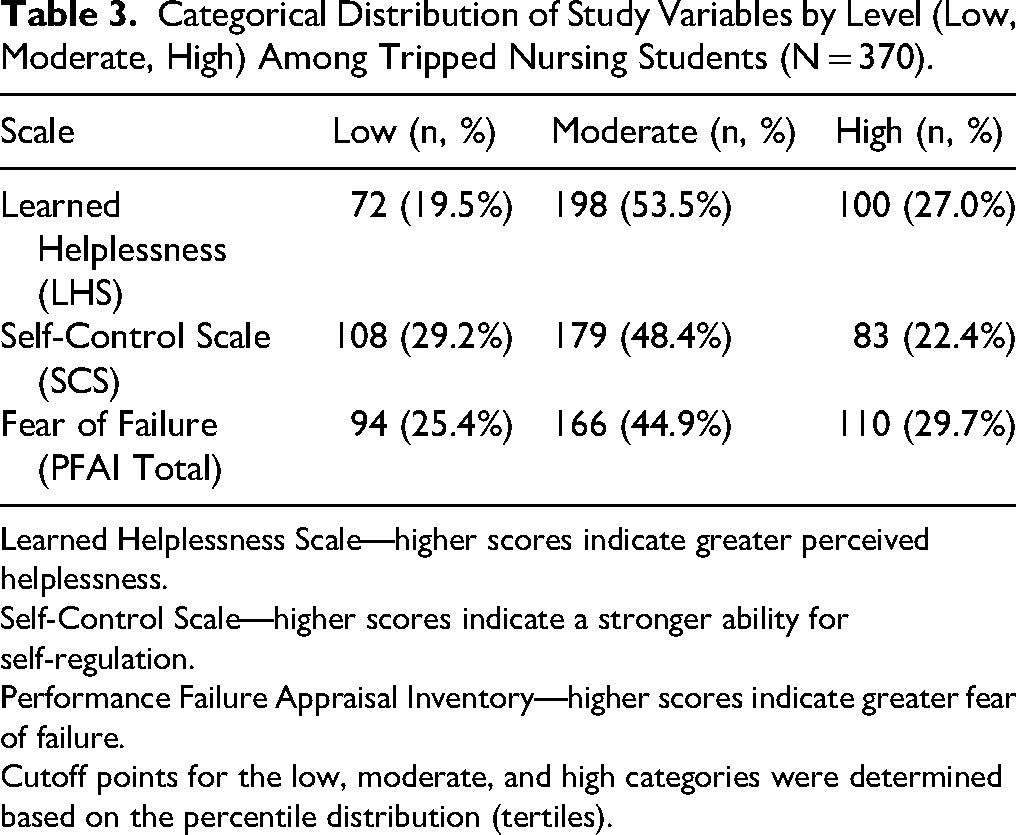
Learned Helplessness Scale—higher scores indicate greater perceived helplessness.
Self-Control Scale—higher scores indicate a stronger ability for self-regulation.
Performance Failure Appraisal Inventory—higher scores indicate greater fear of failure.
Cutoff points for the low, moderate, and high categories were determined based on the percentile distribution (tertiles).
Table 4 shows that LH exhibited a significant negative correlation with SC (r = −0.235, p < .001). Additionally, LH was negatively correlated with all domains of fear of failure, including FSE (r = −0.546, p < .001), FDSE (r = −0.584, p < .001), FUF (r = −0.496, p < .001), FIOLI (r = −0.450, p < .001), and FUIO (r = −0.610, p < .001). SC was also significantly negatively correlated with several domains of PFAI. Specifically, SC showed negative correlations with FSE (r = −0.150, p = .004), FDSE (r = −0.227, p < .001), FUF (r = −0.165, p = .001), and FUIO (r = −0.184, p < .001). Finally, the total PFAI was significantly negatively correlated with LH (r = −0.606, p < .001) and SC (r = −0.177, p = .001).
The Correlation Coefficient Between the Study Variables.

LHS = Learned Helplessness Scale; SCS = Self-Control Scale; FSE = fear of experiencing shame and embarrassment; FDSE = fear of devaluing one's self-estimate; FUF = fear of having an uncertain future; FIOLI = fear of important others losing interest; FUIO = fear of upsetting important others; PFAI-short version: Performance Failure Appraisal Inventory; r: Pearson coefficient.
* Statistically significant at p ≤ .05.
ANOVA and t-tests identified key demographic and behavioral factors associated with the study variables. Students studying <2 h/day showed significantly worse outcomes than all other groups (p < .001), including markedly higher fear of failure (103.25 ± 25.02 vs. 66.21 ± 17.75). Similarly, the small group sleeping <4 h/night reported extreme values, such as a fear of failure score of 117.0. A balanced diet was associated with significantly lower LH than a fast-food diet (41.54 ± 5.39 vs. 45.47 ± 4.77, p < .001). Crucially, having a tripping plan was linked to higher SC (35.80 ± 6.36 vs. 32.75 ± 8.22, p = .001) and lower fear of failure (67.59 ± 18.03 vs. 73.64 ± 24.85, p = .007). No significant associations were found for age, gender, residence, or income, as shown in Table 5.
Associations Between Socio-Demographic Characteristics, Academic Habits, and Study Variables (N = 370).

LH = Learned Helplessness Scale; SCS = Self-Control Scale; PFAI-short version: Performance Failure Appraisal Inventory; F = one-way ANOVA test; t = Student t-test.
* Statistically significant at p ≤ 0.05.
The results of the path analysis, presented in Figure 2 and Table 6, indicate that SC plays a significant protective role against LH. Individuals with higher SC are less likely to appraise failure negatively, as indicated by the strong negative effect of SC on failure appraisal (β = –0.533, p < .001). In turn, negative failure appraisal increases LH (β = 0.085, p < .001), suggesting that when people interpret failure harshly, they become more prone to feelings of helplessness. Importantly, SC also has a direct effect on LH (β = –0.097, p = .005), showing that even without the influence of failure appraisal, greater SC helps reduce helplessness. Moreover, the indirect pathway is significant (β = –0.045, p < .05), indicating that part of the influence of SC on LH operates through reducing negative failure appraisals. Overall, the findings suggest that individuals with strong SC are better at managing how they interpret setbacks, and this adaptive perspective protects them from falling into a state of helplessness. The model fit indices (CFI = 0.939, IFI = 0.951, RMSEA = 0.082) indicate that the proposed model provides a good fit to the data, supporting the reliability of these conclusions.

Path Analysis to Detect the Direct and Indirect Effects of Self-Control on Learned Helplessness Mediated by Failure Appraisal Inventory.
Direct and Indirect effects of Self-Control on Learned Helplessness Mediated By Failure Appraisal Inventory.

CFI = comparative fit index; IFI = incremental fit index; RMSEA = root mean square error of approximation.
Model fit parameters: CFI = 0.939; IFI = 0.951; RMSEA = 0.082.
Model χ² = 27.477* (p < .001*).
Discussion
Academic achievement in nursing programs presents a complex challenge influenced by various psychological and emotional factors (Ahmed & Mohammed, 2019; Eltrass et al., 2022). This study of first-year nursing students with academic setbacks found moderate levels of LH and fear of failure, with significant negative correlations between LH and SC, and between fear of failure and both LH and SC.
The findings of this study indicate that novice nursing students who experienced academic tripping exhibited moderate levels of LH (M = 44.12 ± 5.32), with 53.5% falling into the moderate category, alongside moderate levels of SC (M = 34.84 ± 7.13; 48.4%) and fear of failure (M = 69.64 ± 20.10; 44.9%). These moderate scores suggest that academically challenged nursing students occupy a psychological state characterized by vulnerability but also potential responsiveness to intervention. The average SC levels align with the results reported by Ozturk Eyimaya et al. (2022), who found that only 11.4% of nursing students demonstrated excellent SC, highlighting a general trend toward moderate self-regulatory capacity within this population. Similarly, the moderate LH observed corroborates findings by Shdaifat et al. (2018), who attributed this phenomenon to prevalent academic stressors such as heavy workload, assignment demands, and complex dynamics with faculty members.
In contrast to Alkhazaleh and Mahasneh (2016), who documented low fear of failure among Jordanian university students, this study sample exhibited moderate levels of fear of failure, consistent with those reported by Alabduljabbar et al. (2022). This distinction likely reflects the uniquely demanding nature of nursing education, where the rigor of academic requirements and challenges associated with clinical adaptation intensify students’ apprehension regarding failure. Frank and Sharma (2022) further emphasize that the fear of not meeting academic expectations significantly exacerbates stress among first-year nursing students. Additionally, the nursing curriculum's complexity, encompassing strict academic standards, intricate medical terminology, advanced physiology, and pharmacology, contributes to an overwhelming educational environment for novices (Bahadır-Yılmaz et al., 2015; Frank & Sharma, 2022). The transition from theory to clinical practice, demanding rapid adaptation to practical patient care, imposes an additional cognitive and emotional burden (Zaidi & Al Jadaan, 2022).
This study reveals a significant negative correlation between LH and SC (r = −0.235, p < .001), consistent with Bandura's (1986) social cognitive theory and other studies. Students experiencing high levels of LH tend to have reduced self-regulatory abilities; perceiving academic efforts as futile diminishes motivation for structured studying, time management, and goal-oriented tasks. This association is supported by Elkholy and Abdelsalam (2022) who found significant negative correlations between academic procrastination and SC in nursing students.
Furthermore, the negative correlations between LH and various aspects of fear of failure reveal a notable yet psychologically significant finding. Students with heightened LH paradoxically show lower fear of failure, indicating a detachment from academic outcomes. This emotional numbing reflects a maladaptive coping strategy in which students protect themselves from disappointment by reducing their emotional investment in achievement, having previously accepted failure as inevitable (Baratta et al., 2023; Kofta, 1993).
SC has shown significant negative relationships with various domains of fear of failure: fear of success in education (FSE: r = −0.150), fear of disappointing self-efficacy (FDSE: r = −0.227), fear of unfounded failure (FUF: r = −0.165), and fear of the unknown impacts of failure (FUIO: r = −0.184), all with p < .05. This suggests that improved self-regulatory capacities help mitigate concerns about failure. When individuals demonstrate greater SC, they tend to have more confidence in their ability to influence outcomes through effort, which lessens anticipated adverse effects. This aligns with the findings of Baratta et al. (2023) and Bandura's (1986) assertion that individuals with an internal locus of control perceive failure as less threatening, which in turn leads to better academic performance.
On the other hand, LH, characterized by motivational, cognitive, and emotional deficiencies resulting from exposure to uncontrollable events, causes individuals to perceive outcomes as beyond their control (Conlon & Rogalin, 2007; Winterflood & Climie, 2020). This perspective diminishes the motivation to exert SC (Kofta, 1993), leading individuals to avoid actions that typically provoke a fear of failure because they expect to fail regardless of their efforts.
This study revealed that significant variations in study hours reflect critical behavioral patterns. Nursing students who studied longer demonstrated greater SC, reduced LH, and lower fear of failure (p < .01). This suggests that study duration is both an indicator and a mechanism of psychological well-being among academically challenged students. Hua (2022) found that study habits can modify the relationship between academic achievement and SC, with enhanced SC positively influencing both study habits and academic performance through better time management and consistent study routines.
Interestingly, students with “tripping plans” exhibited increased LH alongside improved SC. This indicates a realistic assessment of academic weaknesses paired with organized coping strategies. Such a trend may highlight a heightened awareness of challenges while adopting systematic approaches. Students who acknowledge their academic difficulties may develop feelings of LH characterized by emotions of powerlessness and resignation in the face of obstacles (Török et al., 2018).
Path analysis findings indicate that SC has both a direct effect on LH and an indirect effect mediated by failure appraisal. This aligns with the study of Filippello et al. (2017). Neuroscience research suggests that the ability to detect and exert control over outcomes, an essential aspect of SC, can prevent the development of helplessness and foster resilience (Baratta et al., 2023). Additionally, the role of cognitive appraisal, specifically how one interprets failure, is supported by research showing that negative attributions and low self-efficacy can increase helplessness, while positive self-regulation can mitigate it (Filippello et al., 2017). This highlights the importance of interventions aimed at strengthening SC and adaptive appraisal to prevent helplessness and promote resilience.
Simultaneously, these students may exhibit enhanced SC, crucial for managing academic responsibilities and avoiding distractions. Research shows that SC is a significant predictor of academic self-handicapping, suggesting that students with stronger SC are more likely to choose effective intervention strategies (Melhem, 2022). By recognizing their vulnerabilities and implementing structured coping strategies, students demonstrate active engagement in their academic environment, which can lead to improved outcomes despite feelings of helplessness (Cahyono et al., 2024). This duality emphasizes the importance of fostering SC and resilience within educational contexts to support students facing academic challenges.
Strengths and Limitations
A key strength lies in its novel conceptual focus on academic tripping—a relatively unexplored psychological phenomenon in nursing education. By examining the interplay among SC, fear of failure (atychiphobia), and LH, this study contributes new theoretical insights into how these variables interact to influence academic underperformance among novice nursing students. This mediational finding provides empirical support for the protective role of SC and offers a valuable foundation for targeted interventions in nursing education. Additionally, identifying modifiable behavioral factors such as study hours and the presence of a structured “tripping plan” provides actionable leverage points for academic and psychological support programs.
Despite these strengths, certain limitations should be acknowledged. The study sample was confined to first-year nursing students from only two Egyptian universities, which may limit the generalizability of results to other educational levels, disciplines, or geographic regions. The cross-sectional design restricts the ability to infer causal relationships or observe longitudinal changes in psychological variables. Moreover, reliance on self-reported measures introduces potential biases, such as social desirability and recall inaccuracy.
Future studies should address these limitations by recruiting larger and more diverse samples across multiple institutions and academic years to enhance external validity. Employing longitudinal and mixed-method designs would allow researchers to track changes over time and explore causality. Integrating objective physiological indicators of stress (e.g., cortisol levels, heart rate variability) and academic performance metrics would enrich the evidence base and reduce self-report bias. Finally, incorporating additional psychological and behavioral constructs such as intrinsic motivation, coping skills, problem-solving ability, resilience, problematic internet use, and learned resourcefulness would help construct a more comprehensive model explaining academic tripping.
Nursing Implications
The study's findings indicate that novice nursing students experiencing academic tripping face moderate levels of LH, fear of failure, and SC, suggesting psychological vulnerability yet openness to supportive interventions. Recognizing these psychological states enables educators and clinical mentors to tailor support strategies that foster resilience, enhance self-regulatory skills, and improve coping mechanisms, ultimately promoting academic success. The negative correlations between LH and both SC and fear of failure highlight the importance of interventions that simultaneously reduce feelings of futility and restore emotional engagement with academic goals. Such interventions should focus on strengthening students’ self-efficacy and self-management by promoting goal-setting, effective time management, and structured study plans. Encouraging development and adherence to individualized academic “tripping plans” may help students better manage academic challenges while mitigating performance failure. Incorporating more clinical training hours, constructive feedback, and personalized academic advising are essential to create a supportive learning environment that addresses both the psychological and practical needs of students. Ultimately, these multifaceted approaches can reduce psychological barriers and enhance persistence and achievement in nursing education.
Conclusion
This study elucidates the complex psychological mechanisms underpinning academic tripping among novice nursing students. The findings confirm that SC serves as a critical buffer against the development of LH, not only through a direct pathway but also indirectly by reducing maladaptive cognitive appraisals of failure. Students with higher SC were less likely to perceive failure in catastrophic terms, which in turn protected them from feelings of helplessness and academic disengagement. The moderate levels of SC, fear of failure, and LH observed indicate students at a psychological crossroads, possessing both vulnerability and a significant capacity for intervention. The identified associations with modifiable behaviors, such as increased study hours and the adoption of structured tripping plans, further highlight actionable leverage points for support. Therefore, moving beyond mere identification of these issues, the imperative is for proactive, skill-based intervention. Nursing education programs should incorporate structured training to enhance students’ self-regulatory skills, including time management, goal setting, and impulse control. Concurrently, cognitive-behavioral techniques should be employed to help students reframe their perceptions of failure, viewing it as a manageable aspect of the learning process rather than a definitive judgment of their self-worth.
Footnotes
Acknowledgments
The authors would like to thank the respondents who participated in this work.

Ethical Approval
The Ethical Committee for Research (ECR) at the Faculty of Nursing at Mansoura University (IRB0000596) approved the data collection for this study. The study followed the guidelines of the Declaration of Helsinki (DoH2008) set by the World Medical Association's Code of Ethics. Strict measures were put in place to safeguard the confidentiality and privacy of the gathered data. Before participating in the study, all participants were required to give written consent by signing a consent form.
Author Contributions
ST and EE: conceptualization, preparation, blind randomization, methodology, investigation, writing—original draft, writing—review & editing. MK and AEl: writing—manuscript & editing, formal investigation and data analysis. MT and ET: conceptualization, preparation, and implementation of the therapy, methodology, investigation formal analysis, data analysis, writing—original draft, writing—manuscript & editing. EE and ME: conceptualization, preparation, and implementation of the program, methodology, formal investigation analysis, data analysis, writing—original draft, writing—manuscript & editing. All authors reviewed the manuscript and accepted it for publication.
Funding
The authors received no financial support for the research, authorship, and/or publication of this article.
Declaration of Conflicting Interests
The authors declared no potential conflicts of interest with respect to the research, authorship, and/or publication of this article.
Availability of Data and Materials
The datasets used or analyzed in this study are available from the corresponding author upon reasonable request.