




Abstract
Background
Nurse educators must seek innovative frameworks for their curricula to prepare nursing students to meet evolving healthcare needs. The South African National Department of Health introduced the new nursing curriculum (R171) in 2013 with the aim of producing generalist nurses who can meet the health care needs of the patients and to align the nursing program with the relevant Higher Education Qualification Framework. R171 was implemented in the North-West Province in 2021.Therefore, the main purpose of this study was to explore and describe the experiences of nurse educators regarding the three-year R171 nursing curriculum in North-West Province, South Africa.
Methodology
The researcher used a descriptive phenomenology research design to achieve the aim and objectives. A nonprobability sampling approach was adopted for the study with use of a purposive sampling technique to select participants with insight and experience on the phenomenon in question. Semi-structured individual interviews, through Microsoft Teams, collected the data, with analysis using thematic analysis.
Results
Three themes emerged from the findings of this study, namely inadequate resources to implement the R171 nursing curriculum, teaching and learning challenges in implementing the R171 nursing curriculum, and the possible solutions for effective implementation of the R171 nursing curriculum.
Conclusion
To implement the R171 nursing curriculum effectively, it is necessary to include nurse educators in the development of the curriculum. There is also a need for comprehensive support that comprises all available essential resources.
Introduction and Background
Nurses play a significant role in the healthcare systems globally and therefore nursing education and training cannot be underestimated (Chan et al., 2019). Nursing education is entering a period of unpredictability as the health care services are disrupted by global health crisis such as COVID-19. Therefore, many nurse educators will have to seek new and innovative frameworks for their curricula to prepare nurses to meet the evolving health care needs (Feller, 2018).
In the 21st century, nursing education in many countries has developed into a multilevel education system (Gao et al., 2017). For instance, nursing curriculum in Canada constantly adapts and evolves to adhere to professional standards, meet academic accreditation requirements, integrate new evidence, respond to social and demographic changes, and accommodate technological advances (Jager et al., 2020).
According to Epp et al. (2021), in the previous nursing curriculum in Canada, nursing students had to complete a practical in medical and surgical nursing from first year to second and were then perceived to be ready to engage in community, mental health, pediatric and perinatal nursing. However, this resulted in an extensive break from medical and surgical nursing and therefore resulted in negatively affecting their clinical confidence and competence (Epp et al., 2021). This resulted in nurse educators experiencing challenges related to faculty workload which negatively impacted in the teaching and mentoring of student nurses as nurse educators will not complete the module or content (Boamah et al., 2021).
According to the WHO (2013), it is a known fact that nurses and midwives form the backbone of health care delivery in Africa. Nursing and midwifery education in the African region is overwhelmed by many weaknesses, which include the weak linkage between the curricula and priority health problems, lack of clearly defined competencies, theory–practice gaps and, consequently, insufficiency to produce graduates who are competent enough to respond to the health needs of the population (Bvumbwe & Mtshali, 2018). According to Muraraneza and Mtshali (2021), nursing education in Rwanda is mainly at the undergraduate level and majority of the nursing graduate hold the advanced diplomas and bachelor's degree. However, Nsengimana (2020) found that nurse educators in Rwanda experienced challenges regarding the competent based curriculum. The challenges reported by nurse educators in Rwanda is that not all nurse educators were orientated on the new curriculum and nurse educators who did not get the training found the implementation of the competency based curriculum to be more time consuming and that led to nurse educators not covering the whole content which ends up affecting the clinical practice of the student (Nsengimana, 2020).
In South Africa, the transformation of nursing education in both the public and private Nursing Education Institutions especially the nursing colleges has been influenced by the laws from provincial health departments and the South African Nursing Council (National Department of Health, 2019). According to Armstrong et al. (2019), the current nursing education structure responsible for producing nursing human resources in South Africa consists of two types of nursing education institutions, namely private nursing education institutions and public nursing education institutions.
According to Mtshali and Zwane (2019), public nursing colleges were operating under the provincial Department of Health (DOH) and the nursing programs were accredited by the South African Nursing Council (SANC) and were not aligned according to the NQF level by the Council of Higher Education (CHE). However, The Strategic Plan for Nursing Education, Training and Practice (2019) reports that all programs and NEIs (both public and private) are required to be registered and accredited by the Department of Higher Education and Training (DHET), SANC and Council of Higher Education (CHE).
All nursing education programs fall within the higher education levels on the National Qualifications Framework (NQF) that is, level 5 and higher, and they fall under the jurisdiction of the Department of Higher Education and Training (Armstrong et al., 2019). The reason for NEIs to move to the Department of Higher Education (DHE) is because the transformation was associated with improved quality of patient healthcare and health service delivery in that graduates will be equipped with discipline-specific skills, as well as research and evidence-based practice skills and to align all higher education qualifications with the Higher Education Qualifications Sub Framework (HEQSF) (Mtshali & Zwane, 2019). According to (CHE, 2022), public nursing colleges were not part of higher education, the qualifications they offered had not been included in the HEQSF and some of the qualifications offered by the public nursing colleges were arbitrarily assigned NQF levels based on the institutional type awarding the qualification, resulting in inconsistencies in the levels. However, The Department of higher education and Training and Council of Higher Education had to register the nursing programs in the relevant NQF level. Therefore, the South African National Department of Health introduced the new nursing curriculum (R171) in 2013 and was pegged at NQF level 6 by DHET in 2022.
The R171 is regulation by the South African Nursing Council relating to the registration in the category general nurse. It is a three-year nursing diploma offered in both the public Nursing Education Institutions and private Nursing Education Institutions leading to registration by the South African Nursing Council as a general nurse.
Nurse educators play a key role in facilitating the change of the nursing curriculum by revising the curriculum and mapping the content of the curriculum and maintaining a relevant program that prepares nursing graduates for success in today's workforce. Nurse educators can contribute by collaboratively and effectively working with curriculum development teams and specialists to arrange and compose textbooks, and content (Alsubaie, 2016).
However, for successful implementation, the nursing curriculum requires re-engineering of the educational system by training and re-training educators and introducing new forms of assessment (Muraraneza & Mtshali, 2021). To the best of our knowledge, there are no studies done yet on the experiences of nurse educators regarding the R171 nursing curriculum in public NEI's in the North-West Province (NWP). Therefore, this study seeks to explore and describe the experiences of nurse educators regarding the implementation of the R171 nursing curriculum at public NEI in the North-West province, South Africa.
Aim
The aim of the study is to explore and describe the experiences of nurse educators regarding the implementation of the R171 nursing curriculum in the public NEI of the NWP, South Africa.
Materials and Methods
According to Polit and Beck (2018, p. 414), qualitative research methods refer to the investigation of a phenomena, whereby the researcher seeks to understand and explore the problem or phenomena of individuals and provides descriptions of that occurrence.
Study Design
Descriptive phenomenology research design was used to explore and describe the experiences of nurse educators regarding the R171 nursing curriculum in NWP. According to Polit and Beck (2018), descriptive phenomenology research design involves the description of lived events or experiences of participants.
Study Setting
This study was conducted at the NEI in NWP, South Africa. This NEI implemented the R171 nursing curriculum in its two campuses in 2021.
Population and Sampling
The target population were all nurse educators facilitating the R171 nursing curriculum at a selected NEI in NWP
The selection of nurse educators was because their registration with SANC, and as such, were directly involved in teaching and learning of R171 in NWP, South Africa. These nurse educators had a minimum of six months’ experience of teaching R171 undergraduate nursing students, and exposure to facilitating the R171 nursing curriculum in NWP, South Africa. Excluded from the study were nonacademic staff members because they are not directly involved in teaching and learning of nursing students in NWP, and nurse educators teaching the legacy program.
Data Collection
Data was collected by an independent person from April 6, 2022 till June 3, 2022. A semi-structured individual interviews was used to ascertain the experiences of nurse educators regarding the R171 nursing curriculum in the NWP. A Video conferencing platform named Teams office was used as an instrumental tool to collect data.
The researcher ensured privacy by creating a private meeting link and password meaning that not everyone had access to the study but only those with a private meeting link and password could access the study. The duration of the interview was between 30 and 60 minutes. Communication techniques such as probing, reflection, clarification and attentive listening were used during data collection. The following questions were asked to obtain responses from the nurse educators:
What do you know about the R171 nursing curriculum?
What are your experiences regarding the R171 nursing curriculum?
What are your suggestions for improving the implementation of the R171 nursing curriculum in NWP, South Africa?
Data Analysis
Thematic data analysis was used to analyze data. The researcher and a co-coder analyzed data separately. The co-coder was given confidentiality form to sign before starting with co-coding to ensure that the privacy of the participants is maintained. The researcher and an independent co-coder analyzed data separately and met for consensus on themes and subthemes.
Trustworthiness
Credibility, dependability, confirmability and transferability were used to ensure Trustworthiness in the study (Brink et al., 2018). The researcher ensured credibility by making sure that the data from the participants is true by checking and clarifying with the participants for the accuracy of the data (Brink et al., 2018). The researcher made use of the member checking with the supervisors to affirm the research findings and to confirm the accuracy of the data. Dependability was achieved by making sure that the research findings become organized in a way that the results are truthful and made use of an independent coder to affirm truthfulness of the obtained data. Dependability was also achieved by including the supervisors during data collection and analysis for peer review.
Confirmability was achieved by making sure that researcher is not biased by opening an opportunity for the rest of the participants who met eligibility criteria to be included in the study and that every experience of the participants are recorded and transcribed just as explained by the participants (Polit & Beck, 2018). Transferability was achieved by ensuring that the research method and data analysis with its interpretation are clearly stipulated so that it proves that the study is not figments of the researcher imagination but have been derived from the data obtained, thus can be transferred for a similar study in the future (Polit & Beck, 2018).
Ethical Considerations
This study was approved by the relevant Nursing Education Institution. Before commencing the interviews, the researcher appointed an independent person, experienced in qualitative research, to obtain informed consent from the participants. The principles for respect for participants, beneficence, privacy, and justice were maintained in this study. The researcher maintained the principle for respect by treating each participant as autonomous and participant's right to withdraw from the study was explained by the researcher that if the participant wished to withdraw, the researcher will respect the decisions of the participant and it will not implicate their function as educators in the NEIs.
The researcher maintained the principle of beneficence by ensuring that the participant's well-being was protected by avoiding asking the participants questions that will psychologically affect the participants. The researcher maintained the principle of privacy by not using the real names of the participants instead the participants were called according to alphabets.
The interview recordings are saved on a password protected computer to ensure privacy and, in the transcribing, and analysis the researcher addressed the participants with the code names of the alphabets to maintain privacy and confidentiality of the participants. The participants in the study were selected and treated fairly by the researcher, even during the procession of the interviews and no psychological implications were noted for attention and address.
Results
The results of this study are presented according to the demographic information of study participants as well as the themes and subthemes that emerged from the data analysis (Table 1).
Themes and Subthemes.
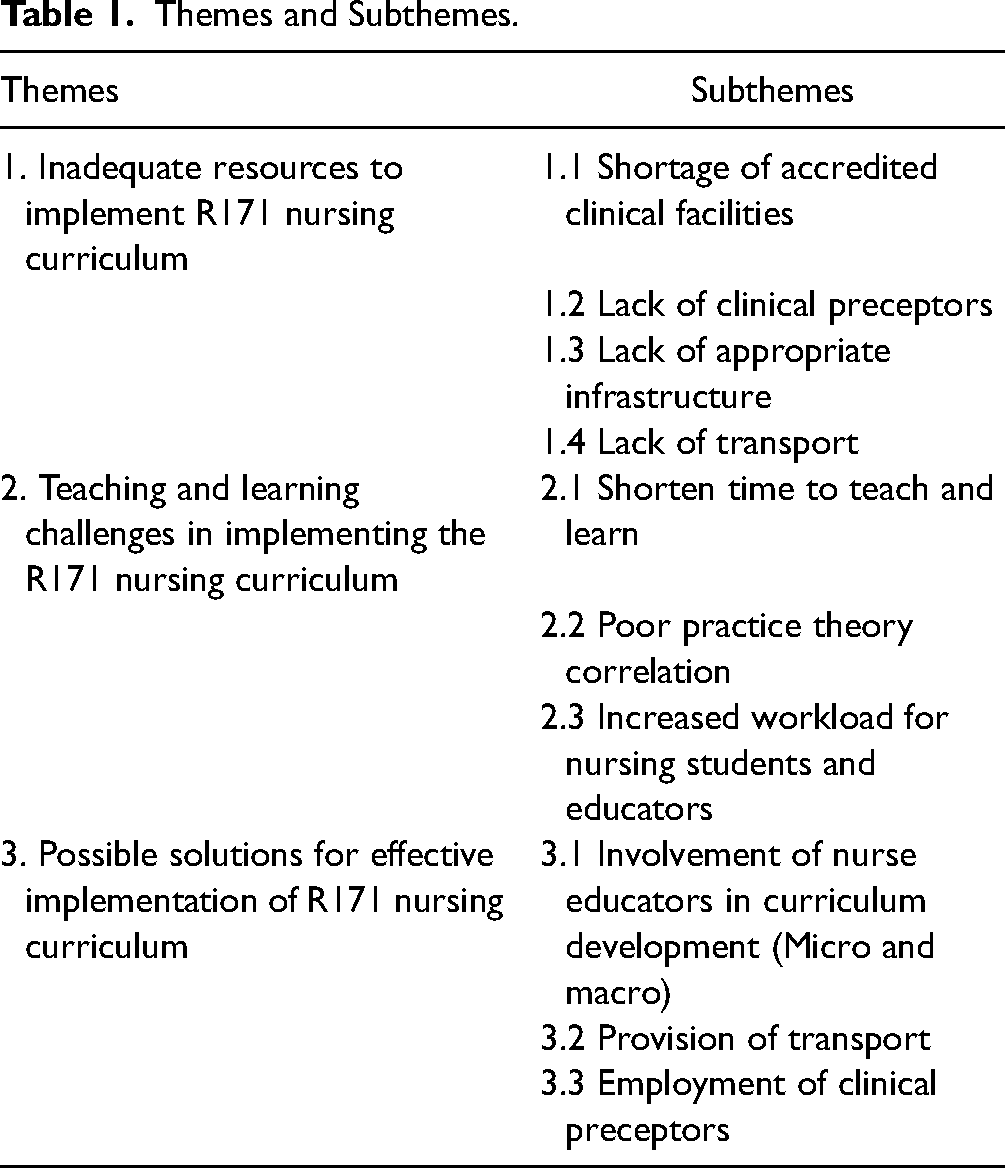
Themes and subthemes
Three themes emerged from the findings of this study namely: inadequate resources to implement the R171 nursing curriculum, teaching, and learning challenges in implementing the R171 nursing curriculum and the possible solutions for effective implementation of the R171 nursing curriculum. The table below represents the themes and subthemes that emerged from the data analysis.
Theme 1: Inadequate Resources to Implement R171 Nursing Curriculum
Nurse educators shared their experiences regarding inadequate resources to implement the R171 nursing curriculum. Four subthemes emerged which include shortage of accredited clinical facilities, lack of appropriate infrastructure, lack of clinical preceptors and lack of transport.
Subtheme 1.1: Shortage of Accredited Clinical Facilities
Nurse educators revealed that not all the clinical facilities within the province have been accredited to take in nursing students for workplace integrated learning as per the curriculum requirement. Tertiary hospitals and academic hospitals are not accredited and that may result in students being placed in smaller hospitals with limited learning opportunities. Tertiary hospitals are hospitals admitting patients with specialized needs such as oncology, psychiatry and complex health needs. Nurse educators end up placing student nurses at the same smaller institutions which results in limited learning for nursing students as they will not be exposed at other clinical facilities. This is indicated by the following excerpts: Yes. What I mean is that for example in the clinics that are in (mentioned name of the hospital), they only accommodate few students. Okay, Like in (mentioned name of the clinic), out of all our students they only accept two students. That is the reason why I am saying they accept few students and sometimes we will like to place more students in those facilities. (P Mam) We had nine clinics accredited in (mentioned name of the town) for the previous group for the first year level of R171. They were not placed in the rural clinics because we did not have clinics that were accredited for the previous group of R171 of first year. We did not. (PG)
Subtheme 1.2: Lack of Clinical Preceptors
Nurse educators experienced challenges regarding the shortage of clinical support staff members such as clinical preceptors, which made it difficult for them to accompany students when they are placed at clinical facilities because of their theoretical workload. Hence, this leads to limited nursing student clinical accompaniment, where nurse educators demonstrate and assess nursing skill at bedside for theory-practice integration. This is indicated by the following excerpts: The department of health must consider hiring clinical preceptors to assist in accompanying the students. (PE) We have started with the clinical coordinators but for now they do not have the Key Result Areas to guide them of what their role are. Because you will find that for an example when we go to (mentioned name of town), there is a clinical coordinator and she will be doing the ward rounds or she will be doing other things and not focusing more on the students. (PD)
Subtheme 1.3: Lack of an Appropriate Infrastructure
The two nurse educators indicated that the college infrastructure is of concern as the college is still under construction and most of the buildings such as the library, the simulation laboratory and classes do not have enough space and resources to cater for the students enrolled for R171. This is indicated in the following quotations: You can see here in one of the colleges that there is construction going on. Our skill lab lacks equipment. We don’t have a proper wound dressing pack. We must improvise to show the students how to dress a wound. Even the clinical facilities where students are placed, they do lack those dressing packs and it's a challenge. (PA) In terms of the resources we don’t have a fully functional library and a computer lab where one can go during those periods to be independent and take care of their learning responsibilities now they don’t have a choice but to stay in class… How do you do a self-study in a class full of forty students going up and down I mean they are so many distractions? (PB)
Subtheme 1.4: Lack of Transport
Two nurse educators indicated that the college transport is of concern as there is no transport for lecturers to do clinical accompaniment resulting in nurse educators using their own cars for clinical accompaniment. This is indicated in the following quotations: There is no transportation for lecturers to go to different clinical facilities where students are being placed. We must follow our students on daily basis. But due to constraints we improvise our own transport to do that which is not right… The situation is frustrating. (PA) Another thing that I experienced is that I think the college I’m working in was not prepared for this curriculum as there are challenges like shortage of staff and shortage of transport which make it hard for educators to accompany students when they are placed at clinical facilities. (P Mam)
Theme 2: Teaching and Learning Challenges in Implementing R171 Nursing Curriculum
Most of the nurse educators experienced challenges regarding teaching and learning in implementing R171. Three subthemes emerged and they include a shortened time to teach and learn, poor practice theory correlation, an increased workload for nursing students and educators. Below is the detailed information on each subtheme that emerged.
Subtheme 2.1: Shortened Time to Teach and Learn
Nurse educators indicated that time allocated for facilitating the modules within the curriculum is limited. Nurse educators expressed that a module that was taught in three years is now being taught in one year, making it difficult for them to complete the module in the expected time as the content is too long and offered in a short period of time. This is indicated by the following excerpts: So how is one student who is currently studying for this gonna take nursing back to its roots while something that was taught to her over three years is now being taught over a period of a year. So that's where my worry is. (PB) It's like all the topics that are in the textbooks, we are supposed to teach them. We are given a short period to attend to all those things. We do not have enough time to cover all those things that are in the timetable… Yes, sometimes you are only given four periods in a day but when you look at your timetable. (P Mam) The periods are short, and the information is too much and sometimes we are unable to complete the learning objectives. (PI)
Subtheme 2.2: Poor Practice Theory Correlation
Two nurse educators indicated that there was poor correlation of theory and practice because some of the modules will be taught, and students will only be placed in clinical facilities relating to what they were taught after a certain time resulting in student nurses not being able to correlate theory and practice. This is indicated by the following excerpts: Some of the things just we had to deal with them along the way. Like the issue of theatre. When students had to be placed in theatre where students were placed in operating theatre. We didn’t know. So it's not practical because I remember at some point introduction to surgical nursing was done, my suggestion is if for instance they are in a block for a certain module then immediately after that the practical part of it must be whatever they were taught just to reinforce that information. (PB) I can give you an example last week we placed students at different institutions but in the middle of that there was a meeting that was going on with the curriculum team that we should also place our students in theatre and it was not there so we had to reschedule our students from where they were place and sneak them somewhere within the period that they will be placed clinically. (PA)
Subtheme 2.3: Increased Workload for Nursing Students and Educators
Two nurse educators indicated that student nurses are given a lot of tasks in a short period of time. This results in nurse educators not completing their content and therefore students having to study for themselves. This is indicated by the following excerpts: The new R171 nursing curriculum is more hectic for the students because it has so many activities involved. For example, if the student is in class they are supposed to have contact session where we the nurse educators are facilitating, and they have task periods as well as tutorials. You will find out that the student must attend two modules in a day. It is more hectic than R425. (PF) The students also have a lot of work to do. They are given tasks in class, and they also write formative assessments and they are many. (P Mam)
Theme 3: Possible Solutions for Effective Implementation of R171 Nursing Curriculum
The third theme that emerged is the possible solutions for effective implementation of R171. Three subthemes emerged, and they include involvement of nurse educators in curriculum development (Micro and macro), provision of transport and employment of clinical preceptors. Below is the detailed information on each subtheme that emerged.
Subtheme 3.1: Involvement of Nurse Educators in Curriculum Development (Micro and Macro)
The participants expressed that they should be involved in the curriculum development as they are the ones implementing the curriculum. The nurse educators believe that when being involved in the curriculum development, identified gaps will be corrected. This is indicated by the following excerpts: I think the curriculum team since there is a curriculum team I think they should involve the lecturers for R171 because they are the ones who are experiencing this thing and I hope they will have more input on how things should be done. (P Mam) They should also include the implementers of the curriculum. If you are up there you are not the one who is implementing this. You won’t know the challenges and you won’t even feel them. My suggestion is that they should include the implementers since we are the ones who have been their hands on. (PB)
Subtheme 3.2: Provision of Transport
Nurse educators expressed that for the curriculum to be a success, transport for clinical accompaniment should be made available to nurse educators. This is indicated by the following excerpts: Because now it comes to the financial restraints. We are supposed to do 70% of it whereby now we find out that we have to go somewhere and there will be no cars. There are no available cars for the lecturers to go there. Sometimes when we are local we have to use our own cars. So we are forced to use our own cars just to make that 70%. Therefore, we need more cars. It goes back to planning. (PB) As we have to accompany the student to clinical facilities we lack transport. The accompaniment should be at 70%. In other words, the students should always be having an educator guiding them in the clinical facilities but because of problems like transport and staff we are not yet there and it's a bit frustrating that we cannot be given the equipment's that we can use to make this curriculum a success. (PA)
Subtheme 3.3: Employment of Clinical Preceptors
Nurse educators suggested that clinical preceptors should be employed and they should know their job description. If clinical preceptors are hired, the workload of the nurse educators will be reduced and therefore they will be able to focus more on theory and assist in correcting the identified gaps on the study guides. This is indicated by the following excerpts: My suggestion is because we lecturers we are also following the students to clinical areas, if the colleges or the nursing council can up with something like there should be clinical facilitators who are responsible for clinical education of the students and the lecturers will be responsible for facilitating theory in the colleges maybe it will be easier like that. (PI) We must have many clinical coordinators who will do the training of the students when they are in the clinical facilities. The very same clinical facilities need to be recognised. (PD) Because now we don’t have clinical lecturers like before, we need to have clinical lecturers. When the students are in clinical, they are the ones that are going to be responsible for whatever clinical practise for these students. Let this lecturer be exposed to class. (PG)
Subtheme 3.4: Increase the Number of Accredited Clinical Areas for Students
Nurse educators suggested that the South African Nursing Council (SANC) must accredit more clinical facilities where nurse educators can place the nursing students. Nurse educators expressed that when there are many accredited clinical facilities for work integrated learning, nursing students will be exposed to more facilities unlike being placed in one facility for a longer period. This is indicated by the following excerpts: The nursing council has to increase the number of students at their accredited facilities. For example, if they said in unit 9 clinic they have accredited two students maybe they should increase the number. Like in Mafikeng provincial, five students is not enough. They should increase the number of students who should be placed there. (P Mam) There is no space for us lecturers. We will be struggling to look for a space where we can just squeeze ourselves especially at the clinics. Maybe if managers can create space for us lecturers where we can see our students in case we don’t do to the procedure on the patients. (P I)
Discussion
This study sought to explore and describe the experiences of nurse educators regarding R171 nursing curriculum in NWP, South Africa. The R171 nursing curriculum requires that public Nursing Education Institutions have a fully functional library, clinical facilitators who will facilitate clinical teaching and learning, a clinical simulation laboratory and well-equipped hospitals and clinics were nursing students will gain clinical experience. Three themes and ten subthemes emerged from the participants responses. Nurse educators experienced challenges regarding the implementation of R171 nursing curriculum in the NWP. The challenges experienced by nurse educators regarding R171 nursing curriculum included shortage of accredited clinical facilities, lack of clinical preceptors, lack of appropriate infrastructure, lack of transport used for clinical accompaniment, shortened time to teach and learn, poor practice theory correlation and an increased workload for nursing students and educators.
The researcher's findings indicate that the involvement of nurse educators in curriculum development (Micro and macro) is critical. According to Mukhalalati and Taylor. (2019) nurse educators play a crucial role in integrating learning theories, subject matter components and nursing students understanding to improve learning. The indicated aspects are incorporated in the process of curriculum development which makes their opinion important as facilitators of the curriculum. The notion is also supported by a study conducted by Brower et al. (2022) who stated that it is essential that nurse educators be involved in curriculum development process, the involve impose a sense of value and ownership to the nurse educators which prevents academic shock, especially to novice nurse educators who are in a transition of identifying and developing professional identity in nursing education.
The authors further discuss that, the active involvement of nurse educators in curriculum development limits uncertainties that may arise and provide a deeper understanding to nurse educators on how to effectively implement the nursing curriculum under different circumstances. Brower et al. (2022) further discuss that novice nurse educators with elementary experience in facilitating the nursing curriculum should receive support and guidance from senior nurse educators in the academic setting for better socialization in the profession.
The study revealed that due to limited resources such as clinical preceptors, poor infrastructure for teaching and learning, and limited clinical facilities for placement for workplace integration learning the nurse educators struggled to implement the R171 nursing curriculum. Bogren et al. (2021) state that the shortage of critical resources and equipment acts as a barrier to providing high-quality nursing education. Therefore, there is a great need to ensure that proper planning and budgeting is done to safeguard the availability of resources such as transports, clinical preceptors and proper teaching and learning infrastructure.
The participants verbalized that for the curriculum to be a success, clinical preceptors need to be employed in the NEI's. The clinical preceptor role is to ensure that nursing students are receiving sufficient clinical accompaniment, demonstrated, and assessed on procedures at the bedside to confirm technical skills competency and socialization in the nursing profession. Therefore, the presence of sufficient clinical preceptors will enable nurse educators to focus on the theoretical teaching and learning of the nursing students, without the worry of the nursing students being without structured clinical teaching and coaching and aid in decreasing the workload burden of the nurse educators. Clinical accompaniment is vital in the nursing curriculum.
According to Teferra and Mengistu (2017), clinical preceptorship, in nursing, is a clinical teaching and guidance program where nursing students are paired with an experienced nurse in the clinical environment to equip them with clinical skills, knowledge, attitude, and nursing values to be safe nursing professions at the end of pre licensure training. Williams et al. (2021) further highlights that clinical preceptor can help nursing students to establish meaningful experiences and can generally create a mutual supportive learning environment for students and to learn without causing errors that can compromise the well-being of the patients or communities. Therefore, it is essential that qualifying clinical preceptors are employed so that they can be able to provide clinical teaching to the R171 nursing students.
The participants further stated that they experienced challenges relating to the accredited clinical facilities by the South African Nursing Council in the North-West Province. Participants further stated that more clinical areas with fully functioning equipment's need to be accredited by SANC in the North-West Province. This is supported by study conducted by Amoo and Enyan (2022) that state that clinical learning is an important aspect of nursing education as it enables students to translate theoretical knowledge to practical skills. Therefore, the clinical environment should be cordial and supportive for effective clinical teaching and learning to be undertaken and for students to undertake assigned tasks.
Strengths and Limitations
The strength of this study is that the experiences of nurse educators facilitating R171 nursing curriculum in the NWP was explored by the researcher and the phenomena was clearly described by the participants. The limitation of the study is that not all nurse educators facilitating the R171 nursing curriculum participated in the study due to their busy schedule in facilitating the curriculum. Data was only collected from the NEIs in NWP and excluded other provinces, thus the findings of the study cannot be generalized to other provinces of the Republic of South Africa (RSA).
Conclusion
All nursing programs in South Africa had to be accredited by the DHET and should align with the HEQSF and the relevant NQF level. R171 (Diploma in Nursing) is pegged at NQF level 6. The public Nursing Education Institutions in South Africa had to meet the standard as set out not only by SANC but by the DHET. Public Nursing Education Institutions must have a fully functional library, a clinical simulation laboratory and clinical trainers in the hospitals and clinics. However, nurse educators have revealed that there are limited resources to facilitate the program in North-west Province, South Africa. With the introduction of the nursing curriculum (R171), nurse educators were not involved in the curriculum development.
Therefore, there is a need for nurse educators to be involved in the curriculum development so that gaps identified by the nurse educators can be resolved as they are the ones who are facilitating the R171 nursing curriculum. Additional clinical preceptors must be employed who have sound clinical experience as nurses and have background in nursing education, with credible insight on clinical accompaniment of nursing students.
This study offered valued information in understanding the experiences of the nurse educators in implementing the R171 nursing curriculum. Those who read the study will be able to synthesis, the challenges as well as the resolution strategies that can be implemented to fill the identified gaps in relations to required resources, and teaching and learning requirements. The knowledge that transpired from the study provides insight that will ensure that the implementation of R171 meets the goal of guaranteeing equipped and supported nurse educators and eventually competent nursing students. There is room for improvement in the provision of R171 in the North-West Province, South Africa.
Footnotes
Acknowledgments
The authors would like to thank all the nurse educators who participated in this study.
Authorship Contribution Statement
This work is part of a master's dissertation of the first author, the two authors were supervisors in the study. All authors contributed to the conceptualization and writing up of the manuscript.
Declaration of Conflicting Interests
The authors declared no potential conflicts of interest with respect to the research, authorship, and/or publication of this article.
Ethical Considerations
This study commenced after approval was granted by the NuMIQ Research Focus area, University Health Research Ethics Committee, North-West Province Department of Health, Multicampus Principal and Head of two Campuses of the selected NEI where data was collected in NWP.
Funding
The authors disclosed receipt of the following financial support for the research, authorship, and/or publication of this article: The study was funded by the postgraduate bursary of the North West University (grant number North West University postgraduate bursary).
