



Abstract
Introduction
Newly employed nurses often experience professional, psychological, and organizational challenges that may compromise their well-being, job satisfaction, and performance. Understanding these challenges in the Palestinian context is vital to inform supportive interventions.
Objectives
To assess the types and levels of workplace challenges faced by newly employed nurses in public and private hospitals in Hebron, Palestine.
Methods
A cross-sectional study was conducted among 167 nurses with one year or less of experience, recruited purposively from six hospitals. Data were collected using a validated self-administered questionnaire covering four domains: personal adjustment, patient and family interactions, workplace violence, and healthcare system challenges. Descriptive and inferential statistics were analyzed using SPSS version 20.
Results
Participants reported a moderate overall level of challenges (mean = 3.01). The most common issues were stress affecting performance, high workload, and sleep deprivation. Patient and family interactions (mean = 3.05) and healthcare system challenges (mean = 3.05) were rated highest, while workplace violence (mean = 2.99) and new nurse adjustment issues (mean = 2.96) also reflected moderate burdens. No significant differences were found by gender, education level, or hospital type; however, departmental differences were significant, with pediatric nurses reporting the greatest challenges (p < .001).
Conclusion
Newly employed nurses in Hebron face moderate, department-specific challenges shaped by systemic inefficiencies and cultural dynamics. Targeted interventions such as structured orientation, mentorship, workforce development, and stronger protections against workplace violence are essential to improve retention, job satisfaction, and the quality of healthcare delivery in Palestine.
Introduction
Nursing is a cornerstone of healthcare systems worldwide, with nurses providing essential contributions to patient care, health promotion, and system resilience. For newly employed nurses, however, the transition from academic preparation to professional practice is often accompanied by multiple challenges that can influence their job performance, psychological well-being, and retention. This transitional phase has been described as one of the most stressful periods in a nurse's career because of increased responsibilities, limited clinical experience, and the need to adapt quickly to organizational cultures and high patient demands (Labrague & de los Santos, 2020).
In low- and middle-income countries, including Palestine, these challenges are compounded by systemic constraints such as limited resources, high patient–nurse ratios, and underdeveloped orientation or mentorship programs (Marie et al., 2017). Public hospitals frequently operate in overcrowded environments with shortages of staff and equipment, while private hospitals, although better resourced, still struggle with workload distribution and staffing gaps (Qtait, 2025; Qteat & Sayej, 2014). These contextual factors place additional pressure on newly employed nurses, who are expected to provide safe and effective care while developing their professional competence.
The city of Hebron represents a unique case within the Palestinian healthcare system. It hosts both large governmental hospitals and a number of private facilities that together serve a dense and diverse population. Nurses in Hebron, therefore, encounter organizational, cultural, and interpersonal demands that reflect the broader challenges of the Palestinian health sector, including limited infrastructure and the effects of ongoing political and economic instability (Dintwe et al., 2025; Taha, 2017). Understanding how new nurses experience and navigate these pressures is vital, both for supporting their professional development and for improving workforce retention.
Despite a growing body of literature on occupational stress and job satisfaction among Palestinian nurses, few studies have examined the experiences of newly employed nurses specifically, particularly across different hospital types and departments. This study addresses that gap by assessing the challenges faced by newly employed nurses in Hebron, with the aim of informing supportive policies and interventions to strengthen early career nursing practice in Palestine.
Review of Literature
The transition from nursing education to professional practice is recognized globally as a critical and vulnerable period for newly employed nurses. Numerous studies report that new nurses face a range of challenges, including emotional stress, clinical incompetence, communication difficulties, and a lack of institutional support, all of which can contribute to dissatisfaction and high turnover (Labrague & de los Santos, 2020).
In Palestine, these challenges are intensified by systemic and contextual factors. The nurse-to-patient ratio remains among the lowest in the region, creating heavy workloads and limiting opportunities for new nurses to consolidate their clinical skills. The Palestinian Central Bureau of Statistics (2022) reported that nurses deliver ∼60% of healthcare services, highlighting their critical role in sustaining the health system despite resource shortages. Studies from Gaza and the West Bank indicate high rates of occupational stress, burnout, and emotional exhaustion among hospital nurses, often linked to overcrowding, staff shortages, and limited organizational support (Allari et al., 2025; Albelbeisi et al., 2021; Al Hajjar, 2013).
Institutional support structures are also underdeveloped. Research has shown that many Palestinian hospitals lack structured orientation or mentorship programs, leaving new nurses to learn by trial and error. Marie et al. (2017) found that inadequate support systems contribute to psychological strain and lower job satisfaction among nurses in community and hospital settings. Similarly, Yehia et al. (2017) emphasized the challenges faced by mental health nurses in the West Bank, underscoring the need for stronger institutional frameworks to improve resilience and retention.
Workplace violence has been identified as another significant stressor. Palestinian nurses frequently report verbal and physical abuse, particularly in emergency and high-stress departments, often from patients’ relatives (Al-Rawajfah et al., 2021). Limited institutional reporting procedures and a lack of legal protections exacerbate the problem, contributing to feelings of vulnerability and dissatisfaction among staff.
Interactions with patients’ families represent an additional area of concern. In Palestinian and other Arab healthcare contexts, families play a central role in care, which can be both supportive and burdensome. Abu-El-Noor et al. (2023) highlighted that while family involvement can benefit patients, it also creates tension for nurses, who must balance clinical duties with family demands in overcrowded hospital environments.
Finally, systemic healthcare challenges such as bureaucratic inefficiencies, poor infrastructure, and limited resources are widely documented in Palestine. Taha (2017) describes how nurses in the West Bank work under conditions of political instability, movement restrictions, and resource shortages, which complicate their clinical practice. These systemic constraints not only affect patient outcomes but also increase stress levels among new nurses who are still adjusting to their roles.
In summary, the literature indicates that newly employed nurses in Palestine face a combination of personal, institutional, and systemic challenges. While international research highlights similar issues, the Palestinian context is marked by additional stressors, including political instability and chronic underfunding of the health sector. However, few studies have examined the specific experiences of newly employed nurses in Hebron across public and private hospitals. This study contributes to filling that gap by focusing on the department-specific and organizational challenges faced by nurses during their first year of practice.
Objective of the Study
This study objective to identify and assess the workplace challenges faced by newly employed nurses in Hebron, Palestine, across public and private hospitals. Specifically, it sought to examine the extent and nature of challenges related to personal adjustment, patient and family interactions, workplace violence, and healthcare system inefficiencies, and to explore how these challenges vary according to demographic characteristics and departmental placement.
Methods
Study Design
This study employed a descriptive, cross-sectional quantitative design to explore the challenges faced by newly employed nurses working in public and private hospitals in Hebron, Palestine. The cross-sectional approach was selected to capture a snapshot of nurses’ experiences during their first year of employment and to identify associations between demographic and institutional factors and the challenges encountered.
Research Question
What are the workplace challenges faced by newly employed nurses in public and private hospitals in Hebron, Palestine?
Sampling and Study Setting
The research was conducted in six major hospitals in Hebron (three governmental and three private). A purposive sampling technique was employed to recruit participants for this study. The target population included newly employed nurses working in public and private hospitals in Hebron who had 12 months or less of professional experience. Nurses were eligible if they held at least a diploma or bachelor's degree in nursing and were currently practicing in a hospital setting. Those with more than one year of clinical experience or working outside hospital settings were excluded. From six hospitals (three governmental and three private), a total of 167 nurses were recruited, yielding a response rate of 89%. This approach was chosen to ensure the inclusion of participants who were in the critical early phase of their professional transition, thereby capturing the challenges most relevant to new nurses in the Palestinian healthcare context.
Inclusion Criteria
Holding at least a diploma or bachelor's degree in nursing.
Currently employed in a hospital setting for 12 months or less.
Exclusion Criteria
Nurses with more than one year of clinical experience.
Nurses working outside hospital settings.
A purposive sampling technique was used, and 167 nurses were recruited. The overall response rate across the six hospitals was 89%.
Study Period: The study was conducted from March to June 2025 at the Hospital, during which data collection, intervention, and follow-up assessments were carried out.
Ethical Considerations
Ethical approval was obtained from the Faculty of Nursing Research Committee under No (ppu.nur-15/01/25) and the Ministry of Health. Written informed consent was secured from all participants. Confidentiality and anonymity were assured, and participation was voluntary.
To ensure standardized ethical and quality control procedures, the research process followed the ethical principles outlined in the Declaration of Helsinki (2013) and adhered to institutional research governance standards. All data collection was conducted using unified procedures across hospitals to maintain consistency and minimize bias. The instrument was pilot tested to confirm clarity and reliability before implementation, and data accuracy was verified through double entry and cross-checking. Participant confidentiality was preserved by assigning anonymous codes, and all records were stored securely under password protection. These steps ensured that both ethical integrity and methodological quality control were consistently upheld throughout the study.
Data Collection Tool
Data were collected using a structured, self-administered questionnaire developed from a review of relevant literature and adapted to the Palestinian context. The instrument consisted of 47 items, divided into five sections:
Demographics and Professional Information (7 items). Challenges Related to Newly Employed Nurses (10 items). Challenges Related to Patients and Families (10 items). Challenges Related to Workplace Violence and Bullying (10 items). Challenges Related to the Healthcare System (10 items).
Responses were rated on a 5-point Likert scale ranging from 1 (strongly disagree) to 5 (strongly agree).
Scoring and Interpretation
For each domain, mean scores were calculated by summing responses and dividing by the number of items in that domain. An overall challenge score was also computed by averaging across the four domains.
Cut-off points were defined a priori as follows:
Low challenges: 1.00–2.33 Moderate challenges: 2.34–3.66 High challenges: 3.67–5.00
These thresholds are consistent with prior studies using Likert-type data in the region and allowed classification of perceived challenge levels into meaningful categories.
Validity and Reliability
Content validity was established through expert review by a panel of five nursing faculty and clinical supervisors. Their feedback guided refinements to item clarity and relevance. A pilot study with 15 nurses (not included in the main analysis) confirmed the acceptability of the instrument.
Internal consistency reliability was assessed using Cronbach's alpha. The overall tool demonstrated excellent reliability (α = .948), with domain-specific values ranging between 0.83 and 0.88. To avoid redundancy, all information relating to validation and Cronbach's alphas is reported here under the validity and reliability subheading.
Data Analysis
Data were analyzed using SPSS Version 20. Descriptive statistics (frequencies, percentages, means, and standard deviations) were used to summarize sample characteristics and challenge scores.
For inferential analysis, nonparametric tests were applied because the data did not meet the normality assumptions required for parametric tests:
Mann–Whitney U test was used to compare differences between two groups (e.g., gender and hospital type). Kruskal–Wallis H test was used for comparisons across more than two groups (e.g., departments and education levels). When the Kruskal–Wallis test showed statistical significance, Dunn's post-hoc test with Bonferroni correction was conducted to identify specific group differences.
Effect sizes were reported to quantify the strength of associations: rank-biserial correlation (r) for Mann–Whitney U and epsilon squared (ε²) for Kruskal–Wallis.
A significance threshold of p < .05 was adopted. Results with p < .001 are reported as such rather than as “p = .000.”
Missing data were minimal (<1%). For example, one case of missing marital status information reduced the denominator from 167 to 166. Analyses were conducted using listwise deletion for missing values.
Results
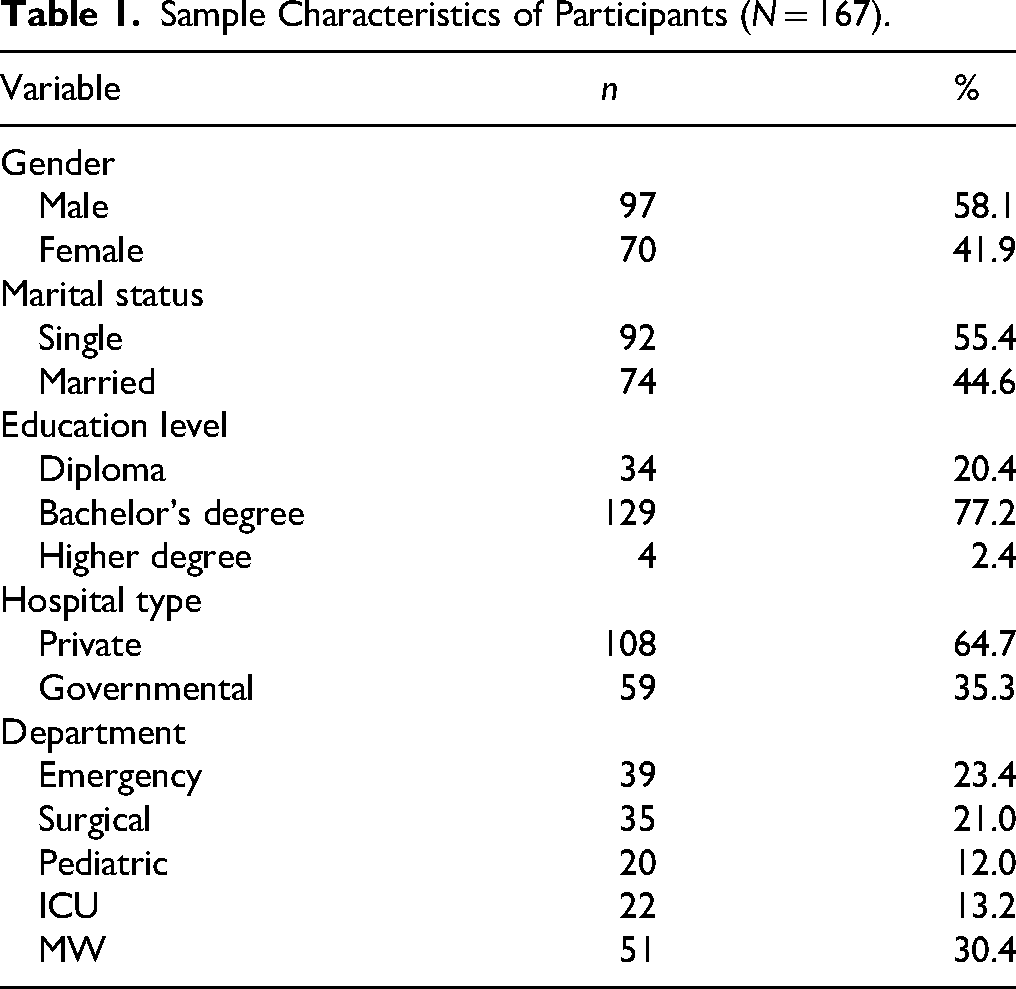
A total of 167 newly employed nurses participated in the study (mean age = 26.0 ± 3.2 years). The majority were male (58.1%) and single (55.4%). Most held a bachelor's degree in nursing (77.2%) and worked in private hospitals (64.7%). Departments with the largest representation included the emergency room (23.4%) and surgical units (21.0%). One case of missing marital status reduced the denominator to 166 for that variable.
As shown in Table 1, the sample distribution reflects a diverse group of early career nurses across hospital types and clinical departments.
Sample Characteristics of Participants (N = 167).
Nurses reported moderate levels of workplace challenges across all four domains, with an overall mean of 3.02 (SD = 0.70). The highest scores were observed for patient/family interactions and healthcare system issues (both mean ≈ 3.05), while violence and bullying scored slightly lower (mean = 2.99).
As presented in Table 2, all domain scores fell within the “moderate” range (2.34–3.66). This suggests that challenges were consistent across domains rather than concentrated in one area. However, patient/family interactions and healthcare system-related challenges appeared slightly more pronounced.
Mean Scores of Workplace Challenges by Domain.

Mann–Whitney U and Kruskal–Wallis H tests revealed no significant differences in challenge scores by gender (p = .984), hospital type (p = .163), or education level (p = .460). However, significant differences were found across departments, H(5) = 22.73, p < .001, ε² = 0.11.
As shown in Table 3, workplace challenges were broadly similar across most demographic groups. Departmental variation, however, was statistically significant, indicating that clinical context influences perceived challenges more than gender, education, or hospital type.
Differences in Challenge Scores by Demographic Variables.

Department-level analysis showed that pediatric nurses reported the highest overall challenge scores (mean = 3.67, SD = 0.62, “high”), while surgical and emergency nurses also reported elevated levels. Dunn's post-hoc tests (Bonferroni adjusted) indicated that pediatric scores were significantly higher than those in rehabilitation and “other” units (p < .01).
As presented in Table 4, pediatric nurses consistently reported the greatest challenges, reflecting the emotionally demanding nature of caring for children and the high involvement of families. By contrast, nurses in rehabilitation and smaller units reported comparatively lower challenge levels.
Department-Wise Challenge Scores (Means ± SD).

Discussion
This study examined the challenges faced by newly employed nurses in public and private hospitals in Hebron, Palestine, and found that overall, participants reported a moderate level of challenges across all domains. These findings highlight the multifaceted difficulties encountered during the early transition period into clinical practice, reflecting both individual adaptation issues and systemic healthcare constraints.
Newly employed nurses in Hebron reported moderate stress related to heavy workloads, limited experience, and sleep deprivation. These findings mirror international evidence on “transition shock,” where early career nurses struggle to adapt to demanding roles with limited preparation (Labrague & Ballad, 2021; Qtait et al., 2025). The absence of structured orientation and mentorship in many local hospitals exacerbates these challenges, consistent with reviews showing that formal transition programs significantly enhance new nurses’ self-efficacy and reduce turnover (Walker et al., 2020).
Challenges involving patients’ relatives emerged as one of the most prominent concerns. In Palestinian and other Arab contexts, families are deeply engaged in patient care, which can sometimes lead to overcrowding, conflicting expectations, and strained nurse–family relationships (Abu-El-Noor et al., 2023; Ojala et al., 2025). The findings underscore the need for culturally sensitive communication training and hospital policies that balance family involvement with clinical efficiency.
Workplace violence, while rated at a moderate level, remains a critical issue. Verbal and psychological abuse was most often in emergency and high-acuity departments were commonly reported. Similar patterns have been documented across the region, where nurses are disproportionately exposed to violence with minimal institutional protection (Baykal et al., 2021; Wasim et al., 2022). Establishing zero-tolerance policies, clear reporting mechanisms, and support services are essential to ensure nurse safety and job satisfaction.
System-related barriers were the most significant stressors identified, including resource shortages, inadequate infrastructure, and bureaucratic inefficiencies. These findings are consistent with evaluations of the Palestinian healthcare system, which emphasize chronic underfunding, staff shortages, and limited professional autonomy (WHO, 2023). Addressing these structural deficiencies requires strategic investment, digitalization of administrative processes, and improved nurse-to-patient ratios to reduce burnout and enhance care quality.
Interestingly, no significant differences were observed by gender, education level, or hospital type, suggesting that workplace challenges are systemic rather than individual. However, challenges varied significantly across departments, with pediatric nurses reporting the highest stress levels. This aligns with international evidence that pediatric nursing involves complex care needs, vulnerable patients, and high emotional demands (Al Muharraq et al., 2022; Zhang et al., 2021). Tailored interventions such as resilience training, peer support, and mental health resources may be particularly beneficial in pediatric and other high-stress units.
Strengths and Limitations
This study provides one of the first comprehensive assessments of the workplace challenges faced by newly employed nurses in Hebron across both public and private hospitals. Including multiple departments and hospital types enhanced the representativeness of the sample and provided comparative insights into department-specific stressors. The study also used a validated instrument with excellent internal consistency (Cronbach's α = .948), ensuring high measurement reliability. The integration of nonparametric inferential analyses further improved the robustness of statistical interpretation, given the data distribution.
However, several limitations must be acknowledged. The cross-sectional design limits the ability to infer causal relationships between workplace factors and perceived challenges. The use of purposive sampling from a single urban area (Hebron) may constrain generalizability to nurses in other Palestinian regions or rural settings. Self-reported data introduce the potential for social desirability bias, and the absence of qualitative interviews restricts deeper exploration of contextual or organizational dynamics underlying the quantitative findings. Additionally, while the study identified significant departmental variations, it did not capture longitudinal changes in nurses’ adaptation over time.
Future research should employ mixed-methods or longitudinal designs to explore the evolution of workplace challenges and evaluate the effectiveness of structured orientation and mentorship programs in improving early career nurse retention in Palestine.
Implications
The findings highlight the urgent need for multilayered interventions. Hospitals should adopt structured orientation and mentorship programs to ease the transition into practice. Policymakers must address workforce shortages, strengthen protections against workplace violence, and invest in hospital infrastructure. Supporting nurses during their early career is essential not only for job satisfaction and retention but also for sustaining the quality and resilience of healthcare delivery in Palestine.
Conclusion
Newly employed nurses in Hebron face moderate but multifaceted challenges across personal, interpersonal, and systemic domains. The most prominent stressors were healthcare system deficiencies and complex patient–family interactions, while workplace violence and personal adjustment issues also posed significant burdens. Although these challenges were consistent across gender, education level, and hospital type, departmental differences—particularly in pediatric units—were notable. Addressing these challenges requires targeted interventions, including structured orientation and mentorship, improved staffing ratios, stronger protections against workplace violence, and systemic reforms to strengthen infrastructure and reduce bureaucratic barriers. Supporting nurses during their transition period is essential to enhance retention, job satisfaction, and the overall quality of patient care in Palestine.
Supplemental Material
sj-docx-1-son-10.1177_23779608251395807 - Supplemental material for Workplace Challenges of Newly Employed Nurses in Hebron: A Cross-Sectoral Study of Public and Private Hospitals
Supplemental material, sj-docx-1-son-10.1177_23779608251395807 for Workplace Challenges of Newly Employed Nurses in Hebron: A Cross-Sectoral Study of Public and Private Hospitals by Zeenat Mesk and Nesreen Alqaissi in SAGE Open Nursing
Footnotes
Acknowledgments
We acknowledge the midwives who participated in the study.

Ethical Approval
Ethics approval was obtained from the University Ethics Review Committee (ppu.nur-15/01/25).
Consent to Participate
Informed consent was obtained from each participant with an assurance of anonymity and confidentiality.
Authors’ Contributions
Zeenat Mesk: conception, study design, data analysis, manuscript writing, and data collection. Nesreen Alqaissi: interpretation, critical revision of the manuscript, and approval of the final version.
Funding
The authors received no financial support for the research, authorship, and/or publication of this article.
Declaration of Conflicting Interests
The authors declared no potential conflicts of interest with respect to the research, authorship, and/or publication of this article.
Data Availability Statement
Data for this study would be available upon reasonable request from the principal investigator.
Supplemental Material
Supplemental material for this article is available online.
References
Supplementary Material
Please find the following supplemental material available below.
For Open Access articles published under a Creative Commons License, all supplemental material carries the same license as the article it is associated with.
For non-Open Access articles published, all supplemental material carries a non-exclusive license, and permission requests for re-use of supplemental material or any part of supplemental material shall be sent directly to the copyright owner as specified in the copyright notice associated with the article.
