




Abstract
Background
The world has faced enormous challenges over the past three years due to a global pandemic that has undermined and altered everyday life around the globe. There were delays in class scheduling, accessibility, and clinical practicum opportunities for students registered in nursing education programs. In addition, these students have dealt with interpersonal or parental difficulties, social exclusion, and personal illnesses related to the pandemic disease (Jokar et al., 2023). All these factors might have led to stress and negatively affected the psychological well-being of these students. Compared to students in other healthcare fields, bachelor nursing students were far more likely to experience significant levels of stress before the pandemic (Al Rasheed et al., 2017). Stress and anxiety are common among student nurses because of encounters with patient distress and mortality, challenging relational dynamics in a clinical environment, a demanding task load, and apprehension of committing mistakes (Lavoie-Tremblay et al., 2022). Prolonged, unregulated stress has been shown to impair nursing students’ academic performance, as well as their physical and emotional health (Hwang & Kim, 2022). On the other hand, protecting mental health and wellbeing helps student nurses regulate their emotions, thoughts, and behaviors in ways that help them overcome the difficulties they encounter (Laczko et al., 2022). Emotional intelligence is a concept that refers to the ability to recognize, understand, and manage one's own emotions, as well as to perceive and respond to the emotions of others. It encompasses a range of skills, including self-awareness, self-regulation, empathy, and social skills (Ikart, 2023). Individuals with high emotional intelligence are adept at recognizing their emotional states and using that awareness to navigate social interactions effectively. They can also empathize with others, understanding their emotions and responding in a compassionate and supportive manner (Coronado-Maldonado & Benítez-Márquez, 2023).
Emotional intelligence is considered essential for building and maintaining healthy relationships, effective communication, and making sound decisions based on both rationality and emotional understanding (Cavaness et al., 2020). By developing emotional intelligence, individuals can enhance their personal and professional relationships, manage stress and conflicts more effectively, and foster a positive and emotionally intelligent environment (Mayer et al., 2000). There is a lack of knowledge and understanding regarding the specific factors that mediate the relationship between emotional intelligence and motivation among nursing students in Saudi Arabia (Abou Hashish & Bajbeir, 2018; Almansour, 2023; Benjamin et al., 2024).
While previous research has established a positive association between emotional intelligence and motivation, little is known about the underlying mechanisms that explain this relationship in the context of Saudi nursing students, therefore, identifying and examining these mediating factors is essential for gaining insights into the psychological processes that influence motivation levels in this specific population. Thus, the research question this paper is attempting to answer is: What are the mediating factors that explain the association between emotional intelligence and motivation to learn among Saudi nursing students?
Review of Literature
Since emotional intelligence (EI) may help people function well on a professional and personal level, it is increasingly being utilized by many organizations and educational institutions. Emotional labor in the nursing profession involves controlling and communicating pertinent feelings (Budler et al., 2022).
Emotional intelligence (EI) has garnered significant attention in the nursing field due to its profound implications for patient care and healthcare outcomes. Firstly, nurses with well-developed EI skills are more self-aware and possess a heightened ability to recognize and regulate their own emotions, even in high-pressure and emotionally charged situations. This self-awareness enables nurses to maintain composure, make sound judgments, and effectively manage stress, which ultimately enhances their capacity to provide safe and competent care (Al-Hamdan et al., 2021; Nightingale et al., 2018). Furthermore, EI plays a crucial role in building strong nurse-patient relationships. Nurses with high EI exhibit a greater capacity for empathy, enabling them to accurately perceive and respond to the emotional states of patients. This empathic understanding fosters trust, open communication, and a sense of psychological safety, which are crucial elements for patient satisfaction and engagement in the healthcare process (Oyur Celik, 2017). Moreover, emotionally intelligent nurses are more adept at effectively managing patient emotions, providing comfort, and alleviating emotional distress, leading to improved patient well-being and overall healthcare experiences (Khademi et al., 2021).
However, emotional intelligence has not yet been thoroughly addressed in the literature in nursing education (Dugué et al., 2021; Galanis et al., 2024; Mora et al., 2024). To advance the field of nursing, scholars and educators must concentrate on enhancing EI in nursing education, thus preparing the future nurses. The achievement and continued enrollment of nursing students may be significantly influenced by EI. It can help nursing students overcome obstacles in their clinical assignments, develop their ability to lead, function better in the real world, and increase the protection of patients during their practice and upon their employment (Dou et al., 2022). The observed association between emotional intelligence and motivation can provide insights into how emotional intelligence enhances the educational outcomes among nursing students.
For students, learning motivation is essential as it is a major indicator of their performance in the classroom (Tang & He, 2023). Human beings can be proactive and engaged or, alternatively, passive and alienated, largely as a function of the social conditions in which they develop and function. Accordingly, research guided by self-determination theory has focused on the social–contextual conditions that facilitate versus forestall the natural processes of self-motivation and healthy psychological development. Specifically, factors have been examined that enhance versus undermine intrinsic motivation, self-regulation, and well-being. The findings have led to the postulate of three innate psychological needs (competence, autonomy, and relatedness), which, when satisfied, yield enhanced self-motivation and mental health, and when thwarted, lead to diminished motivation and well-being (Ryan & Deci, 2000, p. 2024). Learning motivation may be seen as a psychological involvement in education. University students are more likely to embrace varied educational methods. Hence, they may encounter more favorable learning sentiments when they are able to recognize and regulate their adverse feelings in the face of educational obstacles (Schukajlow et al., 2023). An undergraduate may approach studying with greater positivity and optimism when they are emotionally fulfilled. Higher academic obstacles may deter certain undergraduates from being as motivated to learn as others. At this point, greater EI scores are even more important for preserving students’ motivation (Tang & He, 2023). Prior research has indicated a possible substantial correlation between EI and learning motivation (Arias et al., 2022; Rodríguez González et al., 2021). However, more research in a larger student population in various cultural contexts is necessary to confirm this association. To fully capitalize on the benefits of EI on learning, it would be worthwhile to investigate the processes by which EI influences learning among undergraduates.
Self-esteem, described as a person's notion about themselves, as well as their talents and individual attributes, is one of the most extensively researched self-referencing factors, and it has a considerable influence on educational pathways (Dancot et al., 2023). The two primary components of self-esteem are self-like and self-competence. Favorable or unfavorable self-image is referred to in the former; self-efficacy as a measure of individual competency, or assumptions about one's capacity to overcome obstacles, is referred to in the latter. Thus, an intrapersonal factor called self-esteem gives a person the ability to operate without regard to their achievements or shortcomings. A person who has a high sense of self-esteem is more inclined to make every effort to adjust to any circumstance. Since self-esteem plays a role in an individual's growth, interactions with environmental factors in their life-cycle determines how that person's self-esteem is characterized (Supervía et al., 2023). The environment of youth is primarily defined by the family, the educational institution, and the network of friends. In the setting of academia, high levels of self-esteem are generally associated with positive evaluations of interpersonal interactions, expansion of social circle, enhanced intrapersonal abilities, and other mental factors that promote one's well-being (Zhao et al., 2021).
Moreover, according to Zhao et al. (2021), mental well-being is widely characterized as the “positive perception of engagement with different challenges of life,” which includes one's feeling of self-realization and personal progress as well as efforts made by individuals to foster moments of meaningful engagement. According to various studies, nursing students’ decisions to enroll and stay in the profession, as well as their ability to adjust to higher education life, are significantly influenced by their mental health (Campbell et al., 2022; Fortes et al., 2022; Sodeify & Tabrizi, 2020; Tiliander et al., 2024). Furthermore, there's a chance that nursing students internationally are more susceptible to emotional distress by nature (Tzeng et al., 2024). An efficient strategy to enhance the wellbeing of nursing students would be to make repeated appeals for attention to mental health (Hirani et al., 2022).
Thus, the purpose of this research is to investigate the association between emotional Intelligence (EI) and motivation, as well as the mediating roles of mental well-being and self-esteem in that association. Research on the direct and indirect impacts of EI on learning motivation of student nurses through mental wellbeing or perceived self-esteem has not yet produced conclusive results, especially in the Arab World and the Middle East. Thus, understanding the mediating role of self-esteem and mental wellbeing in the relationship between emotional intelligence (EI) and motivation among Saudi nursing students can provide valuable insights into the factors that influence student engagement and success in their nursing education journey. By identifying the mechanisms through which EI impacts motivation, educators and policymakers can develop targeted interventions and strategies to enhance students’ emotional intelligence, self-esteem, and mental wellbeing, ultimately leading to increased motivation and improved educational outcomes. Furthermore, the study's focus on Saudi nursing students fills a critical research gap and contributes to the cultural context of nursing education. The cultural and societal factors unique to Saudi Arabia may shape the way emotional intelligence, self-esteem, and mental wellbeing interact with motivation in this population. This knowledge can inform the development of culturally sensitive educational approaches and support systems tailored to the specific needs of Saudi nursing students, fostering a nurturing and empowering learning environment. Consequently, the following queries were investigated in the current study. What relationship exists between motivation and emotional intelligence among university nursing students in Saudi Arabia? How do self-esteem and mental well-being influence the relationship between motivation and emotional intelligence?
Methods
Research Design
This study is part of a larger study conducted among nursing students in Saudi Arabia. The study utilized a quantitative cross-sectional research approach to investigate potential associations between the variables under investigation. Although they restrict the creation of causal links among variables, cross-sectional designs are useful for estimating associations between variables at a particular moment in time.
Sample
Nursing students in the Bachelor of Nursing Program (BSN) at King Saud University in Saudi Arabia, representing a range of academic levels participated in this study. Using a convenience sampling approach facilitated the highest number of students. Students who met the study's eligibility requirements included those who were fluent in English, continually registered in the BSN program, and had no history of probation or expulsion. Excluded from the course of study were students who were earlier enrolled in a technical nursing diploma program, changed majors, and subsequently enrolled in the BSN program, or were transferred into the program. Students with a history of psychiatric disorders were excluded from the study based on institutional health records maintained by the university's medical and counseling services. Only those with documented diagnoses made by qualified healthcare professionals were excluded. Ethical approval was obtained to access these records, and participant consent was secured before data collection. However, we acknowledge that undiagnosed psychiatric conditions may not have been captured by this method, which could introduce some variability in the measured psychological constructs. This potential limitation is discussed further in the limitations section. To determine the appropriate number of participants, power analyses were performed. A sample of 235 students was required based on a population size of 600 nursing students, a 95% confidence level, and a 5% margin of error. But since this study employs structural equation modeling to develop a mediation model, the required sample size was determined using a ratio of 15:1, based on an 80% power level and a modest effect size of 0.3. As a result, there were an extra 105 students, bringing the total sample size required to adequately power the research and identify an impact down to 340.
Setting
One of the largest universities in the country and the first to be founded in Saudi Arabia is King Saud University. The targeted university offers a four-year nursing degree that includes an obligatory internship as a transition to practice. The curriculum provides students with a wide range of learning opportunities, including high-fidelity simulation, video-based learning, problem-based learning, team-based learning, and didactic lectures in the classroom. Additionally, during their study term, students are given the opportunity and obliged to conduct clinical practice at the associated hospital.
Procedure
Recruitment and Data Collection
A sampling frame was sought after the director of King Saud University's nursing department was approached. They delivered the list of potential nursing students to the investigators. The university emails of the students were on the list. A message inviting 410 students via email was issued to the students. The email contained a request for a consent form, the lead investigator's contact information, and comprehensive details of the research. Included were those who responded with a completed consent form. 367 of the 410 students gave their approval, resulting in an 89% response rate. The students provided reasons for not taking part in the study that, had to do with their personal circumstances. The researchers provided effective communication and clear instructions regarding the importance and purpose of the study. The students also received clear information about the minimal risk and high benefit of the study for them and future nursing students and nurses, which most likely enhanced the response rate. This study was classified as involving minimal risk, per the ethical standards of the university's Institutional Review Board (IRB). Minimal risk was defined as the likelihood and severity of harm or discomfort not exceeding those ordinarily encountered in daily life or during routine psychological assessments. The study involved completion of validated self-report questionnaires related to emotional intelligence, motivation, self-esteem, and mental wellbeing, with no invasive procedures or sensitive personal disclosures beyond those constructs. The potential benefits to participants included increased self-awareness and reflection on their own emotional and motivational states, which may support personal development and academic adjustment. These benefits were communicated during the informed consent process. However, it is possible that participants’ awareness of the study's focus on mental wellbeing and motivation could have introduced social desirability bias or response expectancy effects. While such effects are difficult to eliminate entirely in self-report studies, we attempted to mitigate them by assuring confidentiality and anonymity, and by emphasizing that there were no right or wrong answers. A data collection period extending from September 2022 to April 2023 was utilized.
Instrumentation
Sociodemographic Questionnaire
A demographic data sheet was used to collect information about the students’ gender, age, and academic progression.
Motivated Strategies for Learning Questionnaire (MSLQ)
The Motivated Learning Strategies Questionnaire (MLSQ) was utilized in this study to assess and evaluate the motivational factors influencing learning strategies among participants. The MLSQ, originally developed by Pintrich and De Groot (Pintrich, 1991), is a well-established instrument designed to measure students’ motivational beliefs and self-regulated learning strategies across various academic contexts. Example of questions were, “In a class like this, I prefer course material that really challenges me so I can learn new things”, “If I study in appropriate ways, then I will be able to learn the material in this course”, and “It is important for me to learn the course material in this class”. Participants respond to items on a Likert-type scale from 1 to 7, indicating the extent of their agreement or disagreement with statements related to each subscale. The higher the total score, the higher the motivation for learning. The Cronbach alpha for this study was 0.92.
Wong and Law Emotional Intelligence Scale (WLEIS)
The Wong and Law Emotional Intelligence Scale (WLIES) (Wong & Law, 2017) was utilized by the investigators to evaluate the emotional intelligence of student nurses. There are 16 questions total in the WLEIS, four for each sub-scale. Examples of questions were, “I have a good sense of why I feel certain feelings most of the time”, “I always know my friends’ emotions from their behavior”, and “I always know whether I am happy or not.” The Self Emotion Appraisal component evaluates students’ ability to understand and express their own emotions. In the Others’ Emotion Appraisal component, students are evaluated on their ability to identify and understand the emotions of others. The component on the Use of Emotion assesses students’ ability to direct their emotions toward worthwhile projects and individual success. The ability of pupils to control their own emotions is related to the Regulation of Emotion dimension. A 5-point Likert-type scale, ranging from 1 (completely disagree) to 5 (completely agree), was used to score the WLEIS. Previous research (Law et al., 2008; Shi & Wang, 2007; Wong & Law, 2017) provided evidence of the four-factor structure, reliability, and convergent and discriminant validity of the WLEIS scale. The Cronbach alpha for this investigation was computed and found to be 0.91.
Self Esteem Scale (SES)
The instrument measures self-esteem in a single-dimension structure designed for young people and adults, and it assesses emotions of worth and approval of one's self. It comprises ten questions with four response options ranging from “very much agree” to “very much disagree.” Examples of questions were, “On the whole, I am satisfied with myself”, “At times I think I am no good at all”, and “I feel that I have a number of good qualities”. The cut offs of this scale are well defined. Scores below 16 are considered low, between 16 and 25 are considered average, and above 26 are considered high. A number of investigations with different demographics have examined the sufficiency of its psychometric qualities (Dittmann et al., 2009; Rosenberg, 2015). In this study, the Cronbach alpha was 0.90.
Warwick-Edinburgh Mental Wellbeing Scale (WEMWBS)
The mental well-being of the participants was evaluated using the Warwick-Edinburgh Mental Wellbeing Scale (WEMWBS). The 14-item WEMWBS is a psychometrically sound tool for evaluating wellbeing during the study period. Respondents were requested to evaluate each statement (e.g., “I have been feeling good about myself”, “I’ve been feeling useful”, and “I’ve had energy to spare”) on a 5-point Likert scale from “none of the time” (1) to “all of the time” (5). This resulted in a total score that could range from 14 to 70. Increased wellbeing was demonstrated by a higher overall score (Tennant et al., 2007). The present sample had strong internal consistency, with a Cronbach alpha of 0.85.
Data Analysis
The data was analyzed using the Statistical Package for Social Science (SPSS) version 26. Frequencies were used to describe the characteristics of the sample. Means, standard deviations, and confidence intervals were computed to explore the central tendency and spread of the data. Independent t-test was used to explore the association between study variables and gender. Welch F-test was used to determine if there is an association between self-esteem level and study variables. Welch F-test was used instead of ANOVA due to the inability to satisfy the assumption of equal variances. AMOS was used to carry out structural equation modeling (SEM) to test direct and indirect effects among study variables.
Ethical Considerations
The researchers were granted IRB approval from King Saud University's Research and Ethics Committee (Name and Number: ECO-R-160). All ethical considerations were applied according to the International Declaration of Helsinki's principles and guidelines; students were informed about all details of the study before recruitment and were not forced to be inducted. The researchers are not engaged in any instructional activities with the participating students. No disadvantages were reported to students who did not participate, and written informed consent was obtained.
Results
Participants’ Characteristics
Table 1 presents the demographic and academic characteristics of the study participants. The majority of participants were male (71.9%), while females comprised 28.1% of the sample. This gender distribution reflects the current enrollment patterns in the nursing program at the institution where the study was conducted. In terms of academic progression, students were distributed across various semesters, with the highest representation from Semester 5 (24.5%), followed by Semester 7 (20.2%) and Semester 3 (17.7%). This distribution provided a diverse range of perspectives across different stages of the nursing curriculum. The average age of participants was 21.11 years (SD = 1.63), indicating a relatively young cohort typical of undergraduate nursing programs.
Participants Characteristics.

Descriptive Statistics of Study Variables
The mean self-esteem score of the participating students was 22.34 ± 5.44, which is within the normal range. The mean motivation score was 136.60 ± 34.93; the mean EI score was 74.67 ± 24.03; the mean wellbeing score was 47.03 ± 10.10 . By examining the Q-Q plots, it seems that the data is approximately normally distributed with minor skewness to the left in the emotional intelligence scores. The confidence intervals had minimal standard errors (Table 2, Figure 1).

Histograms and Q-Q Plots of Total Scores.
Descriptive Statistics of Study Variables.

Descriptive statistics showed that the vast majority (69.5%) of the students reported average self-esteem, while 36 (9.8%) reported low self-esteem. The mean scores of emotional intelligence, motivation, and mental wellbeing were examined by level of self-esteem. The results showed that the data were more normally distributed among students reporting average self-esteem. Despite the histograms and normality curves of the other self-esteem groups showing minor skewness, the Q-Q plots indicated normality. This is expected considering the unequal groups, where the results of the descriptive statistics give an indication of unequal variances. The descriptive statistics also provide an indication of how mean scores are changing according to ascending levels of self-esteem (Table 2).
Inferential Analysis
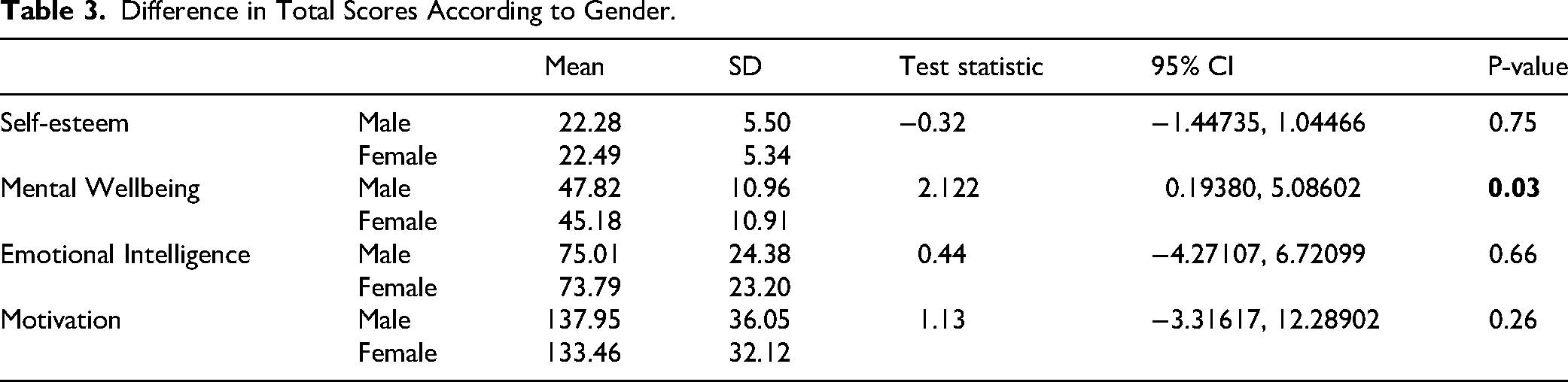
An independent T-test was carried out to determine if there is an association between gender and the study variables. The results of the Levene's test showed equal variances for all variables. The test did not show any significant differences in means according to gender, in which the recorded p-values were > 0.05. The level of mental wellbeing, showed that male students scored significantly higher (p < 0.05) (Table 3).
Difference in Total Scores According to Gender.
A bivariate Pearson correlation was carried out between the total scores of the study variables and age. The results showed a positive linear statistically significant relationship of varying strength between all variables and age (p < 0.05). The strongest correlation was noted between age and emotional intelligence (Table 4).
Correlations Between Study Variables and Age.

An ANOVA test was conducted to determine if there is an association between self-esteem levels and mental wellbeing. The results showed that the association was marginally significant and could be interpreted as highly significant at an alpha level > 0.05. A Welch F-test was conducted to determine if there is an association between self-esteem levels on one hand, and emotional intelligence and motivation scores on the other hand. The Welch test was used due to the inability to satisfy the assumption of homogeneity of variances for the ANOVA. The results showed that the emotional intelligence scores were statistically significantly different according to self-esteem levels (p-values < 0.05). A post-hoc Games-Howell showed a significant difference in emotional intelligence scores between low and normal self-esteem (p = 0.04), and between low and high self-esteem (p = 0.02) (Table 5).
Difference in Total Scores According to Self-Esteem Level.

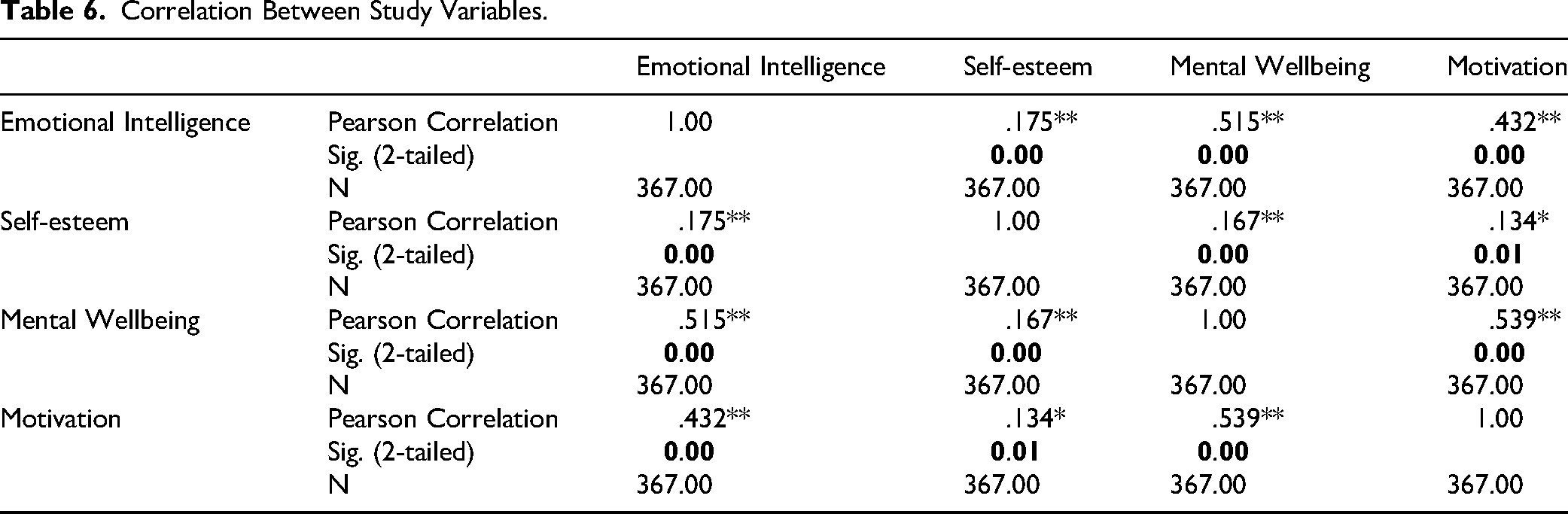
A Pearson's bi-variate correlational analysis was carried out to determine if there is a linear association between the study variables. The results showed a positive, statistically significant linear association of varying strengths between all study variables (P < 0.05). The strongest correlations were noted between emotional intelligence and mental wellbeing (r = 0.515), and between mental wellbeing and motivation (r = 0.539) (Table 6).
Correlation Between Study Variables.
Based on the previous results, multiple structural equation models were conducted to identify how the association between the study variables operates. The results showed that significant pathways exist between the study variables (P < 0.05) (Table 7).
Standardized Path Coefficients.

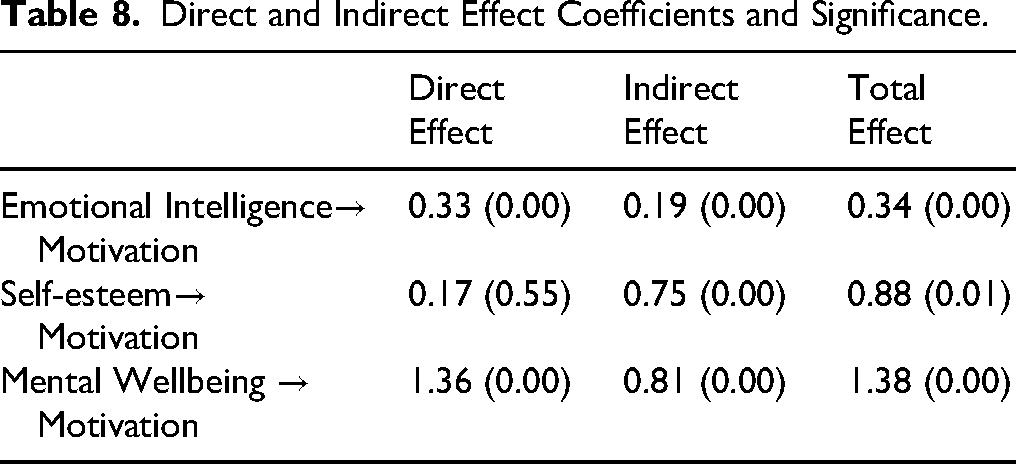
The results further demonstrated that self-esteem had a significant indirect and total effect on motivation, yet no significant direct effect was identified. However, a significant direct effect was observed between emotional intelligence, mental wellbeing, and motivation (p < 0.05). Thus, this indicates that the association between emotional intelligence and motivation is mediated by mental wellbeing and further moderated by self-esteem (Table 8).
Direct and Indirect Effect Coefficients and Significance.
Discussion
In comparison to younger undergraduates, we discovered that older student nurses had better emotional intelligence scores. This is in line with other research (Tang & He, 2023) and may be due to the fact that senior students are more emotionally savvy as they accumulated a greater amount of life and social encounters. The study investigated the intricate relationship between emotional intelligence (EI) and motivation among Saudi nursing students, revealing a substantial positive association, where EI positively predicted motivation. This finding aligns with prior research by Rodriguez-Gonzalez et al. (Rodríguez González et al., 2021). Emotional intelligence, identified as a critical psychological skill for enhancing college students’ learning, enables individuals to manage and control their emotions, leading to a more positive emotional state and increased enthusiasm for learning (Iqbal et al., 2022). This skill is particularly beneficial for undergraduates facing diverse learning challenges, assisting them in cultivating self-awareness, positive learning habits, and mindsets that sustain passion and dedication (Chang & Tsai, 2022). University students who experience additional challenges may encounter emotional distress due to disruptions and stressors. Emotional intelligence plays a crucial role in helping students navigate these challenges, providing increased psychological strength and energy for academic success (Hu et al., 2023; Xu & Choi, 2023). Thus, the study emphasizes the significance of EI in maintaining students’ motivation throughout their academic journey.
The association between emotional intelligence, learning motivation, and self-esteem is another key focus of the study, revealing that EI positively influences learning motivation through the moderating effect of students’ self-esteem. The idea that individuals with higher emotional intelligence tend to possess a more positive self-concept, thereby fostering greater motivation, resonates with the established literature on the subject (Barragan Martin et al., 2021; Xu & Choi, 2023). By balancing positive and negative emotional experiences, EI prevents emotional fatigue, enabling individuals to conquer adversity, build positive psychological assets, and develop a sense of self-esteem (Tang & He, 2023). Higher emotional intelligence in undergraduates facilitates patient problem-solving, active participation in the learning process, and positive boosts to self-esteem (Wan et al., 2023). Elevated self-esteem, in turn, positively impacts mental health, self-worth, confidence, and goal-setting, motivating students on multiple levels (Zhao et al., 2021). Emotional intelligence thus acts as a catalyst for higher self-esteem, with students possessing high self-esteem more likely to employ successful learning techniques, forming the foundation for heightened academic motivation.
Furthermore, the role of mental well-being as a mediator in the emotional intelligence-motivation nexus is in concordance with the previous literature (Juntunen et al., 2022; Rasmussen et al., 2022; Shuo et al., 2022). The present study suggests that the ability to understand and regulate emotions not only contributes to better mental well-being but also serves as a catalyst for increased motivation among nursing students in Saudi Arabia. This adds nuance to the existing body of knowledge by highlighting the importance of mental health considerations in understanding the motivational processes associated with EI. According to Liu et al. (2021) students who believe they have strong mental health are more driven to continue studying and do well in class. This is why it's critical to pay attention to university students’ mental health. According to this research, EI and learning motivation in undergraduates are serially mediated by their own self-esteem and mental health. Prior research has established a link between mental well-being and self-esteem (Auttama et al., 2021). Additionally, self-esteem and learning motivation have been linked in earlier research (Acosta-Gonzaga, 2023; Zhao et al., 2021), as well as mental wellbeing and learning motivation (Rasheed et al., 2022).
Strengths and Limitations
The study design may limit the extent to which the findings can be generalized to other settings or populations. Because of the cross-sectional design, it is not feasible to establish a causal relationship between the variables being studied. To garner a better understanding of the connections among these variables, further research on this topic ought to examine and evaluate mediational frameworks via a longitudinal methodology. The use of self-reporting for parameter measurement, which has a multicollinear influence, is another drawback. SEM was utilized in this study to mitigate these effects, but subsequent research might employ execution or performance methods to obtain more data regarding potential changes in the parameter associations while minimizing subjectivity. A further concern is the convenience sample design. Further research could be pursued using data points from various educational institutions in order to generalize the findings. Undiagnosed psychiatric conditions may not have been captured by this study, which could introduce some variability in the measured psychological constructs.
Implications for Practice
Nursing education programs in Saudi Arabia should strive to create learning environments that not only foster positive emotional experiences but also build resilience and promote psychological growth. A positive yet realistic learning environment can contribute to the development and application of emotional intelligence, which is essential for coping with the demands of nursing education and practice. This includes implementing supportive teaching methods, encouraging open communication, and providing opportunities for collaborative learning. Incorporating structured training modules focused on emotional intelligence—such as self-awareness, self-regulation, empathy, and interpersonal skills—can enhance students’ ability to manage their emotions and maintain motivation. However, it is equally important to recognize that nursing students are frequently exposed to emotionally intense and sometimes traumatic experiences. Therefore, emotional development should not only be about promoting positivity, but also about cultivating resilience, the ability to find meaning in adversity, and the capacity for post-traumatic growth. Drawing on Paul Wong's Positive Psychology framework (Wong, 2021), which emphasizes the integration of suffering and meaning-making in human flourishing, nursing curricula should include interventions that help students reflect on challenges, reframe difficult experiences, and develop a deeper sense of purpose. Strategies such as reflective journaling, narrative writing, mindfulness practices, and meaning-centered group discussions can support this process. Additionally, simulation-based learning, role-playing, targeted educational resources, access to mental health support services, and strong faculty mentorship are essential. These strategies contribute to the holistic development of nursing students, equipping them not only with emotional intelligence but also with the psychological resilience and existential tools necessary to thrive in high-stress healthcare environments and provide compassionate, patient-centered care.
Conclusion
In summary, this research has shed important light on the complex interactions amongst Saudi nursing students’ emotional intelligence, learning motivation, self-esteem, and mental well-being. The findings underscore significant and positive association between EI and motivation, highlighting the pivotal role of emotional intelligence in fostering a positive learning experience. Moreover, the study revealed the moderating function of mental well-being in the relationship between learning motivation and emotional intelligence, emphasizing the importance of considering students’ psychological well-being in educational settings. The validation of previous research findings enhances the robustness of our results and contributes to the broader understanding of these phenomena. The novel finding that self-esteem mediates the association between emotional intelligence and learning motivation adds depth to the current literature, highlighting the need to fosters aspects such as positive self-perceptions in higher education programs.
Footnotes
List of Abbreviations
Acknowledgments
The researchers would like to thank the Deanship of Scientific Research, University of Hail, for funding the publication of this project.

Ethical Statement
The researchers were granted the approval from the King Saud University's Research and Ethics Committee (Name and Number: ECO-R-160). All ethical considerations were applied according to the international Declaration of Helsinki's principles and guidelines, where the students were informed about all details of the study before recruitment and were not forced to be inducted. No disadvantages were reported to students who did not participate, and written informed consent was obtained.
Author Contributions
The manuscript has been conceptualized and designed by MF, YA, and BA. YA wrote the proposal and MF reviewed it and developed the manuscript. All authors worked on validation, data curation, analysis, writing and finalizing the manuscript. SA, RA, LB, SA, and MA equally helped in data validation and analysis as well as reviewing the final draft and rewriting sections in the manuscript.
Funding
The authors received no financial support for the research, authorship, and/or publication of this article.
Declaration of Conflicting Interests
The authors declared no potential conflicts of interest with respect to the research, authorship, and/or publication of this article.
Availability of Data and Materials
The datasets used and/or analyzed during the current study are available from the corresponding author on reasonable request.