




Abstract
Introduction
Emotional intelligence is a crucial factor in managing stress and maintaining overall well-being. Emotions are essential for clinical care quality, as they drive clinical decision making.
Objective
The purpose of this study was to assess the relationship between emotional intelligence and clinical decision making among fourth-year nursing students.
Methods
The study was a cross-sectional study done on a convenience sample of 225 fourth-year nursing students. Data collection was performed by the “Schutte Self Report Emotional Intelligence Test” (SSEIT) and the “clinical decision making scale”.
Results
The analysis revealed that the emotional intelligence mean was 151.3 ± 1.9 (ranging from 33 to 165), which is high. The analysis indicated that the clinical decision making of the participants was high (177.1.3 ± 9.8) (ranging from 40 to 200). Also, the analysis showed that there was a strong positive relationship between nursing students’ emotional intelligence and clinical decision making (r = .70, p = 0.001). Furthermore, the findings revealed that emotional intelligence was a predictor of clinical decision making.
Conclusion
The emotional intelligence and clinical decision making among fourth-year nursing students were high. Also, clinical decision making was found to have strong positive relationship with emotional intelligence.
Introduction
Nurses must navigate emotionally charged situations to ensure safe and effective patient care, necessitating clinical decision making abilities (Kozlowski et al., 2017). Nursing education prioritizes the development of clinical decision making skills as they directly correlate with preventing adverse patient outcomes (Jeppesen et al., 2017). Clinical decision making involves assessing and interpreting cues, making appropriate decisions, and reflecting on outcomes (Tanner, 2006). Clinical learning experiences play a vital role in nursing education by fostering deeper understanding and skill development (Benner, 2015; Tanner, 2006). Despite this, new graduates nursing students often lack advanced clinical decision making and clinical reasoning skills, leaving them inadequately prepared for the complexities of modern healthcare (Kavanagh & Sharpnack, 2021).
Emotional intelligence (EI) has emerged as a critical concept with significant implications for nursing students as the healthcare environment becomes more complicated. According to Salovey and Mayer (1990, p. 189), EI is the “ability to monitor one's own and others’ feelings and emotions, to discriminate among them and to use this information to guide one's thinking and actions.” Excellent nursing practice in such a setting requires a wide knowledge base, high levels of logical decision-making, and efficient problem-solving (Codier & Codier, 2017; White & Grason, 2019). Understanding nursing students’ EI and how emotions are used in practice are crucial initial steps for incorporating EI in the development of safe and quality of nursing care, since preliminary data suggests that low levels of EI have an influence on the quality of care (Noquez, 2019).
EI is essential for making well-reasoned decisions and solving difficulties when students work with complicated, real-world patient situations in a realistic learning environment (Lewis et al., 2019). According to Ballantyne (2020), EI is the ability to identify, control, and use emotional information in managing behaviors and decision-making. Thinking and reasoning are guided by this capacity, which makes it easier to make logical decisions and solve problems that improve safety and quality of nursing care (Cleary et al., 2018). Additionally, EI supports students in making difficult decisions and conversations, particularly in interprofessional team environments where conflicts may occur. It gives them the confidence and abilities to express their concerns clearly and cultivate relationships that are equally respectful, thus averting the escalation of confrontations.
Decision-making and problem-solving skills are vital for survival across all domains, including healthcare. Emotions, alongside other environmental and human factors, significantly impact these processes (Ali & Nageeb, 2020). Given their influence on decision-making, emotions are pivotal for ensuring the quality of clinical care (Alsufyani et al., 2020; Ayed & Amoudi, 2020; Toqan et al., 2022). It's imperative for students to employ sound judgment and clinical decision making abilities to provide safe and effective patient care. Success in their field hinges on finding a balance between these cognitive and emotional processes (Meyer, 2019).
Insufficient emotional intelligence hampers an individual's capacity to manage emotional pressures, leading to reduced effectiveness and hindering the development of emotionally healthy relationships. Consequently, this deficiency diminishes the ability to make rational decisions and tackle real-life complexities, often straining relationships with key individuals (Hodge, 2020). Furthermore, a lack of emotional intelligence can lead to irrational and inaccurate clinical actions, ultimately compromising the quality of patient care and resulting in adverse outcomes (Black, 2019).
The increasingly globalized and competitive landscape places a premium on senior nursing students’ ability to make effective decisions while managing their emotional intelligence. Emotional intelligence serves as a predictor of success in navigating these complex environments and is crucial for achieving positive outcomes in safety and quality of patient care. Therefore, fostering emotional intelligence skills among nursing students is vital for their professional development and effectiveness in delivering high-quality care. Therefore, the aim of the current study was to evaluate the relationship between clinical decision-making and emotional intelligence among fourth-year nursing students.
Literature Review
Emotional intelligence (EI) training should prioritize facilitating thoughtful reflection and effective emotion management, taking into account the specific context and characteristics of nursing students and their educational institutions (Dou et al., 2022). The EI of nursing students significantly impacts their clinical performance, as they demonstrate the ability to recognize, analyze, control, manage, and utilize emotions adaptively (Batran, 2024; Belay & Kassie, 2021). Positive correlations exist between various aspects of EI and components of clinical reasoning and decision-making among nursing students, with emotions guiding their patient care throughout clinical experiences (Meyer, 2023).
Farshi et al. (2015) highlighted the essential role of emotions in decision-making within clinical settings. Conversely, a lack of emotional intelligence leads to inaccurate and irrational therapeutic judgments, resulting in subpar patient care and adverse long-term outcomes (Black, 2019). Moreover, insufficient EI negatively affects students’ mental health (Foster & McCloughen, 2020).
Decision-making involves selecting the best course of action from available options to address a given issue or circumstance (Ehrgott, 2011; Marquis & Huston, 2012). In patient care, students often encounter challenges and provide the final intervention (Maphumulo & Bhengu, 2019). This underscores the importance of robust clinical reasoning and judgment, especially amid increasing responsibilities, to ensure timely and accurate treatment decisions (Manning & DiLollo, 2017).
Supporting students’ emotional intelligence is crucial for enhancing logical decision-making and effective clinical judgment, thereby improving patient care quality, reducing nursing-related stress, and enhancing students’ emotional well-being (Ndawo, 2021). EI guides mental processes and thinking, facilitating rational decisions and effective problem-solving that benefit both patients and healthcare professionals (Cleary et al., 2018).
Navigating emotionally charged environments requires strong emotional intelligence (EI) skills, as emotions play a significant role in guiding judgment and decision-making processes (Kozlowski et al., 2017). Achieving a balance between rationality and emotions is crucial for effective clinical nursing intervention (Akerjordet & Severinsson, 2007). While clinical decision-making and clinical judgment are essential learning outcomes for nursing students to ensure safe and efficient care provision (Benner, 2015), there is limited evidence regarding how emotions influence healthcare professionals’ perception of information, memory recall, and decision-making processes (Christianson, 2020; Hutchinson et al., 2018). Given the critical importance of both emotional intelligence and decision-making in nursing education (Christianson, 2020), nurse educators must deepen their understanding of EI and its relationship with decision-making among nursing students to adequately prepare them for safe clinical practice.
Research Question
What is the relationship between emotional intelligence and clinical- decision making among nursing students?
Methods
Design and Setting
A cross-sectional study was conducted at Arab American University between 2 February and 10 May 2023. Arab American University is the largest nursing school in Palestine, with a student body of 2000 nursing students. The nursing program is four years long and aims to obtain a baccalaureate in nursing. The study involved 500 nursing students in the fourth-year level of the nursing program. The fourth-level students are supposed to be trained in all fields of nursing education, such as medical, surgical, maternity, pediatric, management, psychiatry, and community nursing.
Sample
The initial sample size for this study was determined using Raosoft software, considering a population size of 500 and a response distribution of 50%. With a margin of error of 5% and a confidence interval of 95%, the estimated sample size was calculated to be 218. To mitigate the potential impact of attrition, a convenience sample of 240 students was enrolled. However, despite these efforts, the number of students who ultimately completed the study and returned the questionnaires was 225.
Inclusion and Exclusion Criteria
Students enrolling in the fourth year of the baccalaureate nursing degree met the inclusion requirements. Those enrolling in the first, second, and third year levels were excluded.
Instruments
The instrument consisted of three components, the first of which contained demographic data such gender and age. The Schutte Self-Reported Emotional Intelligence Test (SSEIT) constituted the second portion. Schutte et al. (1998) created the SSEIT to assess emotional intelligence (EI). It has 33 items spread over four subscales: “perception of emotions, social skills, self-management of emotions, and emotion utilization”. Every item has a five-point Likert-type rating system. Higher scores indicated greater EI. The overall scale scores ranged from 33 to 165. With a Cronbach's alpha of 0.90, the instrument is deemed valid and dependable (Ciarrochi et al., 2001; Jonker & Vosloo, 2008; Schutte et al., 1998). For the current study, the Cronbach alpha was 0.88.
The third portion included the self-reported Nursing Clinical Decision-Making Scale (CDMNS), which was created by Jenkins in 1983. There are four domains and forty objects in the CDMNS. These areas included “the search for alternatives or options,” “the evaluation and re-evaluation of consequences,” “the canvassing of objectives and values,” and “the search for information and the unbiased assimilation of new information”. Each of the ten items in each domain is assessed using a five-point Likert scale. Both the overall mean score and the mean score on the subscales can be used to evaluate the scores. The scale's high score demonstrated a strong perception of decision-making. In the scale’ originally study, the Cronbach's alpha value was found to be 0.83 (Jenkins, 1983). It is used in many studies and the entire scale's Cronbach's alpha value was above 0.78 (Abu Arra et al., 2023; Ayed et al., 2023; Batran et al., 2022; Edeer & Sarıkaya, 2015). Cronbach's alpha for the current study was 0.88.
Data Collection Procedure
Once approval was obtained to conduct the study, nursing students were recruited to participate. The researcher met with the vice dean of the nursing school to explain the study's purpose. Upon invitation from the vice dean, the researcher provided interested students with information about the study. Subsequently, the purpose of the study was discussed with the nursing students. The researcher then administered paper-based questionnaires in English, as all participants studied in English.
Ethical Considerations
Ethical approval was taken from the Arab American University The researcher clarified the study's goal to the students and they can leave the study at any time. Students who were approved to participate assigned the informed consent. Participants were informed that involvement in the study is voluntary and will not influence their educational experience.
Data Analysis
Statistical Package for Social Sciences (SPSS) version 26 was adopted for entering data. No missing data or outliers. Descriptive statistics (frequencies, percentages, mean, and standard deviation) were utilized to describe the study variables. Multiple linear regressions were adopted to assess the predictors of clinical decision making.
Results
Participants’ Characteristics
Two hundred and twenty-five nursing students out of 240 nursing students completed the study, with a response rate of 93.8%. The analysis revealed that the majority of the participants, 175 (77.8%), were 22 or less, with 133 (59.1%) being female. Half of them, 113 (50.2%), whose father's occupation is working, and 108 (48.0%), whose mothers are housewives, Approximately half of them, 105 (46.7%), were middle in birth order, as seen in Table 1.
Demographic Characteristics of the Participants (N=225).

The analysis indicated that the emotional intelligence mean was 151.3 ± 1.9 (ranging from 33 to 165), which is high. Also, “perception of emotions” was the highest domain (47.1 ± 1.1), while “utilizing emotions” was the lowest (27.6 ± 0.7). According to clinical decision making, the analysis revealed that the clinical decision making of nursing students was high (177.1.3 ± 9.8). Also, “Search for alternatives or options” was the highest domain (47.7 ± 2.0), while ““Canvassing of objectives and values” was the lowest (41.4 ± 7.1), as seen in Table 2.
Distribution of Emotional Intelligence and Clinical Decision Making (N=225).

A Pearson correlation test was applied to test the relationship between emotional intelligence and clinical decision making. The analysis showed that there was a strong positive relationship between nurses’ emotional intelligence and their clinical decision making (r = 0.70, P < 0.05). Also, most domains of emotional intelligence of nursing students revealed similar results with clinical decision making (P < .05), as seen in Table 3.
The Relationship Between Emotional Intelligence and Self-Esteem (N=225).
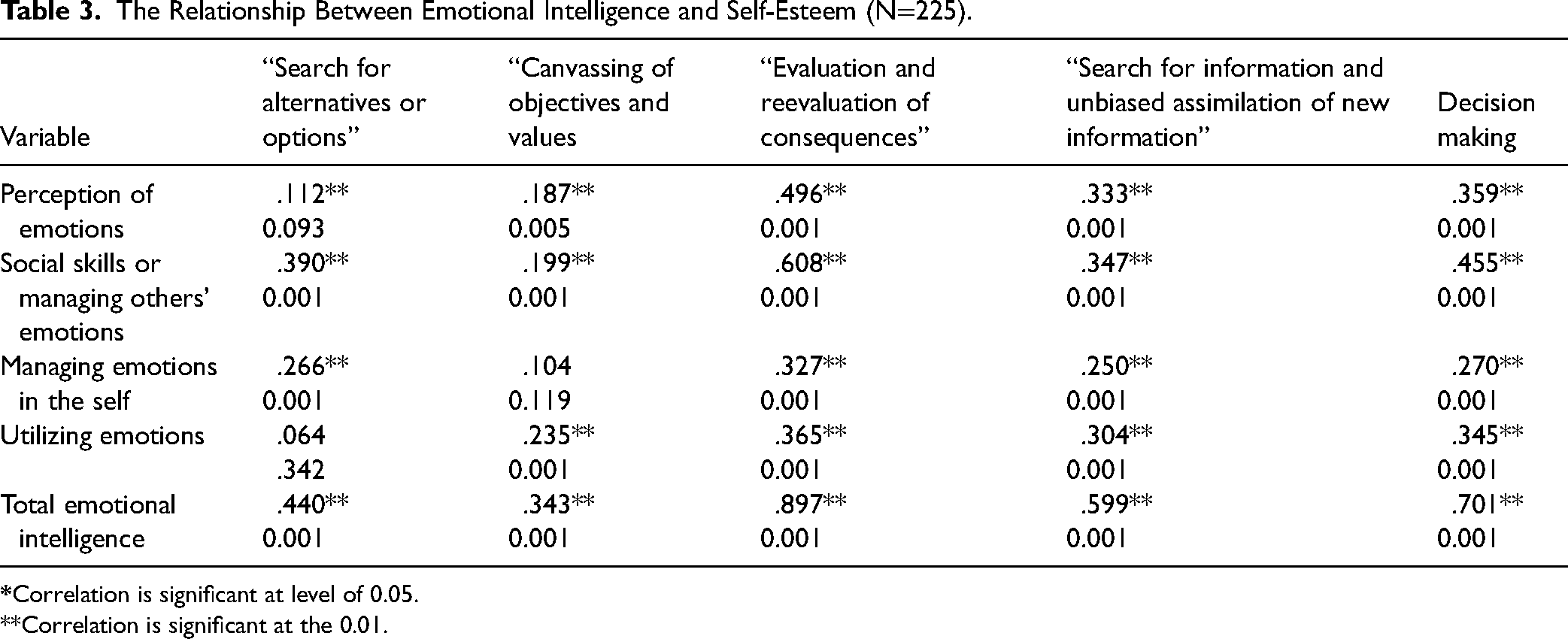
**Correlation is significant at the 0.01.
A multivariable regression analysis was utilized to identify the clinical decision making predictors among nursing students. The independent variables (age, gender, mother’s occupation, father’s occupation, birth order, and emotional intelligence) were entered into the model of predictors. The overall model was statistically significant (p < 0.001, R = 0.720, R2 = 0.519, adjusted R2 = 0.505). This stated that 72.0% of the variance in clinical decision making was illuminated by the whole model.
The findings revealed that emotional intelligence was the predictor of clinical decision making (β= 3.17, p < 0.01) illustrating that a one-point increment in emotional intelligence was associated with a 3.17 increase in clinical decision making, as seen in Table 4.
Predictors of Clinical Decision Making: Multiple Linear Regression.

CI= Confidence Interval, b= Unstandardized beta, B= Standardized beta.
*Significant at p < 0.05.; ** Significant at p < 0.01.
Discussion
EI is the capacity to recognize, make use of, and control feelings in order to engage and communicate with others. The current study's findings demonstrated that fourth-year nursing students possessed a high emotional intelligence quotient (EI), signifying their capacity to recognize and understand both their own and other people's emotions. It is anticipated that the nursing students participating in the study will be able to manage the challenges and expectations they encounter on a daily basis in the real world. The effectiveness of clinical teaching as well as the application of instructional strategies that support nursing students in developing their emotional intelligence skills during their academic training may be responsible for this result. According to previous studies (Abou Hashish & Bajbeir, 2018; Almansour, 2023; ALmegewly et al., 2022), this result was consistent. Furthermore, Štiglic et al. (2018) found that students studying nursing have higher emotional intelligence than those studying engineering. However, this result was inconsistent with study conducted in Egypt by Mahmoud et al. (2013), who found that most of the students in the second, fourth, sixth, and eighth semesters had moderate levels of emotional intelligence overall (90.0%, 86.4%, 87.6%, and 92.4%, respectively). In the same spirit, Benson et al. (2010) discovered that most undergraduate nursing students have average to moderate emotional intelligence throughout the course of four years. The cultural and educational settings in which these researches were carried out must be taken into account. Emotional intelligence assessment and interpretation may be impacted by cultural variations in emotional expression and perception. The development of emotional intelligence in nursing students may also be impacted by differences in curriculum material and instructional strategies.
Also, the results demonstrated a high degree of clinical decision making among the participating nursing students. This result was in line with other research that shown a high level of clinical decision making among nursing students (Dicle & Edeer, 2013; Ho et al., 2013; Özen et al., 2017; Özden et al., 2018). This conclusion, however, differed from that of the Arkan et al. (2022) study, which concluded that the clinical decision-making abilities of nursing students were moderate. Furthermore, the majority of nursing students demonstrated a moderate degree of clinical decision making (Abou Ramadan & El-Demerdash, 2017). It's important to recognize that clinical decision-making is multifaceted construct influenced by various individual, educational, and contextual factors. Therefore, discrepancies in findings across studies may reflect differences in measurement methods, sample characteristics, educational approaches, and cultural contexts.
This study found a very statistically significant association between emotional intelligence and decision making in nursing students. This conclusion was consistent with study conducted by Ragab et al. (2022) who indicated highly statistically significant correlations between emotional intelligence and problem solving among nursing students. Also, a positive relationship was also found between the EI and overall clinical reasoning (Meyer, 2023). However, this finding was in disagreement with Kaya et al. (2018) who found that there was no significant relationship between emotional intelligence and critical thinking disposition of nursing students. These inconsistencies highlight the complexity of the relationship between emotional intelligence and various cognitive abilities, such as decision-making and critical thinking, among nursing students. It's essential to consider factors such as measurement tools, sample characteristics, and cultural contexts when interpreting these findings. Additionally, the multifaceted nature of emotional intelligence and cognitive abilities suggests that their relationships may vary depending on the specific aspects being examined.
Limitations
This study is subject to several limitations that may have influenced its findings. Firstly, the reliance on self-reported questionnaires introduces the potential for reporting bias, as individuals may interpret questionnaire items differently based on their personal perspectives. Additionally, the study's cross-sectional design means that it captures information on emotional intelligence and clinical decision-making at a single point in time. Given that these constructs may fluctuate over time, longitudinal data collection would provide a more comprehensive understanding of their dynamics and how they relate to each other. Moreover, the convenience sampling method employed and the restriction of data collection to a single university, Arab American University University, limit the generalizability of the findings.
Conclusions
Fourth-year nursing students had high levels of emotional intelligence and clinical decision making. Also, clinical decision was found to have a relatively favorable association with emotional intelligence. Furthermore, the findings revealed that emotional intelligence was the predictor of clinical decision making. Emotional intelligence training is vital for nursing students since it enhances both their personal and professional life, as well as their clinical decision making.
Recommendations of the Study
Emotional intelligence concepts and domains ought to be taught in nursing curricula in order to promote clinical decision making among nursing students and equip them to work with patients in a range of clinical settings. Provide ongoing training and education for nursing students on emotional intelligence and its impact on clinical decision-making. This may involve workshops, seminars, or online courses aimed at enhancing nurses’ self-awareness, empathy, and interpersonal skills, which are essential components of emotional intelligence. Developing guidelines, protocols, or interventions based on evidence to support nursing students in optimizing their emotional intelligence and decision-making abilities in clinical settings. Further studies are need to employ more diverse sampling methods to include multiple institutions and longitudinal study designs. This broader scope enhances the generalizability of findings and ensures that nursing practice recommendations are applicable across different contexts.
Supplemental Material
sj-docx-1-son-10.1177_23779608241272459 - Supplemental material for The Relationship Between the Emotional Intelligence and Clinical Decision Making Among Nursing Students
Supplemental material, sj-docx-1-son-10.1177_23779608241272459 for The Relationship Between the Emotional Intelligence and Clinical Decision Making Among Nursing Students by Nida Jawabreh in SAGE Open Nursing
Supplemental Material
sj-docx-2-son-10.1177_23779608241272459 - Supplemental material for The Relationship Between the Emotional Intelligence and Clinical Decision Making Among Nursing Students
Supplemental material, sj-docx-2-son-10.1177_23779608241272459 for The Relationship Between the Emotional Intelligence and Clinical Decision Making Among Nursing Students by Nida Jawabreh in SAGE Open Nursing
Footnotes
Acknowledgements
The author would like to express their thanks to the nursing students who participated in the study
Consent for Publication
I affirm that this work is original and has not been published elsewhere, except as noted in the manuscript.
Data Availability Statement
The datasets generated during and/or analyzed during the current study are available from the corresponding author on reasonable request.
Declaration of Conflicting Interests
The author declared no potential conflicts of interest with respect to the research, authorship, and/or publication of this article.
Ethics Approval and Consent to Participate
Ethical approval for this study was obtained from Arab American University Palestine (2023/A/124) Written informed consent was obtained from all subjects before the study.
Funding
The author received no financial support for the research, authorship, and/or publication of this article.
Use of AI Software
I affirm that the integrity and originality of this work are entirely my own and are not influenced by any AI technology.

Supplemental Material
Supplemental material for this article is available online.
References
Supplementary Material
Please find the following supplemental material available below.
For Open Access articles published under a Creative Commons License, all supplemental material carries the same license as the article it is associated with.
For non-Open Access articles published, all supplemental material carries a non-exclusive license, and permission requests for re-use of supplemental material or any part of supplemental material shall be sent directly to the copyright owner as specified in the copyright notice associated with the article.
