




Abstract
Background
Researchers have traditionally used commercial databases such as Scopus and Web of Science to track scholarly literature and ascertain the impact of publications in terms of citations. In recent years, new open data sources, such as OpenAlex, have appeared, which broaden the array of tools accessible for exploring academic literature.
Objective
This study compares the coverage of scholarly nursing literature by OpenAlex, Scopus, and Web of Science in terms of journals, articles, and citations indexed.
Methods
A list of nursing journals indexed by OpenAlex, Scopus, and Web of Science was compiled to compare the titles covered in terms of country of publication, publisher, and open access availability. Citations of nursing articles published between 2000 and 2022 in the three sources were also analyzed.
Results
OpenAlex indexes nearly all the journals covered by Scopus and Web of Science, plus additional sources from countries outside the Western world. In terms of individual articles, OpenAlex indexes more citations than Scopus and Web of Science.
Conclusion
OpenAlex is a comprehensive source for tracking nursing literature. Currently, its main limitation lies in the lack of a user-friendly web interface, as the need to use an API for data retrieval can complicate the search process for end users.
Introduction
Researchers use bibliographic databases to track scholarly literature and to ascertain the impact of publications in terms of citations. Historically, nursing scholars have commonly relied on two commercial databases, Scopus and Web of Science, as primary sources to monitor literature within the field (De Groote & Raszewski, 2012; Powell & Peterson, 2017). In recent years, several data sources have appeared that broaden the array of tools accessible for exploring academic literature. These new sources include Dimensions, Google Scholar, and Microsoft Academic. In contrast to commercial databases, some of these new tools are openly available to the public.
OpenAlex (openalex.org), named after the ancient Library of Alexandria, is one of the new open databases. It was launched in early 2022 to address concerns raised when Microsoft announced that it was discontinuing Microsoft Academic (Priem et al., 2022). In a news item in Nature, OpenAlex was described as “an ambitious free index of more than 200 million scientific documents that catalogs publication sources, author information and research topics” (Chawla, 2022). Sorbonne University, for instance, decided to discontinue its subscription to Web of Science to redirect its efforts toward the exploration of open, free, and participative tools, in particular by using OpenAlex (Sorbonne University, 2023).
So far, few studies have assessed the strengths and limitations of OpenAlex and none has evaluated its effectiveness in tracking nursing literature. Pioneering research (Akbaritabar et al., 2023) suggests that it is at least as good as Scopus for literature reviews. This study aims to measure the coverage of nursing literature in OpenAlex compared to that of Scopus and Web of Science, and to ascertain its potential to track the impact of publications in terms of citations.
Review of Literature
Two previous studies have analyzed the coverage of the nursing literature by Scopus and Web of Science. De Groote and Raszewski (2012) compared the h-index, a metric that measures productivity and citation impact, provided by Scopus, Web of Science, and Google Scholar for a sample of 30 nursing scholars. They concluded that Scopus indexed the greatest number of nursing publications, although Google Scholar found the most citing references. Nevertheless, all three databases found unique and duplicate citations. In a subsequent study, Powell and Peterson (2017) analyzed the coverage of nursing journals by Scopus and Web of Science. The analysis was supplemented with a comparison of the 2014 publications of a sample of 61 nursing faculty. They concluded that Scopus offered significantly higher journal coverage than Web of Science. These results are consistent with those of a global comparison of Scopus and Web of Science conducted by Mongeon and Paul-Hus (2016), who concluded that, despite Scopus's larger journal coverage in all fields, both databases showed biases, with an overrepresentation of English-language journals to the detriment of other languages.
In recent years, several studies have explored whether new bibliographic databases can replace traditional citation indexes such as Scopus and Web of Science. Martín-Martín et al. (2018) observed that, for a sample of nearly 2.5 million citations, Google Scholar consistently found the largest percentage of citations across all areas with substantial extra coverage compared to Scopus and Web of Science. In a subsequent update and extension of this study based on a sample of more than three million citations, Martín-Martín et al. (2021) confirmed that Google Scholar and Microsoft Academic were more comprehensive than Scopus and Web of Science. However, both studies highlighted the limitations of Google Scholar in terms of usage. There is no reliable, scalable method to extract data from Google Scholar and the bibliographic information provided by the platform is very limited, which reduces the practical suitability of this source for large-scale citation analyses. Harzing (2019) concurred that both Google Scholar and Microsoft Academic had substantively higher coverage than Scopus and Web of Science.
Visser et al. (2021) compared the coverage of scientific documents published between 2008 and 2017 in five multidisciplinary bibliographic data sources: Scopus, Web of Science, Dimensions, Crossref, and Microsoft Academic. In terms of size, Microsoft Academic offered by far the most comprehensive coverage of the scientific literature, indexing many more documents than the other data sources. However, in terms of the quality of citation links, the more established data sources, Scopus and Web of Science, outperformed the other recent alternatives. Within the health sciences, Liang et al. (2021) explored the coverage and citation quality of 30 million PubMed documents across five freely available data sources. Dimensions emerged as the most comprehensive, with Microsoft Academic following closely behind.
In addition to facilitating literature tracking, bibliographic databases play a pivotal role in bibliometric studies, which seek to map the structure and development of scientific knowledge within a given discipline through the analysis of large volumes of scholarly publications. Given the variability in coverage, indexing practices and data formats across databases, their critical evaluation is essential to ensure the validity and reproducibility of bibliometric analyses (Donthu et al., 2021). In response to the growing interest in bibliometric research in the health sciences, efforts have been made to enhance the methodological rigor of such studies. Notably, Koo and Lin (2023) proposed the Preferred Reporting Items for Bibliometric Analysis (PRIBA) guidelines, comprising 25 items adapted from the PRISMA framework, to improve reporting quality and transparency. However, a review of the 100 most-cited bibliometric studies in health and medicine published between 2019 and 2021 revealed a substantial reporting gap: only 25% of these studies included background information on the databases employed.
In sum, previous research concurs that Google Scholar and Microsoft Academic have better coverage than Scopus and Web of Science. However, Google Scholar has limited functionalities and Microsoft Academic was discontinued in early 2022. OpenAlex is based on Microsoft Academic, with its creators making a huge effort to normalize and disambiguate the bibliographic information with additional sources (Priem et al., 2022). This study aims to measure the coverage of nursing literature in OpenAlex and its usefulness to track publication metrics in the field. The research aims to answer the following research questions:
How extensively are nursing journals covered by OpenAlex? How does OpenAlex's coverage of nursing journals compare to that of Scopus and Web of Science? Are there any differences in the coverage of nursing journals by the three sources in terms of country of publication, publisher and open access availability? How does the citation count for nursing articles in OpenAlex compare to the citation count of the same articles in Scopus and Web of Science?
Methods
Journal-Level Comparison
In May 2023, lists of nursing journals indexed by Scopus, Web of Science, and OpenAlex were retrieved from the following sources:
Scopus: https://www.scopus.com/sources.uri The database listed 638 active nursing journals according to the All Science Journal Classification (ASJC) employed by the database to classify journals. Web of Science Core Collection: https://mjl.clarivate.com/collection-list-downloads The database listed 190 nursing journals indexed in the Science Citation Index Expanded (SCIE, 125 journals), the Social Sciences Citation Index (SSCI, 123 journals), and the Emerging Sources Citation Index (ESCI, 63 journals). The sum of journals exceeds 190, since 121 journals were simultaneously indexed in “Nursing” categories in the SCIE and the SSCI. OpenAlex
Nursing journals indexed in OpenAlex (under code “C159110408”) were retrieved through its public application programming interface (API) using the R package openalexR. The search retrieved 3,868 journals. An API is a software interface for two computer programs to communicate with each other. R is a programming language for statistical computing and graphics. The core R language is augmented by extension packages that contain reusable code. OpenalexR (Aria & Le, 2023) is one such package that helps interface with the OpenAlex API to retrieve bibliographic information about publications, authors, venues, institutions and concepts. The code employed is openly available as explained below.
All journals indexed in any of the three databases were compiled into a single list of nursing journals. The match between journals in the three lists was made through the International Standard Serial Number (ISSN), an eight-digit number used to uniquely identify serial publications.
To detect potential geographical variations in journal coverage among the three sources, the countries of publication provided by OpenAlex were categorized according to the geographical regions defined by the United Nations Statistics Division in its publications and databases (United Nations, 2023). The publisher of each journal was also obtained from OpenAlex to identify variability in publisher representation across databases.
Finally, to identify differences in open access coverage, the compiled list of nursing journals was compared against the Directory of Open Access Journals (DOAJ), a website that hosts a community-curated list of open access journals from around the world. The DOAJ list is available at https://doaj.org/csv.
Discrepancies in subject classification across bibliographic databases pose a significant challenge when comparing their coverage of academic literature. This issue arises because Scopus, Web of Science, and OpenAlex each employ distinct and sometimes inconsistent systems for categorizing journals. For this study, only the nursing categories defined by each database were used. Despite the acknowledged inconsistencies, combining all journals indexed in the three sources helps to capture the full breadth of nursing-related literature.
Article-Level Comparison
To assess the degree to which individual articles and citations were indexed in Scopus, Web of Science, and OpenAlex, all articles published between 2000 and 2022 containing the term “nursing” in the title and having received at least one citation at the time of data gathering were retrieved from each source. The search was limited to articles with a digital object identifier (DOI) to enable cross-database matching. A DOI is a persistent identifier used to uniquely identify information resources, such as journal articles, standardized by the International Organization for Standardization (ISO). The search equations were as follows:
Scopus: TITLE (nursing) AND DOI (10.*) AND PUBYEAR>1999 AND PUBYEAR<2023 AND (LIMIT-TO(SRCTYPE,"j”)) Since Scopus does not allow a search for articles with a certain number of citations, all records were downloaded and uncited articles were subsequently excluded. Web of Science: TI=(nursing) AND DT=(Article OR Editorial Material OR Letter OR Review) AND PY=(2000–2022) AND DO=(10.*) As with Scopus, all records were downloaded and articles without citations were removed. OpenAlex
As in the case of journals, article records in OpenAlex were retrieved through its public API using the R package openalexR. The code used for data collection is openly available, as explained below.
Source Code and Data Availability
The R code to retrieve data from OpenAlex is available at https://github.com/angbor09/nursing/. The site includes the two datasets resulting from this research in comma-separated value (CSV) format. The journal dataset includes, for each journal, the ISSNs, the title in each source, the subject category in each source, the country of publication and the publisher as provided by OpenAlex, and the indication of whether the journal is listed in DOAJ. The article dataset includes, for each article, the title, the DOI, the year of publication provided by OpenAlex and the count of citations received according to OpenAlex, Scopus, and Web of Science at the time of data collection.
Results
Journals
After combining the nursing journals listed by OpenAlex, Scopus, and Web of Science, a list of 4,150 journals classified in the field of nursing by at least one of the three databases was compiled. Table 1 shows the number of journals indexed by each source.
Nursing Journals Covered by OpenAlex, Scopus, and Web of Science.
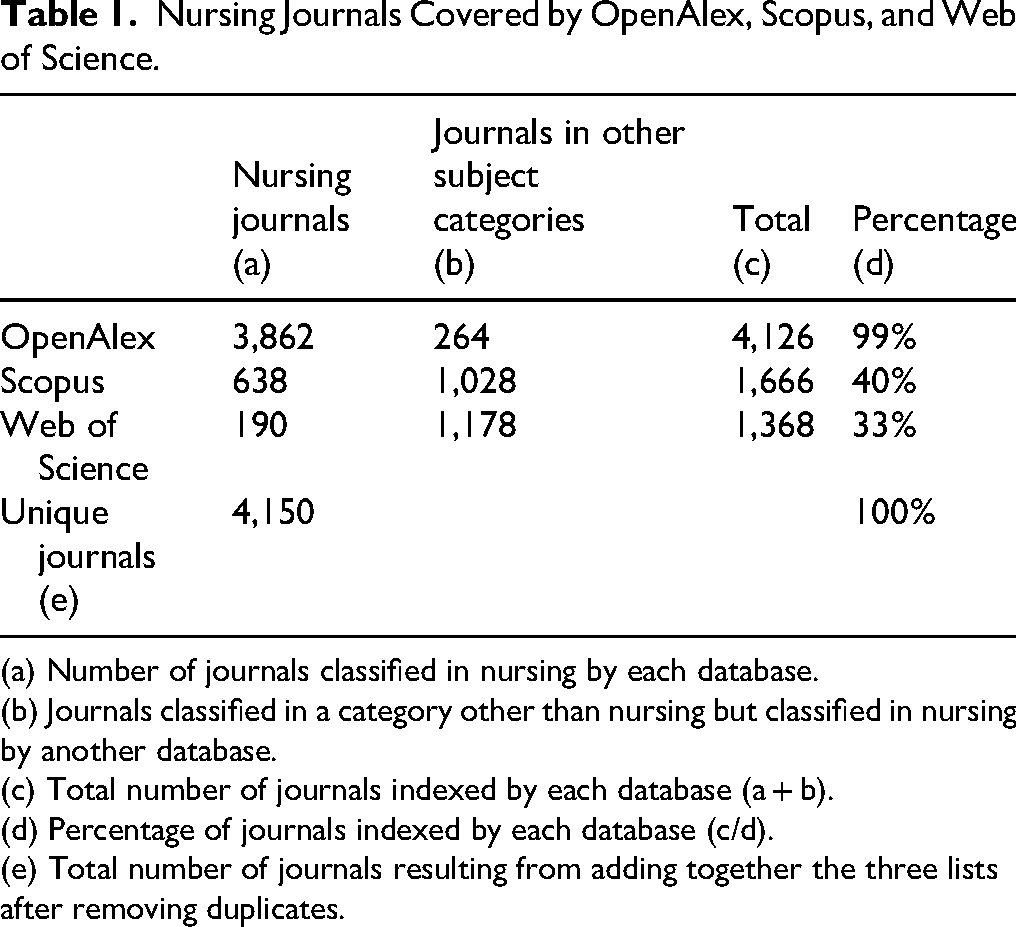
(a) Number of journals classified in nursing by each database.
(b) Journals classified in a category other than nursing but classified in nursing by another database.
(c) Total number of journals indexed by each database (a + b).
(d) Percentage of journals indexed by each database (c/d).
(e) Total number of journals resulting from adding together the three lists after removing duplicates.
The results reveal substantial differences in the subject classification of journals by the three databases. Although the number of nursing journals listed in Scopus (638) seems to be more than three times those in Web of Science (190), most nursing journals in Scopus are indexed in Web in Science, albeit in other subject categories, such as Nutrition & Dietetics (71 journals), Health Care Sciences & Services (25), Geriatrics & Gerontology (17), Psychiatry (16), Public, Environmental & Occupational Health (16), Endocrinology & Metabolism (14), Food Science & Technology (12), Medical Ethics (10), or Rehabilitation (10). The other way around, just 13 journals classified in nursing in Web of Science were classified in other Scopus categories, mostly in Medicine.
OpenAlex is, by far, the source that lists the most nursing journals. However, this apparent broader coverage of the field is partially due to the large number of keywords assigned to each journal in OpenAlex (frequently each journal has six to eight subject keywords) compared to the tighter use of subject categories in Scopus and Web of Science, where journals are frequently assigned to just one or two categories.
Figure 1 shows the overlap among the three databases. The circles proportionally convey the share of journals indexed by each source. The Venn diagram shows the bigger size of OpenAlex in terms of journals covered and the large overlap between Scopus and Web of Science, although the first is more extensive. The Figure was built with the R package eulerr (Larsson, 2021).
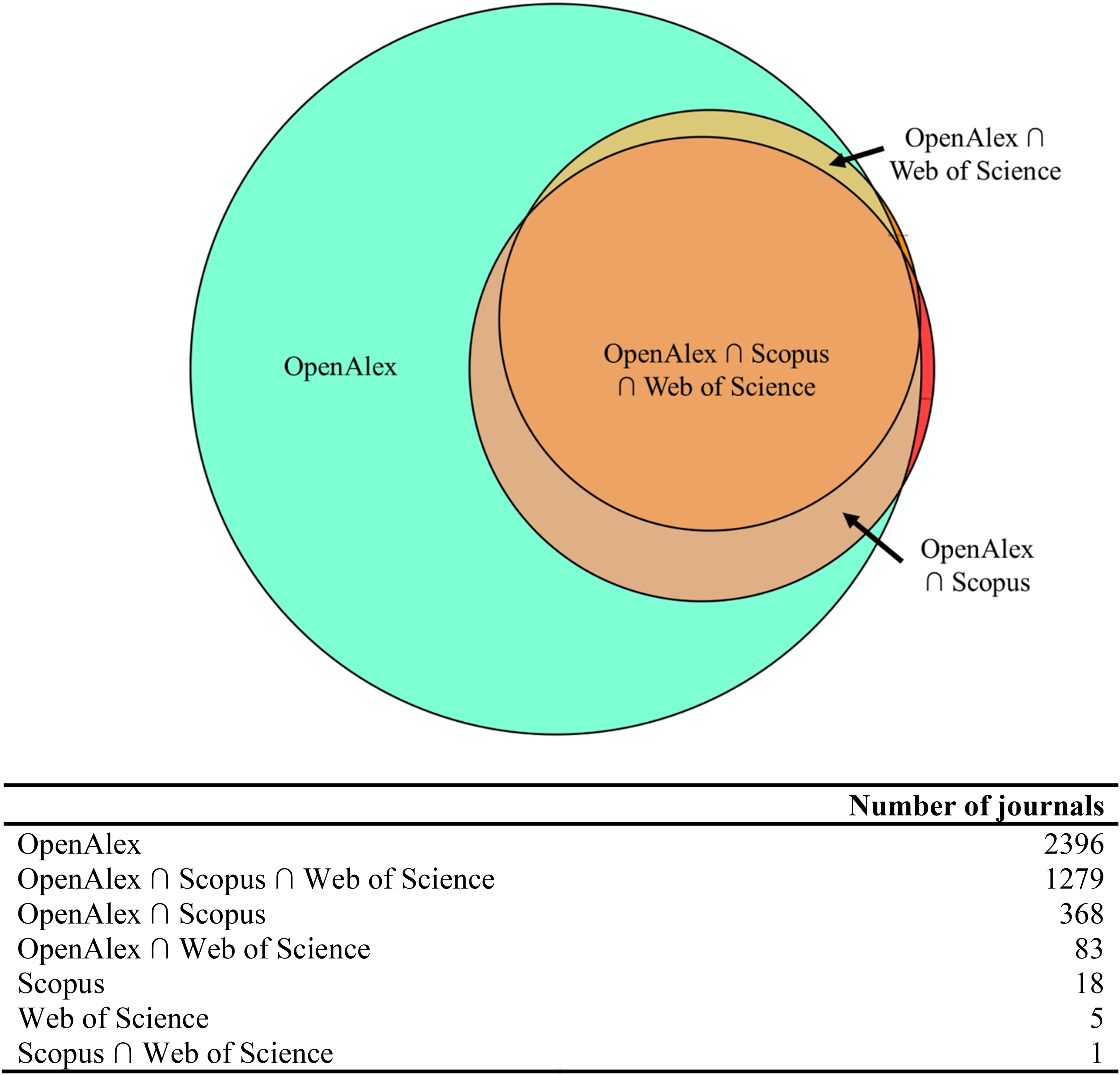
Overlap in the coverage of nursing journals by OpenAlex, Scopus, and Web of Science.
This study aimed to explore whether the broader coverage of the field in OpenAlex could be attributed to the presence of additional nursing journals from countries and publishers not covered by Scopus and Web of Science. As shown in Table 2, most nursing journals indexed by Scopus (80%) and Web of Science (83%) are published either in North America or Northwest Europe. However, in OpenAlex these two regions account for just 63% of the journals covered. In contrast, 22% of the journals indexed by OpenAlex are published in Asia (mostly in Indonesia and India), a region that only accounts for 8% of the journals indexed in Scopus and 6% of those in Web of Science.
Countries of Publication of Nursing Journals in OpenAlex, Scopus, and Web of Science.

n refers to the number of journals for which the country of publication was available in OpenAlex. Journals without information on the country of publication were excluded from the analysis.
Table 3 shows the percentage of nursing journals in each database published by the top five largest academic publishers worldwide (Nishikawa-Pacher, 2022). In OpenAlex, these five publishers account for 42% of the journals indexed, whereas they publish 51% of those indexed in Scopus and 53% of those in Web of Science.
Publishers of Nursing Journals in OpenAlex, Scopus, and Web of Science.

n refers to the number of journals for which the publisher was available in OpenAlex. Journals without information on the publisher were excluded from the analysis.
The additional coverage in OpenAlex of nursing journals published outside the West and by small publishing houses does not translate into a larger coverage of open access journals. In OpenAlex, open access journals are 19% of those indexed, compared to 27% in Scopus and Web of Science.
Articles and Citations
To determine the extent to which individual articles and citations are indexed by each database, articles with a DOI published between 2000 and 2022 that included the term “nursing” in the title and had received at least one citation at the time of data gathering were retrieved from each source. The results are not strictly comparable since the search options vary slightly in the three sources. Nevertheless, it should be noted that Web of Science was the source that retrieved the most outputs at 79,472 articles, compared to 68,146 in OpenAlex and 58,157 in Scopus.
After matching the lists of articles retrieved from each source, a list of 31,740 articles that were simultaneously available in the three sources was compiled. Figure 2 shows the chronological evolution in the number of articles published and the number of citations received by those articles per year of publication. The number of articles increased steadily, rising from less than 500 articles published per year up to 2003 to 3,589 articles in 2021. Irrespective of the year of publication, OpenAlex is the source that retrieved the most citations to these articles, followed by Scopus and Web of Science.

Nursing Articles and Citations by Year of Publication.
At the Time of Data Collection, Each Article had Received on Average 23.2 Citations According to OpenAlex (Median = 11), Compared to 19.9 Citations in Scopus (Median = 10) and 17.7 Citations in Web of Science (Median = 9), as Shown in Figure 3.

Citations of Nursing Journals by Data Source (Outliers Have Been Removed to Facilitate Comparison).
Discussion
The results of the study show that OpenAlex is a comprehensive source to track nursing scholarly literature. OpenAlex indexes nearly all journals covered by Scopus and Web of Science plus additional sources not covered by these citation indexes. This broader coverage offers nursing researchers access to a wider array of publications, enhancing the ability to explore interdisciplinary studies and emerging topics in the field. However, this result should be treated with caution since the subject classification of journals varies significantly from one database to another. These discrepancies can lead to differences in how journals are categorized, potentially affecting the comprehensiveness and accuracy of database comparisons.
In addition to the inconsistent application of subject keywords in OpenAlex, the database's broader coverage can be attributed to the greater geographical diversity of the journals it indexes. While Scopus and Web of Science have been criticized for favoring journals from the Western world (Mongeon & Paul-Hus, 2016), OpenAlex includes many additional titles from underrepresented regions, particularly Asia, thereby increasing the visibility of diverse perspectives in global nursing scholarship.
This expanded coverage is not only crucial for researchers based in non-Western countries but also for international collaborations that rely on inclusive and representative literature. Leading nursing schools, research institutes and funding agencies across the globe emphasize the importance of global health research and cross-cultural comparisons. When bibliographic databases underrepresent journals from specific regions, researchers from Western institutions also face limitations in accessing valuable data and perspectives, potentially compromising the quality and inclusivity of collaborative work.
OpenAlex's inclusion of journals published by smaller, often regional publishers—beyond the dominant five academic publishing groups—further enhances its utility. By incorporating niche, region-specific, and less mainstream journals, OpenAlex contributes to a more comprehensive and equitable landscape for nursing research, supporting both local relevance and global engagement.
The additional sources indexed by OpenAlex are not necessarily available in open access. Although OpenAlex covers nearly all the journals indexed by Scopus and Web of Science, including those in open access, OpenAlex shows the lowest percentage of open access journals. This suggests that the additional sources that are covered are of a closed nature.
For individual articles, the number of citations retrieved by OpenAlex is higher than those retrieved by Scopus and Web of Science. This result is consistent with the fact that OpenAlex covers more sources, that is, the more journals are indexed, the more citations to individual articles are compiled. However, the advantage in the number of citations retrieved in OpenAlex is not as great as the larger number of journals covered would suggest. This confirms that some additional journals indexed by OpenAlex are vaguely related to nursing and the articles they publish offer few additional citations. These journals may include articles that are less central to nursing research or that attract fewer citations overall.
Although more extensive coverage in a bibliographic database may appear inherently advantageous, it is important to recognize that coverage alone does not guarantee quality. Bibliographic databases also serve as gatekeepers by applying selection criteria intended to ensure a baseline level of scholarly rigor. These criteria often include formal peer-review processes, editorial standards, or publishing regularity, all of which aim to maintain the credibility and reliability of indexed content.
In this context, more inclusive databases such as OpenAlex may provide broader access to global scholarship, but they may also include journals that have not undergone the same level of vetting as those found in more selective databases like Scopus or Web of Science. Therefore, while expanded coverage can enhance representativeness and inclusivity, it is equally important to assess the quality assurance mechanisms in place. For this reason, providing background information on the databases used in bibliometric studies—such as the number of journals and records indexed, their selection policies and subject classification methods—is essential for transparency and for interpreting the scope and limitations of the findings (Koo & Lin, 2023).
OpenAlex has expanded the range of tools available to nursing researchers exploring scholarly literature. It covers a broad spectrum of disciplines, making it particularly valuable for interdisciplinary research in fields such as nursing, public health, social sciences, and healthcare policy. Unlike commercial databases, OpenAlex is fully open access, allowing researchers to access it without the barriers of subscriptions, licensing fees, or paywalls. It provides comprehensive metadata on authors, publication venues, keywords, and references, which facilitates the discovery of relevant literature and enables the tracking of citation relationships, collaborations, and emerging research trends. Additionally, OpenAlex's API allows users to download large datasets or integrate data into custom tools, enhancing its utility for conducting systematic reviews, bibliometric analyses and studies of citation networks, and publication patterns.
Strengths and Limitations
This study is the first to evaluate the effectiveness of OpenAlex in tracking nursing literature. It systematically compares OpenAlex's coverage of nursing research with that of Scopus and Web of Science, while also assessing its ability to track the impact of publications through citation analysis. The article provides a comprehensive overview of both the advantages and limitations of OpenAlex. However, the use of distinct and inconsistent subject classification systems across the databases may introduce potential bias into the results.
Implications
OpenAlex has the potential to transform how nursing researchers access, analyze, and engage with scholarly literature. Its open access, interdisciplinary, and transparent nature makes it a useful tool for exploring citation networks, tracking research trends and conducting systematic reviews. By incorporating OpenAlex into their research workflows, nursing researchers can access a wealth of scholarly data, collaborate more effectively and stay at the forefront of emerging research trends in nursing and related fields.
Conclusion
This investigation shows that OpenAlex is a comprehensive source for tracking nursing literature. OpenAlex is an open source that indexes more journals and citations than Scopus and Web of Science, providing a broader scope of scholarly content. At present, its main limitation lies in the lack of a user-friendly web interface, as the need to use an API for data retrieval can complicate the search process for end users. However, this limitation is expected to disappear soon, which will consolidate OpenAlex's position as an open alternative to commercial databases.
Footnotes

Author Contributions
All authors made substantial contributions to this research. They were all actively involved in the conception, study design, execution, data acquisition, analysis, and interpretation. Finally, all authors approved the final version of the article and take full responsibility for all aspects of the work.
Funding
The authors received no financial support for the research, authorship, and/or publication of this article.
Declaration of Conflicting Interests
The authors declared no potential conflicts of interest with respect to the research, authorship, and/or publication of this article.