




Abstract
Introduction
Academic motivation and educational satisfaction are crucial for nursing students’ success; however, comprehensive data on these factors remains limited.
Objective
This study aimed to assess academic motivation and educational satisfaction among nursing students at Kermanshah University of Medical Sciences in 2023 and explore influencing factors.
Methods
A descriptive-analytical study of 340 nursing students used census sampling. Data were collected via a demographic questionnaire, the Academic Motivation Scale by Vallerand, and the Motlagh Educational Satisfaction Questionnaire. Statistical analyses were conducted using SPSS version 25, with p < 0.05 considered significant.
Results
Participants (50% female) had a mean age of 23.12 ± 3.35 years. Over half (54.7%) reported moderate educational satisfaction, while 57.1% had very high motivation. A strong positive correlation was found between motivation and satisfaction (r = 0.58, p < 0.001), with motivation explaining 33.5% of satisfaction variance. A one-point motivation increase corresponded to a 0.24-point rise in satisfaction. Female students showed higher motivation and satisfaction (p < 0.001). Satisfaction was greater among students with homemaker mothers and those in their eighth semester, while motivation was higher for those living with family (p < 0.05).
Conclusion
Most students reported moderate satisfaction and high motivation, with female students scoring higher in both areas. More research is needed to uncover additional factors, and targeted interventions may improve academic outcomes and effectively support nursing students.
Background
Motivation is an intrinsic force that drives individuals to take action based on their needs (Rouhi et al., 2008). It directs and sustains behaviors, energizing individuals to achieve their goals. Higher motivation is closely tied to greater success, better performance, and increased satisfaction (Kosgeroglu et al., 2009; Shakibaee et al., 2005). Some studies consistently demonstrate that motivation is vital for acquiring educational skills. Academic motivation is a crucial factor in students’ learning and overall academic performance, impacting the learning process both directly and indirectly (Brophy, 2004; Ramezani et al., 2021; Stover et al., 2012). Academic motivation is vital in higher education, particularly for nursing students involved in public health. Students need to effectively develop their competencies and skills in various nursing domains, which requires a high level of motivation. Without sufficient motivation, they are unlikely to invest the necessary effort to achieve success. Scholars argue that high academic motivation is the primary driver of academic success, with other factors affecting academic achievement only through their impact on a student's motivation (Tucker et al., 2002).
Academic satisfaction is a key indicator of educational quality, reflecting students’ perception of the learning environment and their overall evaluation of the educational process (Edraki et al., 2011; Rahimi & Asadollahi, 2021). It also indicates students’ level of interest in education and plays a crucial role in shaping their engagement and learning experience (Baykal et al., 2005). Nursing students, who face unique academic and clinical challenges, require a supportive environment and high-quality education to achieve a high level of academic satisfaction (Edraki et al., 2011; Mobarakabadi et al., 2014). A positive educational experience enhances academic satisfaction and directly impacts students’ motivation, influencing their commitment and efforts to achieve academic goals (Rahimi & Asadollahi, 2021). Satisfaction is influenced by both personal factors, like individual learning experiences, and environmental factors, such as the culture and atmosphere of the institution (Dehghani et al., 2014; Tabibi & Keyhan, 2019). Aspects like course content, teaching methods (Amini Shakib et al., 2015), quality of instruction, and evaluation techniques (Tabibi & Keyhan, 2019) significantly impact satisfaction. Career prospects also play a role, as the availability of good jobs, income, and career growth boosts satisfaction with one's field of study (Van der Weijden et al., 2016). Finally, personal goals and expectations are crucial in shaping students’ attitudes and satisfaction with their academic programs (Karimi et al., 2014).
Review of Literature
Research has demonstrated that motivation serves as the driving force behind human behavior (Kareshki & Hashemi, 2014) and is a crucial factor in both learning and academic progress (Acharya & Joshi, 2009). Some researchers argue that motivation is even more important than intelligence, highlighting its critical role in successful learning (Kaveh, 2010). Self-determination theory (SDT) is a foundational framework that provides valuable insights into academic motivation and educational satisfaction. According to Deci and Ryan (Deci et al., 1985), SDT categorizes motivation into two main types: intrinsic and extrinsic. Intrinsic motivation refers to engaging in a task for the sheer satisfaction it offers, whereas extrinsic motivation arises from external rewards or pressures. Within educational contexts, SDT asserts that students are likely to achieve greater academic success and experience higher levels of satisfaction when their psychological needs for autonomy, competence, and relatedness are adequately fulfilled (Ryan & Deci, 2000). Research findings further indicate that promoting intrinsic motivation through autonomy-supportive teaching strategies can enhance both academic performance and satisfaction (Vallerand, 1997). This framework is consistent with studies showing that students with higher intrinsic motivation tend to achieve better academic outcomes and greater satisfaction with their learning experiences (Chirkov et al., 2003). Sarhadi's research emphasizes that motivation, being an intrinsic phenomenon, propels individuals to act and strive, with many human accomplishments rooted in strong motivation (Sarhadi et al., 2022a). Given its significance, understanding and fostering motivation, especially in education, is essential for societal growth (Kareshki & Hashemi, 2014). Similarly, educational satisfaction plays a critical role in boosting student performance (Haghdoost et al., 2015; Jamshidi et al., 2017; Noughani et al., 2015). As Walker and Shelton highlighted, greater satisfaction leads to a stronger commitment to learning, enhancing both academic success and long-term competitiveness (Walker & Shelton, 2008).
For nursing students, who will become key players in healthcare, their attitudes and satisfaction are crucial for maintaining and improving both educational and clinical standards (Fayazi et al., 2017). High-quality nursing care relies on motivated students who are eager to learn and expand their knowledge (Bråten & Olaussen, 2007). Ignoring this can lead to significant individual and societal consequences (Joolaee et al., 2006).
Achievement motivation drives students to reach their goals and excel, encouraging action and striving for success (Slavin, 2012). Researchers argue that motivation is the ultimate path to learning, with its enhancement leading to greater personal growth (Sharifi Shayan et al., 2020). Studies show a cyclical relationship between effort, success, achievement, and satisfaction: increased student effort leads to greater success, which in turn boosts satisfaction, creating a positive feedback loop that further motivates students (Pace, 1982). Salehi also found that motivation improves efficiency, allowing individuals to maximize their potential with greater satisfaction (Salehi et al., 2010).
Given these insights and the limited research on educational satisfaction and academic motivation among nursing students in Iran, this study aims to assess the levels of educational satisfaction and academic motivation and identify the factors influencing them.
Methods
Design
This descriptive-analytical study was carried out among nursing students. This setting was ideal due to its easy access to students and the feasibility of conducting research. Additionally, with a significant population of nursing students, it provided a suitable environment to examine their academic motivation and educational satisfaction.
Research Question
Our question was: What is the level of educational satisfaction and academic motivation among nursing students at the School of Nursing and Midwifery, Kermanshah University of Medical Sciences, and what factors influence them?
Sample
The study population included all undergraduate nursing students from the second to eighth semesters, selected using census sampling. Out of 381 eligible students, 340 completed the questionnaires, 17 provided incomplete responses, and 24 opted out of participation.
Inclusion/Exclusion Criteria
Inclusion criteria included completing at least one semester, being actively enrolled during the study period, and having a willingness to participate. Students were excluded if they lacked interest, were on academic leave, or submitted incomplete questionnaires.
Data Collection
The data were collected directly from nursing students. With the approval of the study protocol and an introductory letter obtained from the Deputy of Research and Technology of the university, the researchers proceeded to the School of Nursing and Midwifery. Upon presenting the introductory letter to the faculty authorities, the researchers received permission to collect data. They then approached the study participants, explained the study's objectives, ensured the privacy and confidentiality of the participants, and obtained informed consent before distributing the questionnaires.
Instruments
The data collection instrument consisted of a three-part questionnaire that assessed demographic information, educational satisfaction, and academic motivation. The demographic form collected details on age, gender, marital status, children, number of children, grade point average (GPA), current semester, family monthly income, parents’ jobs, and accommodation status. Educational satisfaction was measured using the 14-item Motlagh Educational Satisfaction Questionnaire (Motlagh et al., 2008), scored on a 5-point Likert scale, with higher scores indicating greater satisfaction. The total scores range from 14 to 70. A score below 23 indicates low satisfaction, scores between 23 and 51 represent moderate satisfaction, and scores above 51 reflect high satisfaction. The content validity of this questionnaire was previously confirmed by Shakurnia et al. Its internal consistency, as measured by Cronbach's alpha, was 0.84 in prior studies (Shakurnia et al., 2014). In this study, Cronbach's alpha was 0.93, confirming high reliability. Academic motivation was assessed using the Academic Motivation Scale developed by Vallerand. This scale measures three dimensions: intrinsic motivation, extrinsic motivation, and amotivation. It consists of 28 items divided into seven subscales. Intrinsic motivation is further broken down into three categories: to know (items 2, 9, 16, 23), toward accomplishment (items 6, 13, 20, 27), and to experience stimulation (items 4, 11, 18, 25). Extrinsic motivation is divided into identified (items 3, 10, 17, 24), introjected (items 7, 14, 21, 28), and external regulation (items 1, 8, 15, 22). Amotivation is measured by items 5, 12, 19, and 26 (Vallerand et al., 1992). Participants responded on a 7-point Likert scale, with scores ranging from 1 (strongly disagree) to 7 (strongly agree). Total scores range from 28 to 196, where 28–70 indicates low motivation, 70–112 represents moderate motivation, and scores above 112 reflect very high motivation.
The mean scores for academic motivation were calculated as follows: Intrinsic motivation was the average of three categories: “to know,” “toward accomplishment,” and “to experience stimulation.” Each category had four items, and their mean scores were averaged. The extrinsic motivation was the average of three categories: “identified,” “introjected,” and “external regulation,” each with four items, and their mean scores were averaged. Amotivation scores were averaged from four specific items. The results were presented as means with standard deviations, based on participant responses on a 7-point Likert scale. In Weisani et al.'s study, Cronbach's alpha for intrinsic, extrinsic, and amotivation subscales were 0.84, 0.86, and 0.67, with an overall reliability of 0.88 (Weisani et al., 2012). In this study, Cronbach's alpha was 0.92, indicating high internal consistency.
Ethical Consideration
The Research Ethics Committee of the Kermanshah University of Medical Sciences approved the study with approval No. 4020497, and Ethics Code IR.KUMS.REC.1402.254.
Statistical Analyses
Data were analyzed using SPSS version 25. Descriptive statistics (frequency, mean, standard deviation, minimum, and maximum) were used for key variables. Inferential tests, including Independent Samples t-test (relationship between the main variable with gender and children), one-way ANOVA (relationship between the main variable with marital status, father's job, mother's job, semester, accommodation status), Pearson Correlation, and Linear Regression, were employed to explore relationships between the main variables and contextual factors. A significance level of p < 0.05 was considered for all analyses.
Results
Sample Characteristics
This study included 340 participants, evenly split between males and females (50% each). Of the total, 308 students were single, 29 were married, 3 were divorced, and 12 had children. The categorical variables are detailed in Table 1. The average age of the participants was 23.12 ± 3.35 years, with a mean GPA of 16.10 ± 1.84. The average family monthly income was 190.09 ± 120.82 million rials.
Frequency and Percentage Distribution of Qualitative Variables.

Research Question Results
Educational satisfaction had a mean score of 46.00 ± 12.66, with 5.6% of students reporting low satisfaction, 54.7% moderate, and 39.7% high (Figure 1). Academic motivation averaged 117.47 ± 30.48, with 6.5% of students reporting low motivation, 36.5% moderate, and 57.1% very high motivation (Figure 2). The mean intrinsic motivation score was 51.34 ± 17.19, extrinsic motivation was 53.80 ± 17.68, and amotivation was 12.32 ± 6.39. A paired-sample t-test was conducted to compare intrinsic and extrinsic motivation scores. The results showed a statistically significant difference between extrinsic and intrinsic motivation, with extrinsic motivation being higher (t = −4.743, p < 0.001). The mean difference was −2.46 (95% CI: −3.49 to −1.44), indicating that students had significantly higher extrinsic motivation compared to intrinsic motivation.

Frequency of educational satisfaction among nursing students.

Frequency of academic motivation among nursing students.
A significant difference in educational satisfaction was observed between genders, with female students reporting higher satisfaction. Satisfaction levels were also higher among married students and those with children, as well as students whose fathers were retired and whose mothers were homemakers. Female students had the significantly higher academic motivation and subscales than males, who scored higher in amotivation. Married and childless students reported greater motivation, while divorced students had higher amotivation. Motivation was also greater among students whose fathers were employed and whose mothers had freelanced jobs (Table 2).
Relationship Between Demographic Variables and Educational Satisfaction and Academic Motivation with Their Subscales.

Educational satisfaction was highest among fifth-semester students and lowest among seventh-semester students. Those living with their families also reported greater satisfaction. Motivation peaked in fifth-semester students and was lowest in the eighth semester. Fourth-semester students reported higher motivation, whereas those living with their families had significantly higher motivation (Table 3).
Relationship Between Academic Variables and Educational Satisfaction and Academic Motivation with Their Subscales.

GPA showed a significant positive relationship with academic motivation, except for external regulation, and most subscales. GPA was negatively correlated with amotivation (Table 4).
Correlation Between Quantitative Variables and Educational Satisfaction and Academic Motivation with Their Subscales.

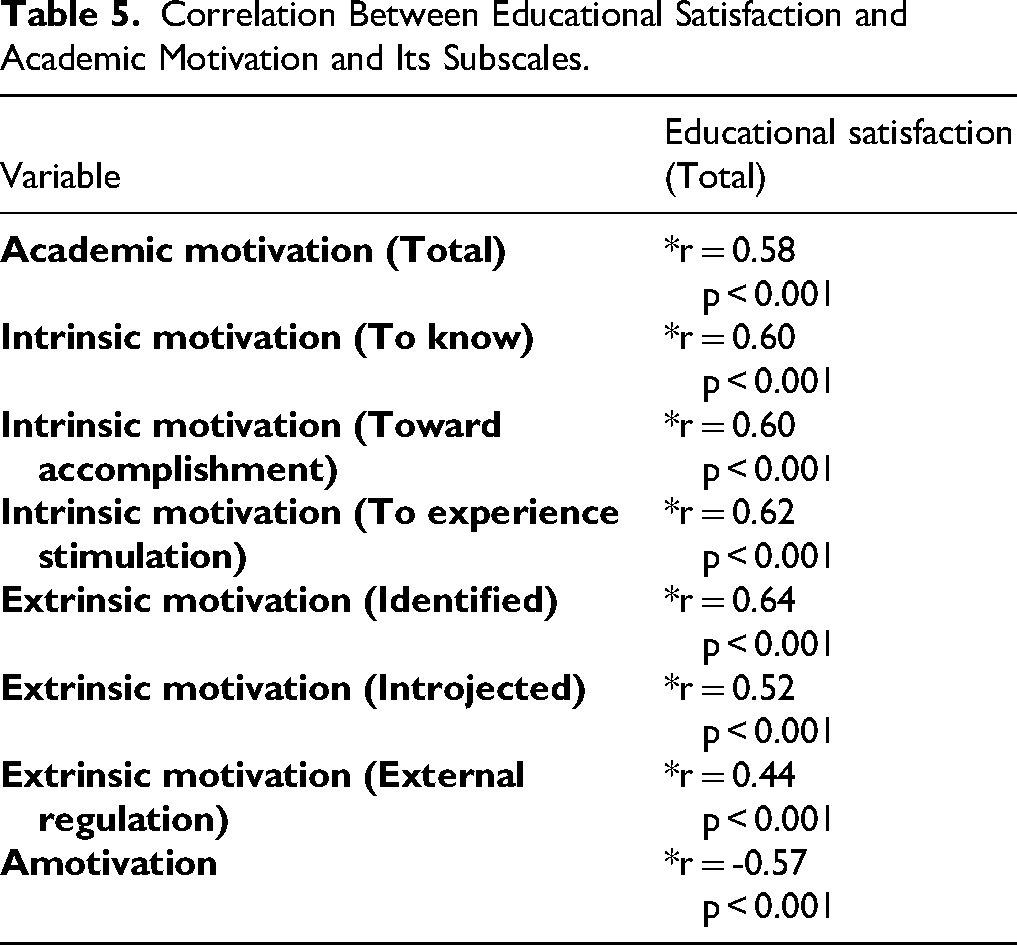
In this study, educational satisfaction was significantly and positively correlated with academic motivation and all its subscales, while showing a significant negative correlation with the amotivation dimension (Table 5). The findings also revealed that academic motivation accounted for 33.5% of the variance in educational satisfaction. Furthermore, for every one-point increase in academic motivation, educational satisfaction increased by 0.24 (Table 6).
Correlation Between Educational Satisfaction and Academic Motivation and Its Subscales.
Prediction of Educational Satisfaction Based on Academic Motivation.

Discussion
This study aimed to evaluate the levels of educational satisfaction and academic motivation among nursing students and identify the factors influencing these outcomes. Results revealed that 57.1% of students demonstrated very high academic motivation. In contrast, a study by El-Sayed et al. in Egypt found that 75% of nursing students exhibited moderate academic motivation levels (El-Sayed et al., 2021). Similarly, Khavid et al., studying dental, pharmacy, and medical students, also reported moderate motivation levels among most participants (Khavid et al., 2020). Sharififard et al. found that nursing and paramedical students generally displayed satisfactory to good levels of motivation (Sharififard et al., 2016). In agreement with this study, Sirati et al. reported very high levels of academic motivation among their participants, suggesting that differences in motivation may be influenced by the environmental context and unique characteristics of each study population (Sirati et al., 2023).
This study revealed that extrinsic motivation is slightly higher than intrinsic motivation, with the difference being statistically significant. A similar result was found in Nguyen et al., although their difference was not significant (Nguyen et al., 2023). Elbsuony also observed this trend but did not mention the significance of the difference (Elbsuony, 2016). This could pose a potential challenge since intrinsic motivation is crucial for achieving sustained academic success. Research suggests that students with higher intrinsic motivation are less influenced by external factors, leading to better performance. Curiosity, a main driver of intrinsic motivation, encourages students to explore and better understand complex concepts (Jolehar & Farhadi, 2018; Roohi & Asayesh, 2012). SDT introduced by Deci and Ryan (Deci et al., 1985), emphasizes that intrinsic motivation—rooted in an individual's innate need for competence, autonomy, and relatedness—plays a pivotal role in promoting sustained engagement and achieving high-quality learning outcomes. According to SDT, intrinsically motivated individuals tend to perform at higher levels, demonstrate greater perseverance, and derive more satisfaction compared to those whose motivation primarily stems from external factors (Ryan & Deci, 2000). Consistent with this framework, the findings of the current study highlight the significant influence of intrinsic motivation as a key determinant of academic success and student satisfaction. Therefore, fostering curiosity and interest through engaging teaching strategies can significantly boost students’ intrinsic motivation, even in less appealing subjects (Capunitan et al., 2023). Using active learning and problem-based teaching methods can increase students’ intrinsic motivation. Research shows that students who participate in interactive learning activities have higher intrinsic motivation (Schunk et al., 2014). Therefore, using teaching strategies that encourage students to explore and discover content can be effective. Extrinsic motivation, particularly in terms of future employment prospects, also plays a crucial role. Students often attend university intending to secure stable careers (Roshanmilani et al., 2010; Stenger, 2014). This study identified a small percentage of students experiencing amotivation, which may be mitigated by the favorable job outlook for nursing professionals (Izadi et al., 2014). Authors have highlighted several factors that can positively influence student motivation, including instructors’ attention to student strengths, fostering student engagement, offering evaluations beyond mere grades, and ensuring robust job prospects. Enhancing these elements, along with providing competitive salaries and improving nurses’ social status, could significantly elevate student motivation.
In this study, 54.7% of students reported moderate educational satisfaction, aligning with Edraki et al., where 56.4% of nursing students expressed similar levels of satisfaction (Edraki et al., 2011). Feizi & Saeedi also reported the students’ level of satisfaction with the facilities and educational services as moderate (Feizi & Saeedi, 2019). However, Davari et al. found that while students in occupational and public health programs reported high educational satisfaction, those in environmental health experienced moderate satisfaction (davari & Ajam, 2022). In the Hoseinzadeh study, overall academic satisfaction with educational processes was reported to be high (Hoseinzadeh et al., 2023). Rahimi's research emphasizes that factors like administrative and educational support, faculty-student relationships, and instructors’ efforts to build student confidence significantly influence educational satisfaction (Rahimi & Asadollahi, 2021). Studies by Meftagh, Rahimi, and others highlight that student satisfaction is closely tied to the quality of education, student–instructor interactions, and both material and moral support (Meftagh, 2017; Rahimi & Asadollahi, 2021). Furthermore, the authors of the current study suggest that effective teaching methods—such as the use of educational tools, relevant content, responsive faculty, and a supportive learning environment—along with fair evaluations and practical training, can greatly enhance educational satisfaction.
According to existing research, positive interaction between instructors and students plays an important role in increasing academic motivation and educational satisfaction (Brophy, 2004; Hattie & Timperley, 2007). Therefore, designing activities that increase student interaction with instructors can significantly increase their motivation and satisfaction.
The correlation analysis in this study revealed a significant positive relationship between educational satisfaction and academic motivation. While this association does not imply causality, it aligns with previous research. Mobarakabadi et al. (2014) found that satisfaction with one's academic field is linked to a stronger motivation to continue studies. Similarly, studies by Atashkar et al. (2014) and Habibi-Kaleybar (2020) reported a positive correlation between motivation and educational satisfaction among medical, dental, and pharmacy students. These findings suggest that motivated students may be more likely to succeed academically, which in turn enhances their satisfaction. Deci et al. (1991) highlighted that intrinsic motivation is closely linked to heightened enjoyment and a deeper sense of fulfillment in learning. This observation aligns with the findings of the present study, which demonstrate that higher levels of academic motivation are positively associated with greater educational satisfaction.
Moreover, this study found that students with higher academic motivation also had higher GPAs, reflecting their academic progress. Hakim's research reported a significant relationship between student satisfaction and GPA, although it did not clarify the nature of this relationship (Hakim, 2013). The results of some other studies also showed a significant relationship between academic motivation and factors related to learning, such as cumulative GPA and GPA of the last semester (Nguyen et al., 2023). On the other hand, Sirati et al. found no significant link between academic motivation and GPA (Sirati et al., 2023). Despite these variations, numerous studies suggest that academic motivation plays a critical role in academic success by positively influencing learning outcomes (Aktaş & Karabulut, 2016; Rose, 2011; Shakurnia et al., 2015). A decline in motivation, however, can reduce academic performance (Pace et al., 2016). Therefore, it can be concluded that an increase in motivation promotes greater effort, improved learning, and higher GPAs, reinforcing the importance of motivation in educational achievement.
In this study, female students reported higher levels of educational satisfaction and academic motivation compared to their male counterparts. This finding aligns with previous research by Izadi et al., which also showed that female students tend to exhibit higher academic motivation (Izadi et al., 2014). Research by El-Sayed et al. also showed that academic motivation in females was higher than in males, although this finding was not statistically significant (El-Sayed et al., 2024). Similar trends were observed in studies by Sarhadi et al. (2022b) and Izadi et al. (Izadi et al., 2014). As the study by Nezhadhosseini et al. also shows, there is a statistically significant relationship between gender and academic motivation (Nezhadhoseini et al., 2024). However, research by Rahimi and Jamshidi reported higher satisfaction scores among male students (Jamshidi et al., 2017; Rahimi & Asadollahi, 2021), which contrasts with the present findings. Additionally, a study in Kenya found no significant gender differences in overall student satisfaction with education, a conclusion also supported by Tesema et al. (Kabanya et al., 2017; Tessema et al., 2012). Feizi & Saeedi also stated in their studies that there is no statistically significant difference in the different aspects of this satisfaction between the male and female groups (Feizi & Saeedi, 2019). One possible explanation for the higher motivation observed among female students in this study is their greater desire for social participation and financial independence, goals that are more prominent among younger generations compared to their mothers (Naseh et al., 2017). Additionally, societal differences, educational settings, and cultural expectations across study populations may contribute to variations in results. Based on the perception of the authors of this study, in the context of Iran, female students appear to experience lower levels of psychological stress compared to their male counterparts. This difference is likely attributed to fewer financial responsibilities. Female students often report higher educational satisfaction without the pressures of securing employment or supporting a future family. Male students, on the other hand, frequently encounter significant financial and career-related pressures, which can split their focus between academic obligations and work. This division of attention may result in diminished academic motivation and satisfaction. Furthermore, male students tend to adopt a broader and more outcome-oriented perspective on education, prioritizing future financial and career success. In contrast, female students generally demonstrate a more task-focused approach, emphasizing immediate academic goals such as exams and coursework. This focus on short-term objectives may foster greater motivation and contribute to heightened academic satisfaction upon achieving these goals.
In this study, divorced students exhibited lower academic motivation compared to their peers, while married students reported higher levels of both educational satisfaction and academic motivation. This finding aligns with Bakhshandeh et al.'s study, which noted increased academic motivation among married medical students (Bakhshandeh bavarsad et al., 2015). Married individuals may be more driven to succeed academically due to their life responsibilities, such as securing higher income, which could serve as a motivational factor (Bakhshandeh bavarsad et al., 2015). In contrast, studies by Rahimi et al. (Rahimi & Asadollahi, 2021) and Jamshidi et al. (Jamshidi et al., 2017) found higher satisfaction among single students, while Hakim's study did not show a significant relationship between marital status and satisfaction (Hakim, 2013). Nezhadhosseini showed that there is no significant relationship between academic motivation and marital status (Nezhadhoseini et al., 2024). Sirati et al. also found no significant relationship between marital status and motivation (Sirati et al., 2023). The variation across studies may stem from differences in academic disciplines (Atashkar et al., 2014). The authors of this study suggest that divorced students may experience lower motivation due to the psychological stress associated with their separation. In contrast, married students may feel motivated by the need to provide financial support for their families.
Additionally, this study found that students whose fathers were retired reported higher educational satisfaction, while those whose fathers were employed had greater academic motivation. Academic motivation was also higher among students whose mothers had freelance jobs, while those whose mothers were homemakers reported higher satisfaction. While Hakim's study in Iran found no significant relationship between parents’ jobs and student satisfaction, it did show a connection between parental education level and student satisfaction (Hakim, 2013). The results of a study in Vietnam indicate that there is no statistically significant relationship between academic motivation and family-related factors (Nguyen et al., 2023). Sanagoo and Hesam in Iran reported a significant relationship between fathers’ jobs and educational satisfaction but no such link with mothers’ jobs (Sanagoo & Hesam, 2013). Researchers suggest that students whose fathers hold prominent positions may be influenced to pursue higher education to integrate into high-status environments (Sanagoo & Hesam, 2013). Furthermore, the authors of this study propose that a mother's presence at home may provide emotional support, which could lead to increased satisfaction among students. Parental occupation has been recognized as a significant factor influencing students’ academic motivation and performance. For example, a study conducted in Aizawl, India, revealed that students whose mothers were engaged in business displayed notably higher levels of academic motivation compared to those whose mothers were homemakers or salaried employees. Similarly, a substantial difference in academic motivation was observed between students whose fathers were traders and those whose fathers were salaried employees. The findings of this article underscore the impact of parental occupation—particularly the mother's occupation—on students’ academic motivation levels (Mr et al., 2024). In Ghana, research conducted within the Sefwi Wiawso Municipality further highlighted the role of parental socio-economic status, including their occupations, in shaping students’ academic performance. The study found that students whose parents were employed in high-income professions tended to achieve better academic outcomes (Oduro-Ofori et al., 2023). Collectively, these studies emphasize the critical influence of parental occupation and socio-economic status on students’ academic motivation and success.
Students living with their families in this study reported higher levels of educational satisfaction and academic motivation. Mobarakabadi's research at Arak University showed similar results, with local students reporting greater satisfaction than non-local students (Mobarakabadi et al., 2014). El-Sayed et al. showed that academic motivation in individuals living with their families was higher than in those living alone, although this finding was not statistically significant (El-Sayed et al., 2024). Hakim also noted a relationship between student satisfaction and residence, though the nature of the relationship was not specified (Hakim, 2013). However, Jamshidi and colleagues found that dormitory students reported higher satisfaction than local students (Jamshidi et al., 2017), while Mehrabian's study found no significant relationship between residence and satisfaction (Mehrabian et al., 2012). Izadi et al. (Izadi et al., 2014) and Sirati et al. (Sirati et al., 2023) found no link between residence and academic motivation. The differences in findings may be attributed to varying dormitory facilities across universities. In this study, living with family likely provided more comfort and support, contributing to higher satisfaction and motivation compared to dormitory living.
Older students in this study reported higher educational satisfaction but lower academic motivation. Jamshidi et al.'s research found a positive relationship between age and satisfaction, suggesting that older students are more satisfied with their academic experience (Jamshidi et al., 2017). Nejadhosseini et al. also stated in their study that there is a statistically significant relationship between age and academic motivation (Nezhadhoseini et al., 2024). El-Sayed et al. showed that academic motivation in individuals over 25 years old was higher than in those under 25, although this finding was not statistically significant (El-Sayed et al., 2024). However, Hakim found no significant relationship between age and satisfaction (Hakim, 2013). Sirati et al. (Sirati et al., 2023) observed that motivation was highest among students aged 22 to 24, while Naseh et al. found a negative relationship between age and motivation, with older students showing less motivation (Naseh et al., 2017). This decline in motivation may be due to older students’ concerns about their age relative to younger peers and perceived limitations on further academic advancement.
Students from high-income families in this study reported lower educational satisfaction and academic motivation, which contrasts with Molavi et al.'s findings that higher family income positively influences motivation (Molavi et al., 2007). Cornilous's research also reported a positive relationship between economic status and academic success (Cornilous, 1978). The current study indicates that students from financially stable backgrounds may feel less motivated to excel academically because they lack the drive for financial security. However, there is limited recent research on this topic.
Strengths and Limitations
The findings of this study exhibit a high level of generalizability, as the sampling was conducted using a census approach, encompassing all nursing students at the School of Nursing and Midwifery of Kermanshah University of Medical Sciences. Furthermore, considering that Iran's nursing education system operates under a nationally standardized and uniform curriculum, the findings of this study may hold relevance for other nursing schools across the country. However, it is important to acknowledge that variations in institutional environments, teaching methodologies, and local contexts could impact students’ experiences. As such, while the results have the potential for broader applicability, they should be generalized with appropriate caution. Additionally, the use of standardized instruments for measuring educational satisfaction and academic motivation, along with the diversity in students’ demographic characteristics (such as gender, academic level, and socio-economic status), further reinforces the generalizability of these findings to nursing students in other universities across Iran. One limitation of this study was the incomplete data collection, as 17 participants submitted incomplete questionnaires, and 24 others declined participation. Full access to the entire sample would have provided more comprehensive insights. Additionally, the study relied solely on questionnaires to assess educational satisfaction and academic motivation. Future research could benefit from qualitative methods, including interviews with students and input from instructors, to gain deeper insights into the factors influencing educational satisfaction and academic motivation. Another limitation of the study is the self-reported GPA, which may be affected by bias. Using actual GPA from academic records in future research would enhance accuracy. Especially for studies that require more precise data, the use of official records could be beneficial.
Implication for Practice
Based on the results of this study, to enhance the motivation and satisfaction of nursing students, educational programs should specifically focus on strengthening intrinsic motivation and consider the gender differences and needs of different student groups. The use of active and engaging teaching methods can help increase intrinsic motivation. Furthermore, addressing the specific needs of various groups and offering suitable social support can significantly enhance student motivation and satisfaction. Furthermore, providing clear career opportunities and creating supportive environments can help strengthen motivation. For groups such as married students, it is essential to offer flexible educational programs and special support. Ultimately, by enhancing these factors, not only will motivation and satisfaction among students increase, but the quality of education and healthcare services will also improve, leading to a reduction in healthcare costs.
Conclusion
In this study, over half of the students reported moderate levels of educational satisfaction, while their academic motivation was notably high. It was found that 33.5% of the variance in educational satisfaction was attributed to academic motivation. Both male and female students reported moderate satisfaction levels; however, female students showed significantly higher motivation compared to their male counterparts, who demonstrated only moderate motivation. Since educational satisfaction and academic motivation are key drivers of success in any field, particularly in nursing where skilled and motivated professionals are crucial, enhancing these factors is essential. Improving student motivation and satisfaction not only enhances service delivery and personal growth but also contributes to societal advancements, reduces healthcare costs, and addresses dissatisfaction in education. To further understand the factors influencing educational satisfaction and academic motivation, more comprehensive research—including intervention studies—is necessary. Identifying and addressing these factors can lead to improved student success and better academic outcomes. Policymakers and educational planners should prioritize these efforts, not only for nursing but across all medical fields. By providing clear career pathways and fostering a supportive academic environment, student satisfaction and motivation—vital assets for the advancement of any nation—can be significantly enhanced.
Footnotes
Acknowledgements
This study was part of a research project approved by the student research committee of Kermanshah University of Medical Sciences, identified by project number 4020497 and ethical code IR.KUMS.REC.1402.254. We extend our heartfelt gratitude to the Vice Chancellor for Research and Technology at Kermanshah University of Medical Sciences, the staff, and colleagues at the School of Nursing and Midwifery, and the instructors whose invaluable guidance greatly contributed to this research. We also wish to express our sincere appreciation to the students who generously dedicated their time and provided their valuable insights for this study.

Ethical Considerations
The study received approval from the research ethics committee of Kermanshah University of Medical Sciences under number IR.KUMS.REC.1402.254, and all methods were conducted in accordance with the guidelines and regulations outlined in the Declaration of Helsinki. Prior to the interviews, written informed consent was obtained from all participants or their legal representative.
Authors Contributions
AA, MMM, and NM was responsible for the project design. Data collection was carried out by MMM, NM, and ZK, while data analysis was conducted by AA and MMM. All authors contributed to the writing of the manuscript and approved the final version for submission.
Funding
The author(s) disclosed receipt of the following financial support for the research, authorship, and/or publication of this article: The study was funded by deputy of research and technology of Kermanshah University of Medical Sciences with No. 4020497.
Declaration of Conflicting Interests
The author(s) declared no potential conflicts of interest with respect to the research, authorship, and/or publication of this article.
Data Availability Statement
The datasets generated and analyzed during the current study are not publicly available due to our institution's regulations but are available from the corresponding author upon reasonable request.
AI-assisted
In the preparation of this article, I utilized ChatGPT, an AI language model, to assist with editing and refining the text. The AI contributed to enhancing the clarity, grammar, and overall flow of the manuscript. However, it is important to note that ChatGPT does not contribute to the original ideas or research presented in the article.