




Abstract
Introduction
Climate change poses major health threats, yet awareness among nurses does not always translate into sustainable practice. Nurse managers’ leadership behaviors may play a pivotal role in embedding environmental accountability within healthcare.
Objectives
To examine the relationships between nurses’ perceptions of climate change and their attitudes toward sustainability practices, and to assess the mediating role of nurse managers’ sustainable management behaviors.
Methods
A descriptive correlational study was conducted at an Egyptian university hospital using a convenience sample of 415 staff nurses and 23 nurse managers. Data were collected using validated tools for climate change cognition, sustainability attitudes, and sustainable management behaviors. Descriptive statistics, correlations, regression analyses, and structural equation modeling were performed.
Results
Nurses reported moderate sustainability attitudes (M = 3.29; 57.3%) but relatively low climate change cognition and behaviors (M = 2.80; 45.1%). Nurse managers’ sustainable management behaviors were moderate (M = 3.58; 64.5%) and had a significant positive effect on nurses’ climate change cognition and behaviors (β = 0.61, p < .001). Mediation analysis confirmed that sustainability attitudes had a significant direct effect on sustainable management behaviors (β = 0.57, p < .001), which mediated their impact on awareness, concern, and behavior, though not intrinsic motivation (p = .207). Climate education predicted nurses’ climate engagement but not nurse managers’ sustainable management behaviors.
Conclusion
Sustainable leadership is critical for translating nurses’ awareness of climate change into environmentally responsible healthcare practices. Integrating sustainability into nursing curricula, leadership training, and health system policies is vital to translate awareness into action.
Introduction
Climate change is one of the most pressing public health challenges of our time, with direct implications for nursing and healthcare delivery (Gkouliaveras et al., 2026; Sherman et al., 2023; Yeboah et al., 2024). Rising global temperatures and more frequent extreme weather events require health systems to adapt rapidly to protect both human health and ecosystem integrity (MacNeill et al., 2021; Myhre et al., 2025). Healthcare itself contributes approximately 5% of global greenhouse gas emissions through energy consumption, transportation, medical supply chains, and waste generation (Or & Seppänen, 2024; Sherman et al., 2023). In Egypt, a nation highly vulnerable to climate impacts including water scarcity, extreme heat, and food insecurity, the government has actively implemented adaptation policies across multiple sectors, with healthcare recognized as a priority area (UNDP Egypt, 2020).
Nurses, as the largest healthcare professional group, play a pivotal role in climate adaptation and share a professional responsibility with nurse managers to advance sustainable practices and support climate-resilient healthcare systems (Abou Hashish et al., 2025a, 2025b; Aronsson et al., 2025; Gaudreau et al., 2024). Accordingly, this study examines nurses’ perceptions of climate change and sustainability attitudes while testing the mediating role of nurse managers’ sustainable management behaviors in translating individual awareness into organizational sustainability practice within Egyptian healthcare settings.
Literature Review
Climate change disrupts ecological systems and directly affects human health through multiple pathways: respiratory illnesses from air pollution and wildfires, increased vector-borne diseases, heat-related morbidity and mortality, mental health impacts, and food and water insecurity (Sherman et al., 2023). The health sector faces a dual mandate: caring for populations affected by climate change while simultaneously reducing its own substantial environmental footprint (Gkouliaveras et al., 2026; MacNeill et al., 2021; WHO, 2022).
Understanding nurses’ engagement with climate change requires capturing both their perceptions and their sustainability attitudes. The Climate, Health, and Nursing Tool (CHANT) operationalizes this engagement across four interconnected domains: awareness (knowledge of climate change), concern (emotional response to climate threats), motivation (willingness to act), and climate-friendly behaviors in both home and workplace settings (Schenk et al., 2019). However, empirical evidence consistently reveals that awareness and concern alone rarely translate into sustained action without structural and organizational support (Allari et al., 2025; Luque-Alcaraz et al., 2024; Osingada & Porta, 2020).
Sustainability attitudes represent an important cognitive and affective bridge between awareness and action, reflecting how strongly nurses value climate action and their willingness to incorporate sustainability principles into professional practice (Richardson et al., 2016; Zoromba & El-Gazar, 2025). The Sustainability Attitudes in Nursing Survey (SANS-2) assesses these attitudes across both educational and clinical contexts, capturing nurses’ beliefs about the importance of environmental content in nursing education and their commitment to sustainable clinical practices (Álvarez-Nieto et al., 2022; Richardson et al., 2016).
Formal education is critical in bridging the concern-to-action gap in climate-related nursing practice. Although planetary health is recognized as a nursing competency, sustainability content remains limited and inconsistently integrated into nursing curricula, leading to high concern but low practical preparedness (Mulu & Kivuva, 2025). This gap reduces nurses’ confidence in applying sustainable practices. Evidence shows that structured educational approaches can strengthen nurses’ ability to translate climate awareness into clinical action (Bobini & Cicchetti, 2025; Mani et al., 2025; Zoromba & El-Gazar, 2025).
In this context, professional nursing organizations have called for embedding sustainability across the educational continuum. The International Council of Nurses identified environmental sustainability as a core professional responsibility and urged its integration into undergraduate, postgraduate, and continuing professional education (ICN, 2017). National and regional nursing associations have similarly aligned nursing practice with the Sustainable Development Goals (SDG), particularly SDG 3 (Good Health and Well-Being), SDG 13 (Climate Action), and SDG 12 (Responsible Consumption and Production) (Gaudreau et al., 2024; Kearns & Kearns, 2021).
Green Leadership in Healthcare: The Role of Nurse Managers
Nurse managers’ sustainable management behaviors act as key enablers of sustainability transformation. Green leadership, defined by environmental awareness, proactive decision making, and commitment to reducing ecological impact, has been shown to influence nurses’ pro-environmental behaviors and organizational sustainability outcomes (Saleem et al., 2025). Evidence from hospital settings indicates that when nurse leaders visibly prioritize sustainability and integrate environmental criteria into decisions, nurses demonstrate greater engagement in resource conservation and sustainable practices (Saleem et al., 2025; Sarıköse et al., 2025).
Sustainable management comprises interconnected dimensions. Demirbilek and Çetin (2021) identified four key dimensions through which managers operationalize sustainability: (1) corporate functioning, defined as aligning organizational strategy and policies with sustainability principles; (2) economic efficiency, which focuses on optimizing resource use and reducing waste and costs; (3) environmental sensitivity, reflecting awareness of ecological impacts and biodiversity protection; and (4) protection sensitivity, which emphasizes safeguarding workplace health and safety alongside environmental responsibility. Managers who integrate all four dimensions embed sustainability within organizational culture rather than treating it as isolated initiatives (Allari et al., 2025; Demirbilek & Çetin, 2021).
The sandwich support model (Chisengantambu et al., 2018) provides a relevant framework for understanding how nurse managers can promote sustainability. The model posits that middle managers, such as nurse managers, are most effective when they receive support from senior leadership, including strategic resources and policy backing, and collaboration from frontline staff through engagement and innovation. In sustainability contexts, this implies that nurse managers require explicit administrative endorsement of environmental goals, adequate resources such as time, budget, and tools, and a workforce that is educated and motivated to participate in sustainable practices (Algabar et al., 2023; Shaban et al., 2024).
Within this framework, translating sustainability awareness into practice depends on system-level change rather than individual motivation alone (Abou Hashish et al., 2025a; Allari et al., 2025). Sustainable healthcare practices include waste reduction, energy-efficient operations, sustainable procurement, telemedicine to reduce emissions, and water conservation (WHO, 2022; Yeboah et al., 2024). When embedded in standardized protocols and reinforced by leadership, these practices become routine components of care delivery (Cavicchi et al., 2022). Sustainable transformation further requires alignment across clinicians, administrators, and supply chains, as isolated initiatives have limited impact (Bobini & Cicchetti, 2025).
This perspective supports the present study's focus on nurse managers as key catalysts, linking organizational strategy with frontline sustainability practice.
Conceptual Framework and Study Rationale
Drawing on this literature, the present study proposes a mediation model wherein nurses’ perceptions of climate change influence their sustainability attitudes, which are then reinforced and operationalized through nurse managers’ sustainable management behaviors. Specifically, the study hypothesizes that leadership behaviors serve as a critical link between individual awareness/attitudes and organizational sustainability practices. Managers who model environmental stewardship, allocate resources for green initiatives, integrate sustainability into performance expectations, and provide ongoing education create workplace cultures where nurses’ latent pro-environmental values can translate into consistent action. Accordingly, the following hypotheses were proposed:
Significance of the Study
Healthcare systems contribute substantially to environmental degradation, yet nurses’ capacity to mitigate this impact remains constrained by a persistent concern-to-action gap. Although nurses often report moderate climate literacy, sustainable practices in clinical settings remain limited, largely due to insufficient education and inadequate leadership support (Álvarez-Nieto et al., 2022; Osingada & Porta, 2020; Zoromba & El-Gazar, 2025). Likewise, nurse managers are strategically positioned to address this gap by prioritizing sustainability, allocating resources, and modeling environmentally responsible behaviors. Evidence indicates that sustainability-oriented leadership enhances nurses’ pro-environmental behaviors; however, the mechanisms through which nurse managers translate individual climate awareness into sustained clinical practice remain underexplored (Algabar et al., 2023; Saleh & Elsabahy, 2022; Sarıköse & Göktepe, 2025).
Despite growing international attention to climate-responsive healthcare, empirical evidence examining nurses’ climate change engagement and sustainability leadership remains scarce in Egypt and comparable regional contexts. Most existing studies originate from high-income Western countries, limiting the contextual relevance of their findings to health systems operating under different environmental, economic, and policy conditions (Allari et al., 2025; Fields et al., 2021; Gaudreau et al., 2024; Luque-Alcaraz et al., 2024; Osingada & Porta, 2020).
This study addresses this gap by providing empirical insight into how leadership mechanisms shape the translation of nurses’ climate awareness into sustainable organizational practice within healthcare settings. Conducted within Egyptian hospitals, the study aligns with Egypt's Vision 2030 sustainability agenda and contributes to SDGs 3, 12, and 13 by informing sustainable leadership development, organizational policy, and climate-responsive nursing education.
Aim of the Study
To examine the relationships between nurses’ climate change cognition and behaviors and sustainability attitudes, and to assess the mediating role of nurse managers’ sustainable management behaviors.
Research Questions
Methods
Research Design and Setting
This descriptive correlational study was conducted at an Egyptian university hospital in accordance with STROBE guidelines.
Participants and Sampling
The study population included 660 registered nurses employed at the hospital. Eligible participants were bedside nurses providing direct or indirect patient care with at least 6 months of hospital experience. Intern nurses and those with less than 6 months of employment were excluded.
Sample size was estimated using G*Power software (version 3.1.9.7) for linear multiple regression. A minimum sample of 244 nurses was required to detect a small effect size (f2 = 0.04) with 80% power at a 0.05 significance level and three predictors. To enhance statistical power and address potential nonresponse, a larger sample was targeted.
A total of 415 staff nurses were recruited from inpatient clinical units using convenience sampling. This approach was chosen to facilitate timely data collection and maximize participation among eligible nurses across clinical units. Of the 660 eligible nurses approached, 415 completed the survey (response rate = 62.9%). In addition, 23 first-line nurse managers completed the survey assessing sustainable management behaviors as mediators in the conceptual model. These nurse managers represented all inpatient clinical units included in the study and constituted the full cohort of first-line nurse managers responsible for supervising the participating nursing staff during the data collection period, representing a 100% response rate from this group. Each nurse manager directly oversaw the nurses working in their respective units, ensuring alignment between managerial behaviors and frontline nursing practice.
Data Collection Instruments
Three validated instruments were used.
The Climate, Health, and Nursing Tool (CHANT) was used to assess nurses’ climate change cognition and related behaviors (Schenk et al., 2019). The 24-item instrument measures five domains: awareness, concern, motivation, and climate-friendly behaviors at home and at work. Awareness and concern items are rated on five-point Likert scales ranging from low to high levels of knowledge and concern, while motivation and behavior items are rated from “never” to “always.” Higher scores indicate greater climate change cognition and engagement in sustainable practices.
The Sustainability Attitudes in Nursing Survey (SANS-2) was used to measure nurses’ sustainability attitudes related to nursing education and clinical practice (Richardson et al., 2016). The scale consists of five items rated on a seven-point Likert scale (1 = strongly disagree to 7 = strongly agree), yielding total scores from 5 to 35, with higher scores reflecting more positive sustainability attitudes.
The Sustainable Management Behaviors Scale (SMBS) was used to assess nurse managers’ sustainable management behaviors (Demirbilek & Çetin, 2021). The 50-item scale comprises four subscales: corporate functioning, economic efficiency, environmental sensitivity, and protection sensitivity. Items are rated on a five-point Likert scale, with scores ≥70% indicating adequate sustainable management behaviors.
A researcher-developed demographic and professional characteristics form collected data on gender, age, education, years of experience, work setting, unit, and prior sustainability education (Supplemental file 1).
Translation, Validity, and Reliability
All tools were translated into Arabic using forward–backward translation, reviewed by a panel of seven nursing experts for cultural equivalence, and piloted with 44 participants (10% of sample). Pilot responses confirmed clarity and cultural relevance. Cronbach's alpha coefficients indicated high reliability: CHANT (0.926), SANS-2 (0.881), and SMBS (0.932), all significant at p ≤ .05.
Ethical Considerations
Ethical approval for the study was obtained from the Nursing Research Ethics Committee of the Faculty of Nursing, Alexandria University (IRB00013620). Formal permission was secured from hospital administration. Written informed consent was obtained from all participants after explaining the study purpose, procedures, and voluntary nature of participation. Confidentiality, anonymity, and the right to withdraw without penalty were assured.
Data Collection
Data were gathered via structured self-administered questionnaires distributed in person. Researchers provided a 15 min briefing and collected completed forms directly. Average completion time was 20 min. Data collection occurred over 3 months in 2024.
Data Analysis
Data were analyzed using IBM SPSS Statistics 27. Descriptive statistics summarized participant characteristics and study variables. Pearson correlation assessed associations, with r values of 0.10, 0.30, and 0.50 indicating weak, moderate, and strong relationships, respectively. Multiple regression identified demographic and professional predictors. Structural equation modeling (SEM) using IBM AMOS 28 tested the hypothesized mediation model, examining nurse managers’ sustainable management behaviors as a mediator between nurses’ sustainability attitudes and climate change cognition and behaviors. Nurse managers’ responses (n = 23) were analyzed descriptively Table 2 and incorporated into the SEM as mediator variables. Nurse managers’ sustainable management behavior scores were aggregated at the unit level and matched to corresponding staff nurses within each clinical unit. Unit-level mean SMB scores were then entered into the structural equation model as a higher-level mediator variable influencing individual nurses’ CCCB outcomes. This aggregation approach ensured conceptual alignment between managerial behaviors and frontline nurse perceptions while accounting for the nested organizational structure. Model fit was evaluated using the Comparative Fit Index (CFI) and Root Mean Square Error of Approximation (RMSEA). Statistical significance was set at p ≤ .05.
Distribution of Nurse Managers According to Demographic Characteristics (N = 23).

Results
Participants’ Characteristics
Table 1 shows that nurses’ mean age was 38.15 ± 10.57 years, and most were female (60.7%). Education was equally distributed between Bachelor of Nursing Science and Technical Nursing Institute graduates (39.8% each). Mean experience was 13.86 ± 9.07 years, with 37.6% reporting 5 to 10 years. Most nurses reported collecting waste at home (85.3%); however, 59.0% had never attended climate change-related education, 56.9% had never heard of global climate change, and 86.7% reported no prior knowledge of sustainability.
Distribution of the Nurses According to Demographic Data (N = 415).

Table 2 shows that nurse managers’ mean age was 46.87 ± 5.68 years; all were female and held a bachelor's degree. Mean experience was 23.89 ± 2.63 years, with all exceeding 20 years. All reported collecting waste at home and awareness of climate change and sustainability, while 78.3% had not received sustainability education.
Levels of Study Variables
Nurses’ CCCB perception showed a low overall level (M = 2.80 ± 0.12; 45.11%). Across CHANT domains, concern scored highest (M = 3.85 ± 0.22), followed by awareness (M = 2.50 ± 0.30) and behaviors at home and work (M = 2.49 ± 0.18), while motivation was lowest (M = 2.38 ± 0.46). Sustainability attitudes were moderate (M = 3.29 ± 0.37; 57.30%) (Table 3).
Mean Scores of the Study Variables and Their Dimensions.

Note. Mean percent score: low ≤ 50%; moderate = 50%–<75%; high = ≥ 75%.
CCCB= climate change cognition and behaviors; SAN= sustainability attitudes in nursing; SMB=sustainable management behaviors.
Nurse managers’ SMB were also moderate (M = 3.58 ± 0.33; 64.52%). Economic efficiency ranked highest (M = 3.80 ± 0.27), followed by corporate functioning (M = 3.73 ± 0.31), environmental sensitivity (M = 3.48 ± 0.54), and protection sensitivity (M = 3.31 ± 0.40). As shown in Figure 1, most nurse managers (78.3%) demonstrated unsustainable levels (<70%), while only 21.7% met the sustainable threshold (≥70%).

Level of sustainable management behaviors (SMB) among nurse managers.
Correlation and Regression Analysis Among Climate Change and Sustainability
All main study variables were significantly and positively correlated at the 0.01 level (Supplemental Table 1). Univariate regression analyses examined the predictive effects of SAN and SMB on CCCB (Supplemental Table 2). Nurse managers’ SMB emerged as the strongest predictor of CCCB (B = 0.272, R2 = 0.540), indicating that a one-unit increase in SMB was associated with a 0.272-unit increase in nurses’ CCCB. SMB explained 54.0% of the variance in nurses’ CCCB, representing a substantial effect.
Nurses’ SAN was also a significant predictor, though weaker (B = 0.151, R2 = 0.230). A one-unit increase in SAN corresponded to a 0.151-unit increase in CCCB, with attitudes accounting for 23.0% of the variance. The markedly higher explanatory power of SMB compared with SAN (0.540 vs. 0.230) indicates that leadership-related factors exert a stronger influence on nurses’ climate-related behaviors than individual attitudes alone.
Mediation Analysis
As shown in Table 4, a significant mediation pathway was identified from SAN to CCCB through SMB. SAN had a significant direct effect on SMB (β = 0.57, p < .001), and SMB, in turn, exerted a strong direct effect on CCCB (β = 0.61, p < .001). The indirect effect of SAN on CCCB via SMB was also significant (β = 0.35, p < .001), indicating that approximately 35% of the total effect was transmitted through manager behaviors. Although CFI and IFI values indicated strong comparative fit, the RMSEA value (0.104) suggests marginal model fit; therefore, findings should be interpreted with caution.
Main Mediation Model: Total, Direct, and Indirect Effects of SAN on CCCB via SMB.

Note. Model indices CFI = 1.000, IFI = 1.000, RMSEA = 0.104, χ2/df = 79.100 / 6, p ≤ .001.
CCCB= climate change cognition and behaviors; CFI= Comparative Fit Index; RMSEA= Root Mean Square Error of Approximation; SAN= sustainability attitudes in nursing; SMB=sustainable management behaviors.
Effects on CCCB Subdimensions
SMB showed significant direct effects across all CCCB subdimensions. The strongest effects were observed for motivation and awareness, followed by behavior at home and work and concern. Detailed standardized coefficients are reported in Supplemental Table S3.
Mediation Pathways Across CCCB Subdimensions
Subdimension-specific mediation analyses revealed differential effects of SAN through SMB. For awareness, 27.1% of the total effect of SAN on awareness was mediated by SMB, whereas 43.3% of the effect on concern was mediated. The strongest mediation effect was observed for behavior at home and work, with 48.6% of the total effect transmitted through SMB. Detailed indirect effects are presented in Supplemental Table S3.
Nonsignificant Mediation for Motivation
The mediation pathway was not significant for motivation. Although SAN had a significant total and direct effect on motivation, the indirect effect via SMB was not significant (β = 0.09, p = .207), indicating that motivation is more directly influenced by individual attitudes than by managerial behaviors (Supplemental Table S3; Figure 2).
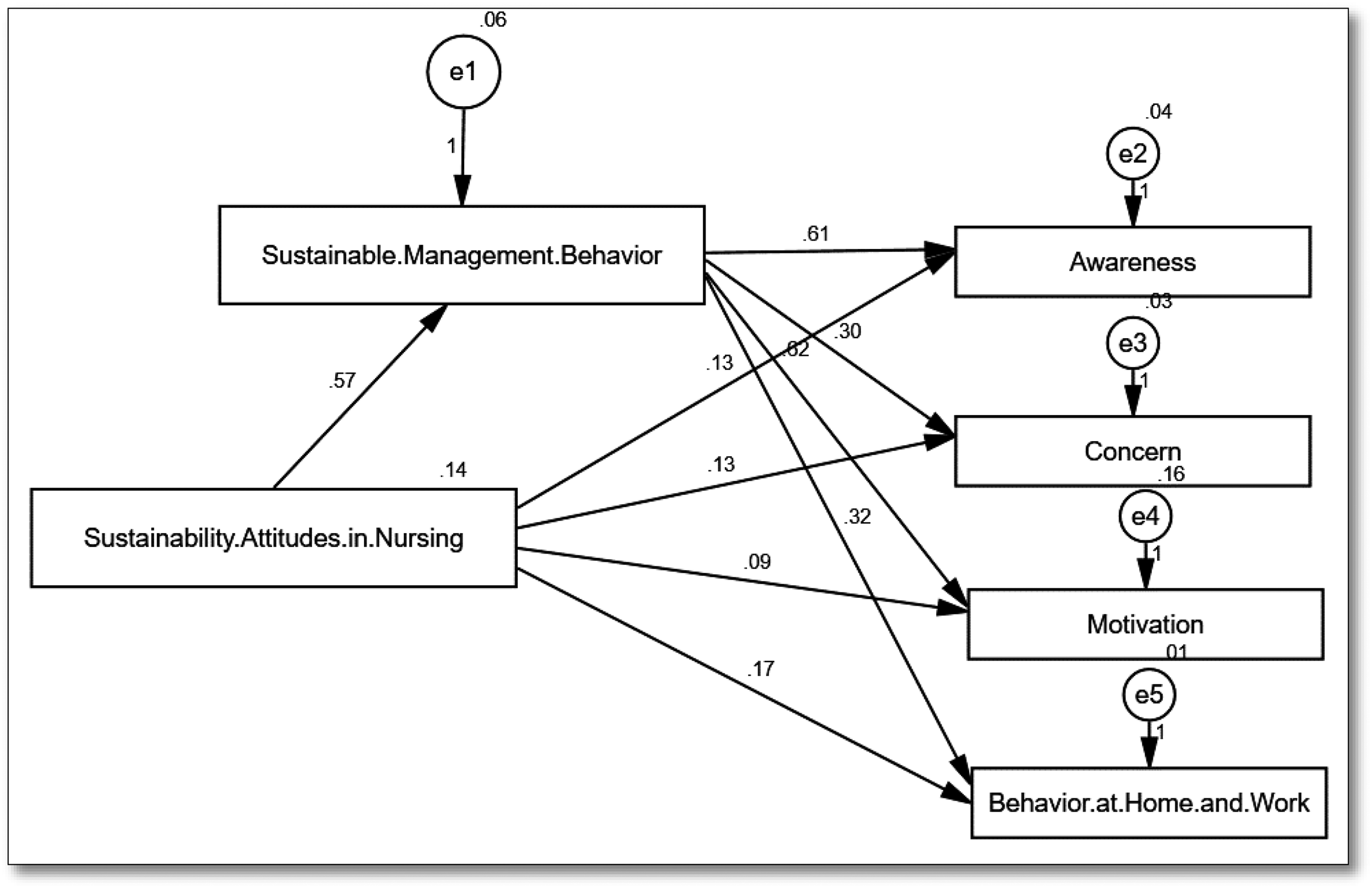
Path Analysis of the Direct and Indirect Effect of SAN on CCCB Mediated by SMB. CCCB= climate change cognition and behaviors; SAN= sustainability attitudes in nursing; SMB=sustainable management behaviors.
Nurses’ Demographics and Study Variables
Table 5 presents multiple regression analyses identifying demographic and professional predictors of CCCB, SAN, and SMB. Among staff nurses, CCCB were significantly predicted by awareness of global climate change (β = 0.19), climate change-related education (β = 0.17), age (β = 0.21), years of nursing experience (β = 0.19), education level (β = 0.15), and sustainability awareness (β = 0.14) (all p ≤ .004). Together, these variables explained 51% of the variance in CCCB (adjusted R2 = 0.51, p < .001). For SAN, significant predictors included climate change education (β = 0.18), age (β = 0.16), years of experience (β = 0.15), education level (β = 0.11), and waste collection at home (β = 0.09) (all p ≤ .042). The model explained 45% of the variance in SAN (adjusted R2 = 0.45, p < .001).
Multiple Regression Analysis Predicting Study Variables From Demographic and Professional Characteristics.

Note. p ≤ .05.
CCCB= climate change cognition and behaviors; SAN= sustainability attitudes in nursing; SMBS=Sustainable Management Behaviors Scale.
Predictors of SMB differed from nurse-level outcomes. Only age (β = 0.19, p = .031) and education level (β = 0.13, p = .040) were significant, while climate- and sustainability-related knowledge variables were not. The model explained 24% of the variance in SMB (adjusted R2 = 0.24, p < .001).
Discussion
The Concern-to-Action Gap in Nurse Climate Engagement
This study identified a clear disconnect in nurses’ climate engagement. Nurses demonstrated low climate change cognition and behaviors, high concern but low motivation, and moderate sustainability attitudes. High emotional concern coexisted with limited climate knowledge and weak behavioral engagement, reflecting a persistent concern-to-action gap. Although nurses recognize the seriousness of climate change and value sustainability, translating concern into sustained action remains constrained by knowledge gaps, limited organizational infrastructure, and unclear professional roles in climate mitigation. These findings align with evidence showing that limited nurse engagement reflects structural and educational barriers rather than lack of interest.
Prior studies support this interpretation. Rempel et al. (2025) and Mekawy (2023) found that nurses often view climate engagement primarily as caring for those affected by climate impacts rather than addressing healthcare-related emissions. Luque-Alcaraz et al. (2024) similarly reported moderate awareness but limited workplace action, attributing this gap to organizational barriers. Qualitative findings by Zoromba and El-Gazar (2025) showed that sustainability is often deprioritized amid patient-care demands unless supported by leadership and policy. Kim and Chae (2025) and Kircher et al. (2022) also observed genuine concern among healthcare professionals but insufficient climate–health knowledge to drive behavioral change. In this vein, Yeboah et al. (2024) emphasized the need to integrate climate–health and sustainability content into nursing education, while Alrabiah et al. (2025) highlighted practical strategies such as embedding sustainability in training, strengthening waste-management regulations, and providing job-relevant guidance.
Nurse Manager Behaviors: Cost-Efficiency Over Ecological Responsibility
In contrast to staff nurses, nurse managers demonstrated moderate sustainable management behaviors with a clear priority imbalance, as cost-efficiency and operational demands outweighed environmental sensitivity and worker protection. This likely reflects managerial performance expectations centered on budget control, staffing, and service continuity, which limit attention to long-term ecological goals (Sarıköse & Göktepe, 2025). As a result, sustainability is framed mainly through cost control and regulatory compliance rather than ecological or workforce protection, a tendency reinforced by limited formal education in sustainable healthcare leadership.
Prior studies support this pattern. Leppänen et al. (2022) reported that nurse managers’ sustainability practices were constrained by narrow ecological perspectives, while Zoromba and El-Gazar (2025) reported that key barriers included organizational challenges, competing leadership priorities, and lack of motivation. Algabar et al. (2023) similarly found greater managerial focus on economic and corporate dimensions than on environmental sensitivity. This imbalance is concerning, as efficiency-driven approaches may compromise worker and patient protection, underscoring the need for organizational strategies that embed ecological and ethical responsibility within healthcare leadership. In this context, Zoromba and El-Gazar (2025) emphasized that leadership support, education, training, and teamwork emerged as critical enablers of sustainable practices.
In relation to Hypothesis 1 and Research Question 1, the three main study variables—nurses’ climate change cognition and behaviors, sustainability attitudes, and nurse managers’ sustainable management behaviors—were significantly intercorrelated. This confirms that individual attitudes, leadership behaviors, and climate engagement operate as an integrated system with reciprocal influence. The strong association between managers’ environmental sensitivity and nurses’ climate engagement indicates that visible ecological concern by leaders most effectively activates nurses’ climate-related behaviors (Algabar et al., 2023). This finding is consistent with organizational behavior literature highlighting leadership visibility and authenticity as key drivers of employee values and actions (Aly et al., 2025; Atalla et al., 2024; Cavicchi et al., 2022).
Regarding Hypothesis 2 and Research Question 2, the findings reveal that nurse managers’ sustainable management behaviors mediate the relationship between sustainability attitudes and climate change engagement, supporting the sandwich support model's assertion that middle managers translate organizational intent into frontline action. This mediation was dimension-specific rather than uniform. For awareness, concern, and behavioral engagement, managers strengthened the translation of nurses’ pro-environmental attitudes into practice. Similar patterns were reported by Saleh and Elsabahy (2022) who emphasized organizational support and leadership commitment as prerequisites for climate engagement in healthcare.
This mediation operates through interrelated leadership mechanisms. Visible managerial commitment normalizes sustainability and signals its organizational value, while role modeling and normative influence reinforce expected behaviors. Resource allocation and supportive systems enable sustainable practices in daily routines, including energy conservation and monitoring, waste segregation audits, green procurement policies, and sustainability committee participation (Gülen & Göktepe, 2025; Kareem & Kummitha, 2025). Consistent with prior research, nurse managers embed sustainability into routine care and shape nurses’ environmental awareness (Algabar et al., 2023; Cavicchi et al., 2022). These findings indicate that even climate-concerned nurses require enabling leadership to translate concern into sustained action (Gaudreau et al., 2024).
The effectiveness of these mechanisms depends on the organizational context. Organizational culture and policy can amplify or constrain sustainability practice. Evidence shows that pro-social leadership strengthens sustainability consciousness, while formal standards and accountability mechanisms are necessary to institutionalize climate action in healthcare delivery (Atalla et al., 2024; Yeboah et al., 2024). Overall, effective climate action in healthcare requires leadership commitment embedded within supportive organizational structures (Gülen & Göktepe, 2025; Kareem & Kummitha, 2025).
A Critical Finding: The Motivation Mediation Gap
Building on these mediation findings, a critical exception emerged for motivation. The findings reveal that the mediating role of nurse managers’ sustainable behaviors varied across dimensions of nurses’ climate engagement. While indirect effects through managers were significant for awareness, concern, and behavioral engagement, the mediation pathway was not significant for motivation. Although managers exerted a strong direct influence on motivation, this effect operated independently of nurses’ sustainability attitudes.
This pattern highlights a distinct intervention gap. Managerial influence appears effective in shaping externally driven engagement but less effective in fostering internally sustained motivation (Zoromba & El-Gazar, 2025). Consistent with self-determination theory, managers primarily activate extrinsic motivation through expectations and reinforcement, which depends on continued leadership presence (Morvati et al., 2024). In contrast, attitude-mediated pathways reflect internalized values that sustain engagement beyond external control (Atalla et al., 2024; Kircher et al., 2022).
For awareness and behavior, the sandwich support model functions as intended, with managers reinforcing nurses’ pro-environmental attitudes (Algabar et al., 2023; Cavicchi et al., 2022). However, motivation requires mechanisms beyond managerial modeling. Strengthening intrinsic motivation, peer influence, and organizational credibility through policies, resources, and accountability systems is essential for sustained engagement (Gaudreau et al., 2024; Gülen & Göktepe, 2025).
Overall, this finding refines the sandwich support model by identifying its boundary conditions. While managers are critical mediators for awareness, concern, and behaviors, additional systemic interventions are necessary to achieve sustained, internalized climate engagement. This aligns with prior calls for leadership approaches that extend beyond role modeling to organizational and structural change (Osingada & Porta, 2020; Sherman et al., 2023).
Linking Study Findings to the Sustainable Development Goals and Sustainability Agenda
The study findings directly align with the SDGs by demonstrating how leadership mediates the translation of climate awareness into practice. The identified role of nurse managers’ sustainable management behaviors supports SDG 3 (Good Health and Well-Being) by strengthening climate-resilient healthcare delivery, SDG 12 (Responsible Consumption and Production) through enhanced resource efficiency and waste reduction behaviors, and SDG 13 (Climate Action) by embedding climate awareness within routine nursing practice. The differential mediation effects observed across awareness, behavior, and motivation highlight that achieving SDG-aligned healthcare sustainability requires both leadership action and systemic organizational support, reinforcing sustainability as an operational—not symbolic—agenda within healthcare systems (Gkouliaveras et al., 2026; Sherman et al., 2023; WHO, 2022).
Demographic and Professional Predictors: Maturity and Knowledge Pathways
Addressing Research Question 3, demographic and professional characteristics emerged as significant predictors of sustainability outcomes, with distinct patterns for staff nurses and nurse managers. Among staff nurses, climate engagement was predicted by awareness of global climate change, formal climate education, age, years of experience, and education level. Together, these factors explained substantial variance in climate change cognition and behaviors, indicating that nurses’ climate engagement develops through combined pathways of knowledge acquisition and professional maturity. This pattern aligns with prior research showing that education, age, and experience consistently predict climate awareness and sustainability practices among nurses and nursing students (Aronsson et al., 2025; Luque-Alcaraz et al., 2024; Mekawy, 2023).
In contrast, nurse managers’ sustainable management behaviors were predicted only by age and education level, not by climate education or environmental awareness. This suggests that managers’ sustainability practices are shaped more by professional maturity and formal qualifications than by climate-specific knowledge (Mohamed et al., 2025). Several factors may explain this pattern. Managers often integrate sustainability within existing organizational priorities such as cost-efficiency and regulatory compliance rather than explicit climate frameworks (Demirbilek & Çetin, 2021; Zoromba & El-Gazar, 2025). Organizational culture and peer expectations may further outweigh individual knowledge, while competing managerial demands related to staffing, budgets, and patient safety constrain knowledge-to-action translation (Atalla et al., 2024). The lower variance explained in managers’ behaviors supports the influence of broader organizational and systemic factors (MacNeill et al., 2021; Or & Seppänen, 2024; Sherman et al., 2023).
These findings highlight the need for role-specific interventions. For staff nurses, efforts should focus on strengthening climate–health knowledge and sustainability competencies, particularly among early-career nurses. For nurse managers, development should emphasize sustainable leadership grounded in systems thinking, enabling integration of sustainability across competing priorities. Mani et al. (2025) underscored the multifaceted role of nurses in addressing climate-related health threats and emphasized the need for strengthened education, policy integration, and context-specific strategies within the Saudi healthcare system. Such efforts require reinforcement from senior leadership through resources, accountability, and performance measures that embed sustainability as a core leadership responsibility (Fields et al., 2021; Shaban et al., 2024; WHO, 2022).
Strengths and Limitations
This study contributes to understanding climate change and sustainability in nursing by examining staff nurses and nurse managers within an organizational context and linking individual perceptions with leadership mediation. Structural equation modeling identified both direct and indirect effects, and analysis across multiple dimensions showed that leadership supports awareness and behavior but not nurses’ intrinsic motivation.
Several limitations should be considered when interpreting these findings. The cross-sectional design precludes causal inference regarding whether manager behaviors influence nurse engagement or whether more engaged nurses perceive their managers as more sustainable. Reliance on self-reported data may introduce social desirability bias. The study was conducted in one hospital using a convenience sampling, which may limit generalizability to other healthcare contexts and introduce selection bias. The nurse manager sample was homogeneous, potentially restricting the applicability of manager-level findings to more diverse leadership settings. In addition, the study focused on nurse managers and did not examine the influence of other leadership actors or organizational governance structures. Finally, the cross-sectional snapshot cannot distinguish between early and mature stages of sustainability implementation. Furthermore, mediation pathways identified in cross-sectional SEM reflect statistical associations rather than temporal or causal ordering. Longitudinal or multiwave designs would be required to confirm whether sustainable management behaviors precede changes in nurses’ climate engagement over time.
Implications for Practice, Education, Policy, and Research
Practice
Nurse managers should be equipped to model sustainability through daily operations, clinical protocols, and staff engagement. Practical examples include implementing unit-level waste segregation protocols, incorporating sustainability metrics into performance appraisals, reducing unnecessary single-use supplies, integrating energy-saving practices into daily routines, and establishing green committees that involve frontline nurses in environmental decision making. Leadership development programs must embed environmental stewardship as a core competency and extend beyond climate knowledge to include systems thinking, change management, and integration of sustainability within competing priorities. Frontline nurses should be involved in sustainability decision making through committees or green teams and supported by recognition and incentives. Healthcare organizations should establish visible sustainability infrastructure, such as resource-use dashboards, green procurement policies, and standardized waste reduction systems, to sustain practice change.
Education
Nursing education should integrate climate change, planetary health, and sustainable healthcare across undergraduate, postgraduate, and continuing professional development programs. Educational strategies should be tailored to career stage, building foundational climate–practice linkages for novice nurses, advancing applied competencies for experienced staff, and fostering sustainable management behaviors among nurse managers. Alignment with organizational systems is essential to prevent knowledge–practice gaps.
Policy
Healthcare organizations should embed sustainability within strategic and operational frameworks, granting nurse managers authority and resources to implement initiatives such as waste reduction, energy conservation, and sustainable procurement. At the national level, sustainability should be incorporated into accreditation standards, quality indicators, and professional regulations. Incentive and performance systems that reward sustainable leadership are essential to position sustainability as a core leadership responsibility, supported by dedicated roles or structures.
Future Research
Future studies should use multilevel and longitudinal designs to examine sustainability engagement across healthcare contexts and over time. Research should evaluate combined interventions integrating managerial modeling with peer influence and intrinsic motivation. Longitudinal designs can clarify whether mediation patterns reflect early implementation or structural constraints. Expanding research to settings with more diverse leadership demographics and governance actors will strengthen generalizability and understanding of system-level sustainability leadership.
Conclusion
This study identified gaps in nurses’ climate change cognition and sustainability practices. Despite high emotional concern and personal eco-friendly behaviors, professional awareness, motivation, and formal education remain limited. Nurse managers demonstrated moderate levels of sustainable management behaviors, with only 21.7% meeting the predefined sustainability threshold. Nurses’ sustainability attitudes were positively associated with managers’ sustainable behaviors, which in turn influenced nurses’ climate change cognition and practices, confirming the mediating role of leadership in healthcare sustainability.
Dimension-specific mediation findings show that different aspects of climate engagement require distinct interventions. Manager modeling translates sustainability attitudes into awareness, concern, and behavioral engagement, whereas motivation requires mechanisms beyond leadership alone. This refines the sandwich support model by showing that managers are essential enablers but insufficient in isolation.
Strengthening sustainability education across career stages and developing nurse managers’ sustainable leadership competencies are necessary but not sufficient. Sustained progress requires complementary organizational change, including structural support, accountability, resource allocation, and integration of sustainability into core healthcare operations. Developing nurses and managers as agents of sustainable healthcare requires coordinated investment in education, organizational redesign, and visible leadership commitment, positioning sustainability as central to healthcare viability in a climate-constrained world.
Supplemental Material
sj-docx-1-son-10.1177_23779608261436185 - Supplemental material for Nurses’ Perceptions of Climate Change and Attitudes Toward Sustainability Practices: The Mediating Role of Nurse Managers’ Sustainable Management Behaviors
Supplemental material, sj-docx-1-son-10.1177_23779608261436185 for Nurses’ Perceptions of Climate Change and Attitudes Toward Sustainability Practices: The Mediating Role of Nurse Managers’ Sustainable Management Behaviors by Nariman Ahmed Mohamed Mostafa Elbassal, Ebtsam Aly Abou Hashish and Noura Mohamed Fadl Abdel Razek in SAGE Open Nursing
Supplemental Material
sj-doc-2-son-10.1177_23779608261436185 - Supplemental material for Nurses’ Perceptions of Climate Change and Attitudes Toward Sustainability Practices: The Mediating Role of Nurse Managers’ Sustainable Management Behaviors
Supplemental material, sj-doc-2-son-10.1177_23779608261436185 for Nurses’ Perceptions of Climate Change and Attitudes Toward Sustainability Practices: The Mediating Role of Nurse Managers’ Sustainable Management Behaviors by Nariman Ahmed Mohamed Mostafa Elbassal, Ebtsam Aly Abou Hashish and Noura Mohamed Fadl Abdel Razek in SAGE Open Nursing
Supplemental Material
sj-docx-3-son-10.1177_23779608261436185 - Supplemental material for Nurses’ Perceptions of Climate Change and Attitudes Toward Sustainability Practices: The Mediating Role of Nurse Managers’ Sustainable Management Behaviors
Supplemental material, sj-docx-3-son-10.1177_23779608261436185 for Nurses’ Perceptions of Climate Change and Attitudes Toward Sustainability Practices: The Mediating Role of Nurse Managers’ Sustainable Management Behaviors by Nariman Ahmed Mohamed Mostafa Elbassal, Ebtsam Aly Abou Hashish and Noura Mohamed Fadl Abdel Razek in SAGE Open Nursing
Footnotes

Ethical Considerations
The study received approval from the Ethics Research Committee of the Faculty of Nursing at Alexandria University (IRB00013622). Before initiating data collection, formal permission was obtained from the hospital administration. Written informed consent was secured from all participants after clearly explaining the study's purpose, potential risks and benefits, and ensuring the confidentiality of their data, anonymity, and respect for their privacy. Participants were informed of their voluntary participation and their right to withdraw from the study at any time without any repercussions.
Author Contributions
NE, EA, NA: Conceptualization; Methodology; Software; Data curation; Study design; Writing—Original draft preparation; Data analysis; Manuscript writing; Critical revisions for important intellectual content.
NE, NA: Data collection.
EA: Study supervision; Final manuscript draft and correspondence.
Funding
The authors received no financial support for the research, authorship, and/or publication of this article.
Declaration of Conflicting Interests
The authors declared no potential conflicts of interest with respect to the research, authorship, and/or publication of this article.
Supplemental Material
Supplemental material for this article is available online.
References
Supplementary Material
Please find the following supplemental material available below.
For Open Access articles published under a Creative Commons License, all supplemental material carries the same license as the article it is associated with.
For non-Open Access articles published, all supplemental material carries a non-exclusive license, and permission requests for re-use of supplemental material or any part of supplemental material shall be sent directly to the copyright owner as specified in the copyright notice associated with the article.
