




Abstract
Introduction
Clinical competence is the cornerstone of quality healthcare, influenced by various factors including age and gender in the clinical experience of nursing students. These factors can impact the acquisition, retention, clinical skills application, and readiness for professional roles.
Objective
The study assessed gender and age differentials on competence level in nursing practice among nursing students in a tertiary institution in Nigeria.
Method
The study employed a descriptive cross-sectional study design. Thirty-three nursing students at 300 levels of academic learning participated in this study using a purposive sampling technique. Clinical Experience Questionnaire and Clinical Competency Questionnaire were used to collect data from respondents. The collected data were analyzed using SPSS version 23 and summarized using descriptive (frequencies, counts, and percentages) and inferential (ANOVA) statistics with the level of significance set at p < .05.
Results
The result of this study revealed that the majority (81.8%) of the respondents were between the age range of 20 and 24 years, and most (87.9%) of the participants were female. The competence of the students varies from high to moderate to low. The findings further showed that gender significantly predicts competencies (p < .05), with female nursing students having higher clinical competence. However, age does not significantly affect the clinical competence of nursing students.
Conclusion
This study shows the significance of gender on nursing students’ clinical competence level in clinical practice. Understanding the impact of gender influence on clinical competence can inform educational strategies and supportive learning experiences fostering male inclusion and retention in the nursing discipline.
Introduction
Clinical competence of nursing students during clinical practice is an essential behavior pivotal to their professional development and confidence building. It tends to improve the quality of nursing care, patient safety, and patient satisfaction (Shibiru et al., 2023). Although there is no acceptable definition of clinical competence, Benner in 2001 conceptualized clinical competence as the ability to perform a task or achieve a desirable outcome under certain circumstances in a clinical context. In clinical education, competence development is affected by multiple factors. These factors are personality, training, experience, background, situation/environment, and methodology or teachers’ factors. Albert Bandura, social learning theorists, assumed that personal, methodology, and environmental variables influence permanent change in behavior such as competence development (Closs et al., 2022). To buttress this assertion, studies have shown that learning environment, teachers’ personalities, and students’ characteristics are associated with effective students’ clinical performance and caring behavior nursing practice (Albagawi et al., 2019; Yüksekol et al., 2021). However, individual student characteristics in clinical settings have a higher influence on learners’ perceptions toward their competence and career development (Avbuluimen & Chiejina, 2021; Christensen & Craft, 2021). Gender and age are typical individual factors that should be isolated to determine their influence on competence development in clinical learning experiences (Shibiru et al., 2023). In Nigeria, the nursing profession faces challenges such as gender disparities and an aging workforce, which has the potential to influence nursing students’ clinical competence (Agege, 2024). Recognizing and understanding how gender and age affect clinical competence, particularly in culturally diverse and resource-constrained environments, is essential for structuring targeted educational strategies and policies to enhance nursing education.
Review of Literature
Clinical competence is the cornerstone of quality healthcare, influenced by various factors including age and gender. These factors can impact the acquisition, retention, and application of clinical skills, thus compromising quality patient care. Gender diversity is an important issue being discussed in most nursing literature in the 21st century. Historically, nursing has been a profession reserved for females due to their feminine features of caring, love, and empathy; however, such socially constructed notions are gradually fading (Royal College of Nursing, 2020). Prosen (2022), who explored the perception of nursing students on gender-defined roles, found that both male and female students were faced with challenges related to gender stereotypes, which can impact clinical learning experiences.
Currently, more efforts are being geared towards how to promote gender inclusion and diversity in nursing to attract and retain more nursing workforce that will meet healthcare challenges. Attracting and retaining male nurses can help ameliorate staffing shortages, foster innovative care, and provide culturally sensitive care to a diverse population (Agege, 2024; American Nurses Association, 2020; National Academies of Sciences, Engineering, and Medicine, 2021). The post-COVID-19 era has helped redeem and redesign the public image of nursing globally.
In the United States, according to the U.S. Bureau of Labor Statistics, 2023, about 12% of the nursing workforce are males, and their population has increased by 59% over the past decade (Munday, 2024). The actual data on the female population in Nigeria cannot be ascertained in Nigeria due to poor recordkeeping. However, based on researchers’ observation, the nursing profession is becoming a career of choice among men as more men have been recruited into nursing training schools lately. Although inconsistency persists in the literature regarding the effectiveness of male roles in the caring profession, Gemuhay et al. (2019) documented a significantly higher competence level toward clinical experience among male compared with female nursing students. Similarly, Liu et al. (2019) demonstrated that female students demonstrated greater caring behavior and critical thinking skills, which are essential components of clinical competence. Prosen (2022), who explored nursing perceptions of gender-defined roles, found that female students display higher clinical competence. Meanwhile, some studies found no gender difference in role performance during clinical experience (Fooladi et al., 2022; Tong et al., 2023; Yüksekol et al., 2021). This may be better understood from Liu et al. (2019)'s view. The authors argued that clinical competence may be influenced by gender orientation rather than biological sex. Gender role orientation refers to attitudes, beliefs, or learned behaviors regarding gender responsibilities. Thus, students with higher gender role orientation or exposures may demonstrate greater clinical competence regardless of biological sex.
Age is another critical factor that influences nursing students’ competence level. Although studies addressing the age differentials in clinical competence are few, according to the Nursing and Midwifery of Nigeria (2020) report, 60.3% of nursing students were between 18 and 24 years old. This demographic trend highlights a significant portion of young adults admitted into nursing education. Some studies revealed that being young may impair care performance in nursing due to inexperience and social distractions (Albagawi et al., 2019; Apeh & Sulaimon, 2020; Ojekou & Okanlawon, 2019).
Other studies show contrary opinions; they highlighted that emotional maturity coupled with wider life experiences can enhance clinical performance among older students (Christensen & Craft, 2021; Shengyao et al., 2024). However, other scholars found no direct association between age and clinical competence (Gemuhay et al., 2019; Gholami et al., 2023). Nevertheless, a learning experience that embraces student-centeredness and the use of varieties of teaching modalities to accommodate for age and gender differences in the nursing discipline has been suggested.
Additionally, suboptimal clinical competence due to these factors can compromise patient care outcomes. Neglecting age and gender differences in clinical practice may lead to decreased student satisfaction, increased dropout rates, and a reduced nursing workforce (Alammar et al., 2020). If nothing is done, it may further add to the acute shortage of nursing staff rampaging the health system in Nigeria after the post-COVID-19 era with a deficit of 144,000 health workers (Agege, 2024). Addressing gender and age differences in clinical competence is vital for developing educational interventions and policies to ameliorate the situation and enhance the quality of nursing education in the nation. Thus, this study aimed to investigate the influence of gender and age differences on competence levels in nursing practice among nursing students in a tertiary institution, Nigeria. This study is part of a larger study conducted by researchers on the impact of clinical experiences on competence levels in nursing practice.
Theoretical Framework
The Model of Reciprocal Determinism proposed by Albert Bandura underpinned this study. The model posits that personal factors, situations, and behavior interact reciprocally and influence one another. Bandura's reciprocal determination model provides a valuable framework for understanding the complex interaction that exists between nursing students’ characteristics, the nursing education environment, and clinical competence development.
Noteworthy, these variables interact dynamically to influence learning experience and clinical performance (Christensen & Craft, 2021; Closs et al., 2022). Thus, assessing specific students’ characteristics in clinical practice may help to understand what to consider for effective clinical teaching and functional clinical nursing education. This work will address factors such as gender, age, and clinical experiences (personal and situational factors as independent variables and competence in nursing practice as dependent variables.
Methodology
Study Design and Study Setting
The study adopted a descriptive cross-sectional research design. This design is appropriate as the variables of interest investigated were not manipulated but were present in their natural form among the respondents. This study used STROBE reporting guidelines guides to ensure transparency. The population for the study comprises 33 nursing students in a tertiary institution, Nigeria. The institution has a nursing department that offers a 5-year, nursing education where nursing students are exposed to both academics and practice the practical aspect of the learning experience covers skills laboratory in the school and practicum in the clinical setting. In the clinical setting, students have opportunities to interact with reality. Participants in the study represented nursing students in the third year of the nursing program selected through the purposive sampling method. To ensure homogeneity, clinical experience per level of program will differ due to the number of clinical exposures at each level of learning, hence, only students at 300 levels of academic learning were invited to participate in the study.
Research Questions
Do gender differences influence the clinical competence level of nursing students?
Does age influence the clinical competence level of nursing students in clinical practice?
Study Sample
This study was conducted between May and June 2023. The sample size was determined using the census method. All students in the third year of the nursing program were recruited.
Inclusion Criteria
All students in the third year of the nursing program who have been in the clinical setting for 2 years.
Exclusion Criteria
Students who are not willing to participate in the study.
Study Instrument
Data were collected using two structured questionnaires; the Clinical Experiences Questionnaire (CEQ) Clinical Competency Questionnaire (CCQ) adopted from the literature (Atay et al., 2018; Liou & Cheng, 2014). The instrument for data collection comprises sections A, B, and C. Section A has demographic data including age and gender; sections B and C contain 20 and 35 items on 5-point Likert scales on clinical experience and clinical competence level, respectively. The instrument was validated by experts consisting of nursing professionals as well as experienced professional researchers who ascertained face and content validity. The instrument was pretested among 10 nursing students from an institution having similar characteristics to the participants of this study. The reliability of the instrument was established through the internal consistency method, with Cronbach alpha coefficient (α) values of .842 and .959 for CEQ and CCQ, respectively.
Data Collection
Data collection took place on the school premises. The instruments were administered simultaneously to eligible participants in the classroom by the first author and two trained research assistants. The purpose of the study was explained to the participants. The questionnaires were collected immediately for analysis. The distributed questionnaires received 100% response rate.
Statistical Analysis
Data collected were analyzed with SPSS version 23. No missing data was recorded. Descriptive statistics was employed to present data in frequency and percentages, while inferential statistics (ANOVA) was used to test the hypotheses. Ethical approval was obtained from the study center, protocol number (Approval No. LREC/06/2120). Written informed consent was duly sought from each respondent, and ethical principles of no harm, confidentiality, voluntary participation, and anonymity were observed.
Results
All the respondents participated in the study. 81.8% of the respondents were within the range of 20 to 24 years with an average age of 22 years, and 87.9% respondents were female. 81.8 had their clinical posting once per week as shown in (Table 1).
Sociodemographic Characteristics of the Respondents.

According to the statistical analysis using ANOVA, the result of the analysis is presented in Table 2. Table 2 shows that a calculated F-value of 4.30 resulted in the gender difference in clinical competence among nurses. This calculated F-value of 4.30 is significant since it is higher than the critical F-value of 4.02 given 3 and 28 degrees of freedom at the 0.05 level of significance. Further analysis of the data shows that female nurses significantly have higher clinical competence than male nurses. The average performance across the categories of clinical competencies shows that female nurses have a higher mean than their male nurses’ counterpart. Hence the null hypothesis was rejected.
Two-Way Analysis of Variance Influence of Gender on Clinical Competence During Clinical Practice.

Note. Significant at .05; df = 1, 2, and 28; critical F = 4.20 and 3.34, respectively.
* Significant at 0.05 indicates that the results are statistically significant at a 5% level (p < 0.05). df stands for degrees of freedom, critical F refers to the critical value of the F-statistic.
Table 3 shows that a calculated F-value of 2.40 results in the influence of the age of nurses on their level of clinical competence. This calculated F-value of 2.40 is not significant since it is less than the critical F-value of 4.20 given 1 and 28 degrees of freedom at 0.05 level of significance. This means that the age of nurses does not significantly influence their level of clinical competence. Again, Table 3 shows that the interaction between nursing students’ age and their clinical experience on clinical competence resulted in a calculated F-value of 3.02. This calculated F-value of 3.02 is not significant since it is less than the critical F-value of 4.20 given 1 and 28 degrees of freedom at a 0.05 level of significance. Consequently, the null hypothesis was accepted.
Two-Way ANOVA on Influence of Age on Nursing Students’ Competence Level During Clinical Practice.
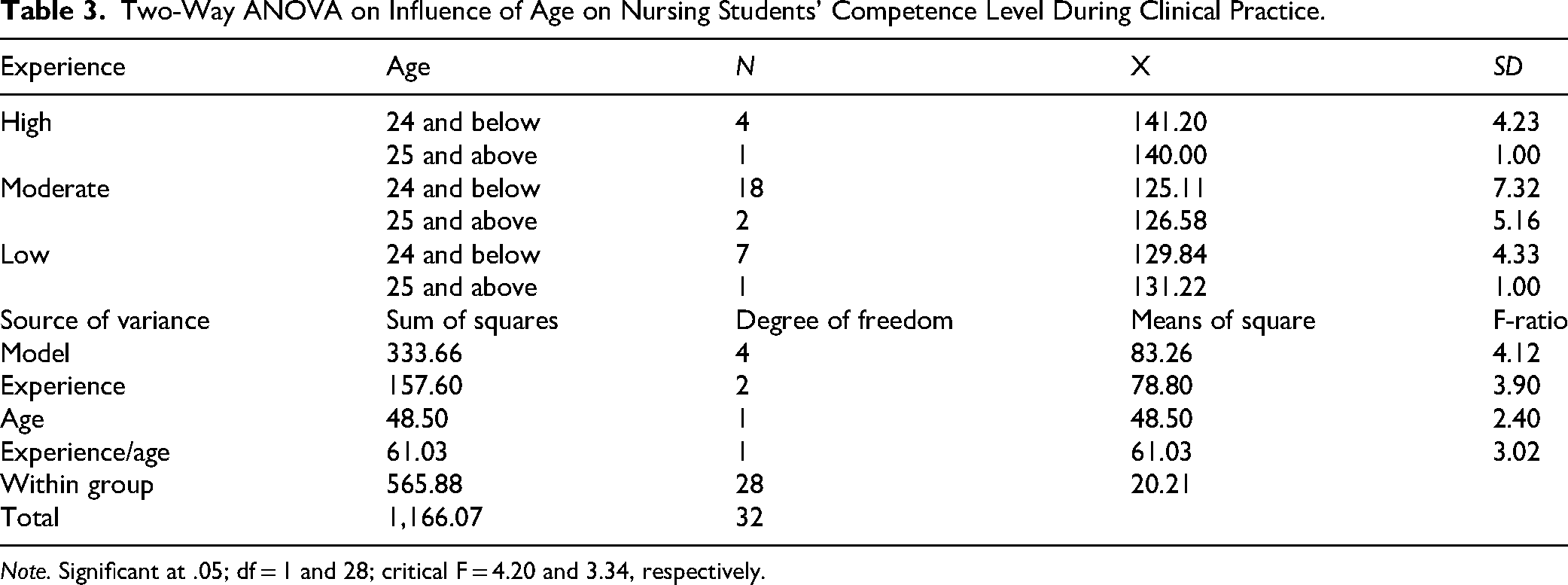
Note. Significant at .05; df = 1 and 28; critical F = 4.20 and 3.34, respectively.
Discussion
Clinical competence is a critical component of nursing education, ensuring students are well-prepared to provide quality nursing care that is safe, efficient, and effective. This study investigated gender and age differentials on competence level in nursing practice among nursing students in a tertiary institution in Lagos State, Nigeria. Previous studies focused on the clinical experiences, clinical environment, and nursing clinical competence level in isolation.
Findings from this study show that the majority of the respondents were between the age range of 20 and 24 years. This implies nursing is attracting young people into the profession. This finding correlates with a finding led by Albagawi et al. (2019), who showed that the majority of nursing students were usually young. This is also supported by Ojekou and Okanlawon (2019), who disclosed that the majority of nursing students that participated in their study were young adults in their 20s. In addition, the findings of this study revealed that most respondents were female. This finding affirmed that the nursing profession is a female-dominated discipline. These findings were in line with WHO's (2020) report that females make up about 90% of the nursing workforce globally; this emphasized the highly gendered nature of the nursing profession.
The findings of this study show that gender significantly predicts clinical competence level among nursing students, with female students exhibiting a higher competence level than their male counterparts. The finding in this study aligns with several recent studies, while others present contrasting results. Prosen (2022) explored nursing perceptions of gender-defined roles and found that female students focus on altruism and positive representation of being a nurse, which contributes to higher competence. Similarly, Liu et al. (2019) demonstrated that female nursing students demonstrated greater caring behavior and critical thinking skills, which are essential components of clinical competence. Also, Gemuhay et al. (2019) and El Idrissi et al. (2021) found a significant association between gender and clinical performance. However, Munangatire et al. (2024), who assessed factors affecting the development of clinical competence among nursing students in Namibia, found no significant relationship between gender and competence level. The author concluded that other factors may play a more substantial role in competence development. Also, some studies found no difference in student gender as a measure of role performance, which is a component of competence (Tong et al., 2023; Yüksekol et al., 2021). Furthermore, a study by Liu et al. (2019) highlighted that gender role orientation, rather than biological sex, predicts caring behaviors and critical thinking among nursing students, suggesting that individuals with higher femininity traits, regardless of gender, may exhibit greater clinical competence. Likewise, the findings of Fooladi et al. (2022) revealed that similarities exist in clinical performance between female and male nursing students.
The previous studies presented a complex picture of gender differences concerning clinical competence. However, it can be said from this study that recording gender differences with females having higher competence levels could mean that male nurses are facing challenges that can be attributed to the feminist nature of the nursing profession, societal expectations, and gender-defined roles, making adjustment to clinical learning difficult. It is worth noting that nursing as a profession has sociocultural implications for male nurses, leading to social stigma and stereotypes (Ojekou & Okanlawon, 2019; Royal College of Nursing 2020), hence low clinical competence development among them. Therefore, it is essential to consider gender disparities and gender role orientation programs when developing educational strategies and policies to improve clinical competence among nursing students regardless of their gender. In addition, if the interests, concerns, and learning needs of male nurses are met, higher competence can be recorded.
This current study also found that age does not predict nursing students’ clinical competencies among nursing students. In line with the findings of this study, Gemuhay et al. (2019) found that the age of nursing students has no significant association with clinical performance. Similarly, Shibiru et al. (2023), who examined the perceptions of nursing students in relation to clinical education, found that clinical competence was not influenced by age. Also, Gholami et al. (2023) reported that age has no impact on competence development but found that other variables such as educational methods, clinical practice experiences, and student engagement may play a better role in competence development. However, the finding of this study contradicts Shengyao et al. (2024) found a significant correlation between emotional maturity and academic achievement, with older students exhibiting a stronger correlation. This was attributed to the fact that older students possess greater internal motivation, and life experiences, which can enhanced their performance. In addition, Apeh and Sulaimon (2020) disclosed that a significant difference in trainees’ critical thinking ability and performance exists in age. The finding of the present contradicts traditional assumptions about the role of maturity in clinical performance. This may imply that age, often perceived as a maker of capability, may not necessarily translate to competence. Although older students may bring valuable experiences and skills to nursing education (Christensen & Craft, 2021), these assets may not directly influence clinical competence development as competence may stem from other factors rather than age. So, the findings of this study should be interpreted with caution. Subjective assessment may not accurately reflect students’ actual clinical abilities, which may obscure the true relationship between age and competence. The fact remains that nursing is a profession that can be chosen regardless of age or gender. Therefore, age should not be a barrier to learning, but gender-related challenges should be looked into by the relevant educational bodies to address the unique challenges faced by diverse groups within nursing education in Nigeria. This study underscores the importance of creating an inclusive and supportive learning environment to bridge the gap, fostering equitable skill development across all demographics.
Limitations and Strengths of the Study
The limitation of this research is the small sample size. Future studies should be on a larger scale. Gender variation is another limitation in this study. This study's finding may be limited by the overrepresentation of female participants reflecting the gender distribution within the profession. This imbalance may restrict the generalizability of the findings to other settings. This study did not address other confounding variables that could influence nursing students’ competence level in clinical practice. Also, this study is a self-reported clinical competence, which may be subjective and overestimated; an observational study on clinical competencies is suggested. It is essential to note that the findings of this study may not be generalized to the entire nursing student population outside the study setting. The strength of this study is that any adult age cohort can practice the nursing profession. In addition, this study is significant for male-inclusive curriculum development, recruitment, and retention in our nursing schools.
Recommendations/Implications for Practice
This study suggested that further research exploring underlying factors contributing to gender differences is important in competence development in clinical practice. Nursing students should be self-motivated to overcome challenges that could impair their competence level in the clinical areas, regardless of their age or gender. In addition, public awareness programs on the social role distribution of women and men in nursing should be created through available measures, such as social media, religious gatherings, particularly in developing countries like Nigeria. There is a need to advocate for gender diversity, mentorship, and support to enhance quality care delivery. Positive portrayals of male presence in the profession could help address the shortage in the nursing discipline. Moreso, male nurse role models and mentorship programs can foster sense of community and belonging, thereby increasing male representation in the nursing profession. Lastly, recruitment and retention of more males in clinical and academic plans should be looked into.
This study has significant implications for nursing education and practice. To promote equity in nursing education, programs must ensure that all students, regardless of gender or demographic background, receive comprehensive training to excel in clinical practice.
Nursing educators should acknowledge and address gender differences to promote inclusive education. Particularly, tailoring education programs addressing skills for sustaining male genders. Mentorship programs and supportive clinical environments can enhance clinical competence development among nursing students particularly among make students who may feel marginalized.
Conclusion
The study highlights significant gender differences in clinical competence levels among nursing students. Recognizing and understanding these differences can inform targeted strategies to enhance clinical competence development and improve patient care.
Supplemental Material
sj-doc-1-son-10.1177_23779608251331587 - Supplemental material for Gender and Age Differential on Competence Level in Clinical Practice Among Nursing Students in a Tertiary Institution in Nigeria
Supplemental material, sj-doc-1-son-10.1177_23779608251331587 for Gender and Age Differential on Competence Level in Clinical Practice Among Nursing Students in a Tertiary Institution in Nigeria by Ayodeji Olubunmi Ogunmuyiwa, Stella Chinwe Anyama, Bukola Beatrice Howells, Comfort Adebisi Ogunleye and Deborah Tolulope Esan in SAGE Open Nursing
Supplemental Material
sj-docx-2-son-10.1177_23779608251331587 - Supplemental material for Gender and Age Differential on Competence Level in Clinical Practice Among Nursing Students in a Tertiary Institution in Nigeria
Supplemental material, sj-docx-2-son-10.1177_23779608251331587 for Gender and Age Differential on Competence Level in Clinical Practice Among Nursing Students in a Tertiary Institution in Nigeria by Ayodeji Olubunmi Ogunmuyiwa, Stella Chinwe Anyama, Bukola Beatrice Howells, Comfort Adebisi Ogunleye and Deborah Tolulope Esan in SAGE Open Nursing
Footnotes

Funding
The author(s) received no financial support for the research, authorship, and/or publication of this article.
Conflicting Interests
The author(s) declared no potential conflicts of interest with respect to the research, authorship, and/or publication of this article.
Supplemental Material
Supplemental material for this article is available online.
References
Supplementary Material
Please find the following supplemental material available below.
For Open Access articles published under a Creative Commons License, all supplemental material carries the same license as the article it is associated with.
For non-Open Access articles published, all supplemental material carries a non-exclusive license, and permission requests for re-use of supplemental material or any part of supplemental material shall be sent directly to the copyright owner as specified in the copyright notice associated with the article.
