




Abstract
Introduction
One of the global strategic direction and policy priorities in 2021 through 2025 is preservice education of nurses. Even though, quality education is the foundation to produce competent health workers, ensuring the competence of the health professionals is as imperative as maximizing their number. This study aims to fill the literature gap among nursing students in public universities.
Objectives
The purpose of this study is to assess the prevalence of clinical practice competence and its associated factors among graduating BSc nursing students in public universities from July 15 to August 15, 2022.
Methods
An institutional-based cross-sectional study was carried out in randomly selected public universities in eastern Ethiopia. A total of 143 students were systematically selected to fill out the questionnaire through multistage sampling. Frequency, mean, and standard deviations of independent variables and proportion of clinical practice competence were analyzed using descriptive statistics. AOR with a p-value of <.05 was used to declare a significant association.
Results
The study found that 69 (53.1%) of study participants were clinically competent. Students with good clinical instructors [AOR: 3.79, 95%CI: 1.56–9.21], learning in a conducive clinical setting [AOR: 3.59, 95%CI: 1.26–10.23] and assessed using measurable methods [AOR: 3.77, 95%CI: 1.53–9.30] were significantly associated.
Conclusion
In this study, almost one in two of the students was clinically incompetent. Respective stakeholders could enhance students’ competence by monitoring and evaluating students during clinical practice, creating favorable learning settings, and developing comprehensive assessment methods.
Introduction
The United Nations 2030 Agenda for Sustainable Development Goal (SDG-3) is rooted in the concept of universal health coverage (UHC) and aspires to support the World Health Organization (WHO) members to optimize their health workforce towards the achievement of the goal (WHO, 2021b). In 2015/2016, Ethiopia, as a WHO Africa member, had a total of 68,084 medical doctors, nurses, and midwives with an aggregate density of 0.74 per 1000 population. However, it was suboptimal in comparison with, 2.3 per 1000, the WHO benchmark for sub-Saharan Africa (FMOH, 2016). Despite the shortage of health workers, the Health Sector Development Plan of Ethiopia IV (HSDP-IV) will project to produce 374,368 health professionals and 127,299 professional nurses by 2025 to meet the WHO benchmark (FMOH, 2016).
One of the WHO's global strategic directions and policy priorities from 2021 to 2025 is the preservice education of nurses (WHO, 2021a). Quality education is the foundation for producing competent health workers to meet national health priorities and population demand. Moreover, ensuring the competence of health professionals is as imperative as maximizing their number (Immonen et al., 2019; WHO, 2016).
In contrast to nursing students in developed countries, those studying nursing in middle- and low-income countries, such as sub-Saharan Africa, face several challenges in their quest for adequate competency (Bvumbwe & Mtshali, 2018; So et al., 2016). Reforming the curriculum, regulating the profession, putting transformative teaching approaches into practice, collaborating and partnering, building infrastructure and capacity, and failing to align competencies with the needs and resources of the population are some of the obstacles (Bvumbwe & Mtshali, 2018; Immonen et al., 2019). Graduate nursing students in sub-Saharan nations, such as Ethiopia, lack the necessary clinical competency as a result of these challenges (Bifftu et al., 2016; Bvumbwe & Mtshali, 2018; Getie et al., 2021).
In Ethiopia, health workforce development and professional practices are monitored and evaluated by two regulatory bodies. The Higher Education Relevance and Quality Agency (HERQA), established by Proclamation No. 351/2003, is responsible for ensuring the relevance and quality of preservice education in higher educational institutions. The other body, the Food, Medicine and Health Care Administration and Control Authority (FMHACA) of Ethiopia, established by Proclamation No. 661/2009, is mandated to avert health problems due to substandard institutions and incompetent health professionals. Even though these agencies were established decades ago, the quality of nursing education is still severed and the production of competent nurses is far-fetched (Feysia et al., 2012; Hart et al., 2018; Weldetsadik et al., 2020).
Literature Review
Clinical competence is defined as the efficiency in solving complicated problems by application of the integration of knowledge, practical skills, professional judgment, and the attitude of students (Kiguli-Malwadde et al., 2014). Nursing competency was also described as the ability to take action by combining knowledge, skills, values, beliefs, and experience acquired as a nurse and it can be viewed as an integrated performance reflecting the professional nurse's feelings, thoughts, and judgment (Immonen et al., 2019; Kiguli-Malwadde et al., 2014; Nabizadeh-Gharghozar et al., 2021).
Since the time of Florence Nightingale, nursing clinical competency has undergone a substantial revolution; currently, it has 12 components: patient-centered care, communication, evidence-based practice and research, critical thinking and innovation, personal traits, quality of practice, collaboration, professional practice evaluation, management of nursing care, resource use, and legal and ethical practice (Shan et al., 2022; Wu et al., 2015). The clinical competence of nursing students is significantly associated with clinical decision-making, job performance, job satisfaction, patient safety, and the overall quality of nursing service (Gaskell & Beaton, 2015; Geleta et al., 2021; Makarem et al., 2019; Mekonen et al., 2020; Rosseter, 2014).
Studies indicated that different factors were significantly associated with the clinical competence level of nursing students such as clinical instructors, clinical settings, assessment methods, student profile, and student staffs interactions were among them (Bvumbwe & Mtshali, 2018; Hailu et al., 2021; Kajander-Unkuri, 2015; Terefe et al., 2023).
Institutional-based cross-sectional studies conducted in public universities of Ethiopia reported that 23.2% to 48.7% of nursing students were clinically competent (Amsalu et al., 2020; Bifftu et al., 2016; Fikre, 2016; Getie et al., 2021; Tesfaye et al., 2020). Despite very little evidence has existed; there is a paucity of evidence in public universities in the eastern part of Ethiopia. This study aims to fill the literature gap on the magnitude of clinical competence among nursing students and its associated factors in public universities. Even though a study was conducted in Dire Dawa, eastern Ethiopia (Hailu et al., 2021), this study differs in its particular focus on only nursing students, excluding private educational institutions and limited to graduating students only. This study might provide specific measures and recommendations that might tackle and address the potential factors associated with graduating nursing students’ clinical competence that ultimately enhance quality nursing education, quality nursing care, and better patient outcomes.
The study's specific objectives:
To assess the prevalence of clinical practice competence among generic nursing students.
To identify factors associated with clinical practice competence among generic nursing students.
Methods
Study Design and Setting
An institutional-based cross-sectional study was conducted in randomly selected public universities in eastern Ethiopia from July 15 to August 15, 2022. There were six universities found in the eastern part of Ethiopia (including North East and South East) that were providing generic nursing education in the catchment. Among them, three universities that had generic graduating nursing students were selected randomly by lottery method. The randomly selected universities were Arsi University, Haramaya University, and Jigjiga University.
Arsi University is located in the Arsi zone, Assala town, Oromia Regional State. It is located 159 km southeastern of the capital city, Addis Ababa. Currently, it is enrolling students in 6 colleges. During the study year, 43 students attended a generic graduating class (GC) in the nursing department.
Haramaya University is among the oldest university in Ethiopia. It is located at a distance of 497 km from Addis Ababa. Currently, the university is enrolling a total of 35,000 students at 8 colleges, 1 institute, and 224 departments in regular, continuing education Program (CEP) and summer programs at doctoral, master, and undergraduate levels. College of Health and Medical Science is located in Harar town. In total, more than 189 students were studying in the nursing program at the undergraduate level, out of which 34 were generic graduating students during the study year.
Jigjiga University is located in Somali regional State, Jigjiga town at a distance of 617 km from Addis Ababa. This university is enrolling a total of 21,379 students at 8 colleges, 1 institute, and 54 departments in a regular, CEP, summer program at both undergraduate and master's levels. The nursing department has a total of 453 students from the first year to the fourth year. Among this, 120 students were attending generic graduating classes during the study year.
Research questions:
What is the level of clinical practice competence of graduating BSc nursing students?
What are the factors significantly associated with the clinical practice competence of the students?
Study Participants and Sampling Methods
Graduating generic BSc nursing students who were at their internship clinical attachment were included in the study. Graduating generic BSc nursing students who were not qualified to attend their internship due to academic and disciplinary reasons were not eligible for this study.
A single population proportion formula was used to calculate the sample size with a prevalence of 48.7% from a study conducted in two public universities of the Amhara Regional State (23), a 5% margin of error, and a 95% confidence level, which yielded a sample size of 384. Since the total population of the study was 197 (less than 10,000), the sample size by correction formula was reduced to 130. By considering a 10% nonrespondent rate (n = 13), the final sample size was considered to be (n = 143).
A multistage sampling technique was used to select the study participants. From six public universities in eastern Ethiopia that had bachelor generic nursing programs, three universities were selected by lottery method. Next, from a total of 197 students in the selected universities, 143 study participants were proportionally allocated to their students’ size by using the probability proportional to size method. Then, the sampling frame of the students was made using their identification number record from the college registrar. Finally, the study participants were selected by a simple random method using a computer random number generator.
Data Collection Tool and Procedure
Data were collected using a structured, self-administered questionnaire. The data collection questionnaire had a total of 79 questions, which were categorized into three parts: socio-demographic data (7 items), clinical practice competence responses (42 items), and factors affecting clinical practice competence (30 items). (Supplementary file 1) The tool was adapted from previous similar studies (Amsalu et al., 2020; Fikre, 2016; Getie et al., 2021). The questionnaire had an overall internal consistency of 0.88 in this study.
The clinical nursing competence (the outcome variable) contains five domains: ethical practice (8 items); holistic approaches to care and the integration of knowledge (21 items); interpersonal relationships (8 items); organization and management of care (3 items) and; personal and professional development (2 items). This outcome measurement had an internal consistency of 0.81 in this study. A five-point Likert scale, in which 1 is responded as “Cannot perform activities satisfactorily to the level required” to 5 as “Can perform activities without assistance plus can lead others too,” was used to rate the perceived clinical competence level of students for each of the five domains. A score of 50% and above in each domain was considered as “competent,” unless considered as “incompetent.” For this study, an overall score of 50% and above in all five domains was considered as “clinically competent,” unless “clinically incompetent” (Amsalu et al., 2020; Getie et al., 2021).
Other Variable Measurements
To analyze factors associated with the clinical competence of the students, factors were categorized into the following five domains. A five-point Likert scale, in which 1 as “strongly disagree” to 5 “strongly agree,” was used to rate the domains. Then the rating was further dichotomized into 1–3 rating as “disagree” and 4–5 rating as “agreed.”
Clinical instructor: if a student agreed to at least 50% of the 13-item questions of good clinical instructor-related factors was considered as “good clinical instructor,” unless “not good clinical instructor” (Fikre, 2016).
Clinical setting: if a student agreed to at least 50% of the 5 item questions of conducive clinical setting-related factors was considered as “conducive clinical setting,” unless “not conducive clinical setting” (Fikre, 2016).
Students’ profile: if a student agreed to at least 50% of the 4-item questions of student profile-related factors was considered as “good student profile,” unless “not good student profile” (Hassen et al., 2019).
Assessment method: if a student agreed to at least 50% of the 5-item questions of assessment-related factors was considered as “measurable assessment method,” unless “not measurable assessment method” (Hassen et al., 2019).
Staff and student interaction: if a student agreed to 2/3 and above of the 3-item questions of staff and student interaction-related factors was considered as “Good interaction,” unless “not good interaction” (Fikre, 2016).
Data were collected by eight BSc degree nurses who had COC (Certificate of competence) and two years of clinical experience and were recruited from each clinical attachment site. First, a brief orientation was given to data collectors on the study objectives, sampling, consent, data privacy, and checking for data clarity and completeness. Next, data collectors described the intent of the study and sought consent from the study participants. Then finally, the questionnaire was distributed and collected from the study participants in their clinical attachment site by the data collectors. To ensure the data quality, a pretest of the tool was performed on 5% of the sample population for clarity and consistency. The data collectors were oriented and trained on the data collection procedures. Data checking and cleaning were done using SPSS before analysis.
Data Processing and Analysis
Data were coded and entered into Epi-info version 7.1. It was transported to SPSS version 22 for data sorting, cleaning, and analysis. Missing data were filtered, analyzed using SPSS, and crosschecked with the original response data Frequencies, means and standard deviations of independent variables and proportion of clinical practice competence were analyzed using descriptive statistics. Variables related to factors were computed into five components of factors affecting clinical practice competence. Binary and multiple logistic regression analyses were carried out to assess the association of selected variables to clinical practice competence among generic graduating nursing students. To minimize potential selection and confounding bias, we tried to incorporate probability and proportional sampling techniques and multiple regression analysis.
In binary logistic regression, variables with p-value <.25 with a confidence interval of 95% were candidates for multiple logistic regression. Odds ratio with a 95% confidence interval and p-value <.05 were used to declare a significant association with clinical practice competence. Results were presented in the form of tables, figures, and summary statistics such as mean, standard deviation, and percentage to describe the study population with relevant variables.
Results
Sociodemographic Characteristic
Out of 143 generic graduating nursing students, 130 of them participated in the study yielded a 90.9% response rate. Seven students were unable to return the questionnaire and 5 students returned incomplete questionnaire responses. More than half 70 (53.8%) of the study participants were female and the majority of them 95 (73.1%) were between 20–23 years old with a median age of 23 years. One-third of respondents 43 (33.1%) were Muslims and 116 (89.2%) of them were single and 41 (31.5%) were Oromo (Table 1).
Sociodemographic Characteristics of Graduating Nursing Students in Public Universities of Eastern Ethiopia, 2022 (n = 130).

Prevalence of Clinical Practice Competence of Graduating Nursing Students
The study found that 69 (53.1%, 95%CI: 45.4–60.8) of study participants were clinically competent with an above mean score of 2.546 and SD 0.334. The highest mean score (2.619, SD; 0.41) was observed for holistic approaches to care and integration of the knowledge domain. The lowest mean score (2.24, SD; 0.97) was observed for the personal and professional development domain.
Factors Associated With Clinical Practice Competence
In bivariate analysis, 16 out of 45 variables were significantly associated with clinical practice competence at a 0.05% significance level. For further analysis, all independent variables fulfilling the minimum requirement (variables with a p < .25) were exported for multivariable logistic regression.
In regard to clinical instructor-related factors, out of 13 variables, 4 of the variables were significant in bivariate analysis at a p < .25 and 3 of them were significant in multivariable analysis at a p < .05. Students with instructors who use different learning methods were 1.93 times more likely to be competent than students who claimed their instructors did not use different learning methods in clinical practice [AOR: 1.934, 95%CI: 1.05–3.53]. Students with instructors who demonstrated skills in cases and problem-solving were 1.96 times more likely to be competent than students with instructors who did not demonstrate skills in cases and problem-solving [AOR: 1.96; 95%CI: 1.070–3.621]. Students who got constructive feedback from their instructors were 2.578 times more likely to be competent than students who did not have constructive feedback from their instructors [AOR: 2.578, 95%CI: 1.261–5.271] (Table 2).
Instructor-Related Factors Associated With Clinical Practice Competence of Graduating Nursing Students in Public Universities of Eastern Ethiopia, 2022 (n = 130).

*Significant at a p-value of < .05.
Regarding clinical setting-related factors, out of the 4 variables, 2 of them were significant in bivariate analysis and a response to sufficient practice resources was significant in multivariable analysis at a significance of p < .05. Students in clinical settings with sufficient clinical procedure materials were 3.458 times more likely to be competent than students in clinical settings with insufficient clinical procedure materials [AOR: 3.458, 95%CI: 1.602–1.467] (Table 3).
Clinical Setting-Related Factors Associated With Clinical Practice Competence of Graduating Nursing Students in Public Universities of Eastern Ethiopia, 2022 (n = 130).

*Significant at a p-value of <.05.
In regard to assessment method-related factors, out of 5 variables, 4 of them were significant in bivariate analysis and 3 of them were significant in multivariate analysis at p < .05. Students who agreed that the assessment method had a positive influence on clinical practice were 2.56 times more likely to be competent than those who disagreed [AOR: 2.56, 95%CI: 1.29–5.09]. Students who agreed that instructors made a difference in the assessment were 5.27 times more competent than those who disagreed [AOR: 5.27, 95%CI: 2.00–13.92]. Students assessed by the assessment method addressing the three learning domains were 4.90 times more likely to be competent than students who were not assessed by the assessment method dressing the three learning domains [AOR: 4.908, 95%CI: 1.975–12.198] (Table 4).
Assessments Methods Related Factors Associated With Clinical Practice Competence of Graduating Nursing Students in Public Universities of Eastern Ethiopia, 2022 (n = 130).

*Significant at a p-value of <.05.
Regarding students’ profile-related factors, out of 4 variables, 2 of them were significant in bivariate analysis and students’ responses to substance use were significantly associated in multivariable analysis at a p < .05. Students free from using addictive substances were 1.88 times more likely to be competent than students who had used addictive substances [AOR: 1.88, 95%CI: 1.08–3.25] (Table 5).
Students Personal Profile-Related Factors Associated With Clinical Practice Competence of Graduating Nursing Students in Public Universities of Eastern Ethiopia, 2022 (n = 130).
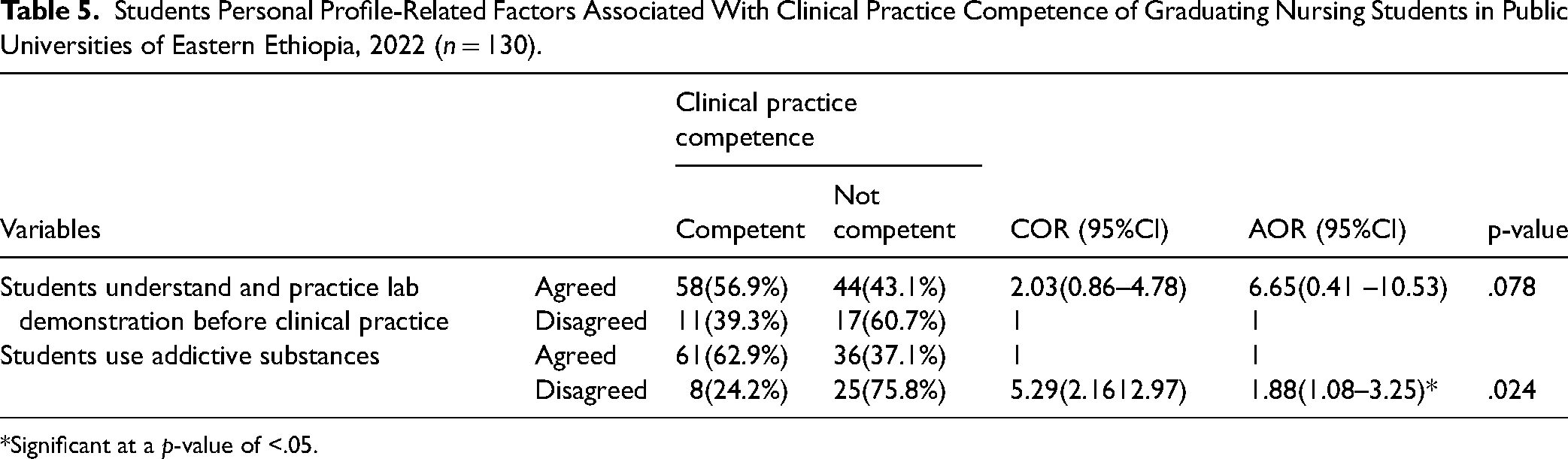
*Significant at a p-value of <.05.
Regarding computed variables (overall factors) associated with clinical competence, out of the 5 variables, 3 of them were significantly associated both in bivariate and multivariable analysis. Students with good clinical instructors were 3.79 times more likely to be competent than students who didn’t have good clinical instructors [AOR: 3.79, 95%CI: 1.56–9.21]. Students in conducive clinical settings were 3.59 times more likely to be competent than students who did not have conducive clinical settings [AOR: 3.59, 95%CI: 1.26–10.23]. Students responding to measurable assessment methods were 3.77 times more likely to be competent than those who claimed the assessment methods were not measurable [AOR: 3.77, 95%CI: 1.53–9.30] (Table 6).
Bivariate and Multivariable Analysis of Computed Variables Associated With Clinical Practice Competence of Graduating Nursing Students in Public Universities of Eastern Ethiopia, 2022 (n = 130).

*Significant at a p-value of <.05.
Discussion
In this study institutional-based cross-sectional study was conducted to assess the prevalence of clinical practice competence and its associated factors among generic graduating nursing students in public universities of eastern Ethiopia. In the present study clinical instructor, clinical setting, and assessment method-related factors were found to be significantly associated with clinical practice competence.
The prevalence of clinical practice competence of generic graduating BSc nursing students was 53.1% (95%CI: 45.4–60.8%). In line with this finding, a similar result was noted from studies conducted at Gondar and Bahir Dar Universities (48.5%) (Bifftu et al., 2016) and Southern Universities of Ethiopia (59.9%) (Terefe et al., 2023).
However, the findings of the present study are higher in comparison with studies conducted in other Ethiopian universities: Amhara regional state (Northern Universities) (33.6%) (Getie et al., 2021), Mettu University (24.5%) (Amsalu et al., 2020), Hawassa University (25.2%) (Fikre, 2016), and Dire Dawa Health Science Colleges (19.2%) (Hailu et al., 2021). This discrepancy might be due to the difference in study setting and characteristics of study participants, as well as the technique of data collection. The disparity might be due to a single institutional study setting and including junior nongraduating students in the studies of Hawassa, Dire Dawa, and Mettu Universities. It is reported that advancement in the clinical academic year enhances clinical knowledge and skills. It might also be related to the poor quality of education and weak regulatory methods noted in private educational institutions like that of the study focus of Dire Dawa Health Science Collages. Nevertheless, in contrast to the study conducted at the University of Turku, Finland (66.7%) (Kajander-Unkuri, 2015) the finding of the present study was lower. This discrepancy might be due to socioeconomic, resource allocation, and quality of education disparity among developing and developed countries.
Clinical instructor factors had a significant association with clinical practice competence. Students with good clinical instructors were 3.79 times more likely to be competent than students who did not have good clinical instructors. Students with clinical instructors who taught using different learning methods, who had skill demonstrations, and who gave constructive feedback were more likely to be clinically competent. A similar study conducted at Dilla, Mekele, and Hawassa universities found similar findings (Amsalu et al., 2020; Fikre, 2016). On the other hand, the study conducted at Mettu University clinical instructor factor had no significant association with clinical practice competence (Amsalu et al., 2020).
The clinical setting had a significant association with clinical practice competence. Students in conducive clinical settings were 3.59 times more likely to be competent than students who did not have conducive clinical settings. Students in clinical settings with sufficient clinical procedure materials were more likely to be competent. A descriptive cross-sectional study conducted at Palestine College of Nursing revealed that 70% of respondents agreed that the clinical practice competence of nursing students could be enhanced by the availability of clinical procedure materials (Immonen et al., 2019). A similar study conducted at Mekele University found similar findings (Hassen et al., 2019). Qualitative studies conducted in Iran, Finland, and Saudi Arabia Universities also support the present study findings (Mekonen et al., 2020; Papp et al., 2003).
The assessment method had a significant association with nursing students’ clinical practice competence. Students assessed with measurable assessment methods were 3.77 times more likely to be competent than students assessed without measurable assessment methods. Students assessed by assessment checklists and assessed by addressing the three learning domains were more likely to be competent. This finding is noted in a study conducted at Hawassa University (Fikre, 2016). A systematic review conducted in Egypt concluded that different kinds of assessment instruments enable reliable assessment (Setiawan et al.). Assessment greatly influences students’ experiences of clinical practice competence and the student's professional identity (Kavanagh & Szweda, 2017).
Limitations of the Study
There was no national standardized questionnaire to assess clinical practice competence for BSc nursing students, as a result, a questionnaire was partially adapted from previous studies' assessment tools.
A limited number of universities were included in the study; hence, it might limit the generalization of the study to the public universities in the whole country.
Since the study was a prevalence study, there will be possibility of recall bias.
Implications for Research and Practice
This study might suggest the need for future research to identify barriers to nursing students’ clinical competency from various perspectives (teachers, students, and mentors) in different universities in Ethiopia. Furthermore, we suggest the need to consider nursing students’ clinical practice in terms of material access, resources (teachers, different teaching and learning methods), quality, and other barriers to practical education.
Conclusions
In the present study, almost one in two of the students was clinically incompetent. Clinical instructor-related factors, clinical setting-related factors, and assessment methods factors were significantly associated with clinical practice competence. Universities are expected to enhance students’ competence by monitoring and evaluating students during clinical practice, creating favorable learning settings, and developing comprehensive assessment methods.
Supplemental Material
sj-docx-1-son-10.1177_23779608241290002 - Supplemental material for Clinical Practice Competence and Its Associated Factors Among Generic Nursing Students Learning at Public Universities: A Cross-Sectional Study
Supplemental material, sj-docx-1-son-10.1177_23779608241290002 for Clinical Practice Competence and Its Associated Factors Among Generic Nursing Students Learning at Public Universities: A Cross-Sectional Study by Lencho Ahmedin, Adamu Birhanu, Mulugeta Mekuria, Nesredin Ahmed, Aminu Mohammed Yassin, Mulualem Keneni, Fenta Wondimneh, Seid Tesi and Henok Legesse in SAGE Open Nursing
Supplemental Material
sj-docx-2-son-10.1177_23779608241290002 - Supplemental material for Clinical Practice Competence and Its Associated Factors Among Generic Nursing Students Learning at Public Universities: A Cross-Sectional Study
Supplemental material, sj-docx-2-son-10.1177_23779608241290002 for Clinical Practice Competence and Its Associated Factors Among Generic Nursing Students Learning at Public Universities: A Cross-Sectional Study by Lencho Ahmedin, Adamu Birhanu, Mulugeta Mekuria, Nesredin Ahmed, Aminu Mohammed Yassin, Mulualem Keneni, Fenta Wondimneh, Seid Tesi and Henok Legesse in SAGE Open Nursing
Footnotes
Abbreviations/Acronyms
Acknowledgments
The authors are very thankful to Ambo University, the respective selected study universities and hospital administrators, the study participants, data collectors, and field supervisors.
Availability of Data and Materials
The participants’ de-identified data used for the current study will be available upon submitting a reasonable request from either the corresponding author or the principal investigator in either SPSS or Stata format.
Authors’ Contributions
LA, AB, and MM were involved in conceptualization, investigation, methodology, writing original draft preparation, and critically reviewing and editing the manuscript. NA, AMY, MB, MK, FW, ST, and HL contributed to investigation, formal analysis, software, supervision, and writing–review and editing of the manuscript. All authors revised the paper critically for important intellectual content. All authors read and approved the final manuscript.
Competing Interest
The authors have no competing interests
Declaration of Conflicting Interests
The authors declared no potential conflicts of interest with respect to the research, authorship, and/or publication of this article.
Ethical Approval and Consent to Participate
Ethical approval was obtained from the Research Ethical and Review Board of Ambo University. (Rf.No.: AU/PGC/336/2021) Additional permission was obtained from the selected universities and respective student's clinical attachment hospitals. The study was conducted following National Institutional Guidelines and in line with the standard of the Declaration of Helsinki. Informed, verbal, and written consent was obtained from each study participant.
Funding
The authors disclosed receipt of the following financial support for the research, authorship, and/or publication of this article: This work was supported by Ambo University.

Supplemental Material
Supplemental material for this article is available online.
References
Supplementary Material
Please find the following supplemental material available below.
For Open Access articles published under a Creative Commons License, all supplemental material carries the same license as the article it is associated with.
For non-Open Access articles published, all supplemental material carries a non-exclusive license, and permission requests for re-use of supplemental material or any part of supplemental material shall be sent directly to the copyright owner as specified in the copyright notice associated with the article.
