




Abstract
Introduction
Smartphones have significantly increased digital engagement among young people due to their ease of use and constant internet access. Nomophobia and the fear of missing out are associated with mobile and internet use, potentially impacting students’ mental health and academic performance.
Objectives
To provide the prevalence of nomophobia and fear of missing out while shedding light on the role of psychological alienation between them.
Methods
A multisite descriptive correlational study was conducted among 1,273 undergraduate nursing students at six Egyptian universities: North Sinai, South Sinai, Port-Said, Suez Canal, Suez, and Damanhur University, Egypt. From June 2023 to November 15, 2023, the students were surveyed using questionnaires on nomophobia, fear of missing out, and psychological alienation.
Results
Nursing students experienced moderate to severe levels of nomophobia (37.4%–45.3%) and psychological alienation (45.8%–55.4%). There was a significant positive correlation between nomophobia and fear of missing out (r = .908, p < .001), as well as between nomophobia and psychological alienation (r = .377, p < .001). Psychological alienation was also found to mediate the relationship between fear of missing out and nomophobia, with the indirect effect being statistically significant (indirect effect = 1.000; p < .001).
Conclusion
The study highlights the significant prevalence of nomophobia and psychological alienation among nursing students. The findings underscore the complex interplay between digital connectivity issues, psychological disconnection, and the fear of missing out. In addition, findings suggest that psychological alienation plays a crucial role in how fear of missing out impacts nomophobia among nursing students.
Keywords
Introduction
The widespread use of smartphones has significantly increased digital engagement among young people due to their ease of use and constant internet access. Students, especially those in academic settings, are deeply immersed in this era of pervasive technology and continuous connectivity. Nursing students, in particular, must navigate this complex environment, balancing the benefits of technological tools with the potential impact on their mental well-being and educational experience (Aldhahir et al., 2023; Gause et al., 2022; Lee et al., 2018). Notably, Naser et al. (2023) found that university students had the highest levels of mobile dependence, spending an average of 94.4 min daily on their phones.
While smartphones and internet access offer undeniable advantages in education, there are also significant negative consequences associated with their excessive use (Pera, 2020). Students use smartphones for various activities, including consuming news, interacting on social media, studying, gaming, shopping, and retrieving information (Alosaimi et al., 2016). The overuse of smartphones can negatively impact nursing students during their clinical training, causing mental distractions, difficulties in concentration and attention, reduced quality of patient care, and impaired retention of clinical information (Aguilera-Manrique et al., 2018).
Literature Review
Within the nursing profession, smartphone addiction poses potential threats to both patient and nurse safety, exerting a discernible impact on clinical effectiveness within healthcare settings. Furthermore, this digital era also introduces challenges, as the constant connectivity may contribute to phenomena like nomophobia (fear of being without a mobile phone) and a pervasive fear of missing out (FOMO). The implications of this digital era underscore the importance of understanding and addressing the unique challenges and opportunities that pervasive technology brings to nursing education (Bacaksiz et al., 2022; El-Ashry et al., 2024).
Bright screens and social media platforms, often seen as ways to socialize, are a significant reason people use the internet excessively. Smartphones have become an essential part of our daily lives, almost like an extension of ourselves (Qi et al., 2023). However, this excessive use can lead to various problems, including the fear of being without a mobile phone, known as nomophobia. The apprehension of being without access to or incapable of utilizing a mobile phone is a prominent digital ailment stemming from the imprudent utilization of smartphones. This condition manifests through emotions of fear, anxiety, and unease, which arise from the deprivation of such technological devices (Yildirim & Correia, 2015).
Globally, the prevalence of nomophobia exhibits a substantial impact, with 70.76% of cases manifesting moderate to severe symptoms and an additional 20.81% categorized as severe, with university students emerging as the demographic most significantly affected (Humood et al., 2021). In addition, it was found that a staggering 99.0% of medical students in India experienced nomophobia, predominantly at a moderate level (Harish & Bharath, 2018). Extending beyond medical education, nursing students are susceptible to heightened levels of internet addiction (Guven Ozdemir & Sonmez, 2021) and nomophobia (Bacaksiz et al., 2022; El-Ashry et al., 2024). Specifically, El-Ashry et al. (2024) discovered that nomophobia is prevalent among nursing students, with a prevalence rate of 40%. Furthermore, studies conducted among nursing students in Spanish and Portuguese contexts reveal higher-than-average levels of nomophobia (Gutiérrez-Puertas et al., 2019).
In addition, social media users might worry about missing important information, not sharing content at the right time, and feeling left out of current discussions (King & Dong, 2017; Li et al., 2018). Individuals may devote extensive periods to social media engagement, perpetually scrutinizing their smartphones, termed “fear of missing out” (FoMO). This condition is characterized by the apprehension of being uninformed regarding social network updates, prompting compulsive behavioral patterns (Alinejad et al., 2022; Kargın et al., 2020). Moreover, studies have indicated varying degrees of FoMO prevalence, with reports categorizing it as moderate (Hoşgör et al., 2017), exceeding moderate (Karaaslan & Ayaz, 2019), or even characterized as high (Pêgo et al., 2021).
Previous investigations have illuminated an association between heightened FoMO, escalated levels of engagement on social media platforms, and problematic mobile phone utilization (Buglass et al., 2017; Santana Vega et al., 2019). Studies indicate the correlations between fear of missing out (FoMO) and nomophobia (NOMO) (Bacaksiz et al., 2022; Hamutoğlu et al., 2018). Additionally, extant literature demonstrates a direct association between FoMO, excessive social media use, and problematic phone usage (Blackwell et al., 2017).
Psychological alienation denotes an adverse emotional condition characterized by a sense of estrangement and disconnection from one's social networks, encompassing peers and family members. It encompasses feelings of isolation, uncontrollability, meaninglessness, and a dearth of social support. This state of helplessness and loneliness gives rise to negative behaviors such as avoidance and rejection (Lobato et al., 2023). Moreover, a study by Huang et al. (2015) suggested a notable correlation between elevated levels of alienation and a proclivity toward negative attributions, potentially contributing to excessive smartphone use among university students.
The findings of a study conducted by El-Ashry et al. (2024) underscore the widespread prevalence of nomophobia among Egyptian nursing students, highlighting their considerable dependence on mobile devices and sensation-seeking behaviors. Both nomophobia and FoMO are identified as digital diseases (Betoncu & Özdamlı, 2019), and there is substantial evidence supporting a positive association between them (Arslan et al., 2019; Durak, 2019; Gezgin et al., 2018). This relationship is further reinforced by Alinejad et al. (2022), who found that FoMO is positively associated with smartphone addiction, with loneliness serving as a critical mediator. Additionally, Karaoglan Yilmaz et al. (2024) reported a significant direct effect of nomophobia on smartphone addiction. Abdel Razek et al. (2021) results indicated a positive correlation between the fear of missing out and nomophobia among expatriate teenagers. However, it is essential to note that nomophobia does not always correlate with FoMO, as Yildirim and Correia (2015) indicated.
Psychological alienation plays a crucial role due to the rapidly changing lifestyle of students, which impacts their psychological and emotional needs (Trivedi & Prakasha, 2021). Atarodi et al. (2020) stated a relationship between self-alienation and smartphone use. Research by Mahajan (2020) revealed that university students experience high levels of alienation. Studies affirmed that while accessing the internet can help satisfy social needs, those experiencing high levels of interpersonal alienation often find that their sense of belonging is not adequately fulfilled in real life; consequently, they increase the use of smartphones for social networking (Assunção et al., 2017; Nongpong & Charoensukmongkol, 2016). Moreover, (Purnama & Sununianti, 2021) assured that alienation increases both time spent on the phone and NOMO. Additionally, earlier studies have shown an association between nomophobia and unfavorable self-perceptions (Durak, 2019).
Psychological alienation impacts a person's traits, including feeling alone, powerlessness, and aimlessness. This disrupts his social connection and adaption, causing him to ignore societal values and norms and live passively with no concern (Aliwa et al., 2021). Teenagers are susceptible to psychological challenges, alienation, and feeling isolated, which have a substantial impact on their lives. As a result, teenagers frequently seek to meet their social and psychological requirements by overusing social media platforms. This finding is consistent with many earlier studies, including Alanzi's (2020) study, which demonstrated a substantial association between internet addiction and psychological alienation among university students. According to Lian (2018), teenagers who experience high levels of social alienation are more likely to avoid negative feelings through greater phone use, which enhances NOMO to have a sense of belonging. Based on this hypothesis, NOMO may result from a lack of social skills and alienation. So, alienation is supposed to have a confounding effect on NOMO. Further research by Ergin and Ozer (2023) pointed out that FoMO's partial indirect impact on NOMO was statistically significant for females but not noteworthy for males. In short, FoMO increases females’ time on their phones, leading to NOMO. Given that alienation affects students’ social needs and their reliance on mobile devices for social interactions, it is crucial to investigate how psychological alienation mediates the relationship between fear of missing out and nomophobia among nursing students (Karaoglan Yilmaz et al., 2023a). We predicted that alienation would lead to an increase in NOMO levels and FOMO.
The research gap identified here involves a deeper examination of the role of psychological alienation in the relationship between nomophobia and fear of missing out among nursing students. While existing studies establish connections between NOMO, FoMO, and smartphone addiction, the mediating effect of psychological alienation in this dynamic remains underexplored. Addressing this gap could provide a more comprehensive understanding of these issues and contribute to better-informed solutions.
Attachment theory provides a psychological framework for understanding NOMO, suggesting that individuals develop attachments to their phones similar to those they form with other people, leading to feelings of stress when they are separated from their phones (Konok et al., 2017). The FoMO phenomenon is interpreted through Self-Determination Theory, which posits that individuals are motivated to act in ways that fulfill psychological needs to achieve a complete sense of self. According to this theory, there are three fundamental needs: competence, relatedness, and autonomy. It is suggested that a deficiency in these needs to varying degrees contributes to FoMO (La Guardia et al., 2000).
To sum up, this study proposes the following hypothesis:
Theory suggests that psychological alienation plays a crucial role in the relationship between nomophobia and fear of missing out among nursing students (Figure 1).

Conceptual model of study variables.
Grounded on hypotheses 1, 2, and 3, we postulate the subsequent hypothesis: Top of Form
Objectives of the Study
Identify the prevalence and levels of nomophobia among nursing students in six universities.
Assess the degree of psychological alienation among nursing students in six universities.
Explore the relationship between nomophobia, psychological alienation, and fear of missing out among nursing students.
Examine whether psychological alienation and fear of missing out predicted nomophobia among nursing students.
Method
Study Design and Setting
Between June 2023 and November 2023, a multisite descriptive correlational study following the “Improving the reporting of observational studies in epidemiology” (STROBE) checklist was conducted through six Egyptian universities: Sinai, South Sinai, Port-Said, Suez Canal, Suez, and Damanhur University.
Inclusion and Exclusion Criteria of Participants
The current study targeted nursing students enrolled in colleges and high nursing institutes allied to the six universities above during the academic year 2023–2024. The study participants encountered the succeeding criteria to be encompassed in the study: students aged 18 years and more, both sexes, who have smartphones or tablets and spend most of their time on electronic screens, and who revealed an interest in sharing in the study.
The researchers in the contemporary study used a convenient stratified sampling to recruit participants from all universities above. To calculate the appropriate sample size, the following formula was used: n = Z2 * P * (1 − P)/d2. The estimated proportion of the population with the characteristics of interest, namely nomophobia, psychological alienation, and fear of missing out among nursing students, was based on a study by El-Ashry et al. (2024) and Bacaksiz et al. (2022). The desired margin of error was set at 5%. Considering a conservative estimate of a 10% unresponsive rate and the anticipated dropout rate, the calculation indicated that a minimum sample size of 1,273 nursing students was required for the study.
A two-stage sampling strategy was employed to enroll nursing students; initially, stratified sampling was used to determine the number of participating nursing students per university, and the targeted number of nursing students from each university was estimated by utilizing the subsequent formula; stratified subgroup sample size = (total sample size/total number of all universities’ nursing students) * total number of the nursing students in each university. Hence, the targeted sample size from the universities of North Sinai, South Sinai, Port-Said, Suez Canal, Suez, and Damanhur was 48, 223, 276, 447, 100, and 179, respectively. The selection of the stratification method guaranteed adequate representation of each university in the sample while considering dissimilarities in nursing students’ size and demographic make-up of the students across different universities and intended to lessen sampling bias. Similarly, it gives a systematic approach to obtaining a population sample. Secondly, convenience sampling was used to recruit nursing students in each university to facilitate reasonableness and viability in data collection (Atta et al., 2024b) (Figure 2).

Path analysis to detect the direct and indirect effect of fear of missing out on nomophobia mediating by Psychological Alienation. Model fit parameters CFI; IFI; RMSEA (1.000; 1.000; 0.341). CFI = comparative fit index; IFI = incremental fit index; and RMSEA = root mean square error of approximation. Model χ2; significance 148.983*(<.001*).
Instruments of Data Collection
Four instruments were utilized to gather data for this study which comprised the following:
Instrument I: Student's Personal Characteristics Data Sheet
The researchers in the Arabic language developed this structured sheet; it encompassed two portions as the following:
First portion involved personal characteristics such as nursing students’ age and sex.
Second portion: It elicited questions about data interrelated to nursing students’ smartphone usage habits, such as the duration of smartphone ownership (Supplementary material 1).
Instrument II: Nomophobia Questionnaire (NMP-Q)
This questionnaire was developed and validated by Yildirim and Correia (2015) in English and translated into Arabic by Jelleli et al. (2023). The questionnaire comprises 20 items rated on a 7-point Likert scale ranging from 1 (strongly disagree) to 7 (strongly agree). The total score ranges between 20 and 140 points, where 20 indicates absence nomophobia, mild level from 21 to 59, values from 60 to 99 reflected a moderate level, and scores from 100 to 140 suggested a severe level. The questionnaire evaluates four dimensions of nomophobia: inability to access information (NBAAI) (four items), the hassle of losing immediate access to information through the smartphone, and searching for the desired information at that moment and giving up comfort (GUC) (five items): feelings inherent to the comfort and psychological tranquility of having control over the smartphone related to its battery, coverage, and credit. Not being able to communicate (NBAC) (six items): feelings about losing immediate communication. Finally, loss of connection (LC) (five items): emotions associated with losing ubiquity after losing connectivity.
The NMP-Q was previously shown to be reliable and consistent for measuring nomophobia among nursing students (Cronbach's α = .83, .82, .84, and .88 for the subdimensions) (El-Ashry et al., 2024; Jelleli et al., 2023). The existing study verified the scale's internal consistency with Cronbach alpha, yielding a Cronbach's α = of .87, demonstrating satisfactory reliability.
Instrument III: Fear of Missing Out Scale (FoMO)
Przybylski et al. (2013) proposed it in the English language and translated it into Arabic by Al-Menayes (2016). The scale is a self-report questionnaire designed to measure the negative emotions accompanied by thinking that one is left out of the social events and rewarding experiences of others, mainly encompassing their friends. It is a one-dimensional scale consisting of 10 items. The scoring system of FoMO was a 5-point Likert scale. Items were scored 1, 2, 3, 4, and 5. Therefore, summed scores of the FoMO scale range from 10 to 50. Higher scores indicate a higher risk of experiencing the fear of missing out (Eskin Bacaksiz et al., 2022).
The Cronbach's alpha reliability of the original version of the FoMO scale is .89 (Yildirim & Correia, 2015). The FoMO was previously shown to be valid and reliable among the Egyptian population and nursing students (Cronbach's alpha = .89) (Al-Menayes, 2016; Eskin Bacaksiz et al., 2022). For the contemporary study, the Cronbach's alpha was .88.
Instrument V: Psychological Alienation Scale (PAS)
Alkouri et al. (2022) developed a Psychological Alienation Scale (PAS) in the Arabic language to assess the degree of psychological alienation among university students from the perspective of the students themselves. The scale consists of 27 questions reflecting four dimensions of psychological alienation: self-alienation, social deficit, loss of purpose, and social isolation.
Each item in the PAS was ranked on a five-point Likert scale extending from (5) “strongly approved” to (1) “vehemently opposed.” The arithmetic means and standard deviations of the degree of psychological alienation as a whole and its dimensions based on the calculation averages suggested to be low from 1.00 to 2.33, average from 2.34 to 3.67, and high from 3.68 to 5.00.
The PAS was deemed to be of satisfactory reliability (Cronbach's alpha = .73, .75, .76, .72, and .80 for self-alienation, social deficit, loss of purpose, social isolation, and psychological alienation as a whole correspondingly) (Alkouri et al., 2022).
For the current study, the Psychological Alienation Scale (PAS) was verified to be reliable as Cronbach's alpha coefficient was reasonable as α = Cronbach's alpha = .80, .72, .79, .75, and .84 for self-alienation, social deficit, loss of purpose, social isolation, and entire psychological alienation respectively.
A panel of seven academic professionals in psychiatric nursing and mental health was invited to evaluate the instruments to verify the study's validity. They requested to review the instruments for relevance, lucidity, feasibility, and unambiguousness regarding face validity. They also confirmed that the included items were appropriate and effortlessly understandable for nursing students. Regarding content validity, a panel assessed the instruments to guarantee that the items broadly covered all aspects related to nomophobia, psychological alienation, and fear of missing out. Based on their evaluation, they decided that the study instruments were valid.
Before beginning the actual study, a pilot study was carried out on 120 randomly selected nursing students, representing 10% of all the nursing students. The pilot study intended to establish the study instruments’ lucidity, applicability, and practicality, appraise the time required for filling in the study instruments, and be aware of obstacles that may be faced during data collection. The pilot's findings reflected no changes were required; the instruments were clear and vibrant. Nursing students who joined the pilot study were excluded from the entire research work sample to ensure the results’ constancy.
Official permissions from the colleges and high institutes of nursing authorities at Egypt were obtained to conduct the study after duly illuminating the inducement of the survey. For the recruitment of the students and data collection for this study, randomly selected nursing colleges and high institutes affiliated with the Egypt governmental universities were considered as strata. Then, an identified number of students encompassing different grades in each college or high institute was involved in the study. Subsequently, in every college or high institute, the research team attended the dean's office to appropriately inform the purpose and duration of the study and track for permission. Consequently, the dean referred the team to the different academic grades’ coordinators to detect suitable data collection days. The researchers interviewed nursing students who met the eligibility criteria and provided their informed verbal consent afterward, elucidating the intention and nature of the study to gain their abundant collaboration.
The nurses filled out the self-administer instruments of data collection. They studied students individually or in groups in their lecture theater in the attendance of the researchers to explain any inquiry to the studied subjects. Each participant took nearly 20–30 min to complete the instruments. After accomplishment, the researchers ensured that all items incorporated in the study instruments were completed. Then, the studied students were acknowledged for the effort and time they generously presented. The data were collected from June 2023 to November 15, 2023.
Ethical Considerations
The contemporary study agreed with the ethical principles of the 2013 Helsinki Declaration and its subsequent adjustments. After elucidating the purpose and implication of the study, ethical permission was granted by the Scientific Research Ethics Committee of the College of Nursing, Damanhur University (NUR 59-C) on 18-8-2022. Written consent was attained from the significant authorities of the settings mentioned above. After a vibrant elucidation of the study's intention, the nursing students who were being studied delivered their informed consent. The researchers confirmed that all data collected would be utilized solely for the research aim. Likewise, participants were notified of their right to decline participation or withdraw from the study at any time before completing the study tools without facing any negative repercussions. An anonymity concept and confidentiality were respected and considered by assigning a code number to each questionnaire. The equivalence of the work of the colleges above and high institutes was not disturbed by the data collection process.
Statistical Analysis
Data were fed to the computer and analyzed using IBM SPSS software package version 26.0. The student t-test compared two categories of normally distributed quantitative variables. For descriptive statistics, categorical variables were presented by percent and frequency, while mean and standard deviation were used to present continuous variables. Normality tests (Shapiro–Wilk and Kolmogorov–Smirnov) were used to test the distribution of the study variables. A one-way ANOVA test was used to compare between more than two categories. Pearson correlation coefficient was used to correlate between variables. Linear regression analysis was carried out using PROCESS macro-model 1 to examine whether the effect of Fear of missing out on nomophobia was moderated by psychological alienation. Categorical variables were converted into dummy variables, and continuous variables were adjusted to have a mean of zero before performing the regression analysis to reduce multicollinearity. The moderator levels were classified as low (one standard deviation below the mean), medium (at the mean), and high (one standard deviation above the mean). Regression is used to detect the most independent/ affecting nomophobia. Path analysis was assessed to detect the direct and indirect effects of fear of missing out on nomophobia mediating by psychological alienation. The results were considered significant at the 5% level, with a 95% confidence interval (CI) that did not include zero.
Results
Sample Characteristics
Table 1 presents the relationship between sociodemographic characteristics and study variables, including the Nomophobia Questionnaire (NMP-Q), Psychological Alienation Scale (PAS), and Fear of Missing Out Scale (FoMO). Significant differences were observed in NMP-Q and PAS based on age, gender, university, nursing educational type, and monthly expenses. For instance, students older than 20 exhibited higher NMP-Q scores (mean ± SD = 78.10 ± 33.38) compared to those younger than 20 (mean ± SD = 74.45 ± 30.23), with a statistically significant difference (p = .193 for NMP-Q). Similarly, females reported higher NMP-Q scores (mean ± SD = 77.46 ± 30.54) compared to males (mean ± SD = 70.53 ± 30.37), with a significant result (p < .001). Differences in PAS were also significant across different universities, with Port Said students scoring higher (mean ± SD = 95.04 ± 14.66) than other universities (F = 2.959, p = .012). Additionally, participation in student activities and monthly expenses influenced PAS scores significantly.
Relation Between Sociodemographic Characteristics of the Students and Study Variables (n = 1,273).
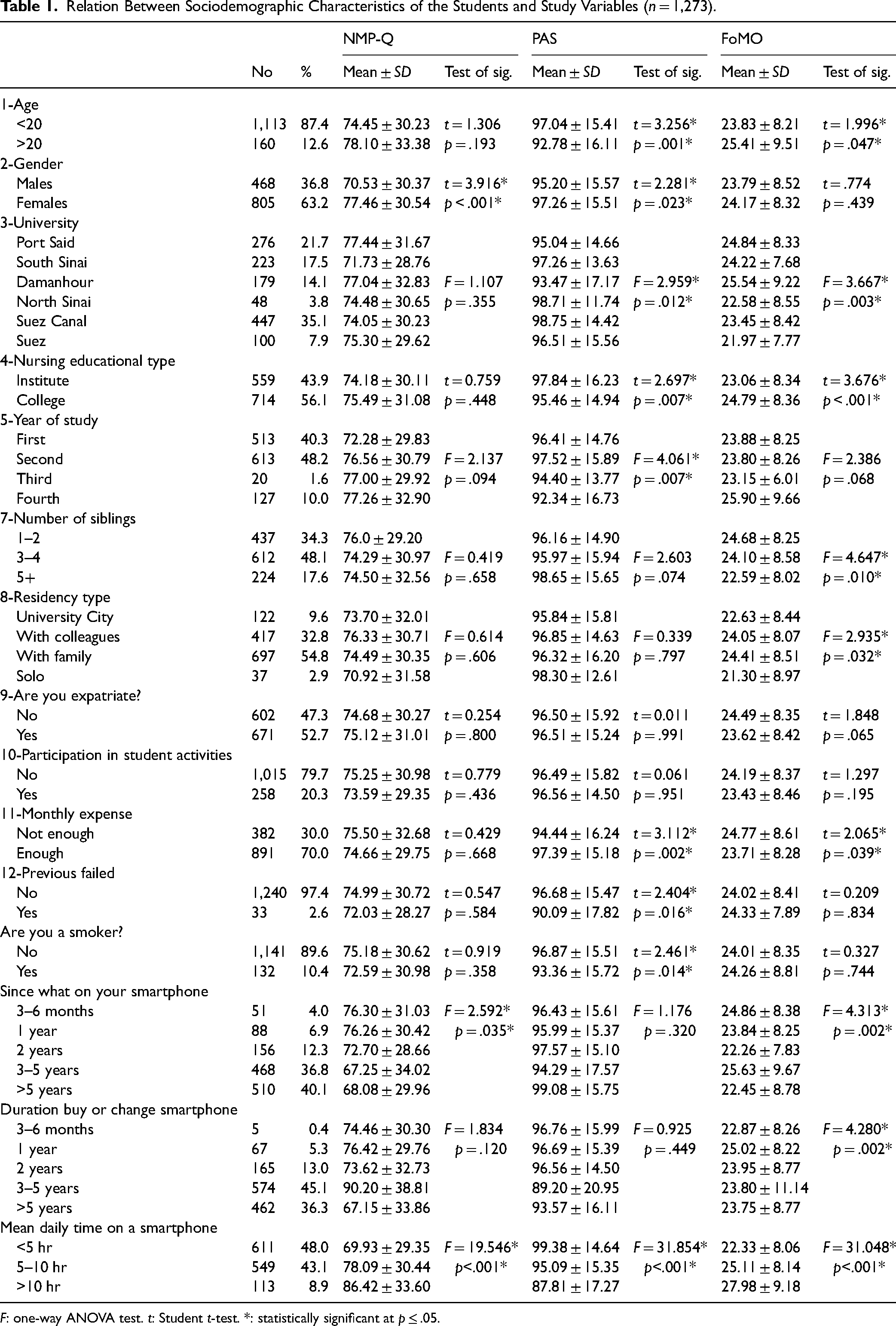
F: one-way ANOVA test. t: Student t-test. *: statistically significant at p ≤ .05.
Significant differences were found regarding FoMO based on age, university, and the type of nursing education, with older students and those from South Sinai reporting higher FoMO scores. Notably, students with a daily smartphone use of more than 10 hr had the highest FoMO scores (mean ± SD = 27.98 ± 9.18), indicating a substantial impact of smartphone use on FoMO (F = 31.048, p < .001).
Table 2 examines the relationship between mobile and internet use characteristics and study variables. Students who check their phones before sleeping (89.3%) exhibit significantly higher NMP-Q, PAS, and FoMO scores than those who do not (10.7%), with p values less than .001 for all comparisons. Similarly, those who check their phones immediately upon waking (83.2%) also report higher scores across all measures than those who do not (16.8%), with p-values below .001. The need to carry an extra charge for a power bank while out is associated with higher scores in NMP-Q, PAS, and FoMO, with significant differences noted (p = .012 for NMP-Q, p < .001 for PAS and FoMO). The use of the internet during the day follows a similar pattern, with higher scores observed in students who use the internet during the day (45.5%) compared to those who do not (54.5%), with all differences being statistically significant (p < .001).
Relation Between Sociodemographic Characteristics of the Students and Study Variables (n = 1,273).

F: one-way ANOVA test. t: Student t-test *: statistically significant at p ≤ .0.
Regarding the source of internet access, students using both phone and home internet (67.7%, n = 862) show higher scores on all scales compared to those using only home internet (20.9%, n = 266) or only phone (11.4%), with p values indicating significance for NMP-Q (p < .001), PAS (p = .004), and FoMO (p < .001). Lastly, self-identified internet addicts (35.3%) score significantly higher on all scales compared to those who do not consider themselves people with an addiction (64.7%), with p-values less than .001 for all comparisons.
Research Question Results
Table 3 presents the distribution of nomophobia and psychological alienation across different geographical locations. For Nomophobia, most students across regions fall into the “Mild” category (34.0% overall), with Port Said at 33.3%, South Sinai at 33.2%, and Damanhour at 34.6%. The “Moderate” category is prominent, with 40.8% of the total sample, including 40.6% in Port Said and 45.3% in South Sinai. The “Severe” category is observed in 23.3% of the sample, with North Sinai having the highest proportion at 26.8%. The chi-square test indicates no significant geographical differences in nomophobia levels (p = .586), suggesting that nomophobia is relatively uniform across the studied regions.
Distribution of the Study Variables Levels (n = 1,273).

χ2: chi-square test.
In contrast, psychological alienation shows notable regional variation. 46.5% of the total sample reported a “high” level of psychological alienation, with Port Said at 41.7%, South Sinai at 46.2%, and Damanhour at 40.8%. Notably, the Suez Canal has the highest percentage in this category at 54.2%. The chi-square test reveals significant regional differences in psychological alienation (p = .012*), indicating that students’ feelings of alienation vary significantly depending on their geographical location.
Table 4 illustrates the correlations between various study variables. A strong positive correlation is observed between “Not being able to access information” and “Giving up convenience” (r = .593, p < .001*), as well as with “Not being able to communicate” (r = .682, p < .001*). Similarly, “Losing connectedness” shows high correlations with “Not being able to access information” (r = .555, p < .001*), “Giving up convenience” (r = 0.695, p < 0.001*), and “Not being able to communicate” (r = .658, p < .001*). The overall Nomophobia Questionnaire (NMP-Q) also exhibits strong positive correlations with each of these variables, including “Not being able to access information” (r = .808, p < .001*), “Giving up convenience” (r = .854, p < .001*), “Not being able to communicate” (r = .895, p < .001*), and “Losing connectedness” (r = .853, p < .001*).
Correlation Between the Study Variables (n = 1,273).

r: Pearson coefficient. *: statistically significant at p ≤ .05.
“Social Isolation” has a moderate positive correlation with “Not being able to access information” (r = .129, p < .001*), and stronger correlations with “Giving up convenience” (r = .101, p < .001*), “Not being able to communicate” (r = .202, p < .001*), and “Losing connectedness” (r = .136, p < .001*).
“Loss of Target” shows significant positive correlations with “Not being able to access information” (r = .160, p < .001*), “Giving up convenience” (r = .108, p < .001*), and “Not being able to communicate” (r = .235, p < .001*). “Deficit” is also positively correlated with these variables, including “Not being able to access information” (r = .131, p < .001*), “Giving up convenience” (r = .122, p < .001*), and “Not being able to communicate” (r = .205, p < .001*).
“Self-alienation” demonstrates a positive correlation with all aspects of the Nomophobia Questionnaire and Psychological Alienation Scale, including “Not being able to access information” (r = .102, p < .001*), and “Overall PAS” (r = .365, p < .001*).
Table 5a shows that social isolation has an unstandardized coefficient (B) of 0.223 and a standardized coefficient (Beta) of .035, with a t-value of 0.940 and a p-value of .348, indicating no significant effect. The 95% confidence interval (CI) ranges from −0.243 to 0.689. Loss of target significantly influences nomophobia, with a B of 0.495, Beta of .100, t-value of 2.519, and p-value of .012*, suggesting a positive effect with a CI from 0.109 to 0.880. In addition, self-alienation significantly predicts nomophobia, with a B of 0.623, Beta of .064, t-value of 2.197, and a p-value of .028*. The CI is from 0.067 to 1.179. Fear of missing out has a substantial effect with a B of 0.899, Beta of .246, t-value of 9.179, and p-value < .001*, indicating a robust association with a CI from 0.707 to 1.091.
Linear Regression Analysis Showing the Effect of Psychological Alienation and Fear of Missing Out on Nomophobia (n = 1,273).

F,p: f and p values for the model. R2: coefficient of determination. B: unstandardized coefficients. β: standardized coefficients. t: t-test of significance. LL: lower limit. UL: upper limit. *: statistically significant at p ≤ .05.
The overall model is statistically significant, with an F-value of 31.932 and a p-value < .001*, explaining 11.2% of the variance in nomophobia (R² = .112, Adjusted R² = .108).
Table 5b consolidates psychological alienation significantly contributes to nomophobia, with a B of 0.377, Beta of .191, t-value of 7.166, and p-value < .001*, with a CI from 0.274 to 0.480. Fear of missing out also significantly predicts nomophobia with a B of 0.908, Beta of .249, t-value of 9.315, p-value < .001*, and a CI from 0.716 to 1.099.
Figure 1 and Table 6 show the direct and indirect effects of the fear of missing out on nomophobia. As shown, Fear of Missing Out had a significant positive direct effect on nomophobia where ((p = <.001) and also an indirect effect through the mediating factor, which is psychological alienation (1.000; 1.000; 0.108).
Direct and Indirect Effects.

Discussion
The rapid growth of digital technologies has caused a significant increase in nomophobia, the fear of being without a mobile phone, and FoMO, the anxiety of missing out on enjoyable experiences that others might be having (Ergin & Ozer, 2023).
Our result, which shows moderate to severe levels of nomophobia among nursing students, is consistent with a recent study on nursing students by El-Ashry et al. (2024), Naser et al. (2023), Bacaksiz et al. (2022), and Gutiérrez-Puertas et al. (2019).
In nursing education, the constant need for mobile access to critical information, accessible communication with peers and faculty, and the complex management of clinical schedules creates a heavy reliance on smartphones. This dependence leads to a strong attachment to these devices, increasing the fear of being without them and contributing to higher levels of nomophobia (Kim & Park, 2019; Rodríguez-Sabiote et al., 2020). Additionally, as digital technologies become more integrated into healthcare, nursing students frequently use mobile apps for medical references and patient care, which makes their smartphones seem even more essential (Atta et al., 2024a; Loureiro et al., 2021).
Consistent with the current result, the findings of the present investigation elucidate those variables such as the average daily duration of smartphone usage, increased frequency of smartphone checks preceding bedtime, immediate smartphone inspection upon waking, and self-perception of smartphone addiction exhibit statistically significant distinctions concerning their association with nomophobia. The identified disparities underscore the relevance of these smartphone-related behaviors and perceptions as determinants in the manifestation and severity of nomophobia among the study cohort.
The notable increase in nomophobia among nursing students at Damanhur University, located in a rural area, is influenced by unique contextual factors. Due to limited on-site resources, the university's geographic isolation leads to a greater reliance on digital technologies for academic communication and information. This lack of physical infrastructure may increase dependence on mobile devices, heightening the anxiety about being without them (Ali et al., 2019). Additionally, the socioeconomic conditions in rural areas often mean that alternative communication options are limited, making mobile devices essential for personal interactions and academic activities.
Psychological Alienation Level Among Nursing Students
The observation of a moderate level of psychological alienation among nursing students, particularly evident in areas such as Social Isolation, Loss of Target, Deficit, and Self-alienation, is almost identical to the results found in Bekhet et al. (2011).
Nursing programs’ intense and highly structured nature, with their rigorous clinical rotations and academic requirements, creates a noticeable sense of social isolation. The complex blend of professional duties and educational responsibilities may lead to a feeling of losing personal and academic goals, which can intensify feelings of detachment (Hojat, 2016; Nursing Education, 2017).
The positive relationship between psychological alienation and nomophobia among nursing students merits scholarly attention. Furthermore, the regression analysis indicated the negative direct effect of Psychological Alienation on Nomophobia. This finding aligns with Bahlul and Awad (2023), who identified nomophobia as a predictor of psychological alienation.
The visible presence of social isolation in the nursing academic environment, combined with a perceived loss of personal and academic goals, creates a psychological landscape where individuals might feel detached. This detachment is exacerbated by shortcomings in personal interests and self-care, highlighting the complex interplay between nursing professional duties and personal well-being (Jantara et al., 2022).
Similarly, Kupcewicz et al. (2022) explored the intricate relationship between loneliness and life satisfaction among nursing students. Their correlation analysis revealed significant negative correlations both average and high strength related to overall loneliness, including its specific aspects of social and emotional loneliness. This research highlighted the complex connections between loneliness and overall life satisfaction, offering valuable insights into the psychosocial dynamics affecting nursing students.
The fear of being without one's mobile device—reflected in subscales like lack of access to information, loss of convenience, inability to communicate, and loss of connectedness—resonates with these feelings. The interrelatedness between psychological alienation and nomophobia highlights a complex dynamic where the perceived lack of mobile device access worsens feelings of social isolation, loss of goals, deficits, and self-alienation among nursing students (Zhen et al., 2021).
The mean daily time spent on smartphones by nursing students, particularly those ranging from 5 hr to more than 10 hr, has yielded notable implications, as it correlates significantly with both nomophobia and psychological alienation. This convergence of findings underscores the potential impact of excessive smartphone usage on the psychological well-being of nursing students. In addition, the observed correlation between the daily time spent on smartphones and psychological alienation suggests that extended periods of smartphone engagement may contribute to a sense of detachment and estrangement among nursing students. Psychological alienation, characterized by feelings of disconnection and isolation, may be exacerbated by the immersive nature of prolonged smartphone use, potentially leading to adverse psychological outcomes.
The negative correlation between FoMO (fear of missing out) and psychological alienation in nursing education warrants a detailed exploration of the factors contributing to this complex relationship. Nursing education, characterized by demanding clinical rotations and rigorous coursework, fosters an environment where FoMO, defined by a constant need for social connection and shared experiences, can help reduce feelings of psychological alienation (Sutanto et al., 2020).
The active engagement prompted by FoMO seeking social interaction, participation, and information sharing can counteract the social isolation, loss of goals, deficiencies, and self-alienation that are typical of psychological alienation (Sutanto et al., 2020). Thus, the continuous drive for connection and inclusion inherent in FoMO seems to mitigate psychological alienation among nursing students. This intricate relationship is confirmed by regression analysis, which shows a significant negative direct effect (−0.737) from FoMO to psychological alienation, indicating that higher levels of FoMO are linked to an increase in psychological alienation.
The observed positive correlation between the FoMO and nomophobia, notably in its subscales encompassing not being able to access information, giving up convenience, not being able to communicate, and Losing connectedness, underscores a nuanced psychological interplay within the realm of nursing education. The findings of this study align with those of Çatiker et al. (2022), as well as Bacaksiz et al. (2022).
The constant academic and professional pressures on nursing students create an environment where FoMO (Fear of Missing Out) is closely linked to concerns about being without mobile devices. FoMO, driven by a strong desire for social and professional connectivity, intersects with the anxiety of potential disruptions in mobile access (Akturak et al., 2021). In this context, the heightened fear of missing out on important information and the convenience of continuous mobile access, communication, and connectivity is intensified (Deniz, 2021). This positive correlation highlights a mutual relationship where the fear of missing out combines with the anxiety of losing mobile device access, creating a complex psychological landscape that warrants in-depth investigation. The current findings also reveal a direct positive effect from FoMO to nomophobia, indicating that greater FoMO is associated with increased nomophobia.
Furthermore, the positive correlation between nomophobia and psychological alienation strengthens the argument that smartphone dependence is intricately linked to feelings of alienation. The fear of being without a smartphone, coupled with the observed psychological alienation, suggests that nursing students who experience nomophobia may rely heavily on their devices for a sense of connection and belonging, potentially leading to a paradoxical outcome of increased psychological detachment.
The mediation role of Psychological Alienation becomes evident in this context. The mediation by Psychological Alienation thus indicates a nuanced process wherein the psychological impact of FoMO on Nomophobia is partially mitigated through the intermediary role of reduced psychological alienation. A similar study found that feelings of loneliness are significant predictors of smartphone addiction among university students (Karaoglan Yilmaz et al., 2023a). In addition, Yilmaz et al. (2023) indicate that smartphone addiction may be linked to social appearance anxiety.
This sense of isolation, or psychological alienation, intensifies the students’ fear of missing out on social interactions and events. As a coping mechanism, students increasingly rely on their smartphones to stay connected and updated, leading to heightened nomophobia, and the fear of being without their mobile devices. Additionally, the constant pressure to remain engaged and informed through digital platforms is exacerbated by Bacaksiz et al. (2022). This cyclical relationship underscores how psychological alienation can drive students towards excessive smartphone use as they strive to alleviate their FoMO, thereby increasing their dependence on mobile devices and fostering nomophobia.
Strengths and Limitations of the Study
This study provides valuable insights into the experiences of Egyptian nursing students with nomophobia, utilizing validated questionnaires and a large, randomly recruited sample from six universities, which strengthens the reliability of the findings. However, several limitations warrant consideration. Firstly, the focus on nursing students from a specific set of universities in Egypt may limit the generalizability of the results to other populations or countries. The experiences and behaviors related to nomophobia could differ in other cultural or educational contexts, suggesting that future research should incorporate a more diverse sample to enhance the generalizability of the findings. Additionally, cross-sectional design provides a snapshot of the situation but limits the ability to infer causality or track changes over time.
Implications
Educators can integrate topics on healthy digital habits, emotional resilience, and self-awareness into curricula, helping students recognize and manage the psychological triggers that contribute to Nomophobia. Additionally, fostering a supportive learning environment that emphasizes face-to-face interactions and social engagement can mitigate feelings of alienation and reduce reliance on digital devices as a primary source of connection and validation.
In nursing practice, the insights from this study highlight the need for holistic approaches to patient care that consider the psychological factors influencing patients’ relationship with technology. Nurses can play a key role in identifying signs of Psychological Alienation and Nomophobia in patients, particularly in younger individuals who may be more susceptible. Developing interventions that address these issues, such as counseling on healthy technology use and strategies to reduce FoMO, can be integrated into mental health nursing practices. Moreover, nurses can advocate for and participate in public health campaigns that raise awareness about the psychological impacts of excessive technology use, aiming to promote mental well-being and prevent the development of Nomophobia among the broader population. Recognizing and addressing these psychological dimensions in patient care can enhance the overall quality of care and support mental health in the digital age.
Institutions can use research findings to inform policies related to technology use on campus. For instance, guidelines on smartphone use in dormitories or during academic activities could be established based on evidence of potential impacts on mental health.
Conclusion
Based on the study results, it is evident that nomophobia and psychological alienation are prevalent concerns among nursing students, with various sociodemographic and behavioral factors playing a significant role. The study found that younger students, particularly those under 20 years old and females, are more likely to experience higher levels of nomophobia and psychological alienation. Additionally, students from certain universities, especially those with active participation in university activities, exhibited higher levels of these issues. The frequency and duration of smartphone use, as well as specific smartphone habits such as checking phones before sleep or immediately upon waking, were also associated with increased levels of nomophobia, psychological alienation, and fear of missing out (FOMO). Notably, students who perceived themselves as addicted to internet use displayed significantly higher levels of these psychological concerns. Furthermore, the study's analysis revealed complex relationships between digital connectivity issues, such as FoMO, and psychological disconnection, with psychological alienation as a crucial mediator. The significant positive correlations among nomophobia, psychological alienation, and FoMO highlight the interconnectedness of these variables. Regression analysis confirmed that both FoMO and psychological alienation are strong predictors of nomophobia, underscoring the importance of addressing these factors in interventions. The findings suggest that while digital connectivity issues like FoMO directly influence nomophobia, their impact is amplified when coupled with feelings of psychological alienation. This underscores the need for comprehensive strategies that address both digital behavior and psychological well-being to mitigate the effects of nomophobia among nursing students.
Supplemental Material
sj-docx-1-son-10.1177_23779608241301223 - Supplemental material for Examining Nursing Students’ Prevalence of Nomophobia, and Psychological Alienation and Their Correlates With Fear of Missing Out: A Multisites Survey
Supplemental material, sj-docx-1-son-10.1177_23779608241301223 for Examining Nursing Students’ Prevalence of Nomophobia, and Psychological Alienation and Their Correlates With Fear of Missing Out: A Multisites Survey by Huda Gaber Hamzaa, Mohamed Hussein Ramadan Atta, Mai Elghareap Hassan Elmetwally Omar, Eslam Reda Fathy Abdel Majeed Machaly, Shaimaa Mohamed Amin and Nadia Mohamed Ibrahim Wahba in SAGE Open Nursing
Supplemental Material
sj-docx-2-son-10.1177_23779608241301223 - Supplemental material for Examining Nursing Students’ Prevalence of Nomophobia, and Psychological Alienation and Their Correlates With Fear of Missing Out: A Multisites Survey
Supplemental material, sj-docx-2-son-10.1177_23779608241301223 for Examining Nursing Students’ Prevalence of Nomophobia, and Psychological Alienation and Their Correlates With Fear of Missing Out: A Multisites Survey by Huda Gaber Hamzaa, Mohamed Hussein Ramadan Atta, Mai Elghareap Hassan Elmetwally Omar, Eslam Reda Fathy Abdel Majeed Machaly, Shaimaa Mohamed Amin and Nadia Mohamed Ibrahim Wahba in SAGE Open Nursing
Footnotes
Acknowledgment
This study is supported via funding from Prince Sattam bin Abdulaziz University project number (PSAU/2024/R/1445).
Author Contributions
We express our heartfelt gratitude to everyone who participated in the study.
All authors write and edit the manuscript in the first and final drafts and have agreed on the final version and meet at least one of the following criteria (recommended by the ICMJE [ Substantial contributions to conception and design, data acquisition, or data analysis and interpretation. Drafting the article or revising it critically for important intellectual content. ]:
]:
Availability of Data and Materials
Upon request for scientific purposes, the researcher of correspondence will provide researchable information of the research.
Declaration of Conflicting Interests
The authors declared no potential conflicts of interest with respect to the research, authorship, and/or publication of this article.
Ethical Considerations
The contemporary study agreed with the ethical principles of the 2013 Helsinki Declaration and its subsequent adjustments. After receiving an elucidation of the purpose and implication of the study, ethical permission was granted by the Scientific Research Ethics Committee of the College of Nursing, Damanhur University (NUR 59-c). Written consent was attained from the significant authorities of the settings mentioned above. After a vibrant elucidation of the study's intention, the nursing students who were being studied delivered their informed consent. The researchers confirmed that all data collected would be utilized solely for the research aim. Likewise, participants were notified of their right to decline participation or withdraw from the study at any time before completing the study tools without facing any negative repercussions. An anonymity concept and confidentiality were respected and considered by assigning a code number to each questionnaire. The equivalence of the work of the colleges above and high institutes was not disturbed by the data collection process.
Funding
The authors received no financial support for the research, authorship, and/or publication of this article.
Supplemental Material
Supplemental material for this article is available online.
References
Supplementary Material
Please find the following supplemental material available below.
For Open Access articles published under a Creative Commons License, all supplemental material carries the same license as the article it is associated with.
For non-Open Access articles published, all supplemental material carries a non-exclusive license, and permission requests for re-use of supplemental material or any part of supplemental material shall be sent directly to the copyright owner as specified in the copyright notice associated with the article.
