




Abstract
Introduction
Baby-led weaning (BLW) is a growing method for parents to introduce food to their kids. As advisers who affect the decisions of parents, health practitioners have significant obligations in this regard.
Objective
We aim to identify existing literature on the knowledge, perceptions, and attitudes of health professionals toward BLW.
Methods
We carried out a scoping review in accordance with the Preferred Reporting Items for Systematic Reviews and Meta-Analyses extension for Scoping Reviews. After registering with Open Science Framework, published articles were retrieved from EBSCOhost, PubMed, SciELO, ScienceDirect, Open Grey, and the Portuguese Scientific Open Access Repository. Primary studies with full-text availability in English, Spanish, or Portuguese, and no data publication limitations were included.
Results
The final sample included seven publications conducted in five countries published between 2012 and 2022. Only one study employed a hybrid methodology showing incongruent practices in parents/health professionals on BLW, whereas most studies employed a quantitative approach. Regarding BLW, it is recognized that there is a dearth of evidence, consensus, and advice.
Conclusion
Despite benefits, health professionals hesitate to recommend BLW due to insufficient study and safety concerns, warranting more research. Hence, our scoping review demonstrated that BLW is a scientifically under-researched subject, indicating a significant research gap that must be filled in the future.
Keywords
Introduction
The World Health Organization recommends exclusive breastfeeding for the first 6 months of an infant's life, with the addition of complementary feeding for at a minimum of 24 months (WHO, 2021). This 24-month period of a child's life provides an opportunity to ensure proper nutritional intake, prevent malnutrition (Michaelsen et al., 2017), and avoid adverse long-term health consequences (Theurich et al., 2020). There is no unanimity regarding the best pattern of food consumption that should be followed globally (Gatica-Domínguez et al., 2021).
As children transition from a liquid milk-based diet to a solid food-based diet, they are traditionally exposed to a widening diversity of flavors. Usually, complementary feeding begins with spoon-fed puree, then transitions to semisolid and finger meals (Cameron et al., 2012a). Yet, in recent years there has been a trend to skip the early stage and go straight to finger food (Cameron et al., 2012b; Fewtrell et al., 2017). This method is known as baby-led weaning (BLW) and is an alternative to complementary feeding (Arantes et al., 2018). Since no official data has been collected, on people who use this method, the prevalence is unknown. Nonetheless, the amount of scientific literature research has expanded significantly during the previous decade (Brown et al., 2017).
With BLW, children are fed food in modest portions, and they feed themselves during family mealtimes (Fewtrell et al., 2017). It is a technique that provides children with greater control over their food intake, improved appetite control, the development of motor skills (Brown et al., 2017; Wati et al., 2024) and allows children the capacity to control the amount of time it takes them to consume food (Fewtrell et al., 2017). When using this approach, the child's developmental stage must also be considered (Oliveira et al., 2023). Although BLW enthusiasts point to several benefits, health professionals raise several concerns, including the risk of choking, exposure to unhealthier food intake (high-energy and low-nutrient density diets), possible nutrient deficiency or excess, and the overall effect on children's nutritional status and eating behavior (Brown et al., 2017).
Review of Literature
Previous literature reviews have addressed this topic (Arantes et al., 2018; Bocquet et al., 2022; Brown et al., 2017; Cameron et al., 2012b; D’Auria et al., 2018; Devlin, 2021; Gomez et al., 2020; Martinón-Torres et al., 2021; Scarpatto & Forte, 2018; Utami & Wanda, 2019). Cameron et al. (2012b) evaluated the general literature regarding how feasible BLW might be for parents. They concluded that there was a lack of consensus among scientific community due to the scarcity of studies in this area. Later empirical studies were reviewed to examine behaviors associated to this approach (Brown et al., 2017). Yet, the authors emphasized the need for additional research, even though there is some evidence to suggest that this novel strategy may lead to favorable effects. In 2018 three reviews were performed (Arantes et al., 2018; D’Auria et al., 2018; Scarpatto & Forte, 2018). Arantes et al. (2018) reported that this practice was endorsed by parents who used it; nonetheless, certain problems were mentioned (e.g., mealtime mess and food waste), as well as professionals’ apprehension about children's ability to self-feed. D’Auria et al. (2018) conducted a thorough review of the literature and determined that the available evidence was of poor quality; hence, major issues of BLW must still be addressed. Scarpatto and Forte (2018) assessed literature to compare BLW to the conventional approach and concluded that BLW could be a viable alternative; however, it required medical and/or nutritional monitoring to ensure the infant's nutritional requirements were met. Following, Utami and Wanda (2019) emphasized that BLW was beneficial for fostering infants’ independence, but a paucity of longitudinal trials prevented them from drawing firm conclusions about nutritional sufficiency, intake, eating patterns, food preferences, safety, and growth trends. In the integrative review performed by Gomez et al. (2020) authors emphasized that despite the discovered benefits, there are still significant hazards, such as choking and inadequate vitamin intake, that require additional research. Recently Devlin (2021) undertook a scoping evaluation of 15 studies and concluded that BLW was a safe and effective method for infants’ supplementary feeding. In the same year Martinón-Torres et al. (2021) conducted a systematic review with the objective of establishing the effect of BLW on weight gain compared to traditional methods. The authors observed inconsistent outcomes, with some research suggesting a decreased weight with the use of BLW and others showing equivocal results. Again, the authors underlined the need for additional research. The last review found (Bocquet et al., 2022) was performed by the Nutrition Committee of the French Pediatric Society. Although benefits of the BLW strategy were identified (breastfeeding promotion, respect for children's appetite, and use of unprocessed meals, among others), the disadvantages (risk of not getting enough energy, iron, zinc, vitamins, and other nutrients, or getting too much protein, saturated fat, salt, or sugar, and risk of choking) prevented them from recommending it over the conventional one.
In the literature, studies have been identified that address parents’ perspectives on BLW or BLW steps (Arslan et al., 2023; Białek-Dratwa et al., 2022; Boelsma et al., 2021). Despite the importance of this topic, less research appears to have been conducted on the knowledge, perceptions, and attitudes of health professionals (Arantes et al., 2018). However, this issue is important because health professionals provide advice and support to parents and are a valuable source of information that can influence parents’ decisions about their children (Boelsma et al., 2021). Few of the identified reviews consider the perspective of health professionals, although they are an important part of this topic. Therefore, we conducted a scoping study that aims to synthesize the current knowledge, perspectives, and attitudes of health professionals regarding BLW. Due to its usefulness for surveying a body of research, a scoping review was favored above other types of literature reviews (Munn et al., 2018).
Methods
Initially a preliminary search was conducted on different platforms namely: PubMed; PROSPERO; the Cochrane Database of Systematic Reviews; the Joanna Biggs Institute Evidence Synthesis; FigShare; and the Open Science Framework. No ongoing scoping review or scoping protocol that assessed knowledge, perceptions, and attitudes of health professionals toward BLW was located. This is a gap in the literature and there is a need to map knowledge in this specific area, given the influence of health professionals on parents’ choices and the growing interest in this topic.
The research question was defined according to PCC (Population, Concept, Context): what is the knowledge, perceptions, and attitudes of health professionals toward BLW? (Population: health professionals; Concept: BLW; Context: children care). Scoping review steps followed Tricco et al. (2018) recommendations as detailed bellow.
Protocol and Registration
This scoping review protocol was drafted according to Preferred Reporting Items for Systematic Reviews and Meta-Analyses extension for Scoping Reviews (PRISMA-ScR) (Tricco et al., 2018) and registered in Open Science Framework in January 2023 (https://osf.io/g3a2u/).
Eligibility Criteria
Consideration was given to manuscripts addressing the knowledge, perspectives, and/or attitudes of health professionals toward BLW. Empirical studies were included regardless of the methodology employed (qualitative, quantitative, or mixed methods). The search was restricted to full-text, freely accessible articles published in English, Spanish, or Portuguese. To maximize the breadth of the available evidence, no data restrictions were imposed. Articles with a sample consisting of both parents and health professionals were included if the analysis allowed the health professional perspective to be clearly distinguished. Methodological research, proceedings, literature reviews, editorials, blog posts, advertising, and opinion pieces were excluded.
Information Sources
To identify the relevant keywords for the search equation, a preliminary search was conducted on Medical Literature Analysis and Retrieval System Online (MEDLINE) and Cumulative Index to Nursing and Allied Health Literature (CINAHL). Secondly the research was performed in CINAHL complete; MEDLINE complete; Nursing & Allied Health Collection (comprehensive); Cochrane Central Register of Controlled Trials; Cochrane Database of Systematic Reviews; Cochrane Methodology Register; Cochrane Clinical Answers; Library, Information Science & Technology Abstracts (LISTA); eBoook University Press collection; eBook Collection; Teacher Reference Center; Education Resource Information Center (ERIC); and MedicLatina via EBSCOhost platform. Additionally, search was also conducted in PubMed, SciELO, SCOPUS, Embase, OpenAIRE, and ScienceDirect. Open Grey, Mednar, B-on, and Portuguese Scientific Open Access Repository (RCAAP) were used for grey literature search. As a third step the list of references from previous literature reviews and the selected article were searched to detect additional relevant literature.
Search
Different keywords (baby led weaning; BLW; health professionals; knowledge; attitudes; perceptions) were combined with Boolean operators (AND / OR) in the research equation without camp limitation. The search formula was the following: ((knowledge OR perception OR attitude) AND (health professionals OR health personnel OR health care provider) AND (baby led weaning OR BLW OR baby-led)). Since platforms have distinctive characteristics different grouping and combinations were used. The search strategy is available on the Open Science Framework and was performed by all authors working in two groups of two in November 2023, with an update in January 2024. After group working, a more consensual outcome was achieved by networking of all authors.
Selection of Sources of Evidence
Duplicates were removed from our initial article sample, and inclusion/exclusion criteria were applied. The selection was based on the article's title, and the abstract was read if it was unclear whether the study was relevant to the review. All authors reviewed the same papers to ensure uniformity. In cases of disagreement between researchers, the articles acceptability was handled through debate until consensus was reached.
Data Sharting Process
A data graphing table was created in Microsoft Excel® to extract variables. All authors collaborated on a shared document and discussed the items to add in the data graphing table to complete the procedure. Then, each researcher extracted the data independently and afterwards compared it. To improve precision, disagreements were handled through discussion until a consensus was formed.
Data Items
Characteristics from each article were extracted concerning the following items: authors, year, country, purpose, methods, and main findings. These items were chosen by all authors as the most relevant ones to identify main studies characteristics.
Critical Appraisal of Individual Sources of Evidence
Article quality was appraised individually by each author and then discussed until agreement. For critical appraisal the Hawker et al. (2002) assessment tool was used. The tool has a four-grade scale (1 = very poor; 2 = poor; 3 = fair; 4 = good) and evaluates articles quality based on items such as: abstract and title; introduction and aims; method and data among others. The total tool score ranges from 9 to 36, and higher scores indicate a higher article quality.
Synthesis of Results
Synthesis of results was concentrated in a table that combined all extracted information. This table was discussed and approved by all authors. Collected data summarized studies characteristics and gave an overview of main findings.
Results
Selection of Sources of Evidence
From our initial sample of 1275 a total of seven articles were selected and included in this review. Articles were excluded based on title because they were outside the scope of this review (1200) or the sample was only parents/caregivers (37). Afterwards abstract was scanned and 31 articles were excluded because health professionals were not included in the sample. Study selection process is summarized in a flow chart adapted from PRISMA in Figure 1.

PRISMA flow chart of study selection.
Characteristics of Sources of Evidence
Publication dates from our article sample ranged from 2012 to 2022. Studies were performed in France (de Rosso et al., 2022), Spain (Arias-Ramos et al., 2022; Rubio et al., 2018; Mauro Martín et al., 2022), New Zeeland (Cameron et al., 2012a), Canada (D’Andrea et al., 2016), and Brazil (Neves et al., 2022). Most studies used a quantitative approach (D’Andrea et al., 2016; Neves et al., 2022; Rubio et al., 2018; Mauro Martín et al., 2022) and only one study (Arias-Ramos et al., 2022) applied a mixed method approach. Sample size ranged from 866 (Mauro Martín et al., 2022) to 21 (de Rosso et al., 2022) and questionnaires (Arias-Ramos et al., 2022; D’Andrea et al., 2016; Neves et al., 2022; Rubio et al., 2018; Mauro Martín et al., 2022) were the most common method of data collection used. Table 1 synthetizes the main studies characteristics.
Study Characteristics.

Note. BLW=baby-led weaning; HCP=healthcare professionals.
Critical Appraisal Within Sources of Evidence
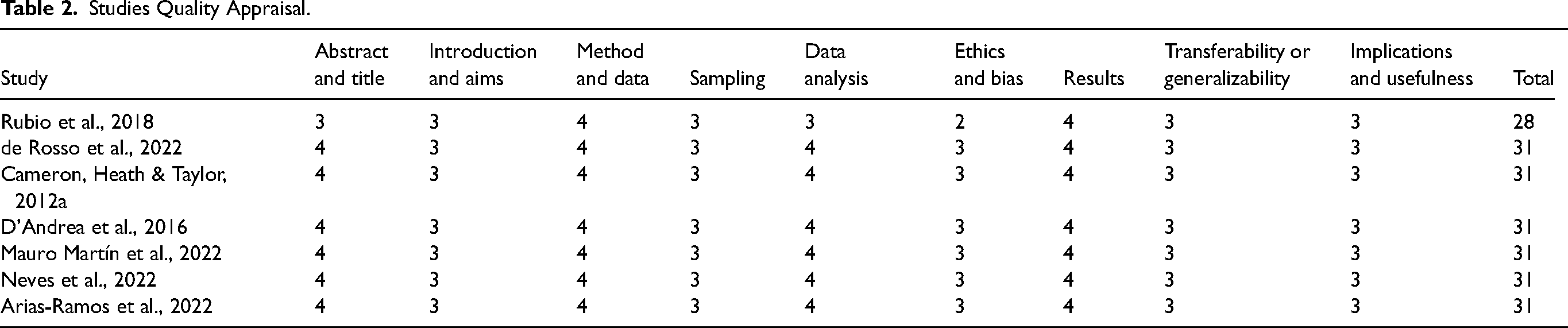
As stated earlier critical appraisal was performed according to Hawker et al.’s (2002) recommendations. Individually, each author performed the critical evaluation, and disagreements were resolved through discussion and consensus. Overall, quality appraisal was quite high and ranged from 28 to 31 as shown in Table 2.
Studies Quality Appraisal.
Results of Individual Sources of Evidence
Since our aim was to synthetize current information, we retrieved the relevant data on knowledge, perceptions, and attitudes of health professionals toward BLW, namely the main findings from each study as synthetized in Table 3. Most studies combined different concepts such as knowledge, attitudes, and experiences (Arias-Ramos et al., 2022; Cameron et al., 2012) or knowledge, practices, and perceptions (D’Andrea et al., 2016). Only two articles aimed only one concept namely attitudes (Rubio et al., 2018) and perceptions (Neves et al., 2022).
Studies Main Findings.

Note. BLW=baby-led weaning; HCP=healthcare professionals.
Synthesis of Results
Only seven articles were included in the final sample. All articles assessed health professionals or both parents and health professionals’ knowledge, perceptions, and attitudes on BLW. Although benefits are recognized the lack of reliable studies seems to be a major concern for professionals. Main results were synthetized in tables to facilitate reading and information organization. In addition, we used the PAGER framework (Bradbury-Jones et al., 2021) to summarize our key findings, as detailed in Table 4.
Synthesis of Review Findings Under the PAGER Framework.

Note. BLW=baby-led weaning.
Discussion
Summary of Evidence
Seven articles met inclusion criteria after a thorough platform and database search, demonstrating a lack of evidence on this topic. Although the number of studies we were able to find is small, they are spread across several countries (Spain, New Zealand, Canada, France, and Brazil) and were published between 2012 and 2022. Even scarce, these studies indicate a tendency for interest in this topic to spread geographically in scientific communities. We found that research’ methods for assessing health professionals’ knowledge differed. Most studies assess health professionals’ knowledge (Arias-Ramos et al., 2022; Cameron et al., 2012b; D’Andrea et al., 2016; Mauro Martín et al., 2022), some combined attitudes assessment (Arias-Ramos et al., 2022; Mauro Martín et al., 2022) or only attitudes (Martínez Rubio et al., 2018). Only two evaluated perceptions (de Rosso et al., 2022; Neves et al., 2022) and two measured practices and knowledge (D’Andrea et al., 2016) or perceptions (de Rosso et al., 2022). Most importantly, the concept under evaluation was rarely addressed. This may influence the observation and measurement of variables, which we considered an important bias. Future studies should begin by clearly stating the concept evaluated early (Polit & Beck, 2017).
Nurses, midwives, well-child providers, dietitians/nutritionists, general practitioners, pediatricians, lactation consultants, pediatric speech-language therapist, occupational therapist, physiotherapist, pharmacists, and dentists were assessed. The professional groups’ contributions are diverse and rich. In contrast, such heterogeneity makes it difficult to establish precise and uniform information. Having a broad group advice parents on their children's nutrition can be challenging.
Three key themes emerge from this review: the BLW approach has become increasingly popular with parents who seek advice from health professionals; health professionals acknowledge a lack of comprehensive understanding of BLW; and there is a need for guidelines on the use of BLW. All publications state that the use of this method has not been properly studied for professional associations or international committees to approve it and provide guidelines to guide the practice of health professionals. However, the method is used by parents who seek advice from professionals (Arias-Ramos et al., 2022), but also from multiple sources (e.g., support groups, informal groups, and online resources), sometimes with conflicting information (Prescott, 2024). Therefore, education and increased research on BLW appears as a major necessity for health professionals.
Main advantages identified by health professionals include easier transition to family shared feeding (Cameron et al., 2012b; Neves et al., 2022; Mauro Martín et al., 2022), better adaptation to new flavors and consistencies (Mauro Martín et al., 2022), enhanced children development (Arias-Ramos et al., 2022; Cameron et al., 2012b; D’Andrea et al., 2016; Mauro Martín et al., 2022), and healthier food behaviors (Arias-Ramos et al., 2022). However, concerns are also identified with an important weight on professionals’ recommendation on BLW. All studies report lack of evidence on this approach. Other concerns include risk of choking (Arias-Ramos et al., 2022; Cameron et al., 2012b; D’Andrea et al., 2016; Martínez Rubio et al., 2018), insufficient nutrient intake (Arias-Ramos et al., 2022; Cameron et al., 2012b; D’Andrea et al., 2016; Mauro Martín et al., 2022), and as food wasting (Cameron et al., 2012b). However, professionals report an increase in BLW questions and a lack of reliable information. These findings support the limited percentage of professionals who routinely recommend BLW (Martínez Rubio et al., 2018; Neves et al., 2022).
Parents search the internet, especially social media, for information. This information may be unreliable and unscientific (Voloshyn et al., 2023). Healthcare professionals should consider using this resource to communicate knowledge, given its importance in this field (D’Andrea et al., 2016). Parents are exploring this issue despite limited data, and this review identified a gap in knowledge about the perspectives of healthcare professionals.
Strengths and Limitations
Strengths of this review include a comprehensive synthesis of the literature published on this topic, as well as a summary of implications for practice and future research. By identifying articles that assessed health professionals’ knowledge and practice of the BLW method, we were able to contribute with a synthesis of what is already known and what should be addressed by future research.
We must regard the lack of studies in this research area to be a significant limitation. Although we performed a wide search for relevant studies only seven were included. This fact impacted our search and underscored the need to invest in this area. In addition, we only included articles with open access, which is also a limitation. Furthermore, the studies found included samples of different sizes, which does not allow consistent conclusions to be drawn, which is also a limitation.
Implications for Practice
Based on our findings, research recommendations include conducting national studies to evaluate the current use of the BLW method, creating and validating instruments to assess health professionals’ knowledge of this topic, creating structured programs for health professionals working in the field of child nutrition to learn about the BLW method, incorporating this method into undergraduate nursing courses to ensure that new nursing graduates have a basic understanding of the BLW, and establishing clear guidelines for the use of the BLW by committees and health organizations.
Conclusions
We identified seven 2012–2022 articles on health professionals’ attitudes, perceptions, knowledge, and practices in five countries for this scoping review. After analyzing the articles, we determined that the proportion of specialists that frequently advocate the BLW method is quite low. Health professionals acknowledge that BLW has benefits, such as an easier transition to shared family meals, better adaptation to new tastes and consistencies, improved child development, and healthier eating behaviors, however the implementation of this method has not yet been sufficiently studied for professional committees to recommend it. The articles point to a lack of scientific evidence for this method and raise questions about its recommendation, including the risk of choking, inadequate nutrient intake, and food waste. We also found that BLW is a method increasingly used by parents who seek advice from health professionals. It is therefore essential to increase research and education in this area. Only then can these professionals feel grounded enough to provide the necessary support and guidance that parents are seeking. This scoping review has clearly demonstrated that BLW is a scientifically underexplored topic, indicating a significant research need to be addressed in the future.
Supplemental Material
sj-docx-1-son-10.1177_23779608241285417 - Supplemental material for Health Professionals’ Knowledge, Perceptions, and Attitudes Toward Baby-Led Weaning: Scoping Review
Supplemental material, sj-docx-1-son-10.1177_23779608241285417 for Health Professionals’ Knowledge, Perceptions, and Attitudes Toward Baby-Led Weaning: Scoping Review by P. Sarreira–de-Oliveira, S. Fernandes, R. Ramalho and F. Loureiro in SAGE Open Nursing
Footnotes
Acknowledgment
The researchers would like to thank the Centro de Investigação Interdisciplinar Egas Moniz (CiiEM) for the support provided for the publication of this article.
Author Contributions
FL, SF, RR, and PSO were involved in conceptualization methodology, validation, and writing—review and editing; and PSO in writing—original draft preparation and project administration. All authors have read and agreed to the published version of the manuscript.
Declaration of Conflicting Interests
The authors declared no potential conflicts of interest with respect to the research, authorship, and/or publication of this article.
Funding
The authors disclosed receipt of the following financial support for the research, authorship, and/or publication of this article: This work is financed by national funds through the FCT—Foundation for Science and Technology, I.P., under the project UIDB/04585/2020.
Institutional Review Board Statement
The study was conducted in accordance with the Declaration of Helsinki, and approved by the Institutional Review Board and the Ethics Committee of Egas Moniz School of Health & Science (protocol code number 1213 approved on March 30, 2023).

Supplemental Material
Supplemental material for this article is available online.
References
Supplementary Material
Please find the following supplemental material available below.
For Open Access articles published under a Creative Commons License, all supplemental material carries the same license as the article it is associated with.
For non-Open Access articles published, all supplemental material carries a non-exclusive license, and permission requests for re-use of supplemental material or any part of supplemental material shall be sent directly to the copyright owner as specified in the copyright notice associated with the article.
