




Abstract
Background:
Medical imaging is vital in the diagnostic workup and evaluation of patients suspected or confirmed to have COVID-19; hence, radiology healthcare workers (HCWs) were an essential part of the early containment response to the pandemic. Radiology services are facing rising demands to introduce stricter infection control measures, and staff are expected to adhere to the new protocols while coping with a surge in patients.
Objectives:
This study aims to identify the knowledge, attitudes and perceptions (KAPs) of radiology HCWs at a single site with regard to workplace preparedness during the COVID-19 pandemic.
Methods:
A 26-item questionnaire was conducted with radiographers, radiology nurses, and support staff who had direct patient contact. Questions were concerned with involvement in managing suspected or positive COVID-19 patients, knowledge of infection control measures, and attitudes and perceptions in relation to working during the pandemic. Results were analysed using t-tests, chi-square tests, and Spearman’s rank-order correlation, with statistical difference set at p<0.05.
Results:
Radiology HCWs self-reported significantly better knowledge of infection control measures and positive work attitudes. Those who had received the flu vaccine had significantly better perceptions of working during the pandemic. Suggested improvements included better organisational structure and more resources, better staff compliance and vigilance, better education, and a clearer focus on staff wellbeing.
Conclusion:
The findings indicate favourable KAPs among radiology HCWs in Singapore with regard to workplace preparedness during the pandemic, but efforts towards sustainability must be considered. Formulating policies to nurture motivated and resilient HCWs during a pandemic is advocated to foster a resilient workforce that is prepared for the next pandemic.
Introduction
In January 2020, the World Health Organisation declared the COVID-19 outbreak a public health emergency of international concern. 1 Subsequently, a global pandemic was announced in March 2020. 2 Although it was expected that lessons learnt from the outbreaks of Severe Acute Respiratory Syndrome (SARS) and Middle East Respiratory Syndrome (MERS) would have increased Singapore’s preparedness for the pandemic, the statistics showed otherwise. In April 2020, the return of overseas-based residents and the rise of cluster infections within foreign worker dormitories had led to soaring numbers of COVID-19 infections that exceeded the nation’s operational capacity; consequently, healthcare resources were overwhelmed. 3 Chest radiography and computed tomography (CT) examinations emerged as essential diagnostic tests in managing COVID-19 infections because their increased sensitivity in detecting lung changes during the SARS outbreak meant they had already played a vital role in early diagnosis here. To continue providing timely imaging services during the pandemic, operational changes were implemented to ensure the safety of healthcare workers (HCWs) while still preventing cross-infection. Apart from coping with increasing radiology demands in the midst of the pandemic, radiology HCWs had to adapt to new policies and guidelines as well as being faced with the expectation of delivering the highest standards of care. Frontline HCWs were being exposed to dangerous pathogens, long working hours, psychological distress, fatigue, and occupational burnout. 4 Therefore, the likelihood of HCWs suffering from physical and emotional overload due to an overstretched healthcare system is evident. 4 Furthermore, a poor understanding of the disease among HCWs can result in delayed identification and treatment, leading to a rapid spread of infection among their own group.5,6 Although relevant guidelines and online refresher courses to boost COVID-19 knowledge and also prevention strategies have been developed for HCWs worldwide, 4 there is still a paucity of literature on the knowledge, attitudes and perceptions (KAPs) of HCWs with regard to the COVID-19 pandemic.
The current literature is limited to exploring knowledge acquisition, attitude generation, and perception formation in relation to radiology HCWs in countries such as Ghana, 7 Spain, 8 Cyprus 9 , and South Africa 10 during the pandemic, and no study has assessed the KAPs of radiology HCWs in Asia. Hence, the purpose of this study is to identify the KAPs of HCWs with direct patient contact in Singapore, a small city-state within the continent, with regard to workplace preparedness at a single-site radiology department during the COVID-19 pandemic. The identification of KAPs will reveal the current psychosocial climate during a disease outbreak, in addition to supporting dynamic changes to the department’s policies and guidelines. This study will be a useful benchmark for the present preparedness of a radiology department in the eastern part of the world and facilitate the enhancement of contingency planning within the department.
Methods
Ethics
This study was granted an ethics exemption by the Centralised Institutional Review Board because data collection was deemed a service evaluation with no anticipated risks to the study participants.
Setting
The study centre, a radiology department in a 1000-bed local regional hospital in the East Region of Singapore, undertakes a monthly average of 30,000 emergency, inpatient and outpatient radiology examinations. Within the hospital as a whole, there is an infection control team spearheaded by nurses, and the department’s own infection control team consists of radiographers and radiology nurses. During their first induction week, staff are fitted with a mask and encouraged to participate in relevant courses informing them of emerging recommendations and standards of care for their patients. From the beginning of the pandemic, the hospital’s operations team have been providing all staff with daily emails containing workflow updates, instructions on infection control measures depending on patient contact type, and information on necessary precautions.
Sample and population
The study population included all radiology HCWs who undertook direct clinical duties as part of the public health response to the pandemic from February to June 2020. Staff not directly involved in providing frontline clinical services were excluded. The participants selected were radiographers, nurses, and support staff (radiography assistants and healthcare assistants).
Survey instrument
All HCWs fitting the selection criteria were invited to complete a 26-item questionnaire (Appendix A) concerning their KAPs during the pandemic response, and provide demographic information to assess the generalisability of the data collected. The questionnaire was created using FormSG, an encrypted online survey platform created by the government’s GovTech agency, and utilised a combination of free text, 5-point Likert, and multi-level response scales. The questionnaire was disseminated to eligible HCWs using both the short message service and emails to seek their voluntary, anonymous participation from 13 July to 12 August 2020.
Survey variables
Demographic details collected included sex, age, profession, marital status, years of work experience, and the flu vaccine and health status of staff from February to June 2020. A 5-point Likert scale assessed the KAPs of participants, with responses as follows: strongly disagree, disagree, neutral, agree, and strongly agree, with a weighting of 1 to 5, respectively, for each positive statement.
Knowledge was determined based on participants’ perceived knowledge of how to perform their job safely. The questions were about infection control training, familiarity with departmental COVID-19 workflow, personal protective equipment (PPE) guidelines, and disinfection processes.
Attitudes were evaluated by participants’ perceived risk of contracting COVID-19 at work. The questions evaluated their attitudes towards safety at work during the current pandemic, their willingness to accept the risk of contracting COVID-19, their confidence in attending to patients with COVID-19-related symptoms, and hand hygiene habits at work.
Perceptions of contracting and spreading COVID-19 due to working in healthcare were assessed based on how participants would feel if their loved ones were infected or vice versa, and their interactions with fellow HCWs.
Finally, an open-ended question gave participants the opportunity to suggest how the department could better prepare for the continuing present pandemic or future ones.
Data analysis
Data were analysed and interpreted using IBM SPSS Statistics for Windows, Version 23.0, and Microsoft Excel 2016. Completed questionnaires were extracted and exported for filtering and coding. The participants’ characteristics and responses were summarised using frequency and proportion for categorical data, and mean and standard deviation for numerical variables.
KAP responses were collected and summed up to generate a score for each section. Mean values were used as cut-off points for sufficient knowledge (knowledge score ⩾17/20), positive attitudes (attitudes score ⩾21/25), and good perceptions (perception score ⩾19/25). The open-ended response was thematically analysed.
Associations between independent variables and dependent variables were assessed using multivariate analysis. All data were deemed statistically significant at p<0.05.
Results
Of the HCWs, 76.1% (n=153) responded, and of these 77.1% (n=118) were female. Of the 87 (56.9%) married participants, 68 (78.2%) had children. The breakdown of participants according to the profession was as follows: 63.4% radiographers, 22.2% nurses and 14.4% support staff, with 56.8% of participants recording more than 10 years of work experience (Table 1).
Socio-demographics of radiology healthcare workers at Changi General Hospital with direct patient contact during COVID-19 (N=153)

The flu vaccine had been given to 75.8% (n=116) of the participants during the pandemic, with a minority (18.3%, n=28) falling sick from February to June 2020, In addition, 15.7% (n=24) of the participants had undergone a swab test because they had presented with symptoms of an upper respiratory tract infection; 91.7% felt reassured by the results of their test (Table 2). More than half of the participants (53.5%, n=82) had attended to suspected/positive COVID-19 patients.
Participants’ responses to questions regarding workplace practices during the COVID-19 pandemic, n (%)

Knowledge
Some form of training and/or induction in terms of infection control measures had been given to 83.6% (n=128) of the participants, and 84.9% (n=130) were familiar with the department’s COVID-19 workflow in relation to performing their jobs safely. Of the participants, 88.3% (n=135) said they were familiar with the PPE guidelines, and 84.4% (n=129) knew about the different disinfection processes (Figure 1).

Radiology healthcare workers’ responses to questions about their knowledge (i–iv) of COVID-19.
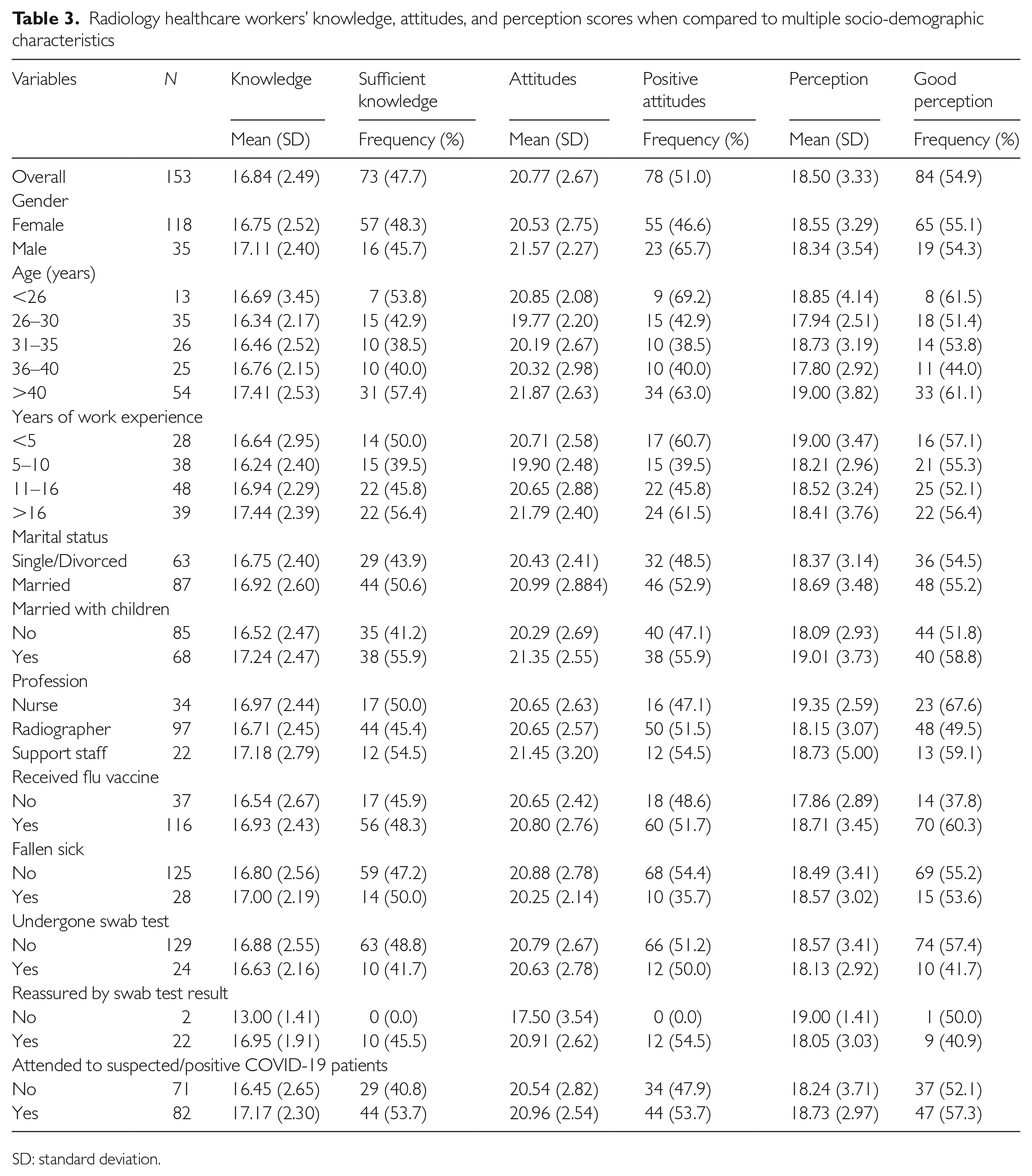
As seen in Table 3, participants who scored 17 or more on the knowledge questions were considered to have sufficient knowledge of COVID-19 workplace practices, with 47.7% (n=73) of participants obtaining a mean knowledge score of 16.84 (SD=2.49). From Table 4, it can be observed that females had 1.44 times better knowledge scores than male participants (aOR=1.44, 95% CI: 0.59–3.50, p=0.42), with younger participants showing 2.37 times higher knowledge scores compared with their colleagues in the 31–35 age group (aOR=2.37, 95% CI: 0.35–15.90, p=0.37). Participants with over 16 years of work experience had 2.30 times greater knowledge scores compared with participants who had 5–10 years of work experience. Higher knowledge scores were also reported for participants who were single/divorced (aOR=1.33, 95% CI: 0.39–4.48, p=0.65), married with children (aOR=2.87, 95% CI: 0.83–9.89, p=0.10) and among support staff (aOR=1.67, 95% CI: 0.44–6.34, p=0.45).
Radiology healthcare workers’ knowledge, attitudes, and perception scores when compared to multiple socio-demographic characteristics
SD: standard deviation.
Multivariate analysis [adjusted Odds Ratio (aOR)] of variables and their association with the knowledge, attitudes, and perception of radiology healthcare workers with direct patient contact during the COVID-19 pandemic

aOR: adjusted odds ratio; CI: confidence interval.
p < 0.05.
Participants who did not receive a flu vaccine (aOR=1.27, 95% CI: 0.55–2.92, p=0.58) or undergo a swab test (aOR=1.11, 95% CI: 0.43–2.92, p=0.826) showed no statistically significant difference in their knowledge scores. However, participants who had had contact with suspected/positive COVID-19 patients demonstrated significantly better knowledge scores (aOR=3.06, 95% CI: 1.32–7.09, p=0.01) compared with those who had had no contact with such patients.
Attitudes
Of the participants, 81.1% (n=124) felt safe working at the hospital and 76.5% (n=117) felt confident the department would assist in caring for them if they fell ill with COVID-19.
The majority (n=127, 83.0%) accepted the risk of contracting COVID-19 as part of their job, and 73.8% (n=113) could confidently participate in the management of patients with COVID-19 symptoms. Almost all (94.8%) self-reported improving their hand hygiene habits at work after the onset of the pandemic (Figure 2).

Radiology healthcare workers’ responses to questions about their attitudes (i–v) towards COVID-19.
Overall, Table 3 shows that 51.0% (n=78) of participants had a positive attitude towards their perceived risk of contracting COVID-19 at work, with a mean attitude score of 20.77 (SD=2.67). It was found that male participants were 2.13 times more positive in attitude (Table 4) compared with their female counterparts (aOR=2.13, 95% CI: 0.87–5.23, p=0.10). Although not of statistical significance, participants younger than 26 felt 5.16 times more positive about their risks at work, compared with their colleagues in the 31–25 age group (aOR=5.16, 95% CI: 0.76–35.03, p=0.10). Moreover, participants with over 16 years of work experience were 1.79 times more positive in their attitudes when compared with those who had 5–10 years of work experience (aOR=1.79, 95% CI: 0.45–7.06, p=0.41). On the whole, radiographers had more positive attitudes than nurses (aOR=1.31; 95% CI: 0.52–3.26, p=0.56) when at work, with positive attitudes also arising if participants had had direct contact with positive/suspected COVID-19 patients (aOR=1.56, 95% CI: 0.69–3.54, p=0.29).
Perceptions
Of the participants, 90.2% (n=138) believed their colleagues were following the infection control policies and guidelines correctly. Less than half (45.7%) agreed their loved ones were worried about becoming infected with COVID-19 through the participants, and about half (51.0%) felt their loved ones were worried the participants themselves might contract COVID-19 while at work. Conversely, 55.5% (n=85) felt worried their loved ones might be subject to a higher risk of becoming infected with COVID-19 because of their job in healthcare. Given their current clinical experience with COVID-19, 75.2% (n=115) were confident they could manage patients should a similar pandemic occur in the future (Figure 3).

Radiology healthcare workers’ responses to questions about their perceptions (i–v) of COVID-19.
Good perceptions of working in healthcare were seen in 84 (54.9%) participants, with a mean perception score of 18.50 (SD=3.33) (Table 3). Male participants had a more positive perception compared with females (aOR=1.26, 95% CI: 0.52–3.07, p=0.62), with those in the 31–35 age group having a better perception of working in healthcare than those aged 26–30 (aOR=1.58, 95% CI: 0.39–6.46, p=0.52). Similarly, less experienced radiographers – less than 5 years of work experience (aOR=1.35, 95% CI: 0.30–5.95, p=0.70) and 5–10 years of work experience (aOR=1.39, 95% CI: 0.39–5.04, p=0.61) – perceived working in healthcare during the pandemic more positively compared with participants with over 10 years of experience. There was also a more positive perception in single/divorced HCWs (aOR=1.47, 95% CI: 0.45–4.77, p=0.52) and those with children (aOR=1.64, 95% CI: 0.5–5.34, p=0.41), with radiology nurses having 2.28 times higher perception scores compared with radiographers (aOR=2.28, 95% CI: 0.89–5.83, p=0.09). Higher perception scores (aOR=2.90, 95% CI: 1.24–6.79, p=0.01) in relation to working in healthcare were statistically significant in participants who had received a flu vaccine. Participants who had undergone a COVID-19 swab test (aOR=1.77, 95% CI: 0.68–4.61, p=0.24) and those who had attended to suspected/positive COVID-19 patients (aOR=1.38, 95% CI: 0.61–3.12; p=0.44) showed better perception scores with regard to working in healthcare, although not statistically significant (Table 4).
Suggestions for departmental improvements
About half (52.3%, n=80) of the participants provided some sound suggestions for improvements in their responses to the open-ended question. Four themes (Figure 4) emerged from the responses and were ranked from most to least mentioned: better organisational structure and more resources (52.5%); better staff compliance and vigilance (36.3%); better education (26.3%); and a clearer focus on staff wellbeing (7.5%). Participants elaborated a desire for a better organisational structure through improved team segregation efforts, a fair rotation of trauma radiographers working the 12-hour shift, and more resources in the form of additional PPE supplies and increased manpower. There was also an emphasis on all staff needing to comply with infection control measures to ensure a safe working environment. Suggestions for increasing participants’ knowledge with regard to managing all patient types during the pandemic included providing educational posters, explicit guidelines, and informative talks. Finally, a clearer focus on staff wellbeing was also requested.
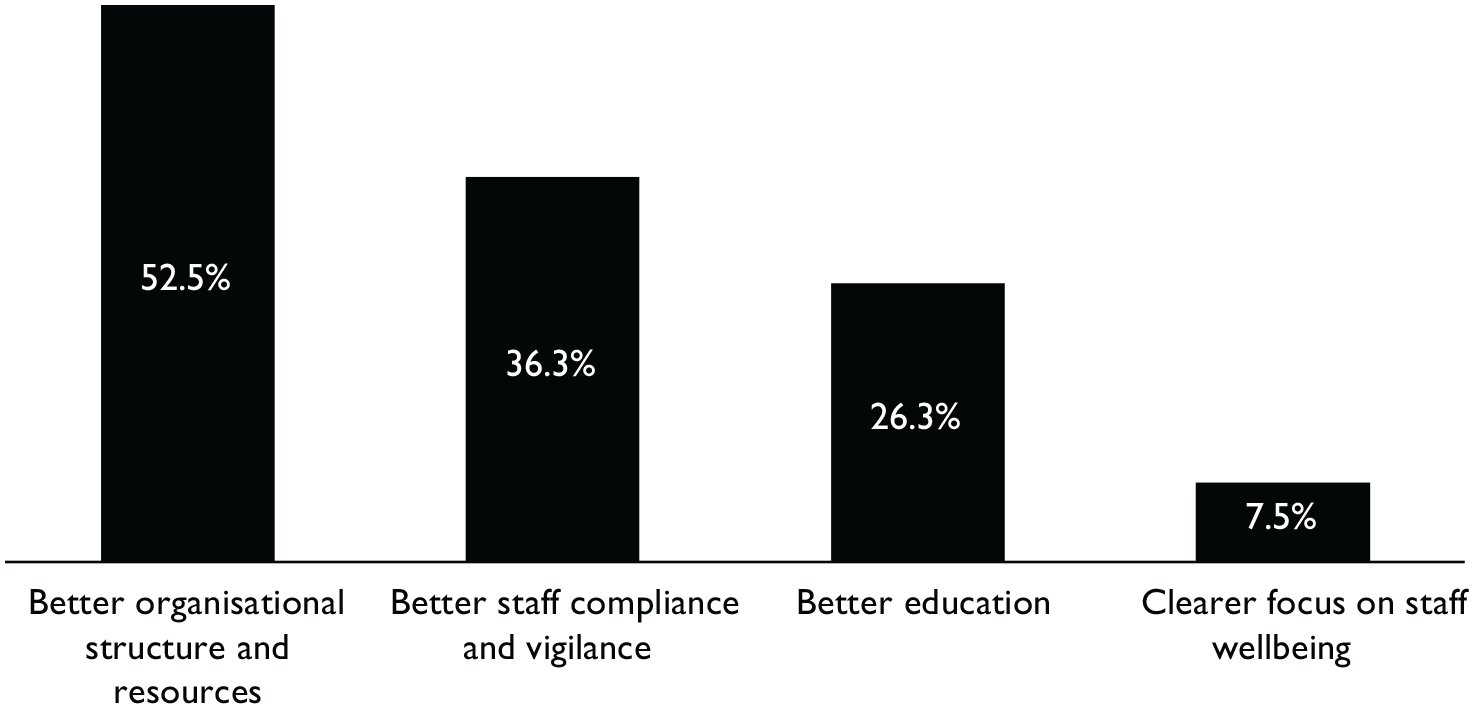
Radiology healthcare workers’ suggestions for possible departmental improvements with regard to pandemic preparedness.
Discussion
The majority of participants were women because of the large number of predominantly female local nurses and radiographers.11,12 The cohort was comprised of very experienced staff who were over 40 years old and who had more than 10 years of work experience. Considering that radiology nurses would have undergone their basic nursing training before specialising in radiology, it was likely, therefore, that they had accumulated more years of work experience. Similarly, CT-trained radiographers would only specialise after completing their general radiography training, a process that takes three to four years in our radiology department.
The Ministry of Health’s National Adult Immunisation Schedule recommends one dose of the flu vaccine for every adult per year or per flu season. During the height of the COVID-19 pandemic, receiving a flu vaccine was even more crucial for optimal protection against circulating flu viruses, especially when there were similarities between flu and COVID-19 symptoms. 13 As a precaution, a complimentary flu vaccine was given to all HCWs within the organisation and was strongly recommended for those with direct patient contact. This decision resulted in a higher uptake of the flu vaccine among the radiology workforce, especially during the period of the pandemic. Contrarily, only 50% of HCWs in a British study accepted the antiviral prophylaxis, refusing a pandemic-specific vaccine due to perceptions of either already being immune, or doubting the vaccine’s potential for preventing infection. 14 Despite healthcare vaccinations being an important policy for employers of HCWs, their patients, and themselves, the uptake will remain inconsistent unless made compulsory. 15 Hence, hospitals are encouraged to foster changes in institutional culture with regard to vaccination and absenteeism 16 to improve the attitude of HCWs towards flu control.
Knowledge
A majority of radiology HCWs at our site believed they were equipped with sufficient knowledge to handle a pandemic. Knowledge is a prerequisite for establishing prevention beliefs, forming positive attitudes, and promoting positive behaviours. An individual’s cognition of and attitudes towards disease will affect the effectiveness of their coping strategies and behaviours. 17 Current literature shows that increased levels of perceived knowledge have translated into significant differences in confidence levels between HCWs with regard to protection during a flu pandemic. 18 In addition, it is recommended that the provision of information with regard to infectious disease, staff training, and effective development of specific guidelines relating to the spread of the virus be made compulsory, 19 a sentiment also expressed by our participants in relation to departmental improvements in view of future pandemics. Therefore, all organisations and hospitals need to ensure the proper initiation and implementation of strict policies to curb infection and assist HCWs in working during a pandemic.
Radiology HCWs in Singapore were generally more aware of the disease through hospital policies, training, and organisational communication that reached every member of hospital staff, an opinion that has also been expressed worldwide. 20 Nevertheless, the Ebola virus outbreak has shown that when an approved antiviral drug or vaccine remains unavailable, 21 knowledge of the disease within community and healthcare settings should still be of fundamental importance.
To ensure an accurate depiction of radiology HCWs’ KAPs during the COVID-19 pandemic, it was essential to include all levels of staff, taking into account those with different levels of education. The current literature has focused less on HCWs with a lower level of education and novices, despite this group requiring more targeted education and training in proper PPE removal. 22 Misinformation arising from unreliable sources may potentially lead to a false sense of protection or raise unnecessary anxiety among HCWs. Therefore, public health and government agencies should promptly and vigorously address such misinformation with appropriate education 23 through the formation of a multi-ministry task force to provide citizens with updates via television information films, government websites or short message service. Further education and training through continuous professional development, sharing of experiences and provision of information about cross-contamination prevention measures used by other radiology departments, particularly with regard to symptoms and transmission, are essential in improving HCWs’ knowledge of COVID-19.
Attitudes
HCWs in our study felt safe when at the hospital’s frontline, exhibiting confidence that the organisation would care for their needs should they fall sick. Their sense of duty was exemplary, because they willingly participated in the management of COVID-19 patients and accepted the risk of contracting COVID-19 themselves. Further observations included an improvement in hand hygiene compliance by all HCWs to minimise disease transmission. In addition, our participants suggested that more focus on the wellbeing of HCWs would be an improvement for future pandemics. This opinion was also observed in studies that found psychosocial support to be essential in preventing HCWs from suffering from burnout during an infectious disease outbreak.24,25 Because the available health resources for HCWs are often directed at alleviating physical morbidity, psychosocial needs tend to be neglected. 26 Hence, it is imperative that the psychological concerns of and stresses experienced by HCWs be placed on the agenda when preparing for a pandemic response, ensuring that methods to allay fears and concerns for personal safety include the education of HCWs and the provision of appropriate PPE. 27
Perceptions
During the avian flu pandemic, the majority of local HCWs felt their job placed them at high risk of exposure, with three-quarters of them worried about falling ill. 28 Similarly, during SARS, Canadian HCWs were torn between wanting to uphold their professional responsibility to care for patients and fear of infecting their own families. 29 Despite the HCWs in our study feeling anxious about the risk of contracting the disease themselves or transmitting it to their loved ones, they still possessed positive perceptions of the risk of infection. Likewise, British HCWs 14 also expressed high levels of anxiety from an increased personal and family perception of uncertain health risk in the early phases of a pandemic but were willing to provide direct clinical care. However, they were generally not enthusiastic about taking antivirals or being vaccinated, 14 in contrast to 76% of HCWs in our study who had opted for the flu vaccine. This could also have been attributed to the implementation of local guidelines in which the flu vaccine was recommended to prevent common flu symptoms being misinterpreted as COVID-19, thereby relieving strain on the healthcare system.
Although many participants believed their fellow colleagues were adhering to infection, control policies and guidelines correctly, a small minority still emphasised that staff compliance and vigilance could be improved in a future pandemic. This could have been a reminder from more prudent staff that no one should let their guard down during a pandemic, a heartwarming sentiment showing how HCWs in our study appeared to accept a duty of care to patients and colleagues alike during any pandemic. As this study has strived to identify only the perceived risk of infection, the actual risk of infection remains unknown and warrants further investigation.
Suggestions for departmental improvements
Apart from suggesting better education, the prioritisation of staff wellbeing, and greater staff compliance as departmental improvements for future pandemics, participants also suggested a better organisational structure and the availability of increased resources. To allow for effective team segregation, 30 the literature recommends the department’s crisis management policy be amended to include the establishment of a disciplined and flexible pandemic response team. 31 Additionally, regular stocktaking should be carried out to ensure rationing of resources, instead of simply providing more. Doing so will reinforce accountability, reduce improper or non-clinical use of supplies and discourage excessive waste. 30 Through this study and other concurrent institutional efforts, our department has effectively implemented weekly stocktakes (Appendix B) and adhered to guiding principles issued by the institution’s medical board to optimise the use of PPE to prevent waste.
Limitations
This study has several limitations. First, given that it was limited to a single radiology department, the generalisability of the results across other geographical locations or differing from demographics is unclear. Furthermore, because the survey was conducted seven months from the first announcement of the pandemic by the hospital management, the lead time may have changed the participants’ views. Participants’ self-reported knowledge may also have led to response bias, with responses potentially being subjective and personal. A longitudinal study assessing KAPs over time would be useful for further insights. Furthermore, a more formative approach through focus groups or interviews would provide a more in-depth understanding of complex nuances in the HCWs’ perspectives in addition to the quantitative findings. Nevertheless, such an investigation provides a framework for understanding the perceptions radiology HCWs have of a pandemic and provides a pivotal starting point from which to improve current preparedness strategies.
Conclusion
The KAPs of radiology HCWs in this study were generally favourable and testament to the department’s effectiveness during this crisis; however, efforts towards sustainability must still be considered. Continual assessment of the physical and psychological wellbeing of the department’s staff will assist in the formulation of policies that nurture motivated and resilient staff during a pandemic, and identify key areas that need to be improved for pandemic preparedness.
Supplemental Material
sj-docx-1-psh-10.1177_20101058211015801 – Supplemental material for Knowledge, attitudes and perceptions of radiology healthcare workers during the COVID-19 pandemic
Supplemental material, sj-docx-1-psh-10.1177_20101058211015801 for Knowledge, attitudes and perceptions of radiology healthcare workers during the COVID-19 pandemic by Jolene Wei Ling Ooi, Amanda Tse Wern Er, Choon Ming Chong, Koh Tzan Tsai and Mei Choo Chong in Proceedings of Singapore Healthcare
Supplemental Material
sj-docx-2-psh-10.1177_20101058211015801 – Supplemental material for Knowledge, attitudes and perceptions of radiology healthcare workers during the COVID-19 pandemic
Supplemental material, sj-docx-2-psh-10.1177_20101058211015801 for Knowledge, attitudes and perceptions of radiology healthcare workers during the COVID-19 pandemic by Jolene Wei Ling Ooi, Amanda Tse Wern Er, Choon Ming Chong, Koh Tzan Tsai and Mei Choo Chong in Proceedings of Singapore Healthcare
Footnotes
Acknowledgements
We would like to thank Mr Gabriel Leong (head of radiography) for supporting this study and Ms Tan Pei Ting (biostatistician), for her valuable assistance with the statistical analysis part of the project.
Authors’ contributions
JO and AE researched the literature and conceived the study. CMC, CCM, and TKT were involved in questionnaire development and patient recruitment. JO and AE wrote the first draft of the manuscript. All authors reviewed and edited the manuscript and approved the final version.
Availability of data and materials
The datasets generated and/or analysed during the current study are available from the corresponding author.
Declaration of conflicting interests
The authors have no conflicts of interest to declare.
Ethical approval
This study was granted an ethics exemption by the Centralised Institutional Review Board because data collection was deemed a service evaluation with no anticipated risks to the study participants.
Funding
The authors received no financial support for the research, authorship and/or publication of this article.
Informed consent
Informed consent was obtained from all participants through full completion and submission of the questionnaire. A statement in the instructions for the completion of the survey said, ‘By completing this questionnaire, you are giving us consent to use the data for the purposes of research. All your responses will be kept anonymous.’

Supplementary material
Supplementary material for this article is available online.
References
Supplementary Material
Please find the following supplemental material available below.
For Open Access articles published under a Creative Commons License, all supplemental material carries the same license as the article it is associated with.
For non-Open Access articles published, all supplemental material carries a non-exclusive license, and permission requests for re-use of supplemental material or any part of supplemental material shall be sent directly to the copyright owner as specified in the copyright notice associated with the article.
