




Abstract
Introduction:
Autism is a neurodevelopmental disorder that occurs in the early childhood period and is characterized by altered social interaction, communication problems, repetitive, and stereotyped behavior. Genetic, environmental, or physical risk factors are associated with prenatal, natal, or postnatal complications, leading to the development of autism spectrum disorders. Prompt diagnosis and management should be an integral component of the care provision in countries like Ethiopia.
Objective:
This study aimed to assess knowledge of childhood autism among nurses working in governmental hospitals in Addis Ababa, Ethiopia.
Methods:
Institutional based cross-sectional study design was used. The sample size was calculated using the single population proportion formula, and the final sample size was 360. Final study subjects were selected by using the simple random sampling method. Data were collected using structured self-administered questionnaires and were then coded and entered into Epi-data version 3.1 and exported to SPSS version 21 for analysis. Descriptive statistics were utilized to show frequencies and percentages, and analysis of variance was carried out to compute the association between the dependent and independent variables. Independent t-test was also done to see the association between dependent variables and independent variables with two means. A p-value of less than 0.05 was considered statistically significant.
Results:
The mean score for knowledge-related items was 8.79 ± 0.4. In this study, out of 331 nurses, 180 (54.35%) had good knowledge. Significant mean score difference was observed among age distribution (F-Ratio = 2.8, p-value = 0.04), level of education (F-ratio = 13.97, p < 0.001) and work experience (F-Ratio = 3.07 p-value = 0.017).
Conclusion:
A significant gap was observed in the overall knowledge of childhood autism among nurses employed in the governmental hospitals of Addis Ababa. The respondents’ knowledge level was significantly different among age group distributions, education levels, and work experience.
Introduction
Autism spectrum disorders (ASDs) are neurodevelopmental disorders that occur during early childhood and persist throughout an individual’s life with altered social interaction, communication problems, and repetitive, stereotyped behavior. 1 Etiologically autism is classified into three: symptomatic (unrecognized organic or neurological cause), cryptogenic (an underlying cause is suspected), and idiopathic (ASD for which no evidence of other neurological or biomedical disorders). 2
Genetic, environmental, or physical risk factors are associated with prenatal, natal, or postnatal complications, leading to the development of ASDs.3–5 Maternal conditions like advanced age, a pre-conception diet deficient in folic acid or vitamins, infection during pregnancy, chronic and metabolic diseases are considered prenatal risks.6–8 Natal risks include premature and delayed crying, whereas postnatal risks include living in high altitude or polluted areas.2,4,9,10 Recent data also shed light on the strong linkage between advanced paternal ages and the risk of developing childhood autism.11–13
The prevalence of ASD varies with sex, as males are five times more affected than females.1,14 Besides, the disease prevalence differs with race and place of residency.15–17 Different studies also assured that white-skinned individuals and those living in urban and air polluted regions are commonly affected.7,8,15
The global magnitude of ASD is one person in 160, and it accounts for more than 7.6 million disability-adjusted lives.1,18 The figures and trends show that the prevalence of autism is increasing at an alarming rate.3,19–21 A Centers for Disease Control and Prevention (CDC) report from 2012 showed that the estimated prevalence of autism increased by a staggering 78% compared with the figures a decade back.22,23 Another study from the United States revealed a significant increase in the magnitude of any developmental disability including ASDs from 2009 to 2011 and 2015 to 2017. 20 Prevalence studies worldwide indicate disparities, ranging from 1.4 to 29 per 10,000 children in Middle Eastern countries 24 and 4 to 17 per 1,000 children in Europe.25–28 However, recent Global Burden of Diseases data indicated that the highest prevalence was accounted for by south Asian countries. 29
Different research findings showed that this disorder is encountered more among developed countries than developing ones.1,14,29–31 Despite this, there is insufficient data to conclude as there are scarce data among the latter group.11,18
Currently, the fifth edition of the Diagnostic and Statistical Manual of Mental Disorders (DSM5) is used to diagnose autism. 32 According to this manual, two domains are essential for the diagnosis of autism. Domain one is related to social communication and social interaction, while domain two is related to restricted and repetitive behavior patterns. Three criteria from domain one and two criteria from domain two are used to diagnose autism. Nevertheless, children with autism could initially be misdiagnosed for other disorders such as attention deficit hyperactivity disorder due to the resemblance of clinical manifestations.33,34
Autism has a consequential impact both at the family and country level. 11 These broad-spectrum effects are directly proportional to the encountered complications and rapidly progressing disabilities. According to studies, parents of children with ASDs have a low quality of life and stress and weariness, which can be considerably decreased by halting the accelerated progress of the disease.35–37 Such results are amplified among caregivers residing in poorer countries, as the majorities already have low living standards.35–37 ASDs could also cause a burden on the economy of nations. For example, in the United States, the total annual expenses related to ASDs are projected to reach close to 250 billion dollars. 13 Overall, a prompt and appropriate response is critical to avoiding this slew of consequences. 38
Little evidence is present on the epidemiology and details of ASDs in Africa. Available reports from few countries revealed that knowledge regarding ASDs among nurses ranges from moderate to low.39–41 This knowledge gap could be explained by the lack of in-depth training on childhood mental illnesses during in-school training. 42 Although there are appreciable efforts to introduce psychiatry specialty nursing programs into the health care system, the vast majority of tasks are still accomplished by comprehensive nurses. 43
Prompt diagnosis and management of ASDs should be an integral component of the care provision in countries like Ethiopia. Strategies are being devised at a national level to overcome the burden imposed by mental health disorders. 44 Though, the focus of these efforts is more geared toward adult-onset problems. Childhood mental disorders like ASDs are either neglected or are not given the necessary attention. 45
A country with a low socioeconomic status like Ethiopia needs to develop practical strategies to tackle problems associated with ASDs. The most seemingly suitable places to identify such cases in hospitals are the pediatric outpatient department, pediatric emergency, or the extended immunization unit. Nurses, the primary health care professionals in these setups, are responsible for the immediate support for the children who show early manifestations. 42 Identifying nurses’ knowledge gaps and equipping them with the necessary information is profound to mitigate the burden.39,46 Therefore, this study tried to assess the knowledge of childhood autism among nurses working in governmental hospitals in Addis Ababa, Ethiopia (Figure 1).

Conceptual framework displaying the knowledge of nurses toward childhood autism and the associated factors.
Methods
Study area and period
The study was conducted at selected governmental hospitals in Addis Ababa, Ethiopia, from 1–30 March 2016. According to the Ministry of Health, human resource unit report, Addis Ababa has 12 governmental and nine nongovernmental hospitals. Of the 12 governmental hospitals, eight are administrated by the Addis Ababa health bureau, while four are under the federal government’s control. A total of 2250 nurses are employed by these governmental hospitals, out of which 562 nurses were working at black lion hospital, 173 at Yekatit 12 hospital, 136 at Gandhi Memorial Hospital, and 246 at Zewditu Memorial Hospital.
Study design
An institutional-based cross-sectional study design was employed.
Population
Source population
All nurses who were working at governmental hospitals in Addis Ababa.
Study population
All nurses who fulfilled the inclusion criteria and were working at the selected governmental hospitals.
Inclusion and exclusion criteria
Inclusion criteria
Nurses who were working at the selected hospitals on a permanent basis were included in the study.
Exclusion criteria
Nurses who were not present due to maternity leave, off-site training, or annual leave and those with less than 6 months of work experience were excluded from the study.
Sample size determination
The sample was determined using the formula for estimating a single population proportion

where Z α/2 = is probability coefficient for desired interval [1.96]; n = minimum sample size determined; p = proportion of population possessing characteristics of interest; d = margin of sampling error tolerated (5%); 1-p = proportion of population that do not possess the character of interest

Since the total population (N) is less than 10,000, a correction formula was used

where nf = final sample size; ni = initial sample size (ni = 384); N = total population (N) = 2250; nf = ni/ (1 + ni/N); nf = 384/(1 + 384/2250) = 328.
After considering a 10% non-response rate, the final sample size was 360.
Sampling technique
From the 12 governmental hospitals in Addis Ababa city, four were selected by using the lottery method. The number of nurses from each selected hospital was determined based on their population proportion, and each study subject was selected using simple random sampling from the list of nurses acquired from each unit (Figure 2).

Schematic presentation of sampling procedures utilized to select nurses from governmental hospitals of Addis Ababa, Ethiopia.
Data collection instruments and procedures
Data were collected using structured self-administered questionnaires. Part one had nine items that dealt with respective nurses’ socioeconomic characteristics. Part two was adapted from the Knowledge about Childhood Autism among Health Workers (KCAHW) questionnaire and had 19 items. 47 The KCAHW tool, which was developed by Bakare et al., was selected for this study as it was tested previously to be an effective tool in measuring knowledge of ASDs among nurses in developing countries.39,48,49 The questionnaire has Cronbach’s alpha value of 0.97 and has been established to have good test–retest reliability. The tool has four domains, and scoring was done according to the original KCAHW questionnaire (Supp). 47 Four trained data collectors were recruited, and the principal investigators conducted day-to-day supervision of the overall process.
Study variables
Dependent variables
Knowledge of nurses about childhood autism.
Independent variables
Age, sex, religion, marital status, educational level, area of specialty, year of experience, training, previous involvement in the management of autism.
Data quality control
The data collectors were trained for one day about the study’s objectives and the data collection approaches. The data completeness and consistency were checked daily, and the collected data were cleaned and compiled by the investigators.
Pretest was conducted on 5% of the final sample size at Saint Paul’s hospital, and based on the results; minor grammatical editions were done to the items. The KCAHW tool has an instruction labeled “The following behaviors best describe a child with Childhood Autism.” During the pretest, participants required clarification on the details of the instruction. Therefore, auxiliary verbs were added to each item to make them probing. For example, Domain 1, item 1 (Marked impairment in use of multiple non-verbal behaviors such as eye to eye contact, facial expression, body postures and gestures during social interaction?) was converted to “Does a child with childhood autism show marked impairment in the use of multiple non-verbal behaviors such as eye to eye contact, facial expression, body postures, and gestures during social interaction?”
Data processing and analysis
The collected data were processed by checking for completeness, missing and erroneous data values. Afterward, it was coded and entered into Epi-data version 3.1 to be analyzed using Statistical Package for Social Sciences (SPSS) version 21. The mean score of the outcome variable was calculated. Various mean scores related to the socio-demographic variables of nurses were computed using a one-way analysis of variance. The statistical mean difference was declared at a p-value less than 0.05. Independent t-test was also done to see the association between dependent and independent variables with two means.
Operational definitions
Childhood—Age less than 13 years.
Good knowledge—Respondents who scored equal to or above the mean score of knowledge-related questions.
Poor knowledge—Respondents who scored below the mean score of knowledge-related questions.
Ethical consideration
Before the commencement of the study, ethical clearance was obtained from the Addis Ababa University College of Health Sciences School of Nursing and Midwifery ethical review committee. Permission was obtained from the authorities of each hospital. The study’s protocol and importance were explained to the participants before recruitment into the study, followed by participant nurses’ written informed consent. All information that was collected from the nurses remained confidential. Coding and aggregate reporting was used to eliminate names and other personal identification of respondents throughout the study to ensure anonymity.
Results
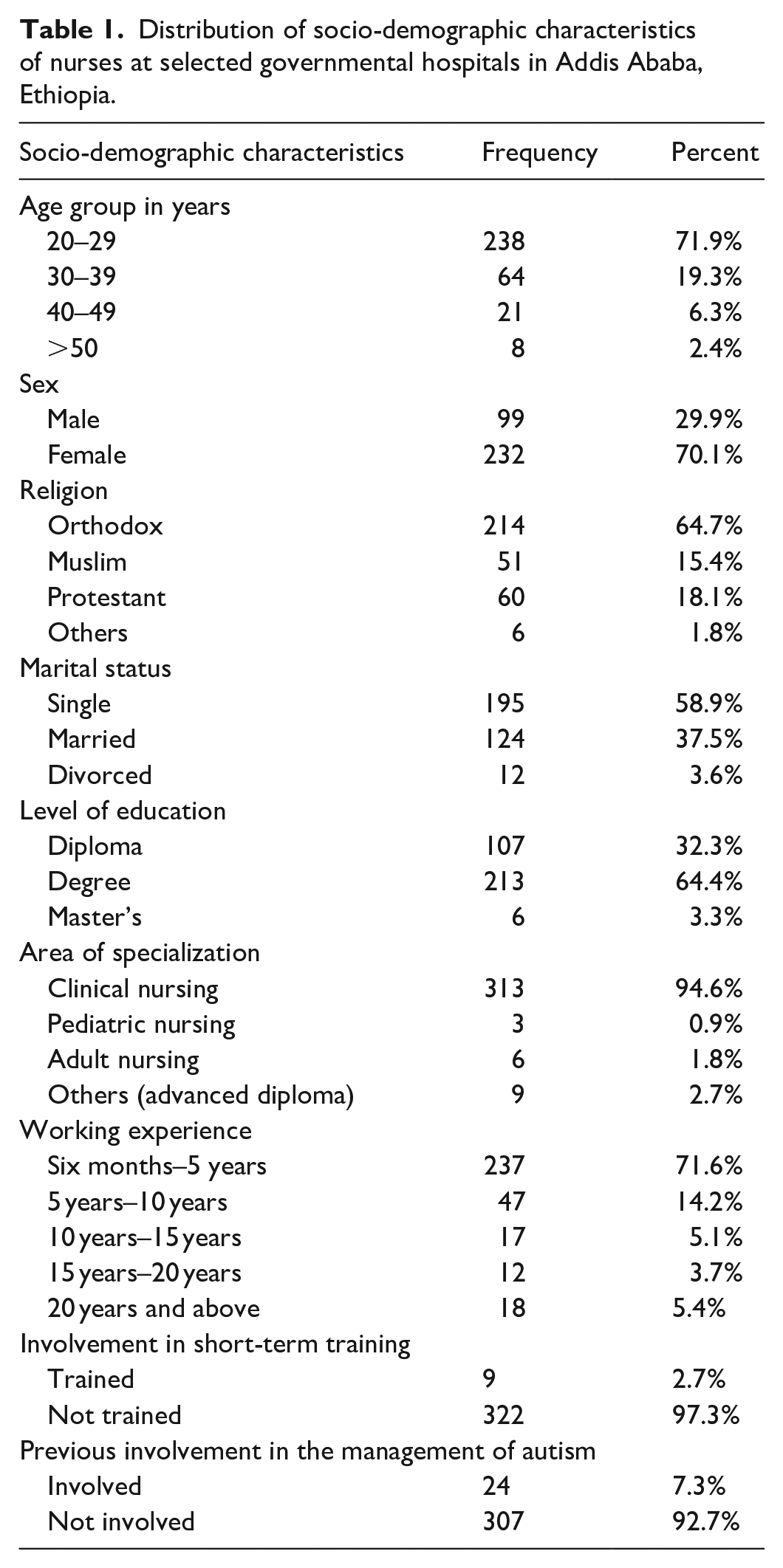
A total of 331 questionnaires were distributed with a response rate of 92%. The majority (70.1%) of respondents were females. The respondents’ minimum age was 20, and the maximum was 54, with a mean age of 28.35 ± 6.48. In 95% of the cases, the average age of the respondents was found to be within 21.9 to 34.8 years. Most of the participants were single, 195 (58.8%), and the majority (64.4%) of the respondents completed their first degree (Table 1).
Distribution of socio-demographic characteristics of nurses at selected governmental hospitals in Addis Ababa, Ethiopia.
Knowledge of participants about childhood autism
The knowledge-related questions were divided into four domains based on their focus area. A minimum of 0 and a maximum of 19 scores were allocated for the KCAHW. The total mean score on knowledge-related questions among respondents was found to be 8.79 ± 0.44. The median score was eight, and the mode was nine.
Domain one, which incorporates eight questions, dealt with impairment in social interactions, and the mean score was 3.75 ± 0.23 at 95% confidence interval (CI). In this domain, a total of 53.47% of nurses scored at and above the mean score.
Domain two contains one item related to impairment in communication, where the mean score among respondents was 0.535 ± 0.05 in 95% of hundred cases. Moreover, a total of 53.5% of nurses scored at and above the mean score.
Domain three contains four items assessing knowledge about obsessive and repetitive characteristics, and the mean score was found to be 1.73 ± 0.13 at a 95% confidence interval. Out of the total respondents, 56.2% scored at and above the mean.
Domain four includes six questions concerning comorbid conditions, autism curability, and its onset. This domain’s mean score was found to be 2.8 ± 0.17 at a 95% confidence level, and 54.8% of respondents scored at and above the mean score (Table 2).
The pattern of score distribution in different domains according to the knowledge of nurses toward childhood autism among nurses at selected governmental hospitals in Addis Ababa Ethiopia.

Factors associated with knowledge about childhood autism
The statistical analysis conducted revealed a significant mean score difference in knowledge between different age group distributions. The respondents’ average score showed a consistent increment as it proceeded from one age group to another in an upward direction (F-Ratio = 2.8, p-value = 0.04). Likewise, a significant difference was observed in the average knowledge score according to the nurses’ year of experience (F-Ratio = 3.07, p-value = 0.017). The comparison of mean scores was also statistically significant among different education levels (F-ratio = 13.97, p-value < 0.001).
One-way ANOVA was performed to see the relation of the knowledge of participants with their socioeconomic characteristics. The mean score level of BSc holders (mean = 9.79, SD = 4.15) was higher than the mean score level of diploma holders (mean = 6.54, SD = 3.61), and the difference was significant at p < 0.001 with a mean difference of 3.378 (95% CI 2.31, 4.45). However, there was no significant mean difference between BSc holders and MSc holders; and between diploma holders and MSc holders. The results also illustrate that the mean score of the respondents with 15–20 years of experience (mean = 10.1, SD = 4.35) was higher than respondents with experience of 5–10 years (mean = 7.81, SD = 3.84). The mean difference was significant at p = 0.046, with a mean difference of 2.736 (95% CI 0.02, 7.2). However, there was no statistically significant difference within other groups. Participants in the age group distribution of 30–39 (mean = 8.72, SD = 4.02) got higher mean scores than respondents in the 20–29 (mean = 8.63, SD = 4.14). The mean difference was significant at p = 0.039, with a mean difference of 0.09 (95% CI −2.2504, −0.0474) (Table 3).
Mean score comparison of knowledge-related questions related to the nurses’ socio-demographic characteristics at selected governmental hospitals in Addis Ababa, Ethiopia.

ANOVA: analysis of variance.
p-value ⩽ 0.05.
The results of the independent t-test with selected independent variables showed no significant mean difference within groups (Table 4).
Independent t-test with selected demographic variables of nurses on knowledge-related items at selected governmental hospitals Addis Ababa, Ethiopia.

CI: confidence interval.
Discussion
This study was carried out to assess nurses’ knowledge regarding childhood autism using the KCAHW questionnaire. Comparable results were found on each domain of the measurement tool among the nurses who took part in the study. According to the findings, the number of nurses who scored equal to or above the mean was relatively higher for domain three (Obsessive and repetitive behavioral pattern). The possible clarification for this can be attributed to the relative familiarity of these identifiable features of ASDs among nurses.
The summation of the four domains on the knowledge assessment tool among nurses employed in the four governmental hospitals was found to be 8.79 ± 0.44. This outcome was lower than a study conducted in Turkey and Saudi Arabia.50,51 This difference could be explained by the variation in socioeconomic status and the curricula of nursing education used by better-developed countries. In addition, the result was less than the mean score of two previous studies conducted in Nigeria.48,49 This variance could be due to the difference in the respondents’ workplaces who participated in these studies. In addition, nurses working in pediatric and psychiatric departments can be considered more aware of ASDs.
This study found a significant mean difference between the age group of 20–29 and 30–39 in that the latter achieved a higher mean score of knowledge. This result is supported by a study from Nigeria. 36 In contrast, another finding from Turkey 51 documented no significant association between respondents’ age and their mean score on knowledge-related questions. This discrepancy could be explained by the variation in the two countries’ socioeconomic characteristics and educational systems impacting health professionals’ competency irrespective of age distribution.
It is believed that a more extended experience of service in the clinical setting has a significant impact on the overall care provision offered to clients at different setups. A significant mean difference was found between working experience and knowledge of nurses toward childhood autism. The respondents with 15–20 years’ experience had higher mean scores than respondents with experience of 5–10 years. These data are consistent with the findings from a study in south Nigeria. 48
This study also revealed a significant mean difference in knowledge scores between the different levels of education among the respondents. It was observed that respondents with a BSc degree achieved higher mean scores than diploma holders. A Turkish study also evidenced a similar result in that nurses with undergraduate degrees were found to have better mean scores than those with high school and associate degrees. 51 Research findings from Nigeria also documented comparable results. 49 These outcomes can be explained by the relative inclusion of more content in higher-level nursing education curricula.
Strength of the study
This study was the first in Ethiopia to investigate the topic and could serve as a reference to initiate further investigation. In addition, the study used a probability sampling technique for selecting participant nurses.
Limitation of the study
The scarceness of data on the topic area and the cross-sectional study design utilized are the limitations of this study.
Conclusion
The magnitude and severity of childhood autism in developing countries like Ethiopia are yet to be studied. The data available on the issue are very scant and is mainly confined to the country’s capital. The extent of the problem in other parts of the country remains concealed. A piece of the problem in Ethiopia is the scarcity of skilled health care providers.
This study identified a significant gap in the overall knowledge of childhood autism among nurses employed in the governmental hospitals of Addis Ababa. The respondents’ knowledge level was significantly different among age group distributions, education levels, and work experience. Moreover, nurses’ knowledge was low in identifying early impairments, associated comorbidities, and long-term complications of the disorder.
Recommendations
The study findings suggest that it is crucial to promote nurses’ knowledge and attitude by facilitating special in-service training focusing on childhood autism. Assessment should be sought to utilize efficient training packages like the WHO Caregiver Skills Training Program to identify children with developmental disabilities. Hospital administrators and the Federal Ministry of Health of Ethiopia (FMoH) must devote sufficient attention to assigning the resources required to facilitate these trainings. The Ethiopian Nurses Association needs to incorporate childhood-onset mental disorders in the recently revitalized Continuous Professional Development program.
It is also recommended that a particular emphasis be given toward integrating more content in nursing education curricula to enhance the knowledge gaps observed. It can be ensured by inviting experts in the field to participate in curriculum design and revision sessions.
The importance of early detection of ASDs is emphasized in this study. To that end, the contextual efficacy and feasibility of ASD screening tools such as the Modified Checklist for Autism in Toddlers (M-CHAT) in pediatric outpatient settings must be evaluated.
Furthermore, community-based studies are required to demonstrate the ripple effects of these disorders on the family system. More studies deem necessary to show the scope of the problem in the country and involve policymakers and prominent stakeholders in assisting the children and their families.
Supplemental Material
sj-docx-1-smo-10.1177_20503121211049121 – Supplemental material for Knowledge of childhood autism among nurses working in governmental hospitals of Addis Ababa, Ethiopia
Supplemental material, sj-docx-1-smo-10.1177_20503121211049121 for Knowledge of childhood autism among nurses working in governmental hospitals of Addis Ababa, Ethiopia by Salem Tasew, Hussen Mekonnen and Abel Tibebu Goshu in SAGE Open Medicine
Footnotes
Acknowledgements
We thank Addis Ababa University College of Health Sciences School of Nursing and Midwifery for the technical support offered. We also give special thanks to the authorities of each selected hospitals, data collectors, supervisors, and study participants.
Author contributions
All authors collaboratively made substantial contributions to conception and design, acquisition of data, or analysis and interpretation of data; took part in drafting the article or revising it critically for important intellectual content; gave final approval of the version to be published; and agree to be accountable for all aspects of the work.
Declaration of conflicting interests
The author(s) declared no potential conflicts of interest with respect to the research, authorship, and/or publication of this article.
Ethical approval
Ethical approval for this study was obtained from Addis Ababa University College of Health Sciences School of Nursing and Midwifery Ethical Review Committee (SNM/0026/2016).
Funding
The author(s) received no financial support for the research, authorship, and/or publication of this article.
Informed consent
Written informed consent was obtained from all subjects before the study.

Supplemental material
Supplemental material for this article is available online.
References
Supplementary Material
Please find the following supplemental material available below.
For Open Access articles published under a Creative Commons License, all supplemental material carries the same license as the article it is associated with.
For non-Open Access articles published, all supplemental material carries a non-exclusive license, and permission requests for re-use of supplemental material or any part of supplemental material shall be sent directly to the copyright owner as specified in the copyright notice associated with the article.
