




Abstract
Background
The current professional nursing education program adopts various great attention for clinical practice to supply nursing students.
Objective
To assess the prevalence and associated factors of stress and coping strategies of nursing students during clinical practice in the school of nursing, Wachemo University, Ethiopia, 2024.
Methods
A facility-based cross-sectional design study was conducted between January 1 and 12/2024. The total number of students was 421. Data were collected using the validated tool and entered using Epi-data Version 3.1 and exported to SPSS Version 25 for analysis. Binary logistic regression was done, and variables with a p-value of <.05 were taken into the multivariable analysis. Statistically significant was declared at a p-value of <.05 with AOR and 95% CI.
Result
The prevalence of stress and coping strategies was 58.4% with 95% CI [53.6–62.8] and 52.0% with 95% CI [47.3–56.5] respectively. Male gender, private regular, and instructor guide were significantly associated with stress. Age group 19–24 years, having low grades, living in a university dorm, clinical staff guiding, instructor guiding, and asking unclear issues were significantly associated with coping strategies.
Conclusion
About six in ten nursing students have stress. Being male gender, being a private, living with families, and instructor guide are significantly associated with stress. Therefore, managing gender-related issues, attending regular programs, living in a university dorm, and guiding the students might reduce the burden of stress during clinical practice. About five in ten nursing students have good coping strategies. Being age group of lower years old, having low grades, living in a university dorm, clinical staff guiding, instructor guiding, and asking the instructor about unclear issues were significantly associated with coping strategies. Therefore, improving grades, living in a university dorm, clinical staff and instructor guidance, and asking about unclear issues might enhance coping strategies.
Keywords
Introduction
Nursing education is a stressful event due to high academic demands, clinical requirements, and complex challenges in clinical practice settings (Hamadi et al., 2021; Hamaideh, 2017). The clinical training of a nurse's education is much more stressful than academic training (Yildiz et al., 2018). Nursing students reported high levels of stress especially in the clinical training settings (Chen & Hung, 2014; Hamaideh, 2017). The current professional nursing education program adopts various great attention to clinical practice to supply nursing students with the required skills to be confident in future nursing professional roles (Obied & Abo Gad, 2017; Obied & Elsayes, 2018). Stress is the active interaction of a person with an environment that causes cognitive, affective, and behavioral changes (Labrague, 2013). Coping strategies are positive or negative reactions to actual stressful situations and individual's thoughts and feelings (Alzayyat et al., 2015; Khater et al., 2014).
Literature Review
Exposure to a new work environment and working on a respected human being with equipment, incivility among clinical staffs, having a gap between theory and practice, fear of making a mistake, fear of unexpected incidents, and communication with staff, peers, patients, and patients’ family induce stress among nursing students (Ab Latif & Nor, 2019; Hamadi et al., 2021; Toqan et al., 2022; Welch, 2023). Kinds of literature view clinical practice for nursing students as a stressful experience that can have negative consequences on academic performance (Jimenez et al., 2013; McKenna & Plummer, 2013). Nursing students frequently suffer high levels of stress during clinical attachment courses (Toqan et al., 2022).
Nursing students’ responses to stress in clinical practice vary from individual to individual (Hamadi et al., 2021; Hamaideh, 2017; Khater et al., 2014). Long-time exposure to stress can lead to serious harmful effects on physical and psychological health (Alzayyat et al., 2015; Shdaifat et al., 2018). Also, stress may cause serious problems such as smoking, drug addiction, alcoholism, and suicide (Khater et al., 2014). Nursing students’ stress can be viewed academically in their inability to finish their assignments on time, inability to solve problems, and deterioration in their grades (Hamadi et al., 2021; Hamaideh, 2017; Labrague, 2013; Mohamed and Abd El-Hafez, 2015).
The coping mechanisms used by students in clinical practice modify and positively impact their stress levels. Coping methods can help students reduce stress while simultaneously increasing academic achievement (Freire et al., 2020). Stress-reduction strategies utilized by students involved problem-solving, transference, optimism, and avoidance (Alanazi et al., 2023).
Having base data about nursing students during clinical practice is crucial to detect the gaps whether it is related to the instructors, clinical staff, clinical site, or the students themselves that might have a crucial effect on the enhancement of their academic achievement. Little evidence is known about the stress and coping strategies of nursing students in developing countries. The nursing program in developing countries is modified from decade to decade as the health system changes. As a result, frequent study is needed to have updated data for developing nations. Therefore, this study aimed to assess the prevalence and associated factors of stress and coping strategies of nursing students during clinical practice in the School of Nursing, Wachemo University.
Methods and Materials
Study Area and Period
The study was conducted in the School of Nursing, Wachemo University. Wachemo University is one of the comprehensive higher institutions in Ethiopia. It was established in 2009 and commenced its function in 2012. The School of Nursing has three departments namely: Comprehensive Nursing, Pediatrics and Child Health Nursing, and Surgical Nursing. The study was conducted between January 1 and 12, 2024.
Study design: A hospital-based cross-sectional study design was conducted.
Populations: All nursing students in the School of Nursing of Wachemo University were the source population, and selected second-year and above nursing students in the School of Nursing of Wachemo University were the study population.
Eligibility Criteria
All selected nursing students in the school of nursing were included. However, nursing students who had no exposure to clinical practice were excluded.
Sample Size Determination
The sample size was calculated using a single population proportion formula, considering the proportion of stress 47.7% from the previous study (Shiferaw et al., 2015), expecting a margin of error of 5%, and a 95% confidence interval.

Sampling Procedure
The School of Nursing has three departments. These are Comprehensive Nursing, Pediatrics and Child Health Nursing, and Surgical Nursing. All three departments have students with clinical practice exposure. There are a total of 649 students in the school of nursing from second to fourth year. Then, the number of students in each year in the respective department was identified. That was, the Comprehensive Nursing Department had 161, 212, and 50 s, third, and fourth-year students, respectively. Pediatrics and Child Health nursing departments had 46, 45, and 20 s, third, and fourth-year students, respectively. Similarly, the surgical nursing department had 39, 52, and 24 s, third, and fourth-year students, respectively. Next, proportional allocation was used to determine the required number of students from each year of each department. Finally, a simple random sampling technique was used to include the students in the students by considering their identification number registration from the registrar and alumni directorate (Figure 1).
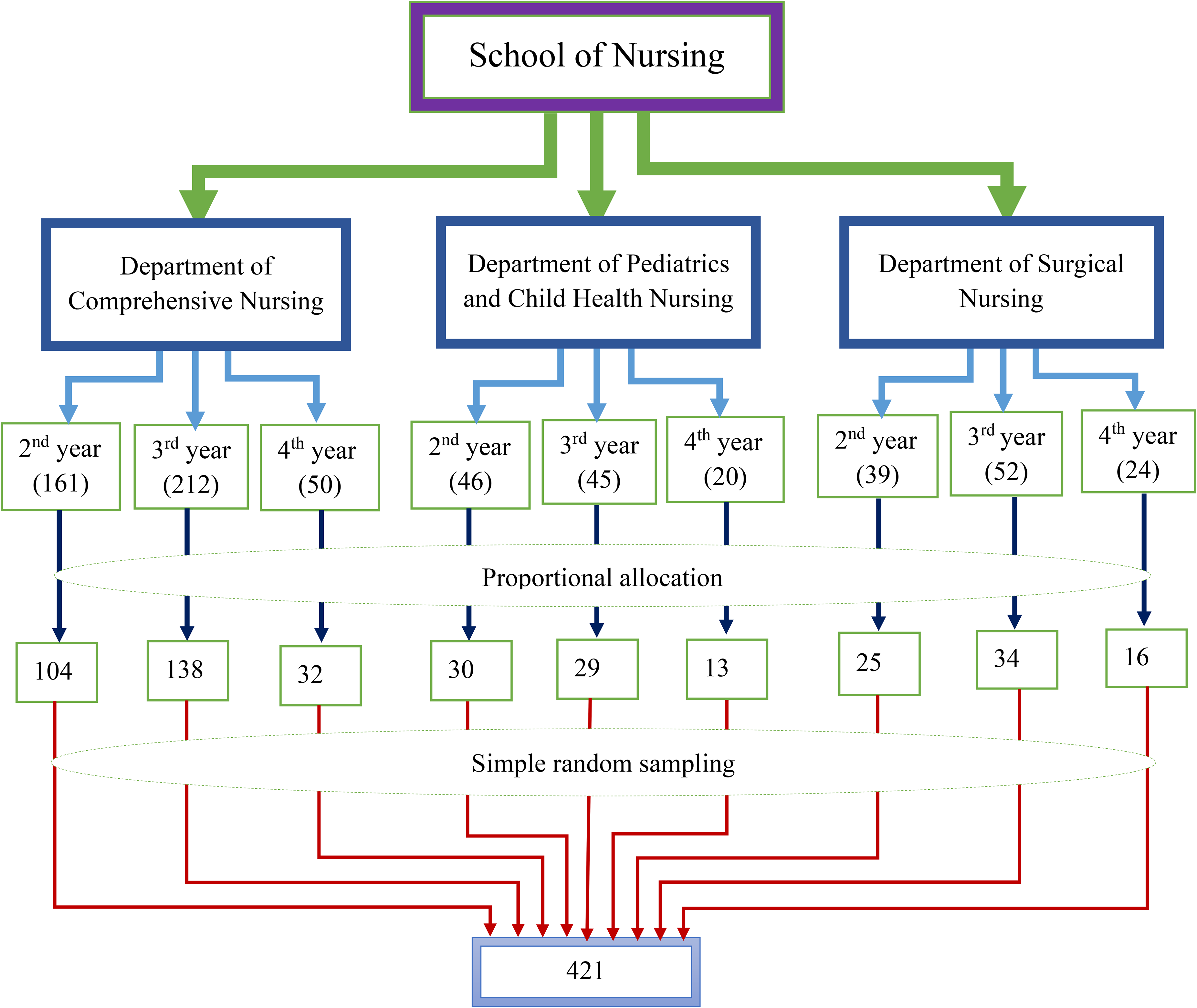
Diagrammatic presentation of sampling procedure of nursing students in the School of Nursing, Wachemo University, Ethiopia, 2024.
Study Variables
Dependent variables: stress and coping strategies.
Independent Variables
Sociodemographic factors: age, gender, marital relationship, program status, year of study, cumulative grade point average, and living status.
Practice site-related factors: site mostly practiced, enough practice cases, enough time, clinical staff guidance, and clinical staff encouragement to be a competent professional nurse.
Site instructor-related factors: gender of the instructor, instructor encouragement to be a competent professional nurse, instructor guidance when performing the procedure, instructor asking questions on bedside discussion without a plan, weekly seminar presentation and pretest, the frequency the instructor follows on clinical practice, the instructor teaches in all available cases, and ask the instructor to clarify unclear issues.
Operational Definition
Stress: The students’ subjective response to the stressors during the clinical practice. It was assessed using 29 questions developed by former researchers (Sheu et al., 1997). Each Stress assessing question has a 5-point Likert-type scale of 0: never, 1: rarely, 2: sometimes, 3: fairly often, and 4: very often. Then, the individual response was computed and recorded, and the mean value was calculated. Finally, dichotomized as no stress (if scored below mean) or stressed (if scored mean and above).
Coping strategies: The student's cognitive and behavioral efforts in the clinical practice setting as being stressful. It was assessed using 19 questions taken from the coping behavior inventory (Sheu et al., 2002). Each coping strategies assessment question has a 5-point Likert-type scale of 0: never; 1: infrequently, 2: sometimes, 3: frequently, and 4: always. Then, the individual response was computed and recorded, and the mean value was calculated. Finally, dichotomized as poor coping strategies (if scored below the mean) or good coping strategies (if scored mean and above).
Private regular nursing students: These are nursing students who pay for tuition, cafeteria, and dormitory.
Data Collection Tool and Procedure
The tool was adapted and prepared in English (Ab Latif & Nor, 2019; Hamadi et al., 2021; Shaban et al., 2012; Sheu et al., 2002; Toqan et al., 2022; Welch, 2023). It contained independent variables categorized under sociodemographic factors, practice site-related factors, and site instructor-related factors. The first dependent variable was stress. It was assessed using questions that included 29 items under six subcategories. The subcategories are; stress from taking care of patients which has eight items, stress from assignments and workload which has five items, stress from lack of professional knowledge and skills which has three items, stress from the environment which has three items, stress from peers and daily life that has four items, and stress from teachers and nursing staff that has six items. Each Stress assessing question has a 5-point Likert-type scale of 0: never, 1: rarely, 2: sometimes, 3: fairly often, and 4: very often. The subscales of the index showed a reliability coefficient (Cronbach's alpha) ranging from .68 to .80 (Jones & Johnston, 1999).
The second dependent variable is coping strategies that was assessed using questions that included 19 items under four subcategories. The subcategories are as follows: avoidance which has six items, problem solving which has six items, stay optimistic which has four items, and transference which has three items. Each coping strategies assessing item has a 5-point Likert type scale of 0: never; 1: infrequently, 2: sometimes, 3: frequently, and 4: always. The Cronbach's alpha of the coping strategies question was 0.73 (Shaban et al., 2012). Two masters in sciences psychiatry nursing professionals and one experienced epidemiologist were recruited for data collection and supervision respectively. Data was collected by self-administration of the tool for selected students in the lecture hall.
Data Quality Control
A pretest was done on 5% of the total sample size at Worabe University and necessary modification was performed based on the pretest. A-day training was given for data collectors and supervisors targeting how to administer the questionnaire, a way to preserve the confidentiality of statistics, the contents of the questionnaire, and data handling security. The supervisors and investigators conducted cloth follow-ups during the whole period of data collection. Every day, after data collection, each questionnaire was reviewed and checked for completeness and the necessary feedback was given to the data collectors for the next day. The Cronbach’s alpha test for stress and coping strategies in this study were 0.78 and 0.83, respectively.
Data Analysis
Data were entered using Epi data 3.1 version and analyzed using SPSS Version 25. Data cleaning was performed to check for missed values. Descriptive analysis such as proportions, percentages, and mean were done and tables and graphs were used for presentation. Multicollinearity was checked by considering a variance inflation factor of greater than 10 and a tolerance of less than 0.05. The goodness of fit test was checked by using the Hosmer–Lemeshow goodness of fit test. Binary logistic regression analysis was done, and variables with a p-value of <.05 in the bivariable analysis were taken into the multivariable analysis. Statistical significance was declared at a p-value of <.05 with an AOR and 95% confidence interval.
Result
Sociodemographic Characteristics of Students
Four hundred twenty-two nursing students participated in the study and that made the overall response rate 100%. More than half, 298(70.8%) students were in the age group of 22–24 years old and 224(53.2%) were females. Nearly half, 213(50.6%) were not engaged for marriage and the program status of 335(79.6%) was regular. The cumulative grade point average of 203(48.2%) was between 2.76–3.25 and 313(74.3%) students live in the university’s dorm (Table 1).
Sociodemographic Characteristics of Nursing Students in the School of Nursing, Wachemo University, Ethiopia, 2024.

Practice Site-Related Factors
More than half, 272(64.6%) mostly practiced on-site mostly used for clinical practice and 312(74.1%) reported that practice cases were not enough as expected. Similarly, 313(74.3%) reported the time for practice was enough, and 248(58.9%) clinical staff not guide the students in practice. However, the majority, 359(85.3%) reported that clinical staff encouraged them to be competent professional nurses (Table 2).
Practice Site-Related Factors of Nursing Students in the School of Nursing, Wachemo University, Ethiopia, 2024.

Site Instructor-Related Factors
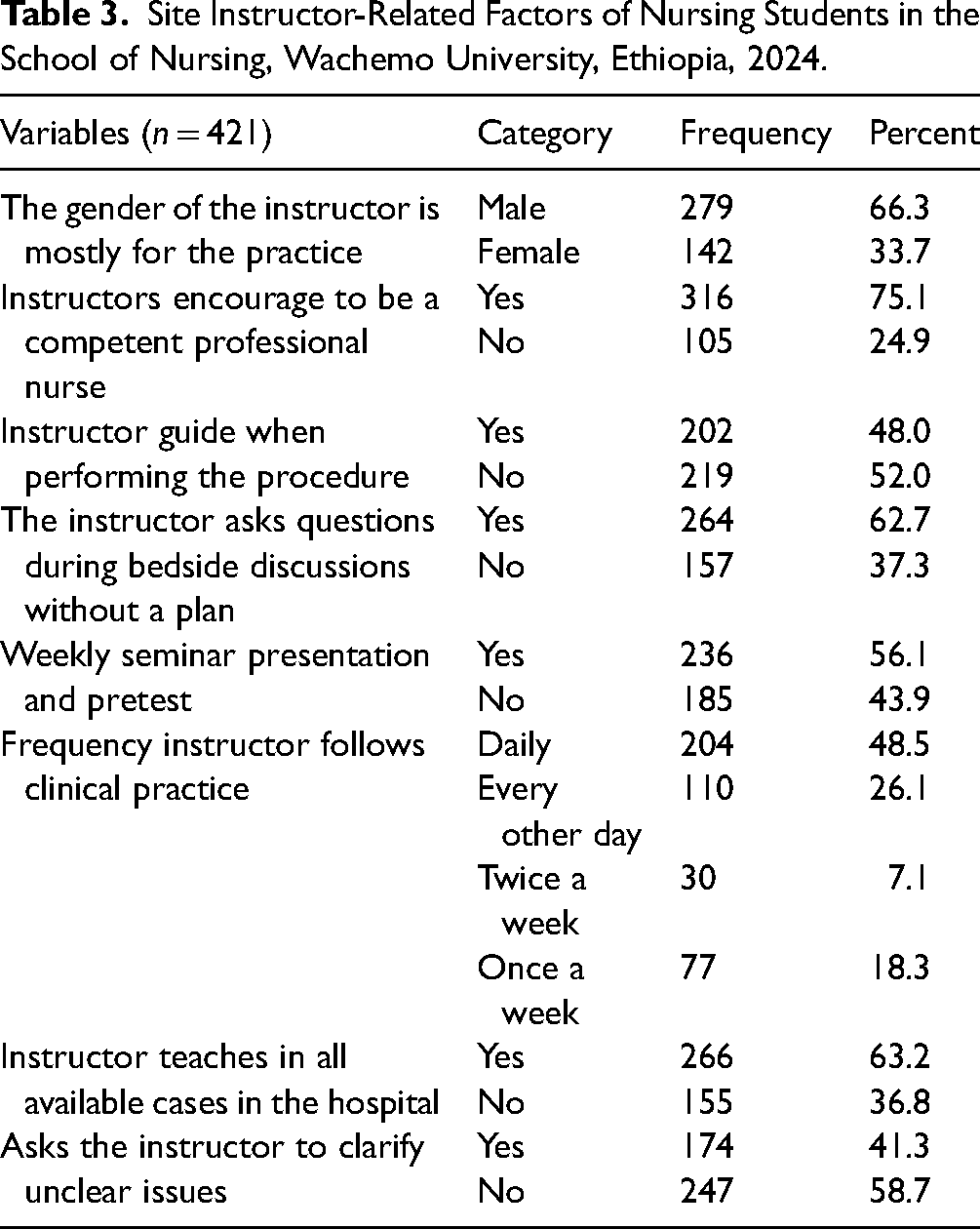
For more than half, 279(66.3%) nursing students, the gender of the instructor mostly for the practice was male, and 316(75.1%) reported that the instructor encouraged them to be a competent professional nurse.
For 219(52.0%) students, the instructor guided them when performing the procedure and 265(62.7%) reported that the instructor asked questions on bedside discussion without a plan. Nearly more than half, 236(56.1%) reported the presence of weekly seminar presentations and pretests, and 204(48.5%) nursing students reported that their instructor followed daily clinical practice. More than half, 266(63.2%) nursing students reported that their instructor teaches in all available cases in the hospital and 174(41.3%) nursing students asked the instructor to clarify unclear issues (Table 3).
Site Instructor-Related Factors of Nursing Students in the School of Nursing, Wachemo University, Ethiopia, 2024.
Prevalence of Stress Among Students in Clinical Practice
(Figure 2).

Prevalence of Stress among students on the clinical practice of nursing students in the School of Nursing, Wachemo University, Ethiopia, 2024 (n = 421).
Sources of Stress for Nursing Students During Clinical Practice
Out of 421 nursing students, the major source of stress was the environment, however, the least source was taking care of patients (Figure 3).

Sources of stress of nursing students during clinical practice, School of Nursing, Wachemo University, Ethiopia, 2024 (n = 421).
Prevalence of Coping Strategies Among Students in Clinical Practice
(Figure 4).

Prevalence of coping strategies among students during the clinical practice of nursing students in the School of Nursing, Wachemo University, Ethiopia, 2024 (n = 421).
Specific Coping Strategies of Students During Clinical Practice
Of the 421 nursing students, the problem-solving strategy was the highest specific coping strategy. However, avoidance was the low specific coping strategy during their clinical practice (Figure 5).

Specific coping strategies of students during clinical practice, School of Nursing, Wachemo University, Ethiopia, 2024 (n = 421).
Factors Associated With Stress of Nursing Students During Clinical Practice
In bivariable logistic regression analysis, gender of student, program status, living status, and instructor guide when performing procedures were significantly associated with the stress of nursing students during clinical practice. Whereas, in multivariable logistic regression analysis, male gender student [AOR: 0.03 95% CI: 0.01–0.06], private regular program status [AOR: 8.39 95% CI: 3.99–17.67], living status with families [AOR: 7.38 95% CI: 2.36–23.09], and instructor guide when performing procedure [AOR: 0.17 95% CI: 0.09–0.33] were significantly associated with Stress of nursing students during clinical practice (Supplementary Table 1).
Factors Associated With Coping Strategies of Nursing Students During Clinical Practice
In bivariable logistic regression analysis, the age of students, cumulative grade point average, living status, clinical staff guide in practice, instructor guide when performing the procedure, and asks the instructor to clarify unclear issues were significantly associated with coping strategies of nursing students during clinical practice. Whereas in multivariable logistic regression analysis, the age of students 19–21 years [AOR: 0.15 95% CI: 0.05–0.51], age of students 22–24 years [AOR: 0.07 95% CI: 0.02–0.21], cumulative grade point average 2.00–2.75 [AOR: 0.05 95% CI: 0.02–0.13], living status in university`s dorm [AOR: 2.42 95% CI: 1.06–5.56], clinical staffs guide in practice [AOR: 2.99 95% CI: 1.57–5.67], instructor guide when performing procedure [AOR: 5.97 95% CI: 3.24–11.00], and students that ask the instructor to clarify unclear issues [AOR: 6.29 95% CI: 3.10–12.77] were significantly associated with Coping strategies of nursing students during clinical practice (Supplementary Table 2).
Discussion
In this study, the prevalence of stress among nursing students during clinical practice was 58.4% with 95% CI [53.6–62.8]. It was higher in a study conducted in Spain, which was 47.92% (Yildiz et al., 2018), in Jima, Ethiopia, 47.7% (Jones & Johnston, 1999). However, it was lower in a study done in Western Rajasthan, India, which was 82.4% (Nebhinani et al., 2020). The possible explanation for this could be related to differences in sample size, variation in study year, variation in coding, and differences in socio-cultural characteristics of students. Similarly, the prevalence of coping strategies of nursing students during clinical practice was 52.0% with 95% CI [47.3–56.5]. It was lower than a study from Jima, Ethiopia, 61.6% (Jones & Johnston, 1999). This might be due to differences in sample size, variation in the study year, variation in coding, variation in curriculum, and seasonal variation in clinical practice.
In this study, the gender of the student was significantly associated with the Stress of nursing students during clinical practice. Male nursing students were 97% less likely to be stressed compared to females. In other studies, female students reported higher stress than male students (Admi et al., 2018; Akhu-Zaheya et al., 2015; Chen & Hung, 2014; D’emeh & Yacoub, 2020; Shaban et al., 2012). This might be due to cultural-related interpretation of cross-gender interactions and the expression of feelings and emotions explicitly. In addition, it might be due to female gender-related situations like menstruation season discomforts.
This study revealed that program status was significantly associated with the Stress of nursing students during clinical practice. Nursing students attending private regular programs were 8.39 times more likely to be stressed compared to nursing students attending regular programs. A study conducted in Jordan stated that students who paid for their study reported a higher level of stress compared with other students. This might be related to the responsibility they feel and the worries they hold about grades and passing program courses in the planned time.
This study identified that living status was significantly associated with the Stress of nursing students during clinical practice. Those nursing students who live with their families were 7.38 times more likely to be stressed compared to nursing students who live in University dorms. This is due to that nursing students who live at home with their families might have familial, social, and neighbor responsibilities that share their reading time. In addition, individuals at home watch television and perform other pleasurable things that might disturb their studying time. Because of this, the students lost their reading time and were stressed about the clinical practice.
This study showed that instructor guidance when performing procedures was significantly associated with the stress of nursing students during clinical practice. Nursing students whose instructor guided them when performing procedures were 83% less likely to be stressed compared to nurses whose instructor did not guide them when performing procedures during clinical practice. It is known that guiding and leading in practical work reduces tension. Similarly, those students who did not get guidance from their instructors become stressed. On the other hand, those students who got guidance from their instructors reduced their stress.
In this study, the age of students was significantly associated with the coping strategies of nursing students during clinical practice. Nursing students in the age group of 19–21 years old were 85% less likely to have good coping strategies compared to nursing students in the age group of 25–33 years old. Similarly, nursing students in the age group of 22–24 years old were 93% less likely to have good coping strategies compared to nursing students in the age group of 25–33 years old. This was supported by a study from Saudi Arabia (Shdaifat et al., 2018). The possible explanation for this might be related to the level of mental development and less exposure to clinical practice as those students with lower ages were mostly in second years. Similarly, the age of students, mental maturity, and clinical exposure increase with their study years, and their coping strategies might increase with the study years.
This study showed that cumulative grade point average was significantly associated with the coping strategies of nursing students during clinical practice. Nursing students whose cumulative grade point average was within 2.00–2.75 were 95% less likely to have good coping strategies compared to nursing students whose cumulative grade point average was within 3.76–4.00. This was supported by a study from Saudi Arabia (Shdaifat et al., 2018). The possible explanation could be those students scoring lower grades have a lower potential for optimistic decision-making ability, being hopeless, and being careless of their achievements as well as themselves. Additionally, students have the potential for good grade scoring are optimistic, and have the potential for managing situations and coping strategies. On the other hand, students scoring low grades are pessimistic and have the lowest potential for managing situations and Coping strategies. In a previous study, nursing students worried about not having poor grades were prone to be stressed (Shaban et al., 2012). In Ethiopian culture, grade is a major concern for the students and their significant others (family, relatives, friends, and neighborhood). In addition, many hospitals are hiring students’ based on their graduate scores, and sometimes, they would look at students’ grades in specific courses (Akhu-Zaheya et al., 2015).
This study showed that living status was significantly associated with the coping strategies of nursing students during clinical practice. Those nursing students who live in university dorms were 2.4 times more likely to have good coping strategies compared to nursing students who live with their families. This was supported by another study that revealed students who live alone and away from their families used more coping strategies and behaviors than those who live with their families (Hamaideh, 2017). This might be because students who live alone or with peers are obligated to deal and cope with their stress without assistance from others which enhances critical thinking and adapting for students.
This study identified that clinical staff guiding in practice was significantly associated with coping strategies of nursing students during clinical practice. Nursing students whose clinical staff guided them in practice were 2.9 times more likely to have good coping strategies compared to nursing students whose clinical staff did not guide them in practice. This was stated in another study that the failure of clinical staff to facilitate immediate feedback on performance negatively affects nursing students’ coping strategies (Shaban et al., 2012). The possible explanation for this might be gaining professional leadership and interpersonal relationship enhances confidence to overcome hard situations. In addition, there might be experience sharing from senior clinical staff during interpersonal relationships that might increase their coping strategies. Moreover, the clinical staff in practice guides and supports in the process of coping strategies.
In this study, instructor guidance when performing procedures was significantly associated with the coping strategies of nursing students during clinical practice. Nursing students whose instructor guides them when performing the procedure were 5.9 times more likely to have good coping strategies compared to nursing students whose instructor does not guide them when performing the procedure. Guiding and leading to direction in practical work enhances self-confidence and coping strategies. In the same way, students who got guidance from instructors were coped. On the other hand, those students who did not get guidance from their instructors lacked good coping strategies.
This study showed that asking the instructor to clarify unclear issues was significantly associated with the coping strategies of nursing students during clinical practice. Nursing students who ask the instructor to clarify unclear issues were 6.29 times more likely to have good coping strategies compared to nursing students who do not ask the instructor to clarify unclear issues. This is due to those students who seek clarification from their instructor having well preparation and self-confidence to be a professional nurse. As a result, they cope with the situation effectively. In another study, nursing students who had an interest in the nursing profession used active coping strategies (Nebhinani et al., 2020).
Limitations of the Study
The study might be prone to subjectivity bias as it is self-reported by participants and socio-cultural features as the students come from various parts of Ethiopia.
Conclusion
About six in ten nursing students have stress in the nursing School of Wachemo University. Being male gender, being private regular, living with families, and instructor guide when performing procedures were significantly associated with the Stress of nursing students during clinical practice. Therefore, managing gender-related issues, attending regular programs, living in the university`s dorm, and guiding the students when performing procedures might reduce the burden of stress during clinical practice.
About five in ten nursing students have good coping strategies at the nursing school of Wachemo University. Being age group of 19–21 and 22–24 years old, having a cumulative grade point average of 2.00–2.75, living in a university dorm, having clinical staff guiding me in practice, instructor guiding when performing procedures, and asking the instructor to clarify unclear issues were significantly associated with coping strategies of nursing students during clinical practice. Therefore, improving cumulative grades, living in a university dorm, clinical staff guidance in practice, instructor guiding when performing procedures, and asking the instructor to clarify unclear issues might enhance the coping strategies of nursing students during clinical practice.
Supplemental Material
sj-docx-1-son-10.1177_23779608241272528 - Supplemental material for Prevalence and Associated Factors of Stress and Coping Strategies of Nursing Students During Clinical Practice in School of Nursing, Wachemo University, Ethiopia
Supplemental material, sj-docx-1-son-10.1177_23779608241272528 for Prevalence and Associated Factors of Stress and Coping Strategies of Nursing Students During Clinical Practice in School of Nursing, Wachemo University, Ethiopia by Elias Ezo, Asnakech Zekiwos, Taye Mezgebu, Senteyehu Admasu, Bethelhem Birhanu, Getachew Ossabo, Elias Nigusu, Awoke Girma, Selamawit Wondala, Jabir Abdella, Dinka Lamesa, Meskerem Teketel, Wubishet Gezimu, Tadesse Sahle and Seifu Awgchew in SAGE Open Nursing
Supplemental Material
sj-docx-2-son-10.1177_23779608241272528 - Supplemental material for Prevalence and Associated Factors of Stress and Coping Strategies of Nursing Students During Clinical Practice in School of Nursing, Wachemo University, Ethiopia
Supplemental material, sj-docx-2-son-10.1177_23779608241272528 for Prevalence and Associated Factors of Stress and Coping Strategies of Nursing Students During Clinical Practice in School of Nursing, Wachemo University, Ethiopia by Elias Ezo, Asnakech Zekiwos, Taye Mezgebu, Senteyehu Admasu, Bethelhem Birhanu, Getachew Ossabo, Elias Nigusu, Awoke Girma, Selamawit Wondala, Jabir Abdella, Dinka Lamesa, Meskerem Teketel, Wubishet Gezimu, Tadesse Sahle and Seifu Awgchew in SAGE Open Nursing
Supplemental Material
sj-docx-3-son-10.1177_23779608241272528 - Supplemental material for Prevalence and Associated Factors of Stress and Coping Strategies of Nursing Students During Clinical Practice in School of Nursing, Wachemo University, Ethiopia
Supplemental material, sj-docx-3-son-10.1177_23779608241272528 for Prevalence and Associated Factors of Stress and Coping Strategies of Nursing Students During Clinical Practice in School of Nursing, Wachemo University, Ethiopia by Elias Ezo, Asnakech Zekiwos, Taye Mezgebu, Senteyehu Admasu, Bethelhem Birhanu, Getachew Ossabo, Elias Nigusu, Awoke Girma, Selamawit Wondala, Jabir Abdella, Dinka Lamesa, Meskerem Teketel, Wubishet Gezimu, Tadesse Sahle and Seifu Awgchew in SAGE Open Nursing
Footnotes
Acknowledgments
We would like to thank the study participants for their openness to kindly provide the necessary information and spare their valuable time.
Authors’ Contribution
Elias Ezo, Asnakech Zekiwos, Taye Mezgebu, and Senteyehu Admasu participated in the ideas, formulation, or evaluation of overarching research goals and aims.
Elias Ezo, Bethelhem Birhanu, Getachew Ossabo, and Elias Nigusu are involved in data management activities, scrub data, and maintain research data (including software code for interpreting the data itself).
Elias Ezo, Asnakech Zekiwos, Taye Mezgebu, Awoke Girma, Selamawit Wondala, Jabir Abdella, Dinka Lamesa, Meskerem Teketel, Wubishet Gezimu, Tadesse Sahle, and Seifu Awgchew conducted the data analysis and interpretation.
Elias Ezo, Asnakech Zekiwos, Taye Mezgebu, Senteyehu Admasu, Bethelhem Birhanu, Getachew Ossabo, Elias Nigusu, Awoke Girma, and Wubishet Gezimu participated in the conducting research and investigation process, specifically performing the experiments.
Elias Ezo, Asnakech Zekiwos, Taye Mezgebu, Senteyehu Admasu, Wubishet Gezimu, and Tadesse Sahle participated in the development or design of the methodology.
Elias Ezo, Wubishet Gezimu, and Tadesse Sahle contributed to the management and coordination responsibility for the research activity planning and execution.
Elias Ezo, Asnakech Zekiwos, Taye Mezgebu, Senteyehu Admasu, Bethelhem Birhanu, Getachew Ossabo, Elias Nigusu, Awoke Girma, Selamawit Wondala, Jabir Abdella, Dinka Lamesa, Meskerem Teketel, Wubishet Gezimu, Tadesse Sahle, and Seifu Awgchew contributed in provision of study materials, reagents, materials, patients, instruments, computing sources and other analysis tools.
Elias Ezo, Asnakech Zekiwos, Taye Mezgebu, Awoke Girma, Selamawit Wondala, Jabir Abdella, Dinka Lamesa, Meskerem Teketel, Wubishet Gezimu, Tadesse Sahle, and Seifu Awgchew used Epi data and SPSS software for analysis.
Elias Ezo, Asnakech Zekiwos, Taye Mezgebu, Senteyehu Admasu, Bethelhem Birhanu, Getachew Ossabo, Elias Nigusu, Awoke Girma, Selamawit Wondala, Jabir Abdella, Dinka Lamesa, Meskerem Teketel, Wubishet Gezimu, Tadesse Sahle, and Seifu Awgchew supervised the study.
Elias Ezo, Asnakech Zekiwos, Taye Mezgebu, Senteyehu Admasu, Wubishet Gezimu, and Tadesse Sahle contributed to the verification, whether as part of the activity or separate, of the overall replication/reproducibility of results.
Elias Ezo and Senteyehu Admasu participated in the preparation, creation, and/or presentation.
Elias Ezo, Asnakech Zekiwos, and Taye Mezgebu made contributions in preparation, creation, and/or presentation, specifically writing the initial draft.
Elias Ezo, Taye Mezgebu, and Wubishet Gezimu have made contributions in preparation, creation, and/or presentation, specifically critical review, commentary, or revision
Availability of Data
The data used for analysis are available on secure and reasonable request.
Declaration of Conflicting Interests
The authors declared no potential conflicts of interest with respect to the research, authorship, and/or publication of this article.
Ethical Consideration
The research ethical review committee of the comprehensive nursing department approved the proposal of this research (CMHS/DCN/38/15).
Funding
The authors received no financial support for the research, authorship, and/or publication of this article.
Informed Consent
Written informed consent was obtained from each participant before initiation of the study, as the information obtained from them would not have been disclosed to a third person and it was only for investigation purposes.
ORCID iDs

Supplemental Material
Supplemental material for this article is available online.
References
Supplementary Material
Please find the following supplemental material available below.
For Open Access articles published under a Creative Commons License, all supplemental material carries the same license as the article it is associated with.
For non-Open Access articles published, all supplemental material carries a non-exclusive license, and permission requests for re-use of supplemental material or any part of supplemental material shall be sent directly to the copyright owner as specified in the copyright notice associated with the article.
