




Abstract
Introduction
Emergency nurses who are working in direct contact with COVID-19 patients are at an increased risk of developing secondary traumatic stress disorder. This study aimed to assess the prevalence, predictors, and consequences of secondary traumatic stress among emergency nurses in Palestine during the COVID-19 pandemic
Methods
The study utilized a cross-sectional design and recruited a total of 189 emergency nurses from multiple healthcare centers in Palestine. Data collected from January 21, 2021, to March 31, 2021.
Results
The study revealed that emergency nurses had a high degree of secondary traumatic stress with the prevalence of high to severe symptoms of secondary traumatic stress being 61% of the total participants. In terms of predictors, the results showed that years of experience, level of education, burnout, and organizational support were significantly correlated with secondary traumatic stress and thus that years of experience and burnout are predictors of secondary traumatic stress.
Conclusion
Based on our findings, nurses in emergency departments in Palestine have a high degree of secondary traumatic stress disorder which impacts their lives on a personal and professional level.
Introduction
Healthcare professionals, such as nurses and doctors, are prone to experiencing secondary traumatic stress (STS) as a result of being exposed to traumatic events they face and witness in their work (Figley, 1995; Elwood et al., 2011; Mealer et al., 2009). Secondary traumatic stress can have significant negative effects on the lives of those who experience it, so it is important to understand its prevalence, predictors, and consequences in populations at high risk.
The ongoing Palestinian–Israeli conflict and occupation put Palestinians at a higher risk of anxiety, stress, and post-traumatic stress disorder (Marie et al., 2020). A research investigation carried out in Gaza in 2016 found that 74% of emergency nurses had witnessed moderate to severe trauma, which was linked to a higher level of STS (Abdo et al., 2016). The prevalence of STS among emergency nurses in the West Bank, where they care for patients with diverse emergency needs, including those with conflict-related trauma remains limited. Additionally, the COVID-19 pandemic has further increased the stress experienced by healthcare providers (Maraqa et al., 2020).
Review of Literature
Several studies have reported that healthcare workers, particularly those on the frontline, are at increased risk of psychological distress, including STS, burnout, and tension, during the COVID-19 pandemic (Martínez-López et al., 2020; Kisely et al., 2020; Greenberg et al., 2020). Marzetti's study found that 40% of frontline healthcare workers worldwide reported moderate to severe STS symptoms, with intrusion being the most common, and 50% reported job burnout (Martínez-López et al., 2020). Female workers and those who spent more time with patients and witnessed more deaths were more affected (Martínez-López et al., 2020). Similarly, Kisely et al. (2020) revealed that healthcare workers were at increased risk of mental health problems, including depression, anxiety, and insomnia, during the COVID-19 pandemic. During the COVID-19 outbreak, frontline workers in the healthcare industry in Italy reportedly suffered heightened levels of stress, anxiety, and depression (Preti et al., 2020). These findings underscore the significance of addressing the psychological well-being of healthcare workers during crises, such as the COVID-19 pandemic (Martínez-López et al., 2020). Recent studies suggest that caring for COVID-19 patients may have negative physical and mental health effects on nurses and increase their risk of STS (Martínez-López et al., 2020; Kisely et al., 2020; Greenberg et al., 2020; Preti et al., 2020; Arpacioglu et al., 2021; Vitale et al., 2020; Vagni et al., 2020; Hu et al., 2020; Lai et al., 2020; Putra, 2019).
Previous research has established a link between working in emergency settings and the development of STS and related symptoms in nurses (Machado, 2018; Duffy et al., 2015; Morrison & Joy, 2016; Ratrout & Hamdan-Mansour, 2020). Ratrout and Hamdan-Mansour (2017) conducted a systematic review of previous studies and found a high prevalence of STS among emergency nurses. According to Wang et al. (2020), 80.6% of nurses in China reported average levels of STS. Secondary traumatic stress was consistently associated with negative outcomes, including burnout, depression, anxiety, job dissatisfaction, and increased absenteeism (Ratrout & Hamdan-Mansour, 2017; Wang et al., 2020; Mealer et al., 2009; Orrù et al., 2021). Mealer et al. (2009) found that symptoms of STS were significantly correlated with depression, anxiety, and burnout. A systematic review study on STS among healthcare professionals found that emergency nurses were at higher risk of developing STS than nurses in other healthcare settings. These findings underscore the urgent need for interventions and support systems to address STS and promote the well-being of emergency nurses (Ratrout & Hamdan-Mansour, 2017; Wang et al., 2020; Mealer et al., 2009; Orrù et al., 2021).
Sociodemographic and work-related variables have been found as influential elements in the development of STS among emergency nurses (Abdo et al., 2016; Ratrout & Hamdan-Mansour, 2017; Wang et al., 2020). According to Mealer et al. (2009) working in an urban emergency department (ED), having a history of psychiatric illness, and having experienced a recent traumatic event were significant predictors of STS. Abdo et al. (2016) identified multiple factors affecting burnout, including age, gender, years of experience, frequent exposure to job violence, relationship with colleagues, and supervision. Furthermore, Ratrout and Hamdan-Mansour (2020) found that coping mechanisms and empathy were significant predictors of STS and that high coping and low empathy were risk factors for developing STS among emergency nurses. The consequences of STS were also examined, revealing a significant association with absenteeism and sick leave, but not job satisfaction (Ratrout & Hamdan-Mansour, 2020).
This current study builds upon previous research to ascertain the prevalence, predictors, and consequences of STS among Palestinian emergency nurses during the COVID-19 pandemic and understand the factors that contribute to its development. Building on this we will determine the consequences of STS on job performance, burnout, stress, and job satisfaction. This knowledge can help develop approaches to reduce the adverse impact of STS. Additionally, understanding which factors have the largest impact on the development of STS can help provide supportive teaching, planning, and counseling to nurses to decrease the consequences of STS on their work and personal lives.
Research Questions
What is the prevalence of “secondary traumatic stress disorder” in Palestine?
What are the predictors of “secondary traumatic stress” among emergency nurses in Palestine?
What are the consequences of STS among emergency nurses in Palestine?
What is the relationship between nursing characteristic and STS in Palestine?
Methods
Design
A cross-sectional, descriptive, quantitative study was performed to carry out this research. The study was conducted in EDs in the West Bank of Palestine covering the south, middle, and north geographic areas. These sixteen departments in total provide emergency care for patients all over the West Bank. Data were collected in the months of February and March 2021 during the third wave of COVID-19. The timeline for collecting data was from the 21st of January to the 31st of March 2021. Distribution of surveys to identified participants for the main study was completed by hand during morning and evening shifts. After distributing 257 surveys, the researchers waited for the respondents to finish them, and 189 surveys were returned, resulting in a response rate of 75%. A pilot study was conducted among 30 emergency nurses in which they filled out the questionnaire as a way to assess the questionnaire before starting data collection on a larger scale. The time needed to fill out the questionnaire was about 15–20 min.
Sample
A convenience sample was drawn from all emergency nurses from 16 different Palestinian hospitals. The sample size depended on the response rate of the nurses working in the EDs. Based on G. Power analysis, the minimal sample size at power 0.90, a medium ES of 0.15 (R2 = 0.15), and 0.05 alpha level of significance is 141.
Inclusion and Exclusion
Inclusion criteria: All nurses that had a certification in nursing regardless of degree (diploma, Bachelor, or master) and who had a minimum 6 months of experience in the EDs and were 21 years of age and above. Exclusion criteria: Nursing students, newly employed nurses with less than 6 months experience in an emergency room setting, nurses that were newly transferred from another department to the emergency room or those who worked part-time, and head nurses.
Instrument: The survey was composed of the following sections:
Section One (sociodemographic characteristics) covered: gender, age, educational level, years of experience in EDs, marital status, types of hospital (public or private), and whether the nurses provided care for COVID-19 patients.
Section two included:
Secondary traumatic stress scale—A scale that is used to investigate the symptoms of STS including “intrusion, avoidance, and arousal.” This scale was adopted in our questionnaire (Bride et al., 2004). According to Beck and Gable (2012), the internal consistency reliability of the STSS is (α = .94). The survey consisted of closed-ended questions based on Likert scale of (1) Very often (2) Often, (3) occasionally, (4) rarely, and (5) never. “A total score below 28 indicates little or no STS; 28–37 indicates mild STS; 38–43 indicates moderate STS; 44–48 indicates high STS; and beyond 49 indicates severe STS.” The Perceived Stress Scale (PSS) is a commonly used tool to assess perceived stress levels in individuals. It was originally developed by Cohen et al. (1983). The scale comprises 10 items, and respondents are asked to rate how often they have experienced certain feelings and thoughts in the past month. The items cover aspects such as “feelings of being upset or stressed, feeling nervous or agitated, and feeling confident in one's ability to handle personal problems” (Cohen et al., 1983). Maslach Burnout Inventory: is a widely used scale for measuring burnout in the workplace. The inventories include 21 items that measure three components of burnout: emotional exhaustion, depersonalization, and personal accomplishment. Emotional exhaustion refers to feelings of being emotionally drained and overwhelmed by work, while depersonalization refers to a negative, cynical, or detached attitude toward others, especially clients or patients (Maslach et al., 1996). Personal accomplishment refers to a sense of achievement and competence in one's work (Iwanicki & Schwab, 1981). Cope scale—28 questions that aim to assess the degree of coping by workers with the situations in the working environment, this is publicly available, and we adapt it to our study and included it in the questionnaire (Jalowiec et al., 1984). Multidimensional scale of perceived social support—A scale that is used to measure the social support provided to emergency nurses which is one predictor of STS, it includes 12 items investigating family and friends’ support. This scale publicly available and approval was obtained from the author (Zimet et al., 1990). Perceived organizational support scale—A scale consisting of 10 items that are aimed at measuring the degree of support provided to employees. In our study, organizational support is one of many indicators that predict the prevalence of STS. This scale publicly available and permission was obtained from the author (Eisenberger et al., 2019). Job Satisfaction Scale- This scale is used to measure the degree of job satisfaction by the employee. In this research, the scale was used to measure the job satisfaction among nurses in EDs. The scale consists of 10 items, and the approval of the author was obtained (Macdonald & Maclntyre, 1997).
After constructing the questionnaire, it was presented to a group of nine experts in the field of scientific research and hold PhDs in nursing, to judge face and content validity, and to get feedback and comments. The reliability of the STSS, MBIS, JSS, MSBSS, POS, and CM questionnaires was statistically tested using the Cronbach Alpha test, resulting in the following values: 0.952, 0.940, 0.919, 0.974, 0.977, and 0.945, respectively.
Ethical Consideration
Ethical approval for this study was obtained from the Helsinki Committee; the approval number is PHRC/HC/804/21 and from the Palestinian Ministry of Health and the hospital administrators where the study was conducted.
Statistical Analysis
In this study, statistical analysis of the collected data was conducted using the statistical package for the social science (SPSS) version 23. T-test and ANOVA were used to test correlation between sociodemographic variables and STS. Also, Pearson Correlation to find the correlation between PSS, MBIS, JSS, MSPSS, and POS with STSS. Furthermore, linear regression for demographic, stress, and support characteristics of ED nurses effect on STSS was used with the statistical significance being set at p < 0.05.
Results
Sample Characteristics
The results of the analysis showed that the percentage of male nurses was higher than the percentage of female nurses (63.5% vs. 34.9%). Among the nurses working in EDs, the percentage of nurses for the age group between 21 and 29 years old was the highest (61.4%) compared to the older age groups (30–39 [30.7%] & 40–49 [5.8%]). In addition, nearly half of the nurses were married (45%) and had a bachelor university degree (61.4%). As for their work experience, most (60.3%) of them had less than five years’ experience and worked in public hospitals (60.3%). As for providing care to patients with COVID-19 in EDs, most (87.8%) ED nurses answered that they provided care to COVID-19 patients.
Research Question Results
Secondary Traumatic stress among emergency nurses in Palestine during the COVID-19 pandemic:
The STS rate among the nurses working in the EDs participating in the study was a 47 (out of a scale of 75), most (or nearly 70%) had rates between 34.5 and 60.5 (out of 75). Furthermore, descriptive analysis revealed that the average of STSS was 47.02 ± 4.32, intrusive subscale of SSTS was 13.99 ± 4.09 out of 25, avoidance subscale of STSS was 19.29 ± 5.82 out of 35, and arousal subscale of STSS was 13.73 ± 4.32out of 25 (see Table 1). The nurses in EDs suffer from high to severe STS levels, with 60% of ER nurses suffering from high or severe levels of STS, with about 45% suffer being at the severe level, while just 23% of participants suffer from mild or lower levels of STS (see Figure 1).

Secondary traumatic stress levels of participants’ responses.
Secondary Traumatic Stress Scale Items of Emergency Nurses.

Relation between demographic variables and STS:
Analysis of variance showed that there is a statistically significant (F = 4.6, p = 0.011) effect of level of education on ED nurses’ STS level. Scheffe Post hoc multiple comparisons showed that those master level education had higher score 54.11(± 16.06) STS levels in comparing with a bachelor level 45.5 (± 12.68) and the difference was significant (p = 0.040) while diploma had no significance with master or bachelor.
Also, analysis of variance showed that there is a statistically significant (F = 3.85, p = 0.010) effect of years of experience on ED nurses’ STS level. Scheffe Post hoc multiple comparisons showed that nurses with 11–20 years of work experience had higher score of 52.6 (± 11.43) STS level in comparison with those with less than five years of experience score of 45.5 (±13.22) but no significance between comparisons (see Table 2).
T Test and ANOVA Test of the Relation Between Demographic Variables and Secondary Traumatic Stress.

Level of significance is 0.05. Bold indicates relation between demographic variables and secondary traumatic stress is significant at the 0.05 level (2-tailed) linear regression for demographic, stress and support characteristics of ED nurses effect on STSS is significant at the 0.05 level (2-tailed) linear regression for Experience, PSS, MBIS and Person Accomplish of ED nurses effect on STSS subscales is significant at the 0.05 level (2-tailed).
Correlations between Key concepts and STS:
It's clear from Table 3 that depersonalization had the highest correlation (r = 0.695, p < 0.001) with STSS, and the highest correlation with STSS subscales; avoidance (r = 0.73), arousal (r = 0.628), and intrusive (r = 0.60). Although the Perceived organizational support scale had a significantly low correlation with STSS, the avoidance subscale was the one who had the correlation (r = 0.153) while the other two subscales neither had correlation nor significance.
Correlations Between PSS, MBIS, JSS, MSPSS, and POS with STSS and its’ Subscales.

**Correlation is significant at the 0.01 level (2-tailed). * Correlation is significant at the 0.05 level (2-tailed). r: Pearson Correlation STSS: Secondary Traumatic Stress Scale.
Demographic, stress, and support characteristics of ED nurse's effects on STSS:
The results of linear regression indicated that the independent variables including demographic and other predictors explained 55% of the variance (r2 = 0.55, F [DF = 15] = 15.8, p < 0.001). It was found that years of experience significantly predicted secondary trauma stress among ED nurses (β = 3.6, p = 0.03), as did PSS (β = 1.31, p < 0.001), and as did MBIS (β = 0.399, p < 0.001) (see Table 4).
Linear Regression for Demographic, Stress, and Support Characteristics of ED Nurses Effect on STSS.

Dependent Variable: STSS. Bold indicates relation between demographic variables and secondary traumatic stress is significant at the 0.05 level (2-tailed) linear regression for demographic, stress and support characteristics of ED nurses effect on STSS is significant at the 0.05 level (2-tailed) linear regression for Experience, PSS, MBIS and Person Accomplish of ED nurses effect on STSS subscales is significant at the 0.05 level (2-tailed).
When examining the variables that had a statistical significance with STSS by the linear regression test, it was found that the PSS and the MBIS scales had a statistically significant effect with all STSS subscales (intrusive, avoidance, and arousal), while experience and Person Accomplish had a statistical effect only with the avoidance subscale (see Table 5).
Linear Regression for Experience, PSS, MBIS, and Person Accomplish of ED Nurses Effect on STSS Subscales (Intrusive, Avoidance, and Arousal).
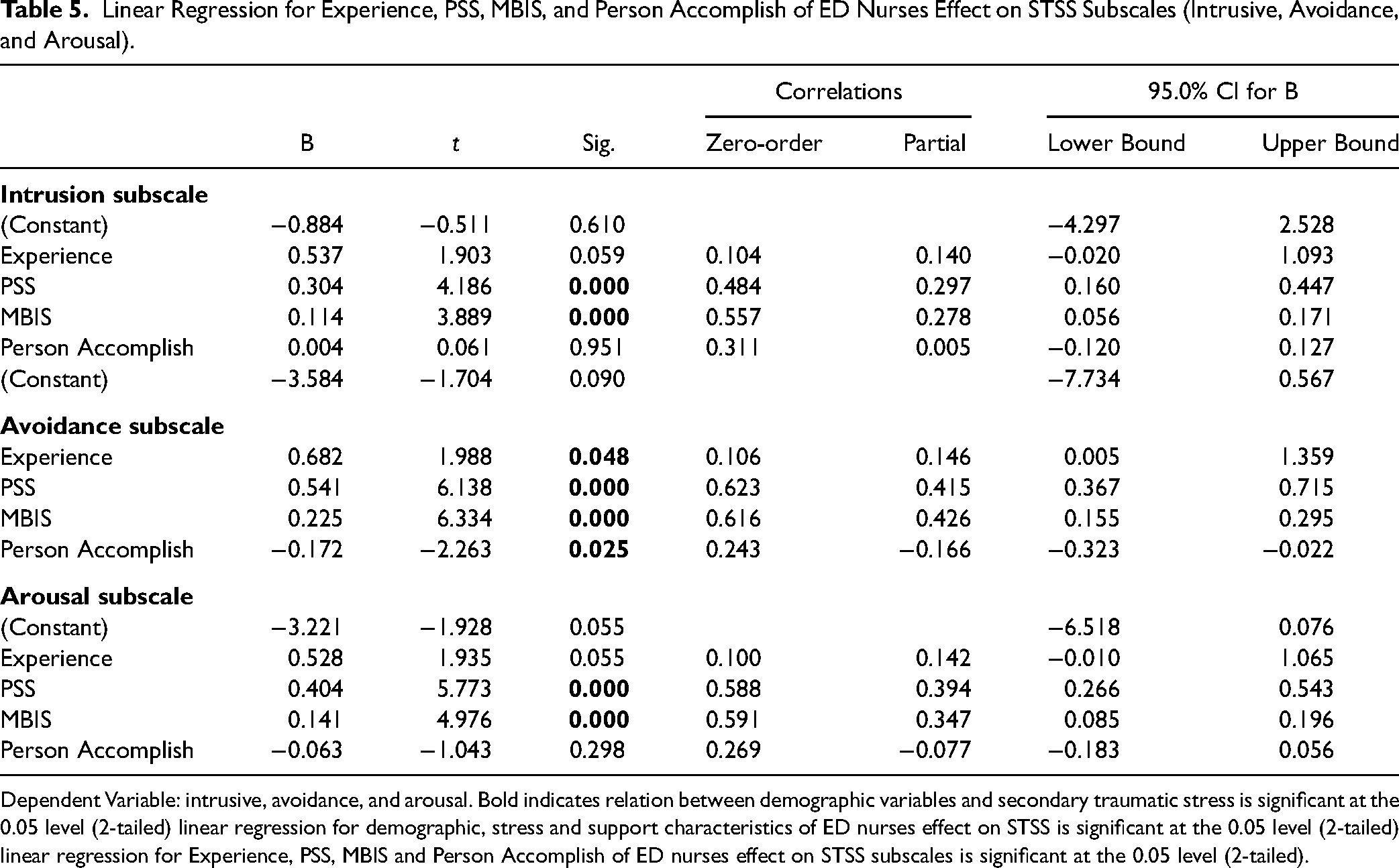
Dependent Variable: intrusive, avoidance, and arousal. Bold indicates relation between demographic variables and secondary traumatic stress is significant at the 0.05 level (2-tailed) linear regression for demographic, stress and support characteristics of ED nurses effect on STSS is significant at the 0.05 level (2-tailed) linear regression for Experience, PSS, MBIS and Person Accomplish of ED nurses effect on STSS subscales is significant at the 0.05 level (2-tailed).
Discussion
The impact of STS disorder on emergency nurses during the COVID-19 pandemic is a pressing issue that requires attention. The present study aimed to investigate the prevalence, predictors, and consequences of STS among emergency nurses in Palestine during the COVID-19 pandemic. The results of this study indicate that the level of STS disorder among emergency nurses in Palestine is significantly high and has considerable impacts on both their personal and professional lives.
Health care workers complain of many stressors that can affect their normal lives and they are at high risk for developing a STS disorder. As a result, such a disorder may have a prominent impact on the nurses’ lives both physically and mentally (Ogińska-Bulik et al., 2021). Many stressors can affect the development of STS. For example, a frontline nurse who is working with COVID-19 patients and in direct contact with infected patients is at a high risk of developing STS (Hu et al., 2020).
The result of the study showed that the prevalence of STS is high in Palestine. This could be explained by the fact the high level of psychological stress that is resulted from COVID-19 pandemic among health care professionals who working under the pandemic with a lack of personal protective equipment's, high workload, and increase number of patients and deaths patient that affects the healthcare workers normal lives (Maraqa et al., 2020). In Jordan, about 52% of nurses complained of high to severe STS (Ratrout & Hamdan-Mansour, 2020); 26.8% of total participants in Spain had a high to severe degree of STS (Martínez-López et al., 2020). In South Korea, about 57.2% of nurses working with traumatic patients had a high degree of stress disorder (Kim & Yeo, 2020); 67.8% of total nurses in Turkey working during the COVID-19 pandemic and were in direct contact with patients, had experienced a high to severe degree of STS (Erkin et al., 2021). And in the United States, 30.8% of nurses studied had experienced a high to severe degree of STS (Kellogg et al., 2018). The studies reviewed showed that the prevalence of STS was higher in Turkey than in Palestine during Covid-19 pandemic (Erkin et al., 2021). Yet the prevalence of STS was lower in United States and Italy than Palestine (Kellogg et al., 2018; Martínez-López et al., 2020).
The results showed that the most common secondary traumatic symptoms in the study were intrusion and then avoidance, with the least common secondary traumatic symptom being arousal. For example, in Turkey, the most common symptom was avoidance followed by intrusion and arousal (Erkin et al., 2021). While in Jordan, the most common symptom was arousal then the second most common was avoidance, with intrusion being the least common which is similar to the result in South Korea where the most common symptom was hyperarousal then avoidance and then intrusion (Ratrout & Hamdan-Mansour, 2020; Kim & Yeo, 2020). The results showed that the COVID-19 pandemic and working with traumatic patients have a large impact on developing STS and that nurses working with infected patients or traumatic patients have a high risk of developing severe symptoms of STS. Moreover, according to İlhan and Küpeli (2022) recent study, the COVID-19 pandemic has led to an increase in the occurrence of STS in emergency health care workers.
In this study, it was found that ER nurses had higher average scores in the avoidance subdimension of the STSS. Specifically, the highest response scores were related to items such as “My heart started pounding when I thought about my work with clients,” “I felt emotionally numb,” and “I expected something bad to happen.” This contrasts with a study conducted in Turkey, where the highest subdimension average scores were related to arousal, with the top three items being “I felt jumpy,” “Reminders of my work with patients upset me,” and “I felt discouraged about the future” (Erkin et al., 2021).
These findings can be explained by the fact that people throughout history have naturally responded to unpredictable or perceived dangerous situations by resorting to avoidance as a defense mechanism, primarily to manage their emotions (Erkin et al., 2021). In the context of this study, nurses working with COVID-19 suspected or confirmed patients may have developed avoidance as a coping mechanism due to their concerns about uncertainties, being separated from their family, witnessing fatalities, worrying about transmitting COVID-19 to their loved ones, or contracting the disease themselves. In coping with such challenging situations, emergency nurses often resort to avoidance as a defense mechanism, which has been shown in a study conducted by Theleritis et al. (2020) to be associated with increased stress levels among healthcare professionals.”
The analysis of variance in the study indicates that there is a statistically significant effect of level of education and years of experience on STS level. The comparison with previous results suggests that, in Turkey, gender, marital status, and age have a statistically significant relationship with compassion fatigue (STS), while level of education and years of experience do not have a statistically significant relationship (Aslan et al., 2021). The result of the Indian study is consistent with our study, in that both studies found that age, gender, and marital status were not significant factors in relation to STS, but years of experience were significant (Rajeswari & Sreelekha, 2017). Furthermore, PSS and the MBIS showed a significant impact on all subscales of STSS, including intrusive, avoidance, and arousal. On the other hand, experience and perceived person accomplishment had a significant effect only on the avoidance subscale of STSS.
Our study found significant positive correlations between STS and perceived stress, as well as burnout, which is consistent with previous research conducted by Orrù et al. (2021) who also found a correlation between professional burnout and secondary traumatization. The study also revealed a low positive correlation between perceived organizational support and STS, but no significant correlation between STS and job satisfaction or perceived social support. This finding aligns with a previous study by Moosavian Khorasani et al. (2019) which found that higher levels of perceived social support are associated with lower levels of STS and perceived stress. Furthermore, our study highlights the consistent association between STS and negative outcomes, including burnout, depression, anxiety, and job dissatisfaction, as found in previous research studies conducted by Ratrout & Hamdan-Mansour (2017), Wang et al. (2020), Mealer et al. (2009), and Orrù et al. (2021).
The study on emergency nurses in Palestine during the COVID-19 pandemic identified only years of experience, perceived stress, and burnout as significant predictors of STS. This differs from findings in Jordan where coping mechanisms were significant predictors, and in Spain where perceived stress, gender, and burnout were significant predictors (Ratrout & Hamdan-Mansour, 2020; Martínez-López et al., 2020). These differences in the predictors highlight the importance of reducing STS should be tailored to the specific needs and challenges faced by healthcare workers in different settings.
Strength and Limitations
This seems to be the first study in Palestine to investigate the prevalence, predictors, and consequences of STS experienced by emergency nurses during the COVID-19 pandemic.
The timing of the data collection during the pandemic considered a limitation. Self-reporting is another limitation. Furthermore, other factors, such as relationship with colleagues, working hours, and empathy, workplace violence, workload, nurses’ quality of working life, organizational well-being were not accounted for. Moreover, the vaccination status of the participants was not evaluated, despite researchers estimating that it could influence the fear of being infected and the resulting stress among emergency nurses. Furthermore, this research has not considered the severity of the patients and the workload of the nurses as variables under investigation. These limitations warrant further studies in this area.
Implication for Practice
The study's findings suggest that healthcare organizations in Palestine should prioritize the well-being of emergency nurses and take proactive steps to prevent the development of STS. To implement this, it is recommended that a specialized training program focused on trauma and coping mechanisms be introduced, as well as the appointment of a community supervisor to provide regular check-ins and support during times of crisis. Additionally, healthcare organizations should conduct further research to understand the relationship between working hours, night shifts, workplace violence, and the development of STS. This information can be used to develop interventions and strategies to protect healthcare workers from STS and promote their overall well-being.
Conclusion
Our study found that emergency nurses in Palestine who work in direct contact with COVID-19 patients experience a high degree of STS disorder, with 61% of participants reporting a high to severe level of symptoms. Among the demographic predictors, only years of experience and level of education were significant factors associated with STS. Additionally, organizational support and burnout were identified as significant factors contributing to STS among emergency nurses in Palestine. These findings highlight the importance of addressing perceived stress and burnout in reducing the risk of STS among emergency nurses and highlight the potential differences in risk factors across different populations.
Footnotes
Declaration of Conflicting Interests
The author(s) declared no potential conflicts of interest with respect to the research, authorship, and/or publication of this article.
Funding
The author(s) received no financial support for the research, authorship, and/or publication of this article.
