




Abstract
Introduction
Quality care is currently on the agenda of policy-makers at national and international levels. Patient-centeredness is considered an integral component of healthcare quality dimensions in addition to its effectiveness and safety. This indicates that healthcare should be viewed from a patient's perspective.
Methods and Materials
An institution-based cross-sectional study was conducted with a total sample size of 422 using systematic random sampling among patients admitted to the Agaro General Hospital. SPSS software version 25.0 was used to enter and analyze the data. The relationship between the dependent variable and covariates was determined using multivariable binary logistic regression analysis.
Results
A total of 405 patients participated in this study with a response rate of 96.0%. The overall percentage of positive perception was 76.3%. Clients aged 31–40 years were more likely [AOR: 2.191, 95% CI: 1.033–4.645, p-value: .041] and clients aged ≥ 51 years were less likely to perceive positively [AOR: 0.490, 95% CI: 0.271–0.886, p-value: .018]. Patients who had paid for receiving care were more likely to perceive it positively [AOR: 3.046, 95% CI 1.043–8.896, p-value: .042]. The odds of positive perception towards the quality of nursing care were higher among patients who thought the hospital cost was medium [AOR: 3.066, 95% CI: 1.286–7.311, p-value: .012], low [AOR: 13.859, 95% CI: 2.245–85.562, p-value: .005], and uncertain [AOR: 6.116, 95% CI: 1.988–18.809, p-value: .002].
Conclusion and Recommendations
Most patients had a positive perception of the quality of nursing care. Being elderly and feeling towards hospital costs have a negative influence whereas having paid for the treatment has a positive influence on the patients’ perception of nursing care. Hence the need increases with age, and healthcare providers should pay great attention while providing care for elderly patients.
Introduction
Despite the nonexistence of a globally accepted definition, different scholars and associations define Quality in different ways. According to the IOM (Institute of Medicine) of the United States, quality is defined as the extent to which healthcare services raise the likelihood of expected health outcomes for people and populations while remaining in line with the present professional knowledge. It has six dimensions: safety, effectiveness, Efficiency, Equity, Timeliness, and patient-centeredness (Federal Ministry of Health, 2020).
Healthcare quality is a recurrently mentioned principle of health policy. It is currently important for policy-makers at national and global levels (European Observatory on Health System and Policies, 2019). As several nations are renewing their focus on the issue of healthcare quality, patient-centeredness is considered an integral component among the three dimensions including effectiveness and safety. This indicates that healthcare should be viewed from the perspective of clients and patients (OECD, 2017a).
Universal coverage for communities, families, and individual clients is an integral aspect of healthcare services as enshrined in the Sustainable Development Goal. However, healthcare coverage is not effective without the consideration of quality care. Therefore, quality healthcare services are considered fundamental to healthcare coverage (WHO & WORLD BANK GROUP, 2018).
Quality healthcare is not an issue only in high-income countries but also in the poorest nations which should strive to provide quality care as per their capacities to afford it (WHO & WORLD BANK GROUP, 2018). It is vital to ensure that cost containment budget inadequacy does not undermine the quality of healthcare to ensure the efficiency of healthcare services (OECD, 2017a). Hence, middle and low-income nations can apply this strategy to achieve their goals regarding quality healthcare services through the effective use of available resources.
Poor quality healthcare services are not merely harmful but also lead to waste of the economy of the country which will help improve the lives of citizens (WHO & WORLD BANK GROUP, 2018). There is evidence for the provision of healthcare services that are of poor quality. In high-income nations, one in 10 clients is adversely affected by healthcare (OECD, 2017b). It is expected that one in 10 (developing countries including Ethiopia) and seven in 100 (high-income countries) hospitalized patients will develop healthcare-related infections (Pittet & Donaldson, 2020).
In the context of Ethiopia, the government dictated that there was an improvement in the quality of healthcare after the implementation of the Health sector transformation plan (HSTP) in terms of effectiveness and safety in different aspects including maternal, neonatal, inpatient and outpatient services (Federal Democratic Republic of Ethiopia Ministry of Health, 2015). Hence, patient satisfaction is the final goal of quality care and little is known of the level of patient perception about the care provided by nurses. Providing client-centered care respectful to and responsive to clients is a fundamental dimension of quality healthcare services. Therefore, this study intended to determine the level of perception of patients and its associated factors at Agaro Hospital of Southwest Ethiopia.
Review of Literatures
Patients’ Perception of the Quality of Nursing Care
A cross-sectional study conducted in China on 440 patients showed that 82.19% of the respondents had a positive perception of the quality of nursing care (Zhao & Akkadechanunt, 2011). On the other hand, a cross-sectional study conducted in Nigeria on 100 admitted patients showed that 44.5% of the study participants had a high level of perception towards the quality of nursing care (O.Agbele et al., 2018).
In the context of Ethiopia, a cross-sectional study conducted at public hospitals of Benshangul Gumuz regional state on 421 patients showed that 49.3% of the participants had a positive perception of the quality of nursing care (Negussie, 2018). Another cross-sectional study conducted in Harar at Hiwot Fana Specialized University Hospital on 281 patients showed that 45.2% of the participants had a positive perception towards the quality of nursing care (Girmay et al., 2018). Similarly, a cross-sectional study conducted in Gamo Gofa at Arba Minch General Hospital on 323 patients showed that 40.9% of the participants had a positive perception towards nursing care (Mensa et al., 2017). Another cross-sectional study conducted at Saint Paul's Millennium Medical College on 340 patients showed that 36.0% of the participants had been satisfied with nursing care (Gishu et al., 2019).
Factors Associated With Patients’ Perception Towards Nursing Care
Age was statistically associated with patients’ perception towards the quality of nursing care in which a cross-sectional study conducted at Arba Minch General Hospital showed that patients aged 35–44 years were 2.7 times more likely to be satisfied with nursing care [AOR: 2.795, (1.224, 6.381)] as compared with those patients aged 15–24 years (Mensa et al., 2017).
The educational level had a statistically significant association with patients’ perception towards the quality of nursing care in which a cross-sectional study conducted in Benshangul Gumuz showed that patients who were unable to read and write [AOR: 21.026 (7.433, 59.479)], were able to read and write [AOR: 8.897(2.852, 27.756)], primary school [AOR: 10.74 (3.752, 30.748)], and secondary school [AOR: 8.228 (2.819, 24.017)] were more likely to have positive perception towards nursing care as compared with those who attended college or above (Negussie, 2018). In contrast, a cross-sectional study conducted at Arba Minch General Hospital showed that respondents who attended College or University were 1.6 times more likely to be satisfied with nursing care [AOR: 1.618 (1.572, 3.392)] as compared with those who were illiterates (Mensa et al., 2017).
The residence has a statistically significant association with patients’ perception towards the quality of nursing care in which a cross-sectional study conducted at Arba Minch General Hospital showed that rural residents were 1.1 times more likely to be satisfied with nursing care [AOR: 1.135 (1.123, 2.035)] as compared with urban residents (Mensa et al., 2017).
Admission ward has a statistically significant association with patients’ perception towards the quality of nursing care in which a cross-sectional study conducted at Hiwot Fana Specialized University Hospital and Arba Minch General Hospital showed that patients who were admitted to the medical ward were less likely to be satisfied with nursing care [AOR: 0.416 (.21, .80)] and [AOR: 0.349 (.162, .751)], respectively, as compared with those patients who were admitted to obstetrics and gynecology ward (Girmay et al., 2018; Mensa et al., 2017).
Methods and Materials
Study Area
This study was conducted at Agaro General Hospital which is located in the Jimma Zone of the Oromia Region, Southwest Ethiopia. It is 385 km from Addis Ababa, the capital city of Ethiopia. A total of 133 health professionals worked in the Hospital (62 nurses, 12 general practitioners, two senior doctors, 27 midwives, 12 medical laboratory professionals, and 18 pharmacists). Based on previous experience, it was estimated that 647 patients would have been admitted per month at the Agaro General Hospital.
Study Design and Period
The researchers used a cross-sectional design on patients admitted at Agaro General Hospital from August to September 2021.
Study Participants
All patients admitted to the Hospital were the source population. Patients who were hospitalized during the data collection period and met the eligibility criteria were the study population.
Eligibility Criteria
All patients aged 18 years or more who had been treated in-patient at the hospital were included. Patients with cognitive impairment and critical illness were excluded.
Sample Size Determination and Sampling Technique
The representative sample size (N) for this study was estimated using the single population proportion formula by considering a 95% confidence level, 5% margin of error (d), 1.96 two-sided critical value (Za/2), and 50.3% prevalence (P) of positive perception (Negussie, 2018).

Data Collection Instrument and Procedures
Data were collected through an interviewer-administered questionnaire adopted after reviewing the literature. The questionnaire consisted of four parts: sociodemographic status, patient-related factors, hospital-related factors, and perceptions of patients. The perception of patients towards nursing care was assessed using the patient perception of hospital experience with nursing scale (PPHEN) (Ozturk et al., 2020). The reliability of the scale was 0.98. The face validity of the tool was assured by experts. The tool had fifteen questions to be responded to as yes or no. The mean value was considered as a cut-off point to classify the patient as having a positive or negative perception towards nursing care.
Study Variables
Dependent Variable
Patients’ perception of quality of nursing care.
Independent Variables
Operational Definitions
Data Quality Assurance
The questionnaire was prepared in English and translated local language by experts. The principal investigators provided training for supervisors and data collectors for three days. Data were gathered by two BSc nurses and supervision was performed by two MSc in adult health nursing. The data were assessed for inconsistencies and completeness.
Data Processing and Analysis
The filled questionnaires were coded, entered into, and analyzed using SPSS software, version 25.0. Data cleaning was performed on the entered data and any inconsistencies were checked. The Hosmer–Lemeshow test was used to check the model fitness for binary logistic regression. A multivariable logistic regression model was used to estimate the association between explanatory variables and the perception of patients towards the quality of nursing care in which a p-value of < .05 had shown a statistically significant determination of the dependent variable. The results of the study are expressed using tables, figures, and descriptive statements.
Ethical Approval and Consent to Participate
Permission was obtained from the hospital administrator and ward head. Verbal informed consent was obtained from the study participants. The purpose and objectives of the study were explained to the participants. The participants were also informed of the right to refuse or terminate their participation at any point. The information provided by each respondent was kept confidential through anonymous recording and coding of questionnaires.
Result
Sociodemographic Characteristics
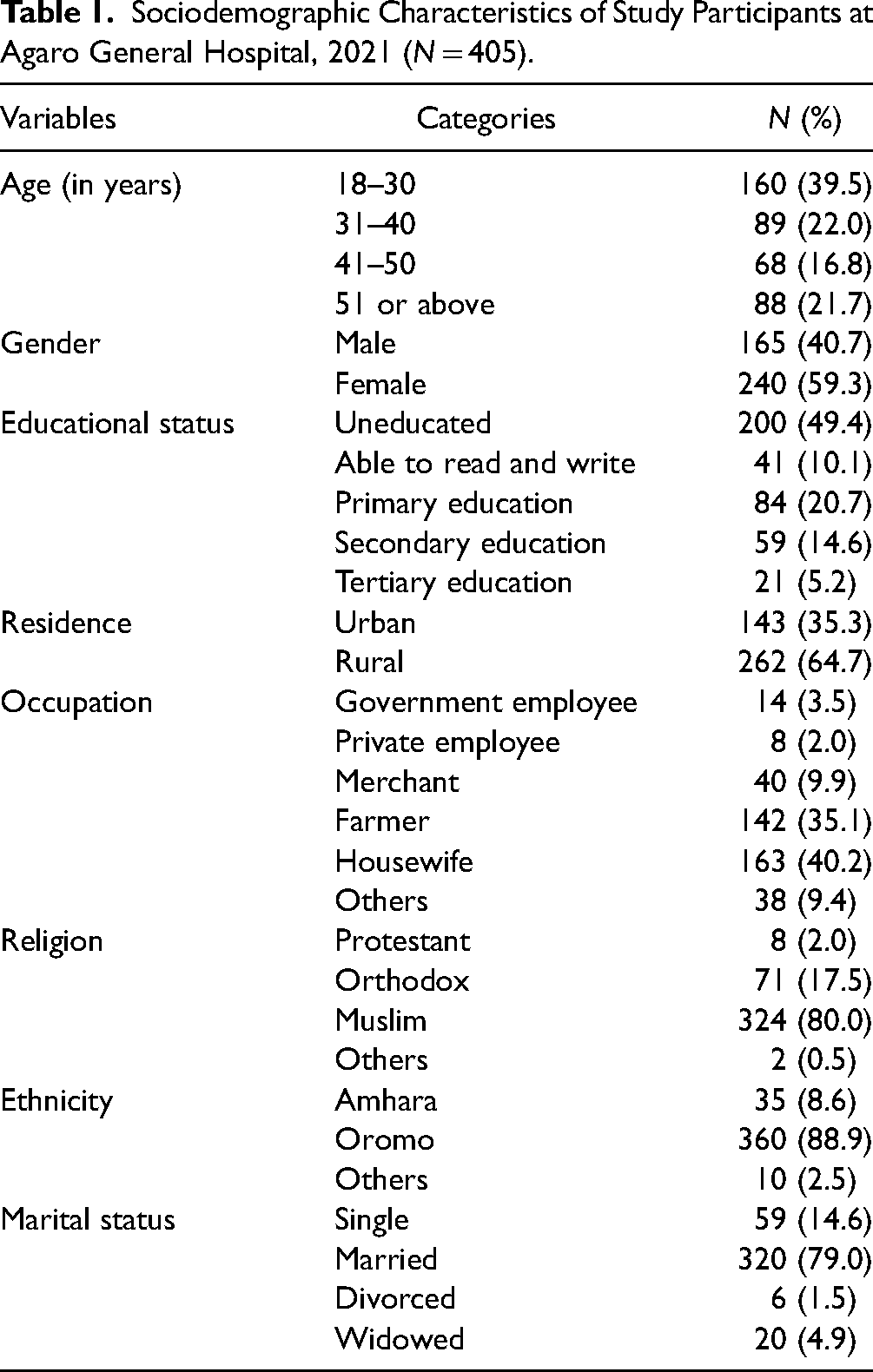
In this study, 405 patients participated with a ninety-six percent (96.0%) response rate. More than one-third of the study participants were aged 31–40 years. More than half were women, rural residents, and Muslims. More than three-fourths of the study participants, 320(79.0%), were married and about half, 200 (49.4%) of the respondents, were uneducated (Table 1).
Sociodemographic Characteristics of Study Participants at Agaro General Hospital, 2021 (N = 405).
Patient and Hospital Related Characteristics
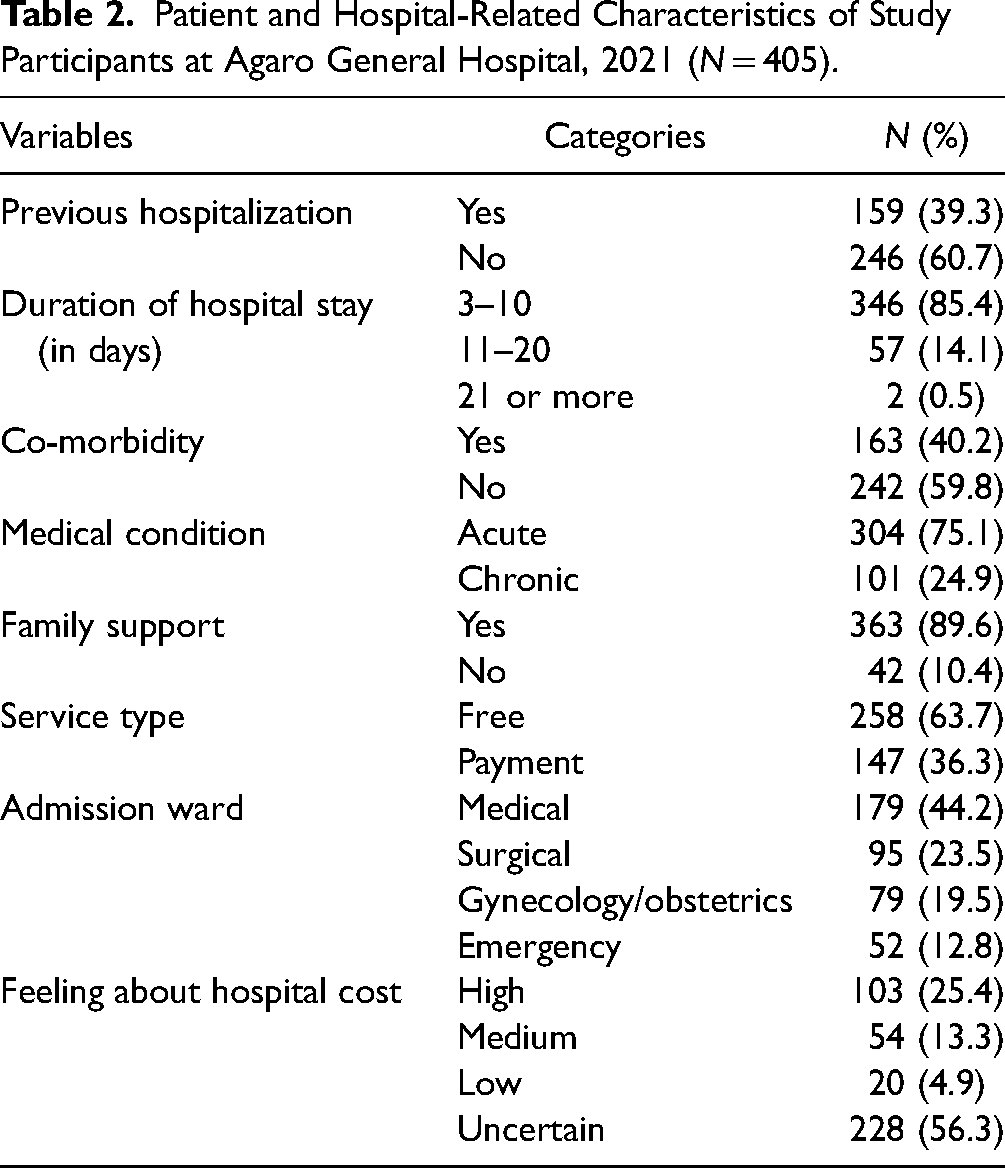
About 35% of the participants had a history of hospitalization. More than three-quarters of the participants, 346 (85.4%), stayed at the hospital for less than 10 days. More than one-third, 163 (40.2%), of the respondents had comorbid conditions. Approximately three-quarters of the participants, 304 (75.1%), were admitted for acute conditions (Table 2).
Patient and Hospital-Related Characteristics of Study Participants at Agaro General Hospital, 2021 (N = 405).
Patients’ Perception Towards Nursing Care
The majority of participants, 322 (79.5%), perceived that nurses helped them to be more realistic. More than two-thirds of the participants, 283 (69.9%), perceived that nurses thought more than what they needed and immediately took care of their requests. More than half, 251 (62.0%), of the participants responded that they did most of the tasks without consulting them (Table 3).
Response of Patients to Perception Questions at Agaro General Hospital, 2021 (N = 405).

About three-quarters of the study participants, 309 (76.3%, 95% CI: 72.3–80.3), had a positive perception of nursing care quality (Figure 1).

Patient perception towards Nursing Care at Agaro General Hospital, 2021 (N = 405).
Factors Associated With Patients’ Perception Towards Nursing Care
Age has a significant association with the perception of patients towards nursing care quality in which patients with aged 31–40 years were more likely to perceive the nursing care quality positively compared with those aged 30 years or less [AOR: 2.191, 95% CI: 1.033–4.645, p-value: .041]. The odds of perceiving nursing care positively were lower among patients aged ≥ 51 years [AOR: 0.490, 95% CI: 0.271–0.886, p-value: .018].
Service type was statistically associated with the perception of patients towards nursing care in which those paid for receiving care were more likely to perceive the quality of nursing care positively [AOR: 3.046, 95% CI 1.043–8.896, p-value: .042]. The feeling of hospital cost has a statistically significant association with the perception of quality of nursing care in which those patients who felt the hospital cost as medium [AOR: 3.066, 95% CI: 1.286–7.311, p-value: .012], low [AOR: 13.859, 95% CI: 2.245–85.562, p-value: .005], and uncertain [AOR: 6.116, 95% CI: 1.988–18.809, p-value: .002] were more likely to perceive the quality of nursing care positively as compared with those who felt the cost as high (Table 4).
Factors Associated With Patients’ Perception Towards Nursing Care at Agaro General Hospital, 2021 (N = 405).

Discussion
According to this study, 76.3% of the participants had a positive perception of the quality of nursing care. The findings of this study are lower than a study conducted in China in which 82.19% of patients had a positive perception of the nursing care quality (Zhao & Akkadechanunt, 2011). This discrepancy may be due to differences in geographical location and socio-demographic status. There is increased usage of advanced technologies and provision of quality care in developed countries which positively alter the perception of patients. In contrast, the findings of this study are higher than those findings of the studies conducted at Arba Minch General Hospital, Hiwot Fana Specialized University Hospital, and in Nigeria in which the overall perceptions of patients towards nursing care quality were 40.9%, 45.2%, and 44.5%, respectively (Girmay et al., 2018; Mensa et al., 2017; O.Agbele et al., 2018). This discrepancy may be due to differences in the sample size. The representativeness of the sample size is fundamental for the accuracy of research results in which a smaller sample size results in less accurate and imprecise findings. The larger the sample size, the more representative the data, and the more accurate the result which decreases the sampling error.
The results of this study were also higher than those of studies conducted at Saint Paul's Millennium Medical College and Pawe General Hospital which showed that 36% and 49.3% of patients had a positive perception of nursing care quality, respectively (Gishu et al., 2019; Negussie, 2018). This discrepancy may be due to the differences in the time at which the study was conducted. There may be an improvement in nursing care service over time goes and hence alter the perception of the patients towards its quality.
Several studies have concluded that age is an insignificant determinant factor for the perception of patients regarding nursing care quality (Köberich et al., 2016; Negussie, 2018). However, this study found that patients aged 31–40 years were more likely to have a positive perception of the quality of nursing care than those aged 30 years or less. Similarly, a cross-sectional study conducted at the Arba Minch General Hospital showed that patients aged 35–44 years were more likely to have a positive perception of the quality of nursing care [AOR: 2.795, 95% CI: 1.224–6.381, p-value: .015] than those aged 15–24 (Mensa et al., 2017). This study found that patients aged ≥ 51 years perceived nursing care more positively as compared to those aged 30 years or less. As individuals age, there are increasing cellular and physiological changes that lead to impaired body function (World Health Organization, 2015). These cellular and physiological changes related to aging may lead to different healthcare needs for different age groups. As the healthcare needs vary among different age groups, the degree of satisfaction and hence the perception towards nursing care vary.
Several studies have identified that nurses have a negative attitude towards elderly care (Kathy, 2017). Increased derangement of body function necessitates increased healthcare needs which in turn can bore healthcare providers. This may be unsatisfactory in admitted elderly patients.
The findings of this study showed that the feeling of hospital cost has a significant association with the perception of nursing care quality in which those patients who felt the hospital cost as medium, low, and uncertain perceived the nursing care quality positively as compared with those who felt the cost as high. Patients always compare the quality of care to their feelings about hospital costs. Patients who had paid for receiving care were more likely to perceive nursing care quality positively as compared to those who received free care. There is widespread use of health insurance in Ethiopia which allows customers to pay money annually and receive free services throughout the year. In this study, most of the participants recorded as free service takers were health insurance users. However, there is an additional process to receive services by patients who are free service users which may delay the time to receive care and increase waiting times for them.
Implications for Practice
Good patient-professional communication is crucial for the best healthcare outcome. The final goal of treating an individual for healthcare providers is to achieve a better health outcome and make patients satisfied with the services. Understanding the satisfaction and perception of the patients towards the services provided by nurses will help them to take appropriate improvements for future services depending on the recommendation of the study.
Strengths and Limitations of the Study
The strength of the study includes the involvement of the possible maximum number of participants and the application of the probability sampling technique. The study used a cross-sectional design in which there may not be a true cause-effect relationship between the dependent variables and the covariates. The social desirability bias may have affected the accuracy of the findings. Hence it was conducted at a specific institution, so the findings of this study might not be representative of other study areas.
Conclusion and Recommendations
This study concluded that the majority of patients had a positive perception regarding the quality of nursing care. Being elderly had a negative influence on patients’ perceptions of the quality of nursing care. Having paid for care has a positive influence on patients’ perceptions of nursing care quality. The feeling of hospital costs was negatively associated with the perception of the patient. Even though the majority of patients have a positive perception regarding nursing care quality, it decreases as patients age. Hence, health institutions and the Ministry of Health should organize training for nurses regarding elderly care to increase their satisfaction. Hence the need increases with age, and healthcare providers should pay great attention while providing care for elderly patients.
Footnotes
Abbreviations and Acronyms
Acknowledgments
We would like to thank Mizan-Tepi University and Agaro General Hospital for their permission to conduct this study. We are grateful to our data collectors, supervisors, and study participants.
Authors’ Contribution
MA: conceptualization, title selection, proposal writing, data curation, data analysis, software, supervision, and writing the final manuscript. MY: title selection, data analysis, software, proposal writing, and writing the final manuscript. All authors read and approved the final manuscript.
Data Availability
The minimum data sets used and analyzed in this study are available within the manuscript and supporting information files.
Declaration of Conflicting Interests
The author(s) declared no potential conflicts of interest with respect to the research, authorship, and/or publication of this article.
Ethical Approval and Consent to Participate
Before data collection, ethical clearance was obtained from the Mizan-Tepi University College of Medicine and Health Sciences Research and Community Service Coordinator. Permission was obtained from the hospital administrator and ward head. Verbal informed consent was obtained from the study participants. The purpose and objectives of the study were explained to the participants. The participants were also informed of the right to refuse or terminate their participation at any point. The information provided by each respondent was kept confidential through anonymous recording and coding of questionnaires.
Funding
The author(s) received no financial support for the research, authorship, and/or publication of this article.
