




Abstract
Introduction
The managerial competence of nurse managers varies according to their management level.
Objectives
This study aims to explore the training priority of managerial competence for nurse managers in small- and medium-sized hospitals based on their management level.
Methods
Nurse managers (122 front-line and 65 middle-level nurse managers and chief nurse executives (CNEs)) from 21 small- and medium-sized hospitals with less than 300 beds participated in a survey. T-test and Borich Priority were analyzed.
Results
Nurse managers identified control competence as the most significant management function in both groups. The training priority for front-line nurse managers was motivation in directing, while it was human resource development in human resource management for middle-level nurse managers and, CNEs.
Conclusion
Five management strategies were reported, which will be the basis for future systematic nursing management in nursing organizations.
Introduction
The healthcare industry has been experiencing a gradual increase in demand for nursing services (Lee et al., 2018), and it is crucial for medical institutions to secure outstanding nursing personnel to maintain a competitive advantage in the face of intense rivalry. This is because nurses constitute a significant portion of a healthcare organization's workforce. In nursing organizations, a systematic approach to human resource management is required for selecting an excellent nursing workforce. The human resource management of nursing organizations includes the planning, recruitment, placement, and career development of nurses. Improving nurses’ competences through career development is of the utmost importance in healthcare organizations because it impacts not only the nursing performance of clients but also the performance management of the nursing organization (Gunawan et al., 2019).
For nurses to provide high-quality services, the nursing manager responsible for and managing the nursing unit should acquire managerial competence (Gunawan & Aungsuroch, 2017). However, the majority of research on the competence of nurse managers has been conducted in general hospitals and tertiary general hospitals (Kim & Kim, 2016; Lee et al., 2018). According to the 5th Survey on Actual State of Health and Medical Services, Korea has 8,409 medical institutions with beds, of which 8,174 (97%) have fewer than 300 beds (Ministry of Health and Welfare, 2022). Even if long-term care hospitals and clinics are excluded, medical institutions with fewer than 300 beds constitute a significant portion of Korea's healthcare. Given that small and medium-sized hospitals comprise the majority of healthcare organizations, there is a need to identify the competence of nurse managers in these hospitals. However, there is insufficient research on nurse managers at these institutions.
In small- and medium-sized hospitals, the nurse turnover rate is higher than in tertiary general hospitals due to poor working conditions and benefits (Do & Kim, 2012). This increased turnover of nurses brings about nurse managers to become overburdened, which in turn increases the turnover of nurse managers. In order to reduce the workload of nurse managers, it is necessary to enhance their competences through support programs. Improving the managerial competence of nurse managers in medical institutions can enhance the performance of nursing organizations, improve the quality of nursing services, and reduce managerial burnout (Membrive-Jiménez et al., 2020). While various clinical nursing competence enhancement programs for nurses have been developed (Ji, 2019; Song et al., 2022), managerial competence programs for nurse managers are inadequate (Kim & Lim, 2022). Small- and medium-sized hospitals will have a greater demand for such programs due to the difficulty of developing their own programs.
Competences of nurse managers were determined using management functions or management levels (González García et al., 2020). In the management functions, there are five functions: planning, organizing, human resource management, directing, and control (Grohar-Murray & Langan, 2011). In addition, there are three management levels: front-line nursing manager, middle-level nursing manager, and chief nursing executive (CNE) (Grohar-Murray & Langan, 2011; Steffensen Jr et al., 2019). Organizational size is also essential for determining managerial competence (Gunawan et al., 2019). According to management levels, span of control varied, and it was related to management range. The size of the organization is also significant because it influences the number of managers and their span of control. However, the size of organizations had rarely been considered until recently. Consequently, it is necessary to determine managerial competence while considering the organizational size and management level.
To develop a program for a small- or medium-sized hospital, the current status and requirements of nurse managers must be investigated and reflected upon. Generally, the Borich formulation was utilized for educational needs assessments (Borich, 1980). It is based on the gaps between educational objectives and performance as well as the current situation and future necessity (Kim & Park, 2020). Recently, the Borich formulation has been widely utilized in the nursing field to evaluate educational priorities (Ha & Park, 2021). The results of the Borich formulation, which serves as the foundation for the development of nursing manager training program contents, can be used to determine the training priority.
In this study, we evaluated training priorities based on an assessment of the present position and future necessity of nurse managers. It will be useful to identify the groundwork for managerial competence and program development.
Review of Literature
The management functions of nurse managers generally categorize five functions. First, planning is one of the most important management functions for determining in advance what tasks must be completed within an organization (Grohar-Murray & Langan, 2011). Through planning, the organization is able to focus on its objectives and prepare for an uncertain future (Weston, 2022). Nurse managers’ financial management and marketing skills have become increasingly vital to organizations’ performance in recent years (Bai et al., 2017). Second, organizing involves placing people and activities vertically and horizontally in accordance with the objectives of the organization (Grohar-Murray & Langan, 2011). According to the organization's size and nursing care delivery system, the number of nurses and nurse managers’ span of control vary (Grohar-Murray & Langan, 2011). Third, human resource management, usually called staffing, is the process of providing an organization with the appropriate and competent personnel to achieve its goals. For the purpose of solving the nursing shortage problems, nurse managers should acquire a fundamental understanding of human resource management. Fourth, directing is the managerial function that utilizes leadership, motivation, and communication to accomplish work through others (Grohar-Murray & Langan, 2011). Utilizing appropriate directing skills in nursing management could benefit nurses in motivating their nursing practice, thereby enhancing the organization's performance. Control is the management of activities in accordance with predetermined plans (Grohar-Murray & Langan, 2011). Currently, one of the most important concepts is the perspective of quality evaluation and patient safety.
nurse managers should have knowledge of management functions and cultivate their managerial competences. The implementation of appropriate educational programs is essential for the growth of nursing management competences. However, there is initial stage of programs designed to enhance nurse managers’ competences (Kim & Lim, 2022). To develop a program to enhance nursing management competences, it is necessary to conduct a survey of the training needs of nurse managers.
Previous studies have attempted to measure the need for education using various methods. Quantitative research methods, such as the Borich Needs Survey (Kim & Park, 2020), and qualitative research methods, such as focus group interviews (Noh & Lim, 2015), have been employed. Needs assessments can be utilized in the preliminary investigation of educational programs because they can identify the needs assessment's priorities.
Aim
This study aimed to identify the training priority of managerial competence for nurse managers in small- and medium-sized hospitals based on their management level.
Methods
Design
This cross-sectional survey investigated the training priority of nurse managers in small- and medium-sized hospitals categorized by their management level.
Research Questions
What are the training priorities for nursing management competences for nurse managers?
Sample
Among 21 small- and medium-sized hospitals with fewer than 300 beds, 200 participants were recruited through convenience sampling method. Of the 200 participants, 187 were used for the final analysis, excluding 13 inappropriate responses. Among the 187 participants were 122 front-line nurse managers and 65 middle-level nurse managers and CNEs.
Inclusion/Exclusion Criteria
The inclusion criteria were nurse managers who worked in small- and medium-sized hospitals with fewer than 300 beds. Additionally, participants should understand the purpose of the study and agree to participate.
Measures
In this study, nursing management competence and general characteristics of participants were assessed using a survey questionnaire. General characteristics were surveyed such as gender, age, nursing experience, nursing manager's experience, education level, and number of hospital beds.
The nursing management competence instrument was approved for use in determining the importance and necessity of nursing management competence as perceived by nurse managers (Kim & Kim, 2016). And then, the content validity assessment by an expert group. Using a 4-point Likert scale, 42 items were used, including five factors of planning (8 items), organization (3 items), human resource management (5 items), directing (16 items), and control (10 items). A high mean score indicates a high nursing management competence and high necessity for nurse managers. Since this measurement was first used in small- and medium-sized hospitals, the content validity of the measurement was verified by eight experts (five nurse managers in small- and medium-sized hospitals and three nursing professors). The Content Validity Index (CVI) value was 0.8 or greater, and the CVI of all items was 0.98, based on Lynn (Lynn, 1986). The Cronbach's alpha at the time of tool development was 0.99; it was 0.95 in this study.
Process
Data was collected between July 7 and 31, 2020. The research objective and methodology were described online to the CNEs of each medical institution, who approved the posting of the recruitment notice and agreed to collect data. A questionnaire was distributed to each institution. The survey was completed after participants gave written consent for participation in the study. In addition, the completed questionnaire was collected by placing it in an enclosed return envelope and sealing it.
Statistical Analysis
The data were analyzed using the statistical program Stata® (ver. 16.1, Texas, USA). Descriptive statistics were used to analyze the general characteristics of the participants, and means and standard deviations were used to analyze the current importance and future necessity of nursing management competence. The t-test, chi-square test, and ANOVA were used to determine the general characteristics based on the management level. Additionally, the priority of education was calculated using the Borich formula.
Ethical Considerations
This study was approved by the Institutional Review Board of Gachon University (approval No. IRB No. 1044396-202002-HR-051-01). Participants voluntarily agreed to participate in the study and provided written consent. The consent form included a sufficient explanation of the purpose and methodology of the research, anonymity, the possibility of withdrawal, and information on how to inquire about the research.
Results
General Characteristics
General characteristics of the study participants are presented in Table 1. There were 122 front-line nurse managers and 65 middle-level nurse managers and CNEs. The majority of participants were female (98.9%), with an average of 21.5 years of nursing experience and 9.0 years of experience as nurse managers. About half of nurse managers held a BSN and work in hospitals with 200 to 300 beds. Statistical differences between the two groups were in nurse managers’ experiences (t = −2.00, p = .047) and educational level (χ2 = 22.48, p < .001).
General Characteristics.

*Fisher's exact test
ADN, Associate degree in nursing; BSN, Bachelor of Science in Nursing; MSN, Master degree of Science in Nursing; FNM, Front-line Nurse Manager; MNM, Middle-level Nurse Manager; CNE, Chief Nurse Executive
Present Status and Future Necessity of Nursing Management Competence
Table 2 shows the present status and future necessity of nursing management competence. In all management functions, middle-level nurse managers and CNEs were scored as more important and necessary in the future than frontline nurse managers. Both groups recognized that control function was the most important and necessary. There were no statistically significant differences between the two groups in terms of importance and necessity.
Importance and Future Necessity of Nursing Management Competence by Management Level.
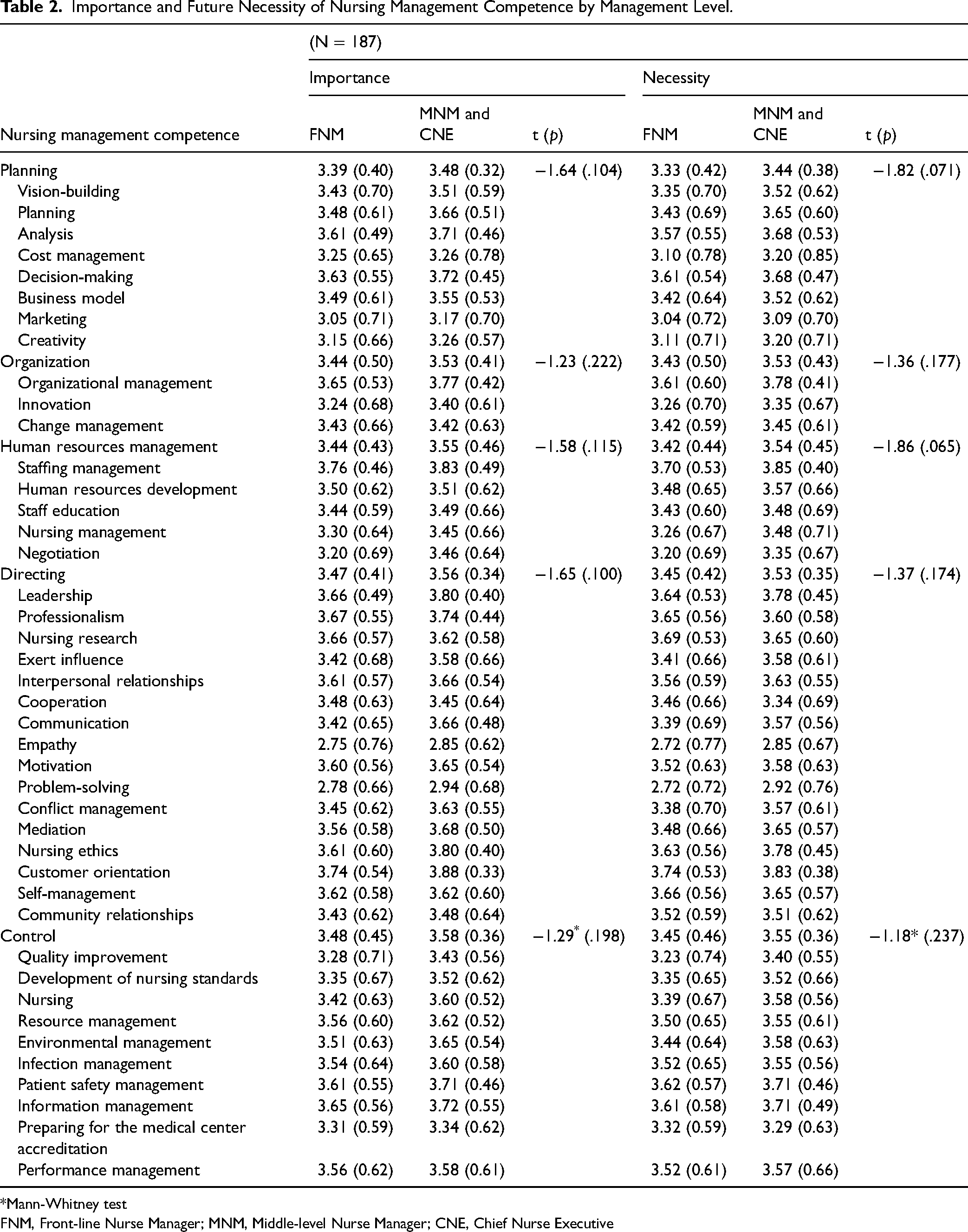
*Mann-Whitney test
FNM, Front-line Nurse Manager; MNM, Middle-level Nurse Manager; CNE, Chief Nurse Executive
Staffing management (mean 3.76, SD 0.46) in the staffing function was the most important nursing management competence for front-line nurse managers, while customer orientation (mean 3.74, SD 0.53) in the directing function was the most necessary for the future. Communication (mean 3.88, SD 0.33) in the directing function was the most important competence for middle-level nurse managers and CNEs, while staffing management (mean 3.85, SD 0.40) in the staffing function was the most necessary in the future. Customer orientation in the directing function is of least importance and is necessary for both groups.
Training Priorities of Nursing Management Competence for Nurse Managers
Training priorities of nursing management competence are shown in Table 3. The training priority of front-line nurse managers was motivation in directing (Borich score 0.347), whereas that of the middle-level nurse managers and CNEs was human resource development in human resource management (Borich score 0.220).
Training Priorities of Nursing Management Competence.

FNM, Front-line Nurse Manager; MNM, Middle-level Nurse Manager; CNE, Chief Nurse Executive
Discussion
This study determined the training priority of nursing management competences for nurse managers based on their level of management. The control function was the most important and necessary for both groups, front-line and middle-level nurse managers and CNE. Front-line nurse managers required staff management for the human resource management function and communication for the directing function. Middle-level nurse managers and CNEs essential communication, and staff management is necessary in the future. The training priority of front-line nurse managers was motivation in directing function, while that of middle-level and CNEs was human resource development in human resource development. Based on the results, five nursing management strategies were discussed.
First, the nursing experience of front-line nurse managers was 21.1 years, while it was 22.4 years for middle-level nurse managers and CNEs. Although there were no statistically significant differences in nursing experience, there were differences in managerial experience. These variations might have occurred in the promotion system. Recently, a career development system for nurses has been implemented in small- and medium-sized hospitals (Kim et al., 2018), but no such system exists for nurse managers. Inefficient human resource management may result from a lack of a systematic promotion process. For effective human resource management, a system must be developed for all levels of nursing personnel, from staff nurses to CNEs. The effect of a promotion system on nursing management has to be further studied.
Second, this study found that the rate of managers with a master's degree was higher and management levels were higher (front-line nurse managers 2.5%, middle-level nurse managers and CNE 23.1%). Continuing education for nurses, such as master's and doctoral programs, not only enhances the professionalism of nurses but also the quality of nursing care (Kim & Ahn, 2022). In order to do this, organizations have to encourage nurses to get master's and doctoral degrees for career development (Warshawsky et al., 2020). As a role model, nurse managers’ continuing education is advantageous for staff nurses. In addition, financial and political support of healthcare organizations are required to promote continuing education.
Third, control is the most important and necessary management function according to front-line nurse managers, middle-level nurse managers, and CNEs. This is similar to the findings of a previous survey of managers working in hospitals with more than 500 beds (Kim & Kim, 2016). Control is associated with enhancement of nursing service quality and patient safety (Grohar-Murray & Langan, 2011). In recognition of the significance of service quality, hospitals have prepared accreditation and patient experience surveys (Andres et al., 2019). Nurse managers understand the importance of service quality management. Although they place less emphasis on the planning function, planning includes financial management and marketing, which have become increasingly important. Increased competition in the healthcare field necessitates that nurse managers have a financial perspective and build marketing strategies for the services they provide. Consequently, it is essential to determine why they are valued less. In addition, programs to improve planning competence must be developed.
Fourth, front-line nurse managers thought staff management was the most important aspect of staffing, whereas middle-level nurse managers and CNEs thought communication in directing was the most important aspect. Briefly, control is the most important function. However, there is a difference between specific details and overall. It is necessary to evaluate specific management functions owing to numerous types of management roles. As the complexity of the healthcare environment increases, nurse managers’ responsibilities expand (Kodama & Fukahori, 2017). In addition, the roles of nurse managers vary depending on their management level (Katz, 2009). Therefore, it is essential to evaluate their needs in terms of their position. Furthermore, both groups reported that customer orientation in directing is less important and essential. It focuses on customer needs (Bellou, 2010). As nurse managers connect the two concepts, it is necessary to explain the significance and rationale for customer focus being essential in nursing.
Fifth, the training priority of front-line nurse managers was motivation. Motivating nurses is key to their success. Front-line nurse managers should encourage and motivate nurses to improve their quality of care (Toode et al., 2011). Middle-level nurse managers and CNEs reported human resource development in human resource management to be the most important training priority. The career development of nurses was one of their support components, so they planned for it despite its difficulty (Kramer et al., 2007). In order achieve positive outcomes, it is essential to assess the educational needs when designing the nursing education program (Kim & Choi, 2019). Based on these results, it is necessary to develop a program that reflects the training priorities of nurse managers.
Strength and Limitations
This research is mostly excellent in three points. First, to the best of our knowledge, it is the cornerstone of nurse managers’ training priorities in small- and medium-sized hospitals, which have rarely conducted research. The findings of this study can construct an educational program for nurse managers. Second, it revealed that the evaluation of training priorities was based on the management level. Training priorities varied based on the role of managers at each management level. Third, the size of the organization was considered as it influences the organization's structure and management function.
These are the limitations of this study. As this study was conducted with a limited representation of Korean nurse managers, its results have a limitation to generalize to a large extent. Future research is required focusing on nurse managers in various regions of worldwide. In addition, a program must be developed and implemented based on these results, and an intervention study must be performed to confirm the effects of program for nurse managers.
Implications for Practice
The results suggested nursing management strategies for nursing management practice. First, it is necessary to set up an effective human resource management system that includes a promotion program. In addition, organizations should provide financial and political support for the continuing education of nurse managers. It is advantageous for nurse managers to serve as a role model. In addition, nurse managers should plan marketing strategies with the viewpoint of finance. A program to enhance competences in planning should be developed. These strategies should be reflected training priorities of nurse managers.
Conclusion
This study is a survey that explores the training priority of managerial competence for nurse managers in small and medium-sized hospitals based on their management level. Control was the most essential and necessary function for both front-line, middle-level nurse managers and CNEs. For the human resource management function, front-line nurse managers require staff management, and for the directing function, they require communication. In the future, middle-level nurse managers and CNEs will require essential communication and staff management skills. The training priority of front-line nurse managers was motivation in the directing function, whereas the priority of middle level nurse managers and CNEs was human resource development in human resource development. The importance of managerial competence, as well as its ongoing relevance and training priority, varied depending on the management level and the size of the healthcare organization. It is vital to construct nursing management education based on the findings of this study and a systematic approach to the use of nursing methods in management practice.
Footnotes
Acknowledgements
We would like to thank the participants who participated in the study.
Declaration of Conflicting Interests
The authors declared no potential conflicts of interest with respect to the research, authorship, and/or publication of this article.
Funding
The authors received no financial support for the research, authorship, and/or publication of this article.
Ethical Statement
This study was approved by Gachon University Institutional Review Board (IRB) (approval No. IRB No. 1044396-202002-HR-051-01)
Authors’ Contributions
MunHee Jun: Conceptualization, data collection and interpretation, writing the manuscript.
Wonjung Noh: Conceptualization, data analysis and interpretation, writing the manuscript.
All authors approved the final version of the manuscript.
