




Abstract
Introduction
Major efforts are being made to control the spread and impact of the coronavirus pandemic using vaccines. However, willingness to be vaccinated depends largely on factors beyond the availability of vaccines.
Objective
This study aimed to investigate the knowledge and perception of university employees towards the COVID-19 vaccination.
Methods
A cross-sectional study was conducted between February and June 2021. A total of 310 university employees from six Palestinian universities participated in the study. A self-reported questionnaire was used for data collection and included the following: personal and medical characteristics of the university employees’ knowledge and perception regarding receiving the COVID-19 vaccination.
Results
Three hundred and ten out of 336 questionnaires (92.3% response rate) were completed and returned by the participants. The results revealed that 41.9% of university employees had good knowledge of the COVID-19 vaccination. On the other hand, 51.9% of them had a positive perception of the COVID-19 vaccination. Also, there is a significant difference between the level of knowledge and perception of the COVID-19 vaccine (p < .05).
Conclusion
Less than half of the university employees had good knowledge, and half of them had a positive attitude towards the COVID-19 vaccination. Also, it has been determined that there is a relationship between the level of knowledge and perception of the COVID-19 vaccine. The study recommended that employees should be involved in educational campaigns to increase their knowledge of the importance of vaccines in COVID-19 prevention.
Introduction
Vaccination against COVID-19 is a key technique for reversing the global COVID-19 epidemic (World Health Organization [WHO], 2020). The COVID-19 vaccines have shown exceptional efficacy in clinical studies and in real-world data. Vaccination is now acknowledged as the most successful and cost-effective public health strategy. It has also significantly improved global health by lowering the incidence and mortality rates of a wide range of infectious illnesses (Dubé et al., 2013; Rappuoli et al., 2011; Shouli et al., 2022). Vaccination against COVID-19 is therefore critical for establishing herd immunity (DeRoo et al., 2020).
Most experts believe that the COVID-19 pandemic cannot be controlled without widespread vaccine acceptance (Skjefte et al., 2021), and that vaccination can promptly and efficiently reduce the epidemic effect (Ramasamy et al., 2020; Walsh et al., 2020). There was a significant disparity in vaccination programs in different countries because some people were hesitant about receiving the vaccine and others refused it (Dula et al., 2021). Vaccination hesitation is a developing concern that refers to any delay in taking or refusing a vaccine despite the availability of vaccination services (Larson et al., 2014).
Literature Review
Vaccine hesitancy has been cited by the WHO as a serious hazard to world health. Inconvenience in obtaining vaccines, complacency, or a lack of confidence are all key contributors to vaccine hesitancy (Portfolio, 2021). Furthermore, depending on the context, time, place, and type of vaccination, several immeasurable variables may complicate the situation (Sarmini, 2021).
The acceptance rate of the COVID-19 vaccination varies from country to country and between different times, with Arab countries showing the highest hesitancy rates compared with other parts of the world (Cascini et al., 2021). Vaccine acceptance rates are less than 55% in Russia and up to 90% in China (Lazarus et al., 2021). In the Kingdom of Saudi Arabia, 50.5% of health workers (Qattan et al., 2021) and 48% of the general public (Alfageeh et al., 2021) indicated a desire to get the COVID-19 vaccination in December 2020.
The global adoption of the COVID-19 vaccination is dependent on various common elements linked to psychological and sociological issues as well as the vaccine itself. People would connect with informed and effective messaging that clarifies the safety, side effects, and efficacy of anticipated COVID-19 vaccines, fostering vaccine confidence and encouraging people to be vaccinated willingly (Roy et al., 2022).
However, because of increased public doubt and confusion about vaccination efficacy and safety, it is unclear if vaccine availability will lead to widespread adoption. There is presently a dearth of information about people's acceptance of COVID-19 vaccines and the elements that may impact their acceptance (Reiter et al., 2020). This gap calls for the need to investigate the knowledge and perception of COVID-19 vaccines among the population. As a result, the purpose of this study was to investigate the knowledge and perception of COVID-19 vaccines among university employees in the West Bank, Palestine.
Methods
Design
A cross-sectional study was conducted on employees who work at six universities in Palestine: Nabulus University for Vocational & Technical Education, An-Najah National University, Modern University College, Birzeit University, Hebron University, Arab American University, and Al-Quds Open University.
Research Question
What are the knowledge and perception levels of COVID-19 vaccines among university employees in the West Bank, Palestine?
Sample
The total number of employees who work at targeted universities is approximately 1,500. The sample size was calculated using the Raosoft program with a confidence level of 95%, a margin of error of 5%, and a response rate of 50%. A total sample of 306 participants was needed to conduct this study. Thirty participants were added to overcome participants who had incomplete the questionnaires or dropped out. As a result, the final sample size was 336 participants. The sample was selected proportionally according to the number of employees at these universities.
Inclusion/Exclusion Criteria
All employees who work full time at the targeted universities in Palestine with a minimum of one year of experience and who have been vaccinated with the COVID-19 vaccine since the vaccine's approval in Palestine were included. Those who are illiterate or have refused to participate in the study are excluded.
Instrument of the Study
The self-reported questionnaire was developed by the researchers after critically reviewing the literature, including:
University employees’ demographic characteristics, such as age, gender, educational level, place of residence, monthly family income, and BMI. Underweight = <18.5; normal weight = 18.5–24.9; overweight = 25–29.9; obesity class 1 = 30–34.9; obesity class 2 = 35–39.9; and extreme obesity class 3 = >40. Knowledge of the vaccine against COVID-19: It consists of seven questions about the COVID-19 vaccine's action, the goal of COVID-19 vaccination, the various types of COVID-19 vaccination, symptoms of post-vaccination exposure, vaccine safety, vaccine safety in pregnancy and lactation, and the vaccine's effect on fertility. Knowledge was assessed by giving 1 to correct answers and 0 to wrong answers. Finally, all knowledge scores were computed, and those study participants who responded above the mean score were considered to have good knowledge, whereas those below the mean value were labeled as having poor knowledge. Perception of the participants regarding receiving the COVID-19 vaccination. It was assessed by 10 items, and their responses were evaluated on a 5-point Likert scale. A score of 5 was given for strongly agree, 4 for agree, 3 for being neutral, 2 for disagree, and 1 for strongly disagree. Then, after each attitude score was added together to obtain a total attitude score, the mean value was calculated. Those students who scored above the mean value were considered to have a positive attitude towards COVID-19 vaccination, whereas those who scored below the mean value were labeled as having a negative attitude.
Validity and Reliability
To test the questionnaire's validity, it was sent to five experts in the field of community health nursing and medical specialists. The modifications were implemented in response to the feedback. The Kuder-Richardson coefficient of the knowledge part and the Cronbach's alpha of the perception part were 0.89 and 0.85, respectively. The Kuder-Richardson coefficient was used for evaluating the internal consistency of the knowledge part because the items in this part were scored correct or incorrect.
Data Collection
After obtaining permission to conduct the study from the targeted universities, the researchers visited the universities and met with the heads of human resources departments. He explained to them the objectives of the study and asked them to prepare a list of the names of the employees to meet them. Then, the researcher explained the objectives of the study to the employees. The employee who agreed to participate was given informed consent to participate and then completed the questionnaire. The participants completed the paper-format questionnaires in the Arabic version. The study was conducted in the middle of the COVID-19 pandemic. The participants used masks to maintain safety standards when they completed the questionnaires.
Ethical Approval
Ethical approval was obtained from the targeted universities. A consent form was assigned to every participant prior to the study and participation was voluntary. It was explained that all data will be kept confidential and will be used for study purposes only. Moreover, a clear explanation was given to each participant about the study objectives and tool. Enough time was given for questions.
Pilot Study
The piloting was carried out with 31 participants. The participants indicated that they had no trouble interpreting or clarifying the contents of the instruments. The pilot study found that the average time taken to complete the questionnaire was 10–20 min. The pilot study participants were excluded from the actual study.
Data Analysis
Statistical analysis was performed using the Statistical Package for Social Sciences (SPSS) version 23. The mean, standard deviation, frequency, and percentages were calculated. In addition, a chi-square was utilized to examine the differences between study variables. The study findings were considered statistically significant at a p-value ≤ .05.
Results
Sample Characteristics
Three hundred and ten out of 336 questionnaires (92.3% response rate) were completed and returned by the participants. The results revealed that less than half of the studied employees (41.3%) were between 30 and <40 years old, with ± SD 36.6 ± 7. Males made up 79.4% of the population, with 35.5% having a postgraduate degree. More than half (54.8%) of the studied employees lived in the city. Also, 43% of the studied employees’ monthly income was not enough. Also, the majority (86.5%) of studied employees were recorded as having a normal weight, as seen in Table 1.
Demographic Characteristics of the Participants (N = 310).

Research Question Results
The analysis revealed that more than one-third of the participants, 41.9%, had poor knowledge regarding the COVID-19 vaccine. According to the analysis of the knowledge questions, most of the participants (75.8%) had poor knowledge about the safety of vaccines regarding pregnancy and lactating mothers. Also, 64.5% of them had poor knowledge about the effect of vaccines on fertility. In addition, 62.6% of them had poor knowledge regarding the safety of vaccines, as seen in Table 2.
Knowledge of University Employees in Palestinian Universities Regarding the COVID-19 Vaccine (N = 310).

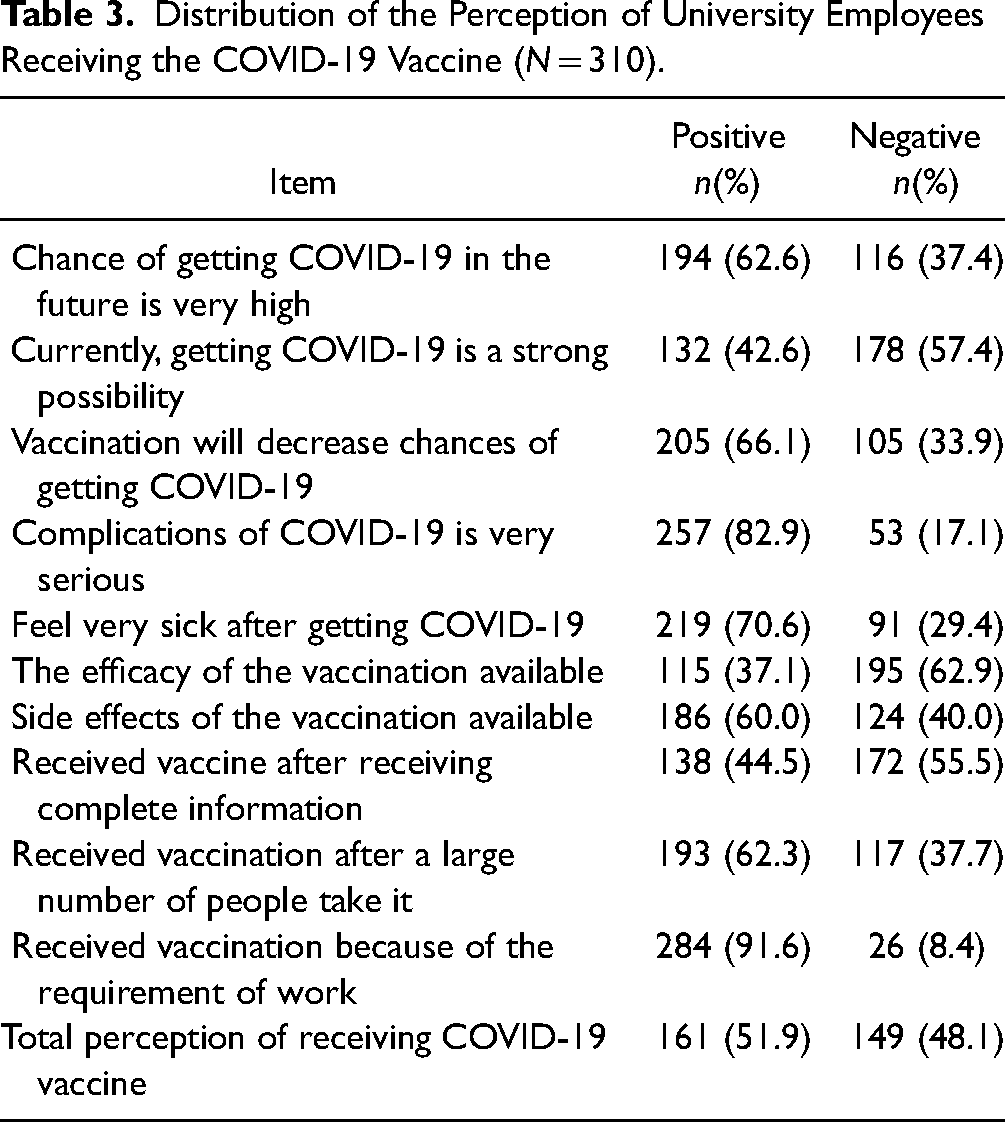
Regarding the perception of the participants towards the COVID-19 vaccination, the analysis revealed that 51.9% of the participants had a positive perception. Also, the items’ analysis of perception revealed that most of the participants (91.6%) had a positive perception regarding the item “Received vaccination because of the requirement of work,” followed by 82.9% regarding the item “Complications of COVID-19 are very serious,” and then 70.6% for the item “Feel very sick after getting COVID-19,” as seen in Table 3.
Distribution of the Perception of University Employees Receiving the COVID-19 Vaccine (N = 310).
Finally, in Table 4, it is shown that there is a significant difference between the level of knowledge and perception level of the COVID-19 vaccine (p < .05).
Difference Between the Level of Knowledge and Perception Towards the COVID-19 Vaccine (N = 310).

Discussion
The current study revealed that less than half of the participants (41.9%) have good knowledge of the COVID-19 vaccination. This finding is slightly higher than studies conducted in China (39.3%) (Hong et al., 2022) and Ethiopia (40.8%) (Mesesle, 2021). The possible reason for the inconsistency might be differences in the study population; this study was conducted on university employees, whereas studies in China and Ethiopia were conducted on cancer patients and the general population, respectively. University employees will have better access to opportunities to get information about the COVID-19 vaccine than the general population. Also, this result is higher than that of Gagneux-Brunon et al. (2021) in a study entitled “Intention to Get Vaccinations against COVID-19” in French, who pointed out that the majority of studied participants have poor knowledge about COVID-19 and take it to avoid transmitting COVID-19 to their families and protect themselves from being extremely vulnerable to COVID-19. Another study by Maraqa et al. (2021) reported that inadequate knowledge of the COVID-19 vaccine is due to its long-term and severe side-effect concerns, fear of the vaccine causing disease, and confusion about efficacy.
However, this finding was lower than a study conducted in Ethiopia (62.5%) (Adane et al., 2022). The possible reason for the discrepancy could be that the study in Ethiopia was conducted by health professionals. Evidence showed that health professionals had better awareness and attitudes towards COVID-19 than non-health professionals (Ekpenyong et al., 2021).
More surprisingly in this study, was that the respondents’ knowledge of the vaccine's safety was very low. This was in agreement with Anorue et al. (2021), who concluded similar results. However, this finding was in agreement with Rahman et al. (2022) results, who found that 54.34% of their study sample agreed that the COVID-19 vaccine is safe.
Regarding perception, about half of the participants have a positive attitude towards COVID-19 vaccination, which was in line with studies conducted in India in a community-based survey (50%) Danabal et al., 2021) and in Ethiopia among healthcare workers (50%) (Hajure et al., 2021).
However, this finding was higher as compared to studies done in Wolaita Sodo, Ethiopia (24.2%) (Mesesle, 2021), and France (25%) (Guillon & Kergall, 2021). The possible explanation for the observed variation might be the difference in study population and study time.
On the contrary, this finding was lower than studies conducted in the United States (68%) (Ciardi et al., 2021), Pakistan (66.8%) (Tahir et al., 2021), and Jordan (61%). (El-Elimat et al., 2021). In the Jordan study, more than half (53.8%) of the study participants were health professionals who had deep knowledge about vaccines and a better attitude towards COVID-19 vaccination compared to other populations (Alle & Oumer, 2021).
Finally, it was discovered that there is a relationship between the level of knowledge and the perception of the COVID-19 vaccine. This means that people with a high level of knowledge about the vaccine are more likely to have a positive perception of it than those with a low level of knowledge about it. Similarly, Aguilar Chávez et al. (2021) concluded in their study that there is a significant relationship between the level of knowledge and attitudes towards the vaccine against COVID-19.
Strengths and Limitations of the Study
The study utilized a self-reported questionnaire. Another limitation was that it only applied to university employees such a view might not represent the view of the general Palestinian population. The study did not account for psychological factors and their influence on vaccine acceptance. Nevertheless, the current study assessed the relationship between participants’ knowledge and perception towards the COVID-19 vaccine, which may help guide future public health efforts that aim to increase the uptake of the COVID-19 vaccine.
Implications for Practice
The result of the present study highlights the importance of assessing the knowledge and perception of the employees towards COVID-19 vaccination at Palestinian universities. The findings of this study recommended that employees should be involved in educational campaigns to increase their knowledge of the importance of vaccines in COVID-19 prevention.
Conclusion
In this study, less than half of the university employees had good knowledge, and half of them had a positive attitude towards the COVID-19 vaccination. Also, the study concluded that knowledge of the respondents’ percentage regarding the safety of the vaccine was very low. Finally, it has been determined that there is a relationship between the level of knowledge and attitudes toward the COVID-19 vaccine. Thus, health education programs and mass media coverage should be strengthened. Moreover, intervention strategies to enhance knowledge and attitudes toward COVID-19 vaccination are needed.
Footnotes
Acknowledgments
The authors would like to express their thanks to the university employees who participated in the study.
Declaration of Conflicting Interests
The author(s) declared no potential conflicts of interest with respect to the research, authorship, and/or publication of this article.
Funding
The author(s) received no financial support for the research, authorship, and/or publication of this article.
