




Abstract
Introduction
Awareness toward premarital screening test and its influence on preventing high risk marriages has become a concern to the health care system in Oman. This is due to the increased rates of inherited diseases and genetic disorders among the Omani population secondary to consanguineous marriages.
Objectives
This cross-sectional study aims to describe the utilization of premarital screening tests of selected university study participants as future prospective couples.
Methods
The study included 400 Omani study participants from different majors at a national governmental university that receives students from all over the country. Data was collected using a self-administered questionnaire.
Results
Out of the 400 study participants 193 [48.3%] were females and 195 [48.8%] were males, and 380 [95%] were unmarried and 19 [4.8%] were married. Personal and family history of hereditary diseases and consanguinity between parents were reported by 40 participants [10%], 158 [39.5%] and 175 [43.8%] respectively. Three hundred and sixty-one [90.3%] of the total participants were aware of the availability of premarital screening tests in Oman. A total of 357 [89.3%] thought it is necessary to do a premarital screening test and 367 [91.8%] agreed to carry out it in the future. The novel contribution of this manuscript is that our logistic regression showed that people with personal or family history of hereditary disease, and have consanguinity between parents, being a female did not show willingness to undertake the screening while those who are married, have higher GPA, and older supported it.
Conclusion
Usability of the freely available premarital screening is low despite the study participants awareness and willingness. Future studies should target those who have a history of genetic disease and females as we found them not willing to undertake the test in this study. We also recommend putting in place mandatory rules and regulations for premarital screening tests with better counselling strategies.
Introduction
Premarital screening has decreased the rates of hereditary disease by lowering the incidences of genetic blood disorders including sickle cell anemia, thalassemia, and infectious diseases including hepatitis B, hepatitis C, and HIV/AIDS (Alhosain, 2018; Aljumah et al., 2016; Barmania & Syed, 2017; Bener et al., 2019; Gosadi, 2019; He et al., 2017; Hiebert et al., 2019; Serjeant et al., 2017). Premarital screening is defined as a panel of tests in which couples that are going to get married are tested for genetic, infectious, and blood transmitted diseases to prevent any risk of transmitting disease to their children (Rahman et al., 2014). Genetic diseases are of particular interest as they contribute to hereditary disorders.
The greatest effect of consanguinity in Arab countries is the increase in the prevalence of rare autosomal recessive genetic disorders that are not present in other societies. For instance, Bardet-Biedl syndrome, Meckel-Gruber syndrome, Spinal muscular atrophy, Sanjad-sakati syndrome, Osteopetrosis, Renal tubular acidosis (Tadmouri et al., 2009). In general, morbidity and mortality rates related to hereditary disorders are rising in Middle Eastern countries (Al-Mousa & Al-Saud, 2017). Consanguineous marriage—often linked with hereditary disorders—is very common in North Africa, the Middle East, and Western Asia (Bener & Mohammad, 2017). With higher incidence of consanguinity there is a significant increase in the prevalence of other inherited disorders such as diabetes, cancer, blood disorders, mental disorders, heart diseases, asthma, gastrointestinal disorders, hypertension, hearing deficit, G6PD deficiency, and common eye diseases (Bener & Mohammad, 2017). Similarly, in Oman, the high prevalence of genetic blood disorders has been attributed to consanguineous marriages (Al-Balushi & Al-Hinai, 2018; Rajab et al., 2013). In this country, 58% of all marriages are consanguineous and 75% of them are first cousin marriages (Al-Balushi & Al-Hinai, 2018). Premarital screening has been implemented to solve the issue of consanguinity and decrease hereditary disorders.
The premarital screening program in Oman was first implemented in 1999. In addition, the child law in Oman issued by the Royal Decree No.22/2014 emphasized the importance of premarital screening and counselling (Cook, 1987). A mandatory test before marriage has also been proposed by researchers in the field (Al-Balushi & Al-Hinai, 2018). Premarital screening tests are available for all Omanis for free. Few studies over the last decade have investigated the levels of awareness of premarital screening tests. A study in 2012 found that study participants (n = 469; 79%) were aware of premarital screening tests and believed in the importance of undergoing one before marriage (Al Kindi et al., 2012). Similarly, recent studies found that most of the participants (84.5%) believed that a premarital screening test was necessary (Al-Farsi et al., 2014; Al Kindi et al., 2012).
Despite the existence of free premarital counseling and screening services in Oman, there are no data and information available about the utility of these services among prospective couples. This novel study sought to explore uptake of the free genetic counselling and screening services among prospective couples as the main contributions and strengths of the study. The findings of this study will contribute to the existing knowledge in premarital screening specifically in the Omani context.
Objective
The objective of this study was to describe the prevalence of utilization, knowledge, attitude, and willingness to utilize the premarital screening test in Oman among prospective couples.
Research Design/Methods
Design
This was a cross-sectional study carried out using a self-administered questionnaire. This design was selected to best examine at one point in time the usability of premarital screening in Oman.
Sample and Setting
This is a cross-sectional descriptive study conducted among junior and senior students enrolled at different majors at a government-funded university in northern Oman. The target population of this study was all participants aged between 18 and 30 years old. Non-probability convenient method was used to recruit participants from this university. At the time of the study, there were a total of 13,000 study participants who were registered from all around the country. The sample size was estimated by Slovin's Formula computing based on 5% margin of error and 95% confidence level, with a total population size of 13,000 individuals. The total sample size computed was 374 individuals. To account for missing data, we recruited 26 more individuals so the total sample in this study was 400 study participants.
Inclusion and Exclusion Criteria
Our eligibility criteria for this study were participants who are planning to get married within the next 5 years or those who are already married. We included participants who are 20 years old and above from both genders.
Measurements/Instruments
A structured self-reported questionnaire with close-ended questions was adopted with permission from Al-Kindi et al. (2019). The questionnaire was previously validated and is also considered reliable (Al-Kindi et al., 2019). The questionnaire consisted of three main parts; the first was on sociodemographic and academic characteristics including gender, age, school, academic year, parents’ consanguinity, and personal and any family history of hereditary diseases. The second part investigated the students’ knowledge of premarital screening programs, their availability, and the source of information where they got to know about premarital programs, what is included, who is eligible for testing, and the diseases being tested. The third part consisted of items that explored the students’ attitudes towards premarital screening programs.
Data Collection
Both males and females from various schools were invited to participate in this study and those willing to participate were enrolled in the study. The questionnaire was distributed to a sample of 400 students. Data were collected through a self-administered questionnaire between October and December 2019.
Data Analysis
All data were entered into SPSS version 24, and the data were checked and cleaned. The researchers used frequencies percentages to describe categorical data and mean and standard deviation to describe continuous variables. Logistic regression analysis was used to predict factors affecting willingness to do the test.
Ethical Consideration
This study was approved by the Ethical Approval Committee at a governmental university in northern Oman. The students were assured that their participation was voluntary, and that all the information they shared would remain confidential. Anonymity and confidentiality were assured and emphasized. Informed consent was obtained from all participants before they completed the questionnaires. The study was conducted in accordance with The Code of Ethics of the World Medical Association.
Results
Sample Characteristics
This study included a total of 400 students enrolled at the university, aged between 20 and 30. Of all participants, 380 (95%) were not married, whereas only 19 (4.8%) were married, and one participant was divorced. Interestingly, the sample was nearly equal in terms of gender – 193 (48.3%) were females and 195 (48.8%) were males. Personal history of hereditary disease was reported by 10% (n = 40) of the sample and family history of hereditary disease was reported by 39.5% (n = 158) of them. The reported disorders were sickle cell anemia, G6PD deficiency, Ehlers Danlos syndrome, ichthyosis, and urticaria. The remaining reported asthma, diabetes, hypertension, and myopia as hereditary diseases. Consanguinity between parents was reported by 43.8% (n = 175) of participants. The sociodemographic characteristics of the participants are shown in Table 1.
Characteristics of the Sample.

Knowledge About Premarital Screening
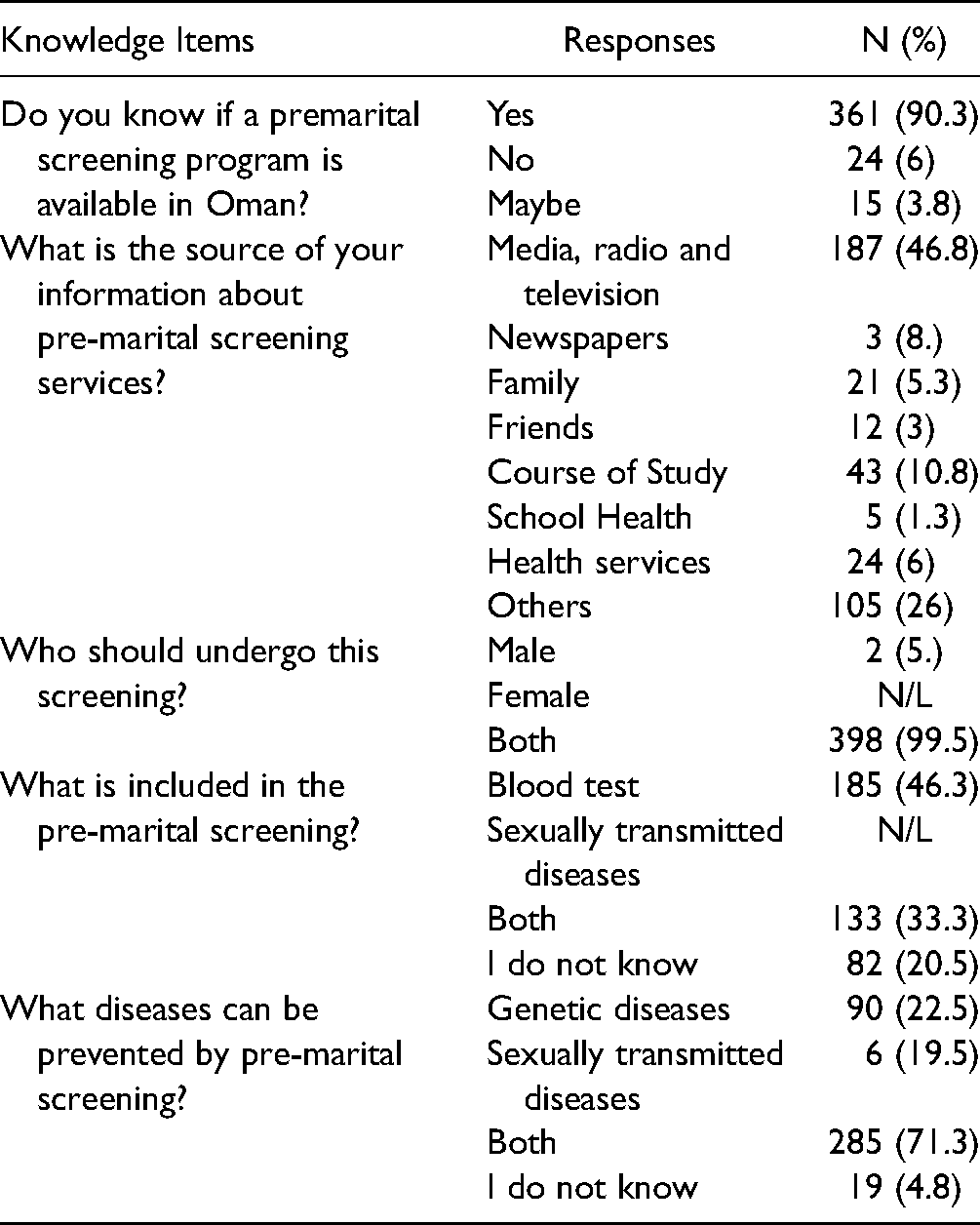
Most of the participants (n = 361; 90.3%) were aware of the availability of premarital screening tests in Oman. The top three main sources of information on premarital screening tests were the media (n = 187; 46.8%), their course of study (n = 43; 10.3%), and health services (n = 23; 6%). Almost all the participants (n = 398; 99.5%) knew that the test should involve both partners. Responses to determine the level of knowledge of which tests were included in the premarital screening test revealed that 46.3% (n = 185) of the participants thought it only involved blood tests, 33.3% (n = 133) thought it included blood tests and a physical examination, while 20.5% (n = 82) did not know the answer. With regard to knowledge of which diseases are targeted by the premarital screening test, 71.3% (n = 285) thought that it targeted genetic blood disorders as well as sexually transmitted diseases, 22.5% (n = 90) thought that the premarital screening test targeted genetic blood disorders alone, 1.5% (n = 6) thought that it only targeted sexually transmitted diseases, and the rest (n = 19; 4.8%) did not know the answer as indicated in Table 2.
Knowledge of Premarital Screening Test.
Attitude Towards and Willingness to Undergo Premarital Screening
Most of the participants (n = 357; 89.3%) thought it necessary to carry out a premarital screening test and 91.8% (n = 367) agreed to do it in the future. More than half of the participants (n = 304; 76.1%) agreed that having a premarital screening should be a compulsory procedure before marriage, 17% (n = 68) were neutral, and 7.1% (n = 28) disagreed. More than a third of the participants (n = 177; 44.3%) agreed that in the case of positive results, laws and regulations should be put in place to prohibit marriage, 39% (n = 156) were neutral, and 16.4% (n = 67) disagreed. Most participants were willing to take a premarital screening program although the majority did not do the screening as indicated in Table 3.
Attitude Towards Premarital Screening.

Determinants of Willingness to Undergo Premarital Screening
Logistic regression showed that people who have personal or family history of hereditary disease, and who have consanguinity between parents, being a female did not show willingness to undertake the screening while people who are married, have higher GPA, and older supported it, as shown in Table 4.
Factors Affecting Willingness to do Premarital Screening Test.

Note: OR odds ratio, * significant at <.05, ** significant at <.01, GPA grade point average.
Discussion
Genetic disorders present a significant health impact on the Omani population due to high prevalence of consanguineous marriages (Al-Balushi & Al-Hinai, 2018). One of the critical steps in the management of genetic disorders is a premarital screening test. The aim of this study was to assess the knowledge, attitude, and willingness of university students towards the premarital screening test. Most of the students (95%) were not married: this group was of interest as prospective marriage partners, and understanding their knowledge, attitude, and willingness to do the test is important to provide a targeted premarital screening test and subsequent genetic counselling. Only 10% of the participants reported having a genetic disorder, however a significant number (approximately 40%) had a family history of genetic disorder that could be attributed to the relatively high prevalence of consanguineous marriages, since almost half of the participants had consanguineous parents. Consanguineous marriage among first and second cousins in Oman has been reported to be at 34%, and 58% respectively (Al-Riyami & Ebrahim, 2003).
There are socioeconomic benefits attached to consanguineous marriages such as the retention of a family's wealth or property and strengthening relationships within a tribe (Hamamy & Bittles, 2009; Kilshaw et al., 2015). As reported in previous studies in Oman (Al-Kindi et al., 2019; Ali et al., 2018; Al-Riyami & Ebrahim, 2003), most students in this study had knowledge of the existence of a premarital screening test, indicating that the level of awareness of this test is generally high throughout the Omani population. However, some of the participants lacked knowledge of the components of the premarital screening test, corresponding to previous findings (Al-Kindi et al., 2019; Al-Riyami & Ebrahim, 2003). There is an urgent need to address these knowledge deficiencies which could create barriers to premarital screening test utilization.
In this study, there was a positive attitude and willingness regarding premarital screening tests, as most of the students thought it was necessary to undergo screening before marriage and opted to do so in the future. Similar findings were reported in earlier studies (Al-Aama, 2010; Al-Farsi et al., 2014; Al-Kindi et al., 2019; Al Kindi et al., 2012). A premarital screening test is still optional in Oman; however, several studies have established the benefits of compulsory premarital screening in minimising the risk and impact of hereditary blood disorders through consanguineous marriages (Al-Balushi & Al-Hinai, 2018; Alswaidi et al., 2012; Canatan & Delibas, 2016; Saffi & Howard, 2015). The findings from this study show a significant increase in the number of participants agreeing to the idea of a compulsory premarital screening test as a procedure before marriage – 76.1% compared to 53.4% in a previous study (Al Kindi et al., 2012). Additionally, more than a third of the participants were in favor of laws prohibiting marriages in cases of positive results. Despite the potential benefits of mandatory premarital screening, a significant number of individuals were still against premarital screening tests as reflected in previous findings (Al-Aama, 2010; Al-Farsi et al., 2014). There are several reasons against premarital screening tests among some prospective couples. A study by Boardman et al. (2020) reported social stigma as one of the main barriers to premarital screening, others included: interference with God's will, the cancellation of the marriage, and hurting feelings. Additionally, lack of sufficient knowledge regarding premarital screening could explain the negative perception among some individuals. In addition, all participants in this sample are from an Islamic religious background, which may have influenced their perception of the premarital screening. Islamic view of premarital and preconception testing varies. Although overall it is recommended to use measures that protect health in the Islamic religion, an argument against premarital screening still exist in some Islamic religious groups (Sulaiman, 2020). Overall, there is a need for ethical consideration when making legislation for mandatory premarital screening to balance between prevention and autonomy of the couples (Altaany et al., 2021). There is a need to determine the barriers to uptake of premarital screening tests among the Oman population and a need to design appropriate strategies. The main source of information regarding the premarital screening test was media (TV and radio) 46.3%, and only 6% of the sample received information about the test from health workers. This could be attributed to the fact that the media has been the main channel of premarital screening test campaigns (Al-Farsi et al., 2014). Similar results were reported by (Farahat et al., 2014). Conversely, a study among high school students in Oman reported friends and family as the major source of premarital screening test information (Al-Kindi et al., 2019). In a population study, (Al-Farsi et al., 2014) found that most of the knowledge about premarital screening tests from health workers, the media, and school were not valued as important sources of knowledge. It is important for the Ministry of Health in Oman to collaborate with other stakeholders in disseminating standard health information, as well as education and communication on premarital screening tests through various channels to ensure accuracy.
The unique findings of this study are that the factors that may affect willingness to undertake premarital screening include being married, having higher GPA, being in senior years and those who were enrolled at the school of law and the school of economy. We expected that female students would be more willing to engage in premarital screening as often females perceived it as an important step before marriage (Ali et al., 2018). However, there was no association by gender with the willingness to undergo the screening test. Not surprisingly, those who were married were more willing to do the screening. This may be because they are in the life stage where this seems to be most relevant and important to them at the preconception stage. It could also be that those who are married have escaped the impact on marriageability that an adverse couple result may have had, and they are willing to do it now versus before marriage. The willingness to do the premarital screening among married couples is similar to that described by Boardman and colleagues in their recent study (Boardman et al., 2020). However, we found no difference between those who were married and those who were not in terms of their history of doing the test: this is consistent with existing literature (Al Kindi et al., 2012; Memish & Saeedi, 2011). A personal or family history of genetic disease was not found to be a significant factor that enhanced participants’ willingness to undertake the screening test. This could be attributed to the fact that in this sample only 10% and 39.5% participants have a personal history of genetic disease or family history of genetic disease respectively. It could also be related to the fact that despite the knowledge of disease risk, people continue to marry their intended partner (Al-Eisawi et al., 2020). On the other hand, despite the physical limitation and the psychological impact caused by genetic disorders, some individuals cope well and even view it as positively as Gods well (Gomes et al., 2019). It was also expected to find that those who have higher GPA and are in senior years are more willing to do the test, as they may be more knowledgeable regarding the impact of hereditary diseases.
Strength and Limitations
The high response rate, inclusion of all the study population, and large sample of the study population were important strengths in this study. One limitation of this study is that we investigated factors that are demographic and so recommendation of future interventions is limited. Future studies should investigate other concepts that can induce health behavior [to do premarital screening tests. In addition, we couldn't infer the causative factors that affect premarital screening due to the nature of cross-sectional design used in this study. Another limitation was that we included both married and premarital students however we didn't ask how many had already had children, which could have informed our results. Future research on the same topic will insure to address this information. In addition, future research will include, including, other possible aspects such as stigma, religion and cancellation of marriage. The sample in this study was highly educated compared to the general population thus limiting generalizability of the findings. Despite these limitations, the results of this study provided important estimates for the factors influencing the decision to do premarital screening, which would otherwise be less known to the international and local nursing community.
Implications for Practice
Findings from this study may inform stakeholders to intervene on factors affecting the prospective couples before marriage. More research is needed exclusively with people who have hereditary disorders to understand this aspect of the findings discussed above. It will also help in tailoring premarital screening awareness programs in terms of focusing on the factors affecting the willingness to undergo the screening. This study will also help in the long-term goal of reducing the impact of hereditary diseases such as sickle cell anemia.
Conclusion
Based on the study results, study participants had a positive knowledge and attitude towards premarital screening and understood the importance of premarital screening tests. Most study participants were willing to utilize premarital screening. However, even though study participants have high indicators for utilizing premarital screening, the majority did not engage in it. This study could also help in developing educational programs designed to enhance study participants’ awareness of – and positive inclination towards – premarital screening tests. We recommend conducting further studies on a wider population investigating what reasons cause study participants of higher education and those who are prospective couples not to utilize premarital screening tests. In addition, studies should target those who have a history of genetic disease and females as we found them not willing to undertake the test in this study. We also recommend putting in place mandatory rules and regulations for premarital screening tests with better counselling strategies. Ethical aspects shall be considered when making legislation for mandatory premarital screening to balance between prevention and autonomy of the couples. These rules may include making the blood testing for common genetic disease mandatory, however leaving it up to the couples to decide to proceed with marriage and conception or not. This will help couples to make an informed decision making early in the process of marriage and for health care system to follow up.
Footnotes
Acknowledgments
We thank all participants who participated in this study.
Declaration of Conflicting Interests
The author(s) declared no conflicts of interest with respect to the research, authorship, and/or publication of this article.
Funding
The author(s) disclosed receipt of the following financial support for the research, authorship, and/or publication of this article: This work was supported by the Research Council, Oman [grant number RC/URG-CON/AHCC/19/01].
Ethical Approval
This study was approved by the Ethical Approval Committee at the College of Nursing of Sultan Qaboos University (Approval no: CON/EA/49/2019).
