




Abstract
Introduction
Nursing manpower is an integral part of any healthcare system and compose the largest healthcare providing group within hospitals (ILO, 2013). Therefore, any nursing manpower shortage will cause serious and threatening consequences on the quality of care (Aiken et al., 2012). The global nursing shortage has reached warning threshold and still on progress (Marć et al., 2019). World health organization [WHO] estimated the urgent need for skilled nurses to reach 12.9 million in 2035 (World Health Statistics, 2013). Saudi Arabia like many areas around the world is suffering from a massive nursing shortage, the Saudi Ministry of Health (2018) reported only 55.2 nurse per 10,000 population and will need 150,000 nursing professionals by 2030 at conservative estimate (Alsufyani et al., 2020).
The current literature reveals that there is a substantial surge in the rates of nurse turnover along with a minimal increase in nursing supply (Falatah & Salem, 2018; Takase et al., 2016). That imposes serious challenges for health care systems worldwide, and several studies have been conducted to understand and address these challenges (Aboshaiqah, 2016; Goh & Lopez, 2016). They concluded that issues like unhealthy work environment and bullying can aggravate the nursing workforce shortage (Blackstock et al., 2015; Fontes et al., 2019).
Review of the Literature
Nursing Turnover is a widely used indicator to measure the quality of workplace environment among healthcare organizations (Kim et al., 2019). Intentional turnover can be defined as a voluntary act by nurses of leaving a particular post, department, organization or the nursing profession entirely (Brook et al., 2019). In Saudi Arabia, anticipated turnover scale was used to measure nurses’ attitude and perception toward voluntarily termination and yield alarming rates 40% among primary health care nurses (Almalki et al., 2012) and 94% among newly hired nurses in a tertiary hospital (Kaddourah et al., 2018). Large number of studies conducted to identify factors that contribute to nurses’ turnover. Direct links were found between turnover and workplace bullying turnover (Clausen et al., 2013; Kim et al., 2019; Sauer & McCoy, 2018).
Hoel and Cooper defined bullying as a “situation where one or several individuals persistently over a period of time perceive themselves to be on the receiving end of negative actions from one or several persons, in a situation where the target of bullying has difficulty in defending him or herself against these actions” (2000, p. 6). Workplace bullying can be categorized as horizontal bullying which usually occurs between co-workers at the same level of managerial hierarchy and vertical bullying which involves persistent exposure to aggression, mistreatment and disrespect from superiors to subordinates. Interestingly, vertical bullying is the most common type of bullying among nurses as direct nursing managers/supervisors caused the majority of bullying incidents as indicated by (AL-Sagarat et al., 2018; Nwaneri et al., 2016). Einarsen et al. (2009) classified bullying behaviors in three subgroups as personal related acts (e.g. being humiliated or ridiculed, spreading gossips and rumours, persistent criticism of mistakes and errors), work related acts (e.g. withholding information, ignoring opinions, unimaginable workload), physical intimidation acts (e.g. finger pointing, shoving or threats of violence.
The intensity and prevalence of workplace bullying varies significantly depending on geographical location. However, bullying prevalence varies considerably between 2.4% and 81% among nurses and about 10% of bullied nurses develop Post-Traumatic Stress Disorder (Bambi et al., 2018). Recently, workplace bullying prevalence among healthcare professional in Saudi Arabia was examine by Al-Surimi et al. in (2020), they indicated that 63% of their participants reported bullying and the main perpetrator were their patients.
Several causes of workplace bullying are well documented, some causes are attributed to individual factors such as a lack of professional experience or role conflicts and low personal confidence, and dissatisfied staff while, environmental factors, such as work overload, insufficient managerial support, and poor communication (Fang et al., 2016). Workplace bullying has a tremendous effect on nursing practice, retention, and job satisfaction. It creates a disruptive work environment and undermines management credibility and trust, eventually jeopardizing patient safety (Houck & Colbert, 2017). It was also reported to cause serious mental illness and psychological trauma and can even lead to suicide in its victims (Leach et al., 2017). The lack of psychological support from managers and colleagues hinders nurses’ coping ability and leads to turnover (Fontes et al., 2019; Park et al., 2018).
Regardless the aetiology of bullying behaviors, Albishi and Alsharqi (2018) emphasized that nurse managers can play an essential role in counteracting bullying, as they concluded that most bullying behaviors can be prevented if staff nurses are equipped with the necessary skills and knowledge to face workplace bullying.
Therefore, nursing work environment and nursing retention require further scientific exploration in the multinational Saudi healthcare system. Thus, this study aims to explore the presence of bullying among nurses and to examine its association with nurse turnover.
Methods
Study Design
This study adopted a cross-sectional, correlational quantitative study design.
Setting
The study was conducted at a medical city complex in Riyadh, Saudi Arabia. This tertiary hospital is considered one of the largest and fastest-growing medical complexes in the Middle East. It has a total capacity of 1200 beds. The facility has about 2170 nurses, who originate from different countries. Culturally based conflicts and biases can arise in such a multinational workplace. Therefore, it provides the opportunity to study bullying in a work setting with a diverse culture.
Sampling
The study used convenience nonprobability sampling. The sample size was calculated using the Taro Yamen formula for finite population. Assuming a sample size n = 338 of significance level α = .05.
Participants included nurses currently working at the medical city irrespective of their age, gender, nationality, or educational level. Head nurses and nursing supervisors are encouraged to participate in the study in order to assess upward and downward vertical bullying. Participants were also required to have spent at least 6 months in the current workplace. Newly hired nurses who are still not performing nursing tasks independently were excluded along with nurses not currently practicing or out of the nursing field.
Ethical Considerations
Institutional Review Board approval was obtained from the medical city, along with approval from the nursing administration to conduct the study. The aim of the study and the data collection process were explained to the participants. The researcher ensured that the participants’ privacy and anonymity were accorded the necessary attention.
Study Instruments
The demographic characteristics questionnaire was developed by the researcher and consisted of items such as age, gender, nationality, marital status, educational level, years of experience, actual role, and area of specialty.
The Negative Acts Questionnaire (NAQ-R; Einarsen et al., 2009) was considered appropriate for determining nurses’ perceptions concerning the prevalence of bullying incidences in the workplace. The NAQ-R is best described as a 22-item Likert-type scale questionnaire with self-labelling approach of asking participants to estimate their bullying exposure. It contains three subscales: the work-related bullying subscale with 7 items, personal bullying subscale with 12 items, and physical intimidating subscale with 3 items. In the current study NAQ-R tested the reliability and found a Cronbach's alpha of.92.
The Anticipated Turnover Scale (ATS) was used to report participants’ viewpoints on why they would choose to abandon their profession (Hinshaw & Atwood, 1984). ATS has been developed to operationalize the concept of staff opinion of their voluntarily termination of their position. It contains 12 items presented in a Likert-type scale format ranging from agrees strongly to disagree strongly. ATS items request staff pinion if they agree or disagree on statements like: “I plan to stay in my position awhile”, “If I got another job offer tomorrow, I would give it serious consideration” and “ I don't have any specific idea how much longer I will stay”. The test scores on the ATS are measured either from 1 to 7 or from 7 to 1 depending on the nature of questions used. The questions could be either positive or negative. The range of possible score is 12–84. The reliability estimate using Cronbach's alpha is.75.
Data Collection Procedure
The primary data for the study were collected by the researcher. During the month of January 2019, the researcher and four trained assistants distributed the survey forms directly to participants with sealable envelops to ensure the privacy and anonymity of participants. A total of 450 questionnaires were distributed. After 14 days, 347 surveys were collected, with a response rate of 77%.
Statistical Analysis
The data were coded and subjected to data analysis using IBM SPSS version 25. Descriptive statistics were used to summarize and identify the demographic characteristics of the study population. ANOVA test was used to identify the relationship between participants’ demographic characteristics and workplace bullying. A Pearson correlation was used to determine the association between the independent variable “workplace bullying” and the dependant variable “anticipated turnover”.
Results
Demographics
Nearly three out of four nurses who took part in the study were women (269 [77.5%]), and 274 (79%) were non-Saudi citizens. Almost half of the participants, 175 (50.5%), were between 31 and 40 years old, and 226 (65.1%) were married. Of the nurses, 275 (79.3%) had a bachelor's degree, 150 (43.2%) had 5 to 10 years of work experience, and 248 (71.5%) were working as staff nurses (see Table 1).
Participants Demographic Characteristics.

Prevalence of Workplace Bullying
Participants’ answers to item 23 on the NAQ-R indicated whether they were being bullied and the rate of exposure to bullying behaviors. Table 2 shows that bullying occurred at a cumulative rate of 33.4% (n = 116). Work related bullying acts formed the most common bullying acts with (34.5%) followed by personal bullying with (31.1%) meanwhile physical intimidating accounted by (25.6%).
Prevalence and Characteristics of Bullying and Turnover Intentions Among Nurses.

Among nurses who reported being victims of bullying, immediate supervisors were the most frequent perpetrator group, 49 (42.2%), followed by colleagues, other supervisors or managers, and customers/patients/students at 24.1%, 19.8%, and 11.2%, respectively (Table 2).
Prevalence of Anticipated Turnover
The participants were dichotomized into two groups: stayers and leavers. The results show that 31.7% of the participants intended to leave their current job, whereas 68.3% intended to stay (Table 2).
Frequency of Bullying Behaviours NAQ-R Items (1–22)
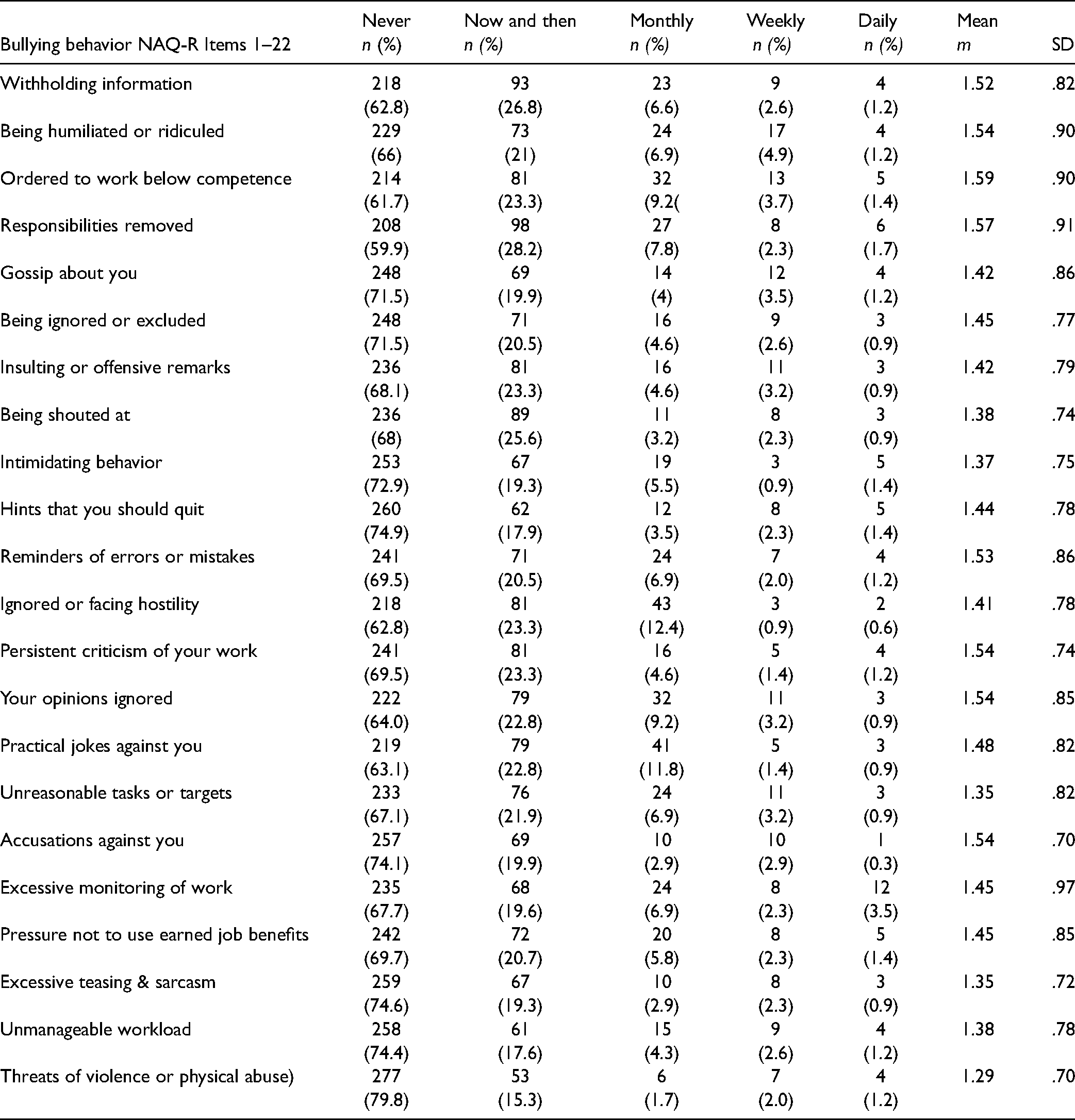
Participants reported that being Ordered to work below competence and Responsibilities removed were the most repeated bullying behaviors with means (1.59 and 1.57) respectively. See Table 3.
Frequency of Bullying Behaviours NAQ-R Items (1–22).
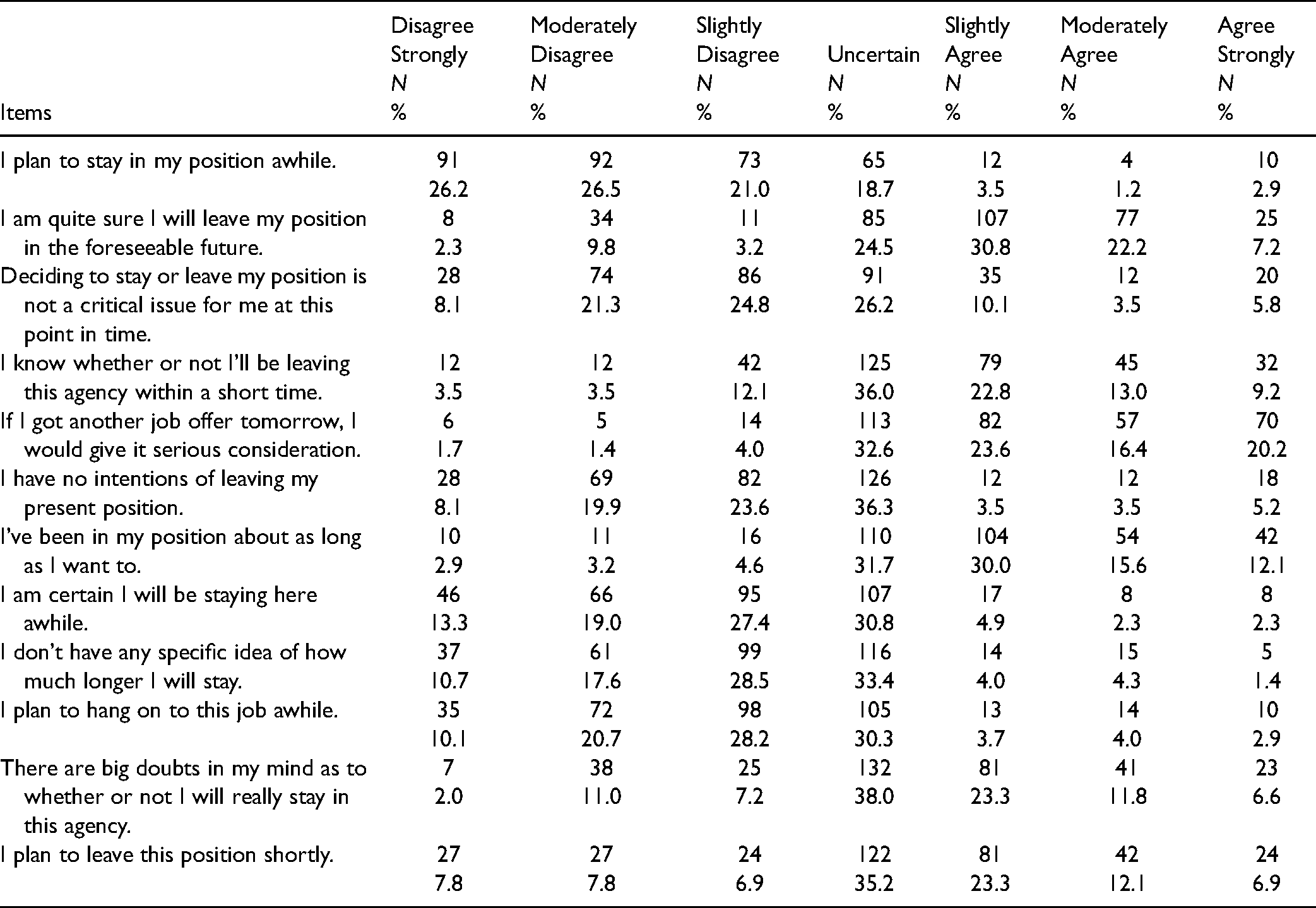
Anticipated turnover among the nurses suggests that they may be leaving their posts soon. A sense of uncertainty about turnover intention prevailed throughout the participants’ responses, more than half of the participants (42.7%) disagreed (moderately or strongly) with the questionnaire item saying that they “plan to stay”. 29.4% of participants indicated that they are “sure of leaving soon.” (Table 4)
Anticipated Turnover Scale Descriptive.
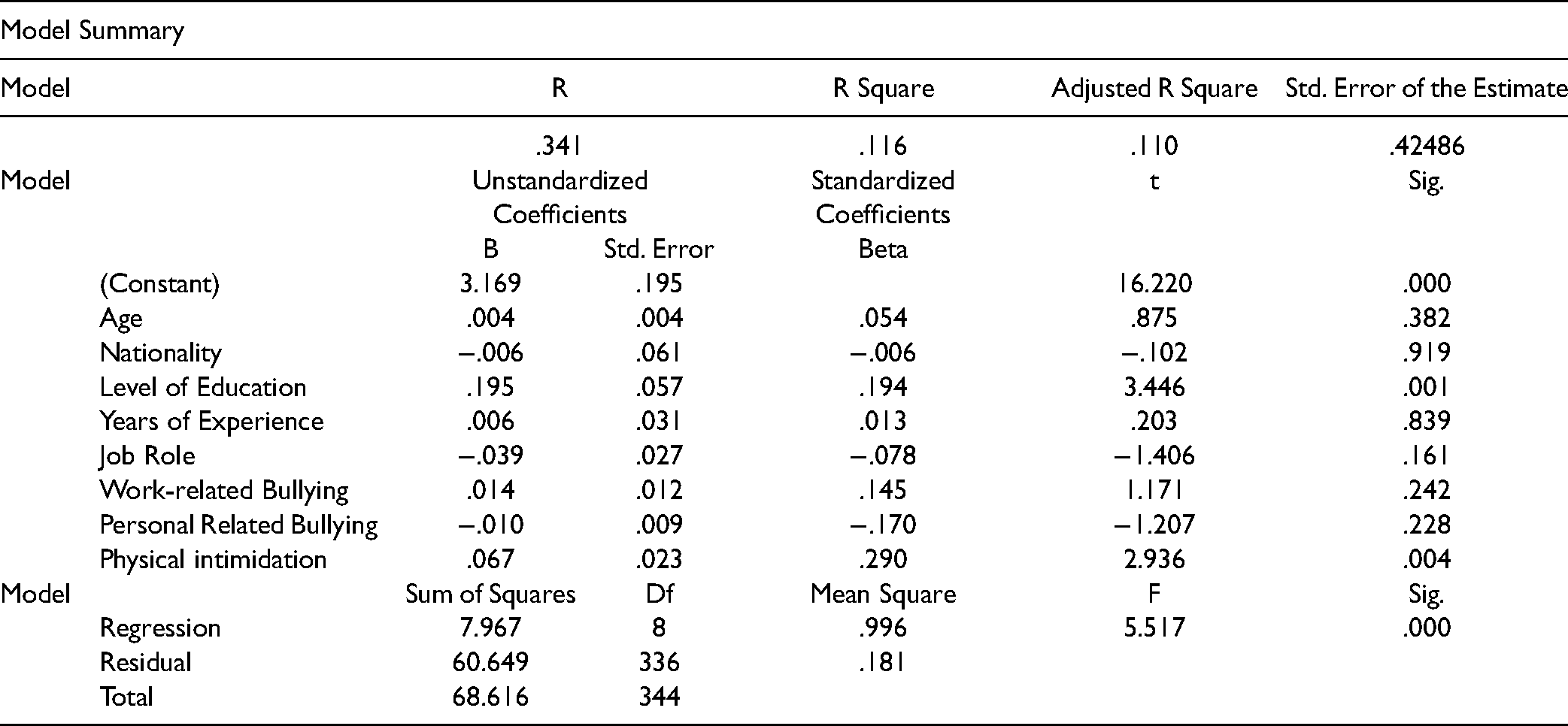
Variables of age, nationality, level of education, years of experience, job role, Work-related bullying, Personal Related bullying and Physical intimidation tested if they predict turnover intention among nurses using multiple regression. Results shows that 11% of variance in anticipated turnover can be accounted by the eight predictors collectively F(8,336) = (5.517), p < .001. the results shows that the level of education (B = .195, t = 3.44, p = .001), and physical intimidation (B = .067, t = 2.936, p = .004), positively predict turnover intentions (See Table 5).
Multiple Linear Regression Predicting Turnover Intention.
Correlation Between Workplace Bullying, Participants’ Demographics, and Turnover Intentions
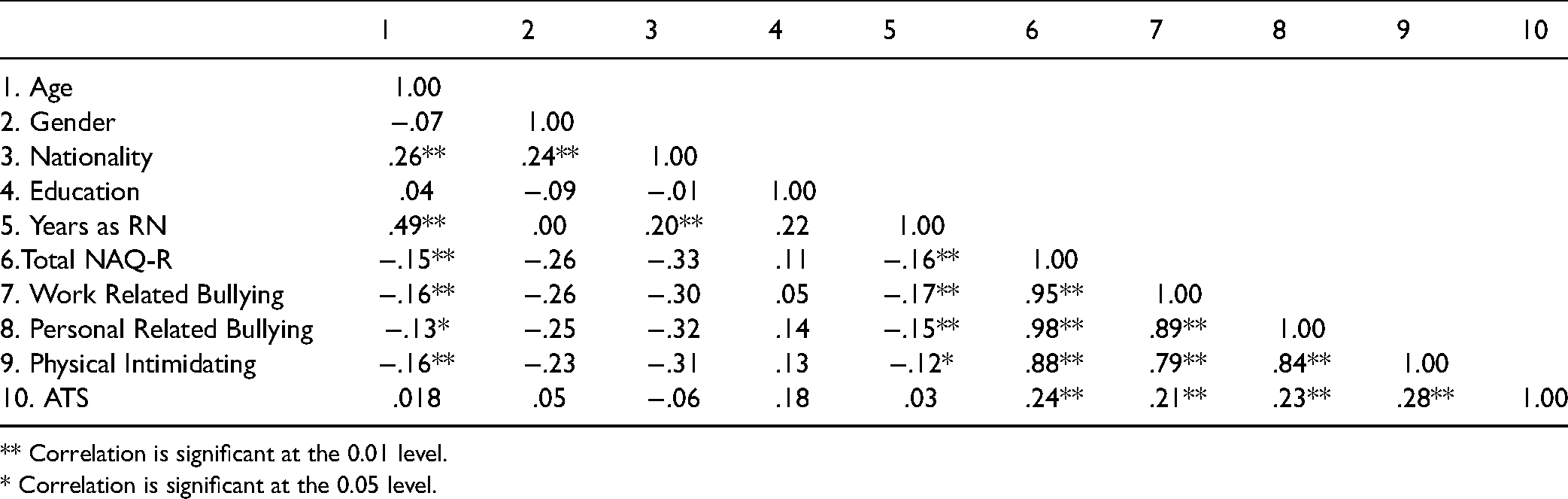
Only age was significantly associated with workplace bullying with an inverse correlation (r = −.15, p = 0.01): as the nurses’ age increased the bullying incidences decreased. However, years of experience, gender, nationality, educational level and current job position had no statistically significant correlation with workplace bullying (Table 6). There was a significant positive association between the incidence of workplace bullying and turnover of nurses (r = .24, p < .01), Correlation is significant at the 0.01 level as shown in Table 6.
Correlation Between Workplace Bullying, Participants’ Demographics, and Turnover Intentions.
** Correlation is significant at the 0.01 level.
* Correlation is significant at the 0.05 level.
Discussion
Workplace bullying is a serious event that has crucial organizational and detrimental health effects on the nursing workforce (AL-Sagarat et al., 2018; Rahm et al., 2019; Sauer & McCoy, 2018). It was documented that bullying is one of the factors known to exacerbate turnover in the nursing workplace (Hsiao et al., 2021). Furthermore, an increase in the exposure of nurses to bullying is an international problem linked to higher rates of turnover intentions (Blackstock et al., 2015). This study aims to determine the occurrence and the relationship between workplace bullying and nurses’ tendency to leave workplace.
Alarming percentage of participants reported of being victim or witnessed an incident of workplace bullying (33.4%). However, the results were similar to recent studies conducted in middle east among registered nurses in Jordan (Al-Ghabeesh & Qattom, 2019; AL-Sagarat et al., 2018) and in Saudi Arabia (Al Omar et al., 2019), these studies shared a high prevalence rates among nurses which mainly attributed to the lack of well enforced antibullying policies in several middle eastern countries. In comparison, the results of the current study showed that the rate of exposure to workplace bullying among staff nurses, as reported by nurses who participated in this study, was higher than the rates reported by Carter et al. (2013); Hogh et al. (2011); and Yun et al. (2014), who found that the rates of exposure to workplace bullying among nurses in the United Kingdom, Denmark, and South Korea were 20.0%, 17.2%, and 9.2%, respectively.
Workplace bullying can be contiguous if there are inappropriate measures to eradicate it. The oppression theory by Freire (2000), explains the characteristics of the oppressed group and why nurses may exhibit such uncivil and hateful behavior toward each other. Similar to oppressed-groups psychology, nurses may remain silent and passive toward their oppressors while the oppression is happening, then later the same oppressed nurses may release their anger upon another nurse in the form of bullying.
Interestingly, direct nursing supervisors/ managers were the main causing group of bullying compared to any other groups. That is probably explained as senior and superior nurses abused their subordinates as they need to demonstrate their power and superiority by intimidating nurses in lower nursing hierarchy. However, this only indicate poor leadership skills and judgement. Nurse managers and leaders plays an important role to build collegiality and team spirit which will enhance professional peer relationships (Saleh et al., 2018).
The current study showed that about one-third of the respondents intended to leave their current job (leavers). This result supports the notion that turnover intention is high among nurses in general (Kovner et al., 2016; Roche et al., 2015). Anticipated turnover among the nurses suggests that they may be leaving their posts soon. A sense of uncertainty about turnover intention prevailed throughout the participants’ responses, more than half of the participants disagreed (moderately or strongly) with the questionnaire item saying that they “plan to stay.” In addition, about one-third indicated that they are “sure of leaving soon.” According to this result, although workplace bullying was experienced by staff nurses, it may not directly lead to turnover intentions. However, the high ATS scores cannot be explained by workplace bullying alone. There may be more than one issue causing the high turnover intent as Kumar and Govindarajo (2014) indicated that employees choose to stay or leave an organization based on various factors which include acknowledgment and rewards, organizational justice, workplace relationships, workplace bullying, managerial support, autonomy, and developmental opportunities. There is no doubt that the repetitive experience of negative symptoms due to work-related bullying could lead to turnover intentions (Yun & Kang, 2018).
Participants’ age was shown a statistically significant correlation with bullying. Results of the current study indicate that bullying occurs with all age groups. However, younger nurses experienced relatively higher bullying incidents, and all types of bullying decreased as the nurses’ ages increased. This finding is significant, because it supports the idiom that “nurses eat their young” (Gillespie et al., 2017; Meissner, 1986) and that the younger nurses are the primary targets of bullying behaviors among nurses (Hickson, 2013). That can be attributed to the lack of new nurses’ abilities to deal with workplace problems and amateur interpersonal relationships, which made them at a higher risk of workplace bullying. The organizations must recognize the groups that are most likely to be targets of bullying and provide them with appropriate education and support. Similar results were seen in a study conducted among office workers in Denmark in which age was significantly associated with workplace bullying (Clausen et al., 2013). Meanwhile, the study findings confirm that both level of education and physical intimidating behaviors against nurses can positively predict intentional turnover. Since almost 80% of participants are expats, a higher level of education may lead them to consider immigration to countries with better economic status. On the contrary, Magbity et al. (2020) found a negative association between nurses’ level of education and turnover.
A statistically significant association between the incidence of workplace bullying and turnover of nurses. Workplace bullying can be considered one of the main reasons behind health care organizations’ high turnover rates, poor retention, and, eventually, nursing shortage. The result confirms that nurses exposed to workplace bullying are more likely to demonstrate increased intention of turnover, which hinders the efforts of organizational retention. The current study is similar to a previous study reporting that bullying significantly predicted the intent to leave among Canadian registered nurses beyond the influences of organizational tenure and organizational factors in the nursing work environment. In addition, the results are comparable with findings of studies among health care workers that showed the presence of an association between the exposure to workplace bullying and turnover (Clausen et al., 2013; Kim et al., 2019). In a study conducted in the southern part of Taiwan, the trend of turnover intention showed a moderate, positive, and significant correlation between turnover intentions and bullying, indicating that bullying is the most important predictor of turnover intention (Sauer & McCoy, 2018; Tsai et al., 2014). Locally, Attar and Alsharqi (2021), examined the factors that influence nurses’ turnover in Saudi Arabia and concluded that poor organizational culture and peer relationships were the main contributing factor causing nurses’ turnover.
Future research Using a mixed-method research design is recommended to support the findings based on quantitative and qualitative data, as the qualitative design will help to gain deeper insight into nurses’ perceptions of workplace bullying. Future research could focus on the relationship between nurse bullying and outcomes of direct patient care.
Strengths and Limitations
The current study provides valuable findings about workplace bullying and nurse turnover intentions. However, the study had several limitations as well, the design used in this study limits generalization. The research findings may not reflect the experience of the entire registered nurses’ population in Saudi Arabia. Also, the survey was based on self-reporting of bullying, which varies according to the experience or perception of nurses. Since the design was purely quantitative, the findings do not provide deeper insights into nurses’ perspectives on their experience of bullying.
Implication to Practice
The findings reveal that the participant's profile has an associative link to bullying. Therefore, proactive programs aimed at avoiding and resolving workplace conflicts should be planned and implemented. Strategies to promote workplace bullying awareness, ways to prevent and deal with bullying can positively affect staff communication and collaboration on achieving better health care which eventually will mitigate turnover, allowing better nurse to patient ratio.
Conclusion
Workplace bullying is a serious issue affecting the nursing profession. Because of the alarming prevalence of bullying, health care systems must implement a stricter policy to contain it. One-third of participants in this study reported incidents of bullying. In a world suffering from a massive nursing shortage, creating a healthy and conducive work environment is a priority for sustaining a sufficient nursing workforce. It is evident that a clear relationship exists between frequent exposure to workplace bullying and nurses’ tendency to leave their current setting. When nurses are exposed to workplace bullying, they are more likely to demonstrate an increased intention for turnover, which hinders the effort of organizational retention.
Footnotes
Declaration of Conflicting Interests
The author(s) declared no potential conflicts of interest with respect to the research, authorship, and/or publication of this article.
Funding
The author(s) received no financial support for the research, authorship, and/or publication of this article.
