




Abstract
Including the patient perspective in health research is not merely beneficial but essential. The establishment of the Austrian Patient Council serves as a practical example of how this goal can be effectively realized. This comprehensive mixed methods study offers valuable insights into the preparatory, foundational, and evaluative steps involved in setting up such a council. By analyzing online surveys conducted at two different points in time and conducting qualitative interviews, the study highlights the critical factors contributing to the council's success. These include selecting research topics of genuine interest to council members; establishing a robust project and administrative structure; ensuring the council is of an appropriate size; and that its membership is diverse and heterogeneous. The study also underscores the importance of implementing measures to facilitate and support active participation, and the need for continuous feedback and flexibility. Overall, the findings demonstrate that patient involvement in health research is feasible and provides a roadmap for meaningful engagement.
Introduction
Without patients, there would be no need for health research. Involving patients and their loved ones in healthcare issues and including their views represents a holistic approach to health research according to open innovation in science (OIS) principles. 1 The immediacy with which patients experience the healthcare system allows them to contribute to creating a bigger picture of patient care. Including so-called ‘lifeworld’ expertise, a term coined by Alfred Schütz, 2 is crucial as a means of incorporating first-hand experience, and depends on having the proper structures, processes, and tools in place to enable and encourage patient involvement.3-5 For all forms of involvement to succeed, the appropriate resources and conditions must be in place. 6
The value of patient involvement has received greater recognition in the World Health Organization's (WHO) Global Patient Safety Action Plan 2021–2030. Strategic objective 4 of the Action Plan is dedicated to patient and family engagement, and recommends to “engage and empower patients and families to help and support the journey to safer health care”. 7 However, this idea is not entirely new. A European Union directive to promote this kind of involvement 8 has been in place since 2009, and in Austria, the main focus of this paper, this concept has been reflected in national reports on patient safety strategies since 2013.9,10
While there are numerous examples of successful patient involvement in healthcare research, most notably in the US and the UK,11-15 the focus has always been on specific topics, such as health economics and outcomes research or engaging patients in practice improvement,16,17 selected clinics, such as Johns Hopkins hospitals or Stanford Medicine,18,19 or specific indications, such as kidney disease. 20 In the US, the PCORI initiative funds patient involvement in comparative clinical effectiveness research. 21 Committees of professional patients are also common at EU level and in Scandinavian countries,22,23 but they represent patients in general rather than primarily contributing to individual lifeworld experience. In Germany, citizens’ councils have been set up, where lay people can get involved in issues relating to general medicine, eg BayFoNet. 24 Although Austria has well-established and organized self-help groups, 25 these groups are usually focused on specific diagnoses and the clinical picture, and they do not focus on health research in general. It seems that the involvement of laypeople is particularly common in climate debates, where numerous initiatives in Europe and worldwide invite civil society to participate.26,27
To summarize, while patient involvement is essential and steadily increasing, to the best of our knowledge there is currently no dedicated body of lay people involved at the general level of health research in Austria. The primary motivation of this project is therefore to give patients a voice in health research projects, by enabling their active participation and encouraging them to share their lifeworld experience. Against this backdrop, the aim of the project presented here was to establish a patient council for the Austrian health system – the Austrian Patient Council. The study offers a detailed example of how a patient council can be established and how its members can work together on health research issues.
Method
Various quantitative and qualitative social research methods were used to examine the process of setting up and running the Austrian Patient Council. Some of the methods and results are presented simultaneously for the purpose of readability.
Preparing for the Austrian Patient Council
After looking into research on international involvement models and consulting experts in patient involvement and the Austrian healthcare system, a concept for the patient council was developed. This addressed the council's potential roles, possible barriers and obstacles, member requirements, and council offerings. In October 2021, funding was secured through the Patient and Public Involvement and Engagement Call (PPIE) of the OIS Center of the Ludwig Boltzmann Society, to establish the Austrian Patient Council. The project team's planned steps are outlined in Figure 1.

Steps taken by project team from initial idea in June 2021 to the end of the first period of the Austrian Patient Council in May 2023.
Establishing the Austrian Patient Council
After creating the concept for the council, a four-week call for applications was launched via press release, newsletters, and social media. This call was designed to be low threshold to attract a diverse range of people older than 18 years and living in Austria. Applicants needed an interest in patient safety, the future of the healthcare system, and a willingness to shape healthcare research and provide ideas for new and existing projects. Other than that, applicants did not need to meet any other requirements. Applicants were asked to return the one-page call sheet (see Supplemental material), including their name, address, gender, date of birth, highest level of education, first language, occupation, motivation for applying, experience as patients, and research interests they would like to focus on.
Three project team members selected 18 applicants for the first cycle of the Austrian Patient Council, discussing all applications thoroughly and reaching a joint decision. Selection was based on applicants’ experience as patients and motivation to participate, with attention paid to balancing age, gender and regional distribution. During the term of the council, detailed information was collected on the members’ lifeworld experiences as patients.
Evaluating the Austrian Patient Council
The members of the Austrian Patient Council were asked to complete a short, anonymous online survey at the beginning and end of the first cycle. The first survey (conducted between July 12 and 27, 2022) consisted of seven open-ended questions and 13 closed questions using a 4-point Likert scale (Very important to Not important at all) to gauge members’ expectations. The second survey (conducted between February 28 and March 15, 2023) evaluated the first year's work on the basis of six closed questions using 3-point Likert scales (Too big to Too small, More than expected to Less than expected), seven closed questions using 4-point Likert scales (Very satisfied to Very dissatisfied, Very important to Not important at all), and five open-ended questions. Both surveys are included in the Supplemental material and were analyzed using descriptive statistics (frequency, mean, range). Additionally, in March 2023, qualitative interviews as described by Witzel 28 with five members provided in-depth feedback on their first-year experiences and suggestions for improvement. Key topics included the atmosphere on the council, potential for improvement, and experiences during the first cycle of the Austrian Patient Council. The interviews were recorded, transcribed, and thoroughly reviewed to identify recurring themes. Researchers then analyzed similarities and differences across interviews before discussing the findings within the research team. The results provide an insight into the opinions and views of the council members.
Results
The Austrian Patient Council was launched in May 2022 as a joint project between the Ludwig Boltzmann Institute Digital Health and Patient Safety (a non-university research organization in Austria) and the Austrian Network for Patient Safety (an expert network for patient safety).
The Austrian Patient Council is a group that regularly holds general and specific project-related meetings and receives training on health-related research topics. This is intended to give patient council members a sense of empowerment and give them the opportunity to make an impact in the field of health research.
The insights gained from the individual phases of the council's first year are presented below. The first survey (at the beginning of the cycle) was answered by 17 members (94.4%) and the second (at the end of the cycle) by 13 members (72.2%), resulting in a total of 30 completed online questionnaires. Additionally, five qualitative interviews were conducted with council members. Further observations and documentation on the set-up and running of the Austrian Patient Council are reported.
The Membership of the Austrian Patient Council
Forty-four people responded to the call for council members in March and April 2022. Eighteen people (10 men and 8 women) aged between 27 and 78 (mean: 50.4 years) with a wide range of backgrounds and experience as patients were selected from the group of applicants. Care was taken to ensure that this selected group covered a range of roles and offered a variety of perspectives, as determined by the information provided in each applicant's motivation statement. The intention was to give a voice to people interested in an overarching view of health research issues and who want to contribute their own experiences as patients. The members were drawn from five different Austrian federal states (rural and urban areas). Most applicants demonstrated a high level of formal education and desire for involvement. The council members heard about the call primarily through word of mouth (n = 5) and the press release (n = 4) (multiple responses possible). The strongest motives for applying for membership of the Austrian Patient Council were an interest in the topic of health research and the wish to contribute their own knowledge and experience.
The Activities of the Austrian Patient Council
The 18 applicants selected to become members of the Austrian Patient Council were invited to a kick-off meeting in Vienna in May 2022, during which the council members and the project team got to know each other and the concept of the council was presented in more detail. During the first year, quarterly council meetings were held (May, September and December 2022, and February 2023). In these meetings, ongoing research projects – such as developing a perioperative messenger – were presented to council members, who provided feedback on aspects like message content and frequency. 29 Council decisions were discussed in plenary in order to incorporate the members’ views.
At the second meeting, in September 2022, a vision and definition of the council were collectively formulated (see Figure 2). In essence, the council's identity was collaboratively shaped by its members.
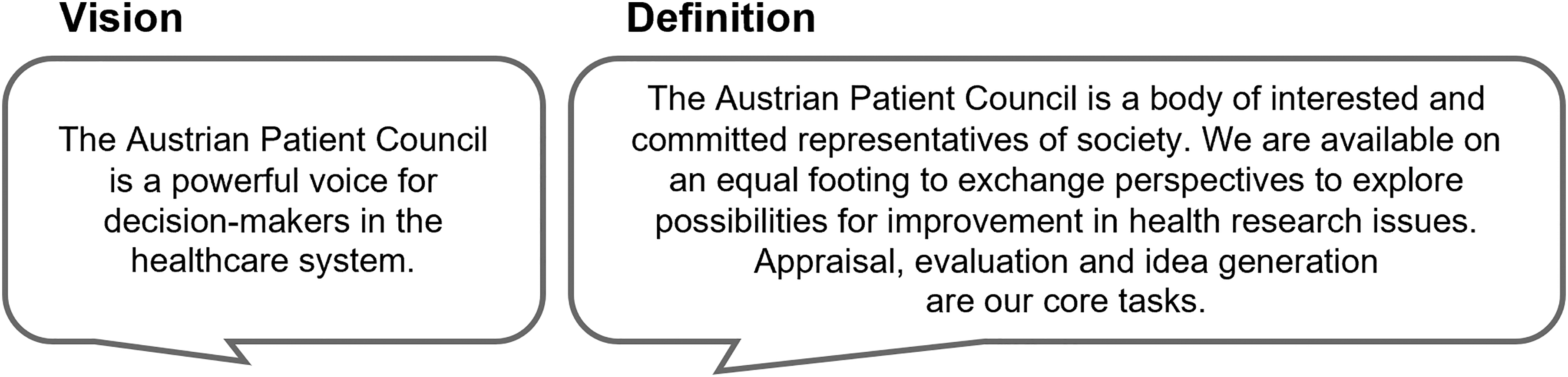
Vision and definition of the Austrian Patient Council as determined by its members.
In addition to the quarterly council meetings, three educational workshops were organized for the council members. The project team selected the topics they believed would be important for the work of the council to succeed. The chosen topics were: 1., OIS principles and the development of research questions in science; 2., the Austrian healthcare system, focusing on the complexity of the system and the interrelationships between different stakeholders; and 3., ethics in health and medicine. The council members’ feedback on these workshops was generally positive, as the following quote shows: “I was particularly interested in the insight into the healthcare system, which is understood only vaguely (…). It was great how it was presented, how insanely complex it actually is. And difficult. I was really amazed, and I really enjoyed it and it enriched my knowledge.”
The council members were invited to participate in focus groups and workshops on topics like language barriers in hospitals and informed consent, led by researchers from one of the council's founding institutes. Ten council members also participated in a project on medical errors conducted by the council's founders. Several members contribute their patient perspectives to the Smart FOX project, which aims to establish the foundation for utilizing citizen-based data donations from standardized electronic health records in clinical research. 30
Administrative Framework of the Austrian Patient Council
Cooperation within the Austrian Patient Council is guided by procedural rules which all the members have agreed to follow (see Supplemental material). It was important to the project team that participation did not involve additional costs for the members and that the expertise provided by members was rewarded accordingly. Hence, members were remunerated for participating in meetings of the Austrian Patient Council and their travel expenses were covered.
Lifeworld Experience of the Council Members
As special consideration was given to lived experience when establishing the Austrian Patient Council, the members were asked in a plenary session to share the type of lived experience they bring to the group. The answers were collectively clustered by several researchers and five areas of experience were identified: 1. Medical conditions they have experienced (eg chronic diseases, cancer diagnoses, rare diseases, pregnancies, medical errors, etc); 2. Challenges faced when ill (eg different types of therapies, self-organization and perseverance, managing illness and work, etc); 3. Specific and technical expertise gained as a result of these experiences (eg insights into the healthcare system, finding alternatives, exchanges with experts, dealing with barriers, etc); 4. Experiences resulting from caring for loved ones (eg sick relatives, nursing homes, organization and support at a distance, etc); and 5. Commitment to others at a meta-level in response to their lived experience (eg insights gained into pupil deficits as a result of the member's job, assisting local non-German speakers in the Austrian healthcare system, a socio-political interest resulting in setting up patient representation, etc).
Evaluation by the Council Members
Seventeen questionnaires were completed at the beginning of the first year, and 13 at the end of the first year. The council members were asked for their opinions on which aspects of the work of the Austrian Patient Council and its processes were very important or fairly important to its success (see Table 1).
Aspects Considered Very or Fairly Important to the Successful Work of the Austrian Patient Council and its Processes by its Members.

The answers to the open questions in both surveys clearly demonstrate the importance council members placed in patient perspectives being heard and recognized, and patients being treated as experts in their own situations.
Equally, members recognize that their contributions to the council will not bring rapid and fundamental changes or “revolutionize” the healthcare system. They see the role of the Austrian Patient Council in initiating changes and offering perspectives that have not been heard to date.
In the interviews, the atmosphere in the council was noted as being particularly positive: “There is (…) a pleasantly constructive climate of discussion and argumentation, in an extremely friendly atmosphere, where people listen to each other, don’t interrupt and put each other down, but try to support each other”. The council members reported that the project team's passion and strong commitment to the council were key success factor. Looking back at the first cycle, the members were highly satisfied with their involvement (see Figure 3).

Members’ satisfaction with their involvement in the Austrian Patient Council, n = 13.
It is clear from the results of the online survey, the interviews, and other feedback that the members felt valued. They appreciated the fact that involvement was not paternalistic. At the end of the first cycle, 12 people expressed interest in further active participation. Six women left the council due to family or work commitments or acute illness.
Discussion
Our study shows that establishing a Patient Council in Austria was feasible to work jointly on health research issues, and successfully involve patients in this endeavor. The process of setting up the council was accelerated by the COVID-19 pandemic, during which public opinion on the risks of SARS-CoV-2 was collected using a participatory crowdsourcing approach and the need for citizens and patients to be heard became more evident. 31 Health is usually perceived as an individual issue, but health research tends to be regarded as overarching and broader.32,33 Thus, the Austrian Patient Council focuses on a meta-level. In contrast to other patient councils, the Austrian Patient Council offers a platform for laypeople without predefined agendas. While the members may lack the expertise of professional patient advocates, their first-hand experiences reflect the lifeworld of “ordinary” patients, enabling different questions and enhancing other forms of patient participation in research. Several factors have contributed to its success.
Project Structure and Administrative Support
Setting up a council requires extensive planning, coordination, and management, 34 all of which were provided by the highly motivated project team. It was crucial to specify the purpose of the council and the need it meets.35,36 Clearly identifying topics in which the council should engage ensures members know what to expect before getting involved. The members of the Austrian Patient Council have a strong interest in health research and have joined for this reason. Despite the passion, openness, and flexibility of the council, our study shows the need for some form of guidance, moderation, and structure. The project team must also engage with members as equals, listening to concerns and suggestions.
Size and Composition
The Austrian Patient Council incorporates many perspectives and experiences, but representing all Austrian patients was never a goal. Not all groups can or want to participate due to other interests or obligations, and the council must remain a manageable size. 35 It was ideal for members to be able to get to know one another personally and contribute at meetings, creating an opportunity to participate and a commitment to actively attend.
Enabling and Facilitating Participation
The willingness to participate depends on members’ interests and the extent to which they feel personally impacted. 37 As participation is voluntary, the council atmosphere must be open and welcoming. 38 Joint activities such as dinners after meetings foster group cohesion and support the openness and good atmosphere in the Council. Members are acknowledged as the experts with respect to their own experiences. They are also remunerated, but the few hours of engagement do not represent professional work. The amount of compensation was carefully considered in consultation with the OIS Center of the Ludwig Boltzmann Society to avoid creating a financial incentive for participation. Keeping administrative efforts to a minimum, such as the use of pre-filled fee notes, also contributed to the council's success.
Continuous Feedback and Flexibility
Planning and preparation are crucial to setting up a council, but require flexibility in their execution.38,39 Good planning creates a variety of implementation options and helps in their preparation.
Communication and dialogue are key to ensuring that all members are recognized and valued. Iterative feedback before and after the first cycle was helpful for the first year's work and the council's development. The project team remained open to feedback and requests during and between meetings. Creating the balance between feedback and member involvement requires flexibility.
Limitations
The main limitation of the study is its individual nature, shaped by its members, project team, and their cooperation. Additionally, differences between regional healthcare systems make it hard to generalize findings internationally, therefore the focus is on a national level. While these findings are specifically tailored to the context of Austria, they possess the potential to be extrapolated to other healthcare systems, with the necessary adjustments made to accommodate the unique characteristics and requirements of those systems. Many well-educated individuals applied to join the council and research has shown that health is strongly influenced by social determinants such as education. 40 This could potentially constrain the broader applicability of the findings from the Austrian Patient Council, as certain population groups may remain underrepresented, thereby preventing a full spectrum of perspectives from being heard. Furthermore, individuals with higher levels of formal education often have access to a distinct range of resources and therefore face different challenges, which may not be adequately captured or reflected. Therefore, efforts must be made to further diversify the Austrian Patient Council's composition in the coming years eg by finding gate keepers to other population groups or strengthening connections with underrepresented communities.
Conclusion
The implementation of a patient council, in which members share their first-hand experience as patients in the healthcare system, is feasible. When setting up and operating such a council, a structure must be established that enables and fosters involvement. We strongly believe that the patient council complements other stakeholders in healthcare research, making it an important supplement rather than competitor to existing institutions.
Key Points/Findings
The council's research topics must be of interest to potential members A constructive, open, and appreciative atmosphere allows everyone to be heard The composition of the council should be as heterogeneous as possible There should be a good balance between the structure of the council and its flexibility
Supplemental Material
sj-docx-1-jpx-10.1177_23743735251331657 - Supplemental material for Putting the WHO Global Patient Safety Action Plan into Practice: Establishing the Austrian Patient Council as a Best Practice Example of Patient Involvement
Supplemental material, sj-docx-1-jpx-10.1177_23743735251331657 for Putting the WHO Global Patient Safety Action Plan into Practice: Establishing the Austrian Patient Council as a Best Practice Example of Patient Involvement by Anna Teufel, Elisabeth Klager, Hannah Hausegger, Christiane Grill, Benjamin Schuster, Maria Kletecka-Pulker and Eva Schaden in Journal of Patient Experience
Footnotes
Author Contributions
AT: Conceptualization, Methodology, Data curation, Formal analysis, Project administration, Writing – original draft, Writing – review & editing. EK: Conceptualization, Methodology, Formal analysis, Validation, Project administration, Writing – original draft, Writing – review & editing. HH: Data curation, Writing – review & editing. CG: Writing – review & editing. BS: Writing – review & editing. MK-P: Writing – review & editing. ES: Conceptualization, Supervision, Formal analysis, Writing – review & editing.
Declaration of Conflicting Interests
The authors declare that there is no conflict of interest.
Ethical Approval
No ethical approval was required to establish the Austrian Patient Council and to report this study.
Funding
The authors received no financial support for the research, authorship, and/or publication of this article.

Statement of Human and Animal Rights
Verbal informed consent (qualitative interviews) and written informed consent (quantitative online surveys) were obtained from the council members for their voluntarily given and anonymized information to be published in this article.
Statement of Informed Consent
Verbal informed consent (qualitative interviews) and written informed consent (quantitative online surveys) were obtained from the council members for their voluntarily given and anonymized information to be published in this article.
Supplemental Material
Supplemental material for this article is available online.
References
Supplementary Material
Please find the following supplemental material available below.
For Open Access articles published under a Creative Commons License, all supplemental material carries the same license as the article it is associated with.
For non-Open Access articles published, all supplemental material carries a non-exclusive license, and permission requests for re-use of supplemental material or any part of supplemental material shall be sent directly to the copyright owner as specified in the copyright notice associated with the article.
