




Abstract
User-centered models for the development of digital health interventions are not consistently applied in healthcare settings. This study used a five-phase, user-centered approach to develop HEARTPrep©, a psychosocial intervention delivered via mobile app and telehealth to mothers expecting a baby with congenital heart disease (CHD) to promote maternal, family, and child well-being. Phases of intervention development were: (I) establishing partnerships; (II) creating content; (III) developing prototype and testable intervention; (IV) conducting think-aloud testing; and (V) completing beta testing. Partnerships with parents, clinicians, and design/technology experts were integral throughout the development of HEARTPrep©. Parents of children with CHD also served as participants in Phases II-V, contributing to the creation of content and providing feedback to inform the iterative refinement of HEARTPrep©. These five phases produced a refined digital health intervention with promising feasibility, usability, and acceptability results. This user-centered approach can be used to develop digital health interventions targeting various health outcomes.
Keywords
Introduction
Digital healthcare, including telehealth and mobile health, can reduce barriers to healthcare access and enhance healthcare delivery.1,2 Digital health interventions have demonstrated efficacy in improving a variety of health outcomes, including disease management, cardiovascular health, and mental health.3-5 Development of digital health interventions should include patient and clinician engagement and user testing to ensure the resulting intervention is feasible, usable, and acceptable.6 User-centered models that focus on the needs of users (eg, patients) in each phase of intervention development have been published,6-10 but these methods are not consistently applied in healthcare settings. 6 Partnerships with design and technology experts are also essential. 11
This study used a five-phase, user-centered approach to develop HEARTPrep©, a psychosocial intervention delivered via mobile app and telehealth to mothers expecting a baby with congenital heart disease (CHD). CHD is the most common birth defect, involving one or more problems with the structure of the heart and often necessitating early cardiac surgery. 12 CHD increasingly is diagnosed prenatally and can lead to substantial psychological distress for expectant mothers. 13 HEARTPrep© aims to reduce distress and social isolation and increase self-efficacy and hope for expectant mothers following prenatal diagnosis of CHD to promote maternal, family, and child well-being. Parents and clinicians from eight health systems previously contributed to the design of HEARTPrep© and indicated that it should be delivered via mobile app and telehealth to ensure accessibility. 14 The phases used to develop HEARTPrep© align with those previously described,7,8 but were adapted for this intervention and include a phase focused on partnerships with parents, clinicians, and design/technology experts.
Method
HEARTPrep© Intervention
HEARTPrep© consists of three sequential self-paced modules and corresponding telehealth sessions delivered via mobile app to expectant mothers following prenatal CHD diagnosis. 14 Module 1 (Adjusting) focuses on adjusting to and coping with the CHD diagnosis, Module 2 (Connecting) focuses on connecting with support networks and managing interpersonal difficulties, and Module 3 (Preparing) focuses on preparing for the birth and infant hospitalization. Each module includes two recorded videos of parents sharing their experiences with CHD and two articles to normalize emotions and promote adaptive coping. Information about trusted resources (eg, websites) can be accessed across all three modules. HEARTPrep© telehealth sessions were previously piloted, with strong feasibility and acceptability results. 15
Intervention Development
Intervention development occurred between September 2021 and September 2023 at Nemours Children's Health (NCH) (Table 1). Procedures were approved by the NCH Institutional Review Board (Nos. 1768680 and 1813613) and parent participants provided written informed consent via DocuSign. All parent participants had to be fluent in English and to have previously received a prenatal diagnosis of CHD.
Five-Phase, User-Centered Approach to Develop HEARTPrep©.
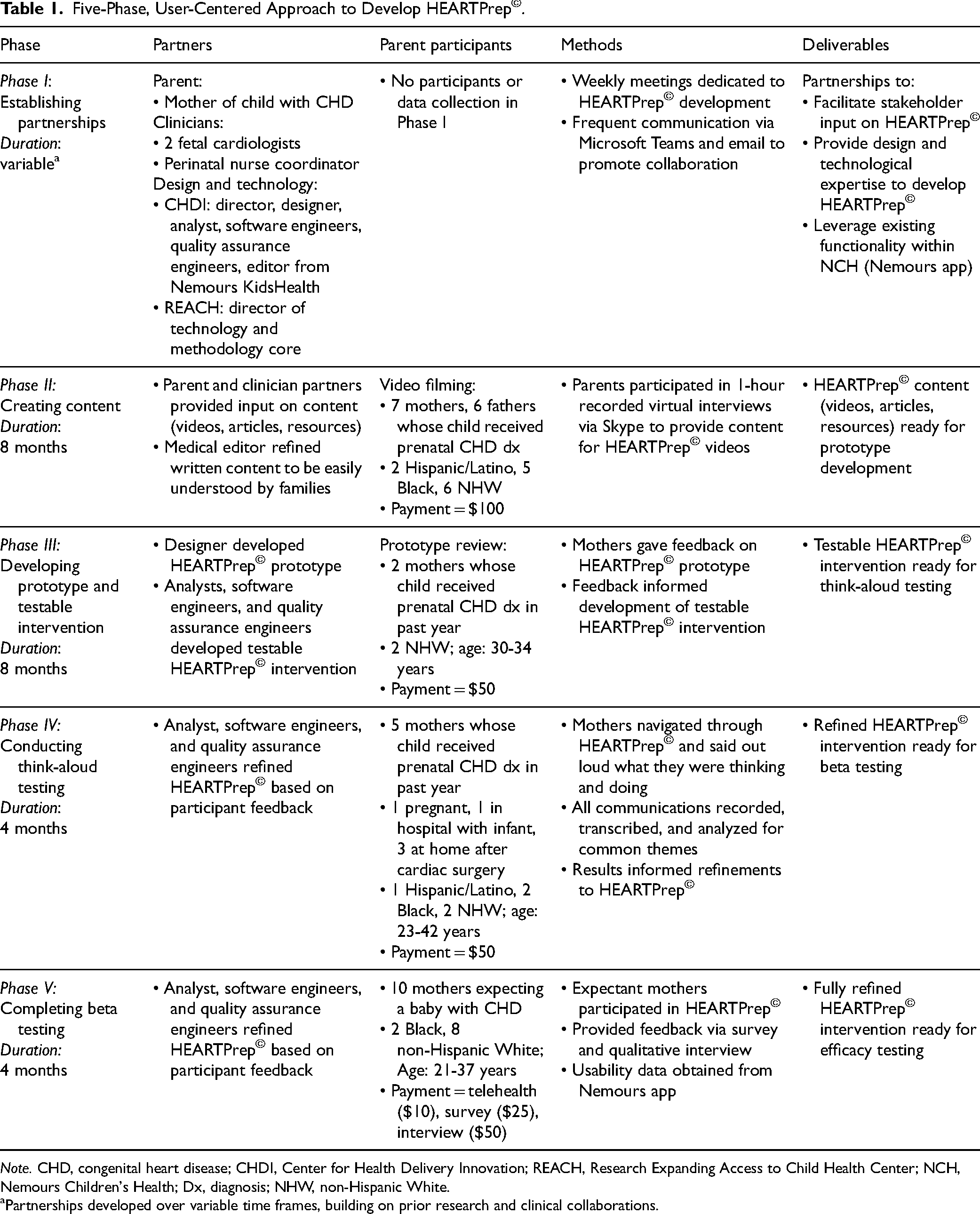
Note. CHD, congenital heart disease; CHDI, Center for Health Delivery Innovation; REACH, Research Expanding Access to Child Health Center; NCH, Nemours Children's Health; Dx, diagnosis; NHW, non-Hispanic White.
Partnerships developed over variable time frames, building on prior research and clinical collaborations.
Phase I: establishing partnerships
Partnerships with parents, clinicians, and design/technology experts were established prior to intervention development. Partnerships developed over variable time frames, building on prior research and clinical collaborations. Weekly meetings dedicated to HEARTPrep© development facilitated and strengthened partnerships.
The “parent partner” had a child with CHD and experience providing peer support to other families. The “clinician partners” were two NCH fetal cardiologists and a perinatal nurse coordinator. Design and technology experts came from two centers at NCH: Center for Health Delivery Innovation (CHDI) (director, designer, editor, analyst, software engineers, and quality assurance engineers) and Research Expanding Access to Child Health Center (director of the technology and methodology core). CHDI uses design thinking to build digital health tools for patients/families, 6 including the Nemours app, a mobile app supported by NCH for telehealth, patient education, patient–provider communication, and medical record access. 16 CHDI partnered with the research team to develop HEARTPrep© directly in the Nemours app, allowing the team to take advantage of a well-established app platform. 16 The Nemours app has been used to deliver and test digital health interventions for other conditions, including pediatric asthma, with promising initial results. 17
Phase II: creating content
Written content (articles and resources) was created by the first author, reviewed by parent and clinician partners, and iteratively refined. An editor from Nemours KidsHealth, 18 which specializes in delivering health information for families, further refined the language. Video content was created by filming parents of children with CHD, with the support of a videographer experienced in creating videos for healthcare interventions. Parent participants completed interviews via Skype in which they shared their experiences with CHD during the pregnancy, in the hospital, and at home. Virtual filming was chosen due to the COVID-19 pandemic, ease, and perceived benefit of filming from home. Video clips were selected by the first author for initial rough cuts, reviewed by parent and clinician partners, and edited based on feedback. The final videos were approved by parent participants.
Phase III: developing prototype and testable intervention
A designer worked with the research team to develop a prototype of HEARTPrep©, with guidance from CHDI collaborators. The prototype was shown via Microsoft Teams to mothers who had received a prenatal CHD diagnosis. They gave feedback on content and design, and refinements were made to the prototype. HEARTPrep© was then built within the Nemours app by CHDI analysts, software engineers, and quality assurance engineers and was made accessible through a test environment.
Phase IV: conducting think-aloud testing
Think-aloud testing is an established tool in usability research to obtain feedback from users as they navigate independently through a task and say out loud what they are thinking and doing.7,19 Participants were mothers who had received a prenatal CHD diagnosis. Mothers shared their screens in Microsoft Teams as they navigated through HEARTPrep©, and all communications were recorded, transcribed, and analyzed for common themes. Results informed iterative refinements to HEARTPrep©. Think-aloud testing concluded once no new issues or recommendations to improve usability or content were identified (eg, thematic saturation).
Phase V: completing beta testing
The refined intervention was beta-tested with mothers expecting a baby with CHD, providing a preliminary “real world” evaluation of HEARTPrep©. Expectant mothers were recruited from the NCH fetal cardiology clinic. Participants completed the HEARTPrep© Evaluation Survey to assess perceived acceptability 15 and a qualitative interview via Microsoft Teams to assess perceived usability. Interviews were recorded, transcribed, and analyzed for common themes. Objective usability data were obtained from the Nemours app (eg, completed telehealth sessions and modules). Beta testing concluded once no new issues or recommendations to improve usability were identified.
Results
The five phases of intervention development produced a refined digital health intervention with promising feasibility, usability, and acceptability results. Participant characteristics are in Table 1.
Phase I
Partnerships were successfully established and contributed to the results of Phases II-V, as described below and in Table 1.
Phase II
Thirteen parents (7 mothers and 6 fathers) participated in video filming. Six videos of parents sharing their experiences with CHD and 6 articles to normalize emotions and support coping (2 videos/articles per module) were created and refined with feedback from parent and clinician partners (Supplemental Material 1). Trusted resources (eg, websites and nonprofit organizations) were also compiled.
Phase III
Two mothers reviewed the prototype of HEARTPrep©. Additional thoughts (eg, It's in God's hands), feelings (eg, jealousy), and coping strategies (eg, focusing on what you can control) were added based on feedback (Table 2). HEARTPrep© was then built in the Nemours app (Supplemental Material 2).
Participant Input and Corresponding Refinements to HEARTPrep©.

Phase IV
Five mothers participated in think-aloud testing by navigating through HEARTPrep© in the Nemours app. Results informed changes to HEARTPrep© functionality to improve usability (eg, removed direct links between articles) and the addition of content (eg, difficulties in relationships) (Table 2). Changes in the wording and placement of content were also made to improve usability and clarity.
Phase V
Ten expectant mothers participated in beta testing. Eight (80%) completed three or more telehealth sessions and seven (70%) completed all three modules (Supplemental Material 3). Early delivery impacted 2 participants, preventing completion of the scheduled third session and assignment of the third module. Modules were often completed within a few days prior to a scheduled telehealth session, suggesting that scheduled sessions may serve as a deadline or reminder for module completion. Participants reported high perceived acceptability (Supplemental Material 4) and minimal to no difficulties accessing telehealth sessions or modules within the app. However, difficulties making time or remembering to complete modules between scheduled telehealth sessions were noted. Recommendations to promote module completion included automated push notifications linking directly to the incomplete module and a focus on module content within each telehealth session to communicate its importance and relevance (Table 2).
Discussion
This study applied a user-centered approach to develop HEARTPrep©. This approach led to important discoveries that could be addressed prior to future testing and clinical use, thereby reducing barriers to usability and adherence.
The development of digital health interventions relies on key partnerships. Each partner brought the necessary expertise based on professional or lived experiences. HEARTPrep© was developed within a mobile app supported by the healthcare system (Nemours app), with existing capabilities for telehealth and patient education. 16 The infrastructure to support this work through CHDI was already in place. The ease of building an intervention within an existent system was weighed against potential downsides, such as navigating competing demands on developers’ time (eg, if a higher priority clinical project emerged) and ceding control over the timeline. Importantly, funding is typically required for user-centered intervention development, given the critical roles of design/technology experts and key stakeholders.
Limitations
Parents not fluent in English were excluded. A Spanish-language version will undergo user testing with Spanish-speaking mothers. This approach to intervention development was iterative, with different sample sizes for each phase, determined by the point at which no new issues or recommendations were identified. Small sample sizes are common for multiphase intervention development research.7,8 However, additional recommendations may have been identified with larger samples. Acceptability, feasibility, and usability will continue to be assessed as HEARTPrep© is tested with larger samples for efficacy.
Conclusion
Key partnerships and rigorous user testing produced a refined digital health intervention with promising feasibility, usability, and acceptability results. If determined to be efficacious through further testing, this model of intervention could be adapted for other birth defects, thereby expanding its reach and impact. This user-centered approach can be used to develop digital health interventions targeting various health outcomes.
Supplemental Material
sj-docx-1-jpx-10.1177_23743735241229374 - Supplemental material for User-Centered Development of HEARTPrep, a Digital Health Psychosocial Intervention for Prenatally Diagnosed Congenital Heart Disease
Supplemental material, sj-docx-1-jpx-10.1177_23743735241229374 for User-Centered Development of HEARTPrep, a Digital Health Psychosocial Intervention for Prenatally Diagnosed Congenital Heart Disease by Erica Sood, Kimberly S. Canter, Steven Battisti, Shannon N. Nees, Shubhika Srivastava, Angel Munoz Osorio, Judith Feinson, Adrienne Gallo, Sean Jung, Erin Riegel, Stephanie Ng and Anne E. Kazak in Journal of Patient Experience
Supplemental Material
sj-docx-2-jpx-10.1177_23743735241229374 - Supplemental material for User-Centered Development of HEARTPrep, a Digital Health Psychosocial Intervention for Prenatally Diagnosed Congenital Heart Disease
Supplemental material, sj-docx-2-jpx-10.1177_23743735241229374 for User-Centered Development of HEARTPrep, a Digital Health Psychosocial Intervention for Prenatally Diagnosed Congenital Heart Disease by Erica Sood, Kimberly S. Canter, Steven Battisti, Shannon N. Nees, Shubhika Srivastava, Angel Munoz Osorio, Judith Feinson, Adrienne Gallo, Sean Jung, Erin Riegel, Stephanie Ng and Anne E. Kazak in Journal of Patient Experience
Supplemental Material
sj-docx-3-jpx-10.1177_23743735241229374 - Supplemental material for User-Centered Development of HEARTPrep, a Digital Health Psychosocial Intervention for Prenatally Diagnosed Congenital Heart Disease
Supplemental material, sj-docx-3-jpx-10.1177_23743735241229374 for User-Centered Development of HEARTPrep, a Digital Health Psychosocial Intervention for Prenatally Diagnosed Congenital Heart Disease by Erica Sood, Kimberly S. Canter, Steven Battisti, Shannon N. Nees, Shubhika Srivastava, Angel Munoz Osorio, Judith Feinson, Adrienne Gallo, Sean Jung, Erin Riegel, Stephanie Ng and Anne E. Kazak in Journal of Patient Experience
Supplemental Material
sj-docx-4-jpx-10.1177_23743735241229374 - Supplemental material for User-Centered Development of HEARTPrep, a Digital Health Psychosocial Intervention for Prenatally Diagnosed Congenital Heart Disease
Supplemental material, sj-docx-4-jpx-10.1177_23743735241229374 for User-Centered Development of HEARTPrep, a Digital Health Psychosocial Intervention for Prenatally Diagnosed Congenital Heart Disease by Erica Sood, Kimberly S. Canter, Steven Battisti, Shannon N. Nees, Shubhika Srivastava, Angel Munoz Osorio, Judith Feinson, Adrienne Gallo, Sean Jung, Erin Riegel, Stephanie Ng and Anne E. Kazak in Journal of Patient Experience
Footnotes
Acknowledgments
The authors would like to thank Dan Huber, Vivek Tayal, Natalie Stephenson, Sasikala Marimanoharan, Mitesh Patel, Louis Savoldy, Sanjay Patel, Ameet Vishwakarma, Stephen Roettger, Sai Bachu, Raj Chennuri, Honey Thomas, Dibba Roy, and all parent participants for their contributions to the development of HEARTPrep©.
Declaration of Conflicting Interests
The author(s) declared no potential conflicts of interest with respect to the research, authorship, and/or publication of this article.
Ethical Approval
Ethical approval to conduct this study and report the results was obtained from the Nemours Institutional Review Board (IRB Nos. 1768680 and 1813613).
Funding
The author(s) disclosed receipt of the following financial support for the research, authorship, and/or publication of this article: This study was funded by the Research Expanding Access to Child Health (REACH) Center of Biomedical Research Excellence supported by the National Institute of General Medical Sciences of the National Institutes of Health (1P20GM144270) and institutional funds from Nemours Children’s Health, Delaware through the PEDSnet Scholars Program.
Statement of Human and Animal Rights
All procedures in this study were conducted in accordance with the Nemours Institutional Review Board's IRB Nos. 1768680 and 1813613 approved protocols.
Statement of Informed Consent
Written informed consent via DocuSign was obtained from the participating parents for their anonymized information to be published in this article. The Nemours Institutional Review Board approved the consent process.

Supplemental Material
Supplemental material for this article is available online.
References
Supplementary Material
Please find the following supplemental material available below.
For Open Access articles published under a Creative Commons License, all supplemental material carries the same license as the article it is associated with.
For non-Open Access articles published, all supplemental material carries a non-exclusive license, and permission requests for re-use of supplemental material or any part of supplemental material shall be sent directly to the copyright owner as specified in the copyright notice associated with the article.
