




Abstract
Background
It is critically important for children to have regular access to healthcare services (1). Regular access is even more important for children living with a household member with a substance use disorder and/or mental health condition, as it leads to a variety of negative long-term health consequences for the child (2,3) that could be intervened upon if identified early in life. Historically, children from low-income families have encountered unique barriers to healthcare access and consequently have not received adequate care (4,5). While expansions in public health insurance programs (ie, the Children's Health Insurance Program [CHIP]) improved access to care for low-income children (6-8) low-income families still experience access barriers, including finding a clinic to accept their specific health insurance and costs may be high (eg, copays are too expensive) (9-11).
To further improve children's access to healthcare, there is a need to better understand how families cope with ongoing financial stressors, (12) time constraints, and difficulty maintaining continuity with a clinician or place of care (8). Past studies suggest that parental beliefs and experiences may play a large role in overcoming some of these access barriers including parents’ usual source of care (13,14), parental health (15), parental beliefs about how often their child should receive care (16), parental healthcare use (17-20), and parental health insurance coverage (21,22). Yet, few studies have interviewed parents to get a deep understanding of their access points to healthcare and why they think the connection between parent and child healthcare utilization exists. Little is known about the reasons parents enter the healthcare system, or why some parents choose a healthcare “home” that is extended to their families, especially for low-income families with public health insurance (ie, CHIP and Medicaid). Previous conceptual models of healthcare access have not adequately described the relationship between healthcare utilization of parent and child (9,23). Thus, the goal of this study was to ask parents, whose children received care at the same family medicine clinic, their perspectives on how their choices around healthcare impacted their child's receipt of healthcare.
Methods
Setting, Participants, and Study Design
This qualitative study was conducted with patients from two family medicine clinics in Oregon. Recruitment and interviews occurred from December 2020 through April 2021. One clinic was an urban Federally Qualified Health Center and the other was a Rural Health Center. Procedures were conducted in accordance with approval from our Institutional Review Board (STUDY00019958). Verbal informed consent was obtained from all participants.
Study Eligibility Criteria
Patients who met the following criteria were eligible for study participation: (1) two visits of a child to either clinic in the last two years (2018–2019) and the child's primary caregiver had at least two visits to the clinic in the same timeframe; (2) the child had visits paid by Medicaid; and (3) the primary caregiver was >21 and <60 years of age. We generated a list of patients meeting study criteria for each clinic. This list was sent to clinic leaders to ask for their input about the acceptability to contact potential participants. Several names were removed from these lists for a range of reasons, including: the child was moved into foster care, severe illness, and/or relocation. Patient lists were then stratified for each clinic by child age (0–2, 3–6, 7–11, 12–18 years) and number of parent visits to clinic in 2018–2019 (2–4, 5–12, >12 visits). We randomly selected caregivers within each stratum and invited them to take part in the study. We called 70 caregivers, of which, 8 declined, 3 were wrong numbers, 1 did not show up for their scheduled interview, and 1 became unresponsive to additional outreach (see appendix table 1 for details). We continued to select and interview caregivers until thematic saturation was reached.
Participants were interviewed by SW (masters trained qualitative analyst) and TW (doctoral trained qualitative analyst) using a semi-structured interview guide. The guide was developed by our multi-disciplinary team and asked questions to elucidate the reasons participants had for receiving healthcare at the clinic and for bringing their child to the same clinic. The interview guide was pilot tested, refined, and then implemented for the remaining interviews. Consent was obtained prior to the interview and participants were given a $25 gift card. Each one-on-one phone interview lasted about one-hour, and was audio recorded with participant permission.
Data Analysis
Interview data were professionally transcribed, de-identified, and put into a qualitative software platform called Atlas.ti for data management and analysis. The data were analyzed by the team (DC, a doctoral trained qualitative methodologist, HA, a doctoral trained investigator, SW, TW, and LM and SM, both masters trained research associates) using a grounded theory approach. This approach was applied to first understand each individual participant's experiences and second to explore the interconnection of the different phases of these experiences based on our inductive analysis (24,25). First, we met as a group to listen to the audio-recording of two interviews while reading along with the transcripts. We discussed each interview and identified factors influencing the parent's and/or children's health, the parent's relationship with the clinic and with their healthcare team, the connections parents made across family members’ health behaviors and healthcare use, and what the parent perceived primary care's role to be in their health maintenance or addressing challenges. The team coded these data during this process, assigning each code a name to align with identified factors, and defining the code for future use. Next, three team members independently coded an interview, compared coding strategies, and discussed discrepancies to ensure that the application and understanding of each code was consistent. Finally, the remaining interviews were coded independently by individual team members. After all interviews were coded, we reconvened to identify the key concepts and patterns that emerged, which were used to develop themes. After conducting and coding 12 interviews, the team agreed we reached thematic saturation and ceased additional interviewing. This saturation was reached across interviews with parents from both the urban and the rural clinic.
In our first round of analysis, we identified concepts/factors that emerged related to initiation and engagement in primary care at the clinic for parents and their children. We analyzed the data a second time to better understand how these factors were interrelated. We did this by looking at output for each of the codes we developed, which were aligned with the concepts/factors that we identified. During this process we found that looking at each participant's story holistically and then comparing stories fostered a better understanding of the factors and the relationship among them as it related to engagement with primary care. To do this, we looked at the data as a group, discussing how key concepts emerged and were connected in each individual's story, and we used each additional story to refine how we grouped and connected emerging concepts. Through this process, we identified three interconnected factors: healthcare initiation, healthcare engagement and continuity, and parent brings child to the same clinic, the latter is an outcome of the former. Next, we highlighted where we had gaps in our analysis, and conducted an additional data review to confirm saturation was reached. Through a series of project team meetings we translated our findings into a figure.
Results
Of the 12 participants, all were a primary caregiver of at least one child whose age ranged from one to 21 years old; 11 were parents, and one was a grandparent who acted in the capacity of a parent; therefore, we use “parent” to describe results below. Half were single parents. Three-quarters had a history of substance use disorder and/or a mental health condition (Table 1). Appendix Table 1 includes the number of parents contacted and interviewed in each stratum within our sampling strategy.
Demographics of Participants.

Figure 1 shows that healthcare initiation (ie, reasons parent-initiated care at a specific clinic) and healthcare engagement and continuity (ie, reasons parent decided to continue receiving care at a specific clinic) are connected to a parent's decision to brings their child to the same clinic for healthcare (ie, reasons parent decided to bring their child to the same clinic for care). As this figure shows, these factors are interconnected and sequential. The arrows between health care engagement and bringing one's child to the clinic are self-reinforcing. Below, we identify and define the elements of these relationships further.

Figure to explain parent and child healthcare initiation and engagement.
I ended up at [de-identified clinic] which is a methadone clinic where they do MAT, Medicaid-assisted therapy, and they had a group there, [de-identified health system] and I got in that, and my first primary care physician through [de-identified clinic] was [de-identified clinician,] who gave birth to my daughter actually …. She was at [de-identified clinic], and so I just started seeing her. We got connected that way, and I’ve been with them ever since. [A643]
In addition to their identified healthcare needs, parents described pragmatic reasons for choosing specific clinic. For example, convenience and acceptance of their insurance coverage were two of the primary factors identified for choosing a specific clinic. A combination of these reasons resulted in the initiation of healthcare on the part of the parent, and the beginning of a healthcare relationship with the clinic and/or clinician that eventually contributed to their sustained engagement.
Really good [describing relationship with clinician]. In fact, the last time that I saw Dr [de-identified], like, he just told me how proud he was of me. If you knew that guy, that's a big deal, because he sees so many people …. It felt very good when he told me that, because it's been a journey as he's just, like, watched me, you know, come in there from the beginning. You know, if I could show you before and after pictures, it's crazy. [A47]
Having the primary care practice be a place where parents received assistance from the clinic for both socioeconomic and practical concerns through wrap-around services also contributed to their staying with a clinic long-term. This whole-person and family-centered care could include a range of services from support with filing taxes, maintaining health insurance coverage, to nutrition and behavioral health support. As described by one parent: … It helps so much because, especially for someone who doesn't have a car, someone who has anxiety and other stuff goin’ on, to have our care under one roof—and then to have people, a wonderful social worker that works there—oh, another service, they helped me with my renewal of insurance. They had people there to help walk me through the application process. I think there was a time I got my taxes done there …. Then they have also free law advice that I need to utilize …. They really are wrap-around. [A771]
This connection could extend to a feeling that the clinical team appreciated the nuance of their medical journey and took careful consideration of their history when supporting their overall healthcare plan. I have [ de-identified clinician] now. I love her. She's amazing …. Unfortunately, not many doctors or nurses even at [de-identified organization] understand methadone really and are somewhat judgmental, and so that's why I just chose to stay with Dr [de-identified]—well, and [de-identified] now because they do know me and they know the workings of methadone. That's why. [A254]
My daughter has been through a really rough life. For any program to help a family that doesn't have the money in situations where—you know what I mean—I needed physical stuff taken care of, she's needed physical stuff taken care of, without programs like [the Clinic] and the stuff that [the organization] offers, I don't know what I would do …. Cause without [it], I’d be somewhere sick. [A486]
Further, they described an environment that viewed the family as a unit comprised of individuals that had different, but related needs. Parents highlighted the value of having a clinician who could create a “family” treatment plan and relay information collectively to the whole family, so that the individual family members could be accountable for the treatment plan and better understand ways to support each other effectively. As described by one parent:
I couldn't imagine it being different. We’re a family, we’re connected, and we’re connected at the doctors. We can all be accountable for each other's health, in a sense, when we’re all at the same doctors. That's really all I have. [A263]
Table 2 includes additional quotes for each factor.
Quotes That Support the Figure Explaining Parent and Child Healthcare Initiation and Engagement.

Discussion
We interviewed parents from two family medicine clinics to understand their beliefs about the relationship between their healthcare and their child's. We found that parents focused on the importance of keeping themselves healthy to keep their families healthy. Specifically, parents noted that if they were unable to take care of their own health, they would be unable to have a healthy family. One of the core pieces of keeping themselves healthy was receiving healthcare when needed. Based on these interviews, we developed a figure which depicts the process of why and how parents sought care at these clinics and what led them to bring their children to the same clinic for healthcare. This figure could be the first step in the development of a model for parent and child healthcare engagement, once future research is done to explore the experiences of families who did not have the initial exposure to the healthcare system that existed in our sample.
The figure illustrating our project findings is unique as previous models addressing this population have not focused on initiation for a specific group of parents and children seen in the same clinics, nor did they include parental healthcare access as a pathway for their children's care. For example, several conceptual models of access do not include family as a factor associated with access (26,27). The Andersen and Aday Model has been used to understand receipt of child healthcare (23), but parental healthcare was not specifically included. The Optimal Care Model describes parents’ need for affordability, availability, and acceptability to achieve optimal healthcare for their children (9) yet, did not take parental healthcare into account. Our findings add to these previous models by describing the complex factors that lead a family to seek healthcare in the same setting.
As three-quarters of the parents interviewed had a history of substance use disorder and/or a mental health condition, our findings are particularly important for understanding access to care for families who may experience stigma or difficulty accessing healthcare. The primary care mental health integration is beneficial in supporting these individuals and their healthcare needs (28). Further understanding of the connection between parent and child healthcare utilization could allow for development of interventions to increase healthcare access to and receipt of recommended healthcare services for children, which could help mitigate the impact of early life adversity (29).
Parents described the value of a healthcare “home” for themselves, and subsequently, their family. Trust was built in a few ways including: feeling able to rely on the clinician during challenging times, noting the clinician has gone above and beyond for them, the clinician/clinic helping them overcome a health challenge, and/or having confidence that the clinician (and/or the rest of the clinical team) would be responsive in times of need. Often parents described this trusting relationship as an essential piece of their recovery path, and that since that healthcare relationship had already been established and maintained, that bringing their children to the same clinician/clinic was a natural extension of their own healthcare experience.
In addition to a good relationship with their healthcare team, parents reported bringing their child to the same clinic for several other reasons including convenience, continuity, and having a clinician who understood the needs of the whole family unit. In some cases, parents noted a variety of “wrap-around” resources and assistance the clinic provided to them and their family. Finally, the combination of these factors led them to feel they had created a healthcare home for their family. Our findings did not differ across the two clinics despite one being urban and one rural.
Our study has several limitations. First, our sample size was small, but we reached saturation in themes described here, possibly in-part because all the patients in our sample described their experiences with their dependents who received care at the same clinic. Second, the patients we interviewed came from two clinics, one of which was a Federally Qualified Health Center and one a Rural Health Center, which have populations that may differ from private primary care practices. Our sample included a sizable proportion of parents with substance use and/or mental health conditions and although we reached saturation, further work with specific subpopulations could be beneficial. Also, we do not know if these parents and children received all recommended healthcare in these clinics or elsewhere, as we did not collect specific information on their healthcare use. We also did not include families who did not receive healthcare at the same clinic, and this is an important area for future research. Lastly, we likely experienced respondent bias as those willing to talk to us were engaged with primary care and likely to have positive things to say about the clinics.
Conclusion
As parents believe there is a connection between their own health and their children's health and see the benefits of having a family clinic and/or clinician to care for themselves and their children, our data depict the interrelated factors that lead parents to bring their children to the same clinic. Our findings suggest that primary care should provide healthcare to family-units. Future research can measure the identified relationship to devise specific strategies for care initiation and engagement and should be expanded to explore experiences of families who did not have an initial exposure to healthcare services.
Footnotes
Declaration of Conflicting Interests
The authors declared no potential conflicts of interest with respect to the research, authorship, and/or publication of this article.
Funding
The authors disclosed receipt of the following financial support for the research, authorship, and/or publication of this article. This work was supported by the Agency for Healthcare Research and Quality (grant number R01HS025962).

Appendix Table 1: Sampling strategy with number of parents contacted and interviewed in each stratum

| Child age (years) | ||||
|---|---|---|---|---|
| Parent visits (#) | 0–2 Contacted/interviewed | 3–6 Contacted/interviewed | 7–11 Contacted/interviewed | 12–18 Contacted/interviewed |
| 2–4 Visits | 6/1 | 7/1 | 10/2 | 3/0 |
| 5–12 Visits | 1/1 | 9/1 | 10/0 | 3/0 |
| >12 Visits | 3/1 | 9/3 | 6/2 | 3/0 |
Appendix Table 2: Answers to the question: Can you tell me what do you think the relationship is between your health and your children's health is?
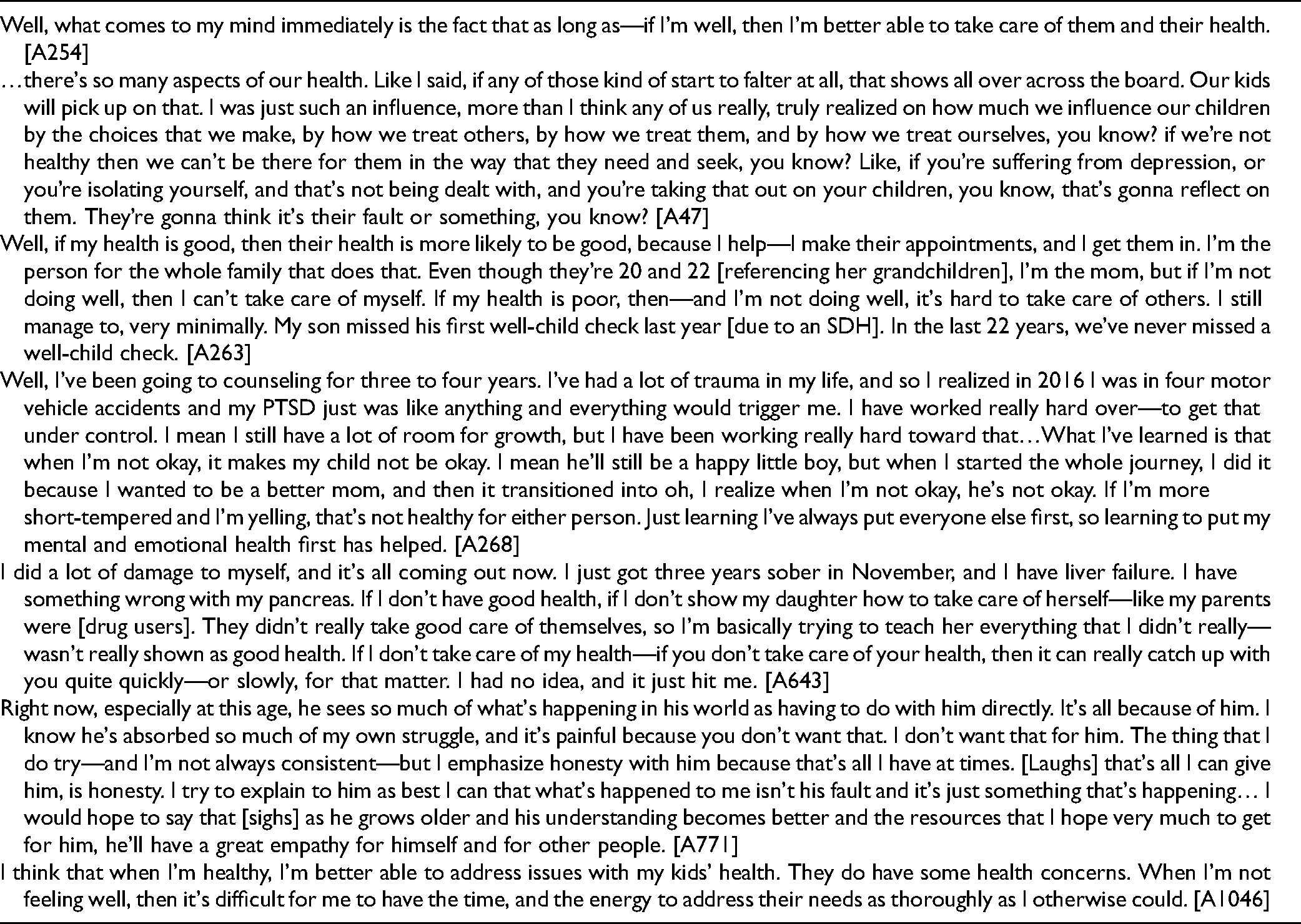
| Well, what comes to my mind immediately is the fact that as long as—if I’m well, then I’m better able to take care of them and their health. [A254] |
| …there's so many aspects of our health. Like I said, if any of those kind of start to falter at all, that shows all over across the board. Our kids will pick up on that. I was just such an influence, more than I think any of us really, truly realized on how much we influence our children by the choices that we make, by how we treat others, by how we treat them, and by how we treat ourselves, you know? if we’re not healthy then we can't be there for them in the way that they need and seek, you know? Like, if you’re suffering from depression, or you’re isolating yourself, and that's not being dealt with, and you’re taking that out on your children, you know, that's gonna reflect on them. They’re gonna think it's their fault or something, you know? [A47] |
| Well, if my health is good, then their health is more likely to be good, because I help—I make their appointments, and I get them in. I’m the person for the whole family that does that. Even though they’re 20 and 22 [referencing her grandchildren], I’m the mom, but if I’m not doing well, then I can't take care of myself. If my health is poor, then—and I’m not doing well, it's hard to take care of others. I still manage to, very minimally. My son missed his first well-child check last year [due to an SDH]. In the last 22 years, we’ve never missed a well-child check. [A263] |
| Well, I’ve been going to counseling for three to four years. I’ve had a lot of trauma in my life, and so I realized in 2016 I was in four motor vehicle accidents and my PTSD just was like anything and everything would trigger me. I have worked really hard over—to get that under control. I mean I still have a lot of room for growth, but I have been working really hard toward that…What I’ve learned is that when I’m not okay, it makes my child not be okay. I mean he’ll still be a happy little boy, but when I started the whole journey, I did it because I wanted to be a better mom, and then it transitioned into oh, I realize when I’m not okay, he's not okay. If I’m more short-tempered and I’m yelling, that's not healthy for either person. Just learning I’ve always put everyone else first, so learning to put my mental and emotional health first has helped. [A268] |
| I did a lot of damage to myself, and it's all coming out now. I just got three years sober in November, and I have liver failure. I have something wrong with my pancreas. If I don't have good health, if I don't show my daughter how to take care of herself—like my parents were [drug users]. They didn't really take good care of themselves, so I’m basically trying to teach her everything that I didn't really—wasn't really shown as good health. If I don't take care of my health—if you don't take care of your health, then it can really catch up with you quite quickly—or slowly, for that matter. I had no idea, and it just hit me. [A643] |
| Right now, especially at this age, he sees so much of what's happening in his world as having to do with him directly. It's all because of him. I know he's absorbed so much of my own struggle, and it's painful because you don't want that. I don't want that for him. The thing that I do try—and I’m not always consistent—but I emphasize honesty with him because that's all I have at times. [Laughs] that's all I can give him, is honesty. I try to explain to him as best I can that what's happened to me isn't his fault and it's just something that's happening… I would hope to say that [sighs] as he grows older and his understanding becomes better and the resources that I hope very much to get for him, he’ll have a great empathy for himself and for other people. [A771] |
| I think that when I’m healthy, I’m better able to address issues with my kids’ health. They do have some health concerns. When I’m not feeling well, then it's difficult for me to have the time, and the energy to address their needs as thoroughly as I otherwise could. [A1046] |