




Abstract
The Ministry of Health (MOH) recently developed the Health Sector Transformation Program (HTSP) to focus on patient satisfaction, safety, and care. This study explored patient satisfaction with outpatient care services.
A semi-structured questionnaire was designed to collect the data of patient satisfaction with pharmacy care services through face-to face interviews of participants and over the internet using an electronic format of the same questionnaire (web-based survey).
A total of 508 participants responded of whom, 51.8% were male and 83% were below 46 years old. The average scores of domains 1, 2, 3, 4, 5, 6, 7, and 8 were 4.51, 4.11, 4.30, 3.70, 3.57, 3.82, 3.63, and 4.15, respectively. The general evaluation of pharmacy services demonstrated that respondents were very satisfied (245; 48.2%), satisfied (143; 28%), and willing to recommend the pharmacy to their families (380; 76.4%). There was no statistically significant difference in the overall satisfaction with pharmacy services among the 2 hospitals (P > .05).
Most respondents were satisfied with outpatient care pharmacy services. More efforts are needed to improve the service of following up on patients’ adherence by the pharmacists.
Introduction
Patients’ satisfaction is an integral component of the quality of healthcare and it has been adopted as a proxy to assess the quality and improve the sustainability of healthcare services in many countries (1). Worldwide, patients’ satisfaction with pharmacy services reflects the extent to which their expectations, concerns, and preferences are met (2–4). The measurement of satisfaction will help to identify pharmacy services in need of improvement, enhance patients’ adherence to their medications, and to provide a positive impact on patient health outcomes (5–7).
Ambulatory or outpatient pharmacy practice is an integral part of the healthcare system that provides pharmaceutical care to patients who are not admitted to the hospital. Ambulatory care pharmacists have the responsibility to improve the patient's knowledge about the proper use of medicines, assess the patient's need for medication, manage the patient's medication-related problems and develop a relationship with the patients and their families (8).
The General Administration of pharmaceutical care at the Ministry of Health (MOH) published a strategic plan in 2012 for 5 years, and one of the dimensions of follow-up assessment was patient satisfaction with pharmacy services (9). In such context, a patient satisfaction survey had been conducted at more than 250 hospital pharmacies and 2500 primary care center pharmacies (10). The survey was constructed based on several indicators such as law domains, policy domains, medication safety domains, patient outcome domains, and customer needs domains (10).
In 2021, the MOH launched the Health Sector Transformation Program (HTSP) to restructure its healthcare system to focus on patient satisfaction, safety, and care. In this regard, the HTSP demanded the researchers understand the current level of patient satisfaction in the various regions (11).
Previous studies have reported on patient satisfaction with pharmaceutical care in terms of evaluating the performance of outpatient services in primary care centers (12). tertiary care hospitals in 2019 (13). and the Northern area (14). specialized hospitals (15). the Eastern region (16). and pharmacy care services in East Province (8). These studies concluded that the patient satisfaction with pharmacy services was adequate at MOH hospital overall. The outcomes showed a lack in pharmacists’ interaction with patients and exertions, medication reconciliation, medication adherence, and pharmacy communication domains which require more focus and improvement by pharmacists. A study recommended conducting training courses to improve staff skills and attitudes to deal with patients (15).
A recent study on 746 patients attending outpatient pharmacies at a public hospital in the Al-Jouf region concluded a low satisfaction level of patients with regard to pharmacy facilities and patient counseling (14). A variety of factors might be involved in patients’ satisfaction process including but not limited to services accessibility, waiting time, availability of medications, and pharmacy staff attitude in providing medication information and counseling (15, 17).
To the best of our knowledge, there is no study that evaluated patient satisfaction with outpatient care services in the Northwestern area. This study focused on exploring the level of satisfaction among patients attending outpatient pharmacies of 2 tertiary care hospitals. Hence, the findings from the present study will be helpful to narrate the current level of patient satisfaction with the HTSP.
Method
Study Site
The survey was conducted on patients’ satisfaction with outpatient pharmacy services for the period of 3 months (January to March 2021) at 2 tertiary care hospitals belonging to the MOH.
The first hospital is a tertiary care hospital consisting of 300 beds. It has adult emergency care, ambulatory care services, and a diabetic center with different medical specialties and surgical wards. The hospital has a pharmaceutical care department that consists of inpatient, outpatient, and emergency pharmacies with limited clinical pharmacy services. The pharmacy services are provided through a very comprehensive computerized physician order entry and unit dose distribution system. The pharmacy department provides total parenteral nutrition services and IV admixture for adult patients, drug information services, medication safety services, and total quality management services.
The second hospital consists of 270 beds. It has emergency services for adults, ambulatory care clinics, and surgical and medical wards for inpatient adult care. The pharmacy includes inpatient pharmacy, emergency pharmacy, and outpatient care pharmacy services. The pharmacy provides clinical activities through total parenteral nutrition, and medication safety.
Study Population and Data Collection
All the visitors to the outpatient pharmacy 18 years of age or older interested to participate in the survey were included. A face-to-face interview was carried out using a semi-structured questionnaire. Almost one-half of the respondents were included using this method and the remaining half of the respondents were obtained via an embed link on a web page and a link via Twitter.
The questionnaire was developed and validated by Yousef Alomi 201 (10). and consisted of 48 questions divided into 2 parts: the first part collects demographic information and the second part contains questions on 10 domains. However, in this study, we combined the related domains and analyzed the collected data on 8 domains which included (1) medication availability, (2) patient counseling, (3) pharmacist and patient relationship, (4) medication reconciliation, (5) medication aberrance, (6) pharmacy location and waiting area, (7) pharmacy communications and waiting time, and (8) overall patient satisfaction with pharmacy services. The response of patients was obtained on a 5-point Likert response scale (from 1 very poor to 5 excellent). All questions were closed-ended questions.
Statistical Analyses
All the statistical analyses were performed using the SPSS version 22 (SPSS Inc.). The significance level was set at a P value <.05.
Standard descriptive analysis was summarized to describe the demographic characteristics of the patients. Categorical variables were expressed as percentages, and continuous variables were expressed as mean and standard deviation. The chi-squared test was used to determine the differences in demographic characteristics of the participants. The Mann–Whitney U test was used to determine the difference in the average scores of the survey among participants of the 2 hospitals.
Results
Participants’ Baseline Characteristics
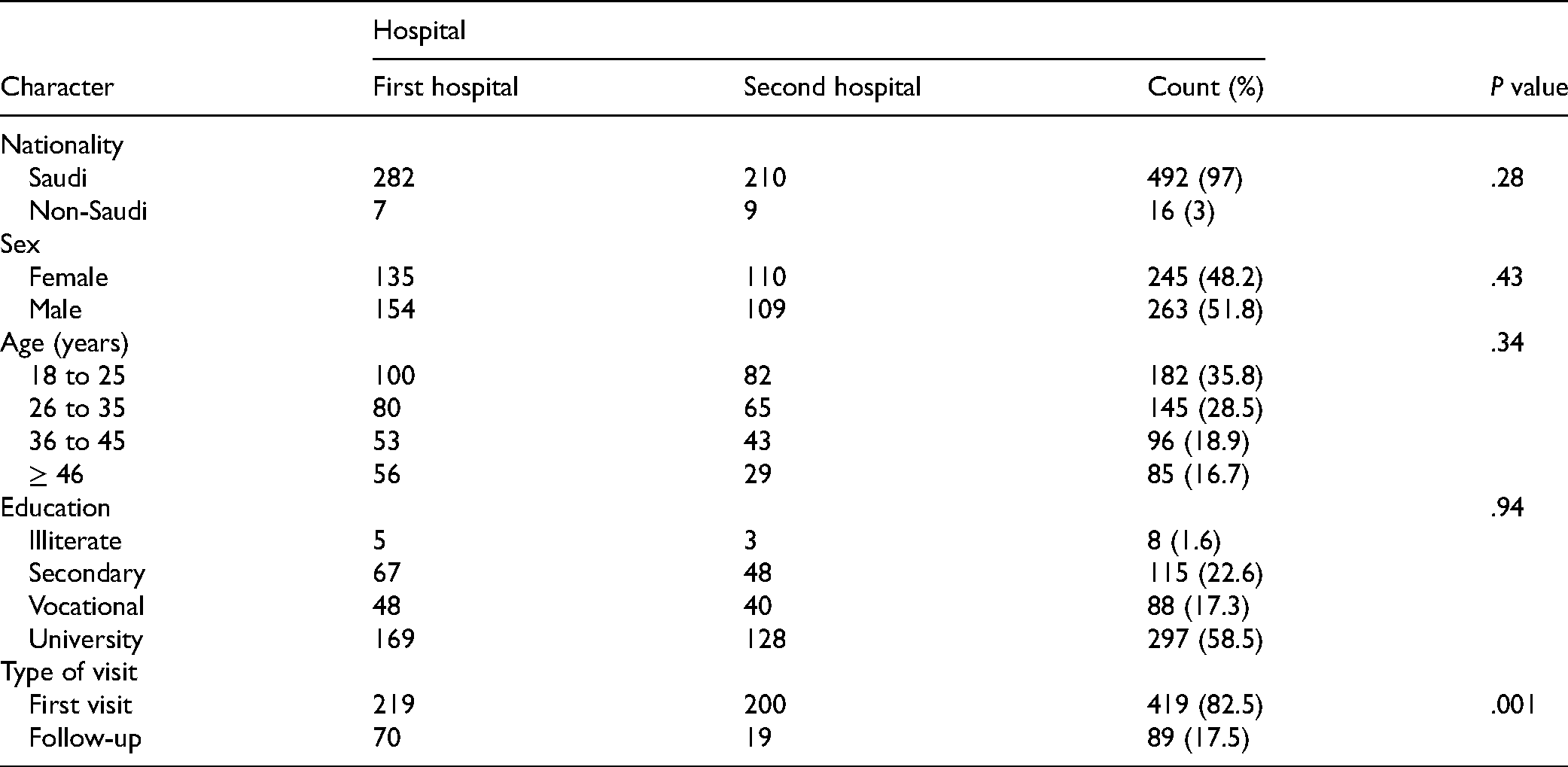
A total of 508 respondents agreed to participate in this study, of whom 492 (96.9%) were Saudi; 263 (51%) were males, and 432 (83%) were below 46 years of age (Table 1). There were no statistical differences in the demographic characteristics of the respondents who attended either hospital (Table 1).
Participants’ Baseline Characteristics.
The average scores of domains medication availability, patient counseling, pharmacist and patient relationship, medication reconciliation, medication adherence, pharmacy location and waiting area, pharmacy communications and waiting time, and overall patient satisfaction with pharmacy services, were 4.51, 4.11, 4.30, 3.70, 3.57, 3.82, 3.63, and 4.15, respectively (Table 2). The general evaluation of the pharmacy services domain was reported as excellent by 245 (48.2%) respondents and very good (143; 28%), with 380 (76.4%) respondents willing to recommend the pharmacy to their family or friends.
Scores of Patients’ Satisfaction to Outpatient Pharmacy Services.

The respondents’ satisfactions were compared in the 2 hospitals and there was no significant difference (P > .05) between them concerning all the domains of outpatient services such as medication availability, patient counseling, pharmacist and patient relationship, medication reconciliation, medication aberrance, pharmacy location and waiting area, pharmacy communications, waiting time, and overall patient satisfaction with pharmacy services (Table 2).
Overall, more than one-half of respondents (265; 52.2%) were very satisfied with pharmacy services and 233 (45.8%) were satisfied, whereas very few respondents (10; 2%) were dissatisfied with pharmacy services. There were no statistically significant differences in the overall satisfaction among respondents attending the 2 hospitals (P > .05) (Table 3). The findings of overall satisfaction might be employed for the calculation of the net promoter score (NPS) to quantify patient recommendations for pharmacy services. Whereas very satisfied respondents may signify promoters (the most enthusiastic and loyal patients who recommend the service or intervention to others), while the very dissatisfied, dissatisfied, and somewhat satisfied respondents are detractors (those who provide negative attitudes toward a pharmacy department). The satisfied respondents represent the passives who are neither supportive nor discouraging of pharmacy services. In this regard, the percentage of the detractors (13%) was subtracted from the percentage of the promoters (52%) to produce a NPS of 39% which signified a positive recommendation of outpatient pharmacy service (Table 3).
Overall Respondents’ Satisfaction With Outpatient Pharmacy Services.

The results showed no statistically significant difference between the satisfaction scores of respondents on the paper questionnaire and web-based questionnaires (Table 4).
Overall Respondents’ Satisfaction by the Mode of Survey.

Discussion
In this study, we explored the satisfaction with outpatient pharmacy services among respondents attending 2 tertiary care hospitals with variant medical specialties. The study assessed patients’ responses to 8 domains of outpatient pharmacy services. There was no statistical difference in all demographic characteristics between the participants of the 2 hospitals. Most of the respondents were Saudi nationals, which was expected because healthcare services are provided through cooperative health insurance regulations and insurance packages and only a small proportion of non-Saudi residents are allowed to receive healthcare services from governmental sectors (18). Most of the respondents were young adults below 46 years old who agreed to participate in the study, whereas few respondents were elderly. This may be due to the interest to participate in the survey through the internet by the young adult population (19). Moreover, the general health conditions of many elderly patients were sick and it was not convenient for them to respond to the face-to-face interview.
We used a mixed-mode survey in our study to improve the response rate as the previous studies recommended adding a paper-based questionnaire with a web-based questionnaire to increase the response rate. Though we used a mixed-mode survey in our study, it did not affect the self-reported satisfaction of the respondents as previous studies in this regard have already ruled out this phenomenon (20–22).
The respondents reported high satisfaction with medication availability domain and medication labeling and written instructions provided by the hospital pharmacists. Our results were similar to that reported in a recent study conducted in public, pediatric, and emergency hospital (13). and to that in outpatient services of primary healthcare centers (12). Since the availability of medicines in hospitals remains the focus of the government, and labeling of medicines is the traditional activity of pharmacists, it might be a possible reason that respondents had higher satisfaction scores in these domains. However, a recent study demonstrated frequent drug shortages in the 10 largest MOH hospitals, which offers the potential interest to conduct larger studies to enlighten the patient satisfaction regarding the drug availability in the near future (23).
Respondents scored less but still very good in the level of satisfaction with pharmacist counseling about the purpose of medications, explaining the side effects and storage of the medications (3.93, 3.65, and 3.74) when compared to medication labeling and providing written instructions. This was also consistent with a recent study in the Al-Jouf province in Northern Saudi Arabia which reported lower scores (3.08 and 3.11) in medication counseling (14). Lack of counseling areas in outpatient pharmacies along with the inappropriate location of such areas might be the cause of patients’ lower satisfaction in this domain (14). However, in the current study, the participants scored very good to the question of whether the counseling area was appropriate and respect privacy. Our results were higher than the scores for ambulatory service at tertiary care hospitals (2.2, 1.96, and 2.23) (4). Low satisfaction levels were also associated with poor counseling practices provided by outpatient hospital pharmacies to diabetic patients (24). Whereas, knowledge, skills, and the quality of pharmaceutical care counseling were determinants of willingness to pay for the service in Saudi Arabia (7). Older age, high educated patients, comorbidities, illness type and longer duration of treatment, few No. of pharmacy staff in the hospitals, increased workload, and lack of continuous education for pharmacy service providers were reported as contributors to the low patient's satisfaction with pharmacy services in the literature (4, 14).
This study demonstrated a low satisfaction rating (2.73) with the service of follow-up of patients’ adherence by the pharmacists. This service is not supported by the majority of hospitals and pharmacies. In fact, the average patient satisfaction rating with this service was very low (1.75) in 3 hospitals (13). Strategies to support tailored pharmacist-based interventions to follow-up on patient medication adherence should be based on addressing factors that affect medication adherence (25). Barriers to optimum medication adherence are multidimensional and include, but are not limited to, the complexity of medication regimen, cost, previous treatment failures, medication-related problems, health condition severity and beliefs about their condition, level of health education, and poor communication with the pharmacist or other providers (26). Examples of successful interventions to solve non-adherence problems are such as the appointment-based model where patients are allowed to schedule an appointment day to pick up all of their medications (27). Pharmacy staff calls patients before their appointment to identify any changes to their medications and confirm the request for a prescription refill. A pharmacist collaborative practice agreement is a formal agreement in which licensed physicians make diagnoses, supervise patient care, and refer patients to qualified pharmacists for disease co-management and modifying medication prescriptions (28). Medication-taking reminders such as telephone calls and text messaging can be used with all age and socioeconomic groups (29). The web-based medication adherence tool with patient-centered communication is also applicable.
Waiting time is one of the fundamental contributors to patient satisfaction. In the current study, patients reported very good satisfaction with waiting time and waiting area and pharmacy location in both hospitals. The waiting time was found to be acceptable as most of the patients preferred to get their medications in less than 30 min. The waiting time domain was found to be significant among the 3 tertiary care hospitals, which is related to the differences in the distribution of the organization system and the No. of pharmacy staff at each of these hospitals (13). Waiting time was the only predictor of satisfaction among patients utilizing the emergency care center (17).
The results regarding the satisfaction with pharmacist's attitude and patient relationships were very good and a bit higher than those reported in tertiary care hospitals (13). It was similar to those reported in a national study conducted in primary healthcare centers (12).
High satisfaction was reported in the area of medication reconciliation. Our results were higher than other previous studies (12, 13). The satisfaction with pharmacy location, waiting area, and waiting time was good as reported in the literature.
The findings of overall satisfaction with pharmacy service may be utilized to conclude the NPS score which was first introduced in 2003 by Fred Reichheld and has become a widespread numeric rating scale of customer loyalty in the industry (30). It has been recently implemented in healthcare settings to quantify recommendation levels in patient experience surveys for quality improvement (31–33). It refers to the likelihood that a patient would recommend a service or an intervention to a friend or family using a simple one-item questionnaire. The NPS score above zero is considered good, with scores above 50 considered exceptional. The NPS enables patients to rate the intervention from the perception of their own experience. Some researchers correlated the NPS score with patient satisfaction with healthcare services and reported an imperfect correlation (31, 33). They raised a concern about the validity of NPS to summarize patient experiences compared to a multidimensional patient perception questionnaire.
This study has some limitations. This was a cross-sectional study over a short duration of time with a limited No. of study sites, which may affect the drawn conclusion as respondents’ beliefs and perceptions are dynamic and based on exposure to the pharmacy services. In this context, the response might be based on the respondent's experience of their frequent visits and the reception of outpatient pharmacy services. The study did not explore factors affecting the responses. However, most respondents reported high satisfaction with all domains of pharmacy services which did not necessitate further investigations of the reasons.
Conclusion
The current study demonstrated overall very good satisfaction scores with the outpatient pharmacy services. More efforts are needed to improve the service of following up on patients’ adherence by the pharmacists. Most of the respondents expressed their willingness to recommend the pharmacy to their friends and family. Our results were found to be better than those reported in the literature in many domains. Notably, the result implicates the professionalism and attitude adopted by the pharmacists toward the respondents, which resulted in a high satisfaction level for the respondents.
Footnotes
Acknowledgments
The authors would like to thank the assistance of Pharm D students, Salah R. Almrwani, Abdulrahem M. Aljuhani, Abdulrahman M. Alanzi, and Abdullah N. Albalawi in the data collection for this study.
Declaration of Conflicting Interests
The author(s) declared no potential conflicts of interest with respect to the research, authorship, and/or publication of this article.
Ethical Approval
The Institutional Review Board, Health Affairs, Tabuk approved this study (reference number TU 077/020/070).
Funding
The author(s) received no financial support for the research, authorship, and/or publication of this article.
