




Abstract
The Partnership Enhancement Program (PEP) is a 6-hour relationship-centered communication training for intact cystic fibrosis (CF) teams. The aim of this study was to analyze qualitative responses from survey participants regarding their takeaways from the training. A total of 210 professionals participated in 20 pilot workshops at 19 care centers in the United States from November 2018 to December 2019. After the workshop, qualitative feedback was captured by PEP facilitators during a feedback gathering session or submitted immediately in writing by participants. The manuscript team used grounded theory and qualitative methods of coding to identify recurring themes across participant responses. Thematic analysis revealed 5 primary themes and a web of interconnected subthemes. Primary themes include the acquisition of skills to improve communication, strengthened patient/provider connection, improved quality of communication, improved team building, and the ability to change and enhance practice. Participants who completed PEP training endorse acquiring communication skills that increase coproduction of care with patients and caregivers as well as improve relationships across the healthcare system.
Keywords
Background
Cystic fibrosis (CF) is the most common genetic autosomal recessive disease in North America, impacting over 30,000 people in the United States (US) and 70,000 worldwide in every racial and ethnic group (1). CF results when a genetic defect causes a systemic cellular chloride channel malfunction which results in excess mucous production in a variety of tissues, ultimately causing a shortened life span (1). To manage their disease people with CF (PwCF) must take numerous oral medicines, spend 3 to 4 h a day preparing treatments, inhaling nebulized medications, cleaning medical equipment, and participating in chest physiotherapy. This makes sustaining daily care a heavy medical burden for PwCF and their caregivers.
Adherence to prescribed therapies is associated with increased lifespan, better lung function, and fewer pulmonary exacerbations; yet reported adherence to prescribed medications is low and has been reported to vary from 31% to 63% (2). This lower than ideal adherence rate is influenced by multiple factors including the high financial cost of medications, their side effects and daily burden, and treatment complexity. To complicate matters further, PwCF and their caregivers report they do not always ask questions or discuss barriers to sustaining daily CF care and the care decisions they make at home with clinicians (3,4).
Opportunities for better care conversations exist and are desired by both PwCF and CF clinicians. Priority topics that need to be addressed in these conversations include social and psychological challenges, transition to adulthood, and sustaining daily care (5). It is important to note that CF clinicians, PwCF, and their family members’ desire resources and training to approach these important conversations well (5).
As part of an initiative to provide resources and training to improve these conversations, an environmental and literature scan (6) showed the positive impact on patient adherence, outcomes, and satisfaction in other chronic diseases when patient and provider communication is improved (7–11). In particular, patients who perceive their providers as employing active listening, demonstrating curiosity with open-ended questions, positive regard, and empathy had better outcomes (12). Collectively, this set of skills represents the foundation of relationship-centered communication (12,13).
Design and Methods
In response to the scans and with the goal of enhancing relationship-centered communication, the Cystic Fibrosis Foundation (CFF) collaborated with the Academy of Communication in Healthcare (ACH) to tailor existing healthcare communication training and develop the Partnership Enhancement Program (PEP) for CF care teams. To our knowledge, this is the first disease-specific relationship-centered communication training designed for intact multidisciplinary care teams. PEP is a 6-hour relationship-centered communication training for intact multidisciplinary CF teams. The practice-based training imparts 3 communication skill sets that are first conveyed to participants through interactive presentation. Next, the facilitators briefly demonstrate each skill using role-play with patient/clinician scenarios. Central to the training, all participants break into small groups for individual skills practice utilizing simple, self-generated cases before moving to increasingly complex scenarios.
From November 2018 to December 2019, PEP was piloted to participants in 19 CF care centers throughout the United States. Participants who completed the training were surveyed and invited to share their feedback after training completion. Analysis of quantitative data from surveys of PEP pilot participants showed high satisfaction with PEP training and the applicability of PEP skills to respond to the needs of PwCF and caregivers’ needs more effectively (14). The aim of this study was to analyze qualitative feedback responses from PEP pilot participants, specifically to ascertain participants’ immediate reaction to the workshop and what impact they imagine it having on either colleagues or patients. To capture the range of honest and open-ended feedback, the prompt, “What would you tell a colleague about this workshop?” was used.
Takeaways were captured verbatim by PEP team members, when participants shared their thoughts to the group as part of debrief at the conclusion of the training. Feedback was written on a large pad of paper at the front of the room so that participants could clarify, correct, or add to statements as they saw fit. Alternatively, participants were invited to anonymously submit their responses on index cards if they preferred. All takeaways were transferred to an Excel database, with all potential identifiers (ie, care center, pilot phase) removed. Data were then imported into NVivo 12 software to facilitate analysis using the auto-code function, which detects significant noun phrases to identify the most frequently occurring themes. As a secondary form of analysis, the manuscript team independently employed manual coding, using inductive coding to identify themes from each response. After 2 rounds of independent coding, the themes were compared until agreement was reached and similar terms were combined into groups. The number of responses in each unique yet complementary theme was tallied to yield the most abundant themes. This approach is typical of grounded theory, where relationships among the categories are identified through repeated review, comparison, and interpretation until all initial variance among individual coders is reduced and common themes are agreed upon (15).
Results
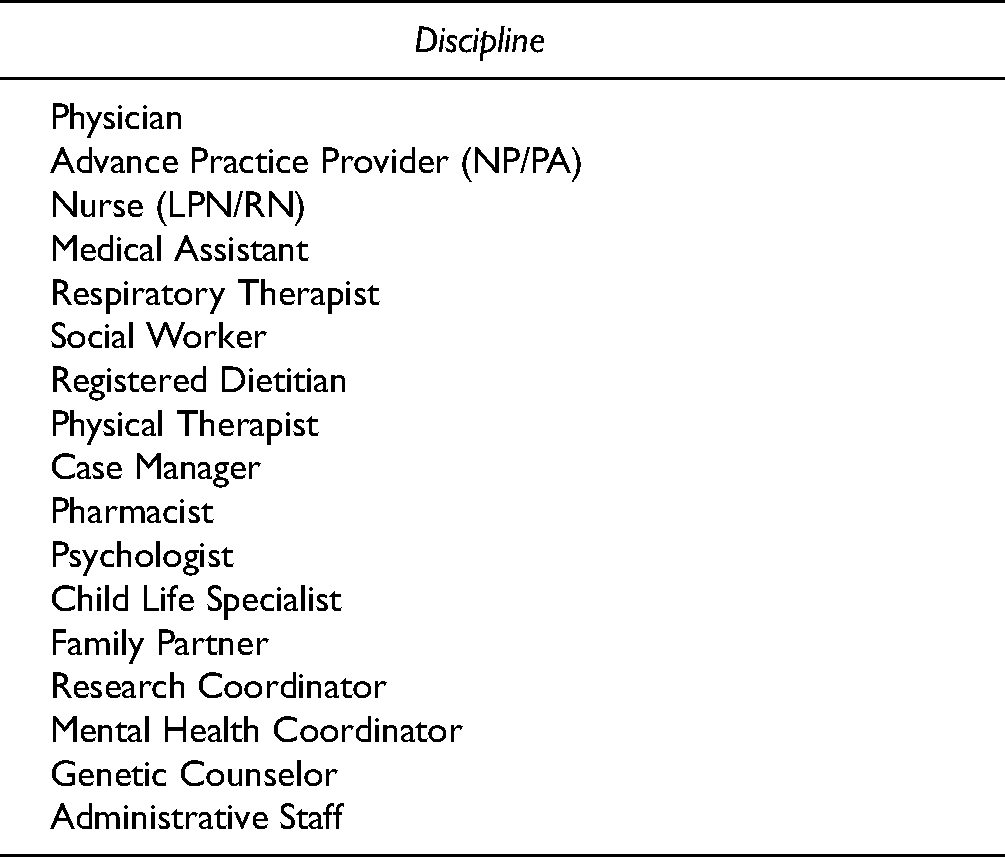
A total of 210 CF care team members participated in 20 PEP pilot workshops at 19 care centers throughout the US. These participants were from intact CF multidisciplinary teams, with 17 disciplines represented (Table 1). Among these teams some delivered care to pediatric patients only (n = 7, 35%), adult patients only (n = 3, 15%), with the majority of teams caring for people across their life span (n = 10, 50%). Although all participants were invited to give feedback on the training, a total of 175 individual comments were received from PEP participants, which includes feedback given during the group debrief and comments submitted anonymously on notecards. Thematic analysis resulted in 5 themes presented in the following section with verbatim examples for each in Table 2.
Care Team PEP Participant Discipline (n = 217).
Themes and Impactful Quotes.

Improved Quality of Communication
The first theme reflects the change in the quality of communication occurring as the result of the PEP training. In many cases, the improved quality of clinician–patient communication was the result of using open-ended questions, better listening skills, not interrupting, improved empathy skills, and making space for PwCF to express their emotions and goals. Many clinicians felt they would also be able to respond to PwCF and caregivers’ needs and concerns more effectively, and possibly in a more efficient manner. Others thought the improved quality of communication would result in improved adherence and outcomes for PwCF.
Strengthening Patient–Provider Connection
The second theme reflects that the PEP training will result in stronger patient–clinician connections and strengthened relationships which was represented across disciplines. Qualitative responses reflect increased patient/family partnership, increased patient-centeredness, enhanced relationships, and the hope of improved care, as the result of the PEP training. Other responses show that uncovering PwCFs’ emotions and concerns (vs those of the provider) is an expected result of the training. Several responses reflected that the PEP training may help providers’ judge PwCF less frequently, which some participants had noted was a problem previously.
Improved Skillfulness
The third theme reflected the tangible skills that participants learned, enhanced, or refined from the PEP training. Many providers referred to these skills as practical, stepwise, and productive. The skills were initially introduced in presentations, then shown in CF-specific examples that were first demonstrated by the PEP facilitators and then practiced by all attendees. Participants also valued the time to practice these skills using role-play centered on real-life scenarios that reflect what they experience in typical CF patient care. Several participants’ statements reflected the positive impact and elevated care that may result because the entire care team now possess the same skills to effectively communicate with PwCF and caregivers. Others pointed out that the improved skills would prioritize patient and family goals, improve satisfaction, efficiency, and possibly outcomes.
Improved Teambuilding
The fourth theme reflects teambuilding that occurred during, and as the result, of PEP training. Although the course is designed as clinician–patient relationship-centered communication training, the multidisciplinary team grew together as a result of experiencing the training together. Several participants remarked on getting to know their teammates better by learning about and from one another. In addition, several responses indicated the positive impact that “speaking the same language” would have on improved communication within the team.
Practice Enhancing/Practice Changing
The fifth theme represents the potential for personal practice enhancement, or transformation, which would result by using what was learned from the PEP training. Responses reflected participants' feelings that they could set a different, more patient-centered tone, in a clinic as well as endorsing the skills would empower them to tackle topics that were previously outside their comfort zone. In general, many participants felt their ability to empathize and increase trust from PwCF, would enhance their practice. Several responses indicate that participants were excited to incorporate the practical skills into clinical practice with PwCF and caregivers in the upcoming weeks.
Web of Interconnected Subthemes
One advantage of grounded theory is its simultaneous attention to deliberate process for thematic analysis while accounting for unique variations. Although reviewers ultimately agreed to the 5 themes described above, they also noted the overlapping and tightly intertwined relationship among them. Reviewers consistently noted that themes did not emerge as discrete entities but rather referred and relied on one another as part of the sense-making process, making the effort to tease them apart challenging. As such, a web of interconnected subthemes emerged. For instance, in response to, “What would you tell a colleague about this workshop?” participants often linked the experience of the workshop to improved patient care, as well as professional development for both the individual and the team saying things like: “The workshop helped to create better communication by teaching techniques and using tools to create relationships with our patients versus talking at our patients. It helps to improve adherence and hopefully outcomes for our patients,”
“"I was excited to do this together with our team; it gives us the opportunity to change the clinic culture together.”
“This was such a helpful workshop. I am excited to do a better job eliciting my patients’ needs and concerns – at the start of the patient visit. I feel this simple concept is transformative and will set the tone for what is to come.”
“I learned how to improve my empathy skills and allow the patient/family the time to express their emotions. It also improved my other communication skills to enhance my practice as a dietitian.”
What initially appeared as a challenge—identifying discreet themes—ultimately became the strength of the data as the reviewers recognized that the comments consistently embraced a systems perspective by reflecting the interconnection of skills, patient outcomes, personal competence, and team performance. Although all health providers work in a system, not all think systemically and embrace the rippling impact of introducing one intervention, such as setting an agenda with the patient. Although the individual responses might have touched on diverse reflections, the unifying element across responses was that they consistently highlighted the interconnection of ideas, experience, and potential.
The strength emerging among the PEP participants was their ability to report back more than workshop content and process, but rather link their PEP experience to larger implications in caring for PwCF and their families. Themes that emerged related to the improved quality of communication with an improved skillfulness that would also strengthen the patient/provider relationship included being able to “listen first” to the patient which participants imagined would lead to increased understanding and support. Other subthemes include increased empathy, trust, partnership, respect, and the ability to cocreate a shared and meaningful language with the patient (Figure 1). Many participants immediately linked this to improved relationships and improved outcomes for their patients. Some imagined they now had the skills to tackle the most difficult conversations, which they previously were afraid to broach with PwCF and their care partners. Others imagined how the approach could bring about true organizational change.

Web of connected subthemes. Note: this figure represents results from thematic analysis. The larger rectangles represent the 5 major themes and anchor the outside of the figure. The smaller boxes represent subthemes. Connection lines are drawn between themes and representing how themes and subthemes are interconnected and link back to each other resulting in a web of themes.
Discussion
Thematic analysis of PEP participants’ immediate feedback suggests that workshop participants consider the workshop a valuable experience. This is consistent with previous literature on relationship-centered communication skills for medical providers (12). It is important to note the value goes beyond a positive workshop experience and includes connections and references to improved patient care, professional development, enhanced teamwork, and a more robust culture of partnership.
Many people can imagine optimally partnering in care using complementary expertise, which is achieved by combining knowledge and experience from a CF clinician's years of experience providing care to PwCF with the unique personal lived experience PwCF have that comes from living with their unique expression of a chronic disease day in and day out. Although this may be easy to recognize and value, recent findings show distinct and notable discrepancies between how clinicians who value the coproduction of care envision partnership and how they implement it (16). Unfortunately, just because someone values and can imagine a skill, it does not make them adeptly skillful. Optimal coproduction is most likely to occur when a provider who wants to partner is armed with high-quality relationship-centered communication skills and has the support to practice and implement these new skills into their care routine.
Limitations
This study does have several limitations. Although this pilot took place geographically across 19 sites, it did take place entirely in the United States. Ongoing data collection from within the United States, and with larger international participation would help strengthen thematic analysis and ensure thematic saturation is met.
To our knowledge, PEP is the first relationship-centered communication training for fully intact multidisciplinary teams. It is possible that this type of training would produce similar results for other intact multidisciplinary teams caring for people with other chronic conditions; however, this pilot only involved teams caring for PwCF; therefore, it is unknown if similar themes would be found by other teams undertaking a similar training tailored to their specialty.
Lastly, the themes provided reflect how participants think the training will impact their practice as they use the skills in the future. It is important for future studies to explore if their perceptions were true by following up with workshop participants after they have actively used the skills from the training in practice for a length of time. This is an area of opportunity for future research.
Future Implications
There are several implications for this research within the CF community and beyond. The first is that CF teams respond well to and appreciate the opportunity to improve communication and care for the patients and families that they serve by developing their own communication skillfulness. Therefore, protecting time and providing the opportunity to participate in the PEP workshop are essential. The second implication is that participants value the chance to learn with other members of their team so that they can share understanding and experience. Therefore, PEP can serve as a team-building opportunity in addition to developing the skills on an individual basis. The fact that some participants imagined organizational change as a possible outcome from the training warrants further study. The third implication, as some teams in this pilot have chosen to do, patient and family representatives can be included in the workshop so that PEP lives its intention by not just promoting partnership but enacting it as well. This has the potential to equip PwCF and their family with skills to strengthen the communication bidirectionally.
Most importantly, the availability of CFTR modifying medications has changed the quality of life, and possibly the quantity of life, for many PwCF (17–19). As such, the trajectory of disease is now more uncertain, as well as the possibility of what the future may hold for PwCF. It is important for CF providers to learn and embrace skills to successfully partner with patients to discuss emotionally charged conversations that rely heavily on a common and meaningful language developed between the PwCF and their provider as well as the strength of the relationship between them. These conversations include sustaining daily care, family building, addressing pain, distressing symptoms/ palliative care needs, and lung transplant. PEP training has the ability to enhance the patient/provider connection and improve provider skillfulness with these conversations.
Conclusion
For PwCF sustaining daily care improves life span, but is difficult, multifaceted, and impacted by many barriers. To better support conversations around sustaining daily care and other high-priority topics, the CFF piloted 20 disease-specific relationship-centered communication workshops, PEP, at 19 care centers in the United States. Analysis of qualitative data from workshop participants shows that participants endorse improved skillfulness, quality of communication, teambuilding, a strengthening of the patient/provider connection, and that their practice would be enhanced by using the skills from the training. In addition, a web of themes shows the interconnected and amplifying impact of such skills on the healthcare system. These themes include improved empathy, trust, a common agenda, shared language, increased support, understanding, respect, efficiency, organizational change, and improved outcomes. If correct, this type of care could transform care delivery for PwCF and their families. Future studies are needed to learn if and how clinicians, and PwCF, feel their care interactions have changed after providers utilize skills from PEP.
Footnotes
Acknowledgements
Drs. Middour-Oxler and Hirschmann conceptualized and designed the study, coded participant responses into themes, drafted the initial manuscript, reviewed and revised the manuscript. Carol Chace coded participant responses into themes and reviewed and revised the manuscript. Lauren Collins utilized NVivo 12 software to facilitate participant analysis and reviewed and revised the manuscript. Chandra Gordon coded participant responses into themes and reviewed and revised the manuscript. Dr. Mann coded participant responses into themes and reviewed and revised the manuscript. Chandler Swope coded participant responses into themes and reviewed and revised the manuscript. Cynthia George coded participant responses into themes and reviewed and revised the manuscript. All authors have approved the final manuscript and agree to be accountable for all aspects of the work.
Authors’ Note
Participants provided informed verbal consent.
Declaration of Conflicting Interests
The author(s) declared the following potential conflicts of interest with respect to the research, authorship, and/or publication of this article: Lauren Collins, Chandler Swope and Cynthia George are employees of the Cystic Fibrosis Foundation. Carol Chace, Chandra Gordon, Dr. Mann, Dr. Middour-Oxler, and Dr. Hirschmann have received payment as a consultant/trainer for the Cystic Fibrosis Foundation.
Funding
The author(s) disclosed receipt of the following financial support for the research, authorship, and/or publication of this article: This work was supported by the Cystic Fibrosis Foundation.
