




Abstract
Background:
Research in pleural diseases has traditionally been neglected but is now growing.
Objectives:
This study aimed to analyze scientific research trends on pleural effusions over the last decades.
Method:
We conducted a bibliometric analysis of the Scopus database from its inception to March 2016, searching for original articles and reviews on “pleural effusion” (key word). Journal, year of publication, number of citations, authors and their affiliations, and the Hirsch (H)-index for some of these variables were recorded and analyzed.
Results:
A total of 15 982 documents were retrieved, of which half have been published in the last 18 years and a quarter during the last 8 years. Chest ranked first regarding the number of documents on pleural effusions (both absolute number and yearly rate) and their scientific relevance (H-index of 76). The United States had contributed the most to pleural research productivity (23%). American pulmonologists Dr Richard Light and Dr Steven Sahn exhibited the highest number of papers (206 and 156, respectively) and author H-indexes (44 and 38, respectively).
Conclusion:
There is growing research activity in the field of pleural effusions, which has gained relevance and visibility in clinical respiratory journals. The United States is the leader in quantity and quality of research productivity in pleural medicine.
Introduction
Pleural effusions arise from a variety of systemic, inflammatory, infectious, and malignant conditions. An estimated 3,000 people per million population develop a pleural effusion. 1 Although scientific research in pleural diseases has increased in recent decades, it seems that it has attracted far less attention than other less common respiratory conditions. 2
Scientific knowledge is mainly transmitted through publications. Journals play a crucial role in disseminating scientific work, evaluating, and peer-reviewing research. 3,4 Citation rates are the primary determinant used to evaluate the impact of published literature. The number of times an article is referenced by other authors is an important measure in assessing its quality. 5,6 In this sense, a number of studies have identified the top cited articles in various medical fields, including gastroenterology and hepatology, 7 respirology, 8 cardiology, 9 and emergency medicine 10 or in particular diseases such as tuberculosis. 11 Bibliometric measures, with a special emphasis on the Hirsch (H)-index and the number of citations, have increasingly attracted the attention of researchers. 12 -14 The H-index is defined as the number of published papers (N) that have been cited N or more times. For example, an H-index of 10 means that a specific author has published at least 10 papers that have each received at least 10 citations. 15 The H-index is the most commonly applied tool for evaluating scientific productivity since it combines both the quantity (number of papers) and the quality (number of citations) of publications. Although it was initially proposed for individual researchers, the H-index can also be applied to papers, journals, subjects, or countries.
To our knowledge, no comprehensive bibliometric analysis in the field of pleural effusion has been performed to date. This study was designed to evaluate trends in pleural effusion research using well-established quantitative and qualitative bibliometric indices, with information obtained from Scopus electronic database, and determine which journals, authors, and countries are steering the field of pleural medicine.
Methods
A bibliometric study on the pleural effusion field was conducted. Original articles and reviews were extracted from the Scopus electronic database, which was selected because it includes all MEDLINE journals while also allowing both citation analysis and key word searches. The Scopus database automatically generates lists with several variables that were recorded in the current investigation as follows: journal name, type of document (original or review), year of publication, number of authors and their affiliations, number of citations, and H-index metrics for documents, authors, journals, and countries.
Our search in the Scopus database using the key word “pleural effusion” was filtered by document type (“articles and reviews”), without language restriction, and excluded the veterinarian field. Therefore, other types of documents such as editorials, correspondence, or clinical cases were not considered. The online search was performed on March 12, 2016. Although Scopus dates back to 1823, more than 80% of the journal documents are from 1996 onward. 16
We identified the most productive (with most articles published) countries, journals, and authors and calculated their corresponding H-index. All participating countries from a single paper counted for metrics. For the initial analysis, journals with more than 100 documents on the subject during the total Scopus coverage time were recorded. However, analyses were repeated after selecting those journals with more than 50 documents during the last 20 years, in order to avoid time bias (i.e., older journals might be more represented due to the cumulative number of documents over time). The “American Review of Respiratory Disease” was renamed “American Journal of Respiratory and Critical Care Medicine” in 1994, and for this reason both were considered to be a single journal. We listed all the countries that accounted for half of the total documents and the authors with an H-index ≥15 concerning articles in the pleural disease field. Additionally, journal impact factors were obtained from the Journal Citation Reports (Web of Knowledge, Thomson Reuters, New York, NY). A comparison between the top ranked countries in the field of pleural effusions and those in other medical fields was based on data obtained from Incites Essential Science Indicators (Web of Science, Thomson Reuters). 17 The latter determines the most influential individuals, institutions, publications, and countries in 22 different research fields. We selected the “clinical medicine” field because it contained pleural effusion papers.
Statistical Analysis
The collected data were exported to the SPSS version 22 software (SPSS, Chicago, Illinois). Linear regression analysis was used to determine statistical trends over time. The Spearman test evaluated the correlation between the number of documents, impact factor, H-index, and number of journal citations.
Results
A total of 15 982 pleural effusion–related articles and reviews were indexed in Scopus from its inception to March 2016. Half of these papers (8065, 50.5%) were published during the last 18 years, and a quarter of them (4092, 25.6%) the last 8 years. The 2 oldest documents dated back to 1945. 18,19 The number of papers did not rise to more than 100 annually until 1963. Pleural effusion documents have significantly increased through the years (β = .121, P < .001, R 2 = .925; Figure 1). If this trend continues, it is estimated that 536 and 689 original and review papers per year will be published in 2020 and 2040, respectively.

Total number of published documents on pleural effusions by year. Each diamond symbolizes data for a given year.
Of the 157 journals in which pleural papers were identified, only 13 each have published more than 100 articles. Chest was the leading journal regarding absolute number of publications (711, including 669 original articles and 42 reviews), rate of original articles per year (14.5), and H-index (76). It was followed by Acta Cytologica and Diagnostic Cytopathology, with 206 and 186 documents, 3.6 and 5.7 originals per year, and H-indexes of 23 and 29, respectively. Other journals’ metrics are listed in Table 1. In order to exclude time bias, calculations were made based on the start year of publication of Respirology (1996), the newest journal (Table 2). Even so, Chest remained the top journal in the number of articles, followed by Diagnostic Cytopathology, Respiration, and Respirology.
Journals Containing More Than 100 Articles on Pleural Effusions During the Entire Scopus Time Span.

aCalculated for the collection of documents on pleural effusions.
bFormerly American Review of Respiratory Disease.
Journals Containing More Than 50 Articles on Pleural Effusions Starting From 1996.
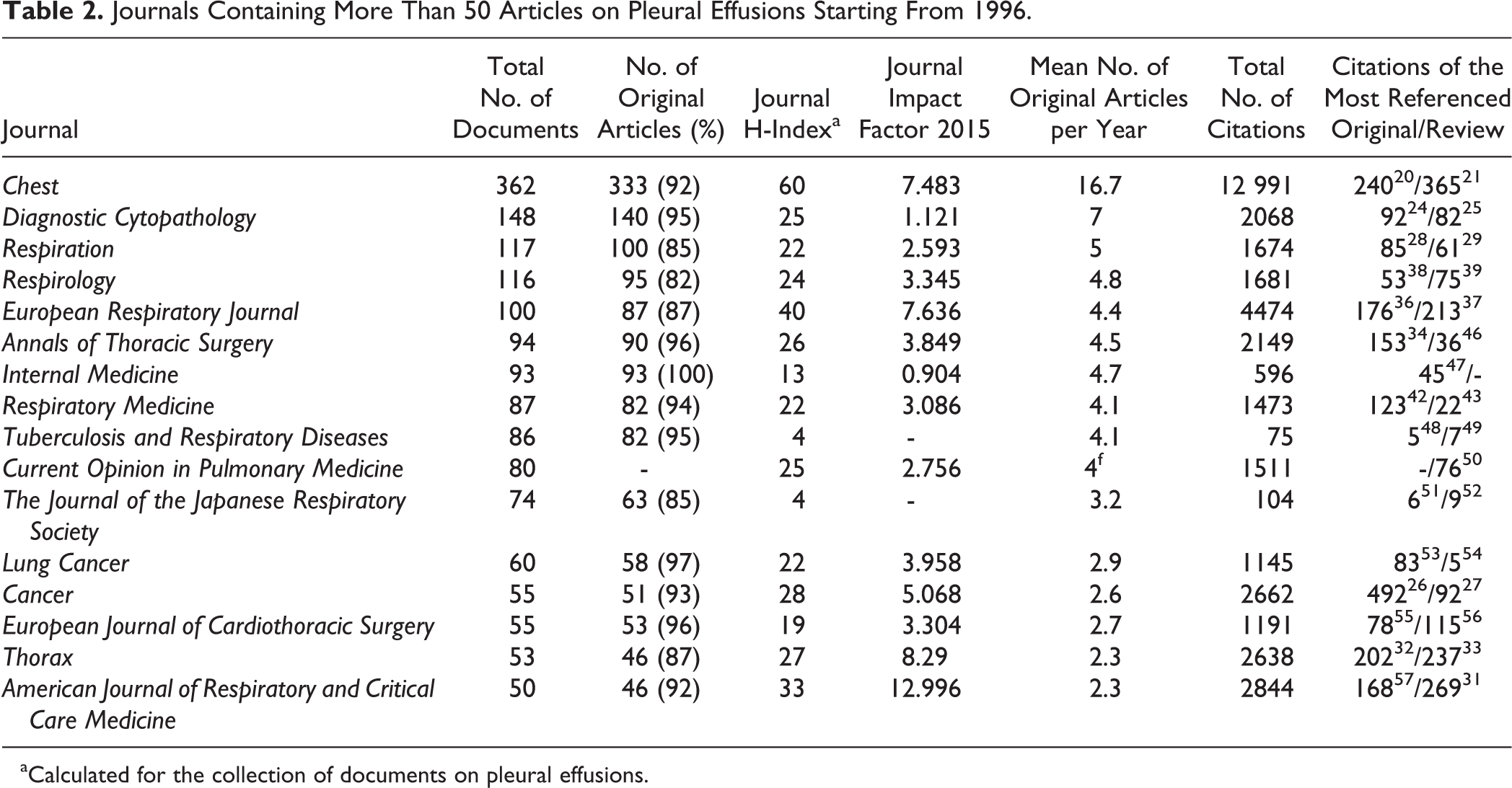
aCalculated for the collection of documents on pleural effusions.
The total number of documents of a specific journal did not predict its H-index or impact factor. However, a positive significant correlation existed between the journal’s H-index and either the impact factor (r = .773, P < .01) or the number of cites received by the most referenced paper (r = .798, P < .01) or the sum of citations for all pleural papers (r = .936, P < .01).
Twenty-nine countries were the source of more than 50 documents each. However, half the total papers came from 8 countries (Table 3), the United States ranking first regarding the number of publications on both pleural effusions and in clinical medicine fields. Of note, Spain, which ranked number 11 in clinical medicine, was fifth with respect to pleural documents.
Research Output of Different Countries on Pleural Effusions.

aCalculated for the collection of documents on pleural effusions in each country.
bAccording to Incites Essential Indicators by Thomson Reuters.
The most productive authors were Dr Richard Light (United States, 171 documents), Dr Steven Sahn (United States, 122 documents), and Dr José M. Porcel (Spain, 79 documents; Table 4). The first 2, along with Dr Ben Davidson (Norway), exhibited the highest personal H-index in the field of pleural medicine. Among those listed in Table 4, the most referenced paper, which refers to the classical criteria for separating exudates from transudates, was written in 1972 by Dr Richard Light. 58
Rank of Authors by H-Index Relating to Pleural Effusion Documents.

aAuthor H-index spanning all scientific topics.
bTotal number of documents spanning all scientific topics.
cAchieved by the documents in the preceding column.
Although a deeper evaluation of documents based on the etiological, diagnostic, or therapeutic aspects of pleural effusions (eg, malignant pleural effusions, pleural infection, pleural procedures, etc) was not performed, the combination of pleural effusion with other key words yielded the following numbers of documents: “diagnosis,” 4191; “malignant,” 3236; “tuberculosis,” 1818; “infection or parapneumonic,” 1761; “pleurodesis,” 1016; “procedures,” 716; “heart failure,” 702; and “hydrothorax,” 56.
Discussion
This is the first study that has quantitatively evaluated the academic literature on pleural effusion research. A recent bibliometric analysis of the top 50 cited respiratory articles did not include any related to pleural effusions. 8 Nevertheless, there has been a remarkable growth in pleural literature over the years. This might be not only due to general reasons such as the widespread use of Internet, which has allowed faster and broader dissemination of medical knowledge, or the current “publish or perish” climate, but also due to the increasing number of new pleural procedures (eg, bedside pleural ultrasound, local anesthetic thoracoscopy, indwelling pleural catheters) and therapeutic strategies (eg, intrapleural fibrinolytics, DNase, or saline irrigation).
Several medical databases currently in use are Pubmed, Web of Science, Google Scholar, and Scopus. A major disadvantage of PubMed is the fact that it does not provide citation analysis, 80 whereas the remaining 3 do. Web of Science and Scopus select peer-reviewed journals, although Google Scholar might be better able to record citations from books and nontraditional sources such as Web sites, dissertations, and open-access online journals. 5 For the purpose of this study, we selected Scopus because, unlike Web of Science, it permits a search using key words. Scopus, produced by Elsevier, is the primary world multidisciplinary bibliographic database. It is accessible online by subscription, contains 60 million records, and covers nearly 21 500 peer-reviewed journals including 100% of Medline coverage. 16
Bibliometrics have become increasingly important since the 1990s. The impact factor is the best known indicator of journal relevance. However, it has a limitation in that less than 20% of the articles from a journal account for more than 50% of the total number of citations, with many articles never being cited at all. The H-index is unaffected by this problem yet has other weaknesses (eg, citations need time to accumulate, 81 and, therefore, journals established in recent years may have lower H-indexes). It has now become the standard practice in bibliometrics to allow at least 3 years to obtain a reliable measurement on the impact of publications. 81 Top cited papers from authors with the highest H-indexes (Table 4) were published before 2010, with the exception of 1 original by Dr Gary Lee (year 2011, 151 cites) 63 and a review by Dr Shi (year 2013, 4 citations). 79
As expected, respiratory journals (eg, Chest, Respiration, Respirology, European Respiratory Journal) contributed the most to published articles on pleural effusion. Specifically, Chest has published a mean of 17 original papers per year during the last 20 years. However, journals from other areas such as cytopathology, oncology, or radiology also covered specific pleural research topics. Some of our findings are similar to those reported in other scientific topics, particularly that the United States dominates world scientific production. 8 -14
As in other citation analyses, several shortcomings need to be addressed in the current study. First, the exclusive use of pleural effusion as the search parameter may have resulted in the overlooking of some articles which employed other key terms (eg, empyema, pleurodesis, thoracentesis, etc). Even papers only marginally related to the topic might have been included if the authors chose to place pleural effusion among the key word list. Therefore, this limitation is author rather than database dependent. Second, only those journals that were indexed in Scopus were analyzed, and it should also be remembered that information from this database before 1996 may be incomplete. Moreover, Scopus sometimes misclassifies reviews or other documents as original “articles” and primarily organizes them by quantitative criteria rather than qualitative (H-index). Bibliometric indexes also have limitations. For example, the number of citations a paper receives usually increases with time, which may change its relative relevance. Consequently, it is not appropriate to compare articles with disparate years of publication or novice with established researchers since the former have had less time to be referenced than the latter. Therefore, it is possible that some promising authors in the field of pleural effusions do not appear in our analysis.
Conclusion
This study has provided an update on the growing research in pleural effusions over the last decades. It can help researchers to determine which journals are more likely to accept articles on this topic. Indeed, the future for the field of pleural medicine looks bright and promising.
Footnotes
Declaration of Conflicting Interests
The author(s) declared no potential conflicts of interest with respect to the research, authorship, and/or publication of this article.
Funding
The author(s) received no financial support for the research, authorship, and/or publication of this article.