




Abstract
Authentic assignments are defined as assessments that allow students to complete activities similar to those in which individuals in the field are engaged. They assess student achievement while helping students understand standards and challenges of the field. In this article, we describe the use of authentic assignments and class activities in a graduate-level nutrition policy course at a public university in North Carolina and evaluate outcomes related to students’ knowledge, comfort, and confidence in engaging in nutrition policy-related activities. The course included a variety of authentic assignments and activities, including a group policy brief project, letter to a legislator, case studies, and an elevator pitch on a nutrition policy issue. During the fall of 2020, students enrolled in two sections of the course (N = 72) were invited to complete a pre- and post-survey. Thirty-five students (49%) completed both surveys and were included in the analyses. There were significant increases in students’ comfort and confidence for engaging in nutrition policy-related activities. Students also appeared to have gained a better understanding of how they and/or their future profession are impacted by nutrition policy and how they and/or their future profession can play a role in nutrition policy. Authentic assignments may be helpful for preparing students to participate in the nutrition policy process.
Introduction
Nutrition policy is an important topic for dietetics and public health nutrition professionals. Policies at the federal, state, local, and organizational levels play significant roles in influencing dietary behaviors. It is important that dietetics and public health nutrition professionals understand how they and their professions are influenced by nutrition policy and have the confidence and skills to engage in nutrition policy-related activities. Dietetics and public health nutrition programs should provide students with opportunities to gain competence in activities related to nutrition policy. The Accreditation Council for Education in Nutrition and Dietetics (ACEND) and the Council on Education for Public Health (CEPH) include competencies related to policy as part of their accreditation standards (Accreditation Council for Education in Nutrition and Dietetics [ACEND], 2021; Council on Education for Public Health [CEPH], 2021).
Authentic assignments are defined as assessments that allow students to apply skills and knowledge under real-world scenarios. They replicate activities that individuals in a field may participate in and allow assessment of student achievement while allowing students to understand standards and challenges of the field (Wiggins, 2011). Research in social work and nursing has shown that students in policy courses that incorporate authentic assignments and class activities have improved knowledge, motivation, confidence, and skills for engaging in policy-related activities. A systematic review of policy practice education in social work programs identified a variety of active learning and hands-on experiential learning activities related to real-world policy activities, such as case studies, simulations, policy analysis, policy briefs, service learning projects, structured debates, and writing letters to legislators (Weiss-Gal, 2016). Evaluations of these types of strategies suggest that different active learning strategies may influence knowledge, perceptions, self-efficacy, skills, and behavior related to policy practice (Weiss-Gal, 2016). As an example, a course for social work students included four experiential assignments (policy brief, policy advocacy plan, implementing a step of the policy advocacy plan, and personal essay analyzing their practice experiences) and examples of “real-world” cases of organizational, local, and national policy advocacy processes (Schwartz-Tayri et al., 2021). Schwartz-Tayri et al. (2021) found increases in policy advocacy motivation (willingness to get involved with advocacy activities), political efficacy (confidence in ability to participate politically), political advocacy skills (belief in having skills needed to engage in policy advocacy), and political advocacy knowledge (exposure to strategies for influencing policy) (Schwartz-Tayri et al., 2021). The researchers also performed a path analysis that found that increases in political advocacy knowledge and political efficacy led to increases in policy advocacy skills, which led to the increase in motivation to engage in policy advocacy (Schwartz-Tayri et al., 2021).
An evaluation of a health policy course for Masters of Science in nursing students that included activities and assignments such as a current affairs discussion, federal budget exercise, group analysis of policy issues, and a policy analysis paper found that students improved their perceived political skills, political knowledge, understanding of political context and political motivation/interest from a pre- and post-survey administered during the first and last class meetings (Rains & Carroll, 2000). Byrd et al. (2004) focused on a public/community health nursing course for Bachelor of Science in nursing students that incorporated public policy learning activities including information sessions and tours of the Rhode Island Department of Health and State House, a legislative assignment where students contacted their state representative or senator, and a public policy group project where students explored a health issue with public policy implications and developed a plan for addressing the issue. Students in the course improved their intentions to engage in policy-related activities and demonstrated competence on their public policy projects (Byrd et al., 2004).
In the present paper, we describe the use of authentic assignments and class activities in a graduate-level nutrition policy course at a public university in North Carolina and evaluate outcomes related to students’ knowledge, comfort, and confidence related to engaging in nutrition policy-related activities.
Course Overview
The graduate-level nutrition policy course covered a variety of topics related to nutrition policy including an overview of the United States policy process, relevant federal agencies, interest/consumer advocacy groups, how research informs policy, equity and diversity, sustainability and health, key United States nutrition-related legislation, and federal nutrition assistance programs. A variety of examples of local, state, federal, and international food and nutrition policies were discussed. The course included pre-recorded lecture videos and online activities completed in advance of weekly class meetings. Guest speakers were incorporated into the course to share their real-world nutrition policy experiences. Instructors and students also shared their own nutrition policy-related experiences throughout the course.
Authentic Assignments
Throughout the course, students completed a variety of authentic assignments and class activities. Authentic assignments and activities included a group policy brief project, a letter to a legislator, case studies, and an elevator pitch on a nutrition policy issue.
The main authentic assignment the students completed was a group policy brief project, which consisted of multiple components completed over the course of the semester. Students started by selecting a nutrition-related issue that could be addressed by a nutrition policy. Their first step was to write a group paper identifying the nutrition-related issue they planned to address, the policy level (i.e., organizational, metropolitan, state, federal), geographic region of focus, and population of interest, including background on the issue and its significance. In the next assignment, student groups were tasked with proposing two potential policy options for addressing their issue, describing the strengths and weaknesses of each, specifying their sense of the political environment in terms of likeliness for the success of the policy, and the policy option they selected and why. Students then wrote a paper describing stakeholders with a potential interest in their proposed policy, how these stakeholders would be influenced by the policy, and whether they would support or oppose it. One of the main components of the policy brief project was the development of a policy drop sheet that could be shared with legislators or other community leaders to encourage them to take action on the proposed policy. Students also developed an evaluation plan for their proposed policy. Students worked together with their group to complete each component of the project.
In addition to the policy brief, students engaged in a variety of other authentic assignments. Students wrote a letter to a legislator they identified on a nutrition policy-related topic of their choice. One of the in-class activities involved students delivering a brief, 2-min elevator pitch on a policy topic to help build their skills with concisely communicating policy issues and ideas to legislators. These authentic assignments were meant to help students go through the process of developing a policy idea and advocating for it in different ways. Additional authentic assignments, such as case studies, were also included in class sections so students had additional opportunities to practice applying what they learned to address nutrition-related challenges. Case studies helped students learn more about topics such as Gap Certification and how that relates to farms being able to sell produce to schools in North Carolina. Students also completed a case study on the Good Food Purchasing Program, which encourages institutions to incorporate five core values: environmental sustainability, nutrition, local economies, valued workforce, and animal welfare into their buying (Center for Good Food Purchasing, n.d.), and how that could be applied to university dining services.
Additional Assignments
Students also completed an informational interview with an individual engaged in nutrition policy. Students were able to select an individual of their choice doing work related to nutrition policy to learn more about that person’s involvement in policy or advocacy efforts. As a way to explore additional nutrition policy topics, students completed a discussion board activity where they wrote about a nutrition-related policy issue and responded to at least three of their classmates’ posts.
Evaluation
Participants
This evaluation was conducted during the fall of 2020. Two sections of the course were offered—one for students in the residential program and one for students in MPH@UNC, which is a fully-online Master of Public Health program. Due to the COVID-19 pandemic, both sections were offered online. The course is required for Master of Public Health students in the Nutrition and Nutrition and Dietetics concentrations and offered as an elective to others. During the fall of 2020, 56 students were enrolled in the residential section and 16 were enrolled in the MPH@UNC section. This evaluation was reviewed by the Institutional Review Board (IRB) at the university where the course was offered and determined not to constitute human subjects research as defined under federal regulations and therefore IRB approval was not required.
Survey Instrument and Analysis
Students were invited to complete an optional pre- and post-survey at the beginning and end of the course that was not part of the course grade. The survey was administered via Qualtrics and was not anonymous as student names were used to facilitate matching of pre- and post-surveys. Survey items were developed by the authors. Students responded to two open-ended items about how they and their future profession are impacted by nutrition policy and how they and their future professions can play a role in nutrition policy. The responses to these items were analyzed by comparing pre- and post-responses provided by students and coding any changes in Excel.
Comfort in engaging in nutrition policy-related activities was assessed by a question where students were provided with a list of four nutrition policy-related activities and were asked to rate their comfort with each of these activities on a scale of 1 (not at all comfortable) to 5 (very comfortable). Cronbach’s Alpha was .92 for the pre-survey and .86 for the post-survey. Confidence in engaging in nutrition policy-related activities was assessed by a question where students were provided with a list of 11 nutrition policy-related activities and were asked to rate their confidence with completing each of these activities on a scale of 1 (not at all confident) to 5 (very confident). Cronbach’s Alpha was .93 for the pre-survey and .91 for the post-survey. Questions on confidence were intended to assess self-efficacy, which predicts behavior according to Bandura’s Theory of Self-Efficacy (Bandura, 1977). Activities assessed through the comfort and confidence questions were selected primarily based on course assignments and activities completed during the course. Statistical significance for changes in confidence from pre- to post-survey was assessed using paired t-tests. Statistical significance was considered p < .05. SAS version 9.4 was used for statistical analyses.
Evaluation Results
Forty students completed the pre-survey and 52 completed the post-survey. A total of 35 students (49%) (24 students [43%] in the residential section and 11 [69%] in the online section) had matched pre- and post-surveys and were included in the analyses. Among students in the residential section, 18 were MPH students in the nutrition/Registered Dietitian concentration, two were MPH students in the nutrition concentration, and four were PhD students in nutrition. Among students in the MPH@UNC section, all were MPH students and three had a concentration in nutrition, six had a concentration in leadership, and two had a concentration in health policy.
Table 1 shows changes in students’ comfort with engaging in nutrition policy-related activities. There was a significant increase in confidence for meeting with a legislator or staff member, arguing for/against a policy, cold calling a policy staffer in an agency, and submitting a comment about a proposed piece of legislation. The mean score at the beginning of the course indicated students were somewhat uncomfortable with these activities and at the end they were somewhat comfortable.
Changes in Comfort for Engaging in Nutrition Policy-Related Activities (n = 35).

Note. Students rated comfort on a scale of 1 (not at all comfortable) to 5 (very comfortable).
Table 2 shows student-rated confidence for engaging in nutrition policy-related activities. There was a statistically significant increase in confidence for engaging in all activities assessed (p < .001). Mean pre-ratings ranged from 1.83 (SD: 1.01) for writing an effective letter to a legislator to 2.97 (SD: 1.04) for identifying key stakeholders who may have an interest in particular food and nutrition policies and knowing where to begin looking for resources or evidence (SD: 1.15). Mean post-ratings ranged from 3.51 (SD: 1.15) for delivering an elevator pitch to a policy maker on a proposed policy to 4.34 (SD: 0.68) for identifying key stakeholders who may have an interest in particular food and nutrition policies.
Changes in Confidence for Engaging in Nutrition Policy-Related Activities (n = 35).
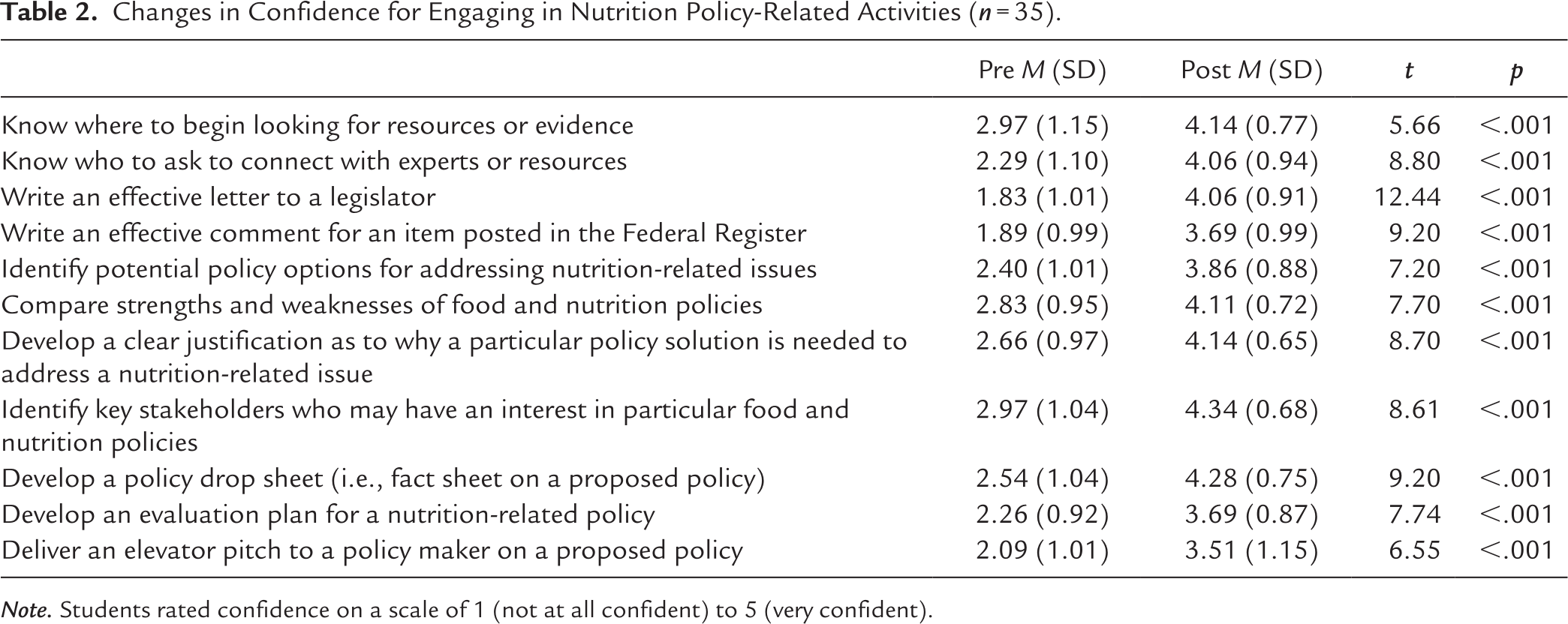
Note. Students rated confidence on a scale of 1 (not at all confident) to 5 (very confident).
At the end of the course, many students expressed having a better idea of how they and/or their future profession was impacted by nutrition policy in the item that asked, “Describe how, if at all, you and/or your future profession are
Residential MPH/RD student:
Pre: Unsure! I feel pretty uncomfortable overall with nutrition policy and would not yet know how to articulate this. If I were to work in public health, there would likely be a translation of assessing community needs into advocacy work, but this is not something I have experience with.
Post: I think this course has really taught me how there is not any area in nutrition that is not impacted by nutrition policy. One of the most insightful parts of this class was the discussion forum post, where classmates posted about a wide variety of nutrition policy that they had an interest in. There were policies about supplements, eating disorders in Medicare, senior nutrition, child nutrition, dietetics education, etc. It was really enlightening how our field is so interwoven with policies at all levels.
Residential MPH/RD student:
Pre: I get emails from NEDA (National Eating Disorders Association) and sometimes they talk about policies that have been passed or are in process, so I know eating disorder treatment is impacted by policy, but I’m not sure how yet.
Post: Lots of policy work with eating disorders as I learned from this class (Eating Disorders Prevention in Schools Act, The Nutrition CARE Act, etc.)
Students were able to describe ways they and/or their future profession can play a role in nutrition policy when responding to the following item: “Describe how, if at all, you and/or individuals in your future profession
Residential PhD student in nutrition
Pre: In my future career, I hope to take an active role in advocating for policies that help create a more just food system.
Post: I could easily see myself commenting on policies or even advocating for or against them in person (although, that would make me nervous). I could see myself actively developing organizational policies.
Residential MPH/RD student:
Pre: We can advocate for certain policies, write policies, implement policies, and evaluate policies.
Post: I can be an advocate for policy changes, help educate policymakers and the public on issues. Write letters to legislators. Comment on bills. Write media blogs or go on radio shows/talk shows to talk about my expertise in the field of nutrition.
Discussion
We found the use of authentic assignments in our nutrition policy course to be a best practice. Authentic assignments allowed the course to go beyond just increasing students’ knowledge about nutrition policy; they helped prepare students to engage in nutrition policy-related activities. Students were able to apply skills through real-world scenarios including developing a policy brief, writing a letter to a legislator, completing case studies, and delivering an elevator pitch on a nutrition policy topic. The use of authentic assignments helped increase students’ comfort and confidence for engaging in nutrition policy-related activities. This may increase their motivation for engaging in the policy process. The findings suggest students may have gained a better understanding of how they and/or their future profession are impacted by nutrition policy and how they and/or their future profession can play a role in nutrition policy, although there were some limitations to the items used to assess this.
Limitations
This evaluation did not include a control or comparison group. It is possible that changes in responses from pre- to post-survey could be due to factors other than this course. Another limitation is that the surveys were administered by the course instructor and there may have been social desirability bias in the way students responded, particularly with the surveys not being anonymous. The pre- and post-surveys were not a required part of the students’ grades, so many students chose not to participate, thus it is possible there were differences in the students who chose to participate and those who did not. The items did not undergo cognitive testing. The responses to the open-ended items on both the pre- and post-survey for many students were fairly broad, so if the survey is used again, modifications to item wording could be considered. For example, in response to the item about how they and/or their profession can play a role in nutrition policy, many students mentioned advocacy, but did not give specific examples of what they could do to advocate for policies. This limited the ability to fully assess these outcomes of the course.
Strengths and Next Steps
We were able to evaluate a graduate level course offered during a time of uncertainty due to the COVID-19 pandemic when learning might have been affected, and we received a good response rate. Moreover, the course is expected to grow in size, and these authentic assignments are likely to work as well even in larger class sizes (with some tweaks) given their applied nature which allows for student preferences over topics/issues, while also providing a greater breadth of topics students may become exposed to based on the diversity of topics chosen across students.
Conclusions
Authentic assignments appeared to be helpful for preparing students to participate in the nutrition policy process. These types of assignments may be beneficial for courses such as nutrition policy as they allow students to gain experience completing “real-world” activities similar to those performed by professionals in the field.
Footnotes
Declaration of Conflicting Interests
The author(s) declared no potential conflicts of interest with respect to the research, authorship, and/or publication of this article.
Funding
The author(s) disclosed receipt of the following financial support for the research, authorship, and/or publication of this article: This work was supported by a large course redesign grant from the Center for Faculty Excellence at the University of North Carolina at Chapel Hill.
