




Abstract
Objectives
A key goal of schools and programs of public health is to prepare graduates for careers in the public health workforce after graduation, but are they achieving this goal? We assessed how the employment outcomes of students earning public health degrees are collected and described in the literature.
Methods
Using the Kirkpatrick model of training evaluation as a framework, we conducted a 6-step scoping review: (1) formulating the research question, (2) identifying relevant studies, (3) selecting studies, (4) charting the data, (5) collating and summarizing the results, and (6) consulting stakeholders. We included articles published from January 1, 1993, through July 4, 2020, that provided data on employment status, employment sector/industry, job function, or salary of public health graduates. We excluded articles that were not written in English and were about dual-degree (ie, doctor of medicine–master of public health) students. We found and reviewed 630 articles.
Results
We found 33 relevant articles. Most articles focused on a single school and combined multiple graduating classes, focused on subspecializations of public health, or focused on graduates’ satisfaction with their curriculum but not employment outcomes. Data were inconsistently categorized, and studies were difficult to compare.
Conclusions
Research on public health graduates’ employment outcomes is scarce and does not follow consistent protocols. New standards should be adopted to systematize the collection of data on employment outcomes of public health graduates.
In addition to their missions of research and service, schools and programs of public health are charged with preparing public health professionals, defined as “a person educated in public health . . . who is employed to improve health through a population focus.” 1 Schools and programs of public health worldwide share this mission. The focus of the Council on Education for Public Health (CEPH) is “the assurance of professional personnel who are able to identify, prevent and solve community health problems.” 2 The focus of the Association of Schools of Public Health in the European Region is to improve the education of public health professionals. 3 The purpose of the Council of Academic Public Health Institutions Australasia is to ensure academic quality in the training of public health practitioners and researchers, 4 and the Association of Schools of Public Health in Africa has a similar mission. 5 Thus, if graduates of schools and programs of public health do not find employment in public health after graduation, it can be argued that these schools and programs are not achieving their missions. Because such schools and programs supply trained professionals for the public health workforce, including professionals who contribute to the 10 essential public health services, 6,7 the employment outcomes of their graduates are a key factor in workforce planning.
Concerns about employment outcomes of university graduates have been growing for several years, 8 and employment outcomes of public health graduates raise particular concern. Although enrollments in public health degree programs have not increased consistently in other countries, 9 the number of graduates with a master’s degree in public health in the United States increased from 4481 in 1992 to 17 948 in 2019, 10,11 and the number of graduates with a bachelor’s degree in public health increased from 759 in 1992 to 17 156 in 2019. 11,12 Meanwhile, overall employment only grew 1.3% per year from 2010 to 2020, 13 and US governmental public health staffing shrank, 14 potentially leading to an oversupply of public health graduates.
In addition, since the seminal 1988 report The Future of Public Health, 15 concerns have been raised that US schools and programs of public health are not as connected as they should be to the government public health workforce (including federal, state, and local health departments). The report noted, “While . . . public health professionals work in a variety of settings, there is a special relationship with the governmental public health agencies at the local, state, and federal level.” 15 This disconnect is especially important because of a documented shortage of public health workers in the United States. 16,17 Similar concerns about a possible workforce shortage have also been raised in Europe. 9 However, even with a large supply of new graduates, a labor market mismatch might occur if too few graduates choose government employment and large retirements of government workers are predicted. 18,19
Since 1993, US schools and programs of public health have been required to report employment outcomes to CEPH 2 to maintain accreditation. Other initiatives that measure postgraduate employment and educational outcomes have also been created, including the National Association of Colleges and Employers (NACE) First Destination Survey of employment outcomes of US college graduates 20 ; the US Department of Education’s College Scorecard, 21 which includes data on college graduates’ median salaries and student loan debt in the United States, measured 1 year postgraduation; the Graduate Outcomes Survey in Australia, 22 an employment outcomes survey that is similar to NACE; and a new unpublished data collection of postgraduate employment and educational outcomes, measured 1 year postgraduation, by the Association of Schools and Programs of Public Health (ASPPH). 23
However, it is unclear what research has been published on the postgraduate employment outcomes of public health students. One of the authors (H.K.) conducted a search for existing systematic or scoping reviews in the Joanna Briggs Institute Database of Systematic Reviews and Implementation Reports, Cochrane Database of Systematic Reviews, and Evidence for Policy and Practice Information and Co-ordinating Centre for “public health” and “employment” but found no reviews of employment outcomes of public health graduates. Two review articles were found, neither of which focused on employment; 1 review included multiple health disciplines 24 and the other focused on pedagogical evaluation. 25 The objective of our study was to examine how data on employment outcomes of students earning public health degrees at the graduate and undergraduate levels are collected and described in the literature using a scoping review.
To provide a theoretical framework for this study, we selected the Kirkpatrick model, 26 which is used to evaluate training programs. This framework was used in 1 review article 24 and was used to evaluate other public health education programs. 27 -30 The model describes 4 levels of evaluation: (1) reaction, which focuses on whether participants experience the training as positive, helpful, engaging, and relevant; (2) learning, which is assessing whether participants acquire the expected knowledge, skills, attitude, or self-efficacy; (3) behavior, which is measuring whether participants apply their training in real-world situations; and (4) results, which is determining whether intended outcomes occur as a result of the training. 26 We defined the postgraduate employment outcomes of public health graduates as a fourth-level evaluation. Our goal was not to contrast employment outcomes themselves but to determine what research has been conducted and assess how data on employment outcomes have been collected and reported.
Methods
Scoping is used to identify gaps in research, clarify key ideas, and report on the types of evidence used to assess practice in the field. 31 A scoping review has 6 steps: (1) formulating the research question; (2) identifying relevant studies; (3) selecting studies (using an iterative approach); (4) charting the data (including both numerical summary and qualitative thematic analysis); (5) collating and summarizing the results, including identifying implications of the findings for policy, practice, or research; and (6) consulting stakeholders. Scoping reviews differ from systematic reviews in that study quality is not assessed; there is a requirement to identify all literature regardless of study design. 32 Scoping reviews have been used in several studies to assess the public health workforce. 33 -37 Our scoping review attempted to answer the question, “How are employment outcomes of students earning public health degrees at the graduate and undergraduate levels collected and described in the literature?”
Scoping and Searching/Consultation
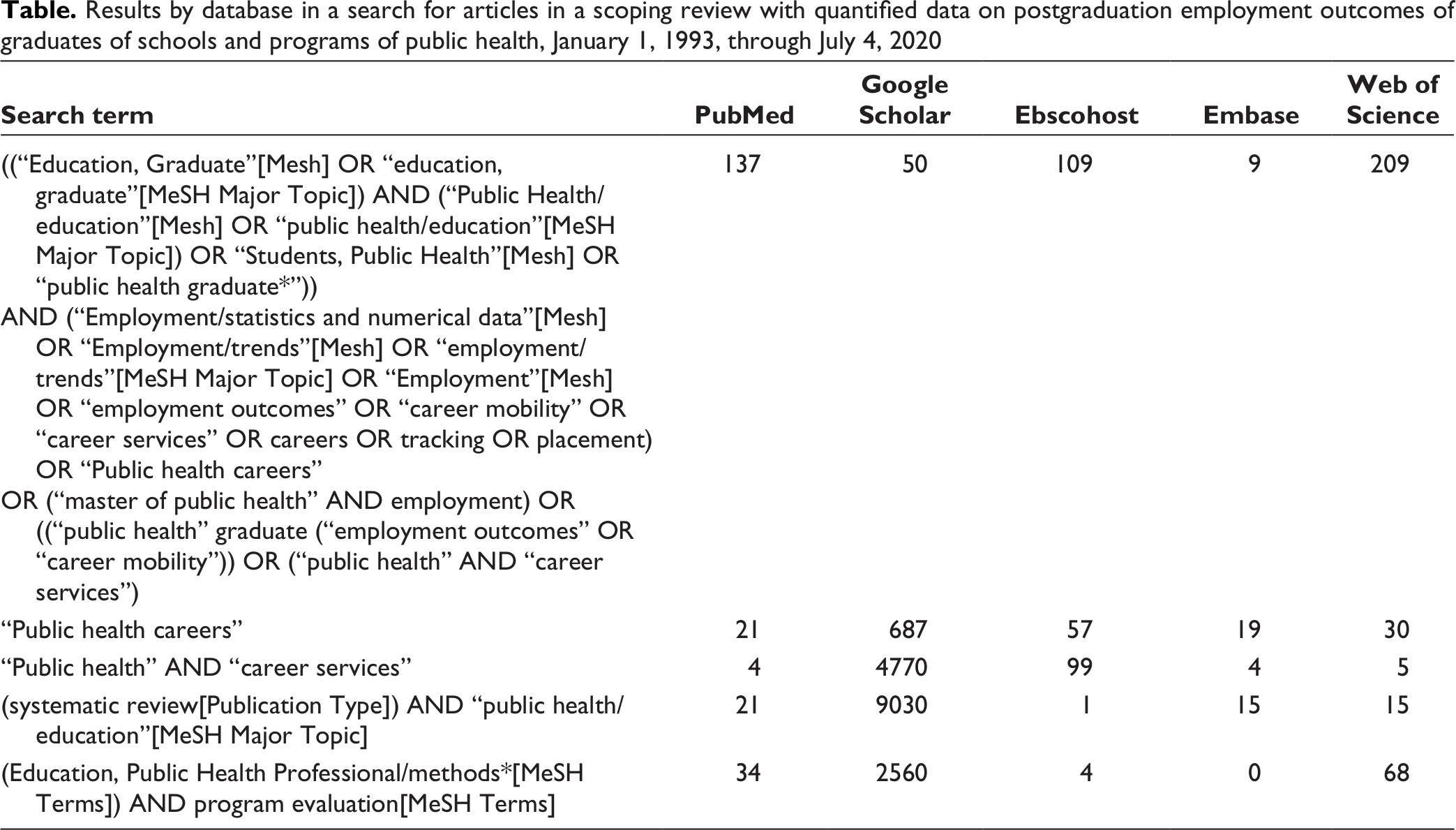
We searched a broad range of databases, including PubMed, Ebscohost, Embase, Web of Science, and Google Scholar (Table). We extracted and uploaded all results except those from Google Scholar into Covidence (Covidence), a software that facilitates systematic or scoping reviews. We asked experts from CEPH, ASPPH, and NACE if additional research was available. A researcher from ASPPH supplied 3 additional articles not otherwise identified, 1 of which was included in the final analysis. In addition, because reports on employment outcomes may be presented on university websites or in reports by professional societies, we searched the gray literature and conducted general Google searches for comparable search terms. The lead author (H.K.) also searched the references of the selected articles and was referred to 2 articles by an informaticist.
Results by database in a search for articles in a scoping review with quantified data on postgraduation employment outcomes of graduates of schools and programs of public health, January 1, 1993, through July 4, 2020
We developed the final protocol using the Preferred Reporting Items for Systematic Reviews and Meta-Analyses protocols (Scoping Extension) 38 and registered the final protocol with Open Science Framework Registries. All sources were publicly available and did not require institutional review board approval.
Identifying and Selecting Variables
We included studies on students who obtained an undergraduate or graduate degree in which their major was public health or a related subdiscipline, such as epidemiology, global health, health policy, or health communication, and that included quantified data on any of the following: status of employment (employed full-time or part-time, unemployed/job seeking, unemployed/not job seeking, or continuing study); employment sector (government, hospital/health care, for-profit, nonprofit); job function; or salary (Box). We excluded articles that focused on students of medicine, nursing, dentistry, social work, or business that did not include outcomes on public health graduates; articles focused on fellowships, internships, or short-term traineeships that did not result in an academic degree; articles that did not include quantitative data on employment (but rather focused on educational satisfaction, qualitative descriptions of curricula, or practica); surveys or expert panels of employers; and articles not written in English. We also excluded articles that focused on dual-degree programs (eg, doctor of medicine–MPH, master of social work–MPH) because the employment outcomes of dual-degree graduates would likely differ from the outcomes of non–dual-degree graduates. Our time frame for the search was all articles published from January 1, 1993, through July 4, 2020; we chose 1993 because it is the year CEPH began requiring students to complete a practicum, which would affect employment (Box).
Inclusion and exclusion criteria used to screen and select articles for inclusion in a scoping review of postgraduation employment outcomes of graduates of schools and programs of public health, from January 1, 1993, through July 4, 2020
Population of interest: students who obtained a degree from a school or program of public health (at the undergraduate or graduate level) where the “major” was public health or a related subdiscipline, such as epidemiology, biostatistics, global health, health policy and management, health communication, health education, or environmental health.
Outcome of interest was employment, including quantified data on any of the following:
Status of employment (employed full-time, part-time, unemployed/job seeking, unemployed/not job seeking, or continuing study)
Sector of employment/type of employing organization (eg, government agency, hospital/health care, for-profit company, nonprofit organization)
Job function (eg, program management, researcher, public health educator)
Job level (entry-level, mid-career, executive) or salary
Articles focused solely on students of medicine, nursing, dentistry, social work, health care business administration, master of health administration or master of business administration in health care administration graduates, or other health-related educational programs but that did not also include outcomes on students of public health
Articles that did not include quantitative information on employment outcomes (but rather focused on items such as satisfaction with the education program or competencies gained, qualitative descriptions of programs, practica, alumni perspectives on the effect of the program on competencies or career growth in general)
Surveys or expert panels of employers who might hire public health graduates but did not specify the employment outcomes of graduates themselves
Articles not written in English
Articles written before 1993
Articles about graduates of dual-degree programs (ie, doctor of medicine–master of public health [MPH], master of social work–MPH)
Two authors (K.S. and H.K.) independently reviewed the titles and abstracts of all articles and made decisions on inclusion by consensus. One author (H.K.) reviewed all articles selected for full review, and 2 authors (O.G. and K.S.) each reviewed half of the total group selected for full-text review.
Data Abstraction and Charting
After consensus was reached, 1 author (H.K.) charted the selected articles in Excel with input and review from 2 other authors (O.G. and K.S.). We contacted the authors of 2 articles to clarify data.
The data chart included study characteristics (geographic location of study participants, population surveyed, whether the survey was of a single school or multiple schools, whether multiple graduating classes were included, the number of surveys and responses), the quality of the study, the Kirkpatrick evaluation level, and the outcomes (including employment status, employment sector/industry, job function, and/or salary). Articles rarely included data for all characteristics.
Data Analysis
Because of the inconsistency of research methods used in the articles, comparing outcomes among reports was not possible. In addition, scoping reviews do not seek to synthesize or aggregate findings from different studies. 32 Because this study was a scoping review, we did not formally rate the quality of study designs, but we did use a modified version of the Newcastle-Ottawa Scale, adapted for cross-sectional surveys. 39 However, we conducted a narrative/thematic analysis of the research.
Results
A total of 861 articles were uploaded to Covidence, of which 231 were duplicates, resulting in 630 unique articles; 41 articles were found relevant for full-text review, of which 23 were included in the study (Figure). We included an additional 10 articles that met the inclusion criteria, which we found through reference searches, Google, and referral by stakeholders and informaticists, for a total of 33 articles (see Supplemental Table in Supplemental Material online).
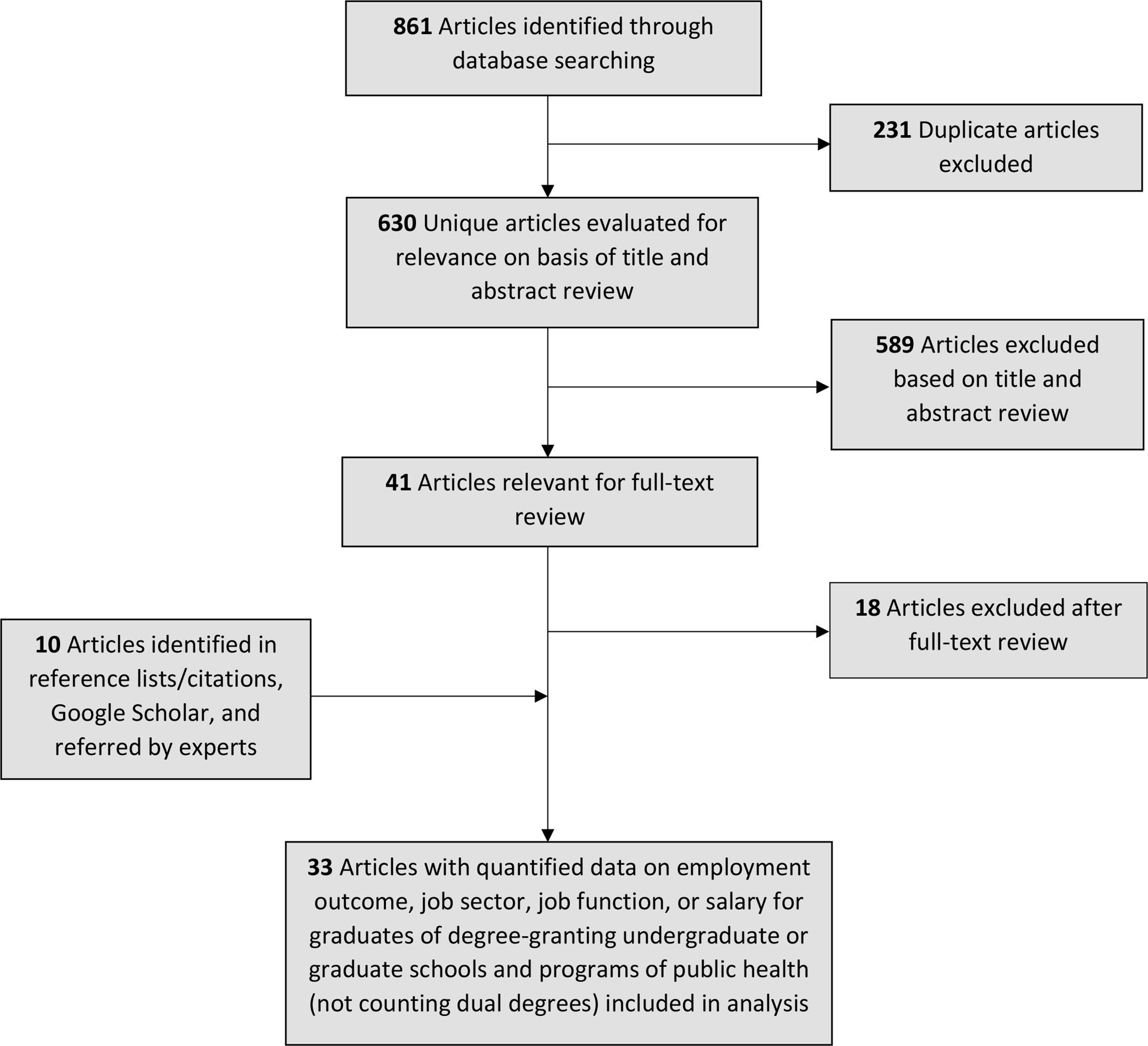
Flow chart of the screening process used to identify articles for a scoping review that included quantified data on employment and other postgraduate outcomes of graduates of schools and programs of public health, published from January 1, 1993, through July 4, 2020.
Study Populations: Geographic Locations and Areas of Study
Twenty-three articles or reports focused on graduates of degree programs in the United States. Two articles focused on graduates of schools or programs of public health in multiple countries, 3 focused on Australia, 2 focused on Canada, and 1 each focused on Vietnam, the United Kingdom, and South Africa. Fourteen articles focused on subareas of public health (3 on health communication/education, 40 -42 3 on maternal and child health, 43 -45 5 on global health, 46 -50 1 on industrial hygiene, 51 1 on nutrition, 52 1 on Aboriginal health), 53 5 articles focused on undergraduates, 54 -58 and 3 articles focused on doctoral graduates. 45,59,60 Two articles focused on postgraduate employment outcomes of a subset of graduates who had previously participated in a volunteer program, 57,61 and 1 focused on international students. 62 Four themes emerged: variability in study methods, inconsistency in study timing, disparate quality of studies, and the employment outcomes themselves.
Study Methods
Seventeen studies were surveys of the alumni of a single school or program of public health using mail, telephone, or online survey methods. 40,44,45,48,50,52 -55,57,58,61 -66 Three studies were surveys sent to graduate programs, 41,43,67 7 were surveys of alumni of multiple schools or programs of public health, 11,42,46,47,49,56,68 2 were based on nationally collected surveys of doctoral recipients in the United States, 59,60 3 were national data collections from numerous schools and programs of public health, 11,20,22 and 1 used data from the published websites of multiple schools and programs of public health. 63
We found only 4 reports, all published since 2014, that included an analysis of multiple schools in the United States and were not focused on subareas of public health, 2 of which were in the gray literature. 11,20,23,63
Study Timing
The timing of the survey distribution was inconsistent. Sixteen studies combined all survey responses of alumni from several graduating classes. 40,42 -48,50,51,57,58,62,64,66,68 However, by mixing the employment outcomes of recent graduates with the employment outcomes of graduates who had years of experience, it was not possible to discern how their training affected them during their career. Seven studies used protocols in which a consistently defined cohort year of graduates was surveyed at a consistent and specific number of months postgraduation (typically 6 months or 1 year after graduation); used 1 or multiple graduating cohorts from the same school or program of public health, each measured at consistent time frames postgraduation; and did not mix multiple graduating cohorts into 1 data set. 11,20,22,23,49,54,63 Seven studies did not indicate clearly which cohorts were included. 41,50,52,53,56,67,68 The data for studies of doctoral graduates using the National Science Foundation’s annual Survey of Earned Doctorates, which are collected annually from all doctoral graduates in the United States, 59,60 were gathered before graduation. One study was unclear about whether the people surveyed were still students or alumni. 67
Survey Quality and Kirkpatrick Level
Most articles made no attempt to assess the differences between responders and nonresponders, 20,40 -45,48 -51,54 -57,63,68 did not describe their survey instrument or its development, 43 -45,48,51 -56,64 and did not describe field testing the survey, institutional review board approval, or statistical methods. Although the standards for designing surveys recommend consulting with experts in the field, 69 and career services professionals often are responsible for gathering employment data, only 4 studies consulted with such professionals. 11,20,63,68 Some studies did not indicate response rates 55,68 ; the question for 1 survey was, “In what type of organization are you currently (or were you most recently) employed?,” which confuses current and past employment. 40
In nearly all studies, data were self-reported by alumni. Public information such as social media profiles or employer reports was used in only 3 reports. 20,54,63 The number of graduates surveyed ranged from 852 to 43 903, 11 and response rates ranged from 30% 46 to 100%. 52
Most studies were not primarily intended to capture data on employment outcomes. The goal of most of the studies was to evaluate the curriculum of a school or program of public health, graduates’ satisfaction with their studies, or the learning objectives or competencies of the degree program. 26 Twelve articles focused primarily on employment outcomes of graduates. 21,22,40,43,49,59,61 -64,67,68
Employment Outcomes
Few articles provided data on all aspects of postgraduate employment outcomes. Although public health workforce taxonomies exist, 70 most studies did not follow them. Unemployment rates ranged from 0% to 20%. Ten articles did not indicate the primary employment outcome (eg, employed, unemployed) 41,42,44,46,47,51,57,60,66,67 7 articles did not report on employment sector, 20,46,51,54,57,60,65 and, when sector was reported, the reports used categories that were too inconsistent to allow comparisons among programs. One article simply stated that graduates were employed “in a range of sectors” 54 and another conflated job function with industry. 46
Although the widely varying survey methods and dates of surveys made it impossible to conduct a statistical comparison, it is possible to make some anecdotal comparisons among various surveys. For example, the range of graduates entering government employment appeared to vary by country, from a low range of graduates (6.6%-11.6%, 54,63 both studies in the United States), to a middle range (60% in Canada, 65 62% in Australia, 22 and 63% in South Africa), 64 to a high end (100% 53 in Australia).
Six articles compared characteristics (eg, employment setting, salary, job level) of students before enrolling into the educational program with postgraduate outcomes 23,46,47,61,62,66 ; 2 articles mentioned graduates moving into national or international organizations from previous careers in local government or nonprofit organizations. 47,62 Two articles compared employment sector for practica with employment for the same students. 41,68 Seven articles discussed salary averages. 11,20,22,23,46,49,54 Only 4 studies discussed job search methods, 42,49,65,68 and 4 analyzed multiple graduating cohorts for a period of years. 11,59,60,63
Discussion
Our scoping review identified little research on the employment outcomes of students who earned public health degrees. Most of the 33 identified studies did not provide useful workforce planning information because they focused on only 1 school, provided information on a subdiscipline of public health, mixed numerous graduating cohorts into 1 data set, or had low response rates. Single-school studies may not be generalizable; 1 article that assessed employment outcomes by sector for multiple schools and programs of public health found that the proportion of graduates entering into different sectors varied greatly by schools and programs of public health. 63 Combining numerous graduating cohort years into 1 study mixes graduates who have years of work experience with graduates who are newly entering the job market, making it difficult to differentiate between the effect of work experience and the effect of education on employment outcomes.
Several articles mentioned the dearth of evidence-based evaluations of the effect of public health educational programs on graduates’ careers, the public health workforce, or society at large. Zwanikken et al mentioned, “No statistical analysis was performed because of the wide variety of study designs and methods,” and noted that “study designs were generally of low quality.” 24 Evashwick et al 25 stated, “Matching education content and capacity with workforce demand was rarely mentioned.” This review confirms that these issues also pertain to public health employment outcomes.
Although the studies we reviewed did not follow consistent research methods, new protocols have been developed. NACE developed protocols in 2014 to systematize measurement of employment outcomes to allow comparison of such outcomes among various degree programs. CEPH also clarified its outcomes measures as part of updated accreditation standards in 2016. 2 In 2015, ASPPH launched a large-scale outcomes reporting effort. 11
This scoping review identified several potential improvements for future research. First, a clear definition of graduating cohorts should be established. Second, stakeholders should agree on a deadline for outcomes surveys to be collected for each graduating cohort. Third, employment status definitions should be consistent. Fourth, schools and programs of public health should set aside resources to collect data on employment outcomes. Fifth, schools and programs of public health should agree on how employment data are reported to the public or to prospective students. Sixth, researchers should connect employment data with workforce needs and assess whether there is an undersupply or oversupply of public health graduates. Seventh, if a labor market mismatch is identified, its causes should be assessed and rectified. Lastly, although data on new graduates’ employment outcomes within the first 6 or 12 months postgraduation are important, longer-term longitudinal studies, including tracking graduates’ career trajectories and integrating these data with workforce research, should be undertaken to provide an evidence-based workforce planning effort.
Limitations
This study had several limitations. First, we attempted to classify sectors that were named inconsistently in various articles, but some data may have been miscategorized because of different nomenclature. Second, because of the large number of irrelevant results, the Google Scholar results were not input into Covidence and were reviewed by only 1 reviewer (H.K.). It is possible that some relevant articles were missed for this reason. Finally, nearly all studies were cross-sectional, which provided only a snapshot of graduates’ status in time rather than providing a longitudinal analysis.
Conclusions
Research on public health graduates’ employment outcomes is inconsistent and few broad studies have been conducted. Thus, little evidence is available on the ability of degree programs to produce public health professionals. A new, not-yet-published national data collection, comprising data collected by ASPPH members and analyzed by ASPPH staff members, may fill the gap in research identified in our review; similar efforts could help other countries to assess the employment of their graduates. This new research may allow comparisons among public health disciplines and provide evidence of labor market mismatches. In light of the need for more trained public health workers because of the current coronavirus disease 2019 pandemic, such mismatches could have substantial repercussions on public health. These data could be crucial in advocating for new investments in public health education. Future research, including international studies, longitudinal studies, and qualitative research, would further improve the quality, consistency, and quantity of data on graduates’ employment outcomes and expand this understudied aspect of workforce research.
Supplemental Material
Supplementary Material 1 - Supplemental material for Postgraduate Employment Outcomes of Undergraduate and Graduate Public Health Students: A Scoping Review
Supplemental material, Supplementary Material 1, for Postgraduate Employment Outcomes of Undergraduate and Graduate Public Health Students: A Scoping Review by Heather Krasna, Olga Gershuni, Kristy Sherrer and Katarzyna Czabanowska in Public Health Reports
Footnotes
Acknowledgments
The authors acknowledge Gloria Willson; library staff members at the Columbia University Medical Center Library; Christine Plepys at the Association of Schools and Programs of Public Health; Jonathon P. Leider, PhD, at the University of Minnesota; Linda F. Cushman, PhD, at Columbia University Mailman School of Public Health; and Edwin Koc at the National Association of Colleges and Employers.
Declaration of Conflicting Interests
The authors declared no potential conflicts of interest with respect to the research, authorship, and/or publication of this article.
Funding
The authors received no financial support for the research, authorship, and/or publication of this article.

Supplemental Material
Supplemental material for this article is available online.
References
Supplementary Material
Please find the following supplemental material available below.
For Open Access articles published under a Creative Commons License, all supplemental material carries the same license as the article it is associated with.
For non-Open Access articles published, all supplemental material carries a non-exclusive license, and permission requests for re-use of supplemental material or any part of supplemental material shall be sent directly to the copyright owner as specified in the copyright notice associated with the article.
