



Abstract
Young people transitioning from out-of-home care (OOHC), commonly known as care leavers, are widely recognised internationally as a vulnerable group often subject to disadvantage. Yet, most studies of their pathways and outcomes to date have been completed in affluent Global North countries, and there have been relatively few reports on their experiences in Global South locations where different political, legislative, cultural and religious contexts exist. The particular attention of this article is on the Republic of Indonesia. Previous literature regarding children and young people in OOHC in Indonesia highlighted the poor quality of care within OOHC institutions and their adverse experiences of institutionalisation. In recent years, the Government of Indonesia has encouraged deinstitutionalisation by preventing family separation, promoting family-based alternative care and only utilising residential care as a last resort for child care. Nevertheless, little scholarly attention and studies have been given to researching young people leaving OOHC, who are likely to have poor life outcomes. Utilising existing grey government and non-government literature and reports, this policy briefing critically examines what is known about the numbers, experiences and outcomes of young people transitioning from OOHC in Indonesia.
Children and Young People Living in Out-of-home Care (OOHC) in Indonesia
Numbers of Children Living in OOHC, Types of Care and Other Important Statistics About Out-of-home Institutions
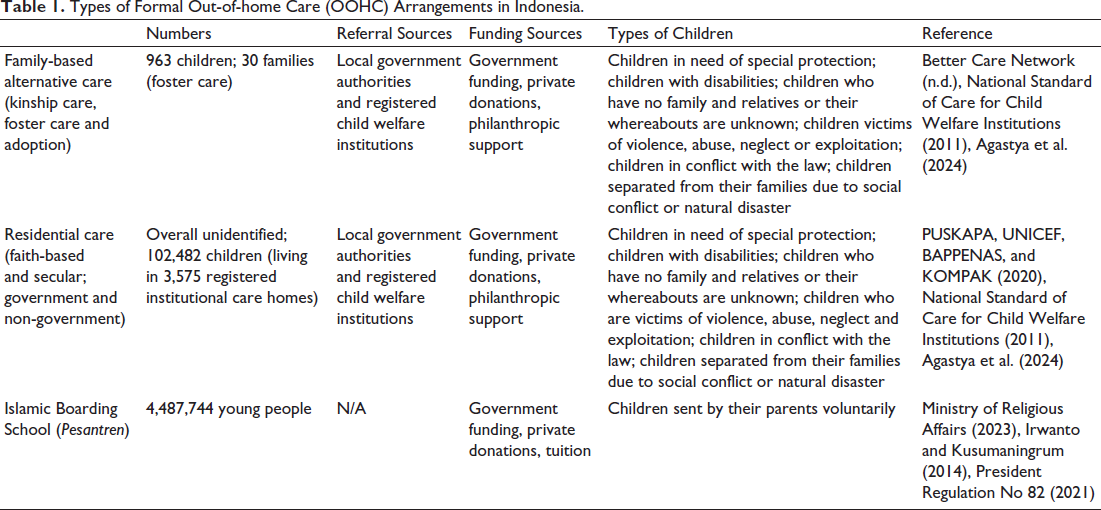
Millions of children and youth are living in some form of institutional care arrangements in Indonesia. The number of children living in these institutions is currently unidentified. UNICEF (2020) stated that significant numbers of children and young people live outside the care of their parents, approximately 2.2 million children. Conversely, other data have indicated that 4.4 million young people live in Islamic Boarding Schools (Ministry of Religious Affairs, 2023). A national report from 2007 described there being approximately 7,000 OOHC institutions in Indonesia, in which half a million children and young people lived, most of whom were unsupervised and unmonitored by the government (Martin & Sudrajat, 2007). In 2020, the Ministry of Social Affairs reported that there were 102,482 children living in 3,575 registered institutional care settings across Indonesia, not including those who are unidentified (PUSKAPA, UNICEF, BAPPENAS, & KOMPAK, 2020).
Previously, most children were placed in institutions as a ‘child protection’ mechanism. Protecting children by placing them in institutions is seen as a way for children to get an adequate education, to have their basic needs met in light of their parent’s economic disadvantage, and to enable them to access a significant religious education that will arguably lead them to a better life and character in adulthood (Irwanto & Kusumaningrum, 2014). Several reports and a peer-reviewed study in Indonesia revealed the dire condition of young people living in residential care settings (Irwanto & Kusumaningrum, 2014; Martin & Sudrajat, 2007; O’Kane & Lubis, 2016; Sutinah & Aminah, 2018).
Table 1 presents the numbers of children, referral sources, funding sources and types of children living in OOHC.
Types of Formal Out-of-home Care (OOHC) Arrangements in Indonesia.
Good Practice of Alternative Care in Indonesia
In the past decade, Indonesia has recognised that the institutionalisation of children was counterproductive to the stated intention of providing ‘child protection’ for children and young people. Indonesia formally identified residential care settings as a last resort for protecting children and youth in its legislation and policy frameworks (Child Frontiers, 2010; Dunn et al., 2007; Ministry of Social Affairs, 2011). A process of deinstitutionalisation of care is currently underway through the 2011 National Standard of Care for Child Welfare Institutions to reform OOHC facilities or orphanages into community-based child and family services (Agastya et al., 2024; He et al., 2021).
There are also family-type alternative care alliances for orphans and neglected children, led by civil society organisations and international NGOs who work with children and young people (Martin James Foundation, n.d.). Asuh Siaga Alliance, established in 2014, consists of 28 non-governmental organisations working closely with leading government ministries on child protection and family-based alternative care (Martin James Foundation, n.d.). There are also several grey literature reports documenting the existence of leaving care programmes for young people transitioning from OOHC conducted by SOS Children’s Village Indonesia (Hodgkinson & Pouw, 2017; Lubis et al., 2018; O’Kane & Lubis, 2016). However, there are yet to be any available published materials with regard to the monitoring and evaluation results for its aftercare support programme. A previous research report from Hodgkinson and Pouw (2017) described care leavers as among the most vulnerable youth in Indonesia.
Factors Underpinning Children’s Placement in OOHC or Institutions
There are several potential factors contributing to children living in OOHC in Indonesia. Family poverty, hope for better living conditions and education for the children are some of the reasons non-orphaned children first come to be placed in institutional care (Irwanto & Kusumaningrum, 2014; Lubis et al., 2018; Martin & Sudrajat, 2007; O’Kane & Lubis, 2016). This includes children and young people whose parents live in remote areas, whose parents send them to institutions far away from their homes and with minimum communication with their biological parents. Furthermore, another reason is to provide a solid religious education to have a ‘good character’ (Irwanto & Kusumaningrum, 2014, p. 11; Martin & Sudrajat, 2007, p. 114).
Other factors highlighted include parents’ migration, mostly as migrant workers overseas, leaving their children behind in informal kinship and residential care settings (Hodgkinson & Pouw, 2017; O’Kane & Lubis, 2016). Another driver of institutionalisation is discrimination based on HIV and disability status (Irwanto & Kusumaningrum, 2014; O’Kane & Lubis, 2016). Children born out of wedlock are also vulnerable and left in OOHC settings because of community stigma (Hodgkinson & Pouw, 2017; Nurlaelawati & Van Huis, 2019; O’Kane & Lubis, 2016). Other drivers documented are the lack of gatekeeping, active recruitment from OOHC institutions, children living in single-parent families, conflict and natural disasters and family violence (Lubis et al., 2018; O’Kane & Lubis, 2016).
Legislative and Policy Background OOHC Context
Indonesia has strong reasons for institutionalising children as a ‘child protection’ mechanism. The 1945 Constitution wrote that ‘the poor and abandoned children are cared for by the state’ (Indonesian 1945 Constitution, Chapter XVI, Article 34). Martin and Sudrajat (2007) assert that the concept of child (alternative) care is rooted in a welfare approach in which the state and the community need to step in to protect and care for ‘neglected or abandoned’ children and children with ‘problems’. However, they also highlighted that there needs to be more clarity and practical implementation of these joint roles and responsibilities between the state and the community. In the 1979 Child Welfare Law, the Ministry of Social Affairs (MoSA) (then known as the Department of Social Affairs) included children who are socially or economically disadvantaged as those who should be the target of welfare services. A significant change in the law occurred in 2002 after Indonesia adopted and ratified the UNCRC 1990 by signing the 2002 Child Protection Law. In this law, Indonesia recognises the importance of family-type (alternative) care; however, the emphasis still strongly refers to the provision of care delivered through residential care institutions.
In 2007, Save the Children, UNICEF and Indonesia’s MoSA, led by Martin and Sudrajat (2007), conducted a large qualitative study across six provinces in Indonesia (Aceh, Central Java, West Kalimantan, West Nusa Tenggara, North Sulawesi, Maluku) to identify and assess the quality of care within OOHC institutions in Indonesia. They collected data from 37 state and non-government OOHC institutions. The research team collected data from 378 participants from these institutions. This study employed questionnaires to get the profile of the OOHC institutions and completed focus groups and in-depth interviews with staff members, teachers, parents and children. They also conducted a substantive literature review of previous child welfare policies and context in Indonesia. The study resulted in a grey literature research report that became a reference point for later child welfare studies in Indonesia.
Martin and Sudrajat (2007) noted that many national government policies and guidelines led to several inadequate policy-making decisions, which made child (alternative) care institutions a priority mechanism for child protection. Furthermore, these policies justify that child (alternative) care institutions are the only ones capable of providing professional care services to children (Martin & Sudrajat, 2007). The policies in the 2000s also resulted in equating family poverty and parental economic disadvantage as proof of ‘incompetence’ or ‘inability’ to take care of children, focusing only on children’s material needs and not their psychosocial needs.
Furthermore, Martin and Sudrajat (2007) also highlighted that the financial support policies provided by the government to care institutions play a significant role in the growing number of child (alternative) care institutions across Indonesia. This points to a lack of gatekeeping (placing only children in need) and active recruitment of children and young people to be placed in institutions, leading to parental separation (O’Kane & Lubis, 2016). Martin and Sudrajat (2007) also mentioned that since the decentralisation of governance in the Reformation Era, there has been a reduction in the capacity and role of national ministries (such as the then Department of Social Affairs) to provide social services for children. The national government has not symmetrically aligned with the sub-national governments (provinces and districts) to meet the needs of vulnerable children and young people at the sub-national level.
The study conducted by Martin and Sudrajat (2007) also highlighted the poor quality of care in several Indonesian provinces. It encouraged the national government to make significant policy and practice changes, at least at the national level. In 2011, the central government, with the support of international organisations such as Save the Children, established the National Standards of Care for Child Welfare Institutions under the MoSA regulation. This regulation provides a more detailed mechanism for OOHC institutions or child welfare institutions (previously called orphanages) operating in Indonesia. The regulation intended to transform these child welfare institutions to be registered, supervised and alter their form of care into deinstitutionalised, community- and family-based care services. Although only a few procedures addressed the specific needs of care leavers, it was a positive response from the government to enhance the quality of care.
However, no evidence exists regarding how the implementation of this regulation has affected the lives of the children and young people concerned (Agastya et al., 2024). More research needs to be completed examining the impact of this policy on the lives of children and young people in OOHC.
Grey literature from non-government sources and a peer-reviewed study have tried to document the outcome of this policy shift. O’Kane and Lubis (2016) report the shifting of the social service workforce and financial allocation to family- and child-centred care. The national government established some prevention initiatives that have been implemented, such as social protection schemes and parenting education to enhance parenting skills (programme from the Ministry of Women Empowerment and Child Protection), alongside programmes that aimed to support families’ resilience to shocks and emergencies, community-based child protection mechanisms, provision of increased access to education for children, and utilisation of available traditional practices to support vulnerable children and families. However, a recent study conducted by Agastya et al. (2024) described the slow progress of this policy shift of transforming child welfare institutions from facility-based care or orphanages into community-based child and family services. They performed a mixed-method approach, conducting a cluster analysis of 50 child welfare service providers in Bandung, West Java. The study indicated that a significant number of private OOHC institutions are still highly dependent on institutional care to fulfil the needs of children’s welfare. The authors identified limited government funding and religious organisations’ missions as potential barriers to systemic change in child welfare institutions.
Indonesia has invested in policy and legislative reforms to strengthen child protection mechanisms and services (UNICEF, 2020). But clear policy or legislation in support of young people leaving care is almost non-existent in the national and sub-national policy spheres (Hodgkinson & Pouw, 2017; Lubis et al., 2018).
The other ‘unique’ condition of the established child protection system in Indonesia is the navigation of complex multi-sectoral coordination from different ministries and levels of government (Ministry of National Development Planning 2015–2019 National Action Plan for Child Protection, 2015). Indonesia’s leading ministry for child protection mandate is the Ministry of Women Empowerment and Child Protection. However, several ministries are also stakeholders in ‘child protection’ such as the Ministry of Health (i.e., child health and nutrition), Ministry of National Development Planning (i.e., child and youth development planning), MoSA (i.e., child social rehabilitation and child welfare institution), Ministry of Education and Culture (i.e., children education), and the Coordinating Ministry of Human Development and Culture (coordinating ministry of ministries involved in human development), among other ministries.
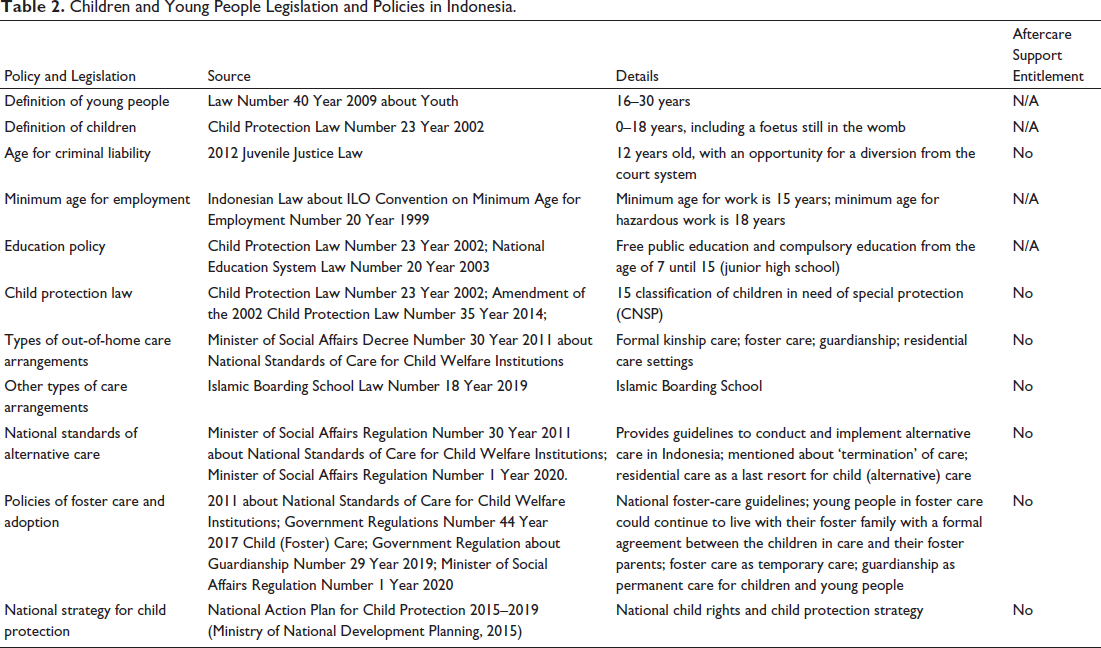
Table 2 shows policies and legislation in connection to children and young people’s protection.
Children and Young People Legislation and Policies in Indonesia.
Cultural and Religious Context of OOHC
Culture and religion play a significant part in the context of OOHC in Indonesia. Residential care settings were influenced by the Dutch colonials, introduced by Christian organisations in the pre-1945 independence era, and then mixed with the culture of Islamic Boarding Schools (Pesantren) after Islam spread to the Indonesian archipelago (Lubis et al., 2018; Martin & Sudrajat, 2007). These Boarding Schools are traditional Islamic teaching institutions where children spend their childhood within the institution.
In Indonesia, the role of community and non-government entities in supporting the welfare of children is driven by the Islamic belief that it is a virtue to help orphans and fatherless children (Martin & Sudrajat, 2007; Quran, n.d.). Martin and Sudrajat (2007) highlight the emphasis of this religious teaching on the growth and establishment of OOHC institutions in Indonesia through faith-based organisations as a commitment of faith and encouraged religious practice. They also point to the importance of the role of Islamic Boarding Schools (Pesantren) even though they are officially not recognised as OOHC institutions. Children are sent by their parents to spend their childhood in Pesantren from as early as 6 years of age, and only leave the institution between 18 and 20 years of age. In 2023, more than 4.4 million young people lived in Indonesian faith-based institutions (Ministry of Religious Affairs, 2023).
Furthermore, extended families also have a role in child (alternative) care. Informal kinship care in Indonesia through informal adoption and foster care by extended families is a common practice in several ethnicities in Indonesia (Lubis et al., 2018). However, the role of the community in helping vulnerable children is seen as minimal and less able to provide direct support compared to the role of the government (Irwanto & Kusumaningrum, 2014).
Experiences and Outcomes of Young People Transitioning from OOHC: Learning from the Global South and the Global North Context
Critical Examination of Previous Studies and Reports
The United Nations (2010) has issued guidelines regarding alternative care of children, which include aftercare support for children living in alternative care settings and also state parties responsibilities towards young people leaving care (Munro, et al., 2011; United Nations General Assembly, 2010, p. 19). It stipulates several requirements including the importance of a clear policy ensuring appropriate aftercare support and follow-ups while considering children’s age, gender, maturity and other exceptional circumstances in the transition process. Furthermore, the guidelines also highlight that extra effort should be made to facilitate young people’s transition by a specialised person who can assist the children’s self-sufficiency after leaving care. Aftercare planning should be prepared as soon as possible before children or young people leave care, and ongoing educational and vocational training opportunities should be instilled as part of the young people’s life skills. The guidelines also mention the need to provide access to social, legal and health services and financial support for young people leaving care and during aftercare. However, it seems the guidelines do not clearly identify an upper age eligibility for aftercare support provision.
Although Indonesia is one of the member states of the United Nations, the government has not been able to provide this aftercare support or develop a specific policy or legislation to meet the needs of care leavers. Policy development in offering support to care leavers seems strikingly non-existent, and this service gap needs to be critically examined in the literature. It raises questions such as ‘What are the challenges and obstacles to establishing a clear policy framework for government and non-government actors to have procedures or mechanisms to support young people leaving care in Indonesia?’ At the same time, several grey literature reports noted that there are non-government care organisations who already provide extended support for care leavers in Indonesia, such as SOS Children’s Villages Indonesia (Hodgkinson & Pouw, 2017; Lubis et al., 2018; O’Kane & Lubis, 2016).
These past two decades also clearly show the development of theories and studies of care leavers in the Global North countries (OECD, 2022). In contrast, fewer studies are available from the Global South countries (Van Breda & Pinkerton, 2020). It is arguably most useful to compare the experience of care leavers in Indonesia with cohorts in nearby Asian countries that have similar social and cultural contexts, rather than other Global South countries that are culturally and geographically distant. Several studies or research reports have emerged portraying the experiences and outcomes of young people leaving care directly or indirectly in other Asian countries (Collins & Tuyền, 2017; Hodgkinson & Pouw, 2017; Keshri, 2023; Modi & Kalra, 2023; Nguyen et al., 2022; Roche, 2019; Rogers et al., 2023; Shang & Fisher, 2017; Udayan Care, 2019; Yin, 2023, 2024). These studies point to variations in the experiences and outcomes of young people while they were in care and after leaving care. The existing evidence capturing care leavers’ experiences and outcomes in Global South countries provides a significant argument that there are unmet needs of care leavers, and arguably establishes an urgent necessity for the introduction of formal leaving care studies, policies and programmes in Indonesia.
Several international research reports from the Global South countries in Asia previously identified critical areas of difficulties experienced by young people transitioning from OOHC. These peer-reviewed studies employ quantitative and qualitative analyses. Much of the work has been done in China and India, where some literature exists about the experiences of young people leaving care. Their challenges include:
Housing insecurity
Research by Dutta (2017) demonstrated the temporary nature of housing facilities as one of the factors of female care leavers experiencing elongated economic difficulties in India. Research by Shang and Fisher (2017) conducted in China portrayed a lack of affordable housing and access to subsidised housing for young people leaving care. A study conducted by Yin (2023) in China also reported unstable housing conditions for youth transitioning to adulthood from care institutions.
Poor mental and physical health
Young people in state care in China are more likely to struggle with identity formation than their peers in the general population (Shang & Fisher, 2017). A large study conducted by Udayan Care (2019) in five states in India revealed that most care leavers faced ongoing emotional distress, and the process of transitioning from OOHC might have had a negative impact on them emotionally. Most of them also did not have health insurance, which posed a higher risk of dealing with chronic illness and health emergencies. A study conducted by Liu et al. (2022) found psychological distress and problematic behaviours experienced by young people leaving care in China due to poor self-expectation such as lack of confidence and fear of independent living alongside economic hardship.
Low educational attainment, employment inadequacy and financial difficulties
A research study conducted by Ibrahim (2016) reported stigmatisation in employment experienced by care leavers in Jordan. Their employers and colleagues treated them poorly by disparaging them. A study in China conducted by Shang and Fisher (2017) indicated young people leaving state care struggle to find adequate employment that could support economic security for independent living due to a lack of social networks for affordable housing. Another study from China conducted by Liu et al. (2022) reported that young people ageing out of institutional care in China faced financial burdens and difficulties in planning their careers and employment, and these difficulties were a major source of stress and turned into unhealthy coping mechanisms such as withdrawal from others or from emotionally challenging situations. A study conducted by Udayan Care (2019) in India also revealed that the lack of vocational training leads to a lack of employability-related skills and low educational attainment, with many care leavers only completing primary education. Many of them did not complete their secondary education and dropped out of school at the age of 18, thus leading to poor academic performance. Also, there is a strong pressure to earn earnings and become financially independent, thus creating significant distress.
Lack of social support and social exclusion
A study in India (Udayan Care, 2019) depicts the inability of care leavers to maintain relationships with parents and families, and also the adverse effects of their time in institutions on their ability to establish a social support system. A study conducted by Keshri (2021) in India found social exclusion is chronic among orphaned care leavers. A study by Yin (2023) also indicated that negative outcomes of care leavers in China are often associated with social exclusion and lack of social support.
Care leavers in the Global North, such as young people leaving OOHC in OECD (Organisation of Economic Cooperation and Development) countries, also experience poorer outcomes than their non-care leaver peers (Gypen et al., 2017; OECD, 2022). The latest OECD report (2022) describes the challenges confronting many care leavers, such as low educational attainment, unemployment, homelessness, high incarceration and high suicide rates. Although policy and aftercare support is available in these countries, challenges remain. For example, there is a need for additional information such as expanded administrative data on care leavers, evidence concerning the kind of support that improves outcomes for care leavers, and the type of aftercare services accessed by care leavers.
Furthermore, studies from OECD countries present evidence of what works to improve pathways and outcomes for care leavers (OECD, 2022). For instance, young people who stay longer in care have better outcomes. Other evidence shows that support for aftercare should have strong legislative authority and adequately detailed policies and procedures.
The leading UK researcher Stein (2012) concluded from previous studies that care leavers could be categorised into three outcome groups: young people ‘moving on’, ‘survivors’ and ‘strugglers’. The ‘moving on’ group experience the greatest stability and continuity in their lives. The ‘survivors’ group are young people who experience more instability than the ‘moving on’ group. The third group, the ‘strugglers’, are care leavers who had the most damaging pre-care experience in which care could not make reparations to assist them in overcoming their past adversities. Stein also mentions that the resilience of these young people is strongly related to their experience of care and their aftercare support. This framework of care leavers outcomes and resilience could provide further guidance to explore the outcomes of care leavers in Indonesia, which are relatively unknown.
What is Known Regarding Young People Leaving Care in Indonesia?
The number of young people leaving care in Indonesia is unknown, with almost no tracking of young people leaving state OOHC or non-government service providers. O’Kane and Lubis (2016) mentioned that the challenges faced by care leavers are the limited preparation they had to leave care, and insufficient follow-up and monitoring after they leave the institutions or other alternative care settings. Only one research report is available that indirectly assessed the experiences and outcomes of young people from OOHC in Indonesia, conducted by Hodgkinson and Pouw (2017) on behalf of SOS Children’s Village Netherlands. They collected data from beneficiaries of one of SOS Children’s Village Indonesia’s care settings in Lembang and other care organisations in Bandung. They used a mixed methods approach including in-depth interviews with 16 stakeholders, a literature review, and consultations with 50 youth comprising direct interviews and four focus group discussions.
SOS Children’s Village Indonesia is one of the international care organisations that provide OOHC services in Indonesia and have a leaving care planning and programme for young people transitioning from and leaving OOHC (Hodgkinson & Pouw, 2017; Lubis et al., 2018; O’Kane & Lubis, 2016). SOS Children’s Village in Indonesia (Lembang in particular) provides an SOS Youth Programme for young people ready to move out from SOS families. This is normally implemented when they start tertiary education or vocational training. The Leaving Care programme was designed to prepare young people to become self-sufficient and gain mature lives (Lubis et al., 2018).
Recent findings from Hodgkinson and Pouw (2017) revealed that these vulnerable young people experienced discrimination and social exclusion based on their economic and social background, while some of them felt excluded because they came from minority ethnicities or religious groups distinct from the surrounding community. The study also points to low-earning employment, which hinders them from having sufficient economic independence, with inadequate responses from local authorities and care workers encouraging entrepreneurship without adequate capital support. These young people have varied responses and experiences to leaving care, both positive and negative. Transition to adulthood is seen as unfavourable when they lose connections with the staff and peers, enter a waiting period to secure stable employment and marry, and cannot provide for themselves. These young people also experience difficulties maintaining social relationships due to their separation and disconnection from their families. They also have minimum opportunities to connect and socialise outside of care during their time in care, thus affecting their ability to connect and integrate with the community at large. There is also an indication that female young people are more likely to experience economic exclusion relative to their male peers. However, this is not further discussed in the study.
O’Kane and Lubis (2016) mentioned that the age of leaving care in Indonesia is 18 or if the children have completed high school. Those children living in institutions will be sent back or reunified with their families. Martin and Sudrajat (2007) also mentioned that OOHC institutions in Indonesia have no or little mechanism to support young people after they leave care.
Potential Harms Experienced by Care Leavers from Institutionalised Care
A study conducted by Irwanto and Kusumaningrum (2014), supported by the Indonesian government and international organisations, documented potentially harmful experiences while living in institutions. The study utilised a mixed methods approach including literature reviews, surveys, focus groups and in-depth interviews. Approximately 641 children from 56 care institutions across 3 provinces were interviewed. A further 180 parents and care providers participated in focus groups and 29 in individual interviews. The study reported that some children in OOHC institutions experience physical and emotional abuse and also sexual violence, and do not have immediate access to basic healthcare. They slept in poor sleeping arrangements (i.e., shared rooms, sleeping with adults) and had limited communication with immediate families while in institutions. A few of these children also engaged in risky behaviours such as using illicit substances, drinking and smoking, while others experienced distress while in care.
Other reports (O’Kane & Lubis, 2016) also documented barriers for care leavers to have an independent adult life, such as inadequate skills to get good and decent-paying jobs and experiencing further psychological pain and anger due to their pre and in-care experiences. This study adopted a qualitative approach involving a literature review, 21 key informant interviews, and 8 focus group discussions including a total of 74 participants (32 women, 15 men, 20 girls and 7 boys). The study was conducted in Jakarta and Bandung. Further sources also depicted the potential harms and challenges of institutional care (Fox et al., 2011; Rogers et al., 2021; Sutinah & Aminah, 2018).
Leaving Care Policy in Indonesia
Available Leaving Care Policies, Practices and Strategies in Indonesia
Much of the government priorities and national discussion about child (alternative) care in Indonesia examine how to improve the quality of care in alternative care settings and deinstitutionalisation of care. There is a dearth of research and analysis concerning aftercare support for children and young people’s outcomes after they leave care, which possibly means that the focus on improving the quality of OOHC results in leaving care pathways and outcomes being neglected. That omission arguably has adverse implications for the policy to provide adequate support to young people who leave care, especially those with limited social support and networks.
There are no clear leaving care policies available in Indonesia. Nor are there any clear pathways for young people beyond 18 years of age from OOHC to receive extended support from the state.
Efforts supporting care leavers documented by O’Kane and Lubis (2016) include initiatives to establish and maintain individual bank accounts for children and young people leaving care. This is a sporadic attempt to implement the National Standards of Care from the MoSA. However, it is unclear how the procedures and mechanisms were implemented.
Furthermore, OOHC workers also mentioned that these young people’s lack of job-related skills might undermine their opportunities to enter well-paying jobs (Martin & Sudrajat, 2007). Most private and state OOHC providers in Indonesia do not have the capacity to provide extended support for young people beyond 18 years of age (i.e., higher education, vocational training, financial support, psychosocial support), although some care institutions allow their young people stay at the institution after reaching their age limit (Martin & Sudrajat, 2007). Another institutional effort to support these young people is to find sponsors after they finish high school to enable them to access higher education (Martin & Sudrajat, 2007). Other institutions provide vocational training with a particular aim to work in a specific type of work after they leave care (Martin & Sudrajat, 2007). Some institutions did not place requirements on these young people to leave care. Martin and Sudrajat (2007) also noted that numerous carer and staff positions are filled by young people who have aged out of care.
Integrated support for young people leaving care in general healthcare, funding, housing and psychosocial support was practically unavailable. A recent report from SOS Children’s Village, which has documented their work with care leavers, indicated that there is no available support from the government (beyond that provided by SOS Children’s Village Indonesia) to cover the potential vulnerability that these young people will face after leaving care (Hodgkinson & Pouw, 2017).
There is also an indication of a strategy directed by care authorities and care workers to encourage care leavers to become entrepreneurs, yet without adequate capital support (Hodgkinson & Pouw, 2017). These young people were directed to have an entrepreneurial spirit, yet they are expected to commence their enterprise with limited knowledge, pre-exposed psychosocial vulnerability and lack of life skills to meet the challenge of adult life. There are no national or sub-national strategies to address the needs of these vulnerable youth for them to access higher education or vocational/job training programmes, or to provide extended placements or support for orphans and neglected young people until they are prepared for adult life (i.e., until they are 21 years of age).
Previous studies of vulnerable youth indicated that orphans and neglected young people emphasise the inadequate social network available after leaving care; thus, they were relying on their previous network within care (i.e., caregivers and peers) to get employment and other independent life means (Hodgkinson & Pouw, 2017).
Discussions and Policy Implications
Adding focus, discussion and debate on the aftercare support system might strengthen the Indonesian child protection system in the long run. A recent report from Save the Children (2021) documented their collaboration with the Indonesian government for 15 years to deinstitutionalise child care by advocating to shift the paradigm of childcare, strengthen families and promote family-based or community-based alternative care. While the report also depicts achievements of establishing a continuum of care consisting of national childcare regulations within and outside of parental care, it does not include aftercare or post-care as a continuum of care. Mendes (2009) suggested that care authorities should provide the same form of continuous and holistic support that typical parents in society would provide after their children leave home, which means integrating leaving care policies and programmes as part of the continuum of care, that is, inserting them into the existing child care systems, not just being a mere after-thought as services. This proposal also parallels with Indonesian familism, that typical traditional Indonesian families are interdependent with their family members, and even live with their extended family members, which provide benefits such as safety, social support and financial support. Older parents also often have a role as economic pillars of multigenerational families, including their unmarried adult-children and grandchildren (Riani et al., 2017; Schröder-Butterfill, 2004).
Given the evidence that young people transitioning from OOHC still experience vulnerability across different jurisdictions and countries, it is worthwhile to discuss and debate the ‘post-care’ state as a continuum of care and child protection mechanism. The government has already provided a pathway and a strong commitment to improve the quality of life of children and youth by strengthening the child protection system in Indonesia. The recent 2020–2024 National Medium Term Development Plan stated the government’s role in improving the quality of life of children and young people by strengthening the child protection system. One of the ways to strengthen it is by reinforcing family care and temporary care in institutions (Ministry of National Development Planning, 2020). According to the UN Guidelines for Alternative Care for Children, aftercare support is a continuum that needs to be met by government and non-government stakeholders. The legislative and strategy framework for care leavers needs a national strategy with clearly defined goals of aftercare support provision and minimum standards of support (OECD, 2022). This could be done by revising the National Standards of Care for Child Welfare Institutions to provide detailed standards of extended aftercare support beyond 18 years old (i.e., flexible leaving care age until 21 years).
Further evidence from previous studies in Indonesia also provides a strong indication of potentially traumatic pre-care and in-care experiences for young people that might affect their transition to adulthood and life outcomes. Thus, it is morally imperative for child protection institutions to provide extended support for the potentially unmet needs of these young people.
An ideal system for a leaving care model on the ‘supply side’ probably needs to have a precise legal leaving care age, flexibility to remain in the care system beyond the legal leaving age, a good mentor system, clear and early pathway or transition plans, adequate financial support, appropriate housing support, robust monitoring and evaluation, mechanisms for aftercare support, strong administrative support for care leavers and strong integrated services (OECD, 2022). While reform at the national level is needed to include aftercare support in the child protection system, strengthening the capacity of sub-national government and non-government care institutions and maintaining strategic alliances with provincial and district-level government child protection stakeholders also needs to be simultaneously conducted, considering that implementation at the sub-national level is often faced with difficulties. Reform of the aftercare support system could also be used to utilise and strengthen the capacity of available collaborative care alliances between government and non-government stakeholders to establish extended support for aftercare.
On the ‘demand side’ of social policy, several ideas could be implemented, such as enhancing the lived experience voice of care leavers and their active participation in the development of policy programmes and services by establishing care leavers community organisations or associations. Also, there is a need to promote further research about and for care leavers. Studies and evaluations of young people leaving care outcomes are almost non-existent in Indonesia. Evaluations and studies should address the complex diversity of care leavers. Intersecting issues within care leavers such as gender, disabilities, care leavers who are more marginalised and socially excluded (i.e., orphans) and care leavers who have complex health and psychosocial problems (i.e., mental illness and substance abuse) equally need to be researched to ensure they are not left behind in the policy development of Indonesia.
Footnotes
Declaration of Conflicting Interests
The authors declared no potential conflicts of interest with respect to the research, authorship and/or publication of this article.
Funding
The authors disclosed receipt of the following financial support for the research, authorship, and/or publication of this article: This article is part of a doctoral study with financial support from the LPDP Scholarship, Ministry of Finance Republic of Indonesia.
