




Abstract
COVID-19 pandemic has caused an unprecedented human and health crisis and has been affecting lives in many forms. What seemed to be a health crisis eventually became a major ongoing global economic crisis. Sector-wide disruptions are threatening both short- and long-term livelihoods and well-being of millions of youth around the globe, especially youth from vulnerable communities. Business closures threatened the operations and soundness of the enterprises resulting in layoffs and wage losses, affecting a major chunk of youth including the young care leavers of alternative care programmes in Asia. This called for customised interventions and support for such young care leavers. Immediate actions were needed for managing their mental health, for maintaining education continuity and for reskilling of such young care leavers to prepare them to cope with the pandemic. This article is based on the learning and experiences of SOS Children’s Villages responses to supporting nearly 1,500 care leavers in various Asian countries. SOS Children’s Villages is committed to ensuring quality care and protection of children and youth through its various alternative care programmes in 15 countries in Asia region. SOS Children’s villages responded to COVID-19 pandemic by supporting youth and care leavers in SOS family-like care. Primarily, these countries reported that the school closures mandated to combat the spread of the virus affected the education and learning of all the children and youth in their care. All projects in Asia started reaching out to the care leavers and started extending a wide range of support to them with both short- and long-term interventions. This article covers SOS Children’s Villages youth programmes, especially from 11 countries of Asia region—Bangladesh, Cambodia, India, Indonesia, Laos, Mongolia, Nepal, Philippines, Sri Lanka, Thailand and Vietnam.
Background and Context
Prior to the outbreak of the pandemic, the world was already struggling with a learning crisis, with 53% children in low- and middle-income countries living in learning poverty, which means being unable to read and understand a simple text by age 10 (World Bank report, 2020). Now the school closures, in an attempt to contain the spread of the virus, have left most students on the planet out of school. This number had reached to 1.6 billion by April 2020, as reported by the World Bank report (2020). On the economy side, all advanced and emerging economies are in recession or depression. As per the World Bank estimates, full recovery of economies will be possible until 2025 or beyond (World Bank report, 2020). This means, the current scenario might just be the beginning; therefore, there is urgent need to prepare the young care leavers of alternative care programmes for facing these challenges more efficiently and independently.
The impact of COVID-19 on education and economy has certainly put youth and care leavers at risk. Nearly, 1,500 care leavers have contacted various alternative care programmes of SOS Children’s Villages in Asian countries. Most of them either have lost their jobs or have been victims of wage loss due to the economic impact of COVID-19. Some care leavers who were self-employed received a major setback as their small enterprises faced abrupt closure due to lock-down measures imposed at several locations in the region. Care leavers working as COVID-19 frontline warriors were also facing social stigma and started facing accommodation-related challenges. Youngsters who are on the verge of becoming self-sufficient are returning to programmes for longer support. Youngsters who have completed their education are not getting a job; hence, they continue to remain in the SOS programme. Education of many youngsters has been disrupted as the universities and colleges are closed, which means they will remain in alternative care until they complete their education and get a job.
Impact of COVID-19 Pandemic on Care Leavers from Alternative Care Programmes
An emergency like COVID-19 pandemic was unprecedented. It has affected everyone irrespective of age, gender, regions, borders, etc. It thus becomes very important to understand the impact of this pandemic on the lives of care leavers in need of alternative care. Obviously, their vulnerability is higher compared to their peers as care leavers are deprived of social network and other socio-economic safety nets. Many times, being the care leavers of alternative care programmes, they also face stigma and dissemination. Family-like care programmes of SOS Children’s villages did necessary assessments and started planning appropriate responses to support youth from alternative care programmes in Asia. This article is an attempt to exchange the key solutions tested by these family-like care programmes, with the stakeholders having mandate to work for care leavers of alternative care.
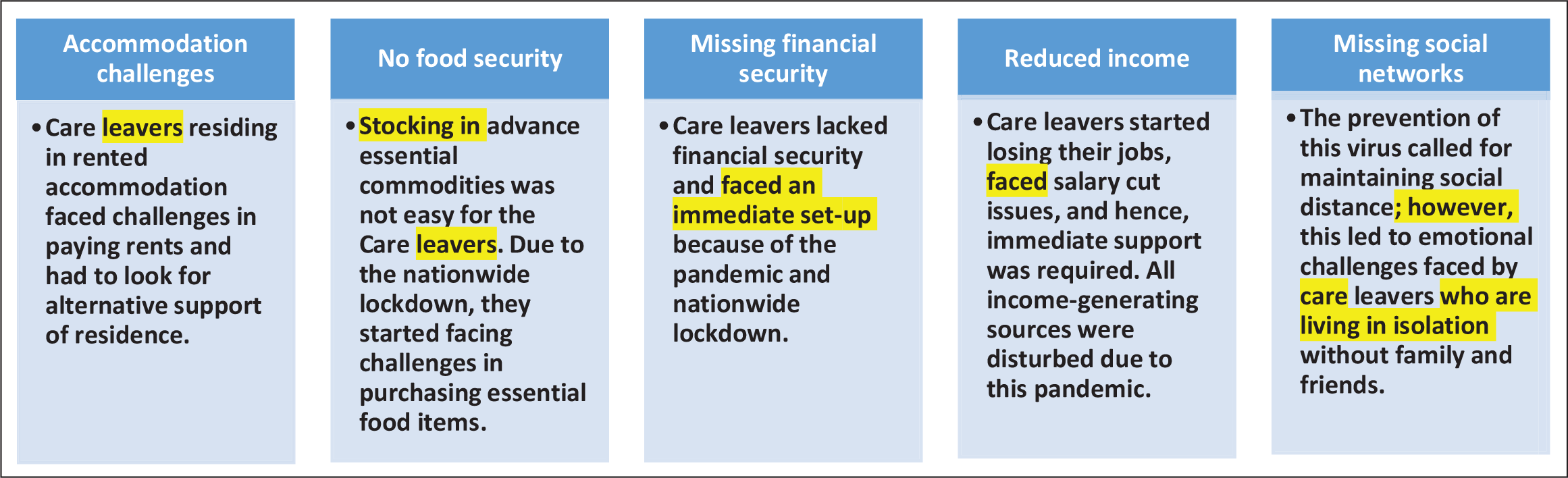
No sooner had the WHO declared COVID-19 as a global pandemic (Wikipedia, 2020), SOS Children’s Villages in the region Asia started reaching out to the care leavers to learn about their well-being. As observed, many of care leavers have been able to bear the shock of the pandemic independently; however, still many care leavers faced a range of challenges as mentioned in Figure 1.
SOS Children’s villages in the region Asia have reached out to almost 1,500 care leavers during the COVID-19 pandemic, until September 2020. As observed, six out of seven care leavers were economically independent either employed in some organisations or earning their living through some self-employed activities. They all started facing challenges as soon as the pandemic hit their regions. Most of the care leavers were broadly contributing to the informal economy by working as freelancers in beauty and wellness sector, entertainment, education, etc. Another major chunk of care leavers were employed in the hotel/hospitality sector. These businesses were severely affected due to COVID-19 and economic slowdown, which affected the continuum of jobs of these youth. Also, one out of five care leavers was self-employed, owning small cosmetic shops, tea stalls, fast-food stalls, tattoo studios, laundry shops, etc. Because of the lockdown imposed and the risk of being infected, all these activities came to sudden closure, and the care leavers struggled for commodities and finances. Most of the care leavers living in rented apartments were not able to manage their rent and, hence, needed accommodation support as well.
Solutions for Minimising the Impact of COVID-19 Pandemic on Care Leavers
Care leavers face challenges quite different from other youth of their age group. They miss social support networks. Ideally, the preparation for leaving care should make them resilient enough to face challenges in the outside world. However, situations like the coronavirus pandemic are quite different, and care leavers should be supported in such unprecedented circumstances if they happen to look back to their caregivers, with the following immediate support mechanism to address their short-term challenges:
Immediate monetary support through bank transfers for their food, rent and other necessary requirements.
Leveraging peer support like the Generation Never Give Up (
Care leavers were connected to various local government relief schemes. This helped them to get enrolled in government records and for receiving schemes and other benefits.
Some care leavers were extended accommodation support, as they had to vacate their rented premises due to non-payment of rent. Those youngsters were accommodated either in the village premises or youth facilities, or a nearby rented accommodation was arranged. The care leavers returning for accommodation mandatorily self-isolated themselves for a period of 14 days to avoid any risk of virus spread.
Other care leavers were provided counselling support so that they do not feel alone in this difficult situation and take any unwanted steps. Some of them also received support from their biological/extended families.
The above-mentioned responses have been helpful to address the short-term challenges care leavers have been facing due to the pandemic. This prevented their immediate fall, but one-time support would not be much helpful as the pandemic is expected to stay longer and its impact will stay even for a prolonged period of time. Many youths of alternative care programmes will be facing unprecedented challenges when they enter into independent living in the coming years. Therefore, some fundamental steps will be necessary to address the long-term requirements of youth and care leavers. Following learning from family-like care programmes of SOS Children’s Villages can provide some solutions for long-term preparation of youth and care leavers in alternative care.
Addressing Mental Health and Well-Being of Care Leavers
Fear and apprehensions during such a crisis are obvious and common for all. Anxiety among youth eventually became vigilant during the lockdown period. They wanted to go out, meet their friends but, at the same time, were worried about their health and were fearful of being infected by COVID-19. The situation proved adverse for youth who were appearing for their board exams. They were worried about the delay in semesters and exam results. Additionally, youth preparing to leave care this year could not do so because they were anxious about leaving care in such unfavourable external environment. They were also required to relook into their preparation and make themselves employable as per the new-normal circumstances. The following were the practices adopted to curtail the effect of the pandemic on mental well-being of youth:
Youth were engaged productively through games, quizzes, virtual competitions, learning life skills, independent living skills, Yoga and exercises. They were encouraged to maintain hygiene by cleaning the surroundings. They also made and distributed facemasks in nearby communities. Youth were encouraged to play outdoor sports (following social distancing norms) to keep their mind and body healthy. Awareness sessions on mental health and well-being were organised. Counselling sessions and mental health services were provided wherever applicable. Psychological first aid (PFA) trainings were organised for youth and educators. Educators/co-workers need to have a listening ear to ensure better mental health for youth. Training sessions on COVID-19 awareness, its effect on health and economy and recovery mechanism were organised to build confidence in youth.
These actions have helped to address the challenges pertaining to mental health and well-being of youth to a greater extent. The whole idea was to keep youth engaged in productive activities. This pandemic has given a lot of free time to think and self-reflect. Youth should be encouraged to carry a positive approach. Projects should also develop and support youth-led initiatives and mobilise the energy and passion of youth to support COVID-19 response initiatives in their communities.
Maintaining the Education Continuity
As the education and training delivery moved from classroom to virtual platforms, major challenges faced by youth were unavailability of digital devices and high-speed Internet connections. Obviously, the pandemic has also expanded the digital divide in manifolds for those who have already been deprived of digital revolution. This interrupted the consistency in attending virtual classes for youth in alternative care. As a response, SOS family-like care programmes adopted following steps:
Most of the family-like care programmes have been equipped with a desktop and Internet connections. This is further being strengthened by increasing the number of devices and improving the connectivity with the help of partners for uninterrupted learning and development. Digital corners have been established for youth with the help of partners to provide extra support for education continuity of youth. Youth residing in boarding hostels have been supported to access Internet with better connectivity for their education continuity. A dedicated Youth Links platform is also available for secured digital learning and engagement with corporate partners and volunteers.
Digital infrastructure plays a key role in supporting youth to continue their education. Youth from alternative care backgrounds will compete with almost half a billion youth looking for a job, when they leave care. With changing trends, we need to ensure that our youth are well equipped with desktops/laptops and good Internet connection so that they are not left behind.
Reskilling for Employment
All activities on skill development and youth employability came to a halt suddenly due to the lockdown measures imposed at most of the alternative care programmes of many Asian countries. Youth of SOS Children’s Villages alternative care programme attend various skill development classes to enhance their skill sets. Computer training, English classes and hobby classes were some of the preferred courses after school/college hours engagements, and these all had to stop abruptly. On the other side, many independent care leavers also started to encounter many difficulties for their survival. The following practices have helped to prepare youth to face the pandemic in a better way:
Youth are encouraged to complete a pool of online courses such as cyber security, computer programming, coding, COVID-19 awareness training and English courses. A list of important websites and courses available was prepared and shared to all the programmes. Career guidance webinars are organised for youth on employment/self-employment opportunities in COVID-19 era with the help of corporate partners. Volunteers from corporate partners are roped in under Youth Can! programme to support employability skills training through virtual medium (Youth links, MS Teams, Zoom, WhatsApp, etc.). Educators started revisiting individual development plans (IDPs) of youth to suggest alternative education and training courses as per the requirement of a post-COVID-19 world of work. Youth planning to leave care in upcoming years are given special attention. They are being prepared with alternative employment training/certification options to improve their employability.
Although it is challenging in the pandemic situation, developing partnerships with local employers and industry experts to develop market-relevant skills prove to be helpful for the youth. Corporate partners also encourage volunteerism and are ready to guide youth and contribute towards their preparations for leaving care. This also helps potential employers to understand the situation and the challenges faced by youth from alternative care.
Conclusion
The interventions and practices outlined here can contribute to the effective responses for youth and care leavers from alternative care background. By all means, youth without parental care and those at risk of losing it are among the most vulnerable groups, and also most vulnerable to the COVID-19 pandemic. They lack support to successfully navigate in this competitive world, which has worsened in manifolds for them after the outbreak of the pandemic. These youth have already started missing their education. Going to educational institutions also means meeting friends, playing sports, sharing thoughts, and all these went missing in ongoing virtual engagements. Their education, learning and employment continuity have been affected severely due to lockdowns, and they and their families are facing economic distress. Now their survival is also vastly dependent on their digital capabilities to access virtual education and other employment-related requirements. As mentioned earlier, COVID-19 has come out with two major challenges related to youth and care leavers of alternative care programmes in Asia: One is related to the alleviation of the plight of care leavers and the other is related to preparation of the youth for independent living in a post-pandemic situation. Indeed, this will require both short- and long-term planning by service providers, donors and policymakers. The need of partnership among all alternative care organisations, authorities and other agencies is much higher than ever for enabling care leavers of alternative care to succeed in their lives during and after the pandemic of COVID-19.
