




Abstract
Multinational enterprises (MNEs) play a fundamental role in advancing the implementation of the United Nations Sustainable Development Goals (SGDs), as they enable cities and communities to reach large-scale solutions. In this article, we analyze 348 MNEs’ sustainability reports with explicit reference to the SDGs to identify the different roles that MNEs play in advancing the SDGs at the local level. Through qualitative content analysis, the literature on MNEs’ roles was validated, extended, and two new roles were found. The five roles of MNEs in local sustainable development that were validated are financer, community capacity builder, product and service provider, partner, and innovator. The three that were extended are employee developer, supply chains and procurement developer, and program deliver, while the two new additions are consultant and awareness raiser. The results of bivariate analyses show that some MNE roles are correlated to headquarter region and the industry sector. The 10 roles are also relevant for implementing all 17 SDGs and 102 of the 169 SDG targets.
Keywords
Introduction
The United Nations Sustainable Development Goals (SDGs) call for a massive transformation, one where the business has a recognized role to not only participate—but to lead (Sachs & Sachs, 2021; Shrivastava, 2018; World Business Council for Sustainable Development [WBCSD], 2017). Management scholars recognize the need for businesses to help address grand challenges, and the SDGs provide a concise list of global priorities in need of immediate action (Caiado et al., 2018; George et al., 2016). To achieve the SDGs, the business must reduce its negative impacts and increase its positive ones (Jones & Comfort, 2016). In addition, most of the global SDGs require local implementation (i.e., city or community-scale), to be achieved (Ordonez-Ponce et al., 2021), and the alignment of community efforts with the global goals (Goworek et al., 2018; Salvia et al., 2019).
Multinational enterprises (MNEs) can contribute to global SDG implementation through their scale and scope (Sachs, 2012), access to capital and resources (Sachs, 2012), the transfer of cutting-edge technologies (Yunis et al., 2018), the ability to provide goods and services to remote locations (Kolk et al., 2017; Sachs, 2012), the transferring of knowledge (Minbaeva et al., 2014), and through best practices that would normally be unavailable to other organizations (Málovics et al., 2008). Together, their collective resources and assets enable them to reach large-scale solutions needed to coordinate and mobilize pathways for accelerating local sustainable development and achieving global progress on the SDGs (Sachs & Sachs, 2021).
Previous literature has examined the roles of MNEs in advancing the implementation of SDGs (Kolk et al., 2017; Montiel et al., 2021). For example, Kolk et al. (2017) categorized MNE roles by their impact on people, the planet, prosperity, and peace—as outlined by the UN 2030 Agenda (United Nations, 2015). Kolk (2016) developed a preliminary framework for analyzing MNEs’ activities on SDG showing that MNEs focus on—SDGs #1 and #10 (people and prosperity), SDGs #7 and #13 (the planet), and SDG #16 (peace). But existing literature, as of yet, has not synthesized potential roles that MNEs might play at the local scale, even though that scale is also critical for SDG implementation. The literature has also pointed out that MNEs pursue country-specific strategies and these strategies differ based on the MNE’s country of origin (Newenham-Kahindi, 2015) and the industry sector of the MNE influences the focus on MNEs in SDG implementation (ElAlfy et al., 2021; Singh & Rahman, 2021). For instance, mining companies engage with local communities in a different way than agriculture companies or sanitation companies (Codita, 2007; Diep et al., 2021; Idemudia, 2009). But the link between MNE roles and industry sector for implementing the SDGs at the local scale has not yet been explored across sectors. While MNEs have been criticized for their negative social and environmental externalities, especially in local communities (Giuliani & Macchi, 2014; Jamali, 2010; Kolk et al., 2017), they also have a positive role to play. Because each goal within the SDG framework requires local implementation to meet corresponding targets and indicators (MacDonald et al., 2018; Martinuzzi & Schönherr, 2019; Ordonez-Ponce & Khare, 2021; Zhou et al., 2022), this article aims to investigate sustainability roles that can be played by MNEs, particularly highlighting the roles they can perform as key actors in the implementation of the SDGs at the local level. This study aims to determine: What roles do MNEs play in implementing the SDGs and/or pursuing sustainability progress at the local level? Does the MNEs’ sector or the location of the MNEs’ headquarters (HQs) relate to the roles they might play? Which SDG targets are explicitly linked to the roles MNEs might play?
The study aims to contribute to sustainability management conversations by providing insights into business roles for implementing the SDGs and on MNE roles in local sustainable development.
The next section provides an introduction to the relevant literature and synthesizes extant literature’s coverage of relevant roles, and the influence of sector and region on these roles. The methods section explains the selection of the sustainability reports, the content analysis procedures to deductive and inductively code for roles, the methods used to check for relationships to HQ location and sector, and the methods used to link the roles to SDG targets. The results section presents the empirical findings, including detailing the 10 roles found. These include validating the five roles found in literature, extending three of these by splitting them into two roles as the empirical findings provide more nuance, and introducing two new roles. The results also show significant findings on the relationships between sector and roles, and the connection between the roles of the MNEs and the SDG targets. The discussion goes deeper discussing the empirical findings in relation to the extant literature, and the conclusion offers a summary of contributions and future research suggestions.
Literature review
MNEs and the SDGs
Since the adoption of the SDGs, business engagement with the SDGs has been mixed. MNEs have acknowledged the SDGs through sustainability reporting with initiatives such as Business Reporting on the SDGs, led by the United Nations Global Compact (UNGC) and Global Reporting Initiative (GRI) spearheading further transparent disclosure of sustainability related topics (GRI, 2017). Business Reporting on the SDGs complements existing GRI standards and the UNGC Communication on Progress, enabling MNEs to better measure and report on their implementation of the SDGs (GRI, 2017). Despite growing attention on the importance of nonfinancial disclosure reporting, companies reporting on the SDGs have been relatively limited and inconsistent as SDG reporting standards are still in their infancy (Mhlanga et al., 2018).
MNEs are also analyzing the SDGs primarily through their direct operations rather than SDG impacts across value chains (WBCSD & Det Norske Veritas [DNV] Germanischer Lloyd [GL], 2018). Companies view the SDGs as a framework to identify more business opportunities as opposed to a framework for identifying and managing potential risks, suggesting another overlooked opportunity for remaining proactive on sustainability challenges (WBCSD & DNV GL, 2018). By positioning the SDGs in the value chain, International Business scholars argue that this is a key way for MNEs to translate country-level SDGs into firm actions (Montiel et al., 2021). Most MNEs are also engaging with the SDGs at a goal level, rather than identifying specific targets to measure progress, presenting a neglected opportunity for meaningful and impactful engagement (WBCSD & DNV GL, 2018). Needless to say, MNEs realize the importance of setting SDG targets, but only 6% who participated in the WBCSD study, as of 2018, had set new SDG-related targets to measure their impacts of their operations (WBCSD & DNV GL, 2018).
A more recent study by Montiel et al. (2021) proposes a framework to assist MNEs in implementing the SDGs. This framework incorporates the concept of externalities as a theoretical driver of implementing the SDGs for MNEs, namely grouping externalities by positive and negative associations, positioning SDGs along the value chain, and identifying internal and external investments that may contribute to the SDGs and subsidiary competitiveness. The first element proposes an understanding driven by MNEs enablement of positive externalities (knowledge, wealth, and health) and negative externalities (overuse of natural resources, harm to social cohesion or overconsumption). The second concept refers to translating country-level goals into realistic actions for MNEs through their value chains. The third element analyzes MNEs internal and external investments in host countries to contribute to achieving the SDGs (Montiel et al., 2021).
Roles of MNEs in local sustainable development
Since MNEs are large corporations with operations across the world or at least in multiple countries, there is an intrinsic value in engaging in the local communities in which they operate. MNEs can have an important impact on local sustainable development considering their impact on the global economy, access to resources and collective assets, ability to provide goods, and services to remote or inaccessible locations (Sachs, 2012) and transfer resources globally (Yunis et al., 2018). MNEs have been taking on various roles for community development, including through two dominant categories (Yan et al., 2018), the first relating to enabling roles such as financing, capacity building, and product and service provision, and the second through facilitating roles focusing on partnerships and innovation. Five roles for MNEs in local sustainable development are synthesized from the extant literature and are explained next in this section.
MNEs have been engaged in local sustainable development by mobilizing financial capital through investment-based activities, such as foreign direct investment, business at the Base-of-the-Pyramid, microentrepreneurship, microfinance, and social entrepreneurial ventures (Chelekis & Mudambi, 2010; Kolk et al., 2014, 2017, 2018). As a dominant social institution, MNEs can contribute to the SDGs through poverty alleviation and addressing inequality (Kolk et al., 2017). However, MNEs have also been scrutinized for their role in the economies of developed and developing countries. Fortanier and Van Wijk (2010) indicate that although MNEs bring local jobs to developing countries, they also take away talent from local businesses (Kolk et al., 2017).
In a social context, MNEs can play a substantial role by responding to communities’ challenges and help to build capacity at the local level while also contributing to poverty alleviation in the community (Kolk et al., 2018; Newenham-Kahindi, 2015). According to a study by Newenham-Kahindi (2015), MNEs use sustainability programs as a means of responding to local challenges by engaging local employees as intermediaries with local communities. With growing legitimacy, MNEs are gaining political authority and greater corporate impact (Dauvergne & Lister, 2012).
MNEs can offer products and services not manufactured locally, or at a quality not otherwise available locally (Darwazeh et al., 2021). The role of MNEs as product and service providers has been viewed negatively for undermining the role of local governments in their host countries (Kolk et al., 2017) and often casts MNEs in a political role. Fundamental shifts in institutional relationships between businesses and governments have leveraged the engagement of private corporations to step into roles traditionally played by governments (Crane et al., 2008; O’Rourke, 2004). In countries where local government capacity to provide basic infrastructure or public services is limited, MNEs operating in those countries are then forced to fill voids in public welfare across communities (Newenham-Kahindi, 2010, 2011, 2015; Selmier et al., 2015). According to Yamin and Sinkovics (2009), strategies of MNE engagement in local communities can aggravate the municipal governments’ financial constraints for developing basic infrastructure, thereby imposing a negative impact on the development of infrastructure in developing countries. That said, local governments can potentially leverage the engagement of MNEs sustainability strategies as a means of filling institutional voids for local sustainable development (Darwazeh et al., 2021).
In the past decade, there have been an increasing number of cross-sector partnerships between MNEs and local stakeholders with the aim of addressing local sustainable development challenges collectively (Newenham-Kahindi, 2015). MNEs are increasingly encouraged to take part in societal problem-solving (Waddock, 1989) through collaborative approaches with other sectors that take shape in a number of different forms (Ritvala et al., 2014). There are several types of partnerships, some of which are led by local governments in collaboration with the business sector and civil society (Kolk, 2008; MacDonald et al., 2018, 2019). Others are led by private stakeholders partnering with the public sector, whereas other forms can be between private corporations and NGOs (Kolk et al., 2008). Partnerships range in the number of partners, geographic scope, time duration, funding sources, functions, and goals (Clarke et al., 2019; Glasbergen, 2007; MacDonald et al., 2018).
MNEs also play an increasingly important role in helping communities innovate, as MNEs are in a distinct position to dedicate significant research and development resources toward sustainability initiatives (Patchell & Hayter, 2013). Moreover, MNEs also possess the innovative technological capacity to provide products/services in locations where access is typically limited and difficult to reach, thereby making their role valuable to the sustainable development agenda at local, regional, and global scales (Kraemer & van Tulder, 2009). MNEs’ technological capacities also makes them an actor with a tremendous potential for innovation in terms of developing sustainable products and services (Hall & Vredenburg, 2003). In addition, technological spillover of MNEs involvement in achieving the SDGs is perceived as a positive externality, one in which a third party may benefit from companies’ actions (Montiel et al., 2021). However, there is uncertainty regarding MNEs’ efforts to invest in sustainable technologies if this means moving away from traditional technologies that are familiar and reliable (Dauvergne & Lister, 2012).
While it is possible to synthesize five roles from the literature, further study is needed to see if these are comprehensive in showing what roles MNEs might play in implementing the SDGs and/or pursuing sustainability progress at the local level.
Influence of MNEs sector on roles in local engagements
The industry sector of the MNE is related to their SDG implementation, although the SDGs themselves are interrelated (Singh & Rahman, 2021). By looking at the social, economic, and environmental dimensions of different sectors, the interlinkages between specific sectors with specific SDGs can be seen (Diep et al., 2021; Nerini et al., 2018; Singh & Rahman, 2021). For example, Diep et al. (2021) found that 124 of the 169 SDG targets were synergistic with the sanitation sector. Meaning that working toward better sanitation will help to reach those SDGs and vice versa. Nerini et al. (2018) found 143 of the 169 targets have synergies with SDG 7 (affordable and clean energy), meaning that improving the energy sector mutually reinforces 85% of the SDG targets. In addition, ElAlfy et al. (2021) found that sectors with higher sustainability impacts were more likely to mention the SDGs in their sustainability reports. Similarly, van Zanten and van Tulder (2018) found a link between sectors with more negative externalities and the SDG targets related to reducing harm.
MNEs’ engagement in local communities is also influenced by the sector in which the organization operates. For example, MNEs in the extractive sector have been responding to sustainability challenges by adopting partnerships with local suppliers as a method of contributing to poverty alleviation and securing a social license to operate (Idemudia, 2009). Working closely with the communities helps MNEs in this sector positively contribute to broader socioeconomic development concerns in the area, which also helps to mitigate liability of foreignness challenges (Moeller et al., 2013). For this reason, it is important to identify whether there are any relationships between the roles MNEs play in local sustainable development and MNEs by sector.
Influences of MNEs HQs on roles in local contexts
Research shows that MNEs operating in different country contexts have different embedded institutional strategies for engaging in local communities (Hardy & Phillips, 1999; Scott, 2014). Although these strategies are dependent upon the context of each country and community, the literature reveals that MNEs engage in the communities of each country differently due to several factors, such as the MNEs’ country of origin, response to local institutional conditions (Newenham-Kahindi, 2015), cultural differences, regulatory requirements (Burritt et al., 2020), stakeholder orientation (Filatotchev & Stahl, 2015; Topple et al., 2017), societal expectations (Muthuri et al., 2012), implementation strategies (Newenham-Kahindi, 2015), and international conventions (Topple et al., 2017).
Specific to MNEs and the SDGs, one study by van Zanten and van Tulder (2018) shows European MNEs pursue more SDG targets than their North American counterparts, based on where the MNE’s home country is located. This research is considering SDGs globally and not at the local scale. Thus, it is important to understand how MNEs’ country of origin (home country), otherwise referred to as the location of MNEs’ HQs, has an influence, if any, on their stated roles in the local community.
Methods
This study analyzed 348 MNEs’ most recent sustainability reports with explicit reference to the SDGs, which were uploaded and registered to the GRI (2019) Sustainability Disclosure Database as of December 2018. The study used qualitative content analysis and Pearson correlation to analyze the sustainability reports, in which NVivo was used to assist in managing and analyzing the qualitative data. According to a 2017 KPMG survey of corporate responsibility (CR) reporting (KPMG International, 2017), which reviewed sustainability and CR reports from 4,900 companies in 49 countries, the GRI framework is the most commonly applied framework for sustainability reporting (Szennay et al., 2019), allowing organizations to identify and inform their positive sustainability impacts (Geba & Giusio, 2017).
Selection of population group
The size classification was used to filter and sort organizations because this study focuses specifically on MNEs, defined as a company with a staff headcount equal to more than 250 employees with multinational operations, and a turnover equal to or more than £50 million or a balance sheet total equal to or more than £43 million (Eurostat, 2018). MNEs must have at least one sustainability report available on the GRI Sustainability Disclosure Database that explicitly references the SDGs, because the study aims to explore MNEs’ roles in local-level sustainability, including sustainable cities and livelihoods. Only one report from each company was assessed so that results are not skewed toward companies that had multiple reports since 2016, versus companies with only one report. By looking at only one recent report, the results are comparable by the same unit of analysis. The study only considered reports in English. A report was also not considered if it was a duplicate upload from a parent and subsidiary MNE.
The MNEs selected for this article represent over 33 different industry sectors. The financial sector has the largest number of companies that were selected, accounting for 47 or 13.5% of the total 348. Other sectors include food and beverage sectors (n: 32; 9.2%), followed by 32 from “other” industries. The second group of companies comes from technology hardware (n: 18; 5.2%), health care products (n: 17; 4.9%), energy, and retailers (n: 16 each; 4.6%), chemicals (n: 14; 4.0%), mining (n: 12; 3.4%), and real estate, and telecommunications with 11 reports each (3.2%). Then, 10 MNEs from the automotive sector, 10 from commercial services, 10 conglomerates, and 10 from the construction industry (2.9%). Also nine from household and personal products, eight from equipment, seven from computers, and six from tourism and leisure industries. Finally, 1.4% of the reports are from the logistics sector (n: 5), just like from metals products, energy utilities, textiles, and apparel accounts for 1.1% each (n: 4); aviation, consumer durables, and media (n: 3; .9%); two public agencies (.6%); and there is one MNE providing health care services, one not-for-profit, one from the toy industry, and one from the tobacco industry (.3%). In terms of the HQ regions, the MNEs were in Europe (n: 129), Asia (n: 111), North America (n: 80), Oceania (n: 14), Africa (n: 8), and Latin America and the Caribbean (n: 6).
Data analysis
The selected sustainability reports were analyzed and manually coded using NVivo. Content analysis was used to identify the roles of MNEs in local sustainable development. Specifically, any content related to local sustainable development and/or implementing the SDGs at the community/city level was first identified. The lead researcher began by briefly reading each sustainability report to become more familiar with the data and generate an understanding of the how data are represented. During this process, the researcher coded sections under broad topical themes for future reference and later went through each coded reference line by line to consider the related role.
When coding, a deductive approach was used to qualitatively code for roles, followed by a round of inductive coding (Yin, 2014). The process first began by building the parent codes based on findings in the literature related to the roles of MNEs in local sustainable development, namely financers, capacity builders, providers of products and services, partners, and innovators (section “Roles of MNEs in local sustainable development”). Each role was represented by a parent code. The coding framework was then revised inductively by adding new codes and splitting categories to accurately represent what was found through the empirical results. First, children codes were added under the five deductively derived parent codes when possible. If the content did not match any of the original five categories, a new parent code was created. During the coding it became apparent that some of the categories held two dominant themes that differed significantly, and thus this category was split into two to better explain the roles. Aiming for the fewest number of distinct roles possible, adding new parent codes was used sparingly, and instead codes titles shifted to combine children codes under one category when possible.
In the first stage, the original data were recoded into a new dataset for SPSS to analyze MNEs by sector and their roles. All MNEs were grouped into file classifications on NVivo to conduct the next step of creating a new dataset. The new dataset was based off the results of a matrix coding query on NVivo that looked at companies by sector and how many companies within each sector referred to any of the roles. Companies were grouped according to sectors in the GRI Sustainability Disclosure Database legend. In the second stage, the data were condensed into 15 categories for the correlation analyses to allow for a higher number of companies in each category to conduct statistical analyses. For categories that could not be combined with other sectors, these companies were put into the Other category and were consequently not included in statistical analysis. The dataset was recoded according to these condensed categories and correlations were tested for significant relationships with roles in local sustainable development. The same process for creating a new dataset was done to analyze correlations between MNEs by HQ region and their roles in local sustainable development. MNEs were also grouped into file classifications by HQ region, which include Africa, Asia, Europe, Latin America and the Caribbean, North America, and Oceania. The bivariate Pearson Correlation was used to measure correlations of MNEs’ roles in local sustainable development and MNEs by sector and by their HQ region. Correlations between MNEs by sector and by HQ region and their relation to the roles they pursue in local sustainable development were computed in two stages using SPSS to test relationships between MNEs’ sector and HQ region by their roles. The significance (two-tailed) value at the 95% confidence interval was used to determine if there is a statistically significant correlation between the variables in the dataset.
A qualitative content analysis was conducted to examine the potential connection between the SDGs, their targets, and the identified roles. The analysis followed three steps (Elo & Kyngäs, 2008; Ordonez-Ponce et al., 2021; Yin, 2014). First, the SDGs and their targets and related indicators were assessed to understand whether the identified roles could contribute to their achievement. The list of SDG targets and indicators can be found at https://unstats.un.org/sdgs/indicators/indicators-list. A table was developed connecting specific roles to determining targets. Second, a structured categorization matrix was designed with the SDGs in columns and the roles in rows (Elo & Kyngäs, 2008). Then, when a connection was identified, the corresponding target was positioned in the intersecting cells of the matrix (Yin, 2014). Third, to determine clusters, all the roles were assessed according to how many SDGs they could contribute to the achievement of, highlighting some that would contribute more than others. The 10 roles were clustered according to the number of targets and, as a consequence, SDGs they could address. This analysis led to the identification of the three distinctive clusters organized according to the roles’ potential capacity to address SDGs. This analysis was led by one co-author, in consultation with the others. Important is to note that the understanding of the SDGs and their targets did not go beyond what is strictly stated in them, as further interpretations or assumptions could lead to misleading conclusions.
Results and discussion
Roles of MNEs in local sustainable development
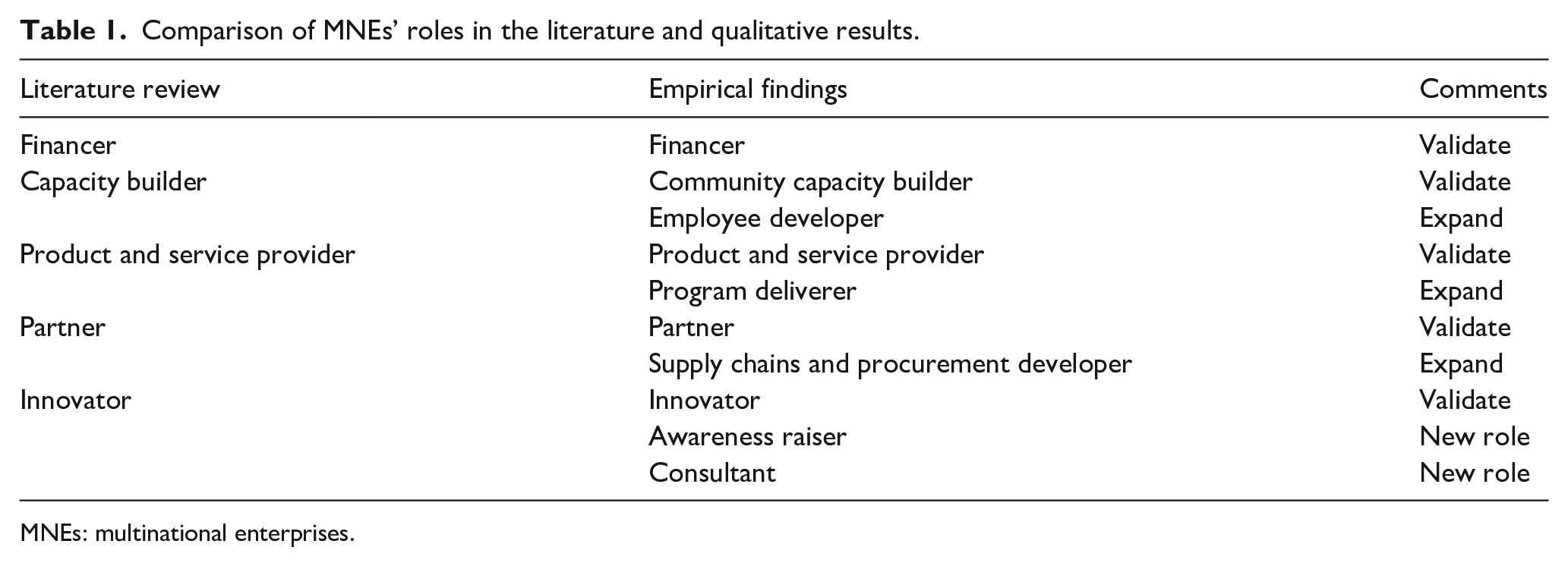
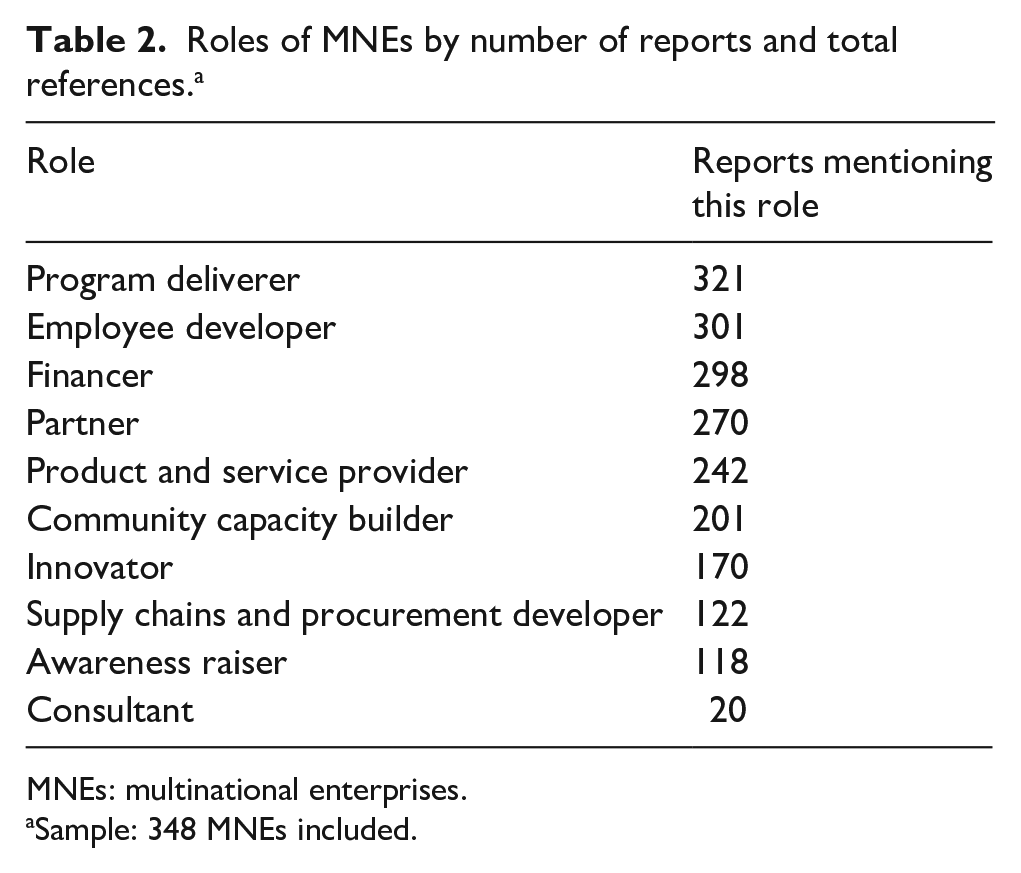
This subsection presents the qualitative empirical results on the roles of MNEs in local sustainable development. Table 1 shows that the literature discussed five roles of MNEs, namely capacity builder, financer, product and service provider, innovator, and partner, which were also found in the qualitative findings. Through the inductive analysis, the role of capacity builder was split into community capacity builder and employee developer, as these captured different beneficiaries and approaches. Product and service provider was also split into products and services related to the MNE’s operations, and program deliverer, which were additional initiatives coordinated by the MNE. Partner was also split into partner, capturing the MNE’s involvement in multistakeholder collaborations, and supply chains and procurement developer, which is related to local procurement strategies to foster economic development. Two new roles were identified in the empirical results, consultant and awareness raiser. Table 2 shows the number of reports mentioning each role.
Comparison of MNEs’ roles in the literature and qualitative results.
MNEs: multinational enterprises.
Roles of MNEs by number of reports and total references. a
MNEs: multinational enterprises.
Sample: 348 MNEs included.
Program deliverer
As a program deliverer, MNEs can play a key role in creating, designing, and implementing initiatives and programs for local sustainable development. In total, 321 reports reference initiatives or programs. Local sustainable development initiatives also include different methods that companies can use to initiate programs for the community, such as knowledge products (e.g., toolkits, research reports, etc.) and events (e.g., conferences, workshops, etc.) for knowledge dissemination. Many MNEs mention taking action to turn their sustainability strategies to create social change by leading programs that foster local sustainable development and target key issues in the community. Agrium (2015), for example, an agricultural company subsidiary of Nutrient based in Canada, mentions leading key programs that empower future generations to take action on challenges facing the world today:
By leading the development of programs like Seed Survivor®, Caring for Our Watersheds®, Journey 2050™ and Agriculture for Life®, we help encourage a new generation to learn more about the challenges and opportunities we face in the world today and to take action. In addition to education, these programs often include a component that involves direct student participation in advancing sustainability. (p. 20)
Employee developer
MNEs can play a role in the community by offering professional development opportunities for employees, such as mentorship, training, and events, which help to develop organizational capacity and have spillover benefits for the local economy. In particular, MNEs can provide mentorship opportunities that create employment for local citizens through internships, apprenticeships, incubator programs, and recruitment initiatives. MNEs can be a direct source of job creation and help to create local economic opportunities for the communities they operate in. By offering employment opportunities, MNEs can encourage knowledge sharing approaches that focus on skills development and knowledge transfer among the local community. The role of employee developer is referenced in 301 reports. For some companies, such as Eldorado Gold, a multinational gold mining company from Canada, developing internal capacities in the company, includes investing in the workforce through various training initiatives to enhance skills development and knowledge transfer to bolster the local economy:
Developing workforce capacity and conducting regular training across all of our sites is an ongoing priority. The majority of our workforce comes from local communities and regions [. . .] We believe there are significant social and economic benefits to building a local workforce and economy, and we invest in relevant training and development initiatives to improve the productivity and safety of our employees. (Eldoardo Gold, 2016, p. 43)
Financer
MNEs can play a large role as a financer for local sustainable development by contributing financial capital to local sustainable development issues through a number of different channels, including funding, grants, scholarships, fundraising, microfinance, loans, sponsorships, charitable donations, entrepreneurial ventures, and taxes. Financing the transition to a sustainable future is key to ensuring local communities have the resources they need to develop sustainably. As a financer, 298 reports have referenced this role. MNEs have funded and sponsored various initiatives for local sustainable development, as well as provided grants and scholarships to support children and youth in local communities. In one example, MNEs such as Citigroup (2016), an American multinational investment bank and financial service, use microfinance institutions and programs as a way of encouraging financial inclusion among the local community:
Microfinance can be a valuable tool in creating income-generating opportunities that support the livelihoods of low-income individuals and their families. Through a range of programs and partnerships, Citi invests in microfinance initiatives that promote financial inclusion and enable economic growth for underserved market segments. (p. 80)
Partner
The partner role can bring individuals, organizations, and communities together through cross-sector collaboration, including formal partnerships, joint ventures, memberships and associations, and other multistakeholder initiatives to support local sustainable development. This role is distinct in that it captures MNEs engagement in leading, responding, and participating in collaborative processes that bring individuals, organizations, and civil society together for addressing complex sustainability challenges. MNEs can view their role in society as a collective effort that needs to leverage partnerships and collaboration to tackle the world’s most pressing issues, particularly at the local level and as it relates to the SDGs. Two hundred seventy reports from MNEs referenced their participation in various initiatives as a partner. MNEs can lead, respond, and participate in collaborative processes with other organizations and communities to deliver progress on a wide range of topics related to local sustainable development through a variety of initiatives and programs. According to Accenture, a multinational services company based in Ireland with operations in consultancy, strategy, innovation, technology, digital, and operations, their role as a partner helps to drive systemic change needed for a sustainable future:
[Accenture] continue[s] to grow our role as a collaborator, convener and thought leader, and to deliver research and insights to help drive systemic change. By partnering with a diverse set of organizations [. . .] we are able to develop innovative solutions and make an even greater impact. (Accenture, 2016, p. 6)
Product and service provider
As a product and service provider, MNEs can provide quality services and products for the community and support supplementary services provided by the local government to assist the community in achieving goals related to local sustainable development through core business operations and peripheral business activities. In this role, MNEs can support supplementary service delivery and provide essential services to the community. MNEs can play this role by providing products and services through their core business operations and peripheral business activities. The role of a product and service provider is referenced in 242 reports. For example, Diageo (2016), a multinational beverage company based in the United Kingdom, provides basic infrastructure for water to supplement essential services in the local community:
Our Water of Life programme (to bring access to clean water, better sanitation, and education around hygiene to those who need it) contributes in some places to the development of local infrastructure. We have increasingly prioritised communities in close proximity to our operations and communities from which we source our local raw materials. (p. 26)
Community capacity builder
As a community capacity builder, MNEs can play an important role in local sustainable development for developing community capacities to enable individuals and organizations to develop and strengthen local capacities and assets needed to help communities develop sustainably. The role of a community capacity builder provides MNEs with a significant opportunity to support local organizations and community groups by providing opportunities for strengthening and expanding existing capacity-building resources, which in turn can strengthen processes for community decision-making, create a shared understanding and vision, facilitate progress toward local goals, and create effective community organizations. Under the community capacity building role, there are 201 reports mentioning this role. For example, for Al-najat Charity (2017), a multinational organization based out of Kuwait that builds and runs private schools, their development programs focus on developing community capacities to help communities identify goals for action and local sustainable development:
The development of communities is a way of strengthening society by prioritizing the actions and perspectives of the communities in the development of social, economic, and environmental policies. This development seeks the empowerment of local communities. It strengthens the capacity of people as active citizens through various organizations and networks. (p. 19)
Innovator
As an innovator, MNEs have the tools and resources to innovate new solutions for solving pressing challenges related to local sustainable development. The role of an innovator is referenced in 170 reports. MNEs can work toward innovative solutions to solve local sustainable development challenges through processes such as product and process design, research and development (R&D), and technological advancements. MNEs can engage in research activities to not only enhance their business knowledge but to inform their sustainability initiatives and engagement strategies to increase their impact and reach in the community. For some MNEs, for example, Cisco Systems Inc. (2017), a networking hardware MNE based in the United States, leveraging technological innovations are key to making an impact on the local community that addresses key challenges and needs identified by experts in the community:
Taking an outcome-driven approach, [. . .] learning firsthand from the local experts about the challenges and needs [. . .] The solution had to be adaptable, resilient, easy to operate and maintain [. . .] We can take on these types of challenges, think big, and apply our technology precisely to solve the needs of those on the ground. (p. 10)
The role of an innovator is distinct from other roles found in the empirical results because this role focuses on innovating new solutions for local sustainable development that may enable other roles to be delivered more efficiently or have a greater impact. The findings indicate that the role of an innovator specifically focuses on introducing new solutions, ideas, methods, products or services for addressing challenges, and needs of the local community to enable sustainable development.
Supply chains and procurement developer
Through leveraging supply chains and procurement, MNEs can play a crucial role in ensuring global procurement practices are inclusive of local, small, and diverse suppliers, including implementing responsible policies and practices across supply chains and leveraging value chains to incorporate the local community. The role of supply chains and procurement developer is referenced in 122 reports. MNEs such a Broken Hill Proprietary (BHP), an Australian mining MNE, pursue local procurement strategies that benefit the communities they operate in and foster local economic development by incorporating the local economy in their value chains:
We support local businesses by seeking to source products and services locally. All our assets are required to have local procurement plans that benefit local suppliers, create employment and build capacity through training of small business entrepreneurs. (BHP, 2018, p. 43)
Awareness raiser
Considering the wide-reaching scale and scope of MNEs, this role is prominent in the empirical results for highlighting local issues, impacts, and strategies that are important for fostering knowledge exchange to increase understanding of local sustainability issues and encouraging behavioral change for systemic change. This role focuses specifically on informing the public with information to help people understand a problem, opportunity, alternative, and/or solution. In total, 118 companies declare content that indicates they play a role in local sustainable development as an awareness raiser. Awareness raising efforts can include advocacy work, which relates to the idea of actively influencing thoughts, opinions, or behaviors, or can be informational for knowledge exchange. MNEs have different goals as an awareness raiser, for example, for Hang Lung Properties (2017), a real estate subsidiary of Hang Lung Group based in Hong Kong, their role as an awareness raiser is to “enhance public awareness and understanding of environmental issues, and encourage members of the public to join hands with us in making a positive environmental impact” (p. 41).
Consultant
The consultant role specifically can help other organizations, social enterprises, government agencies, and community groups with achieving progress on their own performance and goals by providing experience, expertise, and guidance in specialized fields related to the company’s business. As a consultant, this role provides feedback, alternatives, analysis, and decisions related to the inquiries of involved stakeholders. From the 348 sustainability reports, 20 companies were identified with this role. As a consultant in local sustainable development, MNEs report they have been offering skills, experience, resources, and expertise to individuals or organizations in the community through services such as pro-bono consulting and skills-based volunteering. For example, 3M (2019), an American multinational conglomerate, provides pro-bono consultancy services to local communities that are relevant to the company’s operations, which gives employees the opportunity “to lend their business skills, experience, and energy to local non-profit organizations, social enterprises, and government agencies in markets where the need is great and the work is relevant to 3M’s businesses” (3M, 2018, p. 24).
Analysis of companies by sectors and HQ region in relation to their roles in local sustainable development
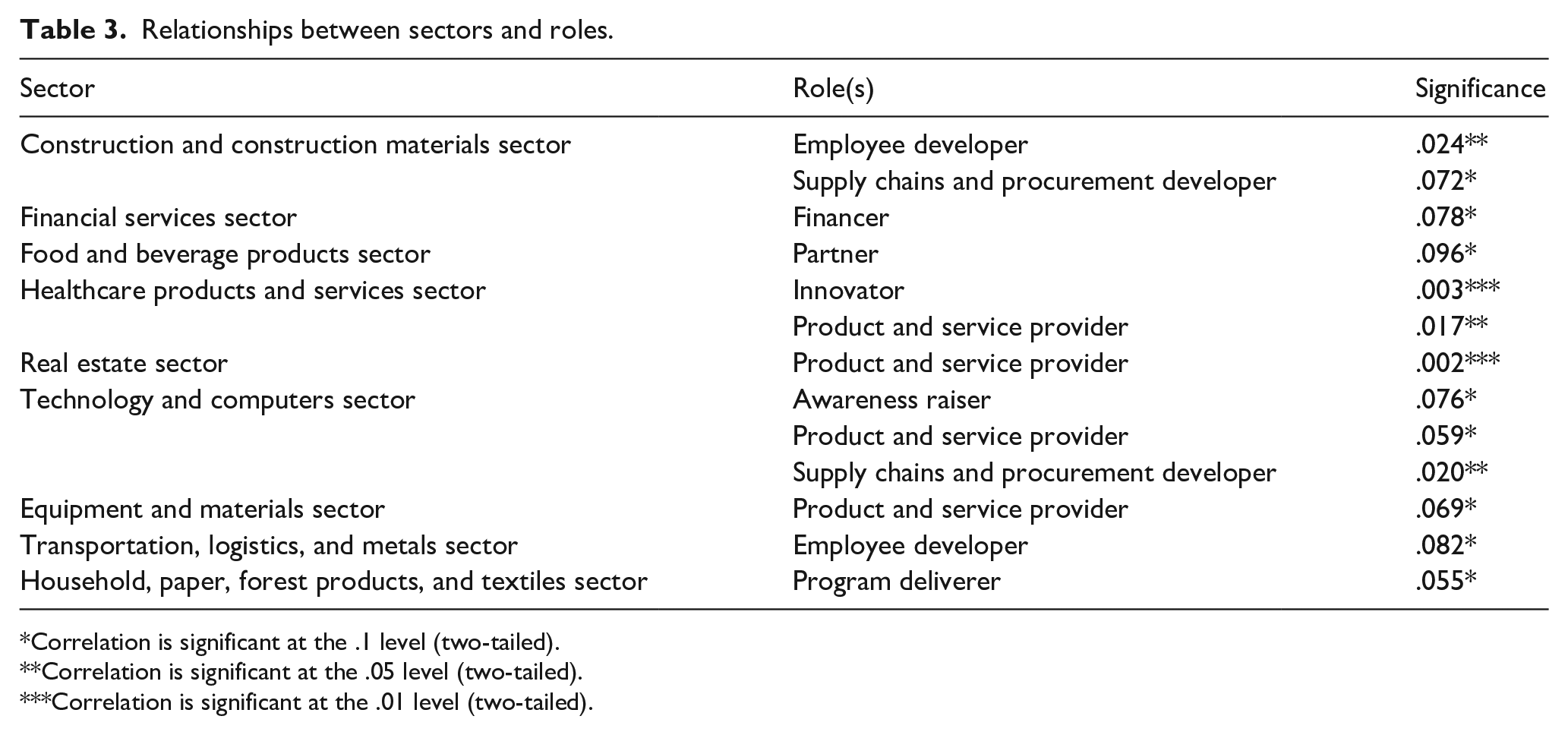
This subsection describes the results from the analysis of companies by sectors and HQ regions in relation to their roles in local sustainable development. Table 3 includes relationships between sectors and roles. There were 15 condensed sectors tested. The results show that eight correlations had statistically significant (two-tailed) values, in which the significance (two-tailed) values were less than p < .10. Three more correlations were statistically significant at the p < .05 level, two-tailed. Two additional correlations were statistically significant at the p < .01 level, two-tailed. There were no significant results for the chemicals, conglomerates, energy, retail and commercial, telecommunications and media, and raw materials sectors. There were also no significant results for the roles of community capacity builder and consultant.
Relationships between sectors and roles.
Correlation is significant at the .1 level (two-tailed).
Correlation is significant at the .05 level (two-tailed).
Correlation is significant at the .01 level (two-tailed).
Employee developer was statistically related to two sectors, specifically the construction and materials sector and the transportation, logistics, and metals sector. Perhaps, because some companies in these sectors are grounded in the trades, they see training local employees as core to their business. Supply chains and procurement developer was also statistically related to two sectors, specifically the construction and construction materials sector, and the technology and computers sector.
As expected, the results show the role of the financer has a significantly statistical relationship with MNEs in the financial services sector. The food and beverage products sector is correlated with the role of partner, while for the role of an innovator for local sustainable development, companies belonging to the health care products and services sector have a statistically significant relationship with this role. Through processes such as R&D, companies in the health care products and services sector are constantly evolving to address, develop, and implement health care innovations to address the needs of society.
The Product and service provider had a significant relationship with most sectors, specifically with companies belonging to health care products and services sector, the real estate sector, the technology and computers sector, and the equipment and materials sector. This is likely because offering core products and services is business as usual for a company, but it is interesting that these sectors chose to frame their products/services as a contribution to sustainable development while the other sectors did not.
Companies in the technology hardware and computers sector have a statistically significant relationship with the role of an awareness raiser for local sustainable development. Finally, MNEs belonging to household, personal, forest and paper products and textiles consolidated sector have a statistically significant relationship to the role of a program deliverer. MNEs play a key role in coordinating the full delivery of programs and initiatives for local sustainable development and focus their efforts on identifying effective mechanisms for program delivery.
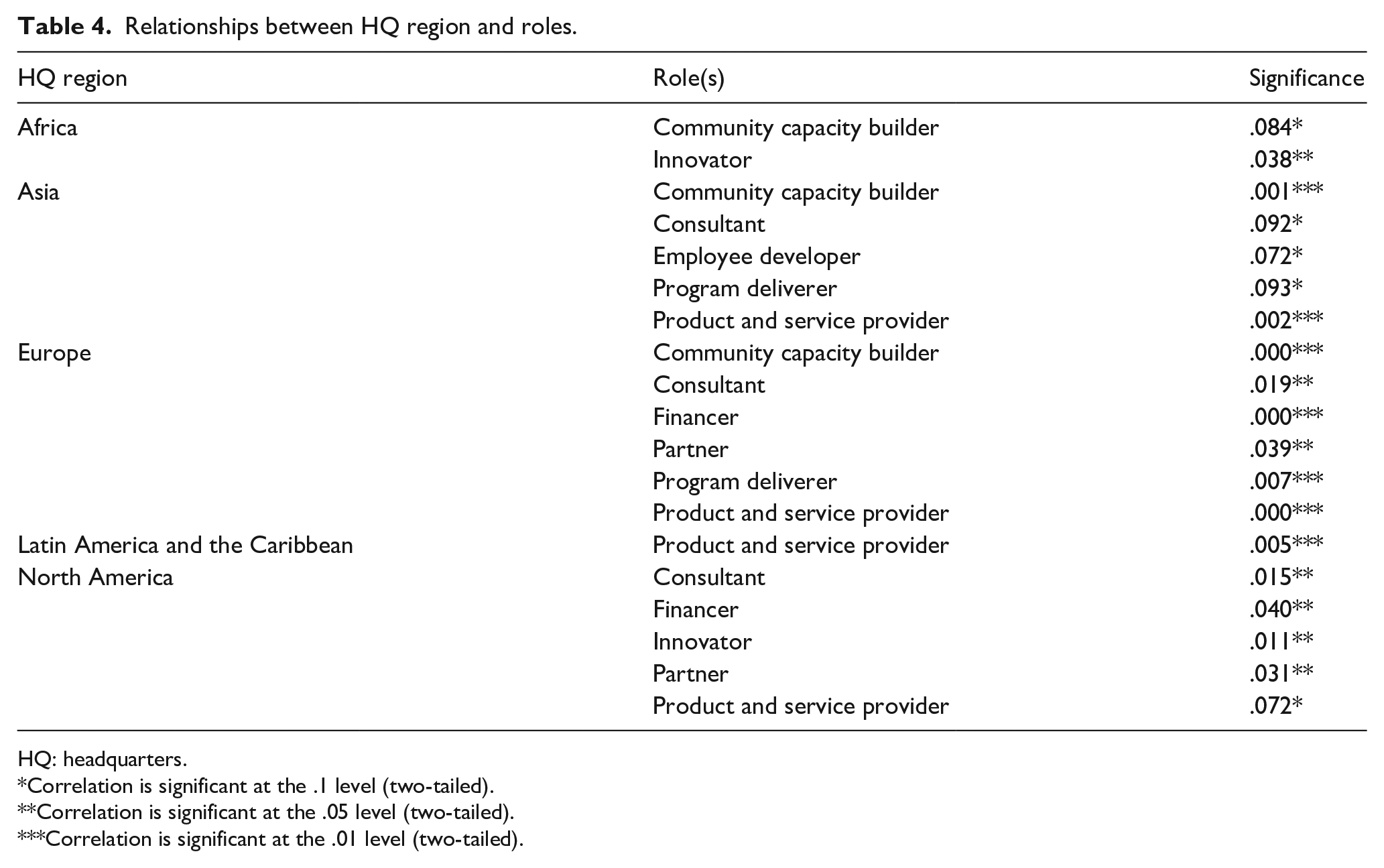
Table 4 includes the significant results about the relationships between HQ regions and roles. Six regions were tested, of which five had significant results. Correlations were computed relating to the roles of MNEs in local sustainable development and MNEs by the location of their HQ region for all companies in the study population that are categorized according to their HQ region.
Relationships between HQ region and roles.
HQ: headquarters.
Correlation is significant at the .1 level (two-tailed).
Correlation is significant at the .05 level (two-tailed).
Correlation is significant at the .01 level (two-tailed).
The results in Table 4 show that five correlations had statistically significant (two-tailed) values and were less than p < .10, two-tailed. Seven more correlations were significantly significant at the p < .05 level, two-tailed. Seven additional correlations were significantly significant at the p < .010 level, two-tailed. There were no significant findings for the Oceania region. There were also no significant results for the roles of supply chain and procurement developer and awareness raiser.
For the role of community capacity builder, there is a statistically signifcant relationship between MNEs with HQs in Africa, Asia, and Europe. In total, there are 248 companies with HQs belonging to the three regions. Innovator, is significant for two regions, for companies in Africa and those in North America. Consultant is significant for MNEs in Asia, Europe, and North America. The empirical findings also identify a relationship between MNEs with HQs in the regions of Asia and the role of an employee developer in local sustainable development. Program deliver is significant for two regions, Asia and Europe, while the product and service provider role is significant for four regions, Asia, Europe, Latin America and the Caribbean, and North America. The results also show that MNEs with HQs in Europe and North America have a statistically significant relationship with the role of a financer and with the role of partner. The results show that of the 47 companies in the population group belonging to the financial services sector, 26 have HQs in the regions of Europe and North America, which might explain the financer role being associated with those regions.
Considered from the HQ region perspective Europe, which has the most companies, also has the most roles (6), while Asia and North America, which also have a large number of MNE HQs, have five roles each. Asia and Europe’s share four of the same roles, while Europe and North America also share four of the same roles. Asia and North America only share two roles. Also, while Africa has only two roles, no other region has the same two roles. While Latin America and the Caribbean’s role is shared with three other regions (Asia, Europe, and North America).
Analysis roles in local sustainable development and SDG targets
When studying the SDGs, their targets and indicators, there are many relationships and opportunities for MNEs to use their roles and contribute to their achievement. Table 5 shows the clusters and the list of 102 SDG targets explicitly linked to the identified MNEs’ potential local roles. As seen in Table 5, the first cluster includes four roles with the capability of tackling almost all the SDGs in some capacity. The broad category includes the roles of program deliverer, awareness raiser, consultant, and product and service provider, with the potential of contributing to almost all SDGs, highlighting SDGs #2—Zero Hunger, #3—Good Health and Well-being, #5—Gender Equality, #7—Affordable and Clean Energy, #8—Decent Work and Economic Growth, #9—Industry, Innovation and Infrastructure, #11—Sustainable Cities and Communities, and #12—Responsible Consumption and Production. However, they can contribute limitedly to SDG #4—Quality Education, and #14—Life Below Water. The second cluster, the partial category, includes three roles that have the potential to contribute to between four and seven SDGs. This category includes the roles of financer, innovator, and employee developer with a high focus on SDGs #2, #3, #4, #8, #9, and #17—partnerships for the goals without any contribution to SDGs #5, #6—clean water and sanitation, #10—reduced inequalities, #11, #12, #13—climate action, and #16. Finally, cluster 3, the narrow category includes roles that only have the explicit potential to contribute to one or two SDGs. This includes community capacity builder, partner, and supply chains and procurement developer, which can only contribute to SDGs #4, #12, and #17. As a result, the SDGs to be potentially addressed the most by MNEs’ roles are SDGs #3, #8, #2, #9, and #17, while the least are SDGs #13 and #14. When interpreting Table 5, it is important to remember that the analysis was focused on targets under each SDG. So while it is possible to assume a specific role might be used to contribute to a specific goal, the targets under the goal are narrower than the broad goal, and are explicit in their preferred actions.
MNEs’ roles and SDG targets.
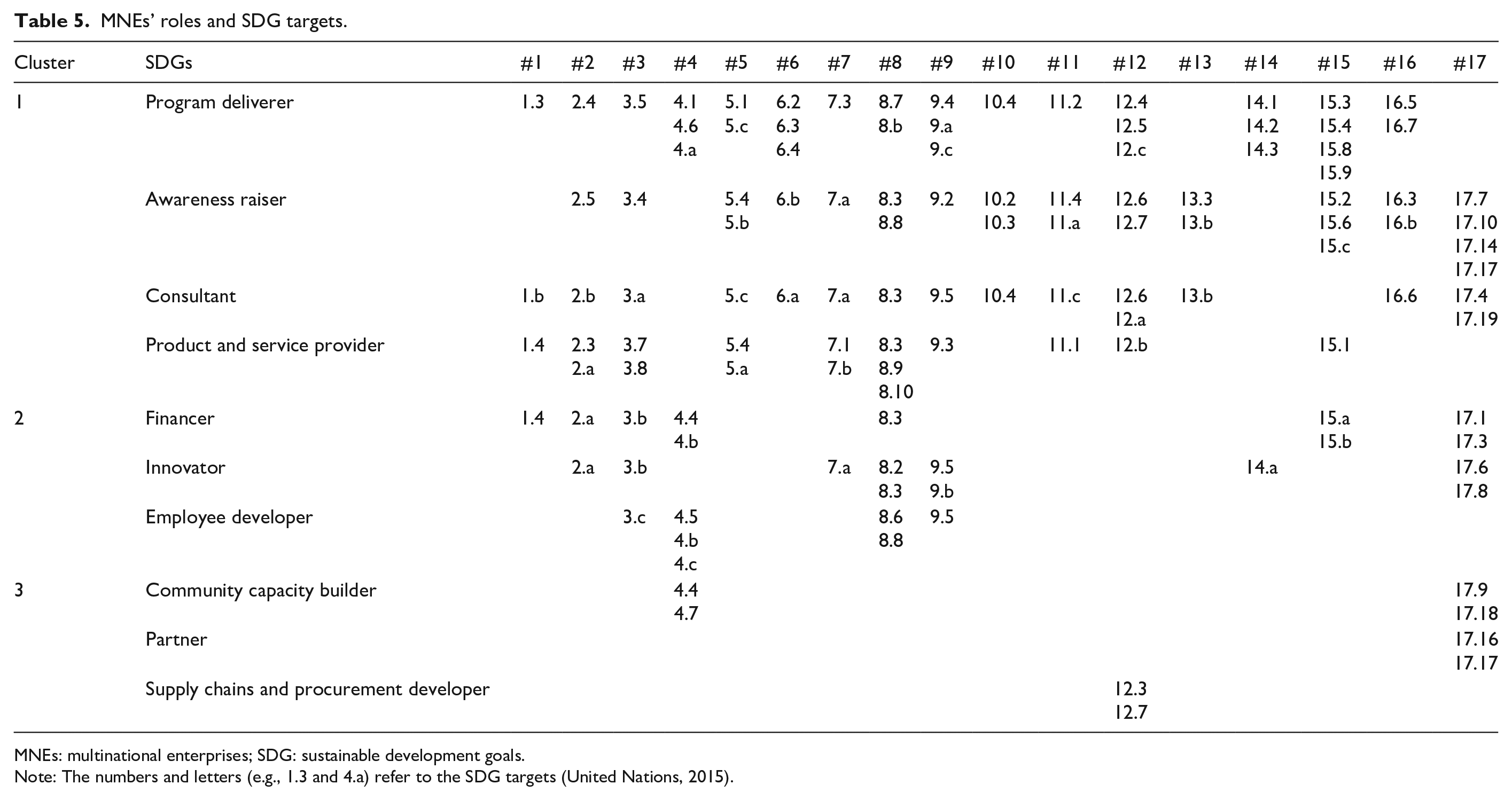
MNEs: multinational enterprises; SDG: sustainable development goals.
Note: The numbers and letters (e.g., 1.3 and 4.a) refer to the SDG targets (United Nations, 2015).
The broad cluster includes the roles of program deliverer, awareness raiser, consultant, and product and service provider. MNEs play a key role as a program deliverer for local sustainable development, a role with the highest potential for contributing to the SDGs among all the identified roles. Targets to be benefited from this role include implementing social protection systems (1.3), ensuring sustainable food production systems (2.4), strengthening substance abuse prevention (3.5), ensuring free primary education for all (4.1), ending female discrimination (5.1), ensuring full access to sanitation (6.2), increasing energy efficiency (7.3), eradicating forced labor (8.7), facilitating sustainable infrastructure (9.a), adopting greater equality policies (10.4), providing access to sustainable transport (11.2), managing wastes environmentally soundly (12.4), reducing marine pollution (14.1), combating desertification (15.3), and reducing corruption and bribery (16.5). The novel contribution of this role relates to the coordinating category of the three dominant types of roles found in the literature (Yan et al., 2018). The literature also shows that MNEs coordinate the delivery of programs and initiatives through collaboration with other organizations through local cross-sector partnerships (Riikkinen et al., 2017) to benefit both partners and increase the impact on the community (Seitanidi & Crane, 2009). This role specifically highlights MNEs’ function in coordinating the delivery of programs and initiatives that may address multiple different issues of local sustainable development. That said, it does not mean any one MNE will be ideal to provide programs for all these SDGs. The sector of the MNE also matters. What this means is that this role, were it conducted by an appropriate MNE, has the potential to be used for any of these SDG targets.
The role of an awareness raiser reached the second most SDGs. Notable targets include promoting access to the benefits of genetic resources and traditional knowledge (2.5); promoting mental health (3.4), shared responsibility within households (5.4), and women empowerment (5.b); supporting local communities participation in water management (6.b), promoting investment in clean energy (7.a), safe and secure working environments (8.8), inclusive industrialization (9.2), social, economic and political inclusion (10.2), and strengthening efforts to protect the world’s cultural and natural heritage (11.4); encourage sustainable business practices (12.6), raise awareness on climate change (13.3), promote forest sustainable management (15.2), justice for all (16.3), and cross-sector partnerships (17.17). The literature acknowledges that the private sector plays a fundamental role in local sustainable development for helping local authorities transform into proactive organizations for articulating sustainability initiatives (Rotheroe et al., 2003). This study finds that awareness raising is a critical component for changing attitudes, behaviors, and beliefs for supporting existing systems of local sustainable development. MNEs in this sector mention the awareness raiser role in their sustainability reports through various campaigns for raising awareness for local sustainable development issues. These companies also highlight many calls to action through programs, campaigns, events, and awards.
The role of a consultant found in the empirical results emphasizes MNEs’ role in offering skills, experience, resources, and expertise to individuals and organizations in the community through services such as pro bono activities and consulting to support services, operations, or organizations in the community. As highlighted, this is another role that can contribute to many SDG targets. Particularly to the creation of pro-poor (1.b) and gender-sensitive policy frameworks (5.c), the prevention of trade restrictions in agricultural markets (2.b), the expansion of cooperation in water (6.a), and clean energy-related activities (7.a), the development of policies toward productive activities and decent jobs (8.3), the upgrade of technological industry capabilities (9.5), the adoption of wage and social protection policies (10.4), the support of the least developed countries through financial and technical assistance (11.c), the strengthening of the scientific and technological capacity of developing countries toward sustainable consumption and production patterns (12.a), the promotion of climate change mechanisms (13.b), the development of effective, accountable and transparent institutions (16.6), the attainment of long-term debt sustainably for developing countries (17.4), and the advancement of sustainable development progress measures (17.19). The empirical results show that MNEs offer their business skills, expertise, and experience to help serve communities and foster the development of sustainable communities to support social enterprises, government agencies, and community groups in their goals and performance for contributing to sustainable development.
The product and service provider role in the empirical results also validates the literature as MNEs have been playing increasingly important roles in delivering products and services to local communities by supporting or supplementing roles traditionally played by local governments and agencies (Newenham-Kahindi, 2015; Yamin & Sinkovics, 2009). The literature identifies wider governance roles taken on by MNEs in terms of filling institutional voids, gaining political authority, and acting as one of the most powerful actors within governance systems (Crane et al., 2008; Dauvergne & Lister, 2012; Detomasi, 2007; Moura-Leite & Padgett, 2011; Muthuri et al., 2012; Newenham-Kahindi, 2015; Yamin & Sinkovics, 2009). The empirical results show that MNEs play a large role in delivering products and services to local communities, particularly in the areas of education, health, food, infrastructure, and other product and service delivery. The role was linked to SDGs #1, #2, #3, #5, #7, #8, #9, #11, #12, and #15. Service provision for education is the most commonly referenced thematic topic within the role of a product and service provider. The literature only identified MNEs’ role in providing basic infrastructure and public welfare (Newenham-Kahindi, 2015; Yamin & Sinkovics, 2009), but did not specifically highlight MNEs’ role in providing private education or any other thematic topics related to local sustainable development.
The partial cluster includes three roles that have the potential to contribute to between four and seven SDGs, specifically financer, innovator, and employee developer. MNEs belonging to the financial sector tend to pursue the role of a financer, as well as innovator and employee developer, which could be a result of MNEs providing investments, financing, and funding services for various local sustainable development issues. These roles are clearly identified as part of the same partial cluster, with a focus on eliminating poverty and hunger (SDGs #1 and 2), improving health and education (SDGs #3 and 4), developing decent employment and the industry (SDGs #8 and 9), and partnering for sustainability (SDG #17). The role of financer has the potential to address targets such as ensuring equal rights to economic resources for all (1.4), increasing investment in rural infrastructure and research (2.a), supporting vaccines and medicines research and development (R&D) (3.b), expanding scholarships for developing countries (4.b), and mobilizing financial resources from multiple sources (17.3). Furthermore, the literature acknowledges that financial institutions play an increasingly important role in advancing sustainable development (Chelekis & Mudambi, 2010; Kolk et al., 2014, 2017, 2018).
The role of an innovator is validated as a role MNEs pursue for innovating new solutions for contributing to challenges for local sustainable development, highlighting their potential to contribute to solving issues such as hunger and health (SDGs #2 and 3), economic growth and industry (SDGs #8 and 9), and partnerships (SDG #17). Particularly relevant for innovators are providing affordable access to medicines and vaccines (Target 3.b), achieving higher levels of economic productivity (Target 8.2), supporting domestic technology development in developing countries (Target 9.b), and enhancing multiactors cooperation in science, technology, and innovation (Target 17.6). The empirical findings show that through processes such as product and process design, R&D, and technological advancements, MNEs are playing an important role in local sustainable development to develop innovative solutions for sustainability.
For the role of employee developer, its potential contributions to health and well-being (SDG #3), education (SDG #4), work (SDG #8), and industry (SDG #9), highlighting increasing health financing and recruitment (Target 3.c), eliminating gender disparities in education (Target 4.5), protecting labor rights and promoting safe and secure working conditions (Target 8.8), and enhancing scientific research and upgrading the technological capabilities of industrial sectors (Target 9.5).
The narrow cluster includes community capacity builder, partner, and supply chains and procurement developer. For the role of community capacity builder, MNEs are motivated by the needs of local communities and how MNEs are able to support existing systems to help communities develop, implement, and maintain the collective skills, resources, and processes for local sustainable development, with a clear role for them particularly in education (SDG #4) and collaboration (SDG #17). In this respect, the identified roles can contribute to increasing the number of youth and adults with relevant skills for employment, decent jobs, and entrepreneurship (Target 4.4), ensuring that learners acquire the skills needed for sustainable development (Target 4.7), as well as enhancing international support for capacity-building in developing countries (Targets 17.9 and 17.18).
The partner role validates the literature as MNEs partner with other organizations and communities through cross-sector collaboration. MNEs’ role as a partner is referenced in the literature as MNEs’ leading partnerships with local stakeholders to address local sustainable development challenges (Newenham-Kahindi, 2015), in which MNEs are increasingly encouraged to take part in societal problem-solving through multistakeholder approaches (Ritvala et al., 2014; Waddock, 1989). The literature discusses various types of partnerships with different organizations leading the partnership process, which can range in terms of number of partners, geographical scope, time and duration, vision and goals, funding sources, and functions (Glasbergen, 2007). For example, local governments can convene businesses and civil society organizations in partnerships (Kolk et al., 2008; MacDonald et al., 2018). The private sector can also convene public sector actors and/or NGOs in collaborative processes (Kolk et al., 2008). In international business (IB) literature, there is limited understanding regarding MNEs’ initiatives in local partnerships linking the SDGs to the sustainability operations of MNEs (Kolk et al., 2017). Previous scholarship has shown that in order for MNEs to achieve greater progress on the SDGs, they need to do so through partnerships, yet IB research mostly focuses on MNEs’ impact on people, the planet, peace, and prosperity without specifically addressing how MNEs aim to achieve progress collaboratively (Kolk et al., 2017). The empirical results reveal the role of a partner includes MNEs’ role in collaborative processes beyond partnerships, such as joint ventures, memberships and associations, and support for other multi-stakeholder initiatives. The empirical results also show that more and more companies are viewing their engagement with local sustainable development as a process that needs to be taken collaboratively with other organizations, particularly through local cross-sector partnerships (Clarke & Crane, 2018; Ordonez-Ponce et al., 2021). Furthermore, some companies are also aligning with SDG 17: partnerships for the goals as a key priority in their operations and engagements.
The role of supply chains and procurement developer is extended by the empirical results. The previous literature does not identify this role, but previous scholarship mentions MNEs investment in trade-based activities in global value chains (Neu et al., 2014), incorporating local economies in their value chains (Kolk et al., 2018; Parmigiani & Rivera-Santos, 2015; Werner et al., 2014), and how MNEs’ value chains have vital leverage points which can be leveraged to enable concrete action for responding to sustainability challenges and the SDGs (Dauvergne & Lister, 2012; Montiel et al., 2021). Sustainable supply chain management has also been studied to have an influence on local poverty levels (Neu et al., 2014). The empirical results show that MNEs role as a supply chains and procurement developer forms a key function in managing supplier relations and implementing responsible supply chain policies and practices, as well as leveraging value chains for local communities. This role found in the empirical findings presents a distinct role in which MNEs consider the needs of the community that drive local procurement strategies and manage supplier relations, which reflects MNEs’ response to their ethical, environmental, and social concerns. MNEs role in a supply chains and procurement developer is important in local sustainable development for fostering local economic opportunities and providing opportunities for local employers to join MNEs’ value chains. This role also helps MNEs to ensure diverse workforces and inclusive supplier management, for example, through supplier diversity programs. It is linked to SDG 12, the construction and construction materials sector, and the technology and computers sector.
Conclusion
The private sector is essential for the development of cities, livelihoods, and providing goods and services to the community (UNGC, 2017). Issues such as poverty and inequality, climate change, and environmental degradation are widespread—yet are only a few of the existing challenges communities face today with the rise of growing ecological crises and social inequality (Knox & Maklan, 2004; Kolk & van Tulder, 2010; Ochoa et al., 2018; Waddock et al., 2002). MNEs leverage distinct strengths compared to other organizations that can contribute to accelerating sustainability initiatives at the local level, and thus to implementing the SDGs at this scale. This research explored the different roles that MNEs might play to support local sustainable development, particularly how their roles help to achieve the SDGs at the local level. By understanding the roles MNEs might play, their efforts can be further leveraged toward local sustainable development. This opens new opportunities for the MNEs, and for those that might partner with MNEs.
The first research question asked: what roles do MNEs play in implementing the SDGs and/or pursue sustainability progress at the community local level? Literature has started to pay attention to the different roles that MNEs are playing to advance SDGs implementation (see section “Roles of MNEs in local sustainable development”). We contribute to this stream of research by offering a synthesis of the different roles that MNEs can play in achieving the SDGs at the local level. Previous literature shows five roles that MNEs can play in local sustainable development: capacity builder, financer, product and service provider, innovator, and partner. This study goes further, showing that three of those five roles found in the literature can be further distinguished due to the results from the empirical findings; particularly the roles of community capacity builder versus employee developer, product and service provider versus program deliverer and partner versus supply chain and procurement developer. Our study expands the roles by identifying two new roles, consultant and awareness raiser. The most common roles were program deliver, employee developer, and financier. The least common were consultant, awareness raiser, and supply chains and procurement developer. Given that consultant and awareness raiser were not covered previously in the literature as an MNE role, the lower frequency might explain this. That said, the awareness raiser was included in about a third of the sustainability reports, so deserves to be added.
The second research question asked: Does the MNEs sector or the location of the MNEs HQs relate to the roles they might play? The literature has studied the relevance of the industry and the HQ country of origin in the development of local sustainable development (see section “Influence of MNEs sector on roles in local engagements”). We contribute by pointing out that there is a distinct relationship between the sector and roles pursued by MNEs in local sustainable development. For example, nine of the consolidated sectors had significant relationships with at least one role. But the roles varied widely between sectors, with eight of the 10 roles showing a relationship with at least one sector. Most of the sectors only had a significant relationship with one role, two sectors were related to two roles, and one sector (the technology and computers sector) was linked to three roles.
This research also shows that there are some statistically significant relationships between MNEs by HQ region and the roles pursued in local sustainable development. Five of the six regions were statistically related to at least one role. Specifically, Europe was related to five roles, North America and Asia was related to four roles, Africa to two roles and Latin America and the Caribbean to one role. Each region was related to a different set of roles and eight of the 10 roles showed as relevant here. This shows that not all MNEs are including the same content in their sustainability reports and/or pursuing the same local sustainability efforts, and that HQ regions influence this.
The third research question asked: which SDG targets are explicitly linked to the roles MNEs might play? From the analysis of these roles in relation to their potential link to addressing the SDG targets, the roles were organized into three clusters. The broad cluster—made up of the program deliver, awareness raiser, consultant, and product and service provider roles—are roles with the potential to be utilized for achieving targets under almost all the SDGs. The partial cluster—made up of financier, innovator, and employee developer roles—support targets under four to seven of the SDGs, while the narrow cluster—made up of community capacity builder, partner and supply chains and procurement developer roles—is only useful for addressing the targets under one or two SDGs. Yet, over 200 MNEs included community capacity builder in their sustainability reports, and 122 MNEs included supply chains and procurement developer.
These findings highlight the importance of considering the targets and not just the goals when considering what progress MNEs are providing toward implementing the SDGs. They also highlight that the SDG authors created more targets related to awareness raising than community capacity building. That said, there were a fair number of targets related to roles that the private sector typically plays, such as product and service provider, financer, innovator, employee developer, and supply chain and procurement developer, indicating that the SDG authors always intended for the private sector to help in implementation. While awareness raiser is more typically associated with civil society organizations (Yan et al., 2018), it was mentioned by 118 MNE in their sustainability reports. These findings emphasize the filling of institutional voids that is happening by MNEs (Crane et al., 2008).
This study’s findings have practical contributions to local governments. In fact, to achieve the implementation of SDGs, the local government need to collaborate with different actors, with MNEs being considered a crucial actor in some locations. The roles of MNEs in local sustainable development provide a basis for understanding the different ways in which MNEs can contribute to the development of local communities. Local governments can use the different roles to decide what type of MNEs is required to advance in the implementation of SDGs. For example, MNEs can play a key role in enabling solutions by providing financial capital; potentially for local governments opening new funding sources for local sustainability action.
Likewise, MNE managers may find the synthesis of roles helpful in considering their options for engaging in local sustainable development, what is typical of their region versus other regions, and what is typical of their sector versus other sectors. The matrix can also provide options to address different SDGs and targets with a role they might have considerable capacity to play.
Finally, while this study looks at how MNEs portray their roles, this research does not aim to explore the degree to which MNEs may be overselling their contributions to the SDGs or their negative impacts on local communities because the reports analyzed are voluntarily self-published by the company. To gain a comprehensive understanding of MNEs’ contributions to the SDGs, future research can observe actions that deter local communities from achieving the SDGs, as well as triangulating company data with information from more neutral external sources like the media. There are many other potential research questions related to MNEs implementation of the SDGs, and their efforts to further local sustainable development.
This study aims to contribute to the sustainability management conversations about SDG implementation, and the potential roles of MNEs in local sustainable development. It also highlights that the SDGs to be potentially addressed the most by MNE’s roles are SDGs #3, #8, #2, #9, and #17, while the least are SDGs #13 and #14, but MNEs might help with all 17 SDGs. Previous research (Kolk et al., 2017) shows that international business literature is mainly focused on SDGs #1, #7, #10, #13, and #16, which when compared to the SDG matrix shows many new SDGs that international business scholars could consider.
Footnotes
Acknowledgements
The authors would like to thank the co-editors of this Special Issue for their leadership, especially Javier Delgado Ceballos who provided such constructive feedback on our paper. We would also like to thank Valentina Castillo Cifuentes for her guidance on the statistical analysis.
Declaration of conflicting interests
The author(s) declared no potential conflicts of interest with respect to the research, authorship, and/or publication of this article.
Funding
The author(s) disclosed receipt of the following financial support for the research, authorship, and/or publication of this article: Financial support for this work was provided by the Government of Canada - Social Sciences and Humanities Research Council (SSHRC) and the University of Waterloo.
