



Abstract
Sustainable Development Goals (SDGs) seek to achieve economic, social, and environmental progress globally. However, trade-offs among these three pillars might occur, particularly in the context of cities. We argue that these trade-offs exist because the traditional factors of production for economic welfare are not always relevant to the other dimensions of city sustainability. Consequently, additional factors are needed to facilitate the progress of the 2030 agenda. We make a case for smart governance, a factor that we associate with the quality of governance. We explore these ideas by examining the economic, social, and environmental dimensions of 128 cities worldwide. Our results indicate that the traditional factors of production (labor, land, and capital) are positively associated with the economic dimension but weakly associated with the social and environmental dimensions. However, smart governance is positively associated with the various dimensions of urban sustainability.
Introduction
The day 15 September 2015 was crucial for humanity, as all 193 United Nations Member States backed an ambitious plan to solve humanity’s most significant challenges after massive consultation. Designed to be implemented through collaboration of governments, civil society, and businesses, the plan was called the “Sustainable Development Goals” (SDGs). It includes 17 goals and 169 targets to be achieved by 2030. This plan was viewed as an opportunity to put the world on a sustainable path, and it was intended to mobilize global efforts to achieve inclusive societies, ensure robust action on climate change, and promote a shift toward sustainable consumption.
Despite the enthusiasm for and efforts dedicated to this plan since its inception, progress toward the goals has been laborious. Indeed, the UN Secretary-General António Guterres recently lamented that “the rate of progress in many areas is far slower than needed to meet the targets by 2030,” raising skepticism about the program’s feasibility (Moyer & Hedden, 2020). One of the reasons the SDGs are stalling is that there are tensions, trade-offs, and challenging paradoxes among economic growth, social equality, and environmental performance (Jay et al., 2017). Indeed, previous research has evidenced the difficulties in reaching simultaneous prosperity for the economy, humans, and the natural environment (Haffar & Searcy, 2017; Hahn et al., 2010; Van der Byl & Slawinski, 2015).
These tensions are likely to be pervasive in urban contexts (del Mar Martínez-Bravo et al., 2019; Wang, 2021) since the challenges addressed by the 2030 agenda are global in nature but have a tangible expression in local places, with consequences reflected in urban areas (Rousseau et al., 2019). Not surprisingly, one of the SDGs explicitly refers to the development of sustainable cities and communities (SDG #11). Although recent research efforts have focused on understanding how the tensions among the three pillars of urban sustainability (economic, social, and environmental) unfold in urban contexts (del Mar Martínez-Bravo et al., 2019; Wang, 2021), we still know relatively little about the sources of tension and, perhaps more worrisome, what can be done to relax these trade-offs. In this article, we argue that these tensions stem from the fact that the resources and capabilities needed for economic prosperity—known as the traditional factors of production (land, labor, and capital)—are not always the same factors required to spur social and environmental success. Consequently, novel factors that can influence all three dimensions of sustainability must be considered. We make a case that good governance quality, or as we call it in this study, smart governance, is such a factor. Because smart governance seeks a balanced interrelation of the state, civil society, and the market to achieve stable economic, social and institutional development, it is expected to influence all three pillars of urban sustainability. However, despite the apparent appeal of smart governance as an essential element needed to pursue the SDG agenda, it has not been empirically and systematically explored in urban contexts where social ills are likely to unfold (Rousseau et al., 2019).
To narrow this gap, this article empirically tests the ideas described above using a sample of 128 cities around the world. The results indicate that the traditional factors of production (labor, land, and capital) are, in general, positively associated with the economic dimension, but most of them are weakly linked to the social and environmental dimensions. Moreover, our work shows not only that both national and local smart governance are positively related to economic welfare but also that smart national governance is related to social equality, while smart local governance is related to environmental quality. Together, our results highlight the importance of improving governance skills at the national and local levels, as they are a critical mechanism for advancing the SDG agenda.
This article makes two main contributions to the existing literature. First, we expand the growing and vibrant literature on the intersection between governance and sustainability (Aguilera et al., 2021). While this research has mostly circumscribed their analyses on the influence of organizational governance mechanisms, the role of governance in the public sector on sustainability issues has been largely overlooked. In this article, we address this omission by developing and testing the notion of smart governance as a fundamental factor in improving urban sustainability. By focusing on smart governance, we bring governments to the forefront as critical actors in promoting city sustainability in line with SDGs 11 (sustainable cities and communities), 16 (peace, justice, and strong institutions), and 17 (partnerships for the goals).
Second, we contribute to the emergent management literature that uses communities as their unit of analysis to explore sustainability-related issues. Previous work has focused on corporations (Berrone et al., 2016a; Marquis et al., 2013) such as banks (Almandoz, 2012), digital platforms (Carrasco-Farré et al., 2022), and nonprofits (Berrone et al., 2016a; Rousseau et al., 2019), but the role of governance as a suitable instrument to promote urban sustainability has remained in the background. By exploring SDG-related issues at the city level, we are able to offer more fine-grained recommendations for urban policymakers. Specifically, our results suggest the need for a regenerative process in contexts characterized by poor governance, as this process can act as a vehicle to help advance the pursuit of SDGs.
The tensions among the SDGS
While the world economy has grown unprecedently over recent decades, some problems, such as social inclusion, climate change, and gender inequality, have remained pervasive and difficult to resolve (World Bank, 2020). The United Nations is a multilateral organization that has been historically concerned with these issues. Since its founding, the United Nations has pursued an agenda of sustainable development. Notably, in its report entitled Our Common Future (also known as the Brundtland Report), the United Nations defined sustainable development as “development that meets the needs of the present without compromising the ability of future generations to meet their own needs” (WCED, 1987, p. 37), which has become a commonly used definition in the context of sustainability. Since then, the United Nations has sponsored various programs and initiatives (e.g., Earth Summit [1992], the Kyoto Protocol [1997], and the Millennium Development Goals (MDGs) [2000]). Given the relative success of the MDGs in reducing extreme poverty, the United Nations decided to push for an even more ambitious plan to address the pressing social problems facing humanity, introducing the SDGs in 2015. The SDGs comprise 17 goals and 169 targets and set a new international sustainable development agenda to be attained by 2030.
Most of the issues addressed by the SDGs are not foreign to management scholars (see the studies by Aguinis & Glavas, 2012; Bansal & Song, 2017; Montiel & Delgado-Ceballos, 2014, for recent reviews). Indeed, management research has a long tradition of studying some of these social and environmental problems, structuring their efforts around concepts such as corporate social responsibility, sustainability management (Bansal & Song, 2017), grand challenges (George et al., 2016), and “wicked problems” (Rittel & Webber, 1973). More recently, scholars have started to address some of these social issues from the SDG perspective. An increasing number of special issues in academic outlets such as the Academy of Management Discoveries (Howard-Grenville et al., 2019), the Journal of International Policy (Van Tulder et al., 2021), and Business Research Quarterly (Delgado-Ceballos et al., 2020) are a testament to this trend. These special issues deal with several SDG-related topics, including the role of organizations in the achievement of various SDGs, such as gender diversity (SDG #5; Goodman & Kaplan, 2019), impact investment (SDG #9; Zhan & Santos-Paulino, 2021), climate actions (SDG #13; Rawhouser et al., 2019), and the development of sustainable communities (SDG #11; Hertel et al., 2019).
These research efforts have provided novel insights into the link between organizations and societal issues, although they have focused almost exclusively on private firms and nonprofit organizations, relegating the role of the public sector’s governance. This omission is surprising since the 2030 agenda raises several issues that require the engagement of all kinds of organizations (SDG #17)—not just businesses—and that need the collective effort of several societal actors (Berrone et al., 2019). In addition, these issues encompass multiple levels of analysis that are of interest to management scholars, including city-level analyses (Marquis et al., 2007), where the public sector plays a significant role (Berrone et al., 2016a; Rousseau et al., 2019).
To make SDGs more accessible, there have been some attempts to simplify them by reducing the number of SDG categories. For instance, the OECD organized the SDGs according to its well-being framework (OECD, 2017), recognizing certain overlaps and important differences. Le Blanc (2015) suggested clustering the SDGs into four related categories: “planetary boundaries,” “the safe and just operating space,” “the energetic society,” and “green competition.” Elder et al. (2016) proposed organizing the SDGs into six main groups: social objectives, resources, economy, environment, education, and governance. Similarly, Griggs et al. (2014) proposed classifying the SDGs according to a six-part framework that comprises sustainable food security, sustainable water security, thriving lives and livelihoods, universal clean energy, sustainable ecosystems, and governance. However, management scholars have preferred a more straightforward classification. They have structured the SDGs according to the three traditional pillars of sustainable development, namely, based on the environmental, social, and economic domains (Berrone et al., 2020). This structure is consistent with other organization-oriented frameworks, such as the triple bottom line or environmental, social, and governance (ESG) factors (del Mar Martínez-Bravo et al., 2019).
The SDGs represent laudable efforts to guide humanity toward long-term prosperity, although their implementation represents significant challenges due to the tensions and trade-offs among the three pillars of sustainability. The United Nations has indicated that the SDG agenda is “indivisible” (UN, 2015), suggesting that all 17 SDGs are interconnected (Sachs et al., 2019; Wang et al., 2019) and that simultaneous action is required for all of them. However, because the economic, social, and environmental elements are intertwined (Bansal & Song, 2017) and because they are multisectoral, multiscale, multiactor issues that are challenging to solve (Ferraro et al., 2015), balancing all of them simultaneously is not a straightforward process.
The difficulties arise because, while some SDGs might be fully aligned and reinforce one another, others might be orthogonal or even negatively related, generating trade-offs and tensions (Le Blanc, 2015). For instance, advances in the context of fisheries and the livelihoods of coastal communities (SDG #14) could have positive effects on poverty eradication (SDG #1) and food security (SDG #2; Nilsson et al., 2018). Conversely, agricultural expansion (SDG #12) could adversely affect health outcomes because of the intensive use of insecticides and unsafe irrigation systems. Thus, these links between various goals and targets can create positive or negative feedback loops (Nilsson et al., 2018) that entail significant challenges and tensions that are difficult to resolve. That is, trade-offs occur because sacrifices have to be made in one area to obtain benefits in another (Byggeth & Hochschorner, 2006).
The management literature has also acknowledged that sustainability is about balancing the economic, social, and environmental pillars, as they are “inextricably connected and internally interdependent” (Bansal, 2002, p. 123). Indeed, ignoring one of these aspects could lead to an incomplete and possibly biased view of the phenomenon. In addition, the management literature has recognized the frictions and difficulties faced in simultaneously reaching economic, social, and ecological prosperity (Haffar & Searcy, 2017; Margolis & Walsh, 2003; Van der Byl & Slawinski, 2015). Hahn et al. (2010), for instance, compellingly suggested that trade-offs in corporate sustainability are the norm instead of the exception and that the underlying assumption that the “three principles are mostly in harmony with each other is rather simplistic” (p. 219). As a potential solution to resolve these tensions, the management literature has suggested that governance is crucial in navigating the multiple pressures generated by the three sustainability pillars (Aguilera et al., 2021).
The three pillars of SDG in cities
The notion of sustainability is not foreign to cities and it often adopts the label of “urban sustainability” (Campbell, 1996). Similar to the concept of corporate sustainability, urban sustainability is defined as the “balance between environmental protection, economic development, and social wellbeing” (Wu, 2010, p. 2). Thus, it is not surprising that the tensions described above are present, and perhaps more palpable, in cities. Previous studies provide arguments and abundant evidence of the difficulties involved in achieving synchronization across the three dimensions of urban sustainability. For instance, Porter (1995, 2016) stated that while certain social programs (such as housing assistance and food stamps) are intended to address societal problems in impoverished metropolitan areas, they are not intended to encourage economic productivity, job creation, or local company success. Florida (2017) summarized numerous studies showing that urban economic growth does not bring social inclusion, indicating that it might actually increase social inequality. Rocha (2019) also acknowledged that a purely economic explanation shows that entrepreneurship might exacerbate employment inequality and communal divisions. Others, such as studies by Glaeser and Gottlieb (2009), Puga (2010), and Glaeser et al. (2009), show that economic progress in a city does not always translate into benefits for all its local citizens, which can promote the rise of “cities of elites” (Florida, 2017).
Moreover, the link between economic growth and environmental degradation in cities has remained challenging to identify. A significant amount of evidence suggests that more powerful metropolises, on average, exhibit worse environmental conditions (Glaeser & Kahn, 2010; Sarzynski, 2012). Confirming the notion that there are trade-offs among the three pillars of city sustainability, Martíne-Bravo et al. (2019) recently explored European cities and found that while urban social sustainability is positively associated with city livability, economic sustainability is positively related to urban pollution.
In short, the tensions between the pillars of the SDGs are likely to be pervasive in the context of cities, preventing the achievement of the desired positive associations (synergies) among them. Thus, a deeper understanding of the trade-offs among the three pillars of city sustainability is needed (Lerpold et al., 2021). Next, we explore the extent to which traditional factors affect each dimension of sustainability and whether smart governance might be a transversal factor that affects all three pillars.
Driving factors of the three pillars of the SDGs in cities
The nature of the determinants of a city’s success has been questioned for decades, although this effort has primarily gravitated toward the notion of economic competitiveness (Lever & Turok, 1999; Lever et al., 1999; Simmie & Lever, 2002). Consistent with the idea of the traditional factors of production, urban economists have provided empirical evidence that labor, land, and capital positively influence the competitiveness of urban areas (Chatterji et al., 2014; Glaeser & Kahn, 2010). Indeed, skills and knowledge (labor; Porter, 1995), the effective use of natural resources (land; Glaeser & Kahn, 2010), and physical infrastructure (capital; Lobo et al., 2013) are the bases of most production systems.
Unlike the case of economic welfare, which enjoys a well-established theoretical model of production factors, the other pillars of sustainability lack such a conceptual framework. In fact, sustainability in management does not offer an integrated theory and often borrows theories from other fields. Consequently, we present hypotheses using the general production factor model as a baseline argument for the link between these factors and the three sustainability pillars. However, since there are not robust enough theoretical frameworks for smart governance and SDGs, our intention with the quantitative empirical analysis is primarily exploratory (Bettis et al., 2014). Nevertheless, our hypotheses provide a baseline to be used in searching for alternative factors behind city sustainability.
Indeed, it is unclear whether the same factors that foster economic productivity can also favor social and ecological progress. We explore whether the tensions among the three pillars of sustainability in cities emanate from the heterogeneous impact that the production factors have on economic welfare, social equality, and environmental quality. That is, we do not know whether the factors that sustain economic growth can also sustain social progress or ecological conservation, or conversely, they might have no influence (or even a deleterious impact), implying the existence of trade-offs. In the latter case, when policymakers make significant efforts toward promoting economic growth, they might be, paradoxically, stimulating social injustice and environmental degradation. As pointed out by Richard Florida, it might be the case that “the same factors that drive economic growth also drive inequality” (Florida, 2017, p. 98).
Nevertheless, it can be argued that a well-educated workforce (labor) should affect the social and environmental dimensions of sustainability. Both a given market’s ability to absorb the existing workforce and the educational level of a population play an essential role in influencing social justice (Berrone et al., 2016a). For instance, a market that accommodates most of the available workforce will positively impact certain aspects of social equality, such as income inequality, because education facilitates access to jobs, productivity, and higher income levels (Becker & Chiswick, 1966). Thus, an educated labor force is expected to foster greater social equality. In addition, highly educated populations are more likely than less-educated populations to be knowledgeable about the negative consequences of harming the natural environment (Alabaster & Hawthorne, 1999) and are more likely to be concerned about ecological degradation. Recent evidence indicates that cities with highly educated individuals tend to have better environmental indicators, such as better air quality (Rousseau et al., 2019). Consequently, an urban population with a higher educational level is anticipated to be associated with greater ecological conservation.
The above arguments predict that labor will positively link with the three pillars of urban sustainability. Thus, we expect the following:
Hypothesis 1a (H1a): In cities, the “labor” factor is positively associated with economic welfare.
Hypothesis 1b (H1b): In cities, the “labor” factor is positively associated with social equality.
Hypothesis 1c (H1c): In cities, the “labor” factor is positively associated with environmental quality.
A similar positive dynamic might be observed when considering the effective use of natural resources (land) as a contributing factor to social equality and environmental quality. When land is used efficiently, an increase in the output of social and economic activities is often observed. The notion of land use efficiency (also known as LUE) is a concept consistent with sustainable development and is the result of dynamic processes driven by economic, social, and environmental factors (Cai et al., 2020). Previous studies have equated LUE to various forms of density (Glaeser & Kahn, 2004). Indeed, urban planning research has long shown how urban designers can significantly influence how citizens access social and public services by efficiently placing physical elements in the city and using the land to distribute activities across space (Handy et al., 2002). For instance, efficient land use leads to lower commute times, better housing, and improved access to educational and cultural services (McCahill & Garrick, 2012). Similarly, efficient land use may reduce pollution levels and augment the percentage of dense green areas in a given city (Glaeser & Kahn, 2010). It can also influence citizens’ behaviors by, for instance, encouraging people to walk and cycle instead of using private cars (Handy et al., 2002). Since land use affects population density, connectivity, and land use mix, which in turn influences behaviors regarding the environment, we expect it to be reflected in the environmental quality of a given urban area.
The above arguments predict the following hypotheses:
Hypothesis 2a (H2a): In cities, the “land” factor is positively associated with economic welfare.
Hypothesis 2b (H2b): In cities, the “land” factor is positively associated with social equality.
Hypothesis 2c (H2c): In cities, the “land” factor is positively associated with environmental quality.
Unlike the case of labor and land, the link between capital and social equality, as well as that between capital and environmental quality, is more challenging to defend. For instance, while investing capital in a disadvantaged urban area can revitalize it economically, there is no guarantee that this benefit will be distributed fairly among its inhabitants. In fact, many scholars argue that certain types of capital investment can lead to racial segregation, ethnic discrimination, and, ultimately, gentrification (Wyly & Hammel, 2004). Similarly, investments in new physical infrastructure are not guaranteed to be made with consideration of their impact on the environment. Evidence suggests that there are substantial barriers to adopting environmental standards, for instance, in the case of green building standards (York et al., 2018).
The preceding paragraphs suggest that while capital can promote economic welfare, it might simultaneously have a negative influence on social equality and environmental quality. Formally,
Hypothesis 3a (H3a): In cities, the “capital” factor is positively associated with economic welfare.
Hypothesis 3b (H3b): In cities, the “capital” factor is negatively associated with social equality.
Hypothesis 3c (H3c): In cities, the “capital” factor is negatively associated with environmental quality.
Smart governance as a critical factor for the SDGs in cities
In addition to the traditionally examined factors, previous work has analyzed other factors that contribute to the promotion of urban growth, such as connectivity (Khanna, 2016), entrepreneurship (Glaeser et al., 2015), and innovation (Lever, 2002). However, the fact that the driving factors of economic growth create some tensions in the social and environmental dimensions invites us to explore novel elements that can simultaneously influence the three pillars of sustainability. This is consistent with the idea that SDGs are unlikely to be achieved by relying on the same practices and applying the same logic that created the studied problems in the first place (Berrone et al., 2020).
In her book, Reimagining Capitalism in a World on Fire, Rebecca Henderson invites governments to increase their effectiveness. She argues that governments must become inclusive, participatory, transparent, capable, and democratically accountable to attain sustainable prosperity. As she summarizes, “effective governments are valued partners in sustaining both the free market and a free society” (Henderson, 2020). Following this idea, we propose that effective governance is a transversal factor (i.e., affects all dimensions) that might positively affect the sustainability of cities.
The notion of effective governance, also known as good governance, is not novel. It emerged in 1989, when it was included in the World Bank’s report on Sub-Saharan Africa (Landell-Mills et al., 1989); this report equated good governance with “sound development management.” However, it was not until recently that the concept of good governance gained traction and has been suggested to be a critical element in achieving the SDGs at the country level (Glass & Newig, 2019). Especially in cities, good governance has been relabeled smart governance (Bolívar & Meijer, 2016).
Although smart governance was initially narrowly defined as the use of technology and data analytics to spur countries, regions, and cities to be more agile and competitive (Goldsmith & Crawford, 2014), the concept evolved to a broader conceptualization. Smart governance was understood to include more than administrative efficacy and instrumental benefits derived from technology. In this work, we consider this more comprehensive understanding of smart governance and characterize it as a transversal decision-making process to develop “better” cities (Barrionuevo et al., 2012). As such, smart governance depends on the effectiveness, quality, and sound guidance of state intervention on society overall. It can be seen as a multidimensional and multilevel construct that includes aspects such as transparency (Gil et al., 2019), stakeholder collaboration (Ricart & Berrone, 2017), the ability to secure social infrastructure through public–private partnerships (Berrone et al., 2019), a citizen-centric approach to solving problems (Meijer et al., 2016), a long-term perspective (Berrone et al., 2016a), a proactive management style (Ruhlandt, 2018), sensible use of public resources (Bolívar, 2018), and a strong willingness to innovate (De Guimarães et al., 2020).
Considering this definition, we argue that smart governance is vital for spurring sustainable economic, social, and environmental development, particularly in the urban context of the SDGs. Cities that enjoy smart governance are better positioned to successfully address SDG-related challenges such as homelessness, social inequality, unemployment, informal economy, pollution, disease, and violence. For instance, addressing climate change defies simple solutions because of its complex multilevel and multiactor nature. Consequently, it requires long-term horizon thinking, participatory architectures, and a willingness to experiment to find acceptable and feasible solutions (Ferraro et al., 2015). Moreover, tackling social issues such as racial discrimination demands knowledge exchange and the inclusion of human capital (Nam & Pardo, 2011; Papa et al., 2013). Solving economic challenges also requires strong leadership, creativity, and cooperation among various functional sectors, parties, and geographical jurisdictions (de Wijs et al., 2016) coupled with institutional readiness. Indeed, achieving the SDGs requires solid political institutions, sound quality policymaking, and efficient public service delivery. Not surprisingly, SDG 16 (“Promote just, peaceful and inclusive societies”) explicitly acknowledges these needs and prescribes “effective, accountable and inclusive institutions at all levels.” These characteristics are integral elements of the notion of smart governance and can thus be envisioned as essential for the successful implementation of the SDG in the context of cities. Thus, we expect the following:
Hypothesis 4a (H4a): In cities, the “smart governance” factor is positively associated with economic welfare.
Hypothesis 4b (H4b): In cities, the “smart governance” factor is positively associated with social equality.
Hypothesis 4c (H4c): In cities, the “smart governance” factor is positively associated with environmental quality.
Methods
Sample and data collection
We collected archival data for 128 cities worldwide to test our hypotheses. Seventy-one of these cities were country capitals. Since one of our main variables of interest is smart governance, we identified the IESE Cities in Motion Index as the main source for our study (Berrone et al., 2017). To the best of our knowledge, this is the only source that captures smart governance at the city level and with a global scope. We departed from the list of 180 cities across the world covered by the report. After collecting the rest of the relevant variables, we dropped 52 cities due to missing values for at least one measure, which led to a final sample of 128 cities. The 128 cities around the world included in our sample represented approximately 30% of the world’s GDP and accounted for approximately 12% of the global population. The geographical distribution of our sample was as follows: Western Europe, 24.2% (31); Asia Pacific, 18.8% (24); Eastern Europe, 18% (23); Latin America, 12.5% (16); North America, 10.2% (13); Middle East, 7.8% (10); Africa, 6.3% (8); and Australasia, 2.3% (3). Table 1 contains the final list of cities included in our sample clustered by region, as well as those cities dropped from the analysis.
Cities included in the sample clustered by region.
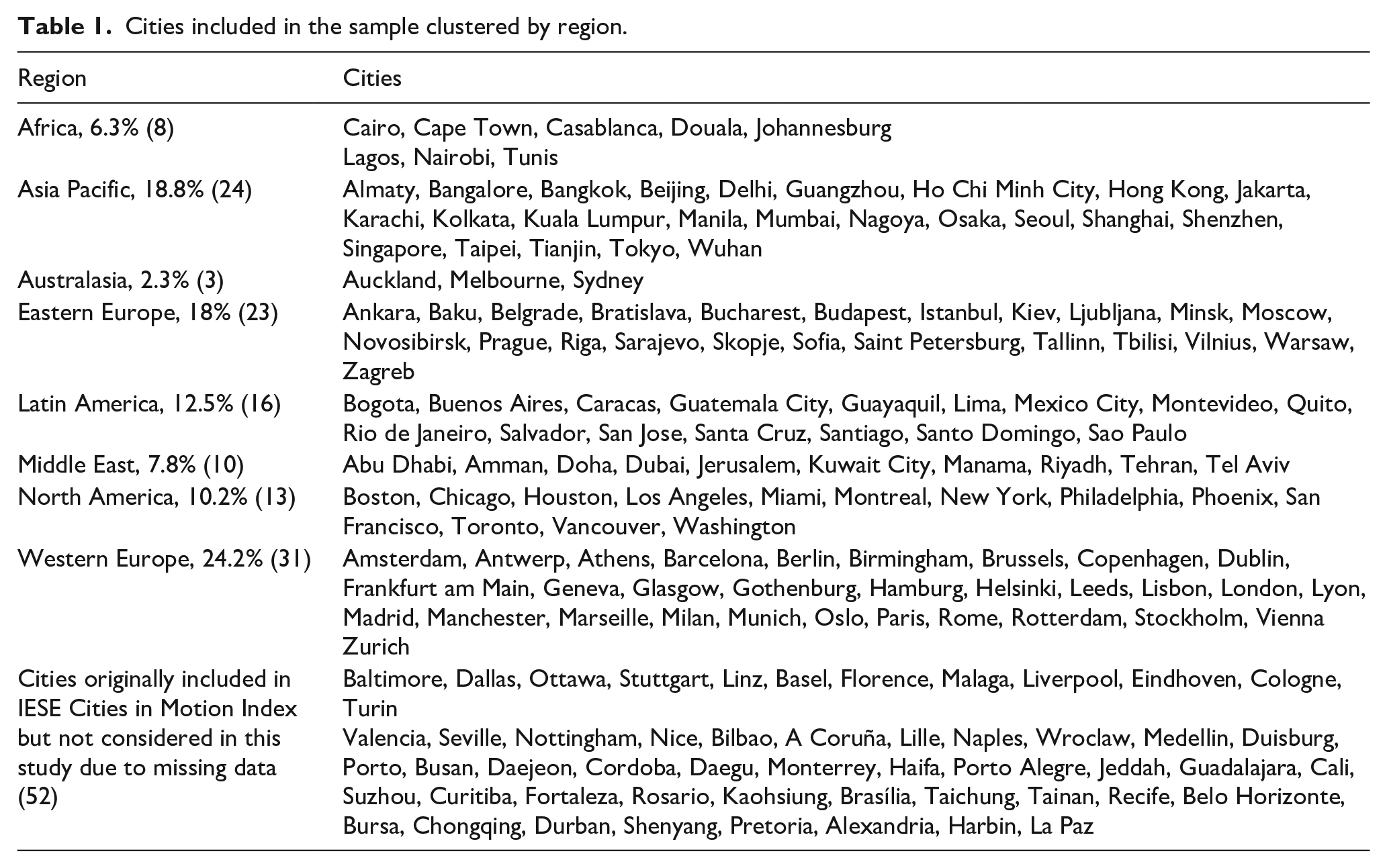
Our sample has both weaknesses and strengths. One caveat is that our sample is affected by data availability. Researching global cities often involves hard-to-find empirical evidence. We walk a fine line between maximizing geographical coverage and finding reliable and comparable data. Overall, we believe we were able to reach a decent balance. In addition, our sample tends to comprise medium and large cities, which restricts our findings’ generalizability to relatively large urban areas. Finally, most of the data are cross-sectional for 2015, which prevents drawing causal conclusions. At the same time, there is a key positive element. Our sample was significantly larger than those used by previous studies since most management studies that explored cities focused on the 100 largest cities and had a geographical scope that was limited to US cities (Marquis et al., 2007; Rousseau et al., 2019; Stuart & Sorenson, 2003).
All the information used in our empirics is from 2015 unless otherwise indicated. We relied on four sources of information. Most of the annual data on the cities’ characteristics were obtained from the Passport Database, a proprietary database available through Euromonitor International. This dataset contains information about global cities and has been used in recent research (Wall & Stavropoulos, 2016). The data for the variables related to the environment, land use, and capital were collected from the GHS Urban Centre Database (Florczyk et al., 2019). This database contains information on spatial entities called “urban centers” according to a set of multitemporal thematic attributes gathered from the Global Human Settlement Layer sources (European Commission) as well as other sources available in the open scientific domain. Finally, smart governance was measured at two levels, namely, national and local. The data for the national measure were collected from the World Bank, while the smart local governance data were collected from the IESE Cities in Motion Index (Berrone et al., 2017). The IESE Cities in Motion Index summarizes multiple indicators arranged according to multiple urban dimensions, including governance, which is the dimension used in this study. We relied on the edition published in 2017, which uses data from 2014, 2015, and 2016 to create the governance indicator. While this might raise some concerns about the temporal sequence of our analysis, there are two factors that minimize these concerns. First, we are interested in associations (and not causality). Second, this variable is relatively stable over time.
Measures
Dependent variable
Economic welfare
To gauge economic welfare, we use GDP per capita, which is the result of dividing each city’s gross domestic product, in terms of US dollars, by its total number of inhabitants. We deflected GDP with the total population since the SDGs seek to meet the minimum quality of life of all individuals. Universally, it is one of the most used measures of prosperity and is frequently used in research. Thus, it stands up to tests of face validity. This variable is expressed in thousands of dollars and is consistent with SDG #8.
Social equality
This construct is approximated with the Gini coefficient at the city level. The Gini coefficient is perhaps the most widely used measure of inequality (Berrone et al., 2016a). A Gini value of zero indicates that all the households in an area have equal income, while a value of 100 means that one household has all the income. Thus, higher Gini index values are indicative of greater levels of inequality. To align values with the label of our construct and to facilitate interpretation, we multiplied this variable by −1 to show that higher values correspond to higher levels of social equality. This variable is consistent with SDG #10.
Environmental quality
A significant number of studies have approximated urban environmental quality with air emissions. They are one of the main contributors of contamination in cities, and local governments are particularly concerned about environmental issues arising from urban air pollution (Moussiopoulos, 2003). We used air quality at the city level as a proxy of environmental quality and employed average PM2.5 concentrations (particulate matter ⩽ 2.5 μm) to measure this variable. PM2.5 is a standard measure of environmental pollution and is considered a risk factor for mortality in cities (Burnett et al., 1998). Again, to facilitate interpretation, we multiplied this variable by −1 to show that higher values correspond to better environmental quality. This variable is consistent with SDG #13.
Independent variables
We used two variables to measure labor as a key factor of production.
Higher education
This variable represents the proportion of the metropolitan population with higher education (i.e., tertiary or post-secondary education) over 15 years old. This variable is consistent with SDG target 4.B.
Employment rate
This variable is the percentage of the employed urban population within the working age range (15–64). This variable is aligned with SDG targets 8.5, 8.6, and 8.8.
Land use efficiency
This variable proxies land as a factor of production. This variable captures the ratio of the land consumption growth rate to the population growth rate between 1990 and 2015. Our measure captures the growth rates of the two most important aspects in urban planning (land and population). In that sense, it gauges how the city accommodates population growth: either by increasing density (maintaining the same level of land) or by expanding its territory. As such, it is a measure of how effectively the land is used. Since this variable captures density, greater values represent greater efficiency in land use. This variable is consistent with SDG target 11.3.
Capital
To proxy capital as a factor of production, we use infrastructural assets. This variable is measured as the per capita amount of built-up area within the spatial domain of a given urban center, and it is expressed in square meters per person. This variable is in accordance with SDG targets 9.1 and 9.3.
Given the multilevel nature of smart governance (that is, it can present at various levels of government), we distinguish between national and local smart governance.
Smart national governance
This variable uses the measure of government effectiveness provided by the World Bank. It captures “perceptions of the quality of public services, the quality of the civil service and the degree of its independence from political pressures, the quality of policy formulation and implementation, and the credibility of the government’s commitment to such policies” (Kraay et al., 2010, p. 10). The range for this variable is from −2.5 to 2.5. A higher value indicates better (smarter) governance.
Smart local governance
This variable uses the measure of governance provided by IESE Cities in Motion. This variable is a composite measure that accounts for the effectiveness, quality, and sound guidance of the local government. It comprises several indicators, including an index that captures corruption, whether a given city has an open data platform, the range of its government web services, the number of functions that its innovation departments have, and an index that captures the strength of its legal system. This variable ranges from 0 to 100. Both governance variables are consistent with SDG target 16.8.
Control variables
We include two controls in all our models. These are as follows:
City size
This variable measures the metro population size and is the total number of inhabitants on a logarithmic scale. This is a standard control variable used in previous urban studies (Glaeser & Gottlieb, 2009).
Political city
This is a dummy variable that assumes the value of 1 if a city is its country’s capital and zero otherwise. Capital (or political) cities have unique characteristics and might enjoy demographic benefits due to their political nature (Mayer et al., 2017), which could affect the implementation of the SDGs.
Estimation methods
To test our hypotheses, we performed an ordinary least squares (OLS) regression analysis with White’s correction, which solves certain heteroskedasticity problems (White, 1980). We used our proxies for economic welfare, social equality, and environmental quality as dependent variables. This is consistent with the idea that sustainable development involves economic progress, social inclusiveness, and environmental sustainability (Sachs et al., 2019). After each regression, we also calculated the variance inflation factor (VIF) to determine whether the results were subject to the threat of multicollinearity. In all cases, these values were below 3, far below the commonly accepted threshold of 10. This indicated that the estimations were free of any significant multicollinearity bias.
Results
Table 2 reports the descriptive statistics and correlations of the variables used in this study. In our sample, the average GDP per capita (our proxy for economic welfare) is US$32.109, consistent with the estimates used by other studies that examine international cities (Richard et al., 2011). The average Gini coefficient (i.e., our proxy for social equality before multiplication by −1) is 41.19, which is similar to the values found in other management studies that explore cities (Berrone et al., 2016a). The average PM2.5 is 24 µg/m3 (i.e., environmental quality before multiplication by −1). According to the European Union Air Quality Directives 2008/50/EC Directive on Ambient Air Quality and Cleaner Air for Europe, the annual PM2.5 limit is 25 µg/m3. Therefore, on average, the cities in our sample are close to this threshold. However, this variable has a wide range, as it has a minimum of 5 (Melbourne) and a maximum of 110 (Delhi).
Descriptive statistics and correlations. a
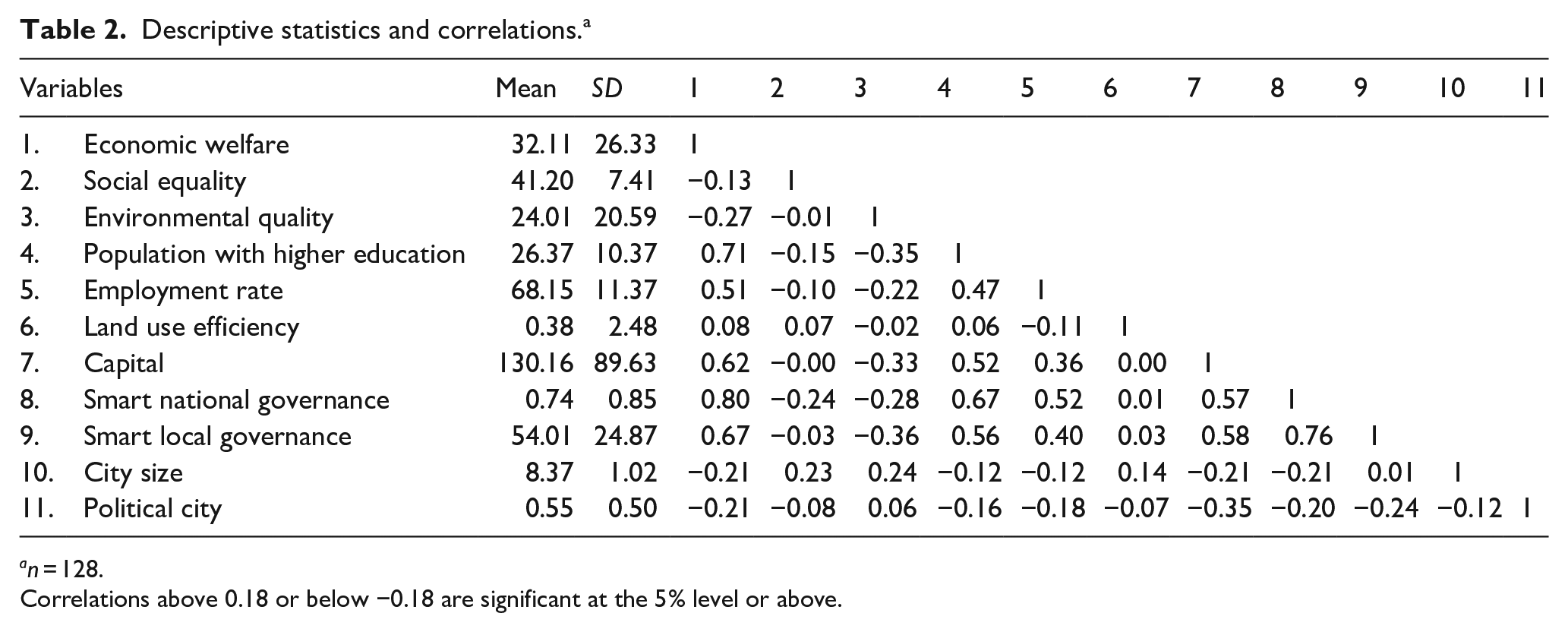
n = 128.
Correlations above 0.18 or below −0.18 are significant at the 5% level or above.
In line with the assumption that there are tensions between the three pillars of sustainability in cities, economic welfare is negatively correlated with social equality (−0.12) and environmental quality (−0.27). In addition, consistent with previous evidence (Abel & Gabe, 2011), economic welfare and population with higher education exhibited a high and significant correlation (0.71). Similarly, economic welfare was highly correlated with the smart national governance variable (0.80), in line with our expectations. Both measures of smart governance were correlated at 0.76, indicating that while they behave in the same direction, they are different constructs.
Table 3 reports the results of the models used to test H1abc, H2abc, and H3abc (regarding the impact of the three factors of production [labor, land, and capital] on economic, social, and environmental progress). Model A has economic welfare (GDP per capita) as the dependent variable and includes the control variables and all the factors of production. The results indicate that the variables proxying labor (education and employment) are positively and significantly associated with economic welfare, supporting the positive association between labor as the classical factor of production and economic welfare (H1a). Moreover, the variables proxying land and capital are both positive and significant, offering evidence supporting H2a and H3a, respectively. Overall, the results indicate that the three factors of production are strongly associated with economic welfare. The R2 for model A was above 62%.
Determinants of economic welfare, social equality, and environmental quality. a
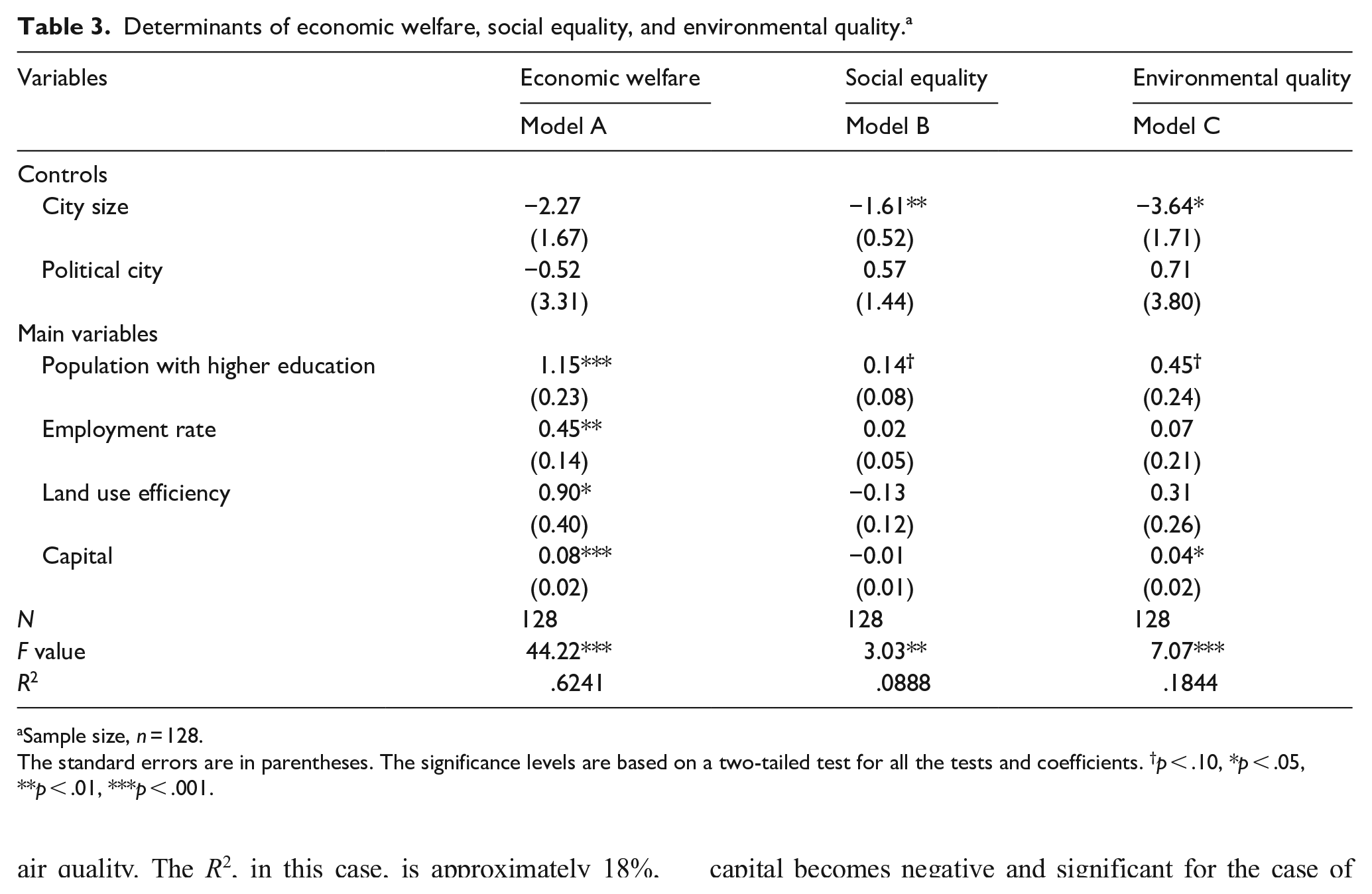
Sample size, n = 128.
The standard errors are in parentheses. The significance levels are based on a two-tailed test for all the tests and coefficients. †p < .10, *p < .05, **p < .01, ***p < .001.
Model B has social equality (the Gini coefficient multiplied by −1) as the dependent variable, and all the factors of production are included. Only higher education is marginally significant. It has a positive coefficient, suggesting that the more educated a population is, the greater the social equality (lower income inequality). This provides limited support for H1b. The other factors of production (land and capital) are not significant and thus fail to offer support for both H2b and H3b. Regarding the control variables, city size was significantly and negatively associated with social equality, suggesting that the level of social equality in larger cities is lower (i.e., there are higher levels of inequality in these areas). It is important to note that the R2, in this case, is significantly lower (8.8%) than in the case of economic welfare, which indicates that other factors that are not considered are more relevant in explaining the variance in this dependent variable.
Model C uses environmental quality as the dependent variable. Again, higher education is marginally significant and has a positive coefficient, suggesting that the more educated a population is, the higher the environmental quality (in line with H1c). However, land is not significant; thus, H2c is not supported. Moreover, capital is positively and significantly related to the dependent variable, suggesting that the more investment is made in the physical infrastructure of an area, the higher that area’s environmental quality. This finding offers evidence against the expectations expressed in H3c. Regarding controls, the larger cities (in terms of population) seem to have poorer air quality. The R2, in this case, is approximately 18%, lower than in the case of economic welfare but higher than in the case of social equality. Again, other factors (not considered in this model) are likely to explain the variance in this dependent variable.
Together, the results from Table 3 indicate that only higher education affects all three dimensions of sustainability. At the same time, capital is related to economic welfare and environmental quality but not to social equality. On the contrary, land and employment are related exclusively to economic welfare. This is in line with the idea that the traditional factors of production are related to economic welfare but do not show a similar link with the other dimensions of sustainability (social and environmental).
Table 4 reports the models used to test H4abc (stating that smart governance facilitates the three pillars of the 2030 agenda). Models A, B, and C use economic welfare, social equality, and environmental quality as their dependent variables, respectively, and they include smart national governance as the primary independent variable. The coefficients of smart national governance are positive and significant for economic welfare and social equality, in line with H4a and H4b. When introducing smart national governance into the model, the coefficients of traditional factors linked to economic welfare maintain their sign. Nevertheless, their magnitude is reduced, and their significance suffers, with the extreme employment rate becoming nonsignificant.
Smart governance as a determinant of economic welfare, social equality, and environmental quality. a
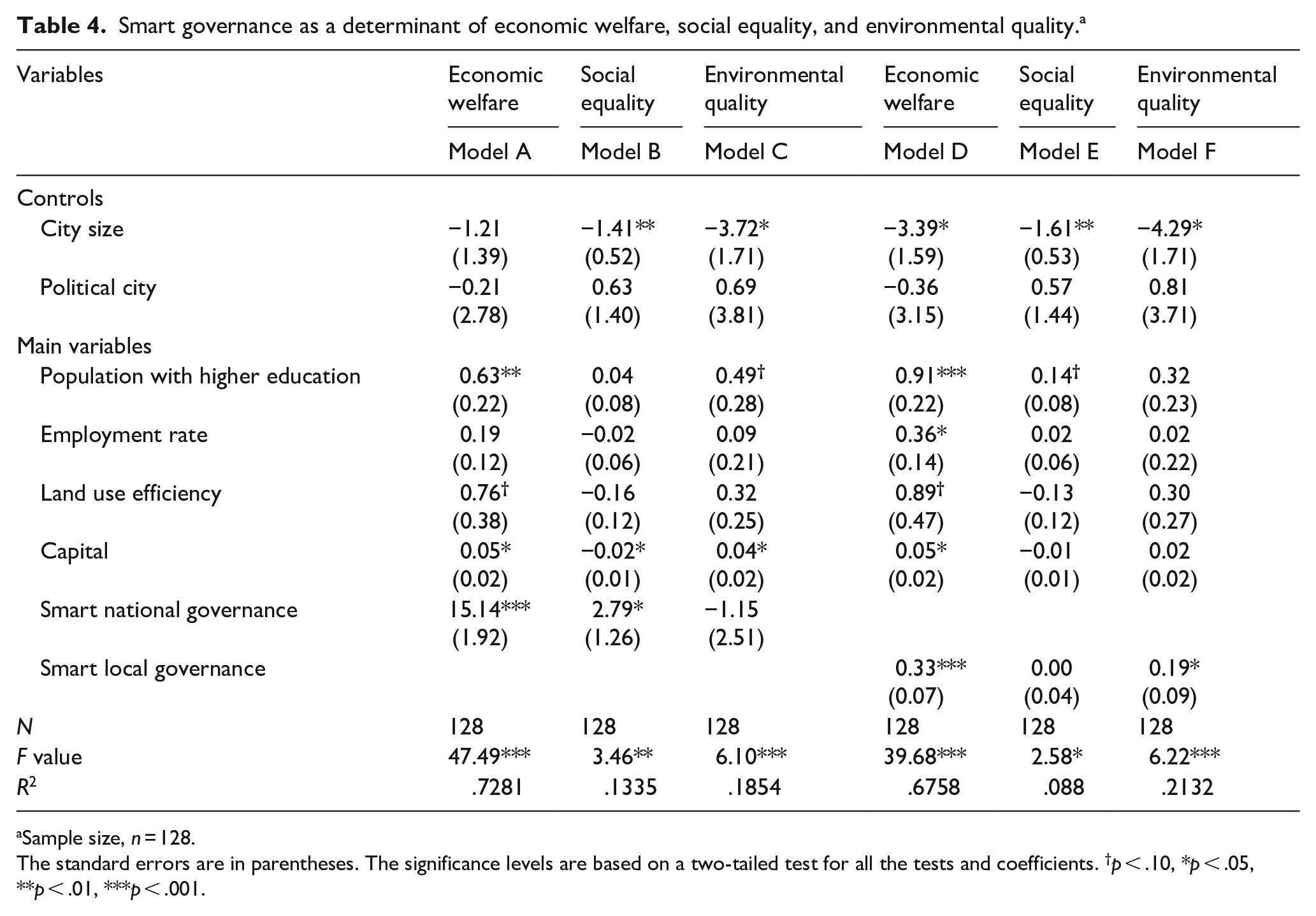
Sample size, n = 128.
The standard errors are in parentheses. The significance levels are based on a two-tailed test for all the tests and coefficients. †p < .10, *p < .05, **p < .01, ***p < .001.
Similarly, the coefficients of traditional factors linked to social equality maintain their sign, but their magnitude and significance are reduced. Interestingly, the proxy for capital becomes negative and significant for the case of social equality. This result suggests that when accounting for smart national governance, more capital efforts do not revert to improvements in the social dimension of sustainability and, in fact, might have a negative impact. The R2 increased to 72.8% and 13.3% in the economic welfare and social equality models, respectively. This means that smart national governance explains approximately 10.4% of the variance in economic welfare and 4.5% of that in social equality. The coefficient of smart national governance in the case of environmental quality is not significant, failing to support H4c.
Models D, E, and F use economic welfare, social equality, and environmental quality as dependent variables, respectively, and they include smart local governance as the main independent variable. The coefficients of smart local governance are positive and significant for economic productivity and environmental quality, offering support for H4a and H4c. In addition, the R2 increased to 67.6% and 21.3%, respectively. This means that smart local governance explains approximately 5.2% of the variance in economic welfare and 2.8% of that for environmental quality. The coefficient of smart local governance in the case of social equality is not significant, failing to support H4b.
Interestingly, when we account for smart local governance, the variable population with higher education (previously marginally significant in Model C, Table 3) now becomes nonsignificant, suggesting that smart local governance is more relevant than education when explaining environmental quality in a city.
Overall, the results from Table 4 indicate that both national and local smart governance are strongly associated with economic welfare, offering strong support for H4a (Models A and D). However, while the former is positively related to social equality (Model B), the latter is positively associated with environmental quality (Model F), providing partial support for hypotheses H4b and H4c. Together, these results show the relevance of quality governance in this context and the differential impact of governance at various levels.
Robustness tests
One assumption that we make is that there are tensions among the three pillars of sustainability; that is, there is no positive relationship between them. Figures 1 and 2 show the scatter plots between economic welfare, social equality, and environmental quality to graphically depict this assumption. Interestingly, Figure 2 is consistent with the environmental Kuznets curve, suggesting that in cities, economic development initially leads to a deterioration in the environment, but after a certain level of per capita income, a city begins to improve its relationship with the environment and levels of environmental degradation reduces. As previously indicated, correlations among these three dimensions showed preliminary evidence in line with this assumption. To further confirm that this was a reasonable assumption, we regress economic welfare against social equality and environmental quality, including all the control variables used in our estimations. In all cases, coefficients were not significant (results available from authors upon request).
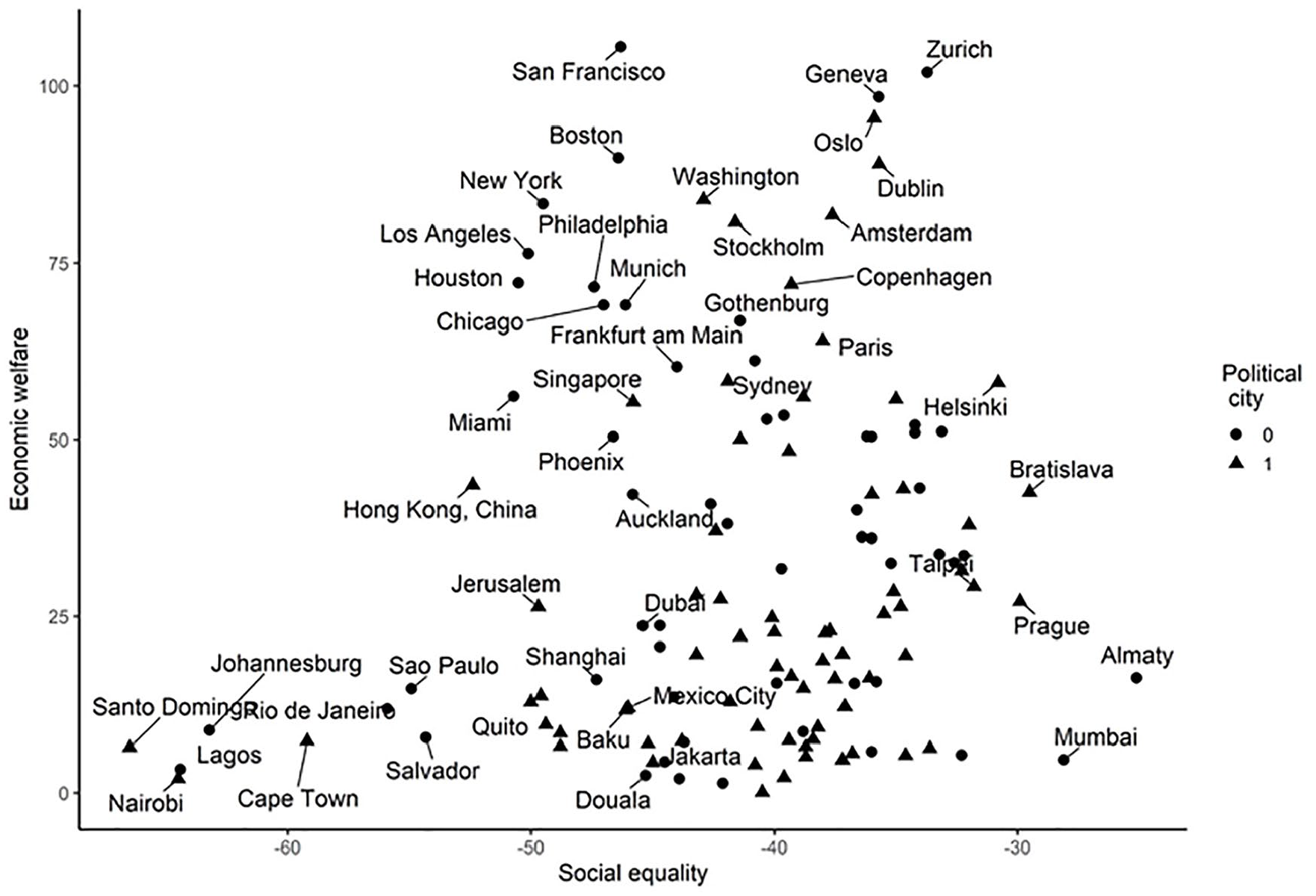
Relation between economic welfare and social equality.
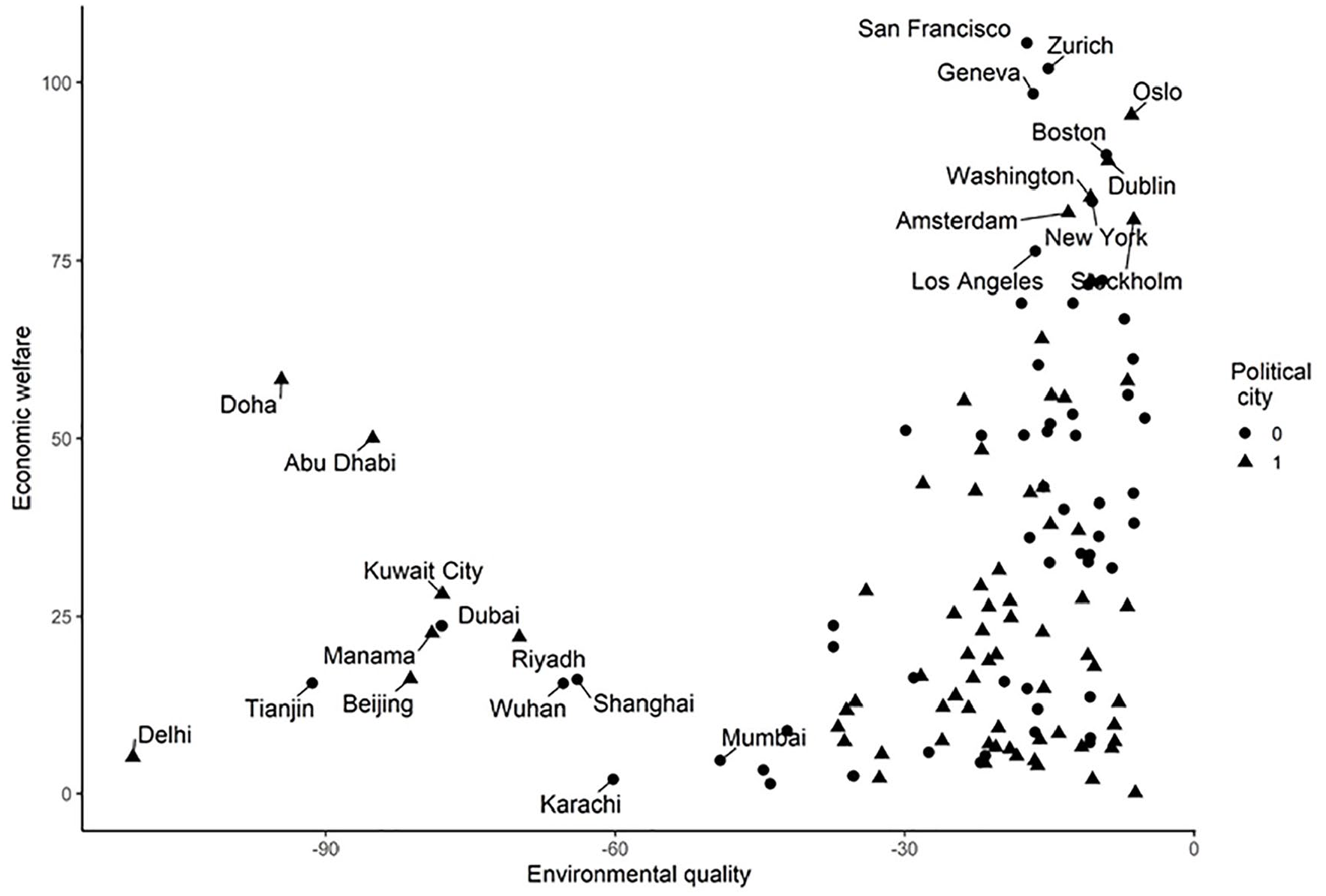
Relation between economic welfare and environmental quality.
These results fuel the debate over whether there are positive links among the various dimensions of sustainability. The management literature has extensively investigated the relationship between social (and environmental) success and financial performance, although there is an ongoing discussion among researchers concerning the sign and intensity of this link (King & Berchicci, 2021). Our results seem to tilt the balance toward those suggesting no obvious link between the dimensions of sustainability since there is an absence of a relationship between economic welfare, social equality, and environmental quality, at least in this sample of cities.
As additional robustness tests, we used alternative variables for some of the dependent and independent variables. For instance, we replaced GDP per capita with wages per hour, which might also be a good proxy for economic welfare. In this case, the results were fully robust to this alternative measure. However, the number of observations dropped from 128 to 98.
To ensure that our models were robust to alternative measures of city size, we re-ran our models using other proxies for city size, such as the “number of households” or the “economically active population.” The results were qualitatively the same as those using the total population (in its log form). We also re-ran our models, replacing our city size measure with land area. Overall, the results were robust and in line with those presented in this article, although this alternative variable was not significant in some models. In addition, smart local governance became only marginally significant for the case of air quality.
Discussion and conclusion
This article explored the relevance of smart governance in the context of achieving the SDGs in cities. Our analysis focused on cities since the 2030 agenda recognizes that national-level problems are expressed in local contexts and, thus, the need to develop sustainable cities (SDG #11). We departed from the notion that there are tensions between economic welfare, social equality, and environmental quality and show that these tensions can be produced by the differential impact that traditional factors of production have on the three main pillars of sustainability. This means that in trying to achieve the SDGs, companies, governments, civic institutions, and other social actors face significant trade-offs that are challenging to overcome with the current economic practices and policies. This study suggests that smart governance can positively influence the three pillars of sustainability. As such, it offers several implications for management researchers and policymakers.
Implications for management research
Our results indicated that in urban contexts, the factors linked with economic progress are not always the same as those associated with social justice or environmental quality. In fact, the various factors showed diverse links with the three pillars of sustainable development. This explains, at least partially, the difficulties that have been encountered in making robust progress in all aspects of the SDGs. If the relevant factors for economic prosperity are not the same as those that guarantee social justice or promote environmental quality, it is not surprising that tensions and trade-offs emerge when cities prioritize economic progress. By analyzing how the traditional factors of production affect each of the sustainability dimensions, we began understanding the underlying nature of these trade-offs.
We showed that while labor, land, and capital positively impact economic welfare, they partially and asymmetrically impact social equality and environmental quality. For instance, capital is related to economic welfare and environmental quality, but it is not related to social equality. On the contrary, land and employment rates affect only economic welfare. Interestingly, while we expected significant trade-offs, our overall results show that traditional factors of production do not generate such substantive tensions. For the most part, our results show that while certain factors allow progress in one pillar, these factors do not come at the expense of the other pillars. In other words, they have neither a positive nor negative effect. One exception, however, is the link between capital and social equality since one of our models showed that capital is negatively related to social progress.
Furthermore, this article fuels the debate over the tensions encountered when tackling SDGs simultaneously (Haffar & Searcy, 2017; Hahn et al., 2010; Van der Byl & Slawinski, 2015). While our article offers city-level empirical evidence supporting the idea that the traditional factors of production secure economic progress, it also shows that the links between these factors and the advances being made in the social and environmental dimensions are tenuous at best. We interpret this to indicate that the current urban economic systems are ill-equipped to address the SDG agenda adequately. More importantly, we go beyond the simple acknowledgment of the trade-offs and tensions between the pillars of sustainability and propose an additional mechanism to make progress in city sustainability. In this regard, Angheloiu and Tennant (2020) highlighted the need to focus on processes as much as on outcomes when advocating for urban sustainability. We showed that smart governance is a valuable process to develop to advance simultaneously in the three pillars of urban progress. This could be the case because smart governance can promote a reflexivity culture and new kinds of knowledge generation that are in line with the SDGs.
Together, our results indicated that a broader conceptual view is needed to understand how to make significant progress in achieving the SDGs at the urban level. While some progress has been made (Berrone et al., 2016a; Rousseau et al., 2019), the current research on this topic has kept a relatively vertical view of the global challenges that the SDGs attempt to address. However, this silo analysis might be problematic since progress in one dimension does not guarantee improvements in the other two aspects of sustainability. Consequently, we suggest that when dealing with the SDGs, it is helpful to adopt a systems thinking approach capable of assessing the interconnectivity of economic, social, and ecological issues. This lens is useful for comprehending the interactions between the various elements of sustainability in a spatial setting such as cities, where the interaction between these dimensions causes tensions that come from complex, uncertain situations (Schad & Bansal, 2018). Furthermore, in the context of the SDGs, this approach opens intriguing new options for future research in the field of sustainability.
Moreover, it was not until recently that cities and communities began attracting management scholars’ attention as relevant units of analysis (Berrone et al., 2016a; Marquis et al., 2007; Rousseau et al., 2019; York et al., 2018). However, much of the stream of inquiry has focused on corporations and nonprofits, surprisingly neglecting the role of the public sector. We contribute to this nascent literature by exploring the role of governance of the public sector in influencing the realization of the SDGs in cities. We proposed that smart governance is a critical factor for the progress of the 2030 agenda. Our results corroborated the value of this factor, showing that both national and local smart governance are positively associated with economic welfare. Concretely, we showed that smart national governance influences social equality, and smart local governance is related to environmental quality. These results highlighted the need for a better understanding of the concept of smart governance and its potential consequences (Barrionuevo et al., 2012). Understanding the various aspects that constitute smart governance, how it interacts across multiple levels, and how it influences sustainable territories’ development is a superb opportunity for the management field to contribute to the achievement of the SDGs. In particular, we invite scholars to invest efforts in exploring how smart governance can build stronger institutions, as they are the backbone of inclusive development and the area where more progress is currently needed, especially in emerging regions (Sachs et al., 2020).
Implications for policymakers
Recently, observers have lamented that the progress toward the SDGs is stalling for multiple reasons (Lomborg, 2018). They include a lack of a detailed schedule for each goal; the high cost of the program, which is estimated at US$45 trillion; institutional configurations that perpetuate problems such as climate change (Schüssler et al., 2014); and the tendency that organizations have toward inaction concerning severe societal problems (Slawinski & Bansal, 2015). Our study highlighted an additional issue, which is the poor quality of governance. Governments should note these results and make smart governance development a top priority if they intend to make substantive progress in the SDGs.
Indeed, our study offered evidence suggesting that the current lack of alignment between the three dimensions of sustainable development in cities is due to the differential impact that the traditional factors of production have on economic, social, and environmental progress. These results seem to indicate that the current economic system cannot adequately address the SDG agenda. This unpleasant reality invites cities to engage in a regenerative process focused on developing high-quality governance, where smart governance takes central stage. Unquestionably, achieving synchronized progress in the economy, society, and environment will likely impose significant trade-offs where win–win solutions are not readily available, and novel alternatives require extended periods to crystallize. Furthermore, the SDG agenda’s complex issues will necessitate huge capital reallocation, major adjustments for entire sectors, and collaboration across diverse social actors. As a result, if governments truly wish to commit to the SDG agenda, they must train their managers in areas such as strategic thinking, stakeholder engagement, and project management. Moreover, urban managers and their teams need to be familiar with the key concepts of earth science, sociology, and economics since the SDGs are multidisciplinary in nature. If this is done correctly, it will enable these individuals to develop new mindsets and creative processes (all elements of smart governance), allowing them to find novel solutions and mitigate the trade-offs across the multiple dimensions of sustainable development.
Our study distinguished between two levels of smart governance with distinct impacts. Smart national governance appears to impact social equality more deeply. This is consistent with the idea that social issues tend to be institutionally structural, affecting multiple levels. As such, they generally require high-order policies that are often designed at the national level, such as educational systems, redistribution tax regimes, and labor laws. On the contrary, smart local governance is closely linked to environmental issues, where the city government has greater authority and leeway for influence. Aspects such as transport systems, green space management, or building ordinances can have a profound impact on the environmental quality of a city (Berrone et al., 2016b). City managers should then account for these multiple levels when redesigning their policies to enable the achievement of the SDGs.
Practitioners can also benefit from our study, particularly those advising cities to make headway on the SDGs. We have shown that smart governance can act as a vehicle in achieving sustainability. Thus, practitioners can help city managers develop skills and knowledge linked to smart governance, such as transparency, collaboration, problem solving, strategic thinking, innovation, and thought leadership.
Limitations
This work is not without limitations, which could be rectified with subsequent research efforts. First, our study is cross-sectional. Consequently, we explored associations, but we could not establish causality. Future studies should span multiple years and use other causal statistical models to address this limitation. In addition, our data are mostly from 2015, the year the SDGs were approved. Significant efforts have been made toward the 2030 agenda over the last few years. Studies using more updated data might observe different dynamics and link our analysis offers. Moreover, we focused on the direct impact of smart governance, but other relations can be explored. For instance, research can focus on understanding the potential moderating effect of smart governance as a relevant catalyst to navigate trade-offs to achieve SDGs in cities.
In addition, scholars could explore the specific mechanisms through which smart governance contributes to sustainable urban development. For instance, smart governance might involve better capital management, which allows cities to navigate the tensions stemming from traditional factors of production more efficiently. Unfortunately, we did not have accurate data to test this possibility.
Another caveat of our study was that our analysis focused mainly on large metropolises. It would be interesting to explore whether the interrelations we found in this study are also present in smaller cities and towns. In addition, there is room for improvement in terms of measuring the construct of smart governance. Given that it is a novel concept, we still do not have fully validated measures of it. Future research can also explore the individual dimensions of smart governance and their role in easing the trade-offs between SDGs. Finally, while both national and local smart governance variables significantly explain the variation in the social and environmental performances of cities, they do not entirely explain these phenomena. Thus, future research should explore additional factors that could affect urban sustainability. Finally, our measures tend to be high-level macro variables. Subsequent studies could explore how specific policies approximated with more microlevel measures advance the SDGs in cities.
Final thought
The SDGs offer a once-in-a-lifetime opportunity to create societies that are greener, wealthier, and more egalitarian. However, we must greatly improve the quality of our administrations and enhance our institutions if we are not to waste it. We will be able to improve society only if we act now.
Footnotes
Declaration of conflicting interests
The author(s) declared no potential conflicts of interest with respect to the research, authorship, and/or publication of this article.
Funding
The author(s) disclosed receipt of the following financial support for the research, authorship, and/or publication of this article: This work was supported by Spanish Ministry of Science and Innovation and the European Social Fund PRE2019-091668, Agencia Estatal de Investigación (AEI) of the Ministry of Economy and Competitiveness—ECO2016-79894-R (MINECO/FEDER), Ministry of Science and Innovation PID2019-104679RB-I00, the Schneider-Electric Sustainability and Business Strategy Chair, the Carl Schroeder Chair in Strategic Management and the IESE’s High Impact Projects initiative (2017/2018). We gratefully acknowledge the developmental feedback provided by the editorial team and three anonymous reviewers throughout the review process.
