



Abstract
Many tourism agglomerations are situated near natural resources, which implies a need to balance business growth with environmental preservation. Our analysis of the location decisions of 295 luxury beach hotels in Spain between 1960 and 2015 reveals two main findings. First, we confirm the positive relationship between the existence of demand-related urbanization services around natural resources and the attractiveness of agglomerations to new entrants. Second, we find that an agglomeration’s attractiveness negatively affects the density of firms in the agglomeration if that attractiveness hinders firms’ access to the same natural resources. Our results contribute to the strategy literature on agglomerations and provide a better understanding of how the tourism industry can work toward achieving the sustainable development goals (SDGs).
Keywords
Introduction
The United Nations’ Sustainable Development Goals (SDGs) constitute an action plan designed to address pressing large-scale grand challenges (Sachs et al., 2019). Environmentally oriented targets found in, for instance, SDG 6 on clean water and sanitation, SDG 13 on climate action, SDG 14 on life below water, and SDG 15 on life on land were included to make the SDGs more ambitious, comprehensive, and respectful with regard to the environment than previous United Nations declarations, such as the Millennium Development Goals. Notably, these targets deal with the difficulty of achieving a balance between ecological and social aspirations and traditional economic priorities related to growth (Neumann et al., 2017). This article examines the evolution of business growth close to natural resources in the hospitality industry and its potential implications for the achievement of the SDGs.
“Sustainable tourism” is one of the key business-related topics included in the SDGs of the United Nations’ 2030 Agenda. The tourism industry is explicitly named in three SDGs: sustainable economic growth (SDG 8), sustainable consumption and production (SDG 12), and life below water (SDG 14) (United Nations World Travel Organization [UNWTO], 2021). Moreover, the increasing human and environmental pressure in coastal areas resulting from the agglomeration of hotel facilities led to explicit consideration of coastal area conservation in both SDG targets 14.2 and 14.5 (Neumann et al., 2017). Not surprisingly, the recently launched One Planet Sustainable Tourism Programme (UNWTO, 2021) establishes that sustainability must be the new norm for every part of the tourism sector. This prevailing vision and its focus on sustainability make it necessary to improve our understanding of those aspects of the sector’s development that may still be unsustainable, such as excessive business growth in certain fragile areas.
Our research interest in this article lies in these three SDGs. We analyze how the agglomeration of hotels around valuable coastal resources evolves, and the implications of that evolution for the competitiveness of regions and firms. Although there is robust evidence on the benefits of co-location for firms (Alcacer & Zhao, 2016; Woo et al., 2019), recent work has called for more research into how agglomerations develop (Kim, 2016; McCann et al., 2016; Pe’er et al., 2016). We focus on the factors that influence how the attractiveness of agglomeration around natural resources dynamically evolves for new entrants. This issue is particularly relevant because it involves certain inherent tensions. On one hand, co-locating with competitors offers certain widely studied benefits, including access to a pool of competitive suppliers and customers (Kim, 2016). On the other hand, new entrants’ access to valuable natural resources may be limited when competitors are already located in a focal region (Lee & Jang, 2015).
To extend the extant agglomeration literature, we analyze a sample of location decisions made by 295 luxury beach hotels between 1960 and 2015. We examine how the availability of urban demand-related services and the density of co-located competitors may influence where new entrants locate around valuable coastal resources, and the strategic implications of these factors for the emergence of new agglomerations. Our empirical analysis improves our understanding of why managers may have conflicting preferences over time with regard to co-locating in an agglomeration around natural resources, and why they should carefully consider the balance between sustainable consumption objectives and developments around natural resources. This article adds to the growing stream of research on the dynamic attractiveness of agglomerations (Alcacer & Chung, 2014; Kim, 2016; McCann et al., 2016; Pe’er et al., 2016; L. Wang et al., 2014). Specifically, our study makes three contributions to the strategic agglomeration literature.
First, multiple works have suggested that a more comprehensive assessment of the benefits of agglomerations may help to explain agglomeration processes (Hervas-Oliver et al., 2017; Kim, 2016; Krugman, 1991; L. Wang et al., 2014). Reviews of the agglomeration management literature reveal that economic and technological factors have received a great deal of attention (Gur & Greckhamer, 2019; McCann & Folta, 2008, 2009) Meanwhile, the economics literature has focused on the strong relation between the initial availability of natural resources and the establishment of agglomerations in multiple industries (Hervas-Oliver et al., 2015). However, it has ignored its strategic implications over time. We bridge these perspectives by analyzing how an agglomeration’s attractiveness to new entrants is simultaneously affected by factors that influence opportunities to access both endogenous demand-related benefits and exogenous natural resource–oriented benefits.
Second, it is tempting to assume that the limited mobility of natural resources provides relatively stable exogenous benefits (McCann & Folta, 2009). However, we extend recent dynamic perspectives on firms’ agglomeration (Alcacer & Chung, 2014; Kim, 2016; McCann et al., 2016; Pe’er et al., 2016; L. Wang et al., 2014) by showing that a higher density of co-located firms negatively affects an agglomeration’s attractiveness to new entrants owing to the difficulties of accessing the valuable but limited natural resources close to beaches in tourist regions. In this regard, changes over time reflect the importance of a dynamic perspective on the attractiveness of an agglomeration.
Third, our results improve our understanding of the importance of ensuring progress toward sustainable growth as prioritized in the SDGs. The emergent management literature on the SDGs (Kolk et al., 2017; Montiel et al., 2021; Sachs et al., 2019) has emphasized the important role of business in achieving these goals. Our results contribute to this stream of literature by showing how new agglomerations may emerge when a proper balance among growth, consumption, and sustainability is present. Specifically, our results confirm that access to natural resources in an agglomeration becomes more difficult as the number of co-located firms increases. Consequently, even if agglomeration benefits in a new region increase, some firms will still favor the superior provision of agglomeration benefits in the original region. While theorists on ecological organizations would argue that a population of firms begins to decrease when it is overwhelmed by competition (Carroll & Hannan, 2000; Hanan & Freeman, 1989), our results show that the sustainable growth of the original agglomeration may offer benefits to both firms in the original agglomeration and firms located in different regions that provide better access to natural resources.
Agglomerations around natural resources
Supply-side and demand-side benefits: the attractiveness of an agglomeration
Management literature on the SDGs (Kolk et al., 2017; Montiel et al., 2021; Sachs et al., 2019) highlights the importance of understanding the interactions between business and the natural resources. The nature of the benefits for new entrants from co-locating around valuable natural resources include both exogenous and endogenous ones. The exogenous benefits include the competitive gains derived from privileged access to the natural resources in a region—such as oil, fresh water, minerals, natural attractions, or soil, among others—and these are often the original reason for the agglomerative process in multiple industries (Hervas-Oliver et al., 2015, 2017; LaFountain, 2005; Rosenthal & Strange, 2001). The endogenous benefits arise from the existence of co-located firms and may encompass both supply-side benefits, such as the existence of specialized labor, suppliers, or knowledge spillovers (Alcacer & Chung, 2014; Alcacer & Zhao, 2016; Engel, 2015; Folta et al., 2006; Funk, 2014; McCann et al., 2016), and demand-side benefits, such as a reduction in consumer search costs (Canina et al., 2005; Chung & Kalnins, 2001; McCann & Vroom, 2010; Urtasun & Gutiérrez, 2017). While the endogenous benefits normally grow as the number of similar firms in the same location increases (Arthur, 1990; McCann & Folta, 2009), previous research mostly assumes that exogenous externalities are independent of the number of co-located firms (McCann & Folta, 2009).
The benefits derived from agglomerations of firms in the same industry have attracted an exponential degree of attention in recent decades (Ryu et al., 2018); however, conflicting influences on the attractiveness to new entrants of co-locating around natural resources merit specific consideration from a managerial point of view. For example, a new winery may find it attractive to be co-located with other competitors in the Napa Valley because this would provide privileged opportunities for access to specialized services and to the high level of demand generated by this American Viticultural Area’s reputation for wine production (L. Wang et al., 2014). However, the existence of competitors may reduce the Valley’s attractiveness to new entrants by limiting the opportunities for access to soil in the best areas and, indirectly, this may encourage the development of new wineries in a peripheral land in the Napa County or in an alternative region, such as Central or North Coast, which offer cheaper access to similar land but fewer demand benefits from co-locating with competitors than in the Napa Valley (Hira & Swartz, 2014). The growing business concerns about limited natural resources (Bansal & Song, 2017; Berrone et al., 2013; Flammer, 2013) will increase the importance of knowing more about the dynamics of agglomerations around natural resources. We define an agglomeration’s attractiveness in this article as its effectiveness in influencing new entrants to co-locate as close as possible to the agglomeration. Thus, if the agglomeration’s attractiveness is high, the entrant will locate the new firm closer to the center of the agglomeration than if the agglomeration’s attractiveness is low. Our research interest in this article is to examine how two factors connected with the existence of agglomerations—the density of co-located competitors and the urbanization in the selected location—may have different impacts on the agglomeration’s attractiveness around natural resources and how this matters to the SDGs aspirations.
Attractiveness of agglomerations in the hospitality industry
Intuitively, one might expect that a manager would prefer their firm to be located as far as possible from its competitors to provide easy opportunities for acquiring customers and reinforced bargaining power with suppliers in the area. However, the hospitality industry used as our empirical setting provides a robust illustration of the co-location tendency (Lee & Jang, 2015; Woo et al., 2019). Although much of the management literature is focused on the supply-side positive externalities of agglomerations in industries (McCann & Folta, 2008), attention to demand-side externalities dominate analyses of agglomerations in the hospitality industry and services in general (Urtasun & Gutiérrez, 2017).
Previous findings have highlighted the importance of agglomerations in reinforcing the strength of demand at a location in the hospitality industry (Baum & Haveman, 1997; Baum & Mezias, 1992; Canina et al., 2005; Chung & Kalnins, 2001; Kalnins & Chung, 2004; McCann & Vroom, 2010; Woo et al., 2019). In general, demand-related externalities are connected to reduced search costs for customers as a consequence of the agglomeration of firms (Marshall, 1920).
Demand-related externalities in the hospitality industry include all the advantages that agglomerations may provide over isolated locations for attracting tourists (e.g., reputation, airports, and transport in the region); however, an excessive growth of competitors in the area may erode or cancel out the potential benefits. A good balance is hard to get. For instance, Oahu’s natural scenery makes it the most visited of the islands in the Hawaiian archipelago. Oahu already offers 31,637 visitor units in 107 different hotels in an island just 44 miles (71 km) long (Hawai’i Tourism Authority, 2018). In this context, it is unrealistic to expect that any new hotel will be able to gain similar access to the privileged beaches enjoyed by the first hotels on the island. However, new entrants will get access to tourists hoping to visit one of the best-known tourist areas in the United States using any of the 27 domestic and international carriers, 4 commuter airlines, and 3 inter-island airlines that land at Honolulu International Airport.
New entrants to hospitality agglomerations have to find a balance between providing similar services to businesses already established in the region and extending the offer. For example, Baum and Haveman (1997) show that new hotels tend to locate geographically close to incumbents who are similar in terms of price, quality, and class but different in terms of size. Similarly, Chung and Kalnins (2001) found that rural hotels had higher revenues when their local market was made up of a greater fraction of hotels that were larger than they were. In general, new hotels are more likely to agglomerate when the region or existing hotels in the agglomeration are already well differentiated; for example, high-quality and larger hotels attract more new entrants than low-quality and smaller hotels (Kalnins & Chung, 2004). Interestingly, there is evidence that, in general, agglomerating is more attractive for firms that are more dependent on external factors (Kukalis, 2010; McCann & Folta, 2008).
The acknowledged benefits that proximity to certain natural resources provide to multiple firms in the industry (e.g., ski areas, beaches, natural parks, rainfall, and so on; Canina et al., 2005: 568) contrast with the scant attention paid in the literature to the evolution of hospitality agglomerations that are close to these valuable natural resources in the industry.
Hypotheses
The baseline foundations: a firm’s access to valuable natural resources
A firm may receive relevant gains from being located in places endowed with exclusive natural advantages that generate industry agglomerations (Ellison & Glaeser, 1999; Russo, 2003). Marshall’s (1920) pioneering work (p. 269) claimed that the location decisions of firms are highly influenced by physical conditions, such as “climate, soil, mines or quarries in nearby areas, or easy access by land or water.” Economic geographers have focused on showing that cost advantages related to easy access to natural benefits explain agglomerations in multiple industries (LaFountain, 2005; Rosenthal & Strange, 2001). Although natural resources have received limited attention in the management agglomeration literature so far, the growing interest in the managerial implications of a limited availability of natural resources (Bansal & Song, 2017; George et al., 2018) reinforces the need to integrate these literatures.
Favorable proximity to attractions or natural settings is one of the single strongest factors for differentiation value in the hospitality industry (Canina et al., 2005). For example, beach hotels typically gain differentiation when they are located on the immediate beachfront, when compared to other similar hotels in the area that are located further away from the beach (e.g., sea views usually command a premium in beach hotels). Extending previous economic perspectives highlighting the connection between the existence of natural resources and the initial exogenous benefits of agglomerated firms (Arthur, 1990), we expect that the number of co-located competitors necessarily decreases the new entrants’ opportunities for accessing valuable but limited natural resources in the region.
Firms located in agglomerations where valuable natural resources are strategically relevant will pay special attention to obtaining privileged access to those natural resources. Firms arriving early to an agglomeration will be able to guarantee privileged access to natural resources because of availability and limited causal ambiguity regarding the strategic role of natural resources in the industry (Kim, 2013, 2016) In our empirical setting, early hotels will look for the location with the best access to natural resources because it offers the opportunity to obtain the maximum level of benefits derived from their proximity to those resources (e.g., charging a premium for direct access from the premises, being located within a walkable distance, or having direct views). However, privileged access to strategic natural resources in the region will become more difficult as the density of the firms in the agglomeration grows while the natural resources remain the same. Each potential new entrant to the agglomeration will find that the existing hotels have already occupied some of the potential locations for accessing strategic natural resources in the industry. Even if there are still opportunities to access natural resources, new entrants will necessarily find fewer and typically less promising opportunities than previous entrants.
In general, market competition is particularly intensive when the consumption of the product or service is local and there is rivalry between firms for scarce but valuable input resources (Kukalis, 2010: 455). As a consequence, new entrants to the agglomeration will get progressively less privileged access to the valuable natural resources in the region when the density of the agglomeration increases. Our baseline hypothesis in this article is:
Hypothesis 1: Access to valuable natural resources in an agglomeration of competitors decreases as the density of firms in the agglomeration increases.
The process: rise and fall in the attractiveness of an agglomeration around natural resources
The rise: urbanization and demand-related services
Subsequent entrants in the lodging industry that choose the same location benefit from the size of agglomeration demand by reducing their costs or risks of attracting customers versus those in less developed regions from a tourism perspective (Urtasun & Gutiérrez, 2017). Regional variations in levels of urbanization may make a substantial difference in the opportunities for new entrants to access the endogenous demand-related benefits of agglomerations in the industry (Graham, 2009). The value of the natural resources in certain tourist regions does not take away from the significance of the demand-related benefits; in fact, the related services may become more significant when climbing, surfing, or diving schools, equipment rental, or boat hire, for example, are available.
Urbanization may generate economies to firms from the scale of markets and from good infrastructure and public service provision (Graham, 2009). The popular idea that agglomerations reduce the search costs for customers in the hospitality industry has been traditionally related to additional opportunities for personal visual inspections (Chung & Kalnins, 2001; Kalnins & Chung, 2004). The use of the internet has increased the information economics (Williamson, 1991) of firms in urban areas versus their geographically isolated counterparts because the consolidated urban regions receive a larger number of online searches, and it is now easier to make comparisons between the offers of assets in different regions.
Urbanization also creates opportunities for provision of demand-related services that are not available in rural areas. These services are particularly relevant for generating demand in the lodging because customers often prioritize convenient access and the facilities that are available around the hotel (UNWTO, 2019). The demand-related services in the hospitality industry usually involve the provision of infrastructure and facilities for visitors, such as airports, internal transport, restaurants, hospitals, or security services, among others.
In general, subsequent entrants in the industry may prefer to be located close to competitors when that means a good provision of related services. Because urbanization generates a relevant package of extra and differentiated benefits to co-located firms (Rosenthal & Strange, 2004), we propose that urbanization increases the attractiveness to new entrants of agglomerations around valuable natural resources. Our hypothesis is:
Hypothesis 2: There is a positive relationship between urbanization and the agglomeration’s attractiveness to new entrants around valuable natural resources.
The fall: density and access to natural resources
Scholarly attention to the preservation of the generated value in agglomerations is more limited and recent (Kim, 2016), but different scholars have begun to suggest the possibility of a progressive loss of attractiveness of co-location (Kalnins & Chung, 2004). McCann and Folta (2008) have raised some doubts about the generalizability of this loss of attractiveness when related to the endogenous benefits of co-locating and suggest that high-resource firms will always enjoy reinforced capabilities to attract more benefits from agglomerations. However, attracting unlimited access to the exogenous benefits of agglomerations may be difficult when they are associated with valuable but limited natural resources. This factor is particularly relevant when access to the valuable natural resources is a key strategic asset in the industry.
Proximity to well-preserved natural resources has been recognized as “the most powerful single factor” in providing differentiation in the hospitality industry (Canina et al., 2005: 568). Although limited research attention has been paid to the difficulties in accessing similar level of benefits derived from existing valuable natural resources once competitors are already located in the region (Lee & Jang, 2015), by and large, proximity to, utilization of, or even views over valuable natural resources are usually more limited and expensive for late entrants, or simply impossible because of physical conditions. Furthermore, the value of natural resources can easily be reduced by overcrowding. Traffic congestion, air pollution, and noise are particularly significant negative factors for consumers of leisure around natural resources. New entrants may find it difficult to deal with these issues and gain competitive access to valuable natural resources when the concentration of competitors grows.
Difficulties in accessing valuable natural resources when the density of an agglomeration grows do not necessarily prevent new entrants from joining the agglomeration, but they limit its attractiveness. Some new entrants may accept suboptimum access to the valuable natural resources in the region (e.g., good views when the best ones are no longer available). This may be good enough for certain new entrants because of the endogenous benefits of co-location. However, when access to valuable natural resources plays a key role in an agglomeration, we claim that the growing density of co-located firms in the region and the resultant difficulties in accessing limited natural resources will mostly negatively influence the attractiveness of the region to new entrants. This situation may contrast with alternative regions where similar natural resources may be available.
To summarize, when the density of firms increases in an agglomeration around valuable natural resources, the attractiveness of co-location to new entrants will decrease because of the exponential difficulties of accessing natural resources in the region. Our hypothesis is:
Hypothesis 3: There is a negative relationship between the density of an agglomeration around valuable natural resources and the agglomeration’s attractiveness to new entrants.
The implications: access to natural resources outside of the agglomeration
Given the benefits of agglomerating close to valuable natural resources, new entrants’ location outside of the agglomeration may be mostly understood as a consequence of a relative degradation of the benefits in the agglomeration in comparison to different geographic areas (Folta et al., 2006; Malecki, 1985; McCann & Folta, 2009). When an agglomeration is unable to provide access to natural resources that generate reduced costs or differentiation in an industry, favorable access to natural resources outside the agglomeration may partially substitute the benefits of being co-located with similar firms.
The inability of incumbents to prevent further access to an agglomeration around limited natural resources may also reinforce the progressive degradation of the relative attractiveness of the agglomeration. Alcacer and Chung (2014) delimitate that the attractiveness of an agglomeration is higher for new entrants when they perceive that incumbent firms in the agglomeration will be able to preserve the exclusivity of the value related to the location. As a consequence, despite the fact that the original natural attractions of the agglomeration may have been well preserved, a high density of agglomerated firms may in time decrease the benefits for new entrants and progressively increase the relative attractiveness of areas outside the agglomeration. Baum and Mezias (1992) have shown that, in Manhattan, locating closer to other hotels increases a hotel’s chances of survival, but the failure rates are higher when neighboring hotels become too numerous in closely bounded areas. We claim that the provision in a new region of conditions superior to those of the original agglomeration may be particularly tempting when access to certain limited natural resources is a strategic but physically limiting factor in the region.
The relative importance of access to valuable natural resources outside the original agglomeration will increase when the opportunities to access natural resources in the agglomeration are insufficient for new entrants. Using a sample of firms from the semiconductor and pharmaceutical industries, Kukalis (2010) showed that the financial performance of laggards located outside the industry cluster was higher than that of geographically clustered firms in a late stage of the industry life cycle. Similarly, laggards entering an agglomeration of hospitality firms around strategic natural resources may face difficulties in extracting value from a highly populated agglomeration in comparison with other locations that are some distance from the original agglomeration centers. This factor has implications for the emergence of new agglomerations. Once alternative regions are able to provide better access to valuable natural resources for new entrants than the established agglomerations, new regions for co-location will progressively emerge.
Because the value generation potentiality of being located close to natural resources is quite explicit (i.e., causal ambiguity is not relevant), the specific distance of a firm from the natural resource increases its importance. Close proximity to the natural resources may be a physical impossibility because of the existence of previous competitors, or the high costs involved may deter new entrants from accessing the valuable natural resources in an agglomeration of competitors. Furthermore, the natural resources may also be finite or degrade when new firms arrive (e.g., a view, clean air, a quiet environment) or may involve property rights that bar new entrants (e.g., a mine, a private beach). We propose that access to natural resources outside the agglomeration becomes relevant when the density of competitors in the original agglomeration is high and prevents easy access. Our hypothesis is:
Hypothesis 4: Access to valuable natural resources outside an agglomeration of competitors becomes more attractive to new entrants as the density of firms in the agglomeration increases.
Methods
Sample
We focus our analysis on the locations made between 1960 and 2015 by a sample that includes all the new 295 luxury beach hotels in Andalusia (Spain). In this research, luxury hotels are considered to be those that have four or five stars according to Spanish legal regulations (i.e., the highest standards in the industry). Our regional focus is appropriate because Spain is the world’s second largest tourist destination, with 81.8 million international tourist arrivals and US$68 billion in international tourism receipts in 2017 (UNWTO, 2018), and Andalusia is the biggest region in the country. In addition, the beach context is relevant to an analysis of the agglomeration of competitors around valuable natural resources as beaches are the most popular category of tourism destination. Although Andalusia has a coastline of 945 kilometers, each subarea has had quite different levels of tourism development. Our agglomeration of interest in this region is the so-called “Costa del Sol” (Sunshine Coast), one of the biggest, earliest, and most long-standing agglomerations of beach hotels in Europe, receiving more than 900,000 tourists each year in a municipality with less than 8 km of coastline (Instituto Nacional de Estadística, 2018). We will analyze how the density of hotels in the agglomeration and the urbanization have influenced the locations of the new luxury beach hotels in the region. We will also analyze how access to the beachfront has evolved as more firms have co-located and the implications of this.
Agglomerations in the hospitality industry have received considerable attention in the management literature. Most of the analyses have focused on how the different approaches and internal characteristics of US hotels may change the level of benefits obtained by agglomerated hotels in urban districts (Baum & Haveman, 1997), rural contexts (Chung & Kalnins, 2001), specific states (Kalnins & Chung, 2004; McCann & Vroom, 2010). or a country (Woo et al., 2019). In this article, we have used a homogeneous strategic orientation, quality category, and region to focus on how the attractiveness of an agglomeration for new entrants evolves and whether access to the beachfront may influence it.
We initially included in our analysis all the new luxury hotels from 1960 to 2015 in Andalusia within 20 km of the coastline. We selected this distance of 20 km following consultation with industry representatives about how far beach hotels are usually located from the coastline in this area. We repeated our analysis with slightly different distances and obtained similar results. As our focus was on beach hotels, we excluded from the sample hotels located in cities considered to be administrative centers because of their different strategic orientation. The final sample is composed of 295 hotels, 256 of which are four-star hotels and the others five-star hotels. These are the two highest official rating categories for hotels in Spain. Public information from the regional Government of Andalusia was our data source for the hotels’ opening dates, categories, and locations.
We began our analysis by entering each of the hotels into the ArcMap software. This software, developed by Esri and used by geographic information system professionals worldwide, is a popular geoprocessing application that allows individuals to create maps, edit and manage spatial data, and perform the analyses needed to turn raw geographic data into valuable information. This software has been broadly accepted and used in studies analyzing the environmental impact of human activities (Ding et al., 2021; Nautiyal & Sharma, 2021).
We calculated the median center of the hotel coordinates in the municipality of Torremolinos (the unofficial capital of our analyzed “Costa del Sol” agglomeration) to delimitate the center of the agglomeration each year. We used Google Maps to find out the global positioning system (GPS) coordinates for each hotel, and each hotel’s geographic location was entered into ArcMap.
Variables
Agglomeration attractiveness
A new hotel’s decision to be located closer to the center of the agglomeration provides a proxy about the agglomeration’s attractiveness for new entrants (Baum & Haveman, 1997). We calculated the attractiveness of the agglomeration for new beach hotels in the analyzed region by measuring the distance from each new entrant’s selected location to the agglomeration center. We used the Generate Near Table tool in the ArcGIS software to measure it as a straight line connecting the coordinate point for each hotel in the sample to the coordinate point of the agglomeration center when the hotel began its activity. We calculated this variable as the additive inverse value of the distance to the agglomeration center to provide a more natural interpretation of our measurement: the higher the value in our measurement, the greater the attractiveness of the agglomeration.
Density of the agglomeration
To measure the influence of the density of the agglomeration on the distance of each new entrant to the agglomeration, we calculated the number of hotels operating in the agglomeration area during the year prior to each hotel opening. To measure this variable, the agglomeration area included the entire circumference space in a radius of 1 km drawn from the previously calculated median center in the agglomeration. This way of measuring hotel density in an agglomeration is similar to that used in previous research (Baum & Haveman, 1997). The utilization of slightly different distances for the radius in our measurement may change the density each year, but it did not significantly affect our final conclusions.
Urbanization
The provision of general services and the infrastructure available to tourists (e.g., airports, internal transport, restaurants, security services, etc.) are relevant factors in their decision-making when selecting a hotel (UNWTO, 2019). The population size is a good metric to measure the level of urbanization (Graham, 2009) and an accurate proxy for the existence of demand-related services in the hospitality industry (Puciato, 2016; Zhang et al., 2013). In this sense, urbanization has been often represented by the total population or total employment of an urban area (Graham et al., 2010) and, consequently, we have adopted total population as a proxy for urbanization. The information about population size in our analysis was obtained from the Spanish Government Institute of Statistics. We obtained this information for each new hotel location in the year prior to its opening.
Access to valuable natural resources
Because proximity to the coast is a key resource for beach hotels, we focused our calculation of the access to natural resources variable in our sample on the new entrant’s access to the coast. Specifically, we calculated the shortest distance from the coordinate point where each new hotel was located to the coastline. This distance is calculated as the perpendicular to the coastline or, if a perpendicular cannot be drawn within the end vertices of the line segment, then the distance to the closest end vertex is used as the shortest measured distance. The higher the value in our variable, the poorer the access to valuable natural resources.
Low-category hotels
The existence of low-category hotels in an agglomeration may lessen the interest of new entrants among luxury hotels in being located in the area (Baum & Haveman, 1997; Kalnins & Chung, 2004). We controlled the percentage of hotels operating in the agglomeration in the year prior to the hotel opening in the category of three or fewer stars.
Chain membership
Being part of a chain has been used as a proxy of resource availability and standardized professionalism in previous agglomeration literature for this industry (Canina et al., 2005; Kalnins & Chung, 2004; McCann & Vroom, 2010). A chain’s internal policies may also influence the location decisions of the sampled hotels (Woo et al., 2019). Although most of the hotels in the analyzed region belong to different firms, we controlled this variable using a dummy variable, where the value 0 implies that the hotel does not belong to a chain.
Hotel size
Hotel size may influence the hotel’s capacity to provide a more complete range of services and it has been used in the agglomeration literature to control for potentially different orientations of hotels depending on their internal level of resources (e.g., Baum & Haveman, 1997; Canina et al., 2005). We measured the hotel size as the natural logarithm number of available rooms in the hotel.
Model specification and estimation
We used a multilevel model for our analysis and our method of estimation was the iterative generalized least squares (IGLS). Specifically, we calculated a multilevel hierarchical linear model, assuming that level 1 was connected to the set of individual measurements for each hotel and level 2 was connected to the years when the analyzed hotels were founded. This approach is appropriate for controlling for the variation that the foundation year of the hotels could produce in our results. Although the variation between foundational years may be also modeled by incorporating a dummy variable for each year, this procedure would be inefficient because of the large range of analyzed years (i.e., it would require the estimation of a large number of coefficients) and would also be inadequate for the purpose of generalization because it does not treat years as a random sample (Rasbash et al., 2019). The selected multilevel models enabled us to understand whether and how the “year” effect may occur. Convergence in our iterative analysis is judged to have occurred when, for each of the parameter estimates, the relative differences between two iterations is less than a given tolerance, which is 10 − 2 = 0.01 (Rasbash et al., 2019).
Results
Table 1 presents descriptive statistics and correlations for all the variables in our analysis. According to the Kolmogorov–Smirnov and Shapiro–Wilk tests, data are not normally distributed, so we calculated Kendall’s tau-b correlations coefficients that are suggested for non-normally distributed data (Kendall & Gibbons, 1990). In addition, for our multilevel model, we converted data to normal scores. In each case, our conversion assigns the value from the inverse of the standard (0.1) normal cumulative distribution for the estimated proportion of hotels from the data variable’s original distribution (Darlington & Hayes, 2017). In addition, we conducted some collinearity analysis using the SPSS statistical program to check whether there were any problems with multicollinearity. The condition indices, which are computed as the square roots of the ratios of the largest eigenvalue to each successive eigenvalue, show one value greater than 30, which implies a serious problem with collinearity (Mason & Perreault, 1991). To fix the collinearity problems, we used centered to the mean scores of the independent variables, and we confirmed that condition indices were vastly improved relative to the original model with values lower than four. Finally, as we have 13 missing values for some relevant control variables, we excluded these cases from our analysis, thus having a final sample of 282 hotels.
Means, standard deviations, and correlations. a
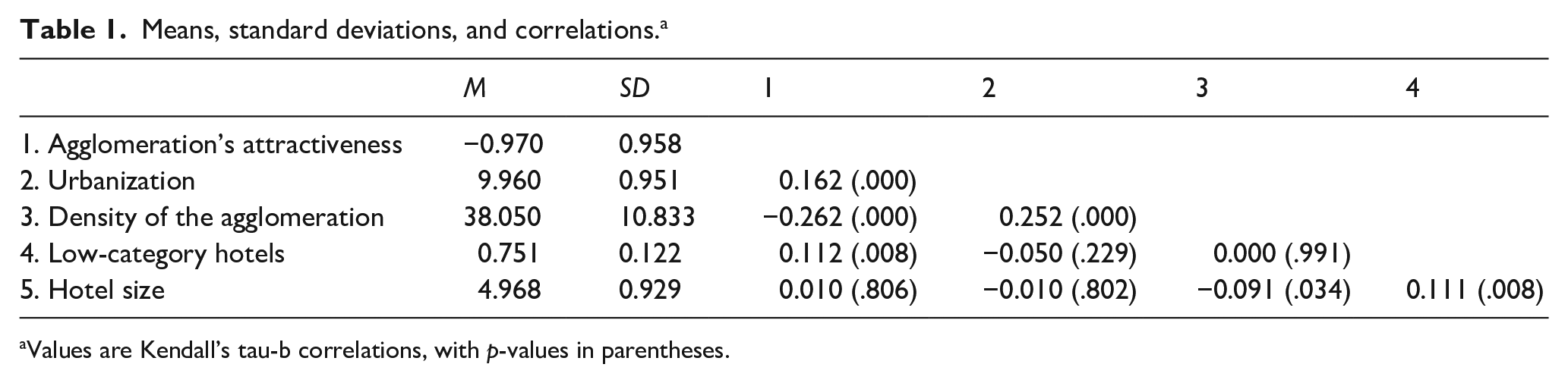
Values are Kendall’s tau-b correlations, with p-values in parentheses.
We began our analysis by confirming that our multilevel methodology is appropriate to control the effects of the foundation year in our analysis. To do that, we first analyzed systematic within and between years variance in the agglomeration’s attractiveness by calculating a baseline model where the level 1 equation includes no predictors; therefore, the regression equation includes only an intercept estimate. The level 2 groups (year in our analysis) are treated as a random sample from a population of hotels. Table 2 shows that the effect of year represents an appreciable proportion of the total variance (18%). To judge significance for variances, we used a likelihood ratio test (Rasbash et al., 2019). We concluded that significant variation between foundation years can be controlled with a multilevel model as proposed (variance of likelihood ratio = 15.678; p-value = .000).
Results of the baseline models. a
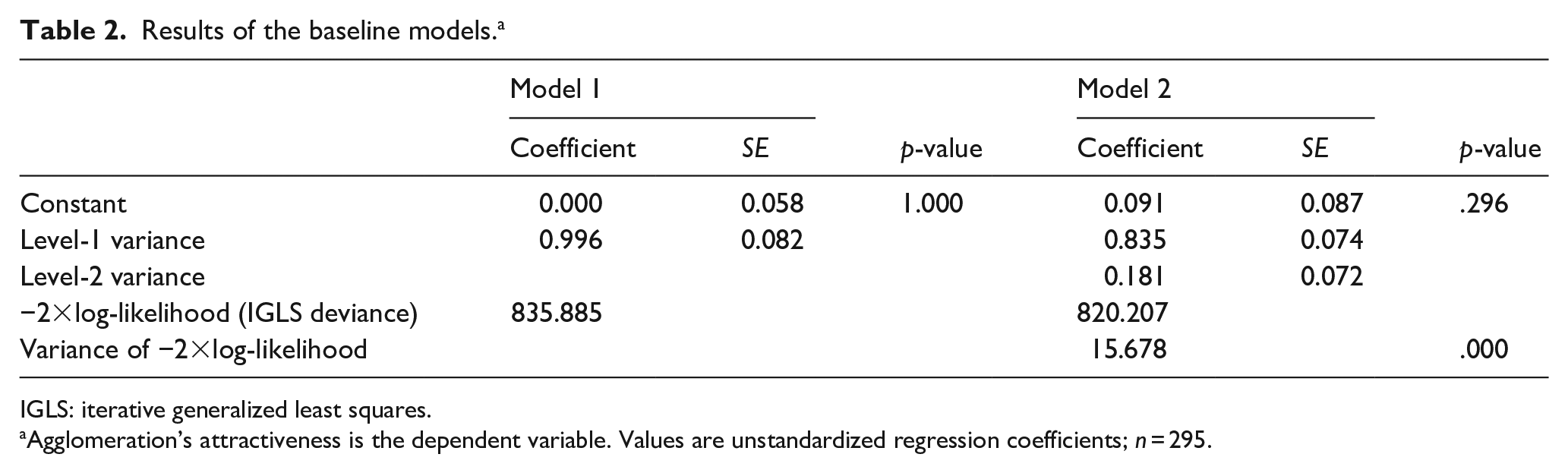
IGLS: iterative generalized least squares.
Agglomeration’s attractiveness is the dependent variable. Values are unstandardized regression coefficients; n = 295.
We estimate an extended multilevel model including our proposed independent variables to test Hypotheses 2 and 3. As previously discussed, our model includes two levels to control the effect of the year in our analysis
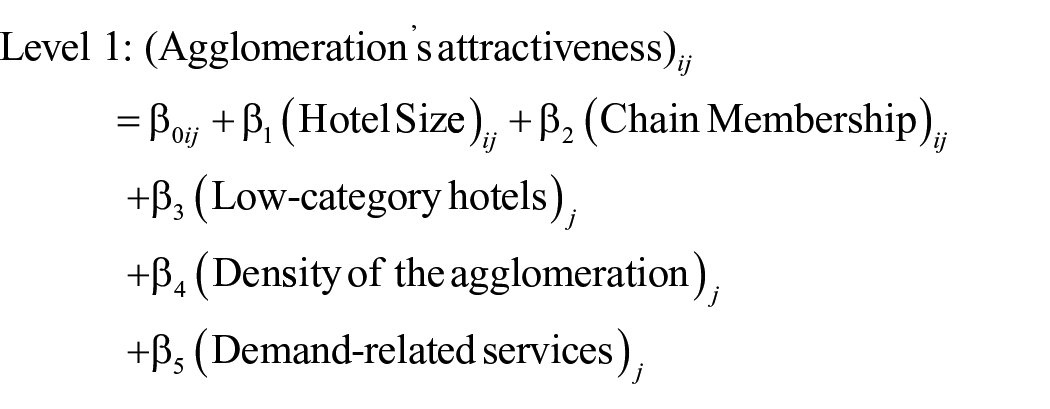

This model assumes that the only variation between years is in the intercept. We have also checked the possibility that each of the coefficients of dependent variables in our model would vary from year to year, which is known as random slope models (Rasbash et al., 2019). Hence, we tested different models where the coefficients of independent variables are random at level 2. Comparing the −2 log-likelihood value of these models with the −2 log-likelihood value of the single slope model, we found that the changes are not highly significant (variance of likelihood ratio = 124.394; p-value = .000), thus confirming the better fit of the original model including the only variation of the intercept between years. Table 3 shows the final results of the hierarchical linear model analyses.
Final results of the hierarchical linear modeling analysis. a
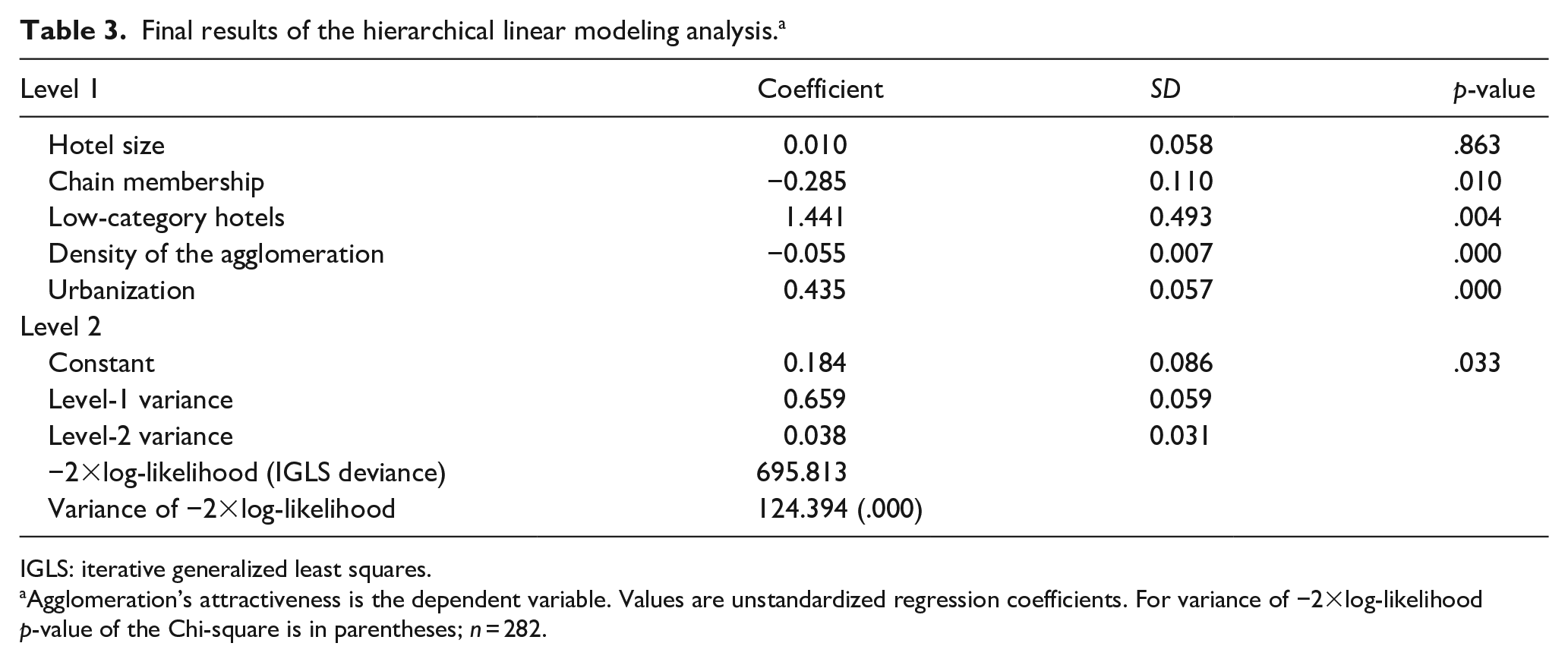
IGLS: iterative generalized least squares.
Agglomeration’s attractiveness is the dependent variable. Values are unstandardized regression coefficients. For variance of −2×log-likelihood p-value of the Chi-square is in parentheses; n = 282.
The results show that two of our control variables (chain membership and low-category hotels) influence significantly the attractiveness of the agglomeration for new entrants. These results are congruent with previous literature on agglomerations examining the effects of firms from the same chain (Canina et al., 2005; Kalnins & Chung, 2004; McCann & Vroom, 2010) and the influence of different quality orientation in the final attractiveness of co-location (Baum & Haveman, 1997; Kalnins & Chung, 2004). The relationship between size and attractiveness is weak in the analyzed sample, perhaps as a consequence of the relatively homogeneous size of the luxury hotels in the region.
As regards the influence of demand-related services, our results show a strong and positive effect of this variable on the attractiveness for new entrants of the analyzed agglomeration (β5 = 0.435; p < .001). This result supports our Hypothesis 2. In addition, our results show that a high density of firms in the agglomeration has a negative effect on its attractiveness for new entrants (β4 = −0.055; p < .001). This result supports Hypothesis 3 in our analysis.
Because of the central importance of the negative influence of density in our analysis, we used a robustness test, adding the quadratic term of the variable density to Model 2. The coefficient of this variable was negative and significant (β = −0.004, p = .001). Although this result suggests a quadratic pattern of rising followed by falling, the inflection point of that relationship is out of the range of our function. We drew a graph on the basis of the coefficients of our model and it shows a decreasing trend of agglomeration attractiveness at an increasing rate when the density of agglomerated firms increases. All these results confirm Hypothesis 3 in our analysis.
Finally, to determine the effect size measure related to variance explained for the overall model, we used the f2 index provided by Cohen (1992)

A formula for R2 specific to multilevel models is provided by Snijders and Bosker (2012). In this study, the result is R2 = 0.31, which can be interpreted as the proportion of variance in agglomeration’s attractiveness explained by the independent variables. Thus, the effect size measure related to variance explained for the overall model is 0.4576. Guidelines for interpretation of f2 indicate that 0.02 is a small effect, 0.15 is a medium effect, and 0.35 is a large effect (Cohen, 1992), indicating that the present effect is large.
Results related to the verification of Hypotheses 1 and 4 are useful to better understand the importance of access to natural resources in an agglomeration and the implications of this. Our baseline Hypothesis 1 argues that as the agglomeration matures, access to the coastal resources degrades. Meanwhile, our Hypothesis 4 proposes that access to those resources increases as the agglomeration density increases. To analyze these hypotheses, we conducted a one-factor analysis of variance (ANOVA) test to discover whether the density of co-located firms was related to the opportunities for accessing valuable natural resources over time inside and outside the agglomeration. As regards the agglomeration’s attractiveness, we classified new entrants into two groups: hotels located in the agglomeration, and hotels that are located in other beach regions. As regards density, we distinguished between high and low density by taking the inflection point as the point at which the density started to decrease in the analyzed temporal evolution of hotels in the agglomeration. As a consequence, each of the sampled new hotel was classified into one of the following groups: (1) located in the agglomeration when it showed a low density, (2) located outside of the agglomeration when it showed a low density, (3) located in the agglomeration when it showed a high density, and (4) located outside the agglomeration when it showed a high density.
We used Levene’s test to analyze the variance heterogeneity in our data and, as a consequence, selected the most appropriate post hoc test. Then, a Tamhane test for comparing the differences between multiple groups was used for our analysis (Howell, 2013). Table 4 shows the descriptive statistics of the variables for each of the four analyzed groups and the analyses of the differences between the different groups.
Differences in access to the coastal resources. a
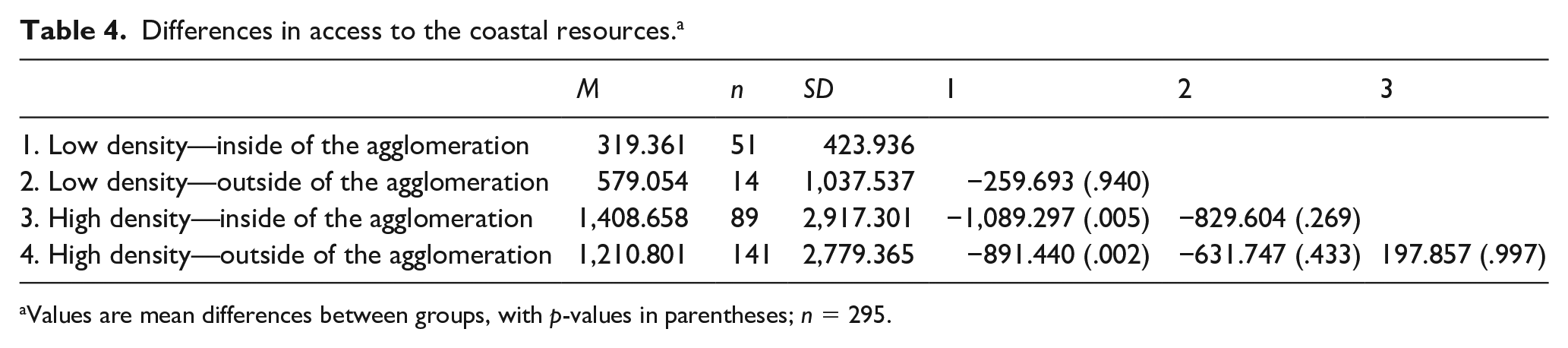
Values are mean differences between groups, with p-values in parentheses; n = 295.
Results of the one-factor ANOVA test show that the hotels that opened in the agglomeration when its density was low obtained excellent access to the coastal resources by being located in the nearest possible proximity to the beach front (M = 319.361, SD = 423.936). Access to the coastal resources was statistically better for those hotels than for any others in the region throughout the analyzed period, including those hotels entering the agglomeration when the density of the agglomeration was high (M = 1,408.658, SD = 1,037.537). This result confirms our Hypothesis 1. Furthermore, our results also show that hotels that opened in the agglomeration when the density of the agglomeration was low got better access to the coastal resources than those hotels located outside the agglomeration when the density of the agglomeration was high (M = 1,210.801, SD = 2,779.365). Finally, it is particularly interesting that hotels located outside the agglomeration when the density of the agglomeration was high had better access to the coastal resources than hotels entering the agglomeration under similar conditions of density, although the differences are less statistically significant here. These results support our Hypothesis 4.
The analysis helps us to understand the process starting around the early agglomeration in Costa del Sol (the first agglomeration in the region, and the most populated nowadays). Figure 1 shows that the first beach hotels to be opened in the region were mostly located in the agglomeration and close to the beach. When the density of the agglomeration increases, some new hotels select two alternative locations. Some enter the agglomeration but have to be located progressively further away from the coastal resources because of limited availability on the beachfront. Those that select locations outside of the agglomeration may find locations with better access to the coastal resources. In any case, these early locations outside the agglomeration were still close to the original agglomeration; they may have sought the benefits of better access to natural resources outside the original agglomeration, but they also benefited from the demand-related benefits of the nearby agglomeration.
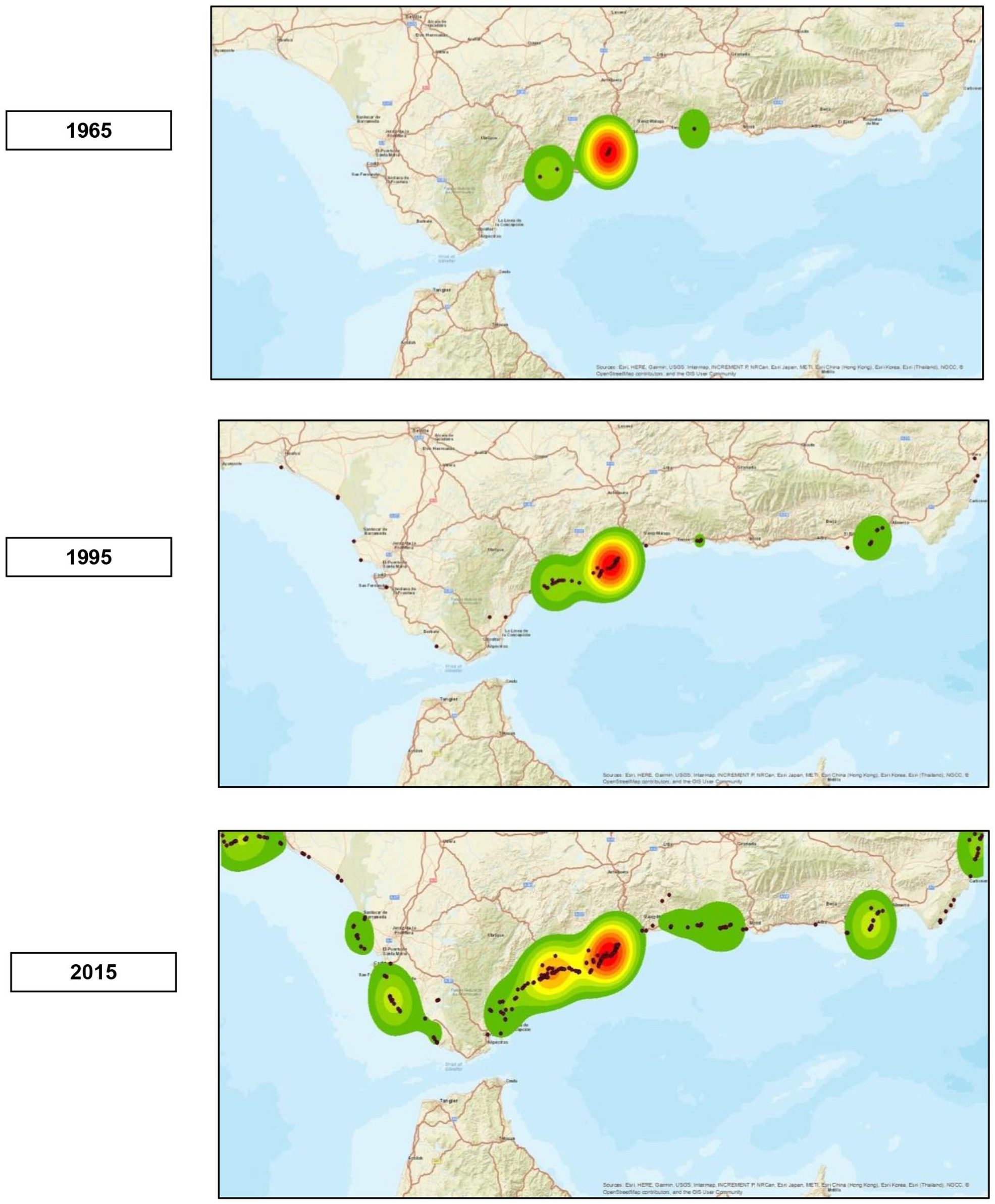
Agglomeration’s evolution.
The new hotels located outside the agglomeration tended to be located closer to the coast than those joining the agglomeration when the agglomeration density was high. However, the former was unable to replicate the ideal access to the coastal resources of the first entrants to the agglomeration. In general, it is interesting to observe that the original agglomeration continued to grow during the analyzed period, but at the same time alternative agglomerative locations progressively gained in importance.
Discussion, future research, and practical implications
Recent research has highlighted the need to focus on the challenges firms face in implementing the United Nations’ SDGs (Montiel et al., 2021). The SDGs related to the hospitality industry require achieving a balance among growth, consumption, and sustainable use of natural resources. This effort is particularly relevant when the combination of fragile natural resources and the agglomeration of businesses around them are core elements. However, the management literature has paid little attention to the implications of concentrations of firms around strategic natural resources. Our research has extended the stream of management literature focused on the SDGs (Kolk et al., 2017; Montiel et al., 2021; Sachs et al., 2019) as well as research on agglomerations (Alcacer & Chung, 2014; Kim, 2016; McCann et al., 2016; Pe’er et al., 2016; L. Wang et al., 2014) by examining the combined relevance of endogenous and exogenous benefits of agglomerations and the evolution of the attractiveness of valuable natural coastal resources to new entrants in the hospitality industry. Our results provide illustrative evidence of the difficulty of balancing the economic, social, and environmental aims of the SDGs. Moreover, they provide some guidance toward achieving them.
We have analyzed the demand-related benefits produced by urbanized agglomerations as well as the issues associated with access to natural resources when the density of co-located firms grows. Our analysis improves our understanding of the dynamic evolution of agglomerations around valuable natural resources and their attractiveness to new entrants. In addition, it complements the growing research interest in the dynamic evolution of agglomerations (Kim, 2016; McCann et al., 2016; Pe’er et al., 2016).
While the management literature has been criticized for excessive oversimplification when dealing with the importance of the natural environment (George et al., 2018), our results reflect the conflicting realities of co-location around natural resources and contrast those realities with the aims of environmental, economic, and social balance found in the SDGs. Specifically, we show that agglomerations may be attractive for new entrants when they provide firms with opportunities to access demand-related services in urbanized areas. However, new entrants also have a strong interest in gaining optimal access to natural resources, which becomes more difficult as co-location increases. The positive relationship between the urbanization of certain locations and the attractiveness of a particular agglomeration follows the pattern found in the management literature on the demand-related benefits of agglomerations. However, our finding of a negative relationship between the growing density of co-located firms in the original agglomeration and the relative attractiveness of the agglomeration is unique. The simultaneous consideration of both relations and our complementary analysis of access to natural resources under different conditions provides an opportunity to better understand the evolutionary process of agglomeration around valuable natural resources.
Our ANOVA results confirm the difficulties new entrants face in accessing the original natural resources as the density of the co-located firms increases. Moreover, access to natural resources outside the original agglomeration improves relative to the opportunities within the original agglomeration as the density of competitors in the original agglomeration increases. The first entrants to the agglomeration in our sample obtained ideal access to the strategic natural resources in the industry. Subsequent entrants found better access to valuable natural resources outside the original agglomeration. The new entrants progressively extended their locations into urban regions that neighbored the original agglomeration. This pattern suggests that, for late entrants, being close but not in the agglomeration provides some of the endogenous benefits of the agglomeration and better access to the exogenous benefits derived from natural resources than the original agglomeration. Over time, new agglomerations emerge in different zones. For instance, once a hotel decides to locate in a new beach area, other new hotels decide to locate in that same area in subsequent years.
Our results highlight a pattern of new agglomeration emergence around natural resources that differs slightly from the pattern traditionally accepted in the extant ecological literature (Carroll & Hannan, 2000; Hanan & Freeman, 1989). A visual representation of the new entrants’ locations (Figure 1) and specialized software provided us with descriptive insights into the evolving agglomeration processes in the analyzed region. While the ecological literature has mainly assumed that the population of firms grows until it reaches a certain density and then progressively declines, we found that multiple regions may grow simultaneously as a consequence of conflicting competitive pressures. We found that a region outside an agglomeration with suboptimal availability of natural resources may progressively become more attractive as accessing the natural resources in the original agglomeration becomes more difficult.
Clearly, our results do not underplay the importance of agglomerations. On the contrary, they highlight the attractiveness of competitors’ agglomerations to new entrants. While some firms may access the value generated by the specialization benefits of agglomerations without being physically located in that area, access to the benefits of nearby natural resources usually requires geographic co-location (Alcacer & Chung, 2014). Our results also confirm that being located close to natural resources may provide direct, difficult-to-substitute benefits (Canina et al., 2005). This result contrasts with a number of works suggesting that advances in information technologies may substantially erode the benefits of spatial proximity (Kukalis, 2010; Tallman et al., 2004). At the same time, our results highlight that only a sustainable balance among natural resource preservation, growth, and consumption may sustain the competitiveness of firms and regions. In fact, excessive agglomeration around valuable natural resources in a region leads to the emergence of better-preserved regions.
Future research
Future research should pay more attention to how alternatives to original agglomerations evolve and the factors that influence their potential to provide more sustainable externalities than those available in the original agglomeration. Similarly, it is important to learn more about how an agglomeration might retain its attractiveness for new entrants under certain conditions and how managers’ time perspectives (Ortiz-de-Mandojana et al., 2019) influence the sustainability of their strategic decisions related to agglomerations. In general, we would welcome insights into when and how alternative agglomerations acquire dominance over or coexist with the original agglomerations, and how firms’ strategic orientations in each agglomeration may differ. Also, we highlight that local conditions that promote new venture creation differ from those that maximize the performance of recently established companies (Stuart & Sorenson, 2003). Therefore, we suggest extending our findings by analyzing the implications of our results for performance.
Our sample of beach hotels was particularly appropriate for this study given the connections between coastal natural resources and competitiveness within this industry. However, we would welcome future research that confirms our results in different empirical settings. The hospitality industry is widely accepted as a context in which the demand-side benefits of agglomeration are highly relevant (Lee & Jang, 2015; Urtasun & Gutiérrez, 2017), and this topic is highlighted in the UN’s SDG agenda. We encourage future empirical analyses focused on the combined role of natural resources and agglomeration benefits in supply-side industries. Our results also call for recognition of the role of natural resources in the potential decline of agglomerations and the risks of excessive agglomerating. Descriptive evidence of environmental issues related to manufacturing and technological agglomerations (e.g., air and water pollution, noise, or lack of space) suggests that natural resources may restrict the sustainable growth of the internal, supply-side benefits associated with firms’ agglomerations.
Finally, future research may extend our knowledge on whether degrading natural resources in an agglomeration may have different effects on the externalities that emerge from those agglomerations. For example, we suspect that specialized technicians may be more sensitive than blue-collar employees to the degradation of natural resources in agglomerations. In general, we would like to see more research on whether preserving the quality of natural resources in an agglomeration may help maintain the endogenous agglomeration’s attractiveness when those resources are limited in quantity.
Practical implications
While some may view the SDGs as a purely ethical narrative, our results show that unsustainable development generates specific problems for firms and affected regions. Unlike other competitive factors, natural resources are often limited and non-renewable. Consequently, difficulties in accessing the benefits of natural resources may limit regions’ success in hosting agglomerations. They may also restrict the success of firms located in an agglomeration in terms of maintaining their strategic advantages before a decline occurs in the region. In this context, taking care of the natural resources around the agglomeration in a sustainable manner should be a priority for all stakeholders, including policy makers, scholars, executives, and social groups. It is necessary to ensure a collective commitment to maintaining the balance between growth and natural-resource preservation. Our results confirm that such a balance is also a key dimension of the SDGs.
Multiple examples around the world serve to illustrate the social and business benefits of agglomerations of similar firms in a geographical region. Natural resources are key factors in many of these benefits. The oil industry in Houston; tourist agglomerations around national parks, ski resorts, and beaches in numerous countries; the coffee industry in Colombia; the orange-juice industry in Florida; and the intensive winery operations in certain regions of Chile, California, France, and Australia are just a few examples. In this context, cities, states, and countries must identify the best formulae for using their natural resources to attract wealth-generating industries to their territories. In addition, agglomerations around strategic natural resources provide firms with strong positive externalities. Hence, managers prioritize existing agglomerations around natural resources in their location decisions owing to their financial and strategic implications. However, our results show that managers and policy makers should carefully consider how the attractiveness of agglomerations may evolve over time. In general, a more holistic view of agglomerations suggests that the integration of sustainability topics into business curricula should help key actors understand that not only is preserving natural resources a moral duty, but also that the planet, people, and profits are often closely related (Aragon-Correa et al., 2017; Leyva-de la Hiz et al., 2022).
Policy makers should work to understand the importance of their roles in generating sustainable competitiveness on a regional level. Early entrants in an agglomeration may enjoy extra benefits derived from local natural resources, but those benefits can only be maintained through the sustainable management of the focal resources. Certain regions may find it more difficult to attract firms when an agglomeration is growing in other areas. However, this situation may change when access to valuable natural resources in the original agglomeration deteriorates, making it more difficult to enjoy the benefits derived from those resources. In this context, our research highlights the central, but often ignored, strategic dynamic role of natural resources in generating and sustaining successful agglomerations.
Our findings suggest that the highly intensive exploitation of natural resources in certain areas may reduce the perceived attractiveness of agglomerations among new entrants. As a practical, indirect consequence, such exploitation also reduces the benefits of being in the region for agglomerated firms. In fact, the media has focused on the difficulties one of the most popular agglomerations in the world—Silicon Valley—has encountered in maintaining its appeal to new entrants (Roose, 2018). Descriptive reports suggest not only that other areas are now more successful in attracting high-technology firms, but also that some firms are leaving Silicon Valley. Although this shift may have several causes, traffic congestion, commute times, and a lack of affordable housing and land on which to build new businesses are widely recognized as important factors. Although our study analyzes a different industry and geographical region, we believe that our conclusions may provide some insights into how an “excessive” agglomeration of similar firms may generate some of the problems currently seen in Silicon Valley.
Managers should consider the fact that locating early in an emergent agglomeration could offer benefits associated with co-locating with current and future competitors as well as privileged access to natural resources. However, the growing density of an agglomeration progressively reduces opportunities to access natural resources. Recent works have shown the relative complexity of optimal environmental policies in terms of preserving the natural-resource benefits in cases of excessive agglomeration (Kyriakopoulou & Xepapadeas, 2013; R. Wang et al., 2018). In such cases, the existence of regulations that do not specifically address the preservation of valuable natural resources or the total absence of such regulations lead to a tendency among incumbent firms and new entrants to intensively exploit the benefits derived from being located close to valuable natural resources, even when doing so leads to a deterioration in the overall situation for all actors over time (Aragon-Correa et al., 2020). Hence, scholars should pay attention not only to the benefits of the initial steps of agglomerating around natural resources, but also to the need for different measures to ensure sustainable growth as the agglomeration evolves.
Footnotes
Acknowledgements
The authors want to thank the members of the research group, “Innovation, Sustainability and Business Development” (SEJ-481), for their help and comments.
Declaration of conflicting interests
The author(s) declared no potential conflicts of interest with respect to the research, authorship, and/or publication of this article.
Funding
The author(s) disclosed receipt of the following financial support for the research, authorship, and/or publication of this article: This work was supported by the Spanish State Research Agency—Innovation and Science Ministry, 10.13039/501100011033 (Grant number: PID2019-106725GB-I00) and the Ministry of Science and Innovation through the FEDER funds from the Spanish Pluriregional Operational Program 2014-20, LifeWatch-ERIC action line (Grant number: LifeWatch-2019-10-UGR-01).
