




Abstract
This empirical article examines how the institutional development of the home country and host countries in which multinational enterprises (MNEs) are embedded can drive MNEs’ research and development (R&D) intensity. In doing so, this study analyzes 967 firm-year observations of 234 pharmaceutical firms from 30 developed and less developed countries in the period from 2010 to 2017. We find empirical support for internationalization toward developed countries as a driver of R&D intensity at the firm level. Furthermore, we find that this positive effect is stronger for MNEs from less institutionally developed home countries. The results can help managers, researchers, and policymakers to better understand the innovation process in R&D-intensive industries.
Keywords
Introduction
Globalization has transformed multinational enterprises (MNEs) into stateless actors disconnected from specific countries in a world without borders (Amankwah-Amoah & Debrah, 2017). While negative attitudes toward globalization have increased in the past years, globalization has brought about “global learning, and the rapid spread of ideas across borders from the transfer of individuals and technologies” (Cuervo-Cazurra et al., 2020, p. 4). As such, today’s MNEs conduct a large portion of their research and development (R&D) activities outside their home country. Foreign activities enable firms to access knowledge resources that would be more difficult to obtain if a firm developed its activity exclusively in its domestic market (Almeida & Kogut, 1999; Bartlett & Ghoshal, 1989; Nachum & Zaheer, 2005). The international business literature recognizes that firms’ internationalization enables the reinforcement of their existing core competences, access to substantial growth opportunities in foreign countries, and the gain of unique knowledge (e.g., Hitt et al., 1997, 2006; Salomon & Shaver, 2005), which, in turn, fosters the international firms’ innovativeness (e.g., Castellani et al., 2017; Zahra et al., 2000). For example, in the context of multinational pharma companies, McKinsey and Company (2017) highlighted how MNEs with global operations across emerging countries can benefit from the interchange of ideas across mature and emerging markets. However, the international business literature has suggested that MNEs are deeply embedded in the national configurations of institutions because individual countries remain distinctive despite pressures to converge (Dodgson, 2018). In this vein, there is an ongoing debate about the extent to which the innovation of MNEs is a reflection of the characteristics of the institutional environments in which they are embedded (e.g., Hernandez & Guillén, 2018; N. Zhou & Guillén, 2015).
Hence, considering that countries differ one from another on their institutional profile, in this study we provide advances to understand how the institutional development of home and host countries affects the R&D intensity of MNEs. We propose that MNEs with a higher internationalization toward developed countries show higher levels of R&D intensity due to the stricter market requirements and increased learning opportunities. Developed countries offer access to more sophisticated knowledge and technologies, as well as networking and cooperation opportunities with local knowledge-intensive firms, universities, and research facilities (Yoo & Reimann, 2017). Furthermore, developed countries generally present better intellectual property rights protection systems, legal systems, and environmental protection systems (Wu & Park, 2019), which allow MNEs to protect their self-developed and acquired knowledge-based assets. In addition, we suggest that this relationship is strengthened for MNEs from less institutionally developed countries. Specifically, we argue that MNEs from institutionally weak countries respond to the institutional characteristics of host developed countries through a higher level of R&D intensity. MNEs from less developed countries have an uncertainty management capability that allows them to be more flexible, adapt better to different political systems and conditions of foreign countries, and recognize more easily new opportunities, thus making it more likely for them to achieve the full potential of ambidexterity in international expansion (Luo & Rui, 2009). When these firms expand their international operations in developed countries, they recognize that they are operating in more efficient and transparent institutional environments where they can generate new knowledge and improve their competitive advantages (Witt & Lewin, 2007; Wu & Wu, 2014). Furthermore, MNEs from less developed countries may seek to align themselves with the international context because global stakeholders promote “guidelines and expectations for MNE behavior on a worldwide basis” (Kostova et al., 2008, p. 998).
We conduct our analysis in the context of the pharmaceutical industry. Drawing on the institutional perspective, our hypotheses are tested on a longitudinal data set of 967 firm-year observations of 234 MNEs from 30 countries in the period from 2010 to 2017. Some works have stressed the role of internationalization in the current innovation challenges of R&D-intensive sectors, such as the pharmaceutical industry (e.g., Gassmann et al., 2018; Kiriyama, 2011; Thakur-Wernz & Samant, 2019). The OECD study by Kiriyama (2011) noted that revenues from global sales have provided incentives and funds for R&D investment for future innovation. Global sales of pharmaceutical products, in turn, mean global diffusion of advanced medical technology and . . . improved health, an essential basis for future growth and innovative capacity. (p. 5)
Thus, given that the pharmaceutical industry is R&D-intensive and increasingly global, our sample provides an excellent context in which to assess the goals of this study. Our focus on the pharmaceutical industry makes our results especially relevant, since it is a global strategic sector with the highest R&D intensity, investing up to 40% of its gross value added in R&D in Japan and the United States (OECD, 2018). In the global pharmaceutical value chain, leading firms directly devise their innovation development plans and rarely delegate this important activity to independent global suppliers (Buciuni & Pisano, 2021). On the other hand, the importance of some emerging countries, such as India and China, is becoming more relevant in the pharmaceutical context. For instance, Chinese pharmaceutical firms have gradually increased their R&D intensity over the past decade. However, in these emerging countries, R&D investments are still quite low compared to developed country firms (X. Chen et al., 2019).
In this article, we advance the stream of internationalization-innovation research by testing a model to explain how the institutional development of home and host countries affects the R&D intensity of MNEs. We contribute to the literature in several ways. First, based on the institutional perspective, we show that MNEs with a higher internationalization toward developed countries increase their levels of R&D intensity. Compared with existing research on the internationalization–innovation relationship (e.g., Castellani et al., 2017; Golovko & Valentini, 2011; Salomon & Shaver, 2005), this article focuses on the level of development of host countries in which MNEs are internationalizing. Our article allows us to analyze whether internationalization toward developed countries influences R&D intensity, which is important considering the increasing importance of less developed markets as host countries for pharmaceutical MNEs. In this way, we highlight that when studying the relationship between internationalization and R&D intensity, it is important to consider not only the level of internationalization but also its orientation toward countries with certain characteristics. Second, we add a more integrative view of how the home country institutional development moderates the relationship between internationalization toward developed countries and R&D intensity, such that this relationship is more positive with lower levels of home country institutional development. This insight contributes to recent theorizing that regards MNEs from less developed countries as having strong incentives to improve their capabilities when they expand to more developed countries by providing empirical evidence of how the logic of these arguments also extends to innovation activities. So, MNEs’ R&D intensity reflects the characteristics of all the countries in which they operate. Third, we also contribute empirically by analyzing a panel data set (8 years) of 234 pharmaceutical MNEs from 30 developed and emerging countries and with 16,479 subsidiaries in 107 countries. Our sample of MNEs in the pharmaceutical industry from developed and less developed countries offers an interesting framework, because this industry has experienced a process of profound transformation. While OECD countries lead the statistics of health and medicine related clinical trials (with over 75% of the total) across the globe (OECD, 2018), some developing countries have emerged as pioneers in innovation and as testing sites for new business models and technologies. For instance, certain countries, such as China and India, might drive pipeline innovation, as witnessed in recent trials of oncology, hepatitis C, and diabetes (McKinsey & Company, 2017). Furthermore, the fact that our sample includes MNEs from both developed and less developed home countries is of special relevance because it allows us to analyze the influence of home country institutional development and to draw a wider generalization of our conclusions.
The rest of this article is organized as follows. First, the related theoretical background and hypotheses are discussed. Second, the sample, measures and methods are presented. Third, the results are analyzed. Finally, the article consolidates the findings and ends with the main conclusions, implications, and avenues for future research.
Theoretical background
Institutional theory describes how each country is the sum of its institutions and how these institutions form the basis of societal structure, and guide behavior within the society (North, 1990). The legal, political, administrative and economic frameworks of the country are formal institutions, while societal norms, beliefs, traditions, and codes of conduct are informal institutions (North, 1990; Scott, 1995). Wan and Hoskisson (2003) combine North’s (1990) institutional view with a more traditional economic perspective on production factors in their concept of country institutional profile, which encompasses labor quality, infrastructure, and natural resources. Countries have differing levels of institutional development, which can lead to specific advantages for firms and different challenges and opportunities for those companies that decide to internationalize toward these markets (e.g., Dunning & Lundan, 2008; Garrido et al., 2014; Meyer et al., 2009).
On the other hand, according to institutional theory, there are differences in the way MNEs from different countries behave and make strategic decisions because the home institutional environment affects the options available to firms operating within them for formulating and implementing strategies, their behavior and performance (Meyer & Peng, 2016; Peng, 2002). Firms develop “particular resources at home to deal with characteristic conditions of the environment there and these resources are then used by the firm in its international expansion” (Cuervo-Cazurra, 2011, p. 384). Recent literature, focused on the particular case of emerging and developing country MNEs, has shown how the institutional voids of their home countries can be a comparative disadvantage but can also foster these firms’ internationalization (e.g., Cuervo-Cazurra & Ramamurti, 2017; Luo & Tung, 2018). Firms from emerging countries may venture into more developed markets to escape the underdeveloped institutions at home (Cuervo-Cazurra & Ramamurti, 2017; Wang & Ma, 2018) and use international expansion to acquire critical capabilities available in more developed countries and to reduce their vulnerability to institutional voids at home (Luo & Tung, 2018). In addition, the home country’s comparative disadvantages can also have a positive effect on creating new capabilities that can be leveraged internationally (Cuervo-Cazurra & Ramamurti, 2017).
In addition, specifically in relation to innovation, Porter’s (1990) seminal work on national competitiveness sees the innovativeness of firms and their consequent competitive success as a function of the characteristics of their home country. Developed countries often offer more sophisticated knowledge-based assets, better intellectual property rights, and greater market requirements (e.g., Wu & Park, 2019; Yoo & Reimann, 2017). The availability of financial and labor quality factors, the sophistication of knowledge and technology, the requirements of local buyers, and the networking and cooperation with local universities and research facilities influence the innovativeness of a firm (e.g., Cuervo-Cazurra & Ramamurti, 2017; Rosenbusch et al., 2019; Wu & Park, 2019). Thus, opportunities and challenges in less developed home and host countries are systematically different from those in developed countries. In the next section, we discuss how the institutional development of the host countries in which MNEs operate may have an impact on these MNEs’ R&D intensity. Moreover, since MNEs’ behavior and strategies can be conditioned by the home country, we analyze to what extent the relationship between internationalization toward developed countries and R&D intensity is moderated by the home country’s level of institutional development.
Internationalization toward developed countries
MNEs through operating in foreign countries access more diverse resources and information sources, and can establish relationships with local businesses and research institutions, to better develop innovations and thus increase their profitability (e.g., Castellani et al., 2017; Kafouros et al., 2008; Villar et al., 2020). Internationalization allows firms to gain access to knowledge and technologies that are not available in the home country, and this new learning enables firms to improve their products and processes (e.g., Hitt et al., 2006; Salomon & Shaver, 2005). For example, the internationalizing firm may learn from customer feedback and competing products and technologies used by foreign competitors, buyers, and suppliers (Salomon & Shaver, 2005). Santos et al. (2004) showed that foreign countries also present opportunities for networking and cooperation with local universities and research facilities. The newly acquired knowledge can help a firm improve its products and processes to gain competitive advantages, and thus enhance its performance in both domestic and foreign markets. As the competitive global landscape requires firms to innovate to achieve and maintain competitive advantage (Hitt et al., 1997; Lu & Beamish, 2004), the greater market size attained through internationalization provides more resources for doing so (Tsao & Lien, 2013). Golovko and Valentini (2011) found that operating in foreign countries will generally expand the revenue base of a firm, and increased sales are likely to provide the firm with more resources to invest in innovation. In addition, internationalization reduces the dependence on the home country for revenues and profits and increases demand from a foreign market, thus allowing the firm to commercialize its innovations to a broader audience and increase the returns on innovation (Alvarez & Robertson, 2004).
Thus, the literature agrees that the extent to which a firm’s operations are conducted in foreign countries drives its level of innovation (e.g., Cassiman & Golovko, 2011; Castellani et al., 2017; Chittoor et al., 2015; Kafouros et al., 2008; Zahra et al., 2000). Internationalization serves as a “springboard” for acquiring innovative capabilities (Luo & Tung, 2007). However, since host countries have different institutional profiles, the influence of internationalization on R&D intensity can be different depending on the institutional development of countries in which these international operations take place. It is important to highlight that countries differ in per capita income, in their ability to produce knowledge, and in the extent to which they can leverage that knowledge by being connected to other countries (Furman et al., 2002). Operating in a certain country implies that firms are embedded in, and face the distinct challenges and opportunities that derive from the country’s institutional development (Dunning & Lundan, 2008; Meyer et al., 2009). Cuervo-Cazurra (2011) argued that “the particular norms and institutions prevailing in the country” (p. 383) induce the internationalizing firm to develop specific resources to be able to interact with other players in the marketplace. The literature based on institutional theory has highlighted how innovation activities are influenced by regulations and laws, by more or less effective institutions which influence the agency problems among the decision makers and the financial resources available to firms (Choi et al., 2014; Cuervo-Cazurra & Ramamurti, 2017) and, specifically, by the national innovation systems that condition knowledge spillovers in a country (Wu & Park, 2019). Thus, general institutional characteristics in the host country, such as government effectiveness, rule of law, regulatory quality, corruption, political stability, and characteristics of innovation systems, such as university and research institutes and financial support for innovation, impact firms’ innovation activities (Rosenbusch et al., 2019).
In general, developed countries, characterized by a higher level of institutional development, present stricter market requirements, which oblige firms that wish to operate in these markets to be more innovative to meet these higher demands. These countries also offer better access to knowledge and technologies and provide superior opportunities for networking and cooperation with local universities and research facilities (e.g., Yoo & Reimann, 2017). Developed countries normally present more advanced intellectual property rights protection systems, legal systems, and environmental protection systems than emerging countries (Wu & Park, 2019). In this regard, Piperopoulos et al. (2018) show that the host countries’ level of institutional development positively moderates the relationship between internationalization and innovation activities. Developed countries provide non-native companies with more sophisticated knowledge and technologies, and offer more opportunities to foster network ties with knowledge-intensive firms and local universities and research facilities. When MNEs operate internationally in more developed institutional environments, they can concentrate on generating new knowledge and improving their competitive advantages (Li et al., 2010; Witt & Lewin, 2007; Wu et al., 2016).
On the other hand, less developed countries offer “fewer opportunities for sourcing advanced knowledge and technologies because of their overall lower levels of economics and technological development” (Piperopoulos et al., 2018, p. 234). Although in developed countries MNEs may need to rethink their business models to succeed, these adaptations for less developed countries often do not require higher levels of R&D investment. For instance, price reductions or adding new functionalities may be necessary for success in less developed countries because the conditions under which products are used in less developed countries differ with respect to their use in developed countries (Ramamurti & Singh, 2009).
In conclusion, we propose that having a higher level of international operations in more institutionally developed countries may positively impact MNEs’ R&D intensity. We argue that the greater market requirements in developed countries compel MNEs to be more innovative, thus driving them to increase R&D intensity. Furthermore, a higher internationalization toward developed countries drives firms to foster investments in R&D with the objective of taking advantage of the opportunities that these markets offer in relation to better access to advanced knowledge and technologies and increased opportunities for networking and cooperating with local firms, high-quality universities, and research facilities. We thus hypothesize the following:
Hypothesis 1. A firm’s internationalization toward developed countries is positively associated with its R&D intensity.
Institutional development of the home country
Building on the institutional perspective, various researchers have concluded that differences in firms’ home country institutional environments have a significant impact on firm strategies (e.g., Cuervo-Cazurra et al., 2018; Wan & Hoskisson, 2003; Yan et al., 2018). MNEs from more institutionally developed countries are seen as more competitive due to the availability in their home country of specialized resources and skilled labor, the existence of related industries and the exchange of market and strategic information, external pressures from more demanding buyers, advanced management practices, and increased competition among domestic firms (Cuervo-Cazurra & Ramamurti, 2017). Some researchers have noted that the existence of physical infrastructure, financial and capital resources, labor quality, and political, legal, and societal institutions facilitates the development of innovations in countries with high institutional development (Rosenbusch et al., 2019). MNEs from countries with high institutional development face tougher competition, which requires continuous innovation and specialized expertise for them to remain successful. For instance, Furman et al. (2002) found that countries that encouraged competition and investments in technical universities increased their innovative capacity. Furthermore, in more institutionally developed economies, governments often promote R&D investments and innovation by granting subsidies or tax incentives, enforcing standards, and by promoting competition, antitrust laws, and open trade (e.g., Carney et al., 2019). In particular, government financial support provides firms with resources to innovate and helps mitigate the risk of unsuccessful projects.
In contrast, less developed market firms often face challenges and increased transaction costs due to institutional voids, such as the lack of or improper functioning of institutions in the product, capital, and labor markets (Cuervo-Cazurra & Ramamurti, 2017). They also often lack high-quality market intermediaries, such as brokers and accounting firms (Xie & Li, 2018). Furthermore, their competitiveness is weakened by political problems, such as instability and unpredictability, corruption, and bureaucracy (Luo & Tung, 2007). In less developed countries, the lack of institutional support, such as shallow capital markets, shortages of skilled labor, weak legal enforcement, and a lack of independent financial intermediaries, seriously hinders a firm’s innovation (K. Z. Zhou et al., 2017). As firms in less developed countries have to invest time and resources in dealing with unpredictable and unstable governments, they are left with fewer resources for developing innovations (Wu, 2013). The innovations of less developed market firms are often fundamentally different from those of developed market firms. It has been argued that the institutional voids present in less developed countries and the lower per capita income of citizens drive innovations for inexpensive, portable, and easy-to-use products (Govindarajan & Ramamurti, 2011). These products focus on solving some of the inherent problems of less developed countries, such as poor road infrastructure or the unreliable supply of electricity (Cuervo-Cazurra & Ramamurti, 2017). However, exposure to political risk and corruption in the home country drives less developed market firms to promote routines and strategic solutions that deal with their uncertain, unpredictable environments (Cuervo-Cazurra et al., 2018).
Some research based on less developed country MNEs has analyzed the internationalization and home country institutions as drivers as innovation (Chittoor et al., 2015; Wu et al., 2016; Xie & Li, 2018). For instance, Chittoor et al. (2015) showed that the impact of internationalization on Indian firms’ investment in innovation became stronger as the level of Indian institutional development increased as a consequence of the linkages with the global economy as well as the improvements of the free market mechanisms in the country. Xie and Li (2018) found that R&D and better-developed market intermediaries at home enhanced the positive effect of exporting on Chinese manufacturers’ innovation, while market openness in the home region tended to diminish it. Wu and Park (2019) demonstrated for Chinese firms that internationalization provides learning opportunities for innovation performance but also incurs higher management costs to handle the information overload from extensive internationalization. As the springboard view posits, MNEs from emerging countries have strong incentives to learn and improve their capabilities and innovation when they expand to international markets, but they also face challenges for growth in highly complex international environments as their internationalization grows greater. Wu et al. (2016) analyzed Chinese MNEs and showed that although host-country institutional development on average enhances innovation performance, such effects are more pronounced for firms with strong absorptive capacity and for those diversifying into a larger number of countries. In the same line, other research has noted that MNEs from weak institutional home countries may generate more innovation benefits than MNEs from developed countries when expanding their international operations into more institutionally developed countries (Cuervo-Cazurra, 2012; Rosenbusch et al., 2019). As emerging country firms often lack competitive internal R&D capabilities, they have been expanding rapidly to internationally and institutionally diverse markets to seek external ideas and upgrade their capabilities (Zhao et al., 2022).
Hence, we propose that when MNEs from less developed home countries expand to the international markets they are more motivated than MNEs from developed home countries to increase their R&D intensity for several reasons. First, they perceive the institutional environment to be more efficient and transparent and one in which they can generate new knowledge and improve their competitive advantages (Witt & Lewin, 2007; Wu & Wu, 2014). Firms from less developed countries expand into more developed countries to benefit from their institutional advantages and technological knowledge (Wu, 2013). They can “more easily recognize new opportunities in international markets that lead to successful expansion, growth, and performance advantages. Hence, they are more likely to achieve the full potential of ambidexterity in international expansion” (Luo & Rui, 2009, p. 52). Second, the uncertainty management capability developed by less developed country MNEs (e.g., Cuervo-Cazurra et al., 2018) allows them flexibility and better adaptation to different political systems and conditions of foreign countries, which can influence their decision to increase R&D intensity. Third, increasing R&D intensity may help these MNEs from less developed countries to distance themselves from their home country institutional voids. Developing country MNEs may seek to align themselves with the international context because global stakeholders promote “guidelines and expectations for MNE behavior on a worldwide basis” (Kostova et al., 2008, p. 998). Thus, we propose that the institutional development of the home country negatively moderates the positive relationship between the firm’s internationalization toward developed countries and its R&D intensity, such that this relationship is more positive with lower levels of home country institutional development. We thus hypothesize the following:
Hypothesis 2. The level of institutional development in a firm’s home country weakens the positive relationship between the firm’s internationalization toward developed countries and its level of R&D intensity.
Methods
Data collection
Our hypotheses were tested with a panel data set of 234 pharmaceutical MNEs from 30 countries in the period from 2010 to 2017. The pharmaceutical industry plays an important role in economies across the globe. The industry’s global aggregate sales reach $1.2 trillion (OECD/EUIPO, 2020) and it employs over 1.2 million people in OECD countries (OECD, 2018). This sector is appropriate for our study because pharmaceutical firms are known to be highly research-intensive and because most of the time these firms directly oversee the way innovations are developed (Buciuni & Pisano, 2021), making them suitable for examining R&D intensity. Furthermore, the OECD has also stressed that internationalization is one of the most important challenges of this industry and can be important in fostering innovation (Kiriyama, 2011).
The research-intensive pharmaceutical industry was in the spotlight recently as it led the battle against COVID-19 from the very beginning, by investigating and discovering diagnostics, treatments, and vaccines to help the world return to normality. While the events of 2020 and 2021 may have made the public think that drug development is quick and easy, the reality is that the pharmaceutical industry is risky when it comes to R&D and most of the risk and associated costs are borne by the firms themselves, as opposed to governments and the public sector in general (European Commission, 2020). It takes on average 10–15 years to develop a new medicine from initial discovery to marketing approval (OECD, 2018). However, only a small percentage of medicines entering clinical trials continue to gain approval. Of those that do make it to the market, a minority results in commercial success. This and the lack of new ideas has resulted in a declining productivity of pharmaceutical firms’ R&D activities, measured as the total cost per approved drug (OECD, 2018).
In a supranational context, as emerging countries have become parties to the Trade Related Intellectual Property Rights (TRIPS) Agreement upon joining the World Trade Organization (WTO), firms in these countries face a different institutional environment governed by a tight appropriability regime. This regime puts pressure on laggard firms from emerging countries to shift from being followers to producers and innovators (Ray & Ray, 2021). For instance, in India from 2005 onward, with the implementation of TRIPS, there has been a profound change as, on one hand, pharmaceutical firms have had to discontinue all reverse engineering of patented drugs and, on the other hand, TRIPS have incentivized pharmaceutical firms to innovate and discover new drugs as the new environment has enabled earning profits from these innovations (Ray & Ray, 2021). In turn, the European Union has recently published an “EU Pharmaceutical Strategy,” which includes new proposals aimed at helping Europe remain competitive and regain its position as a leading force in medical innovation (European Commission, 2020).
We relied on several data sources for the study. The data were collected from Thomson Reuters Eikon and Bureau van Dijk’s Orbis databases and the World Economic Forum’s Global Competitiveness Index. The reliability of Thomson Reuters Eikon and Bureau van Dijk’s Orbis databases has been supported in the academic community and among users of corporate information. These databases include a number of financial (e.g., income statement, balance sheet, statement of cash flows) and non-financial parameters (e.g., business and geographic segments, subsidiaries, major customers). These databases offer a comprehensive platform for establishing customizable benchmarks (e.g., sector and country) for the assessment of corporate performance. The Global Competitiveness Index assesses the economic situation in 141 economies and is “the product of an aggregation of 103 individual indicators, derived from a combination of data from international organizations as well as from the World Economic Forum’s Executive Opinion Survey” (World Economic Forum, 2019, p. 7).
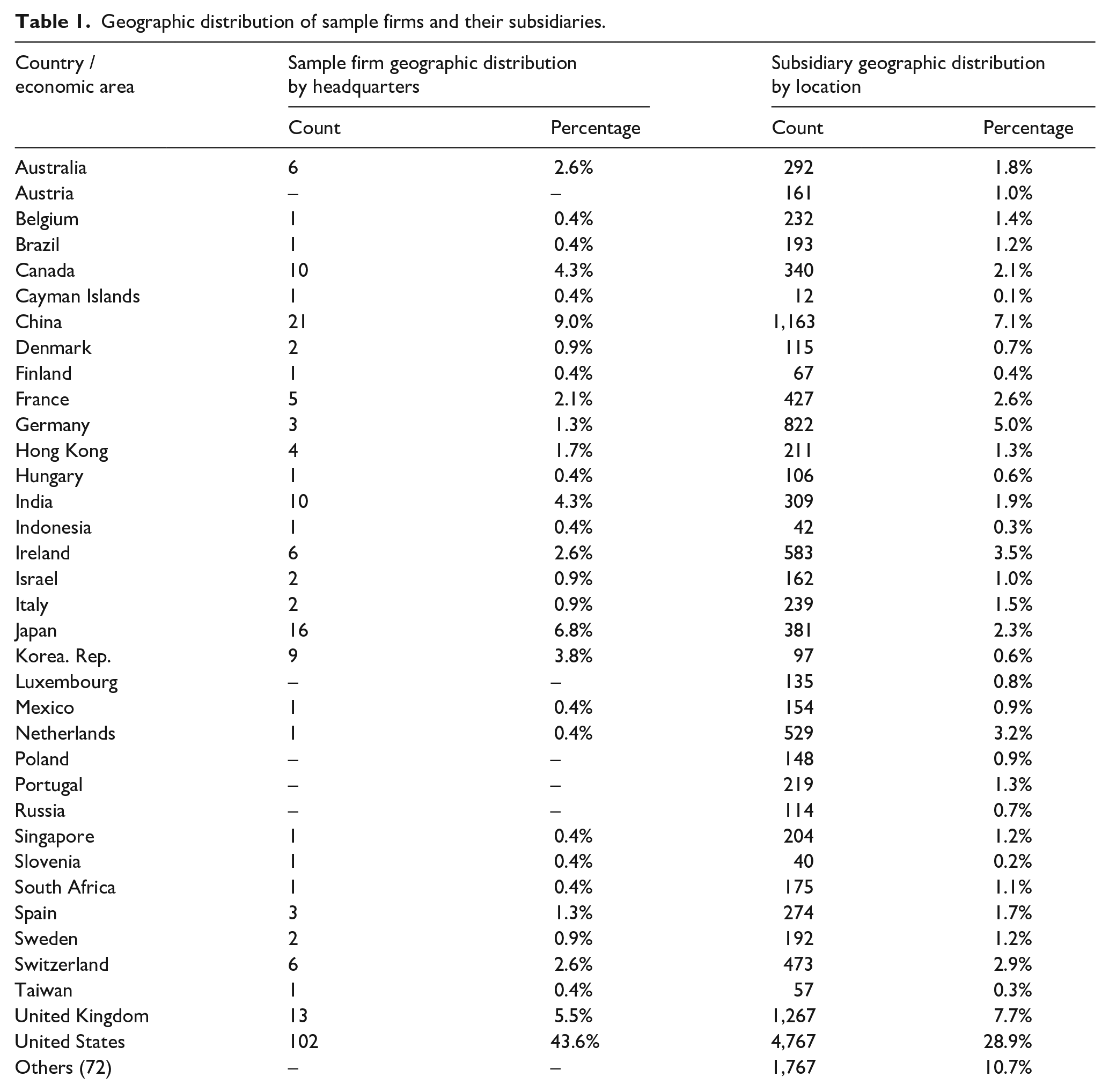
Our initial sample included all pharmaceutical firms with publicly available data on their internationalization and financial accounting details in the Thomson Reuters Eikon database. Thus, the original sample size was 1,875 firms. Due to our interest in multinational firms, we then discarded those firms that only operated in one country, resulting in the final sample size of 234 firms. To deal with the issue of sample selection bias, we performed tests to compare our sample (N = 234) to the total population (N = 1,875) in terms of average firm size, average profitability, and the distribution of firms across countries and regions. We did not find any statistically significant differences for average profitability and regional distribution between our sample and the population. The average firm size in our sample was higher than that of the full population of pharmaceutical firms because we only included MNEs in our sample and these tend to be larger than purely domestic firms. Our sample firms represent 89% of the total revenues of the full population of pharmaceutical firms available in Thomson Reuters Eikon. Table 1 shows our final sample and their subsidiaries distributed among countries, as follows. The sample includes firms from all five continents, although most are from North America (48.3%), followed by Asia (26.9%) and Europe (20.1%). The United States has the highest number of firms in our sample (102), amounting to 43.6% of the total. Other well-represented countries in the sample include the China with 21 firms and Japan with 16 firms. As noted in Table 1, the sample represents both developed and developing countries. When focusing on the 16,469 subsidiaries, we can observe that 73.2% of them are located in developed countries. Developed country MNEs in our sample have 12,051 subsidiaries in developed countries and 2,622 in developing countries, while developing / emerging country MNEs have 656 subsidiaries in developed countries and 1,140 in developing countries. This means that 17.9% of developed and 63.5% of developing country MNEs’ subsidiaries are located in emerging or developing markets. Overall, our sample firms have on average 64 subsidiaries in 11 countries.
Geographic distribution of sample firms and their subsidiaries.
Measures
Dependent variable
This study aims to explain the variable R&D intensity. Innovation can be measured in terms of input or output. Input measures include expenditure in R&D and the number of R&D full-time employees, while output measures range from patents to new products and processes (Filippetti et al., 2017). An input measure was chosen as it represents the efforts of a firm to innovate (Dziallas & Blind, 2019), as opposed to output measures, which quantify the success of the innovative efforts of a firm. The number of patents, for instance, has been criticized as a measure because not all inventions can be patented (Kafouros et al., 2008). As the sample consists of firms operating in the pharmaceutical industry, which are characterized by long development cycles and low success rates, the use of input measures better quantifies the innovative efforts. It is estimated that an average R&D project takes 10–15 years to complete and that only 1 out of every 5,000 projects is successful (Hong et al., 2016). We thus operationalized a firm’s R&D intensity as the ratio of total R&D expenses to total revenue (e.g., Sambharya & Lee, 2014), so as to be able to compare firms of different sizes in a non-biased manner (Tyagi et al., 2018). These investments “involve the commitment of financial resources in the short run on the expectation of future positive returns” (Golovko & Valentini, 2011, p. 366).
Independent and moderator variable
We have drawn data from 16,479 subsidiaries of the 234 MNEs in our sample to measure our first independent variable, internationalization toward developed countries. This variable reflects the extent to which MNEs have oriented their internationalization toward developed countries or less developed countries, and for that reason it is measured as the proportion of foreign subsidiaries in developed countries over total foreign subsidiaries. The data were collected from Bureau van Dijk’s Orbis database, and for each subsidiary, we recorded the country location and establishment date, which allowed us to create time-varying variable. We split the countries in which our sample firms have subsidiaries into two mutually exclusive groups (developed countries and less developed countries). To create this grouping, similar to previous studies (Yoo & Reimann, 2017), we followed the United Nations Conference on Trade and Development (UNCTAD; 2019) classification, which is based on a broad assessment of the respective countries’ economic conditions. We then computed the proportion of foreign subsidiaries in developed countries over total foreign subsidiaries.
To measure home country institutional development—the variable used as a moderator in our second hypothesis—we used the home country innovation profile, in line with previous studies (e.g., Berry et al., 2010). The data are taken from the Global Competitiveness Index of the World Economic Forum (WEF). We used the composite measure of the 12th pillar referring to countries’ innovative competitiveness (“Pillar 12: Innovation capability”). This pillar consists of six factors: “Diversity of workforce,” “State of clusters development,” “International co-inventions,” “Multi-stakeholder collaboration,” “Scientific publications,” and “Total number of patent family applications per million population.”
Control variables
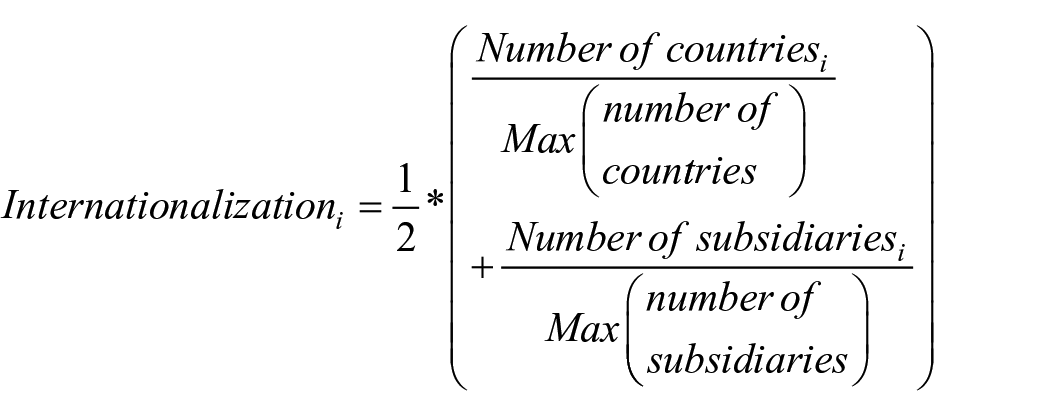
We used various firm-level control variables to take into consideration the effects of firm size, firm age, firm profitability, organizational slack, and firm ownership. First, studies have acknowledged that firm size impacts the level of innovation but disagrees on how (Xie & Li, 2018). We therefore controlled for firm size and measured it with the natural logarithm of the number of employees (Hitt et al., 1997). Second, firm age was measured as the number of years since the firm was established. Third, organizational slack, defined as the surplus capacity of a firm (Cyert & March, 1963), was proxied by the ratio of current assets to current liabilities. It might either encourage investments in long-term research projects or reduce the incentives to invest (Nohria & Gulati, 1997). Fourth, we included a variable for domestic ownership to account for any ownership effects on the level of R&D intensity. Domestic owners, compared with foreign owners, often have more knowledge about their investees and stronger interests in long-term growth (David et al., 2006), which means they may be more likely to encourage R&D investments for their investee firms. The variable was measured as the percentage of total outstanding shares held by investors in the firm’s home country. Fifth, to account for the positive effect that profitability may have on firm’s R&D intensity, we added return on assets (ROA) as a control variable in our analyses. Finally, we included the firms’ overall level of internationalization as a control variable. Our independent variable measures the distribution of international operations between developed and developing countries and does not take into account the total extent of international operations. In this way, we attempted to single out the effect of overall level of internationalization to focus purely on the effect that internationalization toward developed countries (versus developing) might have on our dependent variable. In other words, two firms may have the same percentage of their international operations in developed countries, but their overall levels of international operations may be very different. We measured internationalization with the internationalization index developed by Pisani et al. (2020)
Analysis
All statistical analyses were carried out using version 16 of Stata statistical package (StataCorp, 2019). By having a panel data set, we first needed to select the appropriate estimation technique for our model. Given a panel data, we can define several models derived from the most general linear representation (Baum, 2006)

where N is the number of individuals and T is the number of periods.
On the other hand, Baum (2006) points out that for a given observation, an intercept varying over units results in the following structure

where
Due to the conditions under which the models were estimated (presence of heteroskedasticity and cross-sectional dependence), we used the xtscc command (Hoechle, 2007) that produces Driscoll and Kraay (1998) standard errors for coefficients estimated by fixed-effects (within) regression. Driscoll and Kraay (1998) propose a nonparametric covariance matrix estimator that produces heteroskedasticity and autocorrelation consistent standard errors that are robust to general form of spatial and temporal dependence.
Data analysis and results
The descriptive statistics and correlations among the variables included in this study are presented in Table 2. On average the R&D intensity ratio, defined as the expenditures by a firm on its research and development activities divided by the firm’s sales, amounted to 7.24%. However, the standard deviation of this variable was 58.563, indicating a high dispersion of its values among the companies in the sample. The correlation between R&D intensity and organizational slack was statistically significant. This is consistent with previous research that has highlighted that organizational slack is one of the potential sources for funding R&D activities (W.-R. Chen & Miller, 2007; Herold et al., 2006). It is also interesting to note that our results showed a significant and negative correlation between R&D intensity and firm profitability, measured with ROA. Previous investigations (Huang & Liu, 2005) have shown that a non-linear relationship can exist between these two variables.
Descriptive statistics and correlations.
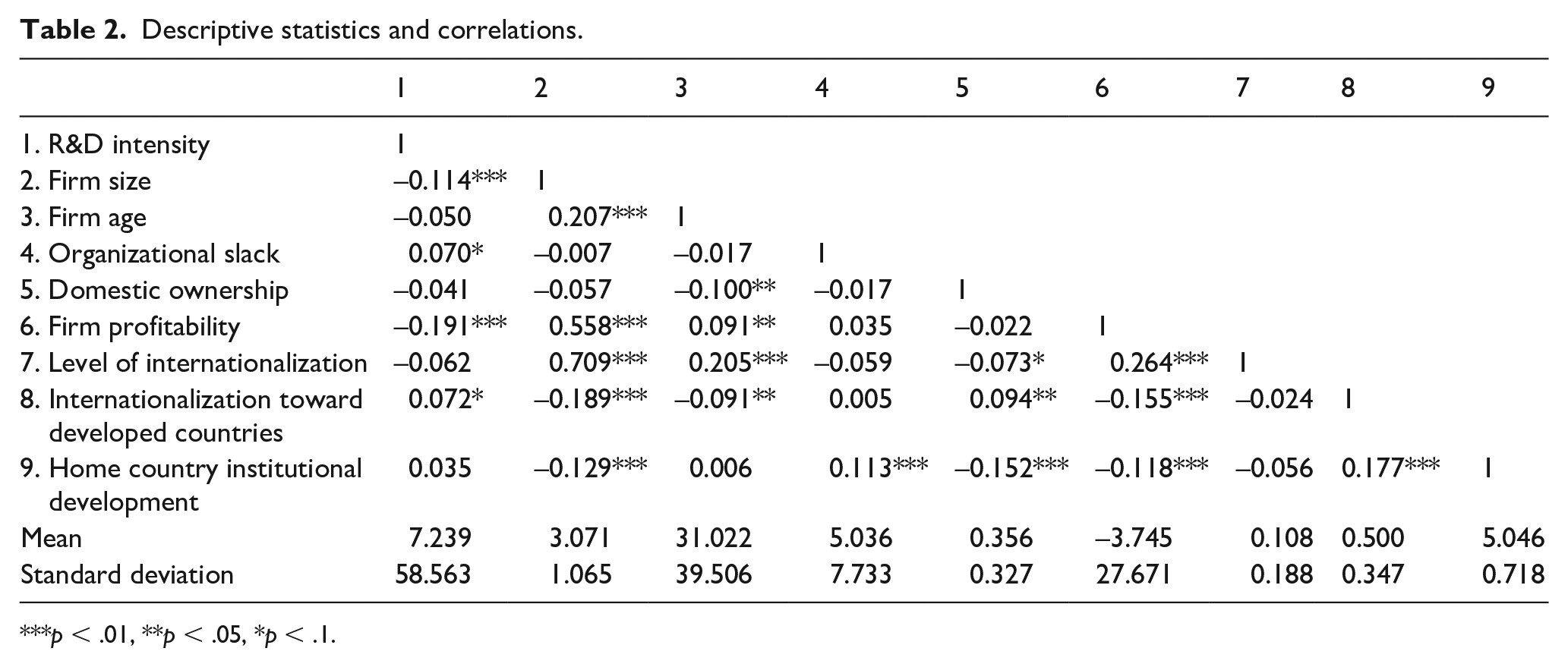
p < .01, **p < .05, *p < .1.
As previously indicated, we tested the hypotheses using regression models that were estimated with the xtscc command (Hoechle, 2007), available in Stata, and using a fixed-effects model. In Table 3, we present the results obtained after estimating the three models. The first model (Model I) included only the control variables. Firm size (β = 39.69, p < .1) had a positive significant effect on the R&D intensity of MNEs, while firm age (β = −1.203, p < .05) and domestic ownership (β = −26.75, p < .1) both exhibited negative significant effects on the dependent variable (in the case of domestic ownership statistically significant at the 10% level). This indicates that larger and younger MNEs and MNEs with higher levels of foreign ownership are more innovative. Organizational slack, profitability, and the level of internationalization did not affect R&D intensity in our analysis. Considering the focus of this article on the level of development of the host countries in which MNEs are internationalizing, it is especially interesting to note that the level of internationalization is not significant in the empirical context of this study.
Regression results.
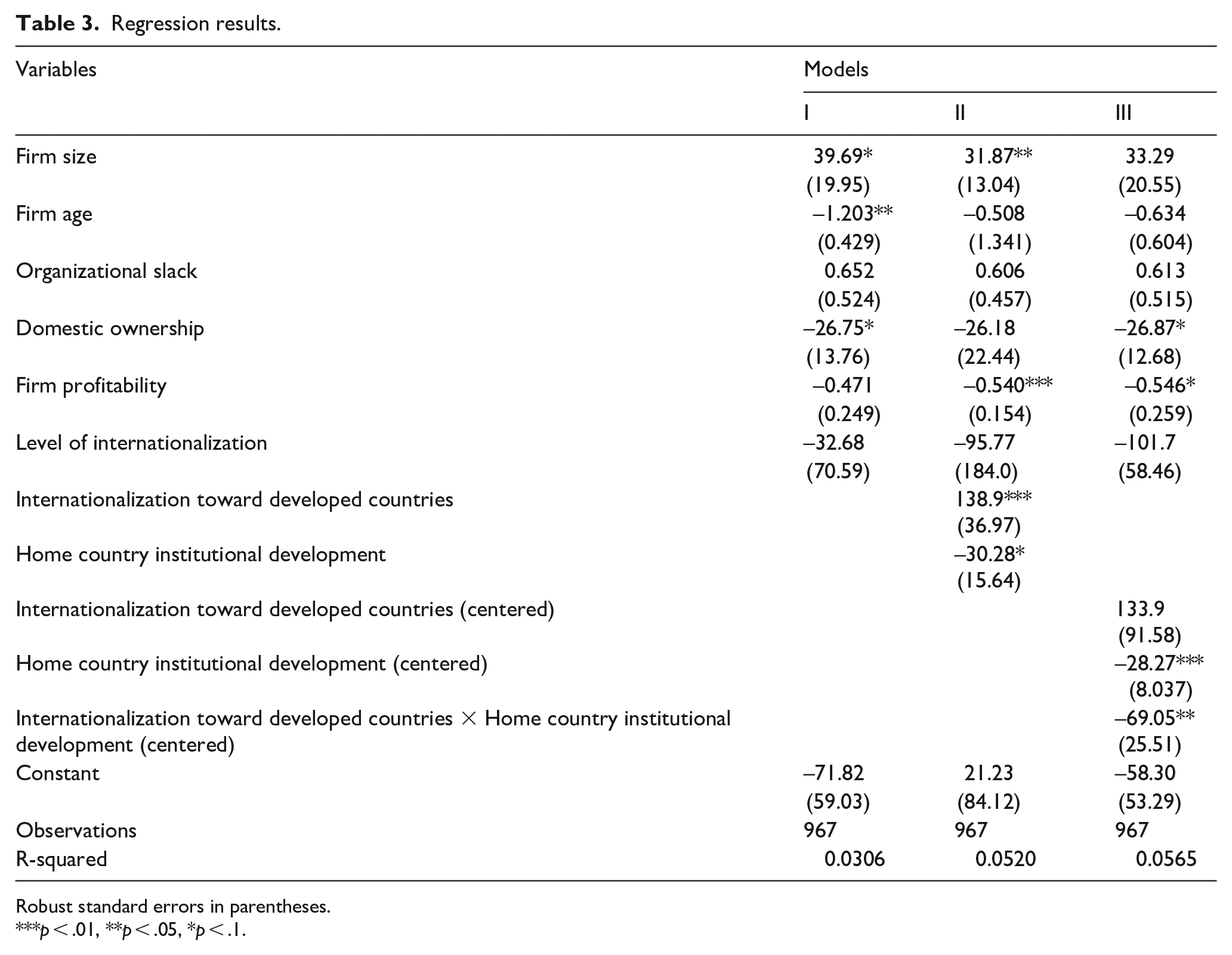
Robust standard errors in parentheses.
p < .01, **p < .05, *p < .1.
Our second model (Model II) allowed us to test Hypothesis 1. For this purpose, we started from Model I to which we incorporated the variables that measure internationalization toward developed countries and home country institutional development. Our results indicated that while the estimated coefficient for the variable related to internationalization toward developed countries is positive and statistically significant (β= 138.9, p < .01), the coefficient for home country institutional development reached a statistical significance at the 10% level. Thus, the results confirmed Hypothesis 1, that is, that MNEs with a higher internationalization toward developed countries exhibited higher R&D intensity.
In the third model (Model III), we performed a moderated regression by adding a multiplicative term calculated from the variables incorporated in Model II. On this occasion, we followed the recommendations of Aiken and West (1991), and variables in the moderated regression were centered by subtracting their mean value. While centering the variables before constructing the interaction term might not help to alleviate possible multicollinearity problems (e.g., Echambadi & Hess, 2007), mean centering does not affect the detection of interaction and is a strategy that can help interpret estimated coefficients (Darlington & Hayes, 2017; Shieh, 2011). After estimating this model, we calculated the variance inflation factor (VIF) values obtaining a maximum value of 1.48 which shows that there were no multicollinearity problems despite the incorporation of the multiplicative term in the third model. In this way, Model III was linked to Hypothesis 2 where internationalization toward developed countries is the core independent variable and home country institutional development acts as the moderating variable. Since the variables considered in the interaction term were centered, their estimated coefficients in Model III indicate the impact of these variables on R&D intensity for the mean of the other variable (Darlington & Hayes, 2017). On the other hand, the coefficient calculated for the centered interaction term was negative and statistically significant (β = −69.05, p < .05). To obtain a clearer view of the nature of the interaction, we plotted the interaction terms obtaining the representation shown in Figure 1 (representation is based on centered data). First, the figure shows that, overall, as the MNEs’ internationalization toward developed countries increases, so too does their R&D intensity, in line with that predicted in Hypothesis 1. Second, home country institutional development has a clear moderating effect on the relationship, as seen when comparing the fitted lines for high, medium, and low home country institutional development. MNEs with low home country institutional development show higher levels of R&D intensity as their internationalization toward developed countries increases than MNEs from highly institutionally developed countries. Thus, Hypothesis 2 was confirmed.
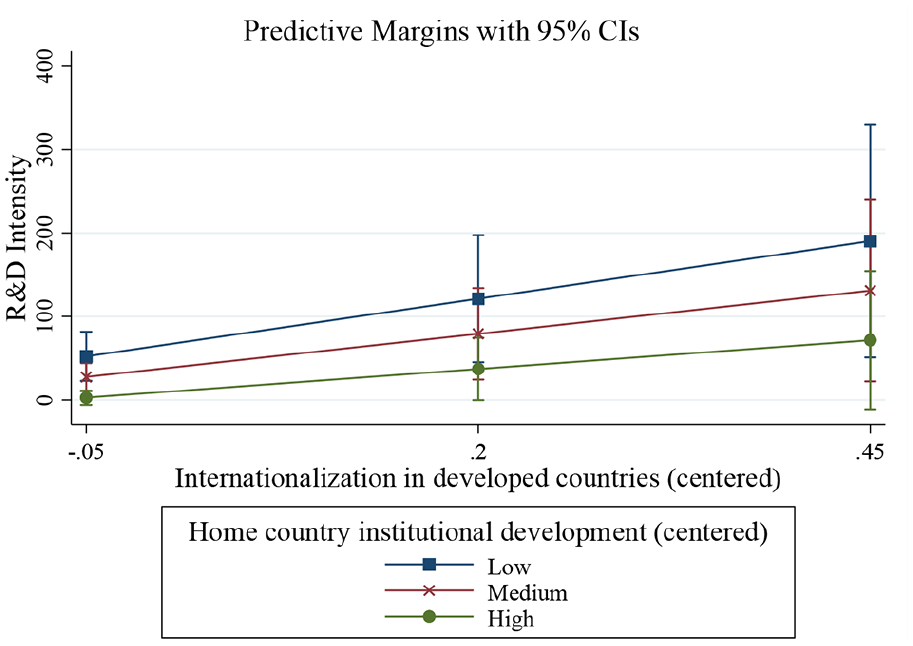
Adjusted means plot for the moderating effect with 95% confidence interval (based on centered data).
Robustness checks
To test the robustness of our models, we followed recommendations of Neumayer and Plümper (2017) and applied a sensitivity analysis to the explanatory variables. To implement this analysis, we used checkrob module (Barslund, 2007) that estimates a set of regressions where the dependent variable is regressed on core variables (which are included in all regressions), and all possible combinations of other “non-core” or secondary variables. This test was carried out both for Model II, which allowed us to test the first hypothesis, and for Model III, linked to the second one. In the case of Model II, as the core variables we selected internationalization toward developed countries and home country institutional development. The rest of the variables were considered “non-core,” except level of internationalization, which is a control variable that is considered in all regressions. For Model III, the variable of interest is the interaction term, so in addition to the two above, the multiplicative term between the previous core variables is included (these variables were centered prior to the calculation of the interaction term). In this case, all other independent variables were considered secondary.
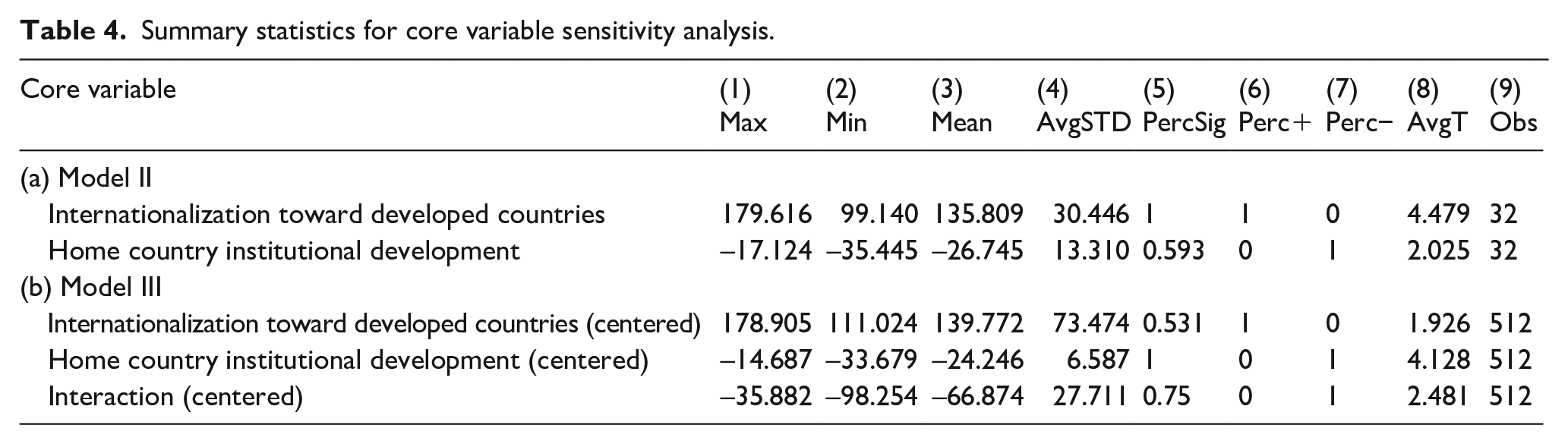
These analyses allowed us to investigate how the results are affected when one or more of the variables that are identified as potential determinants of R&D intensity are omitted. In other words, this approach allowed us to test whether our results on the relationship between R&D intensity and our core variables are robust to changes in the model specification. Tables 4 and 5 present the results obtained after the sensitivity analysis, both for the core variables (Table 4) and for secondary variables (Table 5). The first three columns show the maximum, minimum, and average of the point estimate over all possible regressions performed. Column (4) shows the average standard deviation of the point estimates. Columns (5)–(7) contain the main results from the analysis. They reflect, respectively, the share of regressions where the point estimate is significant at the 5% level, the share with a positive point estimate (not necessarily significant), and finally the share of regressions with a negative point estimate. Column (8) gives the average t-value over all regressions, and Column (9) reports the total number of estimated models.
Summary statistics for core variable sensitivity analysis.
Summary statistics for secondary variable sensitivity analysis.
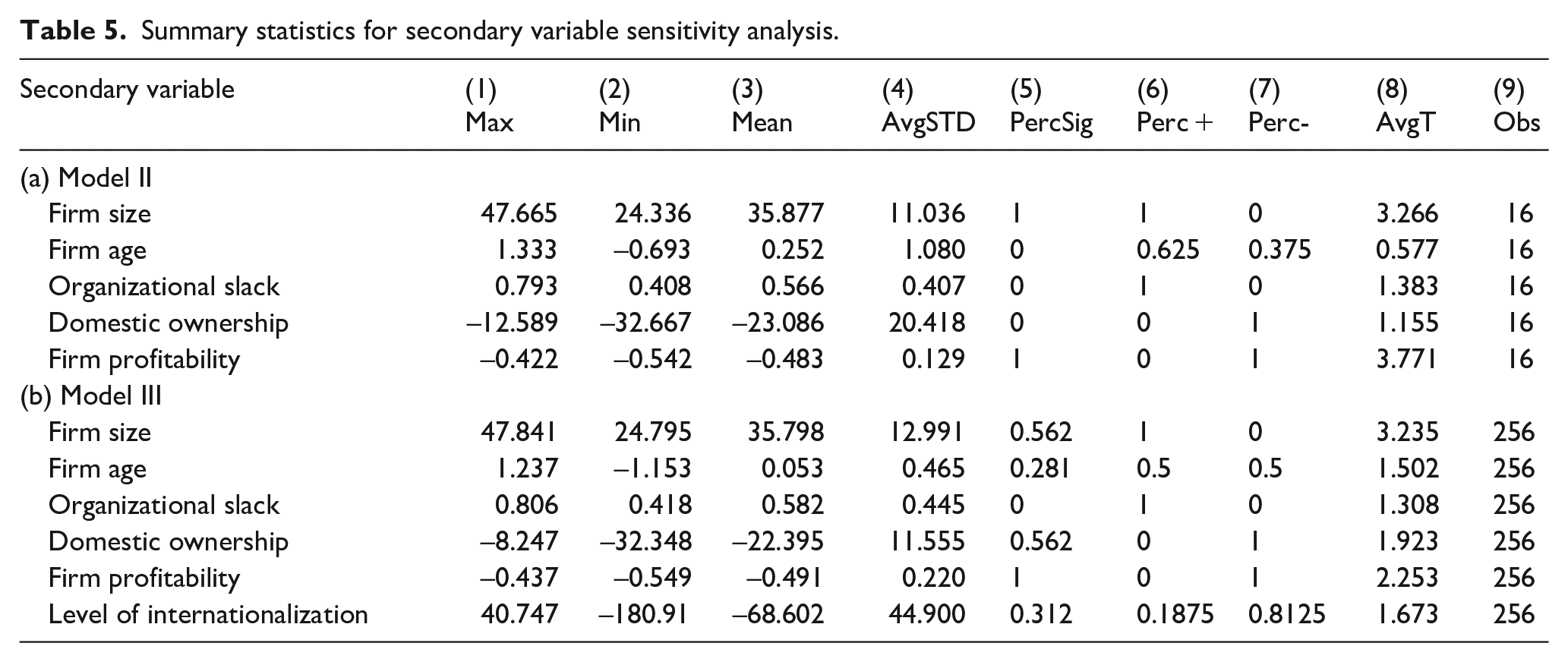
The data in Table 4 show that the core variables were remarkably robust in both of the analyzed models: none of the variables showed sign changes in any combination with the secondary variables. Focusing on Model II, the variable for home country institutional development was significant at the 5% level in 59.3% of cases, while the internationalization toward developed countries variable, linked to the first hypothesis, reached this statistical significance in 100% of the cases, and was on average significant at the 1% level (AvgT = 4.479). Regarding the secondary variables, we found mixed results. As seen in Table 5, except in the case of the age variable, these variables did not show sign changes either. Firm profitability and firm size were always significant at the 5% level, while firm age, organizational slack, and domestic ownership did not reach statistical significance for any of the possible combinations of secondary variables analyzed. Taken together, our analyses indicated that Model II is robust.
Regarding Model III, the interaction term is the most relevant core variable for testing the second hypothesis. In this case, the multiplicative term was statistically significant at the 5% level in 75% of the cases analyzed; and no change in sign was detected regardless of the combination of secondary variables considered. This result again confirms that Model III is robust in testing and confirming the second hypothesis.
Discussion
Innovation has been recognized as one of the key aspects of MNEs to respond to opportunities and challenges they face at home and in host countries (e.g., Govindarajan & Ramamurti, 2011). This article answers to the question of how MNEs’ domestic and foreign institutional environments influence their R&D intensity, by integrating the institutional development of home and host countries as a possible R&D intensity driver.
Our results show that MNEs with higher internationalization toward developed countries exhibit higher levels of R&D intensity. Our research complements prior research by incorporating the institutional development of foreign countries in which firms are embedded, as a consequence of their internationalization processes. Previous research has shown, on one hand, that firms that engage in international activities gain access to technological and market information in international markets and can use this new knowledge to facilitate innovation (e.g., Hitt et al., 2006; Salomon & Shaver, 2005; Santos et al., 2004). MNEs increasingly carry out their R&D activities outside of the home country, as this allows them to gain access to knowledge that would often not be available to firms operating only in their domestic markets (Almeida & Kogut, 1999; Bartlett & Ghoshal, 1989; Nachum & Zaheer, 2005). On the other hand, previous literature has noted that internationalization helps firms increase their sales and thereby incentivizes firms to innovate in the hopes of gaining profit (e.g., Golovko & Valentini, 2011; Tsao & Lien, 2013). Our study, in the context of pharmaceutical MNEs, adds new evidence to prior work by emphasizing that the level of institutional development of the host countries determines the greater or lesser effect that the internationalization of the MNEs has on their R&D intensity. In fact, our results show that the firms’ level of internationalization alone does not impact their R&D intensity; however, when the location of international activities is considered, results are significant and point to the fact that having higher internationalization toward developed countries has a positive effect on firms’ R&D intensity.
In addition, our results show that MNEs from institutionally weak countries increase their level of R&D intensity when they expand to developed countries to a higher extent than MNEs from institutionally developed countries. Increasing their R&D investments helps these MNEs from less developed countries dissociate themselves from the institutional voids of their home countries. On the other hand, since our analysis is based on MNEs from both developed and less developed countries, we complement previous studies that have been primarily conducted with samples of Chinese, Indian, and Latin American firms. These previous studies have highlighted that institutional voids drive firms from less developed countries to expand into more developed countries to benefit from their institutional advantages and technological knowledge (Li et al., 2010; Piperopoulos et al., 2018; Witt & Lewin, 2007; Wu, 2013; Wu et al., 2016; Yoo & Reimann, 2017). However, our findings add to these studies by providing empirical evidence from 234 firms from 30 countries in four continents.
Overall, our findings have some important implications for researchers and practitioners. First, while the international business literature has recognized home country institutional development and internationalization as antecedents of innovation, few studies have integrated both aspects (see the meta-analysis of Hitt et al., 2006). Notable exceptions include the studies of Chittoor et al. (2015), Xie and Li (2018), and Wu et al. (2016) who analyzed the internationalization of firms from a single country (China or India). We offer an adequate approach to the study of firm-level innovation because our analysis of MNEs from 30 developed and less developed countries allows for greater generalizability of the findings. Furthermore, we explore the effects that a higher internationalization toward developed countries can have on the level of R&D intensity and analyze to what extent the level of institutional development in the home country may moderate this relationship. Our work contributes to the existing literature on internationalization and innovation by highlighting the importance of considering the characteristics of all countries in which MNEs operate as determinants of their R&D intensity. In this way, our findings support the idea that MNEs are not “first and foremost, creatures of their home countries” (Stopford, 1998, p. 13) and, thus, do not make decisions based purely on the characteristics of the home country (Perlmutter, 1969; Vernon, 1979). Acknowledging that MNEs’ R&D intensity reflects characteristics of all countries in which they operate supports the importance of considering the “home base” as opposed to the “home country” (N. Zhou & Guillén, 2015) as a determinant of firm-level innovation.
Second, this study adds new findings to existing research on how operating in more developed countries can help developing and emerging country MNEs align with global markets and expectations (Kostova et al., 2008). Extensive recent literature has studied MNEs from less developed countries and has focused principally on how they can escape home country institutional voids and use internationalization to access more efficient foreign countries (e.g., Cuervo-Cazurra & Ramamurti, 2017; Thakur-Wernz & Samant, 2019). Although the internationalization of emerging market firms has stimulated a great deal of attention recently, “there is still paucity of research on the phenomenon of R&D-driven internationalization” (Purkayastha et al., 2018, p. 104). Our findings extend previous literature and fill this gap by showing that MNEs from less institutionally developed countries are more flexible and adapt better to different political systems and conditions of foreign countries and recognize more easily new opportunities (Luo & Rui, 2009). When they expand their international operations in developed countries, MNEs from less institutionally developed countries have the perception that they operate in a more efficient and transparent institutional environment where they can generate new knowledge and improve their competitive advantages (Witt & Lewin, 2007; Wu & Wu, 2014). This is an important contribution to our understanding of how the home country can influence the relationship between internationalization and R&D intensity.
Third, this research responds to the requests of recent research for a focus on R&D-intensive industries in the study of innovation (e.g., Chittoor et al., 2015). Our longitudinal analysis of 234 MNEs in the pharmaceutical industry offers an interesting context because this industry has undergone a process of intense transformation. The pharmaceutical sector is growing at a much faster pace in less developed countries, such as China and India, than in developed countries (Rezaie et al., 2012), and it is therefore of interest to test whether the growing number of MNEs from less developed countries matches the R&D investments of their developed country rivals. After all, staying innovative is vital to achieving and maintaining a competitive advantage, in both the domestic and the global arena (Porter, 1990).
Despite its contributions, this study has a number of limitations. First, the average firm size in our sample was large; thus, our conclusions should be carefully extrapolated to small and medium-sized firms (SMEs). Due to limitations in the availability of data (i.e., as our sample consists of large MNEs that publish their financial information), it was not possible to include smaller firms. It could be interesting to re-estimate the results with a sample including SMEs. Second, our study analyzes R&D intensity; however, it would be also valuable for future research to extend the investigation to innovation performance which could in turn lead to a deeper understanding of the internationalization–innovation relationship. Despite this limitation, we take a significant step toward better understanding the internationalization–innovation relationship by studying the role of institutional development in the home and host countries in which MNEs are embedded as drivers of MNEs’ R&D intensity. Third, our variable for internationalization toward developed countries is measured using subsidiary data only and does not consider other aspects of firms’ international operations, such as revenue. Neither Thomson Reuters Eikon nor Bureau Van Dijk’s Orbis provide a country-level breakdown of revenue. The geographic breakdowns of revenue that are available in Thomson Reuters Eikon are heterogeneous among different firms as they are based on how each firm reports their revenue (e.g., one firm may split their revenue in four regions, while another might provide details only for domestic and international revenue). For this reason, we were not able to compute the proportion of sales in developed countries over total sales. Fourth, our study was conducted in the context of the pharmaceutical industry, a global strategic sector with the highest R&D-intensity. We acknowledge that although studying a single industry has its advantages when it comes to controlling for industry effects, the results might not be applicable to other contexts. Thus, it would be interesting for future studies to apply the theoretical framework developed in this study to other highly research-intensive industries to confirm and generalize the findings.
For practitioners, this study shows that the managers of MNEs could consider internationalization activities to acquire new knowledge from the international markets and improve their products and processes based on such information. Our empirical findings offer a route for pharmaceutical MNEs to guide their internationalization strategy. Our results show that MNEs with more international operations in developed countries exhibit higher R&D intensity, which we believe is motivated by enhanced access to new, diverse sources of knowledge and increased global collaboration between innovation networks to jointly develop and exploit new knowledge and technologies. On the other hand, the need to respond to specific institutional characteristics of host countries can also help explain why the international activities of MNEs from less developed countries have “spillover” effects in their home countries and other less developed countries in which they operate. Through pro-innovation policies, governments could enhance the attractiveness of less developed countries in the worldwide R&D market to attract more foreign investments in R&D.
Footnotes
Declaration of conflicting interests
The author(s) declared no potential conflicts of interest with respect to the research, authorship, and/or publication of this article.
Funding
The author(s) disclosed receipt of the following financial support for the research, authorship, and/or publication of this article: This research has been partially funded by the research grants ECO2016-75909-P (Spanish Ministry of Science, Education, and Universities), ECO2017-88222-P and PID2019-106725GB-I00 / SRA (Spanish Research Agency / 10.13039/501100011033).
