




Abstract
For decades, entrepreneurship and strategy research has been dominated by agent-centric and inward-looking theoretical perspectives. The ongoing COVID-19 pandemic demonstrates the limits of this stance, as its influence on business has been both enormous and palpable. For the most part, the effects of the pandemic are no doubt negative. Business research—and presumably business practice—typically address such influence in terms of failure, resilience, and crisis management among existing businesses. Contrasting this prevalent discourse, we focus instead on positive influence of the pandemic for some emerging and new ventures. We analyze the many possible positive effects on entrepreneurship practice and highlight also positive effects on entrepreneurship research. We illustrate both positives by applying the External Enabler framework.
Introduction
For decades, entrepreneurship and strategy research has been dominated by agent-centric and inward-looking theoretical perspectives (Davidsson, 2020). When they are considered at all, environmental and contextual factors are usually treated as a matter of moderating the fundamental causal force exerted by economic agents (including their actions, resources, capabilities, and other characteristics). The ongoing COVID-19 pandemic demonstrates the limits of this stance. The COVID-19 crisis produces profound and impactful environmental changes through direct health effects, geospatial restrictions (e.g., air travel), political measures (e.g., new legislations), and sociocultural changes (e.g., counter-movements and protests). The crisis’ influence on business has been both enormous and palpable.
The effects of the pandemic are no doubt mostly negative. In many cases, they may be devastating. Business research—and presumably business practice—typically address such influence in terms of failure, resilience, and crisis management among existing businesses (Buchanan & Denyer, 2013; Doern et al., 2019; Korber & McNaughton, 2018; Williams et al., 2017). Titles from a collection of commentaries on COVID-19 in the Journal of Management Studies exemplify the focus and language (e.g., “Covid 19 and our understanding of risk, emergencies, and crises” and “‘15 Days to slow the spread’: Covid-19 and collective resilience”).
Contrasting this prevalent academic discourse, in this essay, we focus on the possibility of positive influence of the pandemic among emerging and new ventures. We analyze the many ways in which some types of entrepreneurial initiative benefit from this externally imposed crisis, that is, the enabling effects on entrepreneurship practice. We also emphasize the pandemic as an opportunity for awakening and redirecting entrepreneurship scholarship (and related fields) to make more room for external forces in core theories, that is, positive, enabling effects on entrepreneurship research. We illustrate both positives by applying the External Enabler (EE) framework (Davidsson et al., 2020). This framework provides structure and terminology for analyzing the enabling effects of different types of external change for entrepreneurial initiatives, such as technological breakthroughs, regulatory reforms, macroeconomic shifts, demographic and sociocultural trends, and changes to the natural environment. While not developed specifically for COVID-19, we now find ourselves amazed at the applicability of our theoretical ideas to think differently about the present pandemic.
At least five factors make the COVID-19 pandemic a suitable context for these purposes. First, it marks a salient occurrence of a “disequilibrating environmental change” of sufficient magnitude to make the theoretical potential of and practitioner attention to external forces hard to ignore. Second, it illustrates that external changes that are undoubtedly negative for society and the economy overall may still be beneficial for some types of business, such as providers of virtual collaboration tools that can facilitate social relationships and the continuation of work despite lockdowns. Third, the COVID-19 pandemic illustrates that enablement can occur in unintended, non-obvious, and multi-facetted forms. Fourth, the varying timing and severity of the pandemic and the countermeasures across the world illustrate types of variance that are important to consider when analyzing the enabling potential of any type of environmental change. Fifth, the COVID-19 crisis illustrates the logical and temporal interplay between several different sources of enablement. The pandemic is not a single event but rather a sequence of enabling elements, such as the health crisis itself, the policy responses implemented or lifted in response, depending on the levels of infections and spread, new technologies such as those developed for contact tracing (e.g., Trang et al., 2020), crowd monitoring (e.g., Adam et al., 2020), or contagion control (e.g., Urbaczweski & Lee, 2020), and emerging sociocultural changes that come in its wake both in positive (e.g., resilient communities, citizen aid for the elderly) and negative fashion (e.g., anti-Coronavirus demonstrations, violence, and protest).
The EE concept and framework
The term External Enabler was introduced by Davidsson (2015) to describe any type of aggregate, external, agent-independent, disequilibrating circumstance that could be of benefit to some new business ventures. The purpose was to provide a more workable way of incorporating such factors compared to the (rightfully, in our opinion) contested concept of “objective opportunities” in the “discovery view” of new venture creation (cf. Korsgaard, 2013; Shane & Venkataraman, 2000). This origin explains the focus on enablement: a concrete change attracts initiatives that can benefit from it but should not trigger venture creation efforts for which that change is detrimental. EEs are thus concrete and tangible and can be observed and sometimes predicted; they are not abstract and elusive market imperfections that are visible as opportunities only in hindsight (Berglund et al., 2020; Dimov, 2011).
Davidsson et al. (2020) developed the EE notion into a framework providing details on strategically important variance across instances of environmental change and the specific ways in which they can benefit individual ventures. Doing so, they narrowed the immediate focus to instances of distinct disequilibrating changes to the business environment. A main reason for this choice was the relatively safe theoretical assumption that the disequilibrating effect of environmental change is temporarily favorable for some business activities, thereby justifying the EE label. Importantly, no change is an EE in general. The EE terminology and analysis focus on those cases that are (potentially) enabled; the same change may have negative impact on other existing and not-yet-existing businesses. Analysis of such disablement requires other vantage points. Moreover, to qualify as an EE, the environmental change has to provide the potential to enable efforts of multiple ventures, whether that potential is realized or not. Idiosyncratic circumstances favoring a single agent or venture are not included in the EE concept.
Several works in leading journals apply the EE concept (e.g., Bennett, 2019, 2021 ; Browder et al., 2019; Chalmers et al., 2021; Frederiks et al., 2019; Leten et al., 2016; McAdam et al., 2020; Nambisan, 2017; Obschonka & Audretsch, 2019; von Briel et al., 2018). Most recently, the Journal of Business Venturing published an elaborate application of the framework to high-speed rail infrastructure development in China (Chen et al., 2020).
We briefly outline the framework below, starting with the graphical depiction in Figure 1. The top and bottom panels of the figure acknowledge the importance of agents and context (beyond the focal EEs). These areas are already comparatively well researched and theorized. Therefore, the EE framework puts the main focus on deepening insight into the relatively less developed, gray-shaded area of the figure, namely characteristics of the EEs themselves along with mechanisms and roles pertaining to their effects in individual cases. The idea is that existing theory about agents and contexts can be used in combination with these EE notions.
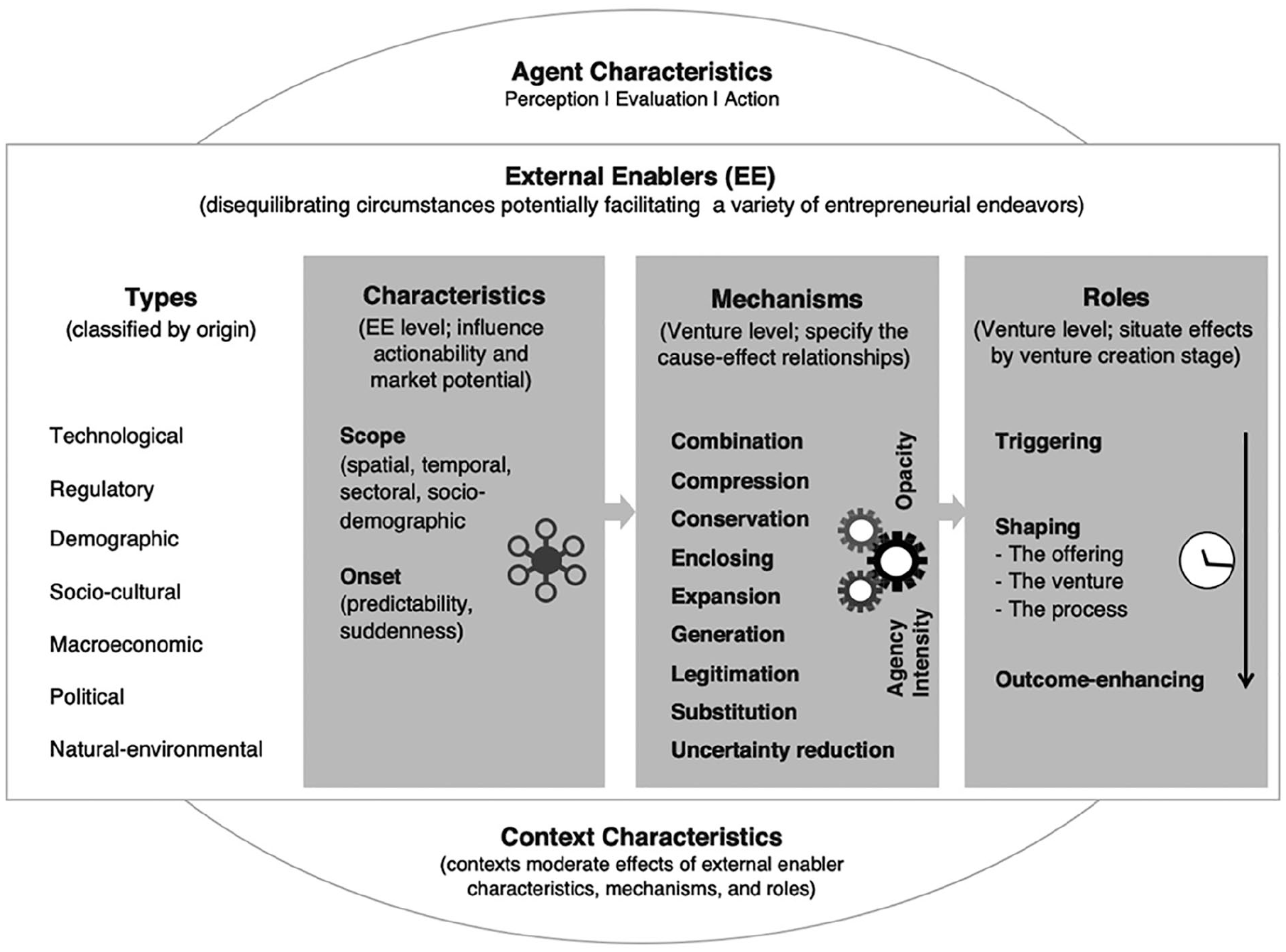
The External Enabler Framework (adapted from Davidsson et al., 2020).
The leftmost column recognizes a range of different types of EE. Due to observed limitations of otherwise excellent prior work focusing on particular types and instances (e.g., Eberhart et al., 2017; Hiatt et al., 2009), the EE framework avoids making EE type a main divider and instead invites theorizing and empirical investigation across types and instances, including combinations of several EEs.
Characteristics of the COVID-19 pandemic as EE
EEs vary in scope along four dimensions: spatial, sectoral, socio-demographic, and temporal. The scope of the pandemic is arguably very high on the first three of these dimensions when compared to most other environmental changes. Most countries, industries, and people around the globe are affected in some way, and often quite considerably. Conversely, both the health effects and the policy restrictions have been of limited temporal scope. For example, we have witnessed a first wave of the virus in the Western world, around March to June 2020, which has seen a temporary installment of a variety of governmental lockdown measures and their gradual release. Since September 2020, we are now witnessing what is referred to as a second pandemic wave in the Western world, with a variety of old and new policy measures being implemented (and hopefully released in due time) as we write.
Although the impact is generally high, there is considerable variance in sociodemographic and sectoral scope. The health crisis in early 2020 affected primarily the elderly, not younger demographics (Stafford, 2020). This being said, effects of lockdowns on work and education have hit the latter the hardest. The negative economic impact has been noticeable particularly in manufacturing sectors (because of global supply chain disruptions), and the hospitality and entertainment sector (because of public attendance restrictions). By contrast, e-commerce businesses and providers of online services in general have thrived. For example, Shopify, an e-commerce solution provider, has nearly doubled its revenue (Kawai, 2020), and Zoom, a video conferencing service provider, has quadrupled its revenue resulting from a surge in demand of their solution (Chapman, 2020).
However, the enabling scope reaches well beyond online shopping and services. For example, boosts in demand have been noted for product categories as diverse as toilet paper and hand sanitizer; a vast range of products for the health care sector as well as online collaboration software and services; home delivery services; mobile games; cleaning robots; bidets; home office equipment; dog training; bicycles; home gym equipment; sex toys; funeral video services; camping and outdoor equipment; and many more. Not to mention massive demand for a vaccine as well as vitamin and mineral supplements that might help to boost the immune system until the vaccine arrives.
Variance in scope implies variance in strategic potential as well as in what type of economic agent is likely to perceive and act on the new possibilities. This situation provides input to theoretical development and reason for empirical investigation. For example, one might speculate that the greater the scope along one dimension (especially spatial scope), the more likely are large, incumbent firms to take an interest, thereby possibly deterring success chances for independent start-ups as go-it-alone ventures (while conceivably enhancing their chances as attractive acquisition targets). However, when scope is large also along sectoral and socio-demographic scope dimensions—as in the case of COVID-19—there may be room for many new initiatives across product categories and tailored to different socio-demographic groups and geographical places. This would indicate fertile ground for a myriad of new and small, independent ventures, especially as limited temporal scope may suit better for small and nimble agents and reduce the perceived attractiveness for large corporations.
The impact of COVID-19 varies across countries. Non-pharmaceutical interventions have varied greatly in timing, measure, reach, and severity (Flaxman et al., 2020). This makes the pandemic a veritable, natural laboratory for studying effects of varying scope as well as interactions between variance in EEs and in the cultural, economic, and institutional contexts that various countries (and states within federations) represent.
To use an obvious example, the extent of enablement of selling facemasks as a fashion item would be greatly affected by the extent of community spread of the virus but probably even more by the extent to which their use be recommended or mandated by authorities (Flaxman et al., 2020). It would also be moderated by the extent of prior cultural adoption among the general public of face masks for protection against other environmental risks (e.g., as in parts of Asia; see Burgess & Horii, 2012). As another example, while in Australia, the demand for camping and outdoor equipment has surged due to border closures, countries in the Northern hemisphere with less favorable weather conditions did not experience a similar surge of demand for outdoor hospitality services.
A second EE characteristic discussed in the EE framework is onset. Some changes happen fast (and are often labeled “external shocks” or “environmental jolts” in the literature; e.g., Bradley, 2015) whereas others, such as demographic shifts, are more gradual (e.g., Kohlbacher et al., 2015). The EE framework makes room for both. Further, some changes are completely unpredictable whereas others come as less of a surprise. These two dimensions of suddenness and predictability may often be correlated but they are not inseparable. Chen et al. (2020) provide an interesting illustration: high-speed rail services from a specific location can start in full scale on a particular day (sudden) but this can be known far in advance (predictable). Interestingly, they found no announcement effect, that is, no effect on start-up activity until traffic actually started.
Due to its staged spread across the world over time, the COVID-19 pandemic—tragic as it is in terms of effects on lives and livelihoods—again provides an interesting research laboratory. Although experts were aware of the risks of a pandemic, the “when” and “where” as well as many specifics were unknown even to them before COVID-19 occurred. Therefore, predictability was much higher in countries that were affected at a later time than in those that were hit early. Likewise, that liberal democracies would impose unprecedented lockdown measures was initially unknown but later a near certainty (Sebhatu et al., 2020). Furthermore, precisely what kind of products and services would benefit from various types of supply- or demand-side enablement was something that entrepreneurs would have to work out for themselves in the early onset countries whereas those in late onset countries could see and learn from the earlier examples (cf. the notion of opacity below).
There is thus reason to expect differences across countries in the entrepreneurial responses to the pandemic. For example, these might manifest as different lead times between initial onset and action and different types of agents implementing entrepreneurial responses to the crisis and the countermeasures. This said, Chen et al.’s (2020) observation of absence of announcement effect may mean that such early- versus late-country differences are small or non-existent, indicating that our world is not as full of entrepreneurially alert individuals as we might sometimes think (or as some theories assume).
Enabling mechanisms and roles derived by entrepreneurs from COVID-19
Mechanisms represent favorable cause–effect relationships derived from EEs on the venture level. If an EE has the capacity for a particular mechanism, some but not all ventures can potentially benefit from it. Conversely, while an EE can provide different mechanisms for different ventures, no venture can derive from it a mechanism that it is not inherently able to provide. Thus, enabling mechanisms depend on features of the EE as well as those of the venture.
Davidsson et al. (2020) specify six supply-side mechanisms (compression [saving time], conservation [saving resources], resource expansion, resource substitution, combination [leveraging existing, external capacity, e.g., a platform], and generation [making possible new functionality, possibly beyond delivery]). They further list two demand side mechanisms (demand expansion and demand substitution); one addressing improved value appropriation potential (enclosing) and two that apply across several domains (legitimation and uncertainty reduction). These mechanisms offer strategic advantages; a venture benefiting from an enabling mechanism is in some way better off than it would be without the EE. However, EEs and their mechanisms provide partial enablement; they are not complete recipes for success. Importantly, the supply side (and enclosing) mechanisms refer to effects on the venture itself. If the EE makes possible a product or service that saves time and resources for their customers, this would not represent compression and conservation from the venture’s point of view. Instead, it reflects features of their products that are probably made possible by what from the venture’s perspective are generation or combination mechanisms.
Enabling mechanisms individually or collectively contribute to one or more roles EEs can have in the venture creation and development process. Roles—triggering, shaping, and outcome-enhancing—are thus venture-level phenomena situating the impact in the venture creation process. For example, anticipation of one or more mechanisms may trigger the creation of a new venture and can also contribute to outcome-enhancement without having been a reason for starting the venture. Davidsson et al. (2020) mention the outcome of the venture creation process as such—whether it leads to a viable, sustained venture—as the most important outcome criterion but allow for outcomes beyond that point. Between triggering and outcome, the EE mechanism may shape the product (e.g., what products or services to offer; particular product features) the venture (e.g., organization; business model) or the venture creation process, (e.g., making it simpler and faster). Roles thus allow a processual view (Davidsson & Gruenhagen, 2020).
Table 1 lists example mechanisms and roles enabled by COVID-19 that we observed in ventures. Interestingly, only a few of those ventures (Macchio, Archie Rose, and UVIS) are closely related to the health side of the pandemic, and even they are to varying degrees co-dependent on associated regulations. Although the most obvious case of demand expansion providing outcome-enhancement is well represented, the examples within that group show considerable variation. In all, the table demonstrates an impressive range of mechanisms and roles enabled by COVID-19, from ManiCo’s facilitated start-up process to Rausgegangen’s apparent 180-degree pivot (Teutenberg, 2021) while mainly appealing to the same people.
Enabling mechanisms and roles attributable to the COVID-19 pandemic.
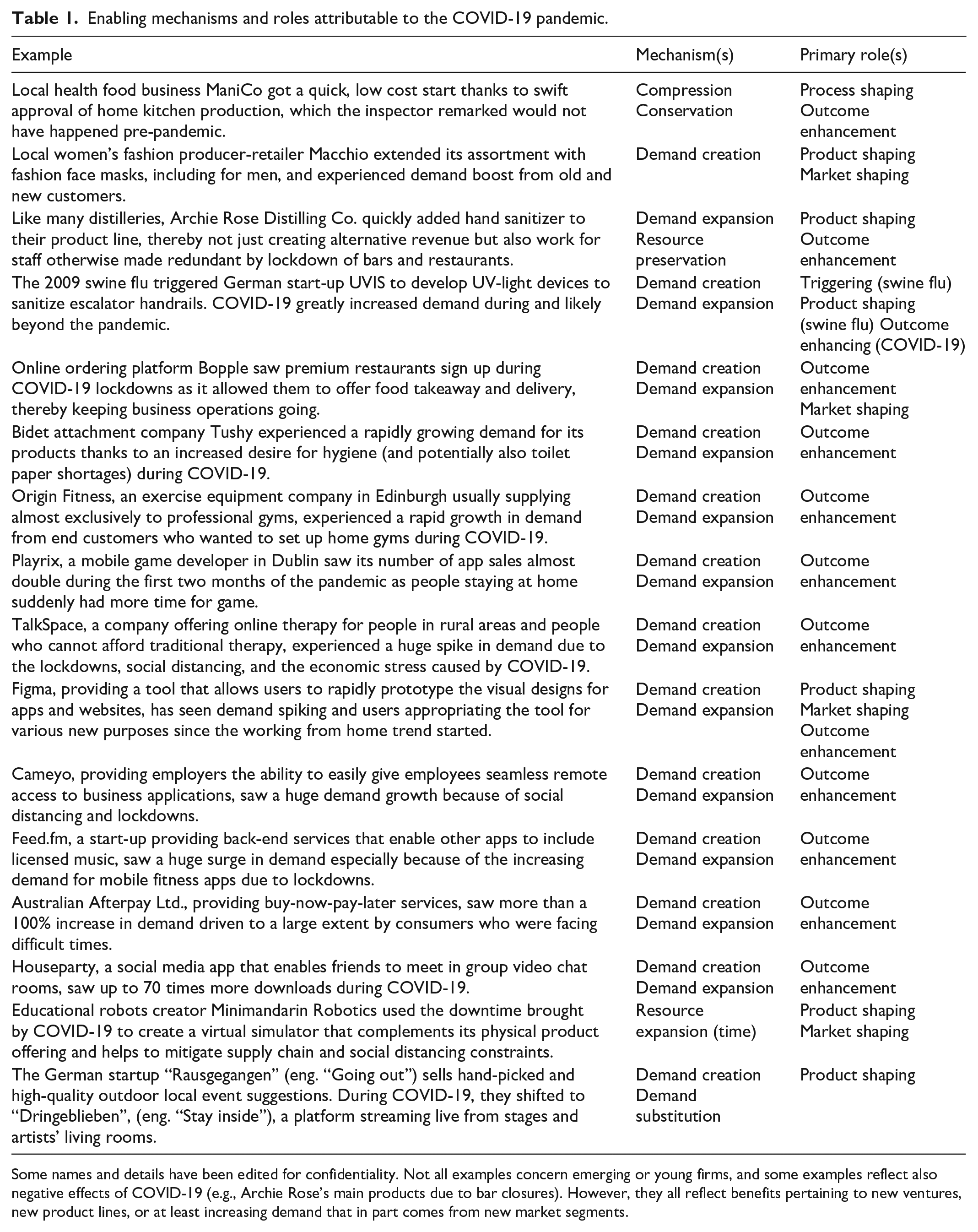
Some names and details have been edited for confidentiality. Not all examples concern emerging or young firms, and some examples reflect also negative effects of COVID-19 (e.g., Archie Rose’s main products due to bar closures). However, they all reflect benefits pertaining to new ventures, new product lines, or at least increasing demand that in part comes from new market segments.
This richness of effects indicates several new avenues for research. Traditional entrepreneurship research focusing on the recognition, identification, or evaluation of an opportunity typically subjects some complex stimulus (such as external conditions and/or design ideas for imagined future ventures) to an overall attractiveness evaluation, either for oneself or for others (Haynie et al., 2009; Wood & Williams, 2014). The EE framework invites investigation in much greater detail of which specific perceived benefits underlie such assessments—for example, potentials for improved costs, resources, product features, demand, competitive shielding, etc. Furthermore, the sources of these benefits need not be assumed to occur or to be assessed just at the outset of the venture creation process.
The opacity and agency-intensity of EE mechanisms
The EE framework discusses two general and strategically important characteristics of EE mechanisms (see Table 1). The first is opacity—how easy or difficult it is to envision a mechanism enabled by an external event before it has been demonstrated. The second characteristic is agency-intensity (a term adapted from Ramoglou & Tsang, 2016), denoting variance in the amount of time, effort and other resources it would take an entrepreneurial agent to benefit from a mechanism. For example, the possibility of using UV technology to sanitize handrails and organizing the production of devices for such purposes (UVIS) arguably represents far higher opacity and agency-intensity for the average person than is the idea of producing and selling sanitizer (Archie Rose) or textile facemasks (Macchio). Similarly, Rausgegangen’s turnaround requires more creative ingenuity than it takes Playrix and Houseparty to cope with the increased demand that the pandemic generates for their products.
Past research typically conceives of such variance only on the agent side, in terms of greater prior knowledge of particular individuals (Shane, 2000) or superior absorptive capacity, resources, or dynamic capabilities of organizations (Barney, 1991; Cohen & Levinthal, 1990; Teece et al., 1997). The EE framework presents an invitation to engage in more balanced theorizing across agents and their external environment. The notions of opacity and agency-intensity provide a fruitful entry point for such theorizing. Furthermore, they bypass the assumptions of heroism and strategic rationality behind all entrepreneurial success that are rather explicit in Shane and Venkataraman’s (2000) discovery view. The EE framework recognizes that entrepreneurs can benefit from mechanisms with low agency-intensity without even being aware of them, as when changes in weather favor certain types of product. When opacity and agency-intensity are high for most potential agents, those for whom they are less so—such as UVIS’s founders when COVID-19 struck—may be in such a position based either on strategic foresight or sheer luck (Denrell et al., 2015).
Developing the EE framework further
The degree to which the EE framework helped generating insight into the entrepreneurship implications of the COVID-19 pandemic amazed us. This said, the EE framework is new, and its application to the COVID-19 pandemic also gives reason to reflect on some of its features. In what follows, we present five such reflections.
First, when past entrepreneurship research has at all rendered external change a major role, it has typically focused on a single type of change, and often a single instance (Kimjeon & Davidsson, in press). While the original formulation of the EE framework mentions interrelationships and interactions among different EEs, the COVID-19 case really highlights the importance of paying attention to such matters. Enablement in this case can be driven either directly by the health crises, by the policies it triggered, a combination of the two, or combinations involving other EEs associated with COVID-19, such as new technologies, or emergent sociocultural movements in society. An illustrative example of combined EE effects is the meteoric rise of Peloton, an exercise equipment and media company that provides in-house training services. This company leveraged technological advances (a technological EE) to create a new home exercise bike that puts riders in virtual exercise rooms with other riders. It was already promising enough to reach an IPO in 2019 but the health concerns triggered by COVID-19 (a natural-environmental EE) vastly increased demand for in-house workouts and remote interaction; lockdown policies (a regulatory EE) mandating work from home and closing gyms provided a further boost. A second, less business-centric example would be the palpable connections observable between the pandemic outbreak and sociocultural movements such as Fridays-for-Future in Europe, or Black-lives-matter in the United States. As these examples demonstrate, EEs can occur in some form of temporal and/or logical sequence. Processual scholarship could start identifying patterns in such sequences to understand how such changes in context relate to observable (new venturing) action (Pentland et al., 2020).
Second, the application to COVID-19 gives reason to refine the notion of scope. The total impact of the pandemic varies across spatial, sectoral, sociodemographic, and temporal dimensions as postulated in the EE framework. However, presence and variance in enabling scope does not necessarily match the scope of total impact. While the assumption that there always are some potential ventures that benefit also from overall negative changes like COVID-19, the size of this significant minority does not need to be perfectly correlated with the magnitude of the EEs total economic and social impact. The distinction between total impact and (new business) enabling impact thus calls for a more careful analysis of the form of enablement. Reflecting the interrelatedness of EEs, it is also possible that the enabling impact of COVID-19 will be of longer duration than the health crisis itself. This would be the case if, for example, it leads to enduring changes in people’s values, preferences, and behaviors, that is, the health crisis and (temporary) regulatory EEs transform into a more enduring, sociocultural EE. Some indications exist, for example, that COVID-19 is impacting people’s attitude toward climate change (“Climate and COVID-19,” 2020).
Third, although onset—like scope—is considered an inherent property of EEs, our analysis of the pandemic makes clear that the suddenness and predictability of global EEs can vary spatially. This has consequences for the type and timing of entrepreneurial responses to EEs as well as what type of agents (e.g., large, incumbent firms vs. independent start-ups) try to pursue opportunity arising from them. For example, incumbent firms may primarily be pursued by independent new ventures in countries with early onset of COVID-19, whereas in countries affected at a later point in time it may be that incumbent firms will be able to move faster on ideas trialed and tested in early-onset regions.
Fourth, our analysis gives reason to reflect on what attributes can be rightfully attributed to the EE versus the entrepreneurial agent. Consider our observation that it may be considerably easier for prospective entrepreneurs in late onset COVID-19 countries to identify what products and markets are enabled because they can observe developments in earlier onset countries. Is this best seen as people now having more prior knowledge? They do, but tracing from Hayek (1945) the notion of prior knowledge is a matter of individual differences, and such differences will exist both in early and late onset countries, albeit around different means. The differences across countries over time may be better regarded as decreasing opacity as the pandemic progressed across the world.
Fifth, as regards mechanisms, some of the observed effects in Table 1 already go beyond the mechanisms included in the original EE framework, such as demand creation (several examples of demand where virtually none existed before) and resource preservation (Archie Rose’s keeping staff employed by producing hand sanitizer). Partly new are varieties of mechanisms such as resource expansion referring to time as a resource and product shaping as product line extension rather than determining the main product/service or some of its features. New is also the market-shaping role, exemplified by Macchio, Bobble, Origin Fitness, and Minimandrin finding their way to new customer categories (however, see also Kimjeon & Davidsson, in press). These examples demonstrate that the list of enabling mechanisms is by no means exhaustive and requires further analysis.
Conclusion
In this essay, we used the COVID-19 pandemic to back up the argument that greater attention to external changes to the business environment is well overdue in entrepreneurship research, as well as in related fields like strategy and management. Focusing on the positive, enabling effects of COVID-19 for emerging and new ventures rather than its roles as a major setback for well-established incumbents, we used the EE concept and framework to illustrate strategically important types of variance in external changes (scope and onset). We also detailed the many ways they can benefit individual ventures in terms of mechanisms pertaining to supply, demand, and value appropriation and different roles the pandemic may play in shaping products, processes or the organization of the venture.
We illustrated the EE framework’s potential by analyzing its varying characteristics across countries and by detailing some of the many instances and forms of enablement in terms of EE mechanisms and roles. This hopefully demonstrates the richness of the framework as well as the multitude of positive impacts for emerging and young ventures potentially derived from the COVID-19 pandemic. It does not, however, amount to explaining these cases, because explanation requires theory, and the EE framework is not yet a theory. Still, we argue that the EE framework offers a useful structure and terminology to guide further theoretical development, both on its own and in combination with existing, agent-centric theories (Davidsson, 2020). The notions of opacity and agency-intensity of EE mechanisms provide a particularly valuable entry points for extending theories on individual and organizational levels to embrace variance also in the environment to which they respond.
Furthermore, we believe that the framework has considerable potential as a practitioner tool (von Briel, Davidsson, & Recker, 2020). It can heighten attention to all types of external changes and provide a schema for assessing their overall as well as specific potentials, all of which can be contrasted against own interests, strengths, and weakness, as well as the interests, strengths, and weaknesses of potential rivals. While the enablement we observed in our examples may be as much a result of luck as it reflects strategy, the systematic application of the EE framework as a strategic tool can make future practitioners somewhat less reliant on chance events for their good fortune.
Footnotes
Authors’ note
Jan Recker is now also affiliated to University of Hamburg, Hamburg, Germany and not University of Cologne, Koln, Germany.
Declaration of conflicting interests
The author(s) declared no potential conflicts of interest with respect to the research, authorship, and/or publication of this article.
Funding
The author(s) received no financial support for the research, authorship, and/or publication of this article.
