



Abstract
This article investigates the role of discourses in processes of deepening authoritarianism and war. By bringing Jacques Rancière’s works on politics and depoliticisation into dialogue with poststructuralist discourse analysis, the article argues that discursive depoliticisation contributes towards authoritarian consolidation and shows how authoritarianism deepens in a co-dependent nexus of domestic and international politics. Focusing in particular on Rancière’s concept of gaps, the article argues that the core mechanism of depoliticisation is to neutralise the gap constitutive of politics proper and that this neutralisation unfolds in discourse, through the logics of archipolitics, parapolitics, metapolitics and ultrapolitics. The article (1) develops a framework for unpacking discursive depoliticisation empirically by conceptualising Rancière’s logics as ideal-typical depoliticising discourses and (2) applies that framework in an analysis of Russian official discourse in recent years (2015–2023). The article thereby explains how discursive constructions have strengthened Russian autocracy: entrenched depoliticising discourses, produced and reinforced in a co-constitutive internal/external sphere, made possible authoritarian consolidation in Russia under Putin and its war on Ukraine. The article puts forward the concept of discursive depoliticisation as a novel perspective on ‘hybrid’ and authoritarian regimes, as well as Russia’s intensified war on Ukraine and full-on autocracy from 2022 onwards.
Introduction
- Tell me, which concentration camp are they taking you to?
- I don’t know, I’m not interested in politics.
Jokes like this one started circulating in Russian-speaking social media after Russia’s February 2022 full-scale invasion of Ukraine in (Krivets, 2022). The jokes ironise over people expressing lack of interest in politics even when authoritarianism strengthens rapidly, reflecting the view that an apolitical climate enabled Putin’s increasingly autocratic regime and disastrous war. This article presents theoretical and empirical support for the assumption that depoliticisation fosters autocracy and war. 1 It presents the framework of discursive depoliticisation as a novel conception of authoritarian consolidation 2 that provides a new understanding of authoritarian politics and its relationship to international conflict, without rehashing democratic peace theory or prescribing liberal democratic institutions as the model (see Sakwa, 2022). Empirically, the article studies Russian discourse from 2015 to early 2023, covering the period following the watershed year 2014, when Russia annexed Crimea and launched its military aggression in Eastern Ukraine. The analysis ends a year into the full-scale invasion of Ukraine launched on the 24th of February 2022. The article unpacks how and why discursive depoliticisation in Russian official discourse contributed towards increasing autocracy domestically and aggressiveness externally.
If it is true that Russia’s aggressive foreign policy is rooted in its authoritarian system domestically (e.g. McFaul, 2020) and that a revisionist strategic culture can be ‘activated’ in an era of global systemic change (Tsygankov, 2020), the current international security crisis unleashed by Russia’s full-scale war in Ukraine takes impetus from domestic authoritarianism while simultaneously bolstering it. However, the mechanisms through which democracy deteriorates remain poorly understood, especially in IR, which has delegated the question to the field of comparative politics. This neglect hampers a clear understanding of which role (lacking) democracy plays in the setbacks to international security and (liberal) order, and in international politics generally. Offering a new take on the relationship between authoritarianism and international order and security, this article investigates how democracies die 3 at the very intersection of domestic and international politics.
In the heyday of liberal triumphalism – following the supposed post-Cold war ‘end of history’ (Fukuyama, 1992) – democratisation research was dominated by the transitological paradigm, which falsely assumed that regimes in transition automatically moved towards democracy (Carothers, 2002). The hybrid regimes literature (cf. Levitsky and Way, 2010) later discarded this assumption, but the field is still marred with blind spots and biases. Critics argue that the democratisation literature – and its IR cousin, Democratic Peace Theory – continues to be Eurocentric, particularistic and orientalist, to conflate democracy and liberalism, and to reduce democracy to an operationalisable list of institutional procedures (Abrahamsen, 2000; Lawson, 2008; Hobson, 2008; Morozov, 2013; Mälksoo, 2019; Schaffer, 2000, 2015; Stivachtis, 2015). Thus, while Ukraine’s fight for freedom underscores democracy’s inherent value, the academic study of democratisation is dominated by Western-biased checklist approaches. To reclaim the normative and analytical force of democracy, the field needs alternatives.
Several works have utilised the concept of discourse to explain authoritarianism in different contexts, which has yielded valuable insights, especially in explaining why most authoritarian states refrain from outlawing all kinds of non-state associations and expressions. For example, Tan (2007: 306, fn1) found that in Singapore, civil society was managed in a patriarchal fashion through a state discourse cast as a ‘fatherly’ ‘voice of reason’, domesticating the position of civil society and confining it to ‘feminine’ and less political domains like care, arts and dialogue. Lewis (2013) has conceptualised how authoritarian rulers produce legitimacy discourses that may be challenged by civil society, but also how resilient and widespread state hegemonic discourses can be – in the case of Kazakhstan, being reproduced in the blogosphere (Lewis, 2016). Much scholarship on discourses in nondemocratic regimes is concerned with the discursive legitimation of authoritarian rulers, for instance by studying autocrats’ ‘discursive appeals to legitimacy’ (Omelicheva, 2016; see also this article for a helpful review of studies of discursive legitimation). March (2003: 9) finds that the hegemonic discourse in Uzbekistan creates an ontological fusion at a pre-political level, in which ‘the nature of the political community, the purpose of the state, the unifying political telos and the present regime are fused into a single entity’, and that this ‘hegemonic reality’ shrinks the space for politics. As such, March studies how discourses not only legitimate specific ruling regimes, but can delegitimise politics sui generis, or it render unthinkable.
Relatedly, some IR contributions on the case of Russia (Casula, 2013; Morozov, 2015; Makarychev, 2008) have drawn on the work of political philosopher Jacques Rancière (1995, 1999, 2005) and suggested to analyse authoritarian consolidation as depoliticisation – the negation and withering away of politics itself. 4 I build on these Rancière-inspired approaches by making two interventions: First, my account of depoliticisation proceeds from reading gaps as key to Rancière’s theorisation of politics and its negations. Second, I explicitly develop Rancière’s theory as a theory of the relationship between discourses and democracy, by reframing his three logics of depoliticisation as three discursive mechanisms that deepen authoritarianism. This also involves clarifying and systematising Rancière’s concepts to enable transparent and consistent empirical application.
The article’s first contribution is thus that it puts forward a novel, empirically applicable framework of discursive depoliticisation. 5 To be specific, the article combines Rancière’s (1999) depoliticisation theory and its three logics of depoliticisation with poststructuralist discourse analysis (Laclau and Mouffe, 2001 [1985]) and ideal-types as analytical tool (Weber, 1949). Discourses can be defined, in a poststructuralist manner, as ‘systems of meaning-production that fix meaning, however temporarily, and enable us to make sense of the world and to act within it’ (Dunn and Neumann, 2016: 2). As such, the framework is based on the crucial constructivist insight that political realities are socially constructed and discursively mediated (Laclau and Mouffe, 2001 [1985]; Hansen, 2006; Milliken, 1999), and shape political outcomes because discourse set the boundaries for the range of the possible (Dunn and Neumann, 2016: 45). In addition, the framework enables an integrative analysis of how authoritarian consolidation is linked with states’ external relations, as it proceeds from the premise that states’ domestic and international spheres are co-constitutive (Snetkov, 2012, 2014). The contribution is therefore not a discussion of the democracy concept as such, but a new, poststructuralist discourse analytical framework based on Rancière’s understanding of democracy.
The article’s second contribution is that it explains how discursive constructions have strengthened autocracy in Russia from 2015 to early 2023. The empirical analysis unpacks the context of Russian authoritarianism and serves as an empirical illustration of discursive depoliticisation. Russia is arguably well-suited for probing theories of authoritarian consolidation. Numerous scholars have declared Russia a hybrid regime type (Hale, 2015; Krastev, 2006; Levitsky and Way, 2010; Zakaria, 1997), and Russia is now increasingly viewed as an autocracy (see e.g. Fischer, 2021; McFaul, 2021; Azarieva et al., 2022). In Russia, domestic authoritarian consolidation and aggressive foreign policy are clearly interrelated (Morozov, 2015; Snetkov, 2012, 2014; Wilhelmsen, 2016). Therefore, the study focuses on the post-2014 period, as it was marked by heightened Russian aggression alongside deepening authoritarianism inside Russia. Putin’s return to the presidency in 2012 marked an authoritarian, conservative and sharply anti-Western turn domestically, which spilt onto the international realm in earnest with the military campaigns in Ukraine from 2014 and Syria from 2015 and serious Russia-West hostility (Laruelle, 2016; Morozov, 2015; Neumann, 2016; Sharafutdinova, 2014; Østbø, 2017; Wilhelmsen, 2019). This development has (so far) culminated in Russia drastically intensifying its war in Ukraine from February 2022. Western countries responded with wide-reaching sanctions and weapon deliveries to Ukraine. The present analysis will lay out how domestic repression and external assertiveness reinforced each other in Russia in 2015–2023 through processes of discursive depoliticisation.
The article has two main sections. The first develops Rancière’s theory into a framework of discursive depoliticisation: I discuss Rancière’s conception of politics proper and of gaps and his logics of depoliticisation as ways of neutralising gaps. Then, I translate Rancière’s theory into a framework of ideal-typical depoliticisation discourses. The second section utilises this framework for empirical analysis and illustrates how discursive depoliticisation has unfolded in the Russian case, both before (2015–2022) and after Putin launched the full-scale war in Ukraine on the 24th of February 2022, a war which is still ongoing at the time of writing.
Rancière’s theory: Politics and its negations
Jacques Rancière’s articulation of democracy as ‘the part of those who have no part’ (1999: 30) is at the core of his democratic theory. For Rancière, politics proper 6 takes place when a part of the society – the demos – demands to play a part. Crucially, this constitutes democracy because the demos has no more reason to govern than to be governed – the ‘power of the people […] is not the power of the population or of the majority, but the power of anyone at all’ (Rancière, 2005: 49). In other words, Rancière defines democracy in terms of the lack of any final foundation for politics (or ‘governing’), and therefore constitutes what Marchart (2007: 127) dubs post-foundationalist political theory. Rancière further defines politics through its reverse, the police – in the Foucauldian sense, as a general system of ordering as opposed to (only) the ‘petty police’ (Rancière, 1999: 28). The logic of the police is the opposite of the logic of equality – the police is ‘distribution of places and roles, and the systems for legitimising this distribution’ (Rancière, 1999: 28). In contrast, politics involves ‘actions that reconfigure the space where parties, parts, or lack of parts have been defined, [… shifting] a body from the place assigned to it’ (Rancière, 1999: 29). Democracy is the disruption of the police order and amounts to ‘the institutions of politics itself’ (Rancière, 1999: 101).
Mind the gap(s): The stage for politics
Rancière’s theory of depoliticisation naturally rests on his particular conception of politics and democracy. In my reading, the notion of gaps lies at the core of Rancière’s political theory. According to Rancière (1995, 1999, 2005), gaps – or splits, intervals, dualities – set the stage for politics proper because they represent the tension between the universal and the particular, between parts and totalities – between universal equality for everyone and the police order where everyone has their particular place. Rancière (1999: 62–63) writes that ‘[politics] works at the meeting point between police logics and the logic of equality [… and that] the whole problem is knowing how to interpret this gap’. Gaps between ‘equality and its absence’ constitute the ‘original split in the ‘nature’ of politics’ (Rancière, 1999: 89, 70), because the equality of citizens always co-exists with the inequality between men. A typical gap is the missing 1:1 overlap between the equality of citizens as a declared principle underpinning a political community, such as the nation-state, and the (lack of) equal rights within that community. In Rancière’s politics, such gaps are not meant to be ‘filled’ to reach some totality (unlike the idealised totality of knowledge sometimes invoked in academic articles claiming to fill a literature gap) – instead, gaps stage the always-momentary constitution of the people as political subject.
As such, gaps matter for another key concept of democracy: the people. The potency of gaps makes democracy possible because the basis for political action consists in confronting the gap between the ideal, equal people and the real people trapped in hierarchical police orders. When the demos (‘the part of no part’) holds up gaps, it unmasks the contingency of the social order and momentarily establishes itself as a political subject, undermining the status quo and its police logic (Rancière, 1999: 35–36). To use contemporary examples, campaigns such as ‘Trans women are women’ and ‘No one is illegal’ (regarding refugees) illustrate how politics reconfigures the political space and disrupts the taken-for-granted distribution of people within it. To maximise democratic power is to argue wrong by disclosing this split or gap, by demonstrating the difference of the people from itself, the difference between ‘the suffering-working people and the sovereign people’ (Rancière, 1999: 87). Put differently, politics is to dispute the universal (Rancière, 1995: 102) in the name of universal equality of all people. With Laclau and Mouffe (2001: x), we could say that politics is to unmask and dispute hegemony: a particular social force assuming representation as the universal. Conversely, the essence of depoliticisation is to interpret this gap in ways that neutralise it, thus removing the stage for politics that the gap constitutes.
Lastly, written egalitarian laws are crucial to Rancière, also because of gaps. Egalitarian laws are not ‘mere form’, but materialisations of equality – however fragile the inscriptions are, however far from experience, it means that an element of the power of the people exists (Rancière, 1999: 88). To do politics is to argue wrong by pointing to the universal equality that is inscribed, but not enacted, by demonstrating the gap between the two. An example given by Rancière (1999: 89) is to ask, ‘Are Frenchwomen included in the ‘Frenchmen’ who hold universal suffrage?’ In Deranty’s (2003: 153) reading of Rancière, egalitarian laws are ‘historical inscriptions of equality within inequality’, that nevertheless ‘can become ossified and lose their emancipatory inspiration, but they can also be reclaimed at any time by new struggles as references or principles’. As such, laws can be ‘elements integrated in the police system’ but can also be reinscribed in new contexts, ‘as reiterations of previous inscriptions’ (Deranty, 2003: 153). In today’s Russia, the formal law is clearly part of the police system, but is also reinscribed and reiterated in moments of democratic struggle. For example, a young Russian man peacefully protesting in Moscow in 2019 raised a copy of the Russian constitution in his hand as he ducked inside the riot police van (photographed by Feldman, 2019). For Rancière, constitutions matter in the fight for political equality exactly because staging the equality-inequality gap enables political action.
The disavowals of politics
Ideal-typical framework of discursive depoliticisation, based on Jacques Ranciére (1995, 1999, 2005).
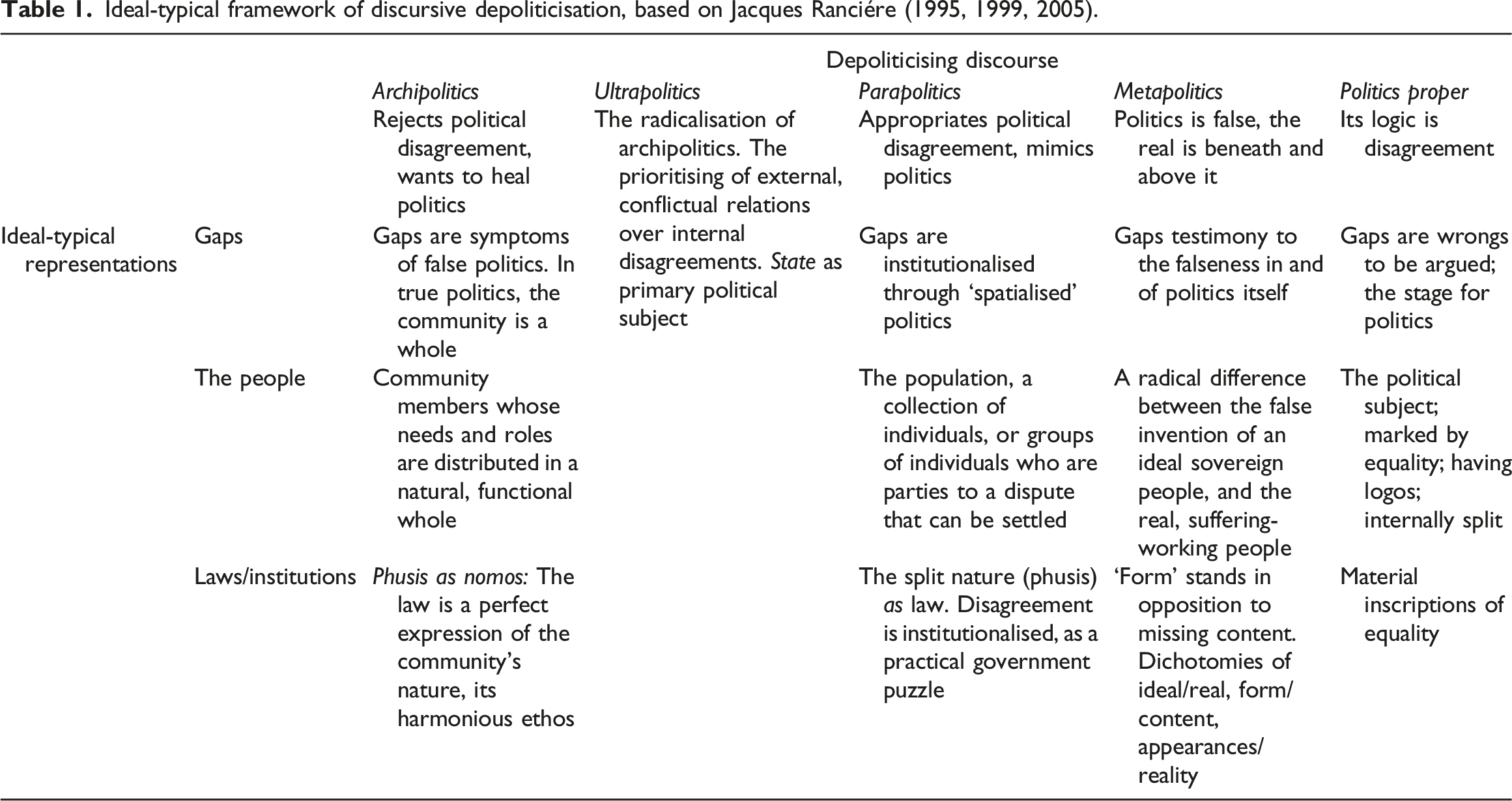
Plato, who displays ‘resolute hatred of democracy’, equates politics and police through what Rancière dubs archipolitics: the opposition between republic and democracy (Rancière, 1999: 10, 68). Contrary to democracy, Plato holds, true politics embodies its own principle, and there is nothing left over: it is a functional whole, ‘a body animated by the one soul of the whole’ (Rancière, 1999: 69). In Plato’s vision, the people is reduced to community members, whose needs and roles are distributed organically (Rancière, 1999: 66), while the law is the perfect expression of the community’s way of being, it achieves ‘phusis as nomos’, nature as law (Rancière, 1999: 67–68). When the law is seen to express the harmonious spirit of the whole, there is no room for a gap between man and citizen: such a duality becomes a symptom of false politics (Rancière, 1999: 63) and in facing this duality, archipolitics evokes the true/false (republic/democracy) dichotomy (Rancière, 2005: 58).
While archipolitics rejects democracy, parapolitics mimics it (Rancière, 1999: xiii). Starting with Aristotle, it makes politics identical to the police order by appropriating the specificity of politics, namely disagreement (Rancière, 1999: 70). Parapolitics declares that all should share in ruling, but instead transforms political actors into the roles and forms characteristic of the police (Rancière, 1999: 72). Parapolitics mimics the people’s internal split by allocating groups to their respective places (Rancière, 1999: 75), thereby institutionalising gaps into a spatialised system. As such, it implies an oligarchy that nurtures the democratic desire for alterations (Rancière, 2005: 75). In parapolitics, laws and institutions incorporate the split nature of the people, in which the unequal count of the people becomes a mathematical task for government to solve. The people is broken down into factions or parties – groups to negotiate between (Rancière, 1999: 72). Hobbes is the second exponent of parapolitics. His social contract splits the demos into individuals, so that ‘there are only individuals and the power of the state’, eliminating the part with no part (Rancière, 1999: 77).
The key invention of metapolitics, established by Karl Marx, is ideology: this concept entails the abolition of the true/false opposition, contending that the only truth is the truth of the false. In metapolitics, the truth of politics rests only in its lie (Rancière, 1999: 82). The typical metapolitical dichotomy is between form and content, between political appearance and social reality. Metapolitics interprets the man/citizen duality as an opposition between a false, ideal sovereign people and a real, suffering-working people (Rancière, 1999: 87). As such, metapolitics neutralises gaps by interpreting them as signs of politics’ inherent falseness, concealing the real beneath it.
In Slavoj Žižek’s rendition of Rancière, he adds ultrapolitics, which Viacheslav Morozov (2015: 152–3) conceives as the radicalisation of archipolitics. The epitomic ultrapolitics is Carl Schmitt’s philosophy, and involves cancelling out politics by ‘bringing it to extremes, via the direct militarisation of politics’ (Žižek, 2006: 187). In this way, ultrapolitics eliminates politics proper by putting a taboo on internal disagreement in the face of an existentially threatening other, ‘fetishizing unity as the condition for existence and action […] by discursively outlawing dissent as suicidal naivety or as treason’ (Thorup, 2013: 75). 7 As such, ultrapolitics puts the internal-external dynamic into play, as the unity of the inside becomes crucial for the strength of the outside. Through prioritising external threats and challenges, the state becomes the privileged political subject, effacing politics as a possibility inside the state. Ultrapolitics thus parallels archipolitics in its effects – it depoliticises through negating internal disunity. As Thorup (2013: 75) puts it: ‘Ultra-politics is offered as the real, hard politics but is actually a way to avoid the truly hard fact of politics: disagreement’.
The concept of ultrapolitics may be juxtaposed with Laclau and Mouffe’s (2001: xvii) concept of antagonism, which they see as ineradicable, positing that ‘defining an adversary’ is pivotal to their project of radical democracy, similar to what I refer to as politics proper. 8 However, the crucially poststructuralist antagonistic frontiers of Laclau and Mouffe are formed within a field of differences (and identities) that is never fully fixed (2001: 105–114). In contrast, the depoliticising Schmittian antagonism of ultrapolitics ‘essentialis[es] the fixed boundary between inside and outside and thus present[s] the nation as the only thinkable locus of political subjectivity’ (Morozov, 2015: 152–3). And whereas democratic antagonism acknowledges that ‘any form of consensus is a result of hegemonic articulation’, that is, produced by discursive practice of creating relationships of equivalence and difference (Laclau and Mouffe, 2001: xviii, 105), ultrapolitics is a radicalised archipolitics which fetishises its fixed exterior as a natural and necessary outside of a the people as a given, pre-discursive totality (Morozov, 2015: 152–3).
Rancière’s ‘figures of displacement of politics’ are different ways of muting the play between the ‘ontic’ politics and the ‘ontological’ political (Marchart, 2007: 159–162). Archipolitics makes the ontological side, the political, into the foundation for ontic politics, dictated by the founding essence of the community, as decided by the philosopher (Marchart, 2007: 160). In contrast, parapolitics obliterates the ontological side as the ‘ontic’ politics of competition becomes dominant, domesticating the instituting antagonism of the political (Marchart, 2007: 160). Metapolitics, in a symmetrical fashion to archipolitics, denies any ontological grounding of the ontic side of politics and sees the latter as ‘a false appearance of deeper-lying social structures’ (Marchart, 2007: 160). Lastly, in ultrapolitics, the ontic disappears completely as ‘the political’ comes to dominate fully with its emphasis on destructing the enemy, to potentially catastrophic effects such as civil war (Marchart, 2007: 160). There are affinities between my emphasis on (neutralised) gaps and Marchart’s focus on (displaced) ‘difference’, and it would be possible to expand on that theoretically. However, this article’s main aim is not conceptual but to read Rancière in a way that enables empirical analysis of deepening authoritarianism. I turn to that effort now.
A new framework: Towards discursive depoliticisation
The above section presented Rancière’s depoliticisation logics (1999, 2005) as ways of interpretating gaps, people, and laws that produce sameness between politics and the police, resulting in a depoliticised space. This article combines Rancière’s theory with poststructuralist discourse theory and analysis by casting Rancière’s depoliticisation logics as ideal-typical (Weber, 1949) depoliticising discourses, systematised in Table 1: this is the proposed framework of discursive depoliticisation. Grounded in poststructuralist discourse analysis (Laclau and Mouffe, 2001 [1985]), the proposed framework holds that discourses affect political outcomes because they define the range of the possible (Dunn and Neumann, 2016: 45) and endow some actors with agency while depriving others of it (Milliken, 1999). Drawing on the large literature on how discourses can be subjected to empirical study (cf. Hansen, 2006; Dunn and Neumann, 2016), the synthesised framework enables in-depth empirical analysis of ‘the logic governing a set of discourses and practices which turn democracy into its contrary’ (Rancière, 2009: 116). As demonstrated in the empirical section, to examine representations of gaps, the people, and laws/institutions proved a useful analytical heuristic.
I contend that the synthesis is justified because Rancière and poststructuralist discourse analysis share key theoretical assumptions, in particular that social reality is produced through language and thus contingent, and that power naturalises the contingency of the status quo (Rancière, 1999: 28–30; Dunn and Neumann, 2016: 54, 2016). For Rancière (1999: 32), what makes an action political is not the subject or the place, but ‘solely its form’; it is to set the stage for disagreement through positing equality. In other words, the essence of politics is to deconstruct a discourse that naturalises inequality and to rearticulate it as conflict presupposing equality. Rancière highlights the contingency of any order and the need for ‘the police’ to guard and legitimise the status quo, while politics proper unmasks this contingency and disrupts the order.
Methodology
I have used Hansen’s (2006: 64) framework to guide my source selection, more precisely the first of her so-called ‘intertextual models’. This model involves analysing general material and key texts from official discourse. Official discourse is crucial because state action is legitimised through it, but should be situated in a wider intertextual web that incorporates texts that have impacted official discourse (Hansen, 2006: 60). Because a central aim of the present article is to analyse the relationship between the internal and the external axis in Russian discourse, texts oriented towards both the domestic and international domain were included. Time constraints made it necessary to delimit the texts subjected to in-depth analysis. However, I have followed Russian official discourse more broadly over the last eight to nine years, mainly focusing on statements by Putin, Lavrov and their press secretaries, and I believe the findings presented here mirror broader discursive patterns of Russian official discourse.
Criteria for general material are that the texts should a) clearly articulate identities and policy, b) be widely attended to, and c) have formal authority (Hansen 2006, 65). General material on the domestic side includes four of the President’s annual addresses to the Federal Assembly (Poslanya Prezidenta), because these statements are meant to speak to the breadth of issues facing the country each year, primarily from a domestic point of view, and hence meet Hansen’s criteria. I have read the 2015, 2019, 2020 and 2023 addresses (Putin, 2015b, 2019, 2020, 2023), thus covering the beginning, middle and end of the period studied. The general material on the international side meet the same criteria and include one early (Putin, 2015a) and one more recent (Lavrov, 2019) speech by the Russian Federation at the United Nations General Assembly, as well as the official Foreign Policy Concept (i.e. doctrine) of the period (Ministerstvo inostrannykh del Rossiiskoi Federatsii, 2016).
Key texts from the period under study are identifiable through a general reading or through the use of search tools (Hansen, 2006: 84). As domestic key texts, I have selected two parts of the high-profile interview series ‘20 questions with Vladimir Putin’ (Putin and Vadenko, 2020a, 2020b) from the state news agency TASS, an interview series released in 20 chapters in the months leading up to the 2020 constitutional reform. The specific two parts were selected because they treat themes at the core of the research topic, namely the relationship between the people, civil society and political institutions. As key texts from the international realm, I have chosen a widely broadcasted and much-discussed interview with President Putin to the Financial Times (Putin and Barber, 2019), Putin’s (2021) so-called ‘article’ On the Historical Unity of Russians and Ukrainians, designated by scholars, (e.g. Götz and Staun, 2022; Person and McFaul, 2022) as a key texts, as well as four texts that express the official position on pivotal events of the 2022 full-scale war: the February 21st speech of ‘recognising’ Donetsk and Lugansk (Putin, 2022a); the speech launching the 24th of February full-scale invasion (Putin, 2022b); Putin’s announcement of the ‘partial mobilisation’ on September 21st (Putin, 2022c) and the speech upon the annexation of Donetsk, Lugansk, Zaporizhzhia and Kherson on September 30th (Putin, 2022d).
In discourse analysis, a reading is only valid to the degree that it is careful and thorough, attentive to the different articulations, linking and juxtaposition of signs in a text (Hansen, 2006: 45). Given the pivotal role assigned to language in discourse analysis, a reading’s validity is limited unless the researcher knows the original language, reads the texts in original and display sensitivity to historical and cultural context (Dunn and Neumann, 2016; Hansen, 2006). For this reason, all the texts were analysed in the original language, Russian, occasionally consulting official translations and dictionaries to avoid anything becoming lost in translation.
In developing the analytical framework, the empirical analysis served as a vehicle for theorising or a ‘plausibility probe’ (Levy, 2008: 7). This meant that rather than presenting or testing a theory, the analysis engaged in a process of theorising as recommended by Swedberg (2012), iterating between empirical observation and theoretical concepts. The iteration was built into the research design through an open and innovative ‘pre-study’ (‘context of discovery’) phase followed by a ‘main study’ (‘context of justification’). All texts were imported into the NVivo software for qualitative analysis, which allows for coding elements of texts as nodes (see appendix for code sheet and text coded under each ‘node’). In practice, the pre-study consisted of the in-depth analysis of the first three texts, during which the depoliticisation ideal-type framework remained open to adjustment, using the annotations feature in NVivo to document my many reflections on the categories.
In the pre-study phase, I also identified several other nodes during the analysis related to the topic of Russia, the West, and the international order, topics I considered relevant for the internal-external axis of depoliticisation. These were: ‘Liberalism’, ‘Respect for diversity/Self-determination’, ‘Multipolarity’, ‘Stability’, ‘Statehood’, ‘Difficult past/90s’, ‘West’, ‘Interference’. As the analysis progressed, I eventually identified these closely interrelated nodes as the fabric of a narrative regarding the dangers associated with the West’s lack of respect for states’ diversity, which holds that Western leaders do whatever they want and routinely cause chaos and erosion of statehood. Тhis narrative functions as a backdrop for the depoliticisation discourses in Russian official discourse, in particular for the ultrapolitical emphasis on state sovereignty and agency, and the metapolitical dichotomisation of ‘fake’ rules, norms and universalism of the West versus the ‘real’ underbelly of geopolitical competition. In addition, ‘Democracy’ and ‘Values’ were initially used as separate analytical categories (nodes) but emerged as less relevant to the study’s aim when the framework became more consolidated in the ‘main study’ phase. As a result, the final set of nodes were ‘Archipolitics’, ‘Parapolitics’, ‘Metapolitics’, ‘Ultrapolitics’ and ‘Politics proper’, as well as ‘Gaps or Duality’, ‘People’, and Laws/Institutions’ – certain representations of which signal depoliticisation, in accordance with the framework developed.
Discursive depoliticisation in Putin’s Russia 2015–2023
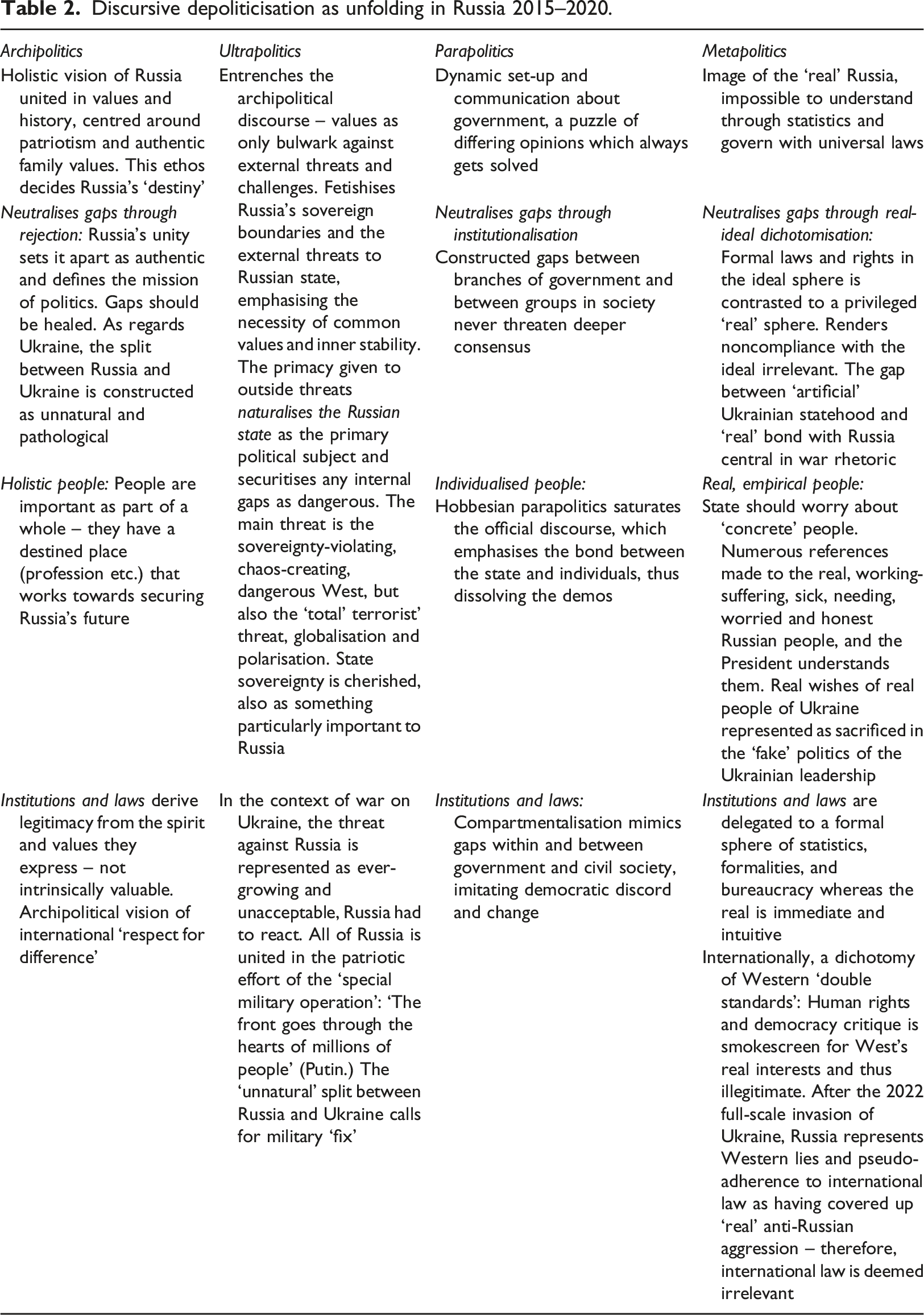
Discursive depoliticisation as unfolding in Russia 2015–2020.
Before I turn to my own discourse analysis of the text sample studied, I would briefly like to revisit Morozov’s (2015: 147–154) observations of how Rancière’s depoliticising logics work in Putin’s Russia, both to show the state of previous research, but also to anchor the findings of my discourse analysis in the wider Russian discourse. First, Morozov finds that archipolitics is central to Putin’s ‘paleoconservatism’, which through a range of measures attempts to fix Russia’s ‘traditional’ identity and leaves no room for alternative identities, thus silencing entire groups such as LGBTQ+ people. Next, the endless petty fights and the all-overseeing figure of Putin as the sovereign are textbook expressions of parapolitics’ twin logics of politics-as-competition and of citizens-as-individuals under the sovereign. Next, metapolitics’ representation of ‘politics as mere representation vis-à-vis the hidden truth of the social’ (Morozov, 2015: 149) has endured since Soviet times, and is most clearly expressed in contemporary Russia through the abundance of conspiracy theories – among them, that Washington plotted both the Ukrainian Euromaidan and the Russian Bolotnaya protests. Lastly, Morozov points out that the ultrapolitical logic of the ‘enemy at the gate’ has been key to regime discourse at least since the 1999 Kosovo crisis. With this longer-term overview of depoliticisation of the Russian discursive field in mind, I turn to my own empirical analysis.
Archipolitics/ultrapolitics: Externally threatened, internally united
From 2015 to early 2022, archipolitics was the most pronounced depoliticising discourse in Russia – perhaps unsurprisingly, given scholarly observations of Russia’s ‘value turn’ from 2012 onwards (Laruelle, 2016; Morozov, 2015; Østbø, 2017; Sharafutdinova, 2014). The discourse constructs certain tasks and values as intrinsic to the community’s nature, which is quintessentially archipolitical: institutions exist primarily as expressions of spirit and are followed to the extent that they correspond with the people’s ethos. In particular, archipolitics dominates the domestic discourse on demography and education, geared towards the goal ‘to preserve the nation’, a priority independent of electoral institutions: We have a long-term agenda that should be independent of election cycles and current market conditions. And, obviously, that is to preserve the nation, to raise children and unveil their talents – which determines the future of any country, including ours. (Putin, 2015b)
In many instances, archipolitics is radicalised and strengthened through ultrapolitics. The discourse repeatedly constructs the community’s spirit as essential for Russia’s survival and success and emphasises a harmonious ordering of society made necessary by external pressures. In analysing the domestic discourse, this ultrapolitical justification for a society united around one archipolitically conceived value set is a consistent finding. The discourse repeatedly constructs the causal link between a Russia united around family values and an internationally successful and safe Russia. The following quote is a typical example: It is very important that [children and youth] accept the authentic values of a large family, that the family is love, happiness, the joy of motherhood and fatherhood, that the family is a strong bond of several generations, where respect for elders and care for children always unite, give a sense of confidence, protection, reliability. If all this becomes a natural moral norm for the younger generations, an integral part and pillar of their adult life, we can really solve the historical task of guaranteeing the development of Russia as a large and successful country. (Putin, 2020)
In general, the state’s needs and subjectivity tend to supersede those of the people in the domestic discourse. Ranging from infrastructure projects to education, domestic policy initiatives, including the so-called National Projects, 10 are repeatedly justified with reference to the needs of the country in a challenging global environment (Putin, 2019, 2020).
Furthermore, the ultrapolitical goal of tackling challenges in a changing world justifies an archipolitical distribution of people staying in their proper place. The discourse states that ‘national development depends on [people] and the results of their labour’ and happens when ‘the striving for being needed and useful is supported, and finds work according to their calling and their liking’ (Putin, 2019). In this way, the archipolitical gearing of the inside – the functional whole of the single-spirited community – is constructed as necessary for the community to survive and thrive internationally, and the state replaces the people as the main political subject in a manner of ultrapolitics.
In Russian official discourse from international settings, ultrapolitics is manifest in the mobilisation of a narrative of the dangerous, chaos-creating West. In general, the discourse naturalises the ultrapolitical assumption that the only guard against chaos is to preserve the state as the privileged political subject. The discourse constructs a narrative of a dangerous international situation in which an ailing and intolerant West tries to impose its models by all available means, including military, on political systems that are different – and its remedy, namely the indisputable primacy of state sovereignty. This way, international anti-Westernism and domestic anti-pluralism bolsters each other through archi-/ultrapolitics.
A prominent instance of such ultrapolitics is the discursive emphasis on ‘inner stability’ as vital to preserving statehood in an unstable global environment. The backdrop narrative constructs instability as a threat to the very existence of the state and the West as instability’s source, since in this storyline, fixed through numerous representations, the West routinely disregards other states’ sovereignty and right to security. The logic of this narrative is ultrapolitical since it dictates that inside the state, the people must honour statehood and promote stability at almost any cost – the alternative is collapse.
The Russian official discourse construes stability as internal-external: while threatened continuously from the outside, stability can also deteriorate from within. This logic permeates the following answer from President Putin’s to a question regarding Russia’s prospects in a world of polarisation and dissatisfaction with leaders: [You ask] for how long Russia will sense that she is a stable country? The longer, the better. Because a lot depends on stability, internal political stability, one’s position in the world depends on it. And ultimately, perhaps, and most importantly, people’s well-being depends on it. And naturally, one of the reasons for the Soviet Union’s collapse was that it was difficult to live, people’s real incomes were very low, and the shelves in shops were empty, so people’s immune system for preserving statehood got weaker. (Putin and Barber, 2019)
The analysis illustrates that ultrapolitics and archipolitics are mutually reinforcing. On the topic of Russia’s then-recent intervention in Syria, President Putin praised and explained the public support for the operation. The threat was ultrapolitically framed, namely as ‘total’, and the representation of the supportive Russian community was archipolitical, as a having one mind, one understanding, one ethos: In the fight against terrorism, Russia has demonstrated extreme responsibility and leadership. These resolute actions are supported by the Russian society. And in this absolutely determined position of our citizens lies a deep understanding of the total threat of terrorism, the demonstration of genuine (istinnye) patriotic feelings and high moral qualities, the confidence that the national interest, their history, and traditions, our values, must be protected. (Putin, 2015b)
In this example, the archipolitical and ultrapolitical elements are closely intertwined, and they firmly support each other. The community has an archipolitical ‘deep understanding’ of the ultrapolitical threat. The ultrapolitical peril threatens the very archipolitical spirit of the community; its history, traditions, and values, but also the state-centred ‘national interest’. The ‘genuine patriotic’ feelings underscore that the ethos of the archipolitical community concerns the state itself. In this way, the people are rid of political agency as the archipolitical representation cancels out any disagreement – here is only support – and the ultrapolitics of the ‘total threat’ delegates all agency to the essentialised state agent. The result of such discursive processes – also indicated by the passive phrasing ‘the decision on a military operation was made’ (Putin, 2015b) – is a depoliticised space inside Russia.
Internationally, archipolitics permeates the Russian discourse on the ‘dangerous, chaos-creating West’, who does not understand, or refuses to understand, that all countries are different. This discourse holds that institutions should express individual states’ particularities instead of the West’s imposed and misconceived universal standards. The archipolitical underlying assumption is that institutions merely express a community’s nature – law is epiphenomenal to spirit. Thus, the vision of respect for international diversity promoted by Russia is one of archipolitically conceived states. As Putin says: […] regarding the party and the construction of the party-state in China, the Chinese people should decide this for themselves, we don’t interfere with that, we don’t meddle. Today’s Russia has one set of principles and life norms, an own set of rules, and in China, with 1,35 billion people – there are other rules. Try yourself to rule a country with 1,35 billion. This is not Luxembourg, after all, with all due respect to that wonderful country. (Putin and Barber, 2019)
Beyond archipolitical visions of individual states, the international community as a whole is also archipolitically framed. The discourse represents the monotheistic religions as the root of the world community’s shared value set, and that these values should be the basis for international cooperation (Ministerstvo inostrannykh del Rossiiskoi Federatsii, 2016; Putin and Barber, 2019). For instance, the discourse constructs a ‘necessity of forming a value base of cooperation supported by the common spiritual-moral potential of the foundational world religions, and also principles and understandings of striving for peace and stability’ (Ministerstvo inostrannykh del Rossiiskoi Federatsii, 2016). Crucially however, the harmonious and value-based international order articulated by the Russian discourse is hierarchical, as some states are assigned special roles and places. Russia is represented as a country that plays a critical role in bringing harmony and balance to world affairs, both due to Russia’s multiconfessional nature and its ‘unique role, developed through centuries, as a balancing factor in international affairs and in the development of global civilisation’ (Ministerstvo inostrannykh del Rossiiskoi Federatsii, 2016). Russia’s privileged position in this archipolitical image is reflected in its status as a veto power in the UN Security Council – again, institutions express ethos. The disagreements structuring the UN, including the practice of veto, are ‘completely natural’, because the ‘core’ of the UN consist of the different opinions expressed in the UN and the compromises reached, according to the discourse (Ministerstvo inostrannykh del Rossiiskoi Federatsii, 2016). Thus, the discourse frames the UN and the international community archipolitically and assigns Russia a special place.
Parapolitics: Rotation and pluralism support status quo
Turning to parapolitics, the Russian domestic discourse spatialises institutions by splitting up main governmental and societal institutions into opposing parts – President-cabinet, federal-regional, executive branch-bureaucracy, bureaucracy-civil society – in a state of dissent and/or dissatisfaction with each other. For instance, one text (Putin, 2020) constructs dispute the subject of food programs for schoolchildren (‘I will not hide that we had big discussions in this regard’) and the responsibilities of the regional versus the federal level on the subject of teachers (‘Here there was much controversy, as well’). Recurring parapolitical tropes include suggestions, instructions and reprimands from the President to other branches of government, representing decisions as debated or deliberated, and to contrast the federal and local bureaucracy with watchful and/or authentic civil society organisations. This illustrates how parapolitics depoliticises by feeding the need for change and rotation without real disagreement (Rancière, 2005: 74–75).
Furthermore, civil society is spatialised in itself, as divisions are constructed between different parts: On one side is the ‘millions and millions’ of volunteers in healthcare, education and environmental protection who ‘simply help people’, which is ‘great’ (Putin and Vadenko, 2020a). On the other there is the part of society that does ‘not agree’ with its authorities – which is also ‘great’ (Putin and Vadenko, 2020a). This way, parapolitics makes gaps, but these are depoliticising gaps: Although Russian institutions and society are construed as different groups with differing views, the disagreements are not truly political as theorised by Rancière – where the ‘the place, the object, and the subjects of the discussion are themselves in dispute’ (Rancière, 1999: 51). On the contrary, this mimicked disagreement ends up naturalising consensus and the status quo.
One way by which parapolitical disagreements transform into consensus is through archipolitics. This also points to a considerable flexibility in depoliticisation discourses and how they act together. The above example of the apparent disagreement concerning food programs in schools illustrated this: while the discourse constructs both sides of the disagreements as ‘logical’, only one of the solutions corresponds to ‘the logic characteristic to our society: everyone should feel that they are on equal footing’ (Putin, 2020 my emphasis) – a quintessentially archipolitical idea. The parapolitical mimicking of dispute is thus archipolitically solved through this premise and justified as ‘extremely important for our society’ (Putin, 2020). Similar flexibility is also detected elsewhere. This integration of depoliticising discourses is not considered by previous applications of Rancière, and is further discussed below.
Parapolitics also constructs the Russian people as a collection of individuals, which precludes political subject formation à la Rancière. The overarching relationship constructed by the discourse is between an active, caring state and individuals receiving support, in which the state provides individually tailored help. Moreover, the sovereign President presides over his subjects and judges which matters to lift up, as exemplified in one text (Putin, 2015b) in which Putin asks the Duma parliamentary deputies to prioritise the issue of corruption because the issue ‘worries the society’. As such, Russian discourse is permeated by Hobbesian parapolitics in which ‘there are only individuals and the power of the state’ (Rancière, 1999: 77).
Metapolitics: False formalities and false West versus Putin in touch with ‘the real’
As for metapolitics, the Russian official discourse constructs numerous metapolitical dichotomies between form and content, real and ideal, concrete and abstract. These metapolitical gaps represent politics as a sphere removed from people’s reality, antithetical to a place where real solutions are found. Supporting this, the discourse in domestic contexts consistently constructs formalities as irrelevant for solving real problems (Putin, 2020). Often, numbers, statistics, and bureaucratic documents are framed as separate from, or even a threat to, real help needed by real people.
Related to this, metapolitical representations of the Russian people proliferate: the people is constructed as real, working-suffering, sick, needing, worried and honest. For example, Russians are ‘very sincere, understanding and candid’, ‘ordinary people [who] speak from their soul’ (Putin and Vadenko, 2020b), and ‘concrete people’ are the ones who will suffer if disorder breaks out (Putin and Vadenko, 2020a). People ‘worry what the state will do after [the cash benefit program ends]’. People ‘are not fooled. They acutely feel hypocrisy […] and the important thing for them is what is really done for their life and the life of their families. And not sometime, but now’ (Putin, 2019). The discursive construction of the metapolitical real sphere underneath politics also allows for constructing ties between groups or institutions to one of two spheres, either real or ideal/formal. For example, journalists are discursively placed at a ‘terrible distance’ from the people (Putin and Vadenko, 2020b). In contrast, Putin presents himself as knowing the struggles of real people in these examples.
Internationally, metapolitical gaps structure Russia’s narrative of the West’s conduct on the global stage, outing the West as having a real agenda beneath their formal rules or ideology. A host of signs express that formal covers up the real, including ‘the rules’, ‘the rules-based order’ (Lavrov, 2019) ‘democratic’ (Putin, 2015a) (quotation marks in original), pretext, ideology, politicisation, double standards, instrument, and artificial (Lavrov, 2019; Ministerstvo inostrannykh del Rossiiskoi Federatsii, 2016; Putin, 2015a). These metapolitical tropes construct the West as promoting a set of ‘rules’ (in quotation marks) that serve as a mere pretext for their real interests. Metapolitics saturates Russia’s overarching narrative of wars and instability, in particular with reference to the Middle East.
Here, however, my analysis indicates a tension between politics and metapolitics. While metapolitical representations of gaps abound, these representations co-exist with political representations of gaps: The political gap between egalitarian international law and its noncompliance by the West is discursively used to stage an argument about equality. In the Russian discourse, the gap between the West’s ideology and the real interests beneath indicates false politics. However, the remedy for false politics lies in the egalitarian texts cherished by the Russian discourse, namely international law, and in particular the UN charter. Instead of metapolitically rejecting international politics tout court as false, this tension between politics and metapolitics seemingly produces a gap between false Western interpretations of laws and real international law. Thus, while parts of international law, such as the UN Charter, are interpreted in a political way, metapolitics dismisses as false what it represents as Western ‘rules’. As such, metapolitics in Russian discourse is mobilised to eliminate the political potential of Western interpretations of international rules, such as the responsibility to protect (R2P) principle, human rights and democracy. For example, the discourse constructs R2P as a threat to the law-based international order because it is used as a ‘pretext’ (‘pod predlogom realizatsiya kontseptsii ‘otvetstvennost’ po zashchite’) for military interventions and other forms of outside interference, thereby violating international law, in particular the sovereign equality of states (Ministerstvo inostrannykh del Rossiiskoi Federatsii, 2016). However, as I explain below, while the gap held up has political potential, Russia’s argument falls short of being politics proper, since it is merely aimed at creating an alternative status quo with more agency for the Russian state.
The flexibility of depoliticising discourses and the double-speak on ‘sovereignty’
As mentioned, different depoliticising discourses are seamlessly combined throughout the body of texts. One domestic example of metapolitics and parapolitics in combination is when the President urges that malfunctioning medical centres in Russia be ‘put under control’ by The All-Russian Popular Front (Obshcherossiiskii Narodnyi Front, hereafter ONF) (Putin, 2020). The medical centres face a metapolitical problem: while average health numbers are improving, people are still lacking real medical help in the districts because local bureaucrats only care about statistics. By appealing to the ONF, parapolitics becomes the tool to address this metapolitical gap. The ONF is a patriotic movement formed by President Putin in 2011 and officially headed by him (Malle, 2016). The juxtaposition of ONF with local government illustrates how parapolitics spatialises politics and imitates the split of the people (Rancière, 1999: 75). The discourse constructs civil society in general in this depoliticising way, setting the ‘good’ civil society apart from the overly bureaucratic ‘bad’ system. Speaking about NGOs, the President says: ‘They often work more effectively, with better quality, with authentic care for people, there is less bureaucratism in their work’ (Putin, 2015b).
Moreover, metapolitics mixed with ultrapolitics helps separate these ‘good’ NGOs from the ‘bad’ ones, who are targeted by the Foreign Agent Law. Putin warns that some activities in civil society might be ‘disguised’ as humanitarian work, public health or environmental protection, and that people engaged in this may be ‘reluctant’ to disclose that they are receiving foreign funding for their involvement in domestic political activity (Putin and Vadenko, 2020a). Here, the metapolitics of the suggested ‘cover-up’ is combined with the ultrapolitics of essentialising domestic politics as a unitary privileged sphere that must be protected from interference.
As regards the metapolitical dichotomisation of ‘false’ (Western) and ‘real’ variants of democracy and human rights, metapolitics merges with the ultrapolitics of fetishising state sovereignty. As explained in the next subsection, the metapolitics-ultrapolitics combination is the key discursive depoliticisation mechanism pertaining to Russia’s war in Ukraine. On the topic of ‘the export of the now so-called ‘democratic’ revolutions’ in the Middle East (Putin, 2015a), the discourse articulates ‘what really happened’: Aggressive outside intervention led to that, instead of reform of state institutions, the way of life itself was just unceremoniously destroyed. Instead of creating democracy and progress, there was violence, poverty, social catastrophe. And human rights, including the right to life, were not respected. (Putin, 2015a)
In the official Russian discourse, then, only state sovereignty is real – the equality of people inscribed in human rights declarations is represented as a metapolitical surface phenomenon unless state sovereignty is respected first. The metapolitical denial of Western interpretations of ‘democracy’, ‘human rights’ and ‘responsibility to protect’ thus supports the ultrapolitical primacy of (certain) states before people.
The parallels between Russia’s critique of Western liberalism bears pronounced resemblance to the critique penned by Carl Schmitt in the 1920s and 1930s, and reveals that Russia’s rhetorical defence of sovereignty is ultrapolitical rather than properly political – Schmitt is the thinker that epitomises Žižek's (2006) concept of ultrapolitics. Both Russia and Schmitt accused Western liberalism of usurping moral concepts at the detriment of state sovereignty. According to Schmitt, Western ‘normativism sought to replace the state by its law and to rid politics from the notion of sovereignty’ (Koskenniemi, 2010: 427). Schmitt lamented the reintroduction of ‘just war’ into international law, allocating authority to define ‘just’ to the international level (2010: 427). Echoing Schmitt, Russia revolts against normative judgements as a tool in international relations, stressing that states should refrain from judging domestic developments in other states (Putin and Barber, 2019). As Schmitt and Putin warn against substituting normativism for the political agency of states, they engage in ultrapolitics – such discourse fixes the boundary between inside and outside, thereby representing the state as 'the only thinkable locus of political subjectivity' (Morozov, 2015: 152–3). While it may be political to argue radical equality of sovereignty between states – as noted above – the argument amounts to ultrapolitics when the arguer is a state, because the argument assigns all political subjectivity to the state agent, thereby ridding the demos inside the state of independent political agency.
Crucially, while Russia preaches ‘sovereign equality’ it also praises ‘sovereignty’ as something particularly essential to Russia. Sovereignty and statehood are elevated as literally existential, and the reason for that is allegedly a foundational characteristic of the Russian political community: ‘[Russia] is either sovereign, or she is not at all. […] Other countries can [be states without being sovereign] – Russia cannot’ (Putin, 2019). In this way, Russia’s argument of sovereignty showcases how archipolitics and ultrapolitics reinforces each other’s depoliticising effects and reveals that Russia’s apparent appeal to equality is a call for influence for the Russian state rather than an appeal to universal equality. The ultrapolitics of this ‘sovereignty’ essentialises the (Russian) state as the sole political subject, and the archipolitics constructs sovereignty as the sine qua non for the implicitly undivided Russian political community. Furthermore, this representation shows the deep hypocrisy in Russia's self-appointed role as sovereign equality defender, because the notion of sovereignty as ultimately ‘Russian’ discursively paves the way for sidestepping the sovereignty of other countries less ‘entitled’ to sovereignty (see also Deyermond, 2016; Mälksoo, 2022). The foreign policy enabled by such discourse is on brutal display in Russia’s war on Ukraine as intensified from 2022, to which I now turn.
Discursive depoliticisation and Russia’s war in Ukraine
As explained above, there was a discursive tendency pre-2022 to give primacy to the state’s needs and agency. This ultrapolitical tendency is radicalised after Russia intensified its war on Ukraine from 24th of February 2022. The full-scale invasion was discursively justified among other things by ultrapolitics in the form of very explicit articulations of threat to Russian state and sovereignty. In his invasion speech on the 24th of February, Putin, 2022b stated that ‘the military development of the territories bordering us, if we allow it, will remain for decades, and maybe forever, and will create an ever-increasing, absolutely unacceptable threat for Russia’. Ukraine is represented as on the verge of getting nuclear weapons and as being run from NATO headquarters in practice, therefore posing ‘a direct threat to Russia’ (Putin, 2022a). While the West is still represented as the ultimate source of threat, this threat is becoming more existential and urgent through representing Ukraine as the West’s geopolitical proxy against Russia: ‘Step by step, they dragged Ukraine into a dangerous geopolitical game, the aim of which is to turn Ukraine into a barrier between Europe and Russia, a bridgehead (platsdarm) against Russia’ (Putin, 2022b).
The construction of current threat was bolstered by historical references ‘evidencing’ that loss of state agency in the past was catastrophic: In the late 1980s, the Soviet Union grew weaker and subsequently broke apart. That experience should serve as a good lesson for us, because it has shown us that the paralysis of power and will is the first step towards complete degradation and oblivion. We lost confidence for only one moment, but it was enough to disrupt the balance of forces in the world (Putin, 2022b, kremlin.ru translation).
The lesson drawn from the implosion of Soviet statehood is also that it could have been avoided, since it was the results of mistakes made by the political leadership at the time: Putin clearly states that ‘the breakup of historical Russia under the name of USSR is on their [the Bolsheviks, the party leadership’s] conscience’ (Putin, 2022d).
In the context of intensified war and the corresponding militarisation of Russian society, ultrapolitics mandates full unity of the inside to protect the security and sovereignty of the outside. Putin casts the future 2024 presidential elections in archipolitical terms bolstered by ultrapolitics, asserting that while elections are about ‘different approaches’ to ‘social and economic tasks’, ‘leading political forces’ are ‘united on the fundamental [issues]’, listing security, well-being of the people, sovereignty and national interest, and he quotes Petr Stolypin (prime minister and interior minister under tsar Nicholas II) that ‘all of us must unite and coordinate our efforts, our commitments and our rights to support one historical supreme right – the right of Russia to be strong’. Thus, through ultrapolitics, disagreement and political rights are quite explicitly articulated as subjugated to ‘national interest’ and Russia’s strength as a state.
Together with ultrapolitics, metapolitics is the most prominent mode of discursive depoliticisation from at least February 2022 onwards. Two metapolitical tropes stand out: first, the dichotomisation of Western words versus action, between the West’s false promises of peace versus the real, belligerent motives – and real military build-up – covered up by them. For example, Putin says that ‘again and again they try to convince us that NATO is a peace-loving and strictly defensive alliance that poses no threat whatsoever to Russia. Again, they suggest trusting their words. But we know the real value of such words very well’ (Putin, 2022a). This dichotomisation in the discourse ultimately serves to dismiss international agreements altogether and to legitimise Putin playing the game of hard geopolitics that the West allegedly has played all along: For Putin, ruthless NATO/Western countries have served Russia nothing but ‘cynical deception and lies or attempts at pressure and blackmail’ stemming from Western ‘exceptionalism, infallibility and all-permissiveness’, displaying ‘contemptuous and disdainful attitude to our [Russia’s] interests’ (Putin, 2022b). Therefore, Putin concludes that ‘the old treaties and agreements are no longer effective. Entreaties and requests do not help. Anything that does not suit the dominant state, the powers that be, is denounced as archaic, obsolete and useless’ (Putin, 2022b, kremlin.ru translation).
Oftentimes, ultrapolitics and metapolitics work in tandem, for example by highlighting how Western ‘pseudo-values’ (metapolitics) is used with the aim to destroy (ultrapolitics) Russia. In the below quote we also see how the discourse now articulates that the metapolitical cover-up operation has been revealed, most of all by Western actors themselves, who have now openly disclosed their goal to break Russia. This ‘reveal’ is expressed multiple times in the 2022-2023 speeches: … some Western elites […] are doing their utmost to preserve their domination, and with this aim in view are trying to block and suppress any sovereign and independent development centres in order to continue to aggressively force their will and pseudo-values on other countries and nations. The goal of that part of the West is to weaken, divide and ultimately destroy our country. They are saying openly now that in 1991 they managed to split up the Soviet Union and now is the time to do the same to Russia […] (Putin, 2022c, kremlin.ru translation).
We see the same combination of ultrapolitical threat and metapolitical assumed cover-up operation – which is now revealed – in this quote: USA and NATO were rapidly deploying army bases and secret biological laboratories near our borders, they mastered the future theatre of war through war games, and they prepared the Kiev regime that they control, and Ukraine, which they had enslaved, for a big war. And today they admit it – they also admit it publicly, openly, without hesitation (Putin, 2023).
The second metapolitical trope is the dichotomy constructed between artificial Ukrainian politics, statehood and sovereignty as opposed to the sphere of ‘real’ Ukrainian people and the ‘real’ historical and spiritual bond between Russia and (especially Eastern) Ukraine. Ukraine is represented as having a surface layer of false politics – its ‘political and electoral procedures’ are nothing but ‘a cover, a screen for the redistribution of power and property between various oligarch clans’ (Putin, 2022a). The ‘real’ underneath is, on one hand, corrupt, self-serving Ukrainian politicians and on the other, the real-suffering Ukrainian people, whose wishes and interests were repeatedly ignored. The real of the latter is bolstered by archipolitics – millions of Ukrainian people who, according to Russian official discourse, harbour a genuine wish to develop ties with Russia, both culturally and economically (Putin, 2022a) – from the beginning, Ukrainian authorities ‘started building its sovereignty on the negation of everything that unites us, they strived to distort the consciousness and historical memory of millions of people, whole generations, living in Ukraine’ (Putin, 2022d). The ‘wall’ created in what is ‘essentially one historical and spiritual space’ is a ‘common calamity’ (beda) (Putin, 2021).
This second metapolitical tropе is bolstered by the first metapolitical trope, that of Western fakeness, because the false surface layer of Ukrainian politics is that which is associated with the West, Ukraine having turned into ‘a colony with a marionette regime’ (Putin, 2022a). The metapolitics of ‘fake’ Ukrainian statehood is also bolstered by a historical re-narration of why Russians and Ukrainians are ‘one people, a united whole’ and how Ukraine never had any real sovereignty in the first place (Putin, 2021). We should note that the story Putin crafts about Ukraine is contradictory: Ukraine was never a real state, but Ukrainian elites also ‘sold out’ Ukrainian statehood to the West.
Looking beyond Putin’s speeches, the war effort manifests as a witch hunt for internal dissent in Russia that, with its demand for total unity and crackdown on ‘fakes’ (Amnesty International, 2022), is cast in ultrapolitical and metapolitical guises. The parapolitical element is relegated to the propaganda machinery on state TV and quasi-independent Telegram channels, a realm where a certain pluralism of opinion exists within an otherwise tightly controlled media landscape. For example, top TV propaganda host Vladimir Solovyov hosted guest Karen Shakhnazarov saying that Russia gravely underestimated Ukrainian capabilities and Western unity (clip via BBC’s Francis Scarr [@francis_scarr], 2023a), and Solovyov himself criticised the response to drone attacks on Russian soil (clip via BBC’s Francis Scarr [@francis_scarr], 2023b). The Telegram bloggers are pro-war ‘Russian patriots’ that may nonetheless disagree with authorities regarding warfare strategies (Beardsworth, 2022). As typical of parapolitics, these mimicked gaps must never threaten the general consensus, and the Kremlin still polices the discursive boundaries; for example, state media were allegedly ordered not to report on statements from Evgeny Prigozhin after he made a particularly critical comment about lack of ammunition supplies to the Wagner mercenary group (Meduza, 2023). And while Shaknazarov’s performance on Solovyev’s ‘debate’ certainly looked like disagreement – as underlined by the sceptical and disagreeing body language of his interlocutors – the conclusion to his polemic was highly ultrapolitical: ‘It is a dangerous situation and we can’t lose, therefore, we need to organise ourselves’ (translation by Francis Scarr [@francis_scarr], 2023a).
Conclusion and discussion
The Russian case illustrates the productivity of discursive depoliticisation as a framework, both for IR theory and democratisation theory. Building on Rancière, I have argued that the core mechanism of depoliticisation is to neutralise the gap constitutive of politics proper – by rejecting internal gaps and assuming radical difference to the outside (archi-/ultrapolitics), institutionalising gaps (parapolitics), or taking gaps as a sign of falseness of form (metapolitics). As a framework, discursive depoliticisation ties together value-based state-centrism, paradoxical consensus-driving disagreement and primacy of the authentic over the formal as three discursive faces of one phenomenon, all contributing toward towards authoritarian consolidation of the polity. The empirical analysis showed how Russian official discourse (2015–2023) neutralised gaps through a combination of archi-/ultrapolitics, parapolitics and metapolitics: it cultivates traditional values and state sovereignty, it uplifts insignificant debates and quasi-divisions within a one-directional political system, and it dismisses certain formalities domestically and internationally (if promoted by the West) as surface phenomena and underscores instead Putin’s contact with ‘the real’. This framework also captures key discursive dynamics with regards to Russia’s war in Ukraine and how it became possible: Via ultrapolitics, the war in Ukraine is represented as a necessary response to an existential threat to Russian sovereignty and statehood, and via metapolitics, as the long-hatched plan of the West to destroy Russia while making peace promises at the surface.
Especially as regards archi-/ultrapolitics, the full picture emerges only by analysing the internal and external political spheres together. In both domestic and international contexts, the Russian official discourse essentialises the inside/outside state boundary and constructs internal unity as necessary for external agency and survival, and vice versa: outside interference would allegedly jeopardise the Russian way of life. This relationship is evident throughout the period under study, but especially pronounced after the launch of the full-scale war in February 2022.
The discourse analysis zooming in on Russia’s war in Ukraine shows how a combination of metapolitics and ultrapolitics is key to making war possible. The war is fought in the name of Russian sovereignty and by denying Ukrainian, as clearly exemplified by Putin’s assertion that ‘true sovereignty of Ukraine is possible only in partnership with Russia’, as Russia and Ukraine supposedly share ‘spiritual, human and civilisational ties … hardened by common trials, achievements and victories’ (Putin, 2021 translation by kremlin.ru). These statements combine the metapolitics of false versus real principles (of sovereign statehood) with the archi-/ultrapolitical notion of a historically and spiritually united Russo-Ukrainian political community facing external hardship. Accompanied by strong articulations of military threat to Russia – from the West, via Ukraine – and a metapolitical narrative discrediting Western principles and promises as empty lies, these logics of discursive depoliticisation constitute a cornerstone in the official discourse representing Russia’s war in Ukraine as necessary and natural – along with the domestic crackdown that has accompanied it.
Thus, the proposed framework incorporates both authoritarian functioning and authoritarian aggression. As such, discursive depoliticisation presents itself as a potent analytical alternative for understanding aggressive authoritarian states both internally and externally. The framework brings together several aspects of hybrid or authoritarian regimes that are usually debated separately by the existing literature on hybrid and authoritarian regimes. Firstly, democratic decline is often associated with illiberalism (Nyyssönen and Metsälä, 2021; Zakaria, 1997), but the present framework illustrates why archipolitical depoliticisation is not about illiberalism or any other ism in itself. To claim that illiberalism is the ideology threatening democracy puts the cart before the horse. Instead, archipolitics – a depoliticising discourse claiming that the community is united by a common spirit, thereby cancelling gaps and politics – is the fundamental discourse that various isms and value sets are added to. 11 However, the success of archipolitics probably hinges on whether the proposed ethos has a privileged position in national identity discourses already. Laruelle (2020: 116) emphasises the deep resonance of the illiberal credo in the Russian public, being ‘a genuine producer of common sense’. In other words, illiberal ideas reverberate in Russia because the national discourse shelter similar ideas already. Therefore, ideological trends in each national discourse should form the backdrop of research on depoliticising discourses. Equally, future studies of discursive depoliticisation should take historical legacies into account – there was unfortunately no room for historical grounding in the present article.
Secondly, the lens of parapolitics is applicable to most accounts of ‘managed’ (regime-controlled) disagreement in Russia and similar contexts: scholars have studied ‘managed opposition’ (e.g. March, 2009), ‘managed competition’ (Sakwa, 2015), ‘managed’ civil society (Cheskin and March, 2015), ‘managed pluralism’ in the ideological domain (Bacon, 2018) and ‘managed democracy’ more broadly (cf. Krastev, 2006). Parapolitics explains why these ‘management’ phenomena are depoliticising in nature: they cancel out politics proper through appropriating its constitutive logic, disagreement, and neutralise gaps by institutionalisation. As illustrated in the empirical analysis, parapolitics can depoliticise the discourse on the socio-political system as such, by splitting government into parts; parts that suggest, parts that assume new responsibilities, parts at the giving and receiving end of reprimands. These parapolitical alternations work to appease the ‘democratic taste for change’ (Rancière, 2005: 75).
Thirdly, while the current canon observes that informal practices tend to supersede formal structures in hybrid regimes (cf. Levitsky and Way, 2010), the depoliticisation framework explains how. Through metapolitics and archipolitics, discursive depoliticisation renders formal institutions false or irrelevant, robbing them of normative force, as illustrated in the empirical analysis. The Russian official discourse constructs metapolitical binaries – of form and content, the ideal and the real – and privileges the real as clearly superior. Metapolitical representations of gaps can thus disarm law as a tool for democracy, because discrepancies between the formal and the real are interpreted as a symptom of the falseness of institutions. If power then presents itself as connected to the real beneath, like Putin does – knowing what ‘the real, suffering people’ needs, for instance – formalities can be legitimately written off. The archipolitical strategy is to deny gaps altogether and construct the political community as true and whole. With formal institutions as a mere expression of the fundamental, namely the spirit or ethos, laws lose their independent normative force. This way, metapolitics and archipolitics render formal institutions less relevant for regime legitimacy.
At the same time, discursive depoliticisation theorises why institutional forms contain a potential for democratic action. While my analysis suggests that gaps between laws and reality can be discursively disarmed and depoliticised, gaps remain a latent stage for politics proper. Thus, the metapolitical managing of the real/ideal dichotomy and the archipolitical negations of gaps amount to an unstable position. As Sakwa (2010) argued, there is a dual state in Russia: the informal para-constitutional order, allowing the leadership to manage politics in unaccountable ways, co-exists with the constitutional order, which holds power accountable to written laws. Admittedly, Russia’s constitutional order was severely weakened with the 2020 amendments. However, even in Russia in 2022, the law remains a key tool for activists in the aftermath of street protest, as exemplified by the work of the human rights and media organisation OVD-Info. OVD-Info offers help (including legal aid) to those ‘persecuted for exercising the right to freedom of assembly and other basic political rights’ (OVD-Info, 2022). I therefore hold that the potency of laws and corresponding gaps remain a possibility for democratic rupture even in highly depoliticised, authoritarian states.
Lastly, this framework may also be applied to analyse the democratic challenges experienced in more or less established democracies in the West, as discursive depoliticisation is structurally similar across regime types. Future research should therefore develop the framework in other contexts, both democratic, hybrid and authoritarian regimes. A key question that remains is: what separates depoliticisation in Russia and more democratic states? Is it, for instance, the degree to which depoliticising discourses are hegemonic, or how they mobilise material forces such as the coercive apparatus? The promise of discursive depoliticisation consists in offering a single and theoretically parsimonious approach for current trends threatening democracy. Common for the archipolitics of nationalism, xenophobia and resistance to multilateral governance, the ultrapolitics of domestic witch-hunts during wartime, the parapolitics of electoral autocracies and the metapolitics of populist leaders fetishising the ‘real’ is their depoliticising nature.
Supplemental Material
Supplemental Material - Depoliticising democracy through discourse: Reading Russia’s descent into autocracy and war with Jacques Rancière’s political theory
Supplemental Material for Depoliticising democracy through discourse: Reading Russia’s descent into autocracy and war with Jacques Rancière’s political theory by Anni Roth Hjermann New Perspectives
Footnotes
Declaration of conflicting interests
The author(s) declared no potential conflicts of interest with respect to the research, authorship, and/or publication of this article.
Funding
The author(s) received no financial support for the research, authorship, and/or publication of this article.
Supplemental Material
Supplemental material for this article is available online.
Notes
Author biography
References
Supplementary Material
Please find the following supplemental material available below.
For Open Access articles published under a Creative Commons License, all supplemental material carries the same license as the article it is associated with.
For non-Open Access articles published, all supplemental material carries a non-exclusive license, and permission requests for re-use of supplemental material or any part of supplemental material shall be sent directly to the copyright owner as specified in the copyright notice associated with the article.
