




Abstract
Prevailing studies on silence and democracy, in spite of silence’s inherently ambiguous nature, focus on subscribing meaning(s) to silence. Such attempts of turning silence into speech, point to an adversary relationship between silence and democratic theory. First, this article conducts an onto-epistemological critique of democratic theory’s treatment of silence (as meaning). Second, it suggests that there are self-reflective analytical benefits for scholars of democratic theory should they broaden up their gaze from silence as meaning toward silence-as-doing. This article argues that this can be done by shifting the epistemological focus from interpreting possible meanings behind the nonvoters’ silence into analyzing the context and/of interpretations of silence as ambiguous. Third, to illustrate this, the article uses the 2018 name referendum in North Macedonia which shows how the speech-centered approach of democratic theory is utilized to serve political goals rather than reaching the democratic ideal of “everyone having a vo-ice/te.”
Introduction
What would democracy do if there was no voice? Vox populi, vox Dei [from Latin: The voice of the people (is) the voice of God] as a fundamental democratic postulate places speech at the heart of democracy and silence as its ontological adversary. Speech enjoys a special onto-epistemological status which has traditionally left silence as analytically ostracized when it comes to democratic theory, and by extension also scholarship on citizenship, voting and abstention. The lack of voice and speech translated into nonvoting or abstention, has generally been considered a characteristic of the apolitical, unparticipating and undemocratic citizen, and only in some cases an acceptable choice made by nonvoters where there are carefully considered reasons or exceptional circumstances (see Brennan, 2009; Brennan and Hill, 2014; Hanna, 2009; Hayden, 2019; Lomasky and Brennan, 2000; Singh, 2018 among others). In both cases, however, the adversarial relationship between democratic theory and silence has prevailed, as scholarship has invariably sought to translate the meanings behind nonvoters’ silences, speaking in this way on behalf of the silent ones.
This article argues that democratic scholarship should consider adopting some insights from recent International Relations (IR) conceptualizations of silence and its epistemology, particularly in the work of Xavier Guillaume among others (2018; Dingli, 2015; Dingli and Cooke, 2019; Ferguson, 2003; Freeden, 2015; Guillaume and Schweiger, 2018; Schweiger, 2015, 2019). These arguments advance an epistemological shift toward studying silence-as-doing, which entails accepting its inherently ambiguous nature.
The first section of the article describes the adversarial relationship between democratic theory and silence as nonvoting, while opening the space for questioning this relationship, and asking whether democratic scholarship may fruitfully study silence as devoid of meaning. These conceptualizations are elaborated in the second section, preceded by a condensed overview of postcolonial and feminist approaches to silence which paved the way for Guillaume and others. The section points out that newer scholarship on democratic theory (see Gray, 2012a, 2012b, 2015; Jungkunz, 2012; Vieira, 2020; Vieira et al., 2019), although going beyond the traditionally antagonistic relationship between silence and democratic theory, remains caught within a historical speech-centered approach of democratic epistemology, due to its insistence on giving meanings to silences. As such, it could benefit from considering how a concept of ambiguous silence is of analytical value.
This article, therefore, creates a bridge between more recent IR epistemological approaches to silence and democratic scholarship; and then builds on this synthesis to examine the referendum of September 30, 2018 in North Macedonia 1 as a specific case and an example in the third section. It contributes to supporting democratic scholarship in achieving a better understanding of the politics surrounding silent nonvoting as a democratic mechanism, while avoiding speaking on behalf of the silent nonvoters and becoming their ventriloquist. The analytical potential of silence as doing, will not help scholars to reveal the “true” meanings behind silences. Rather, in a self-reflective manner, it helps to unravel, unpick and disclose the democratic politics of the situation which is inseparable from democratic normativity. As the case of North Macedonia reveals, the speech clause of democratic theory can be utilized by political actors for the furthering of their own political agendas, rather than fostering a democratic ideal in which everyone speaks. Democratic scholarship can detect and call out those situations when this takes place, but first, it must be able to engage in a self-reflective critique of its relationship with silence; and second, it must consider how the ambiguity of silence can be a cherished analytical tool rather than a hindrance to overcome.
Voice, silence and democratic theory
This section offers a summary of pivotal scholarly contributions to the relations between democracy, voice and silence. The section establishes the onto-epistemological position of silence in the literature of democratic theory, which has predominantly seen silence as unimportant, undesirable, a lack, absence or deficit. It then suggests that democratic theory should broaden up its epistemological gaze from studying silence as an enigma whose meanings are to be discovered and interpreted, toward accepting silence as analytically ambiguous and analyzing it as a doing, which the following sections further explore.
In his Politics, Aristotle (1932, I. 10. 1253a11, emphasis added 2 ) claimed: “[a]nd why man is a political animal in a greater measure than any bee or any gregarious animal is clear. For…man alone of the animals possesses speech.” Since “man” is “by nature a political animal” (Aristotle, 1932, I. 9. 1253b9), his political nature then actualizes itself exactly through speech. Relying on this Aristotelian philosophy, Hannah Arendt (1998 [1958]: 4) notably declared that “speech is what makes man a political being.” Although infamous for their critique of (representative) bureaucratized democracy (see for more Cheek, 1991; Wolin, 1983), both Aristotle and Arendt see the vocal citizen as the ideal active citizen. To the ontological imperative of voice as a conditio sine qua non of (democratic) political activity, Sean W.D. Gray (2012a: 3; see also Gray, 2012b, 2015; Gest and Gray, 2015) refers to as “the speech clause in democratic theory” or “the vocal ideal.” Before engaging with Gray’s and some other later suggestions (see Vieira et al., 2019 below), adopting his comprehensive summary of contemporary democratic theory literature organized into minimalist, pluralist, and expansionist democrats based precisely on the intensity of the speech clause that each argue for, is of value to this article.
Democratic minimalists share a concern about modern democratic systems and widespread discontent with respect to democracies in general around the world (see Green, 2010; Przeworski, 2010; Schumpeter, 2003 [1942]), but they seem to be satisfied with the machinery of ballot boxes and citizens exercising their basic right to vote. For minimalists, it is with the act of choosing by voting that citizens responsibility can be considered completed. Hereafter minimalists suggest that political elites take over. “Elections, though, are not a series of independent referendums bunched together in one choice. They authorize governments to govern, not only to listen to voices of public opinion” says Perzweroski (2010: 114). Along the same lines, Max Weber (1946: 42) claimed: “[i]n a democracy the people choose a leader whom they trust. Then the chosen man says, ‘Now shut up and obey me’.” Different from minimalists, pluralists, besides choice, also require that their citizens be able to voice their interests, priorities, to advocate and to bargain. “[P]luralists argue that better collective decisions aim to satisfy as many citizens’ interests as possible through vocal acts of advocacy and bargaining” says Gray (2015: 481). Pluralists therefore pay attention to responsiveness. As Fenno (1996: 78) states, “[c]andidates and citizens both have something the other wants and something to offer in exchange. Candidates want support and they offer responsiveness.” Finally, expansionist theories of democracies are the most demanding with regard to the rights and the responsibilities that come from the use and the actualization of the vocal ideal. In these theories, states Gray (2015: 482), “voice is thus synonymous with popular control.” Among the long list of expansionists whose work he elaborates on (see Bohman, 1998; Gutmann and Thompson, 1996; Mouffe, 2000; Richardson, 2002 among others), that of Jürgen Habermas (1975) stands as one of the earliest. To illustrate the scope of the spectrum of voice(s) aimed to be included in democratic political activity according to expansionists, Habermas’s (1996: 183) following statement should suffice: “the mode of election must ensure, via choice of personnel, that all the relevant perspectives and voices are included.” It therefore becomes clear that speech is an inseparable imperative to all of these different branches of democratic theory. This places silence, as speech’s most natural adversary, also in an adversarial relationship with democratic theory.
Since in a democratic vocabulary the main mechanism for translating voices into meaning is the act of voting, the ontological imperative of speech extends into literature on voting as a duty for democratic citizens. Silence, in the form of low voter turnout, is seen as an indicator of a democratic deficit. The democracy-voting-citizenship “trinity” has dominated most scholarship on voting abstention, and it has moreover directed its efforts toward offering different measures for improving low voter turnout. Its roots go back to Anthony Downs’s (1957) work which yielded voting as an expression of the perceived personal interests of voters following their cost–benefit calculus. Without going too deep into Downs’s postulate, it is worth noting that voting is deemed as the most rational choice of a potential voter should the return it generates be higher than its costs. Of course, complications in the formula arise and with this many attempts to “fix” what was called “the paradox that ate rational choice theory” (see for more Grofman, 1993; see Brennan and Lomasky, 1997 [1993]; Riker and Ordeshook, 1968), but all of these, claims Sarah Birch (2017: 15), and also other sociological approaches which she differs from the Downsian inspired economic accounts in that they consider voting a social civic norm which goes beyond the cost-benefit analysis (see here Gerber et al., 2016 among others), are “unsatisfactory from a conceptual point of view.” They claim that “from the point of the logic of democracy, electoral participation is instead a collective action problem” (Birch, 2017: 27) and therefore Birch (2017: 23; see also Birch, 2009a, 2009b; Birch and Lodge, 2015) proposes compulsory turnout as the way for “all voices…[to be] equally considered and equally valued in political decision-making.” When it comes to compulsory voting, there is little doubt left of any value that silence might hold for democracy and democratic theories. However, whether compulsory or not, such scholarly endeavors of looking at silence as abstention and low voter turnout, all together stem from the postulation that higher turnout is naturally beneficial for democracy, and hence silence, if not prohibited through compulsory voting, is at least of no value to it.
There are a few examples which challenge this position. Among others, Loren Lomasky and Geoffrey Brennan (2000: 62) defy the assumption that there is a moral duty to vote, and with this they go a step further in exempting the silent citizen who abstains from falling “short with regard to any responsibility entailed by citizenship.” Though this is no argument for silence, it is one against seeing silence and good democratic citizenship as juxtapositional. Contrary to Birch’s stance, Singh (2018: 843) claims that “forced participation inflates the tendency of those with negative orientations towards democracy to see the democratic system as illegitimate” debunking the supposition that speech, at any cost, is not only not always advantageous, but can moreover be detrimental to democratic systems. Others go a step further in not only seeing compulsory voting as harmful to democracy but also seeing abstention as possibly beneficial to democratic choice. Abstention can serve those who aim to “help their favored alternative by withholding their vote” claims Grant M. Hayden (2019: 585). From unguilting the silent democratic citizens, to attiring them with the ability to use silence for their justifiable personal strategic interests, Jason Brennan 3 (2009; see also Brennan and Hill, 2014) places abstention within the realm of collective responsibility. This flips entirely the debate from one on questioning the duty to vote to one on asserting the duty not to vote. Democratic citizens have a “duty to avoid voting badly” they say (Brennan, 2009: 535, 548), considering themselves simultaneously “a defender of democracy.” Unusually, Brennan (see also Hanna, 2009) argues for silence in democracies, claiming that silence is not always a threat, and instead that it can moreover be looked at as an encouragement to democracy.
At first sight, this defense of democratic silence might seem like a sufficient degree of reconciliation between silence and democratic theory. This, however, is not the case as the work of Lomasky, Brennan, Singh and others remains itself voice-centered in so far as the (temporary) suspension of voice it accepts is subjected to the interpretation of acceptable intentions and meanings that condition it. In all of the above-mentioned scenarios, the democratic citizen is allowed not to vote either because; 1) the costs of voting are higher than its benefits; 2), they have no moral duty to do so; 3), by remaining silent they can better reach their strategic goals; or 4) by abstaining they prevent a bigger collective damage, in which case they not only are allowed but they are advised or requested to be silent. In all of these scenarios, the silent democratic citizen is approached as a subject whose abstention, in order to be justified or even understood, must be interpreted by turning their silence into the meanings or reasons that condition it. So inherently fundamental is speech to democratic theory, that even in the most flexible of approaches to studying silence as (non)voting, instances of silence are acceptable (to study) only due to expectational or specific circumstances as defined by these authors. What of cases, however, where a myriad of other untheorized meanings could serve as impetuses for the silent democratic citizen? Could/should democratic scholarship possibly theorize all possible meanings behind silences? Further, what of cases in which silence can be traced back to no meanings whatsoever? Is the latter even an imaginable scenario for democratic theory and with this also for those who study it? If it is, what is its analytical potential, if any? The next section seeks to answer these questions while further arguing for an epistemology of democratic theory which studies silence as potentially and inherently devoid of meaning(s).
Bridging the gap: Democracy and ambiguous silence
Through critiquing the imperative of voice that democratic theory is built upon, this article, rather than aiming to contribute to normative democratic theory, aims to contribute to the study of it. This section establishes the basis for such an intention. In other words, this section establishes the epistemological benefits to democratic scholarship should it consider an epistemic shift from perpetual attempts to clarify the meanings behind silence so as to assist democratic theory in reaching its normative speech ideal, to reallocating its focus toward silence as ambiguous and studying it as a doing, as later IR approaches of studying silence suggest. This shift comes with the advantage of a more self-reflective democratic scholarship which is aware of its speech bias and is attired to detect situations where the democratic postulate of inevitable speech, when misused politically, reproduces the same logocentric order which silence has the potential to interrupt.
To do justice to IR scholarship on silence within the confines of this article would be unfeasible and perhaps even undesirable, yet it is important to briefly touch upon some of the canonical work which preceded and, in a way, led to studying silence as doing. Here the contributions of postcolonial and feminist studies (see for a critique on both Mohanty, 1988) in the study of silence are indisputable. Postcolonialism (see Said, 2003 [1978]; Spivak, 1988; see also Acharya and Buzan, 2007, 2010; Jones, 2006; Pasha, 1997; Puchala, 1997; Shani, 2008; Yaqing, 2007; and many others) focuses on the effects of colonial and imperial rule on the subaltern colonized subject while pointing out the narrow scope of Western IR tradition as leading to rejection, marginalization and elimination of the subaltern by silencing it. The central suppressed and silenced subject within the feminist framework is the woman in a masculinist world with her gender often subsumed into other layers of her identity such as race, class or religion. bell hooks (2015 [1989]; see also bell hooks, 1984, 1994) is one of the most significant proponents of this approach, which seeks to capture the complexity of gender and race dynamics in relation to silence as marginality, powerlessness, and suppression, followed by Cynthia Enloe (2004, 2014 [1990]), as they both call for a “multiyear, transnational feminist activist campaign” (Enloe, 2014 [1990]: 366) emphasizing that “[t]he formation of a liberatory feminist theory and praxis is a collective responsibility, one that must be shared” (bell hooks, 1984: 15). Their work, however, was undertaken by many scholars who would then take it upon themselves to speak for the (silent) international by drawing on communalities and qualities of all women around the world (see as examples Elshtain, 1981; Nussbaum, 1999), threatening to reproduce the same silence that feminism sought to fight. With this, as Mohanty (1988: 79) states, “it seems evident that Western feminists alone become the true ‘subjects’ of this counter-history” and it is in this reproduction of the same hegemonic order which it aims to dissect that Mohanty finds feminism’s “colonialist move.” It is along these lines that Sophia Dingli (2015: 730) claims that “[c]asting an essentially constructed group as voiceless…permits the theorist to play the role of ventriloquist, being free to impose on their subjects their own ideas of what constitutes empowerment and emancipation. This imposition produces an even deeper silence on the group that one intends to make visible and heard,” and democratic scholarship runs the same risks.
Therefore, Dingli (2015: 732, 721; see also Dingli and Cooke, 2019) argues for “a radical re-imagining of silence in IR” which accepts that “a degree of silence will be a permanent feature of theory and practice in international politics.” Instead of aiming to eliminate doubts about what stands behind everybody’s silence and with that eliminating silence per se, recent scholarship (see Ferguson, 2003; Guillaume, 2018; Guillaume and Schweiger, 2018; Schweiger, 2015, 2019) goes even a step further from Dingli’s “acceptance” or “tolerance” of silences into acknowledging the analytical potential deriving from the very ambiguity of silence. These endeavors are radically different from hitherto conceptualizations of silence in IR in that they epistemologically celebrate rather than condemn silence. They are also different from more recent scholarship of democratic theory which looks at silence as potentially beneficial for democracy (Gray, 2012a, 2012b, 2015; Jungkunz, 2012; Vieira, 2020; Vieira et al., 2019).
Let us compare such IR approaches to silence with more recent democratic scholarship. Even in more critical (democratic) citizenship studies which bridge debates on democracy, transnationalism, and citizenship, silence remains undertheorized as the nucleus of focus are yet voiceful or visible acts of citizenships. Isin’s noteworthy contribution to citizenship studies (see Isin, 2009, 2015, 2019; Isin and Nielsen, 2008) broadens the focus of citizenship studies from formal and legal citizenship toward a myriad of substantive citizenships constituted of practices. This conceptual shift then conditions a spillover effect into other required epistemological transitions such as that of moving from the citizen as the subject in the heart of analysis, toward the acts which turn subjects into those citizens. 4 This has conditioned a more inclusive approach of citizenship studies (see also Erel, 2009; Jeffers, 2011; McNevin, 2011; Nyers, 2008; Nyers and Lowry, 2003; Squire, 2017) in which the concept of citizenship, by being looked at through acts that bring citizens into being rather than subjects who are legally known as citizens, challenges traditional foundations of democratic citizenship. However, this literature yet again, rather than looking at silence as an act of citizenship, challenges a “certain liberal paradigm about citizenship which emphasizes audibility as opposed to visibility” (Nyers, 2008: 175–176) and sets the “task of decolonizing citizenship” (Isin, 2015: 4) by, in way, speaking on behalf of the silent ones.
Succinctly, literature on democratic theory in general, as well as democratic citizenship and voting/abstention in particular, remain voice-centered. Even when open to acknowledging silence as potentially of value, such scholarship does so solely under the condition of disambiguing silence by ascribing meaning(s) to it. A recent example may be seen in a critical exchange between scholars (see Vieira et al., 2019), which aims to transcend the negative implications of silence for democracy and democratic theory by turning silence into speech. Vincent Jungkunz (2012: 126, 135), for example, speaks of democratic silence as “resistance and empowerment,” drawing attention to the “the various meanings that well-timed silences convey.” Silence as inherently ambiguous is unacceptable because, “[t]his ambiguity would leave silence particularly vulnerable to neglect and/or misinterpretation” argues Vieira (2020: 978). To undertake the endeavor of finding potential in silence “[f]irst and foremost, it means focusing on silence as a mode of communication” suggests Jung (Vieira et al., 2019: 428, emphasis in the original). This communicative mode of silence which is solely dependent on its audience-relative nature and others’ interpretations of silences’ meanings, is in Gray’s view, “both a feature and a bug” (Vieira et al., 2019: 435, 433) since with this “there is an ever-present danger of misinterpretation.”
Therefore, although making a significant contribution in claiming silence as of value for democracy, Gray’s and others’ endeavor remains one of aiming to clarify “possible motivations for the increasing prevalence of silent citizenship” (Gray, 2015: 487) and hence one in which misinterpretations are inevitable. This is also why Gray continues to claim that “[t]he problem with choosing silence is that its meaning is not yours to interpret” (Vieira et al., 2019: 431). Silence as an analytical notion is a recent innovation to democratic theory which ought to be welcomed because, he argues, “silent citizenship is linked to deficits of democracy” (Gray, 2015: 474) and which might sometimes not be the case. The conceptualization of silence as a mode of communication in this and other scholarly contributions presents a step forward as it promotes paying attention to what has been ignored or demonized by democratic theory until quite recently. As long as it, however, intends to provide with the most correct diagnosis of the reasons behind the silences of those who do not speak, it remains within the normative democratic ideal of “one must have a vo-ice/te” and it is only within such an endeavor that silence risks being misinterpreted.
This is where later IR scholarship on the study of silence could be of help. Michael Freeden (2015: 1), for example, points out to “the endemic lack of voice that is ignored, unnoticed, untheorized, covered up or reinterpreted by political theorists because they lack epistemic expectations—and consequently methodological tools—that could incorporate and recognize some silences for what they are—an absence pure and simple.” This stands in juxtaposition to, for example, Vieira (2020: 977, emphasis in the original), who on the other hand, claims that: [I]n reading all non-voice as silence and silence as the mark of absence, those seeking to emancipate the silent may be complicit in their silencing. For even where silence is not chosen but suffered as a silencing, treating silence as a “no sign” discharges relevant audiences—most notably, the representative system itself—from their responsibility for silence and for empowering citizens from their silent positions.
In reference to this then, it must be said that for Freeden and others, to treat silence as an absence does not necessarily mean treating it as a “no sign,” but treating silence as potentially absent of meaning. Guillaume (2018: 477) asks: “[b]ut what of practices that are not necessarily meant to produce meaning? What if the order of practice was not premised on language? How should we engage this from the perspective of an order of analysis? How, then, should we make sense of silence, the potential absence of meaning par excellence?” This very absence of meaning can then generate many “signs” extracted from the contextualized speech of those who interpret that silence, rather than scholars’ own interpretation of the potential meanings of silence.
To treat silence as potentially devoid of meaning, means also to be able to see it beyond being either a choice or imposed silencing, which Vieira and others confines it to by having to designate a meaning to it, though this might entail some loss of the scholar’s self-proclaimed role to speak on behalf of those who are silent. This is where Guillaume (2018: 483) goes back to the work of Ferguson (2003) and others and turns to silence as ambiguity as the “[k]ey to moving beyond this negative understanding of silence.” Guillaume (2018: 489, 486) argues that precisely due to its ambiguous nature one can see silence as a “radical irruption of a logocentric order” which “offers an analytical window onto the language game of that order, how it is played, by whom, and how silence affects the game through the reactions to, and thus interpretations of, the silence that is (potentially) present.” This epistemic move toward studying silence-as-doing, however, is conditioned by recognizing its nature as inherently ambiguous. If scholars are led by the intention of chasing down the truths that might stand behind the intentions of citizens’ silences, then they risk missing out on those instances where silence might seem to be without intention, ahistorical and meaningless. The ambiguity of silence does not only open up the analytical space for silence as (possibly) more than a passive expression of the inability to speak, but it moreover suggests an epistemological position which acknowledges that one can never fully grasp the meaning or intention behind silence (unless speech interferes).
Therefore, to operate analytically from and within the terrain of the ambiguity of silence requires first, an acceptance of its inherently undefinable and truthless nature; and second, it requires looking at silence as doing something to the specific language which conditions a specific game or order. To better understand what silence does then, there are three starting conditions that need to be met: no assumption of the meaning and understanding of silence can take place before any understanding of the rules of the game it participates in is reached; this understanding of the context requires an analysis which elucidates the role of silence; and such an analysis is to be based on “the reactions to, and thus interpretations of, the silence rather than its potential meanings” (Guillaume, 2018: 489). “Rather than trying to identify where the unambiguous meaning of someone’s silences lies, our approach emphasized how this silence has an effect onto those it affects” say Guillaume and Schweiger (2018: 108).
Viewing silence as ambiguous sets in motion a means to considering an infinite number of interpretations of meanings of silence which democratic theory could benefit from. If we better “listen” to what silence does rather than what it means, starting with an epistemological acceptance of silence as ambiguous, then the referendum of September 30, 2018 in North Macedonia becomes the source of disruptive but insightful discoveries. Silence-as-doing points to eruptions in the democratic “game” where the democratic ontological imperative of voice seems to be utilized by various political actors to turn silence into speech and convert it into different meanings while maintaining democratic positionality. These conversions are used for political gains and the materialization of political agendas.
Indeed, politicians do this all the time, framing 5 issues by omitting or emphasizing some elements of reality so as to harvest popular support/rejection for political decisions. However, to do this while remaining within the democratic “game,” turns such undercurrents into something specifically of interest to democratic scholarship. The case examined below shows the need for self-reflecting scholarship that can capture the contradictions. How can democratic scholarship do that if it itself remains “trapped” into the speech clause of democratic theory by either rejecting silence as valuable or by only and always translating its meanings and turning them into the speech of those who are silent? The aim of this exercise is, by producing an alternative account of how scholars of democratic theory could approach silence in the name referendum in North Macedonia, to also open the space for a self-reflective epistemological approach and allow for the myriad of different contradictions, questions and the fragility of democratic principles that such an epistemic approach elicits to emerge.
(FYRO)/(North) Macedonia: The ambiguous silence of nonvoters
[R]emember that on the 30 of September when you go and vote at the referendum, you hold the keys to the future of your country. It is in your hands, and only in your hands, and nobody else can do it for you. And you cannot afford to stay silent…
It is established above that the lack of voice as such, most often in the form of the lack of participation in voting—that is low voter turnout, is generally considered a sign of deficit to the ideal of democratic citizenship. It is also established that so detrimental is the lack of voice to democratic theory that any ambiguity that comes with low voter turnout is epistemologically unbearable and it must be turned into speech by digging deeper into its potential meanings. This approach, however, comes with its own risks, among others speaking on behalf of the silent ones whose reasons for silence (if any) one can never truly know unless speech interferes. Silence-as-doing is grounded on an epistemological assumption that silence is ambiguous accompanied by an analytical approach that looks at the context of/and interpretations of silence by those who speak (rather than the meanings of those who are silent) was offered as an alternative. This opens the space for self-reflective and self-critical scholarship on democratic theory. This section uses the September 30, 2018 referendum in North Macedonia on the country’s change of name as an illustration of the potential benefits that this alternative approach can offer.
This referendum was declared inconclusive due to the low turnout of 36.91 percent of Macedonia’s eligible voters from which 91.46 percent of voters voted “yes” and 5.65 percent voted “no.” The State Electoral Commission consequently declared that “The decision has not been adopted because more than half of the total number of citizens registered in the Voters’ List did not vote” (Official Gazette of the Republic of Macedonia, 2018: 12). Though deemed inconclusive, the silence of the nonvoters was treated as nothing close to being ambiguous. Its meanings were immediately translated by the political actors in the country and the international arena, with each giving to it its own flavors, interpreting it as per their own political interests. This, at a first sight, might seem like just everyday politics. This article’s intention is to precisely treat the politics which surrounds silence as important to democratic scholarship. Such politics is what gives meaning(s) to—an otherwise inherently ambiguous—silence. It further maintains that the speech imperative of democratic theory allows for such interpretations of silence; and that if scholarship turns its gaze toward the interpretations and their context it would indeed be able to call this out, potentially questioning how the adversarial relationship between democratic theory and silence is utilized for the collection of political points rather than achieving the democratic ideal in which everyone votes. Ambiguous silence, this article suggests, “breaks” the democratic logocentric order by seeing how “the speech clause in democratic theory” or its “vocal ideal” (Gray, 2012a: 3; see also Gray, 2012b, 2015; Gest and Gray, 2015) is utilized by politicians—not to further contribute to that vocal ideal where all citizens speak but—but to fill in on that deficit with their own interpretations and play the democratic “game.”
To illustrate this, below are contextualized the two main interpretations of the nonvoters’ silence surrounding the name referendum: silence as boycott and silence as consent (see Table 1 below).
Interpretations and reactions to the results of the referendum of September 30, 2018 in North Macedonia.
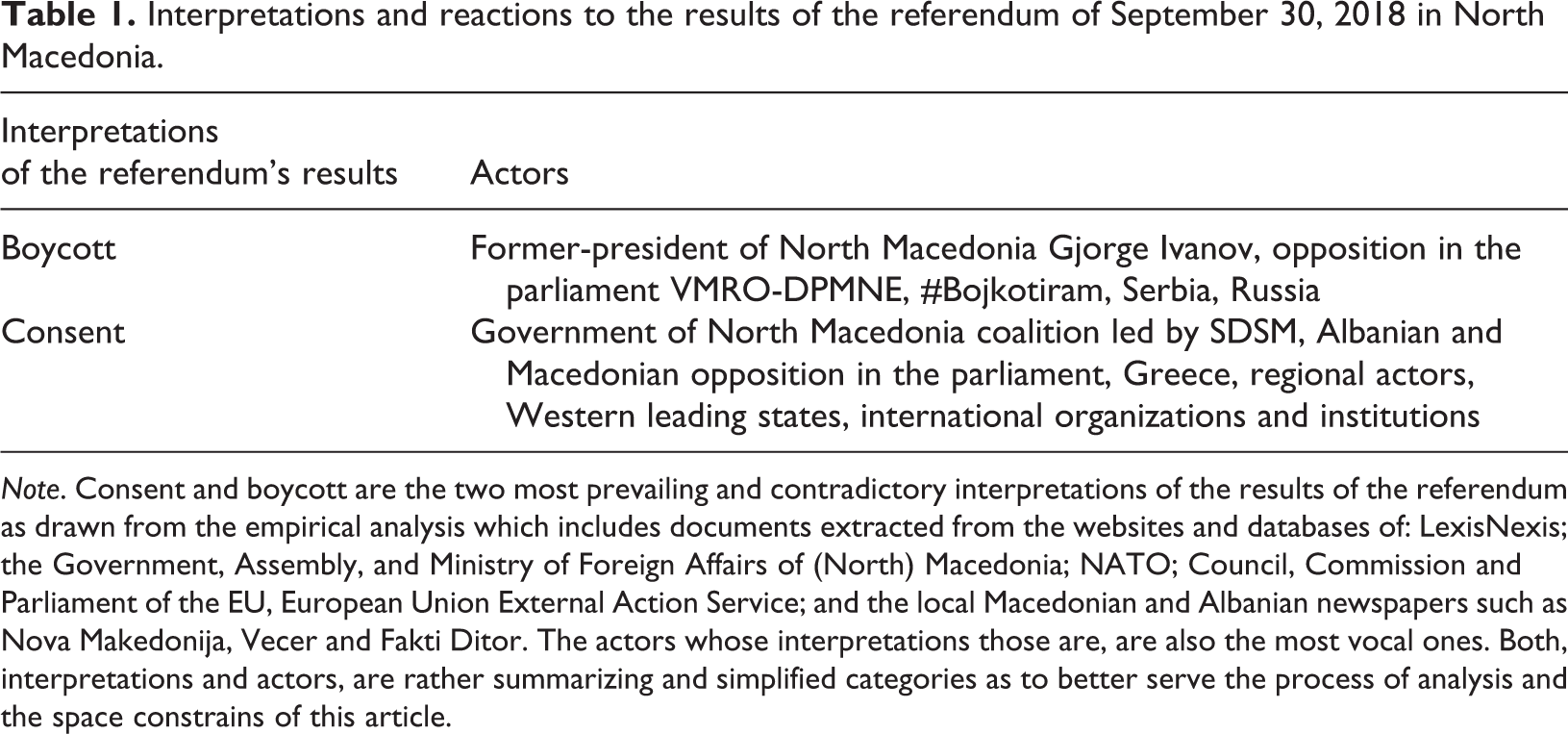
Note. Consent and boycott are the two most prevailing and contradictory interpretations of the results of the referendum as drawn from the empirical analysis which includes documents extracted from the websites and databases of: LexisNexis; the Government, Assembly, and Ministry of Foreign Affairs of (North) Macedonia; NATO; Council, Commission and Parliament of the EU, European Union External Action Service; and the local Macedonian and Albanian newspapers such as Nova Makedonija, Vecer and Fakti Ditor. The actors whose interpretations those are, are also the most vocal ones. Both, interpretations and actors, are rather summarizing and simplified categories as to better serve the process of analysis and the space constrains of this article.
Before dismantling these two predominant interpretations of the silence of nonvoters, let us first set the context. The question on the ballot stated: “[a]re you in favor of European Union and NATO membership by accepting the agreement between the Republic of Macedonia and the Republic of Greece?” The Prespa agreement 6 to which the question refers to, was signed on June 17, 2019. The agreement which was led by the intent of triumphing over a 27-year long dispute between North Macedonia and Greece since the former’s (then called Republic of Macedonia) independence in 1991, would result with the name of (the Republic of) Macedonia being changed into (the Republic of) North Macedonia erga omnes. This long-standing and deep-rooted quarrel between the two countries had begun with Greece refusing to recognize the country’s then constitutional name “Republic of Macedonia” and its citizens as “Macedonian” under the account that this would have raised identity questions and territorial aspirations in relation to Greece’s northern region, also called Macedonia. Under the Interim Accord 7 reached with the help of UN auspices, Greece had agreed not to obstruct North Macedonia’s membership in international bodies given that the country used its UN reference i.e. the former Yugoslav Republic of Macedonia (FYROM). However, this showed not to be the case as Greece would continue to block North Macedonia’s accession to NATO and the EU, and North Macedonia was stuck on its path into Euro-Atlantic integration processes. This hence explains also the referendum question which suggested that the change of name of the country was tantamount with its integration into the EU and NATO.
The referendum came after these and many other series of events as a result of the Prespa agreement which was deemed “historic[al]” by too many local and international actors for one to count. Among those who eagerly celebrated it was the High Representative of the Union for Foreign Affairs and Security Policy Federica Mogherini (European Union External Action, 2018b; European Union External Action, 2019), Commissioner Johannes Hahn (European Union External Action, 2018a), UN’s Special Representative Matthew Nimetz, who had been dealing with the Macedonian issue since 1994 (United Nations Secretary-General, 2019), as well as Heather Nauert, the U.S. State Department’s spokeswoman (US Embassy in North Macedonia, 2019). NATO was just as enthusiastic, with its Secretary General Jens Stoltenberg having welcomed the “historic agreement” (NATO, 2018a). The same descriptive lexicon was used by the Minister of State for Europe at the German Federal Foreign Office Michael Roth (2018), and also by the Chancellor of Austria Sebastian Kurz (2018). Just as vocal about it, among the many members of the North Macedonian governing coalition led by the Social Democratic Union of Macedonia (SDSM), was the country’s Foreign Minister Nikola Dimitrov. With regards to the referendum, which was yet to take place, Dimitrov said that “the crossroads we are facing is historic, we should decide together whether we will make the step forward or stand still, that is, go back in the pit” (Republic of North Macedonia Ministry of Foreign Affairs, 2018).
While the results of the referendum met one of the legal criteria for being considered as valid, in that the majority of those who voted said “yes” to the question at the ballot, they failed to meet the criteria of most of the eligible voters casting their votes. Article 30 of the Law on Referendum and Other Forms of Direct Declaration of the Citizens (Official Gazette of the Republic of Macedonia, 2005: 26) stipulates that “[r]eferendum decisions at the state level are considered adopted if voted by the majority of the total number of citizens who have voted, [and] if more than half of the total number of citizens registered in the Voters List have voted.” With this, the consultative message of the referendum would have been one where the answer did not meet the criteria for it to be considered neither as affirmative as the supporting actors treated it, nor as negative as the opposition did. Further complexities became apparent as, while the option for consultative referenda exists in the Referendum Law (Article 27), Article 73 of North Macedonia’s Constitution states that the “decision reached via referendum is binding” having also established in the same article that “[t]he decision of the majority of voters in a referendum is adopted on condition that more than half of the total number of voters voted.” This is further problematized if one historically contextualizes the results of the referendum by noting that the 2018 referendum was only the second time since the country’s independence that the 50 percent threshold was not met (Reflektor, 2019), the other being the referendum in 2004. The latter was an attempt to reduce autonomy for the Albanian minority in the country and the greater control of local authorities. Contrary to calls to not remain silent, which the EU and NATO directed to Macedonian citizens during the name referendum, in 2004 they had in fact urged boycotting the referendum (Bos, 2004). The same actors that relied on the speech clause of democracy to treat the results of the 2018 referendum as consent, had previously attempted to, in a way, impede the democratic ideal of voice. One must here recall that that the autonomy of the Albanians that the 2004 was aiming to curtail was the result of the Ohrid Framework Agreement (2001) which put an end to the armed conflict of 2001 in North Macedonia, and which being mediated by both the EU and the United States (US) was considered a major political victory for both.
During the 2018 referendum, the EU and NATO who had declared the agreement as historic, deemed the results of the referendum as overwhelmingly positive and democratic, and moreover a sign of consent. “A great day for #democracy in #Skopje!” tweeted Commissioner Hahn (2019) upon the decision of North Macedonia’s Assembly on the 19th of October 2019 to start the process of renaming the country. In another joint statement of Hahn and Mogherini, they had both stated that “[i]n a peaceful and democratic vote an overwhelming majority of those who exercised their right to vote said yes to the Prespa agreement” (European Commission, 2018). Through the same lexicon, the UN Secretary-General António Guterres urged the country to proceed with the name change recalling “[t]he importance of the fact that an overwhelming majority of those voting, supported the Prespa Agreement” (United Nations, 2018). “It was a clear majority in favour of the name agreement” (NATO, 2018e) said Stoltenberg, and that he welcomed “the ‘yes’ vote.” Interpretations of silence as consent are also found in the reactions of Greece (Tsipras, 2018), and some of the Balkan regional actors such as Slovenia’s Foreign Minister Miro Cerar who saw “the result as a convincing message” reported Total Slovenian News (2018).
The interpretations of the referendum’s results as consent by these actors are well-aligned with the position of the government of North Macedonia coalition led by SDSM, Albanian opposition in the parliament who also supported the agreement and some members of VMRO-DPMNE who voted for its ratification. North Macedonia’s Prime Minister Zaev commented on the referendum as a sign of “success for democracy and for European Macedonia” (Government of the Republic of North Macedonia, 2018). SDSM’s MP Snezana Kalevska Vanceva had interpreted the consultative nature of the referendum as one which demands the results of the referendum to be read as consent. According to Kalevska Vanceva it is the MPs’ “obligation under the Constitution…to ratify that referendum” (Assembly of the Republic of Macedonia, 2019), though, as stated above, article 73 of the constitution requested that more than half of the total number of voters to vote for the decision to be adopted. Those in support of the agreement who also treated the results of the referendum as consent relied on two contradictory arguments: that the decision was binding since an overwhelming majority of those who voted said “yes”; but also, that the referendum was of consultative nature and therefore the fact that the 50 percent turnout of registered voters was not met is inconsequential. They would also draw references to the outdated list of registered voters (Burazer, 2018; see for more Veselinovic, 2018) which, as the Foreign Minister Dimitrov had explained, is what makes it seem that the issue is the turnout. Such rationalizations, however, open the space for one to ask whether the government had not known the situation with the outdated list of registered voters prior to declaring the referendum; and if yes, then why was not remedied before the vote took place.
All in all, in a self-contradictory fashion, the coalition supporting the agreement acknowledged silence when referring to the referendum as not binding due to the low turnout, but it nevertheless treated it as consent by continuing to ratify the agreement through the parliament. To treat silence as consent and ratify the agreement, the governing coalition relied on the democratic speech clause, claiming that 91.46 percent of voters who backed the agreement need to be listened to. This was not to encourage the democratic citizen who remained silent to speak and hence strive to reach the normative democratic ideal—else, it would not be infused with meaning—but to materialize political agendas. Though there was no legal obligation under the Prespa agreement for the referendum to take place, Stoltenberg had explicitly said that NATO would invite North Macedonia to join the alliance only “given that the agreement between Skopje and Athens is finalised, also with a referendum in the former Yugoslav Republic of Macedonia” (NATO, 2018c). He had many times confirmed that “there is no other way” (NATO, 2018h), that there is “no alternative way” (NATO, 2018f) or “no plan B” (NATO, 2018g) to join NATO without an agreement with Greece. Upon the signing of the agreement, he had said that this is a “once in a lifetime opportunity” (NATO, 2018h) or a “unique opportunity” (NATO, 2018b) in a joint statement with European Council President Donald Tusk. Mogherini too had added that such an opportunity “might not come again any time soon” and hence the citizens of Macedonia could not afford to remain silent, as had the Prime Minister Zaev stated that “this chance will not be repeated” (Smith, 2018). Zaev had come to power in 2017 forming a parliamentary majority with the Democratic Unity for Integration (DUI) and Alliance for Albanians following the 2016 early elections in the country. In his inauguration speech, he had vowed to take the country into NATO and begin accession talks with the EU by the end of his mandate (Marusic, 2020). “We don’t change our name because we want to do it. We do it because of our future in the EU and NATO. Everyone is aware why we do it” Zaev stated elsewhere (Delauneyuy, 2018). And indeed, North Macedonia did get an invitation to join NATO in July 2018, while in March 2020 the EU decided to open accession negotiations with the country (Council of the European Union, 2020).
Let us now turn to the opposition which viewed silence as boycott. These actors had called for boycotting the referendum even prior to the results and hence interpreted the results along the same lines. The then President of North Macedonia Gjeorgje Ivanov, had called explicitly for a boycott and referred to the change of name as a “historical suicide” (Radio Free Europe/Radio Liberty, 2018). Moreover, a self-defined “anonymous decentralized group without a leader” (#Bojkotiram, 2019) had through different Twitter and Facebook accounts called for boycott and interpreted the results just the same. Their proclamation says: “[w]e, the Macedonians…guided by the majority will of the people expressed in two referendums (mandatory 1991 and consultative 2018)…invite everyone to unite now, with one single goal: organizing a continuous and massive Resistance to the illegitimate and illegal constitutional changes” (Proclamation #Boycott of constitutional changes, 2018). According to Macedonia’s Investigative Reporting Lab, Russia had been suspected for standing behind #Bojkotiram in North Macedonia (Kampanjata na Bojkotiram ja vodi pomala grupa za koja stojat ruski službi? 2018). Michael Carpenter, a former Obama administration official, supported such claims (Santora and Barnes, 2018), and so did the U.S. Defense Secretary Jim Mattis (see Baldor, 2018). Ministry of Foreign Affairs of the Russian Federation had reportedly released a statement suggesting the low turnout was a reflection of the citizen’s boycott on the deal (see Gotev, 2018), and the Russian Ambassador to Skopje, Sergei Bazdnikinhad had “recalled that nearly two thirds of Macedonians boycotted the referendum” (TASS Russian News Agency, 2018). Different from most other regional actors, Serbia’s position seemed aligned to that of Russia as the President of Serbia Aleksandar Vučić, during a visit in Moscow had stated: “I’m afraid and it seems to me that some people from abroad underestimate us, people from the Balkans” (Agatonović, 2018) alluding to the Western celebratory mood on the results of the referendum and their encouragement for the Prespa Agreement to nevertheless be ratified.
Ivanov, who had previously called the Prespa agreement a “criminal act” (Sekularac, 2018) and refused to sign it off, would later say in his address to the Assembly of North Macedonia: “the silent majority brought a loud decision,” and that this was “a sign of democratic maturity” (Assembly of Republic of Macedonia, 2018c: 3). Ivanov who had been appointed as the presidential candidate for the 2009 Macedonian presidential election by the now largest party in opposition, the Internal Macedonian Revolutionary Organization—Democratic Party for Macedonian National Unity (VMRO-DPMNE), was only one among those who opposed the Prespa Agreement and interpreted the results of the referendum mainly as a sign of boycott. As the government went ahead with ratifying the agreement through the Assembly on July 5, 2019, “[t]he silence of the million and 200,000 citizens in the Republic of Macedonia was a response to the rape you committed against democracy” (Assembly of Republic of Macedonia, 2018a: 4) said Nikola Micevski, the coordinator of the parliamentary group of VMRO-DPMNE. Referring to the government’s decision to nevertheless proceed with the ratification of the agreement through the Assembly, Micevski would declare that “SDSM is erasing democracy in Republic of Macedonia through disrespecting the will of its citizens expressed in referendum” (Assembly of Republic of Macedonia, 2018b: 11). Although VMRO-DPMNE had interpreted the results of the referendum as reflecting of boycott in the aftermath of the referendum and had explicitly rejected the agreement, its leader Hristijan Mickoski in an official press conference declared his party’s official position: “[w]e do not accept the name agreement,” but he also had stated that “every citizen should act according to their own conviction” (Alsat, 2018). Mickovski, however, applied his own conviction to the silence of the citizens who decided not to vote by saying that “Macedonia spoke out today, saying that this referendum will not pass” (Veselinovic and Cullinane, 2018) just a day after the referendum. The majority of eligible voters, however, had not spoken that day by not appearing to vote, and neither had they said that “this referendum will not pass.” They, instead, were silent.
Such actors who interpreted the silence of nonvoters as boycott asked the governing coalition to listen to the will of the democratic citizens, but at the same time, also in a self-contradictory move, referred to the referendum as advisory and called for ignoring the speech of 91.46 percent of voters, when these voters were highlighted as a sign of consent to the ratification of the agreement. These incongruences again call for attention to contradictions: either the results of the referendum are binding as a sign of boycott and a “no” vote from the silent nonvoters, which would then mean that so is the speech of the 91.46 percent of voters binding; or, by the same token, the speech of the 91.46 percent of voters at the referendum is unbinding because it does not reach the 50 percent turnout of eligible voters, but with this so is not binding the silence of nonvoters as a boycott.
An insistence of interpreting silence as boycott and yet arguing from a democratic position, entailed refusing to treat silence as simply ambiguous. Here, the interpreters on the opposing side of the 2018 referendum in North Macedonia share a reading in common with hitherto scholarship on democratic theory. On the other hand, by choosing to focus on the voice of the 91.46 percent of voters who voted “yes,” the political actors who supported the agreement, also ignored the silence of nonvoters which was the silence of the majority of North Macedonia’s eligible voters. Their focus on speech also implied an automatic treatment of silence as consent, and not as ambiguous. Since democratic theory maintains a speech-centered normative approach, these political actors could claim that they were only acting democratically by listening to speech, as they were infusing meanings into the silence of nonvoters.
There is yet no self-reflective epistemological basis to take note and call out this dynamic whereby the speech clause of democratic theory and the ideal democratic society of citizens where everyone always vo-tes/ices their concerns is turned against its own logic and used for political gain. Hitherto approaches of studying silence as meaning focus only on why the nonvoters did not vote, and not on what did their representatives do with their silence. The latter was instead made apparent precisely through silence’s presence and not the lack of it. Had the abstention been much lower, this break into the democratic game of the political elites in North Macedonia but also of the regional and international actors, would not have been as analytically irruptive. An acknowledgment of silence as of analytical potential precisely due to and not despite of its inherently ambiguous nature demands for a postulate of analysis which holds that the silence of nonvoters per se can only be meaningless unless the speech of those who remain silent intervenes. As such, any interpretation of the same can only be speculative, and thus we must refrain from such an endeavor. The process of analysis here is guided first, by the principle of seeing the silence of nonvoters as of analytical potential; and second, by avoiding assigning to it a possible meaning which would replace that of the nonvoters. Instead, it reaches toward the interpretations of that silence, which is what it epistemologically can be certain of, and allows for silence to irrupt the same, uncovering the inconsistencies within and among those interpretations. This is the analytical power of recognizing ambiguous silence, which we will never get to really know (unless through speech). It is precisely silence as ambiguity i.e. one without (a clear) meaning, which irrupts and discloses the political game of those who speak on behalf of the citizens of North Macedonia as defenders of democracy.
Conclusion
Democratic theory, although having already stepped forward into reimagining silence as of value for an understanding of democracy, treats those who do not speak as having something to say and having to say something. With this the endeavors of most democratic scholars have hence remained ones led by questions of what would there have been said should democratic citizens have spoken. Silence, having been reduced to either the inability or the choice for one to refrain from speech, gave birth to a long-standing tradition of scholars that continue to be focused on discovering the reasons and potential meanings behind silence, and so becoming the spokespeople of the silent ones. Therefore, silence is still an analytical obstacle to overcome. This stands in juxtaposition to more recent IR contributions to the study of silence which seek to look at silence from what it does rather than what it means. This can only be possible if its inherent ambiguity is taken into consideration as something of analytical value. Such an ambiguity breaks the assumption that there is inevitably a choice, meaning or reason behind any silence which we can fully grasp and interpret, and it hence opens the space for looking into all that silence can do or does and which is not bound or limited to the possible intentions of those who remain silent.
Bridging IR and democratic scholarship on silence, this article has argued that the epistemic focus of a speech-centered approach of democratic scholars needs to change. Scholars of democratic theory should consider getting comfortable with, and arguing from and within, a self-reflective epistemological position which recognizes its speech bias, and acknowledges the ambiguity of silence as of analytical value. The name issue in the now North Macedonia was used in this article to illustrate the analytical potential that the ambiguous nature of silence has for scholars of democratic theory. The case shows how turning the gaze toward silence-as-doing reveals opportunities for identifying and unpacking instances where politics exploits the democratic imperative of speech for supporting political agendas rather than the fostering of the democratic imperative of voice. The consultative referendum on the change of name of Macedonia into North Macedonia did not meet the standards to be considered conclusive. Yet, political representatives ascribed their own political agendas, set prior to the voting taking place, into the results of the referendum by all interpreting the silence of nonvoters to their own benefits. Yet all claiming to do what was democratically right. They did this precisely by taking advantage of the speech clause of democratic theory and its adversarial relationship to silence. It is because silence (as ambiguity) is so intolerable that the silence of nonvoters was turned into speech and interpreted as either consent or boycott. Any other interpretation, including that the nonvoters might have deemed their representatives as preoccupied with furthering their political agendas through their international peers rather than advancing the democratic ideal of speech and hearing their citizens’ vo-ice/tes, was left unconsidered.
The speech clause of democratic theory is hence, in a way, utilized against itself, and the article arrives at this conclusion not through discovering the meanings behind nonvoters’ silence, but through judging on the basis of the agency of those who speak. It takes a different epistemological route which exposed, juxtaposed and contextualized the speakers’ interpretations of the meanings behind nonvoters’ silence, avoiding in this way any attempt to speak on behalf of the silent ones as politicians do. The insights that derived would not have been made as apparent had one, the low voter turnout i.e. the nonvoters’ silence been much lower; and two, had this article speculated on its possible meanings instead of accepting its ambiguity and turning the gaze toward its interpretations. Therefore, it is because and not in spite of silence that so many questions were raised; and it is because the silence was ambiguous that the political games played from within the democratic logocentric order could be exposed. This analytical approach has the potential to shed light on other cases and democratic events, beyond silence as nonvoting in a referendum, and beyond North Macedonia, and this article provides a groundwork for further explorations of this potential.
Footnotes
Acknowledgements
This paper has significantly benefited from the excellent feedback of Adriana Cuppuleri, Gëzim Visoka, Husni Ashiku, Kenneth McDonagh, Maria Todorova and Xavier Guillaume, as well as contributions from friends and colleagues from the East European Reading Group (EERG) and the Russian, East European, and Eurasian Center (REEEC) at the University of Illinois, Champaign-Urbana. I am thankful to the School of Law and Government, Dublin City University (DCU) and the Irish Research Council (IRC) for financially supporting this article.
Declaration of conflicting interests
The author(s) declared no potential conflicts of interest with respect to the research, authorship, and/or publication of this article.
Funding
The author(s) disclosed receipt of the following financial support for the research, authorship, and/or publication of this article: Funding have been received from School of Law and Government, Dublin City University, Dublin, Ireland and Irish Research Council, Dublin, Ireland.