



Abstract
Vaccine hesitancy is a threat for global health. Shortly, millennials and Z generation (gen-Z), the digital natives, are responsible for the future of the children. No study was found yet regarding child immunization and the usage of media in Jakarta, Bogor, Depok, Tangerang and Bekasi (Jabodetabek), Indonesia. This study aim to determine factors affecting millennials’ and Z generation’s knowledge about child immunization and the usage of media as the source of health information. Online questionnaire was distributed from 25th September to 20th November 2020 to students and workers in Jabodetabek. Subjects with child and/or <15 or >40 years old are excluded. Analysis was done with SPSS 20. Total of 376 subjects with mean age 18 (15-38) years old were collected. Subject’s varies from high school students (48.4%), university students (46.2%) and workers (1.6%). Total of 357 (94.9%) subjects willing to complete their future child’s immunization. Internet was the primary source of health information for 357 (94.9%) subjects, especially Instagram for 129 (34.3%) subjects. Concluded that subjects’ immunization status affects their willingness to fully vaccinate their future children. Digital media (Instagram) is the primary source of health information. Educational background affects their consideration in trusting online sources
• Vaccine hesitancy is a threat to global health.
• Nearly 67 percent of Indonesia’s population are millennials and Z generation (the digital natives) who will become parents in the next few years and are responsible for their children’s health.
• No study has been found yet regarding millennials and Z generation’s knowledge of child immunization and the usage of media as the source of health information in Jakarta, Bogor, Depok, Tangerang and Bekasi (Jabodetabek), Indonesia.
• Subjects with complete immunization status are more likely to agree to give their future children complete immunization compared with subjects who have incomplete immunization status or unaware of their immunization status.
• Digital media, mainly Instagram, is the primary source of health information for these generations in Jabodetabek, Indonesia.
• High school students are more influenced by others’ opinion, such as family members, instead seeking sources of health information from existing heatlth media.
Introduction
Vaccine hesitancy is a threat for global health especially for the young populations. It is considered 1 of 10 threats toward public health according to World Health Organization (WHO) in 2019. The definition of vaccine hesitancy is the delay in acceptance or refusal of vaccination despite availability of vaccination services, concluded by Sage Working Group. American Academy of Family Physicians (AAFP) did a research on 1500 citizens in the United States aged 25 to 73 years old and concludes that young population, the millennials and Z generations, are at risk toward vaccine hesitancy.1-3 WHO considered Indonesia has a low immunization coverage. Baseline Health Research (RISKESDAS) 2018 report shows that only 57.9% children in Indonesia have a complete basic immunization status and 9.2% children do not receive immunization at all. Low immunization coverage can cause outbreak of diseases that can be prevented by immunization, such as diphtheria, polio, and measles.4-6 Central Bureau of Statistics (Badan Pusat Statistik) in Indonesia found that most population in this country marry at the age of 20 to 23 years old. This means in a few years ahead millennials and Z generations (gen-Z) will become parents that are responsible for the future of the children. Early interventions are needed to prepare their health literacy to achieve a healthy and success Indonesia.8,9
Data varies in determining the cut off birth year that classified as millennials and gen-Z, most mentioned 1980 to 2005 considered as millennials and gen-Z. These are the unique generations raised in a constant state of connectedness through the Internet, smartphones, and fast-moving digital technology but they are also more individualistic and diverse in values. This unique characteristic may make it difficult for them to engage with traditional health communication culture.7-9 Health care professionals should take part in creating an effective health promotion, together with other sectors and government, to this generations that are responsible for our future. No study was found yet about millennials’ and Z generation’s knowledge on child immunization and the significant sources of information. This study’s objective is to determine factors affecting millennials’ and Z generation’s knowledge about child immunization and the usage of media as the source of health information in order to improving the way health promotion brought to this evolving generations that are soon going to be parents.
Methods
Online questionnaire was distributed through social media and online communication platforms with total sampling from 25th September to 20th November 2020 to students and workers in Jabodetabek that had access to internet as the inclusion criteria. Subjects with child and/or younger than 15 years old or older than 40 years old are excluded. Questionnaire includes demographic questions of the subjects and parents, basic immunization status, source of immunization, and health-related information, willingness to fully vaccinate future child. Analysis was done with SPSS 20 program.
Results
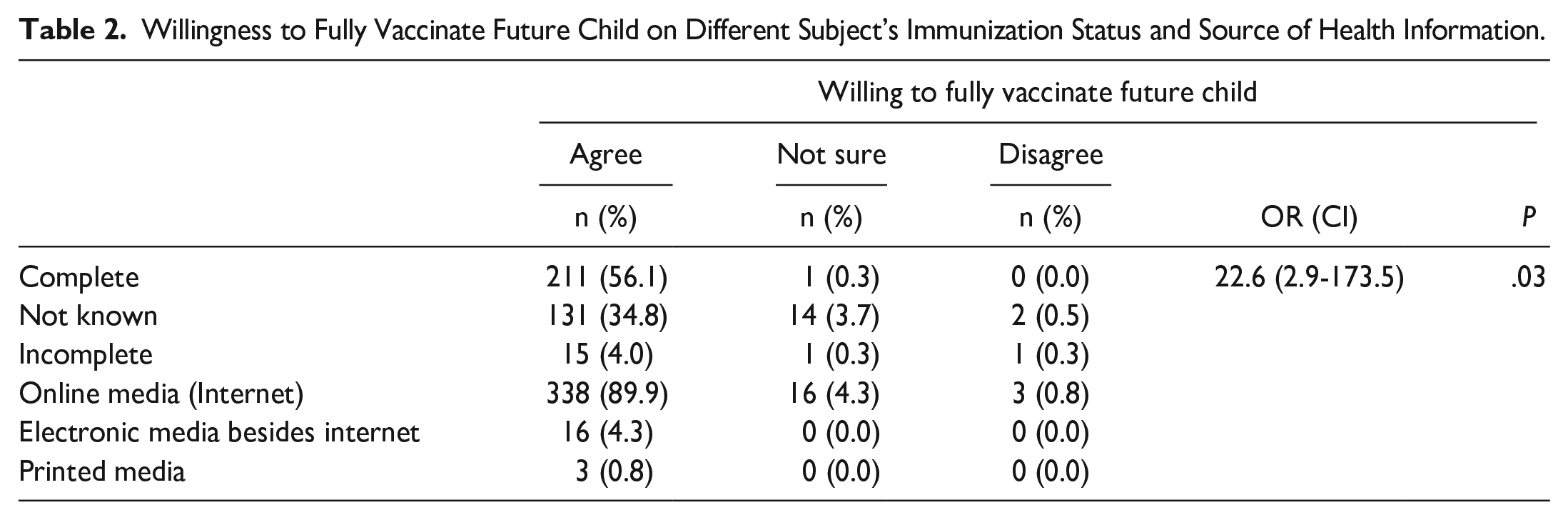
Table 1 shows the demographic characteristic of 376 subjects with mean age 18 (15-38) years old were collected, 203 (54%) subjects are female. Subject’s varies from high school students (48.4%), university students (46.2%) and workers (1.6%). Most parents (235 (62.5%) fathers, 242 (64.4%) mothers) graduated college. More than half (212, 56.4%) subjects aware and complete their basic immunization as shown in Table 2. Almost all 357 (94.9%) subjects are willing to complete their future child’s immunization. Table 3 shows that internet is the primary source of health information for 357 (94.9%) subjects, especially Instagram, chosen by 129 (34.3%) subjects.
Subject Demographics and the Characteristic of Perception Toward Immunization and the Usage of Media for Health Information.

Willingness to Fully Vaccinate Future Child on Different Subject’s Immunization Status and Source of Health Information.
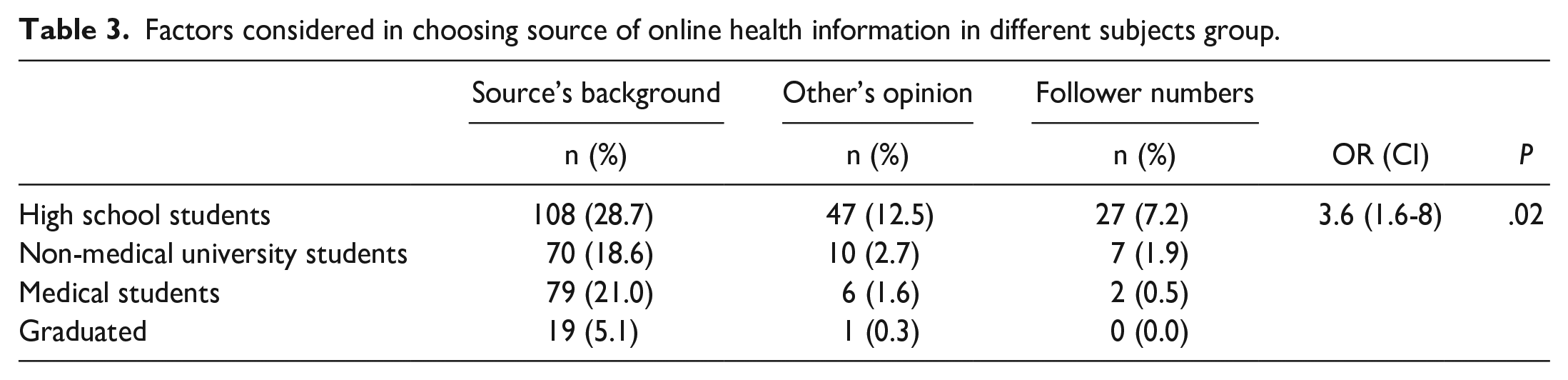
Factors considered in choosing source of online health information in different subjects group.
Discussion
Millennials and Gen Z: In Whom Our Future Holds
Around 67% of Indonesia population were born on 1980 and above, which categorized them into the millennials and Z generation. Indonesia’s economy depends on these generations where 52% of economy activity comes from them who are around 20 to 40 years old at the moment. The youngest age of a marriage according to law in Indonesia is 19 years old, where in 2019, 20 to 23 years old are the most common age. This data informs that in 5 to 10 years ahead, millennials and Z generation are becoming parents that carry the obligation to take care of their children’s health. The important decisions about our youngest populations, including the decision to vaccinate, will be soon depending on them.3,7-10 Unless we can make reasonable projections, we cannot address or mitigate healthcare needs and health care demands for this key segment of our population. 11
Vaccine Hesitancy
The definition of vaccine hesitancy referring to SAGE Working Group on Vaccine Hesitancy is the delay in acceptance or refusal of vaccination despite availability of vaccination services. This is a complex issue that varies across time, place and vaccine types. 12 Vaccine hesitancy is included as one of the 10 threats to global health in 2019 according to World Health Organization (WHO) report. 13 In another blow, the COVID-19 pandemic threatens to set back hard-won global health progress achieved over the past 2 decades—in fighting infectious diseases, for example, and improving maternal and child health. 14 American Academy of Family Physicians (AAFP) cited that millennials give the most uncorrect answer on a questionnaire about vaccination knowledge in a research with 1500 subjects in the United States. From the same research, more than 50% of the subjects that agree about the anti-vaccine statements are also millennials. 8 No data was found yet about vaccine hesitancy in millennials and Z generation in Indonesia while this study shows that 357 (94.9%) subjects agree that basic immunization is crucial for children and they willing to fully vaccinate their children in the future. Most of them also are fully vaccinated (212 subjects, 56.4%) while some do not aware of their basic immunization status (147 subjects, 39.1% (Table 1). These findings are found similar between all education backgrounds.
In this study, Table 2 shows that subjects with complete basic immunization are more willing to fully vaccinate their future children (P .03, OR 22.6, CI (2.9-173.5)) and different source of health information does not affect this perception. The future of our children also depends on the situation of previous generation. Studies explained that biological, epidemiological, economic, and logistical are known to affect the achievement of immunization program. In the other hand, social-determinants such as parental education, financial support, parenting practice and cultural tradition also play role in low-middle income countries. 15 A published literature from a research done in 200 mothers whose child were 9 to 59 months in Pekan Baru, Indonesia found that Measles-Rubella immunization uptake increases with high maternal education, maternal knowledge, strong family support, high perceived susceptibility. 16
Most common reasons behind vaccine hesitancy were risk-benefit (scientific evidence), knowledge and awareness and religion/culture/gender/socio-economic, however data validity still needs to be improved since not many country are doing evaluation regarding this problem. 17
A Challenging Milestones for Health Promotion to the Digital Natives Generation
Online platform is the main information source for 357 (94.9%) subjects on this research (Table 1). Besides Instagram (129 subjects, 34.3%), search engine website is the most used platforms for the millennials and gen-Z to find information related to immunization and other medical conditions (96 subjects, 25.5%). Most subjects choose video (216, 57.4%) as the most convenient of information form followed by infographic posters (98, 26.1%). There is no difference between subjects’ and parent’s education background toward these findings (P > .05).
Health misinformation needs to be prevented by having a good digital literacy. This study shows that high school students are more at risk to be affected by others’ opinion compared with doing more research themselves about the account’s credibility while trusting online sources of health information; P .02, OR 3.6, CI (1.6-8) (Table 3). A research held by Harvard School of Dental Medicine and Northeastern University College of Social Sciences and Humanities acknowledge that the most influential online sources about immunization were the health community (National Institutes of Health, Centers for Disease Control and Prevention) or mainstream media (New York Times). It said that the vaccine-hesitant community simultaneously used primary pro-vaccine article within vaccine-hesitant narratives. 18 In Indonesia, The third International Conference on Transformation in Communication (ICoTiC 2017) mentions that 54 000 articles related to immunization on June-July 2016 are titled with misleading headlines according to Indonesia Police Criminal Investigation Department (BARESKRIM Polri). 19 These findings demonstrate an unsafe online environment where rules are not strict enough to prevent the media to mislead young populations and affecting their decision about health-related choices. Evidence based literature are available more in scientific platform with medical narratives that are not quite accessible for young or non-medical populations. On the other hand, vaccine-hesitant communities are still grow in numbers. 18
The importance of online media in the evolving medicine practice 4.0 should be a drive for all health related professionals to participate in improving the online environment. Indonesia still needs to improve the legal policy that restrict online health misinformation. A specific digital policy can be collaborated with technology innovations where strict restriction and blockage of online health misinformation was done by the server itself through keywords analyzing. 20 Indonesia Ministry of Health mentioned that medical professionals need to be prepared with a more complex competency such as data and technology literation and equipped with interprofessional knowledge to build an interdisciplinary health care services in the digital era.21,22
Other than media, high school students compared with university students and workers aged group are more likely to trust health information from family members although they do not have medical background; P .01, OR 2.7, CI (1.5-4.8). Attention to improve the delivery of health promotion and medical practice needs to start soon with an agility that fits the evolving generations, therefore they can become a prepared parents in the following decades. Millennials and Z generation was raised in a constant state of connectedness through the Internet, smartphones, and fast-moving digital technology but they are also more individualistic and diverse in values. This unique characteristic may make it difficult for them to engage with traditional health communication culture. Literature suggests the SHAPE frameworks which consist of Seek to understand, Humbly communicate, Authentic, Partner with others and Engage in future thinking to prevent the pitfalls in communicating with the digital natives generation. 9 International Training of Trainers of International Pediatric Association (IPA) Vaccine Hesitancy Project 2018 addressed that community advocacy can be an effective tools to reach vaccine-hesitant populations. Deep research regarding the reasons behind this community and the cultural characteristic should be prepared continued with 3 main messages: the facts about the problems that we find in their community, the solution that we suggest to make their community better and the action we propose to be taken collaboratively with them.
Conclusion
Millennials and Z generation are shortly becoming parents that have urgent needs to understand the importance of child immunization. This study finds subjects with complete immunization status are more likely to agree in giving their future children complete immunization. Digital media, mainly Instagram, is the primary source of health information for these generations. High school students are more influenced by others’ opinion while choosing the source of health information from the media. Strict government policies are urgently needed to prevent health misinformation in the era of digital based healthcare service especially preparing for the future of the digital natives.
Footnotes
Acknowledgements
All authors participated in substantial contributions in this article.
Author Contributions
All authors contributed to the design and implementation of the research, data collection, data analysis and manuscript writing.
Declaration of Conflicting Interests
The author(s) declared no potential conflicts of interest with respect to the research, authorship, and/or publication of this article.
Funding
The author(s) received no financial support for the research and authorship of this article.
Ethical Approval
This study was approved by Ethical Clearance Committee Faculty of Medicine Catholic University of Indonesia Atma Jaya with ethical approval number: 06/06/KEP-FKUAJ/2020.
