




Abstract
Objective:
The exposure of organophosphate could be caused by the absorption in some parts of the body like skin and breath. Toxicity may cause nausea, vomiting and dizziness which are not too specific related with the pesticide toxicity. The purpose of this study is to understand the association between organophosphate exposure and farmers’ health in Kulon Progo County from the perspectives of physical, emotional and social health.
Methods:
This study was conducted using descriptive observational design. The blood sample was collected during harvesting periods in 2016. The inclusion criterion of farmers was using organophosphate-contained pesticide during the planting period of red onion. The farmers who had renal disease, liver disease and cancer were excluded. The organophosphate exposure parameters were the duration and frequency of pesticide application, width of the area, serum cholinesterase activity and the completeness of personal protective equipment.
Results:
Among 84 farmers, most of them were male (85.7%), and the mean age was 49.1 (standard deviation: 12.5) years; 71.4% of the subjects experienced tremor, 17.86% experienced dizziness and 8.33% subjects experienced nausea–vomiting after pesticide application. According to the pesticide application, in average, subjects used pesticide 1.4 h/day with the area of 1.285 m2. The frequency of pesticide used is three times per week. Around 97.6% subjects used incomplete personal protective equipment. The average of serum cholinesterase activity in subjects with tremor is higher than subjects without tremor (p > 0.05). There is a significant association between serum cholinesterase activity and creatinine content (p < 0.05). The farmers’ quality-of-life domain scores are lower than the scores of the normal population in Yogyakarta.
Conclusion:
Organophosphate exposure may affect the farmers’ physical health and quality of life.
Introduction
Organophosphate is the chemical agent which is mostly used as insecticide and is an addictive agent in the particular industry.1,2 Currently, hundreds of active agents and formulation of pesticides are available in the world with the cost of US$30 million. 1 Around the world, 3,000,000 people are exposed to organophosphate yearly with 300,000 fatal outcomes.3,4 According to United Nations Press Release in 2004, it was predicted that 1–5 million organophosphate poisoning presence was estimated every year and thousands around them were experienced by the farmers. Most of the cases were present in underdeveloped country due to less hygiene, information and limited self-protection. The mortality cases due to the organophosphate poisoning reached 99% in Asia, Europe and the United States.5–15
The mechanism of organophosphate’s toxicity is via inhibiting the acetylcholinesterase (AChE).16,17 The inhibition of AChE will cause the increase in acetylcholine concentration in the synapse. This mechanism will cause some nicotinic and muscarinic symptoms and central–peripheral nervous system toxicity. 18 Generally, the neurologic symptoms will appear when the AChE reached 50% inhibition. 19 Even though the mechanism of organophosphate toxicity is primarily through AChE inhibition, however, through the cholinergic crisis, there are several other enzyme systems which get affected. The toxic outcome is a collective manifestation of all these systems. 20
Organophosphate poisoning can be acute or chronic. The symptoms of acute toxicity are hypersecretion, bronchoconstriction, myosis, diarrhea, bradycardia, central nervous system (CNS) depression, seizure, cyanosis and coma. 18 These symptoms will appear within 24 h after pesticide application. Symptoms of acute toxicity will be reversible if properly treated; however, the effect will be fatal if the treatment is inappropriate. 21 The organophosphate poisoning was experienced by the farmers through inhalation or dermal contact. The severity of organophosphate depends on pesticide type, dose, duration of application and frequency of application. The intensity of organophosphate poisoning was influenced by the area of pesticide application, climate, skill of application and personal protective equipment. 22 Previous studies reported the significant association between organophosphate exposure and acute renal failure.23,24 One study found that inhaled organophosphate exposure may cause acute renal failure and the need for hemodialysis. 25 Organophosphate toxicity is also associated with the tremor as one of the extrapyramidal symptoms in around 59% farmers which resulted in prolonged ventilation and hospitalization. 26 Furthermore, mild leukocytosis and decrease in hemoglobin were also associated with organophosphate poisoning.27,28 This study aims to understand the association between organophosphate exposure and farmers’ health in the Kulon Progo county from the perspective of physical, emotional and social health.
Methods
We conducted cross-sectional studies among red onion cultivating farmers of the Kulon Progo county of Yogyakarta. The blood analysis was conducted during the harvest time of red onion which was in February, June and October 2016. The inclusion criteria of farmers were using organophosphate-contained pesticide during the planting period of red onion. The farmers who had renal disease, liver disease and cancer were excluded. We calculated the sample size according to the population number which was 509, proportion assumption was 0.5, statistical power was 80% and the significance level was 95%. The farmers signed the agreement form after the consent procedure. This study was approved by the Ethical Committee of Universitas Ahmad Dahlan (no. 011605113). We defined the organophosphate exposure by serum cholinesterase activity, duration and frequency of pesticide application (hours and time/week, respectively), width of the area of pesticide application (meter square) and the completeness of personal protective equipment (head cover, goggle glasses, mask, hand gloves, clothes and boot). These data were collected from interviews. The analysis of full blood chemistry, serum creatinine, urea nitrogen and serum cholinesterase activities was carried out on derived venous blood sampling. The farmers who did not experience acute toxicity symptoms were categorized as the non-toxic group and the farmers who experienced acute toxicity symptoms were categorized as the toxic group. The quality of life was measured using self-administered Short Formulary 36 questionnaire which was filled in by the farmers. This questionnaire had three questions which were grouped into eight domains, such as physical function, role limitation due to the physical function, role limitation according to the emotional function, energy, pain, social function, mental health and general health. The score was in the range of 0–100, the higher the score the better quality of life.
Linear regression was performed to analyze the association between cholinesterase activity and parameters of organophosphate exposure and renal function and blood chemistry. The Student’s t-test was performed to understand the differences in organophosphate exposure parameters between toxic and non-toxic groups.
Results
We recruited 84 farmers from Kulon Progo County, who were gathered from three onion farmer groups. Kulon Progo is well-known as the fruit and vegetable production county in Yogyakarta. The most pesticides used by the farmers were profenofos (4-bromo-2-chloro-1-[ethoxy(propylsulfanyl)phosphoryl]oxybenzene) and dimethoate (2-dimethoxyphosphinothioylsulfanyl-N-methylacetamide). 29 The toxicity of profenofos and dimethoate is acute and moderate-level toxicity with the mechanism of cholinesterase inhibitor. Dimethoate is also a carcinogen. 30 Table 1 presents the farmer’s characteristics which include demographic characteristics, pesticide application, personal protective equipment application and health characteristics. Most of the farmers are male (85.7%) and their education is limited to elementary school (48.2%). The mean age is 49.1 (standard deviation (SD): 12.5) years. The physical examination shows that around 48% farmers had high blood pressure and most of them did not recognize the symptoms. According to pesticide application, the farmers applied the pesticides for an average of 1.4 h/day over the mean area of 1285 m2. The mean of the frequency of application was three times per week. Most of them (97.6%) used incomplete personal protective equipment, and around 40.5% of them washed the clothes which were used during the pesticide application together with other clothes.
Subjects’ characteristics.

Table 2 presents the full blood chemistry test results. The laboratory assessment presents that the mean of full blood count, renal function and serum cholinesterase are in the normal range.
Results of full blood chemistry test.
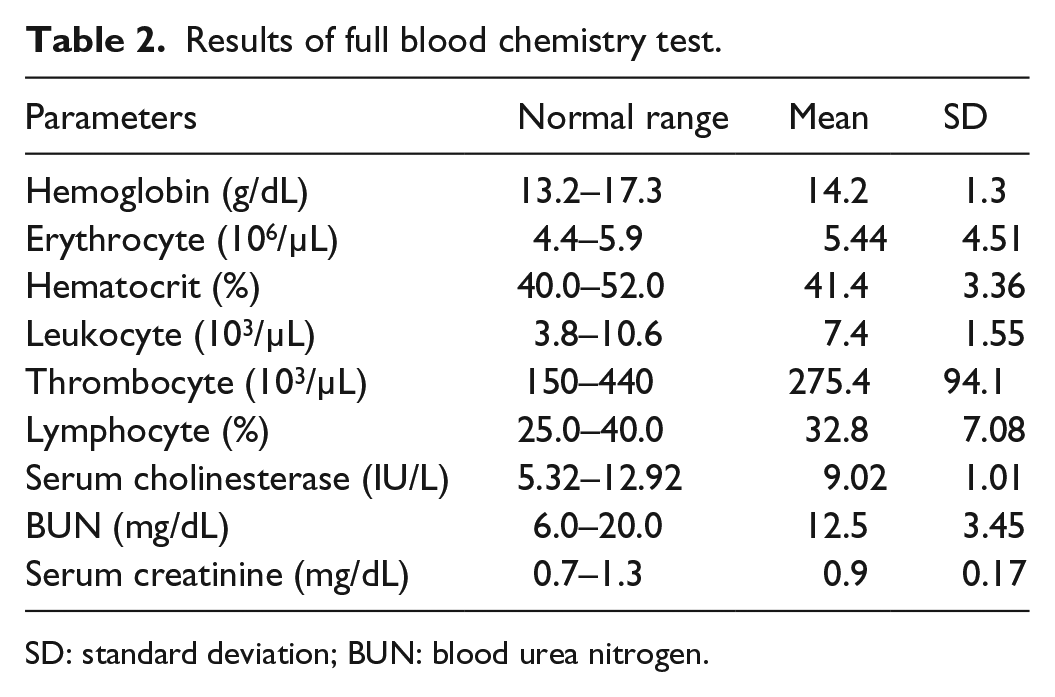
SD: standard deviation; BUN: blood urea nitrogen.
Table 3 presents the acute toxicity symptoms due to organophosphate exposure and also the treatment after experiencing acute toxicity. Around 17.86% farmers experienced a headache, 8.33% farmers experienced nausea and vomiting and 60.71% of them experienced nothing after the pesticide application. According to the acute organophosphate toxicity experienced by the farmers, we grouped the farmers into toxic (n = 33) and non-toxic groups (n = 53). Moreover, the duration of pesticide application in each application to the toxic group was longer than the non-toxic group (0.9 vs 0.8 h; p > 0.05). Surprisingly, we found that around 71.4% farmers experienced tremor. The cholinesterase activity was not significant different in the farmers with tremor and without tremor (9.3 ± 1.20 vs 8.2 ± 1.10; p > 0.05). Most of the farmers did not do anything to treat the toxicity symptoms. The linear regression test presented no significant association between the cholinesterase activity and blood urea nitrogen (p = 0.43). However, a significant association was shown between serum cholinesterase level and serum creatinine (p = 0.026). The association had a positive value, meaning that the higher the serum cholinesterase activity, the higher the serum creatinine. There was no significant association between parameters of organophosphate exposure (duration, frequency and width of the area) with renal function and blood chemistry (p > 0.05).
Characteristics of toxicity symptoms.

Table 4 lists the score of quality-of-life domains. The higher score means the better quality of life. The highest score is presented in the physical function domain and the lowest score is seen in the pain domain. In general, the domains of quality of life are good because the score values are higher than 50. The domain scores of Kulon Progo farmers are lower than the normal population in Yogyakarta.
Quality of life of the farmers.

SD: standard deviation.
Discussion
Our study reports the presence of organophosphate toxicity which is represented by the symptoms of headache and nausea–vomiting as acute toxicity and tremor as chronic toxicity. The toxicity symptoms of organophosphate can be determined according to organophosphate accumulation in the body. Some symptoms will appear 7–21 days after acute symptoms. The excessive amount of organophosphate in the peripheral synapse may cause the activation of sympathetic and parasympathetic nerves, and thus, the neurotoxicity like tremor will appear. 31
The renal function is also influenced by the higher exposure of organophosphate. Our study results are in line with the previous study which presented the proportion of farmers with grade 2 of organophosphate poisoning symptoms like gastrointestinal disturbance. 28 Headache, nausea and vomiting are the symptoms which are related to the increase in serum cholinesterase activity. These results are consistent with the activity of serum cholinesterase, which is higher in the non-toxic group than the toxic group, and the serum creatinine of the toxic group is higher than the non-toxic group. These findings could be caused by the longer duration of pesticide application in non-toxic group. Surprisingly, most of the farmers did not undergo any treatment for the acute toxicity symptoms. Based on the interview, it is clear that they did not recognize the acute toxicity symptoms and did not understand how to treat the symptoms. There is a need for an awareness program for the farmers about the safe use of pesticides. Other neurological symptoms like tremor due to the organophosphate poisoning dominated more.32,33 Theoretically, the exposure of organophosphate which could be measured from the frequency, duration and concentration of organophosphate can influence the CNS and cause tremor. Organophosphate will inhibit acetylcholinesterase function, and furthermore, there will be accumulation of acetylcholine. Some neuromuscular symptoms like paralysis and tremor will appear. Organophosphate hydrolysis is very slow, sometimes cannot be hydrolyzed which cause the chronic toxicity. 31 The findings about renal function of this study are also consistent with a previous case report which presented that 58-year-old male patient experienced hemodialysis due to the increase in serum creatinine induced by organophosphate. 25 Farmers who experienced organophosphate toxicity had decrease in cholinesterase activity. 34 The previous study in Turkey also found that the most frequent acute toxicity of organophosphate was vomiting and the observed biochemical effect found in the subjects was leukocytosis. 8
Another previous study in Magelang, Indonesia, showed that 99.8% farmers using pesticide experienced mild, moderate and severe toxicity symptoms. 35 The duration of pesticide application and the wind direction can also influence cholinesterase activity. 36 Indonesian government ruled out that the duration of pesticide application should not be more than 4 h/day continuously in a week. The maximal exposure of pesticide is 5 h/day and 30 h/week. However, World Health Organization (WHO, 1996) also ruled out the duration of pesticide application as 5–6 h/day and the health assessment should be conducted every week including the cholinesterase activity. 37 If the farmers take a break for some weeks from organophosphate exposure, the cholinesterase activity will reach the normal range in 3 weeks and the erythrocytes will reach the normal range in 2 weeks. 38 The farmers in Kulon Progo also take a break for some months between the planting and harvest season, and the laboratory parameters are in the normal range, except for the tremor as chronic toxicity symptoms.
According to the Indonesian government rules about the appropriate and safe use of pesticides, the pesticides should be used with the concern of target, pesticide quality, time, pesticide type, dose and the way to use. The recommendation for using the pesticides should be 5 h maximally/day including the preparation. 39
The quality of life of the farmers in our study is good. We did not find a significant association between quality of life and organophosphate exposure. However, compared to the previous study in Iran, the score of quality-of-life domain in our study group is higher than the farmers exposed to organophosphate. The organophosphate exposure could influence the psychological health of Iran farmers and also may cause depression, anxiety and stress. 40 Also in Zimbabwe, the increase in organophosphate poisoning got related to the mental and social health. Suicides were found as predominant reason for the poisoning. 15 When compared to the normal population’s quality of life in Yogyakarta, the domain scores of the Kulon Progo farmers are lower than the scores of the normal population. According to these data, we understand that the organophosphate exposure may influence the farmers’ quality of life.
The limitation of our study is that it is a study conducted by cross-sectional design, meaning that we cannot explore the confounding variables in the past which may affect the association between organophosphate exposure and the outcome. We did not use a control group because the organophosphate toxicity could be experienced in chronic or acute condition and most of the people in this area have ever been exposed to pesticides. Thus, we could not afford to find the subjects for the control group. We minimized this confounding variable by assessment method during the physical examination. We recommend that the local government give more education to the farmers about the safe application of pesticides. Moreover, the farmers should increase their understanding and awareness of the toxicity symptoms of pesticides and the ways to treat the symptoms.
Conclusion
According to the physical perspective, farmers experienced both acute and chronic toxicity due to organophosphate exposure. A significant association is seen from the serum cholinesterase activities and creatinine. The duration, frequency and width area of pesticide application do not have an association with renal function and other blood chemistry. From the psychological and social perspectives, farmer’s quality-of-life scores are lower than normal population scores in Yogyakarta. Health promotion and education about the toxicity symptoms of organophosphate exposure and the treatment for the toxicities should become the priority of government health programs.
Footnotes
Acknowledgements
The authors thank the Principal and staff of the Department of Food Management, Kulon Progo County.
Declaration of conflicting interests
The author(s) declared no potential conflicts of interest with respect to the research, authorship and/or publication of this article.
Ethics approval
Ethical approval for this study was obtained from Komite Etik Penelitian Universitas Ahmad Dahlan Yogyakarta (Ethical Research Committee, Universitas Ahmad Dahlan, Yogyakarta; approval number 011605113).
Funding
The author(s) disclosed receipt of the following financial support for the research, authorship, and/or publication of this article: The authors received financial support for the research, authorship and/or publication of this article from Research and Development Institution of Universitas Ahmad Dahlan Yogyakarta.
Informed consent
Written informed consent was obtained from all subjects before the study.