




Abstract
Objective. To evaluate the association between characteristics known to be associated with under-immunization and participation in immunization campaigns among Peruvian children. Methods. This is an analysis of data collected as part of the Peru 2012 Demographic and Health Survey. Analyses were conducted among children in 2 groups: children aged 18 to 29 months among whom core vaccine coverage is typically determined by the Peruvian authorities and children aged 30 to 59 months who may have received the core vaccines at older ages. The associations between relative wealth, location, maternal education, primary maternal language and the outcome, participation in an immunization campaign within the past 2 years were estimated using logistic regression models adjusted for survey design in each age group. Results. For children aged 18 to 29 months, campaign participation was higher if the mother had completed secondary school compared with those not having completed secondary school (27.4% vs 20.1% [prevalence odds ratio (POR) = 1.51 (1.08, 2.13)]). For children aged 30 to 59 months, campaign participation was higher if the mother had completed secondary school (40.4% vs 35.1% [POR = 1.23 (1.02, 1.49)], adjusted for residence) and if the child resided in Lima versus in other urban areas (46% vs 35.4% [POR = 1.52 (1.16, 2.01)], adjusted for maternal education). Relative wealth and mothers’ primary language were not associated with campaign participation. Conclusions. This study suggests that children of mothers with higher education and those residing in Lima had higher prevalence odds of reporting that their children had participated in a vaccination campaign. This contrasts with the populations vaccination campaigns typically target (poor, rural, or indigenous) to improve vaccination coverage.
Introduction
Immunization days or campaigns have been commonly used to improve immunization coverage. 1 These campaigns can be used to respond to a public health emergency, such as a vaccine-preventable disease outbreak, to address under-immunization in groups at risk for specific diseases, or to improve vaccination coverage among populations that are otherwise difficult to reach, either due to geography or socioeconomic status.2-4 While immunization campaigns aim at increasing immunization coverage, they might also interrupt routine health service delivery.5,6 Gloyd et al in 2003 specifically questioned the overall efficacy of campaigns and their negative impact on the health system in Ecuador and El Salvador. 7
The Peruvian Ministry of Health promotes immunization through a variety of avenues, one of which is participation in the “Vaccination Week in the Americas.” 8 The “Vaccination Week in the Americas” was created in 2002 following an outbreak of measles in the Andean countries, and since has been an annual event with voluntary participation from several Latin American countries. One of its stated goals is to reach “populations with little access to regular health services, such as those living in urban fringes, rural and border areas, and in indigenous communities.” 9 This goal is echoed in several of the Peruvian documents describing the campaigns. 10 Peru has participated several times in “Vaccination Week in the Americas.” 8 Participation in the intercountry collaboration is a multidimensional effort, including education and political advocacy in addition to the direct immunization campaigns at multiple sites. 11 The Peruvian government’s outreach strategies varied over the years of this study’s focus. The 2010 campaign employed extensive publicity through public service announcements, and vaccination teams provided focused vaccination delivery. The 2011 campaign lasted 1 day, and combined increased services at health posts, temporary mobile vaccination posts in centralized locations, and home visits. The 2012 campaign featured especially robust outreach that included mobile teams visiting hard to reach sites and providing comprehensive vaccination. 12
The proportion of the child population immunized in Peru has increased in the early part of the 21st century, with the overall “fully vaccinated” percentage for the 18 to 29 month olds in the country improving from 51.4% in 2009 to 73.9% in 2012 (fully vaccinated being defined as having received 1 dose of the Bacille Calmette-Guérin vaccine, 3 doses of diphtheria/tetanus/pertussis vaccines, 3 doses of the poliomyelitis vaccine, and 1 dose of measles containing vaccine, documented by vaccine card or maternal report). 13 Although immunization coverage has been improving, the contribution of campaigns to this increase has not been assessed. Consistent with the stated goals, campaigns should be targeted to and preferentially reach populations at risk for poor immunization coverage.
Because there is mixed evidence regarding the overall impact of campaigns, the goal of this study was to evaluate whether children with sociodemographic factors targeted by vaccination campaigns were indeed those participating in them more often than other populations. Specifically, the aim was to examine the cross-sectional association between relative wealth, geography, maternal education, primary maternal language and the outcome, and participation in immunization campaigns among children aged 18 to 29 months and 30 to 59 months in Peru. These exposure variables were chosen as indicators of children living in communities at risk for “little access to regular health service,” as stated in the campaign goals. Region and relative wealth within region (such as in a city) can be important determinants of vaccination.14,15 Maternal education has also been shown to be associated with vaccination proportions. 16 Maternal indigenous language was selected as a proxy for indigenous communities, an at-risk group specifically mentioned in the campaign goals. 9
Methods
Source of Data, Study Population, and Design
This project was a secondary data analysis of the 2012 Peru Encuesta Demográfica y Salud Familiar (ENDES) collected by the Instituto Nacional de Estadística e Informática, Lima, Peru. The data were accessed from the United States Agency for International Development (USAID) Demographic and Health Survey (DHS) Program.13,17 This cross-sectional population-based survey explored issues of health and economics for the Peruvian population, specifically focusing on the populations of women aged 15 to 49 years and children aged 0 to 4 years. The ENDES used the DHS methodology with limited technical assistance and funding provided through USAID. 17 The ENDES 2012 was the latest data available for Peru through the DHS program and was selected for analysis with the purpose of obtaining the most up-to-date information on the reach of campaigns in selected populations. This survey was conducted from March to December, 2012. 13
The survey used a 2-stage sampling method, stratified by urban and rural areas, with the first stage consisting of primary geographical units (clusters) of approximately 120 households each, and the second stage consisting of systematically sampled households, with the number of households selected within each cluster varying by rural/urban stratum. Survey administrators calculated individual-level sampling weights and included cluster and stratum variables that accounted for the survey design and allow for accurate population estimates. 13
We performed analyses for age groups 18 to 29 months (the age at which Peru and many other Latin American countries customarily measure immunization proportions) 18 and 30 to 59 months (to account for children receiving vaccines after the recommended age). Children aged 18 to 29 months could have participated in campaigns advertised by the Ministry of Health in April/May of 2010, May of 2011, and April of 2012. Children aged 30 to 59 months could have participated in those campaigns, or in some cases in similar ones conducted in preceding years. 12 We analyzed the data separately for each group while preserving the sampling weights and complex survey design for the whole study sample using the appropriate procedures in SAS.
Definition and Measurement of the Outcome Variable
The study’s primary outcome measure was maternal report of campaign participation within the past 2 years during the ENDES interview as reported in the database. There was a discrepancy between the final database, which was labeled “campaign participation in the last 2 years,” and the question in Spanish on the survey included in the final DHS report, which did not include a temporal component. The following is the question regarding campaign participation: “¿Algunas de las vacunas que recibió (NOMBRE) fueron parte de alguna Campaña Nacional de vacunación?”
13
Translation: “Were some of the vaccines that (NAME) received part of a National Vaccination Campaign?”
Children were considered as having participated in the campaign if their mothers answered “Yes” to the question of whether the child had been immunized in a campaign, and as not having participated if their mothers answered “No,” “No vaccination in the last 2 years,” or “Don’t know.” The percentage of living children in the target age groups with missing data for campaign participation was calculated. Additional models were run excluding those answering “Don’t know” to the campaign participation question.
Exposure Variables
Area of Residence
We created one area of residence variable using 2 variables available in the ENDES, location of participants in urban or rural localities and then by geographic area (low jungle, jungle, mountains, Lima metropolitan area, or remaining coastal areas). The constructed area of residence variable categorized participants’ residence as “Lima” when the general geographic area was “Lima metropolitan area” “other urban” when the location was urban but not Lima metropolitan area, and “rural” when the location was rural.
Relative Wealth
The ENDES survey calculated a wealth index for each household using standard DHS methodology. 19 ENDES’ wealth index for Peru included variables such as the availability of household goods, access to public services, household construction materials, and access to transportation. 13 To more accurately characterize household wealth relative to each individual household’s area of residence, we separately ranked households on the wealth index within the 3 categories of the area of residence variable (ie, Lima, other urban, rural). Quintile distribution of the raw wealth index scores within each area of residence was used to create a 5-category (ie, poorest, poor, middle, wealthier, wealthiest) relative wealth index variable. This strategy was similar to that previously used in a 2-level (urban/rural) stratification by Poterico et al, studying obesity in Peru. 20
Maternal Education
The ENDES dataset categorized the highest level of maternal education completed in 4 ordinal groups (none, primary, secondary, higher). More than 95% of mothers in the sample had completed primary school. Therefore, to permit comparison between groups of more comparable size, we dichotomized the variable to distinguish mothers who completed secondary education (68.6% of the sample) from those with less than secondary education (31.4%).
Maternal Indigenous Background
The ENDES survey measured indigenous status according to the primary language spoken by the mother (Spanish, Quechua, Aymara, other indigenous language, foreign language). We dichotomized this as indigenous (Quechua, Aymara, or another indigenous language spoken) and nonindigenous (Spanish or a foreign language spoken) in order to focus on the indigenous community per the stated campaign goals.
Vaccination Status
Because families who vaccinated their children may be more likely to participate in campaigns than those who did not, we explored whether adjustment for individuals’ vaccination status would affect the model estimates. We followed the guidelines of ENDES 2012, which defined individuals as “fully vaccinated” if they had received 1 dose of the Bacille Calmette-Guérin vaccine, 3 doses of diphtheria/tetanus/pertussis vaccines, 3 doses of the poliomyelitis vaccine, and 1 dose of measles containing vaccine.13,21
Statistical Analyses
All reported counts and analyses accounted for the complex sampling design including weights. For households in which there was more than 1 child in either age stratum (18-29 months or 30-59 months), 1 child of each age group was randomly selected to avoid clustering. The ENDES sampling weights were adjusted by multiplying the weight for the selected child by the number of children of the same age group in the household to preserve the overall weighting. There were multiple children in the same age group in the same household for only 1.4% of 18 to 29 month olds and 7.0% of 30 to 59 month olds. To assess the potential impact of excluding multiple children from the same households, we ran all models including these children while ignoring clustering within household. These models resulted in very similar estimates; therefore, only the results from the models including 1 child in each age group per household are presented in this article.
SAS (v9.4) survey procedures were used to explicitly consider cluster (Primary Sampling Unit), strata, and weight variables. Descriptive statistics were calculated, including the weighted proportion of children participating in vaccination campaigns according to their sociodemographic characteristics. To assess association between the child’s characteristics and participation into the campaign in each age group, weighted bivariate analysis and weighted multivariable logistic regression models were performed. Effect modification was examined for the exposure variables of relative wealth, area of residence, maternal education, and maternal language. Model selection was determined using the purposeful method, examining how adding any exposure variables as potential confounders affected odds ratio (OR) estimates and retaining a confounding variable in the model only if its presence changed the OR estimate more than 10%. 22 Models were also run with and without adjustment for vaccination status (proportion of individuals fully vaccinated) to assess its potential confounding impact. Because adjustment for vaccination status did not affect these models’ estimates, the final model for each age group is not adjusted for vaccination status.
Sensitivity Analysis
As explained earlier, there was a discrepancy between the questions asked during the interview and the information available from the database as to when the child has received a vaccine during a campaign. Children in the younger age group could have only attended a campaign in the past 2 years given their age. However, children in the older age group may have participated in earlier vaccination campaigns, which could lead to an overreporting of the primary outcome, participation to vaccination campaign in the past 2 years. To address this potential bias, a sensitivity analysis was performed assuming an extreme case in which responses to the campaign question in the 30- to 59-month age group represented campaign participation spaced over an average of the preceding 4 years instead of the reported 2 years. The reported campaign participation was assumed to result from the following formula:

where p is defined as the probability of participation to a campaign for a period of 2 years, regardless of the time period. In other words, p could represent the probability of vaccination in the previous 2 years or from the previous 3 to 4 years. This had the effect of reducing the proportion of those attending a campaign in the past 2 years almost by half. Assuming nondifferential misclassification of campaign participants, subjects in the 30- to 59-year-old group were proportionally reallocated (using the proportions of children in each combination of sociodemographic characteristics) to “campaign participation” or no “campaign participation” using the new proportion p. The relationships between the exposure variables and the outcome variable were reexamined to test the robustness of conclusions to this type of misclassification.
Ethics Review
The University of Oklahoma Health Sciences Center Institutional Review Board determined that this project did not require ethical approval.
Results
The total number of households surveyed for the entire ENDES is given in the final report as 27 488, with a response rate of 99%. Reasons for nonresponse included refusal to complete interview, house found empty, and house not present. The total number of women interviewed for the entire ENDES is given in the final report as 23 888, with a response rate of 97.3%. Reasons for nonresponse included absence, refusal, postponement or partial completion, and inability to complete the survey. There was no further specific breakdown of response rates among mothers of children in the target age ranges. 13
Campaign Participation
There were the equivalent of 1742 and 4442 weighted children in the 18- to 29-month and the 30- to 59-month age groups, respectively. Data on campaign participation were missing for approximately 1% in each group, leaving 1727 in the 18- to 29-month age group and 4393 in the 30- to 59-month age group for analysis. Of those with otherwise complete data, less than 1% of mothers reported that they did not know if their children had received vaccines at a campaign. Classifying these children as “missing” instead of “no” did not appreciably change the results from what is reported. Table 1 shows the weighted percentage of the sociodemographic and vaccination variables of interest in each age group. Most children in both age groups were from nonindigenous backgrounds, had mothers who had completed secondary education, were fully vaccinated, and had not participated in a vaccine campaign. There was an approximately equal proportion of male and female children in the sample. Table 2 describes, for each age group, the weighted percentage of children vaccinated according to their sociodemographic characteristics along with the corresponding weighted crude OR and their 95% confidence interval (CI). Among older children, campaign participation was significantly higher among Lima residents than among residents of rural or other urban settings. There was no difference in campaign participation based on relative wealth in either age group. In both age groups, the odds of campaign participation were higher among those whose mothers had completed secondary school than among those whose mothers who had not.
Weighted Percentages (Standard Error) of Children by Sociodemographic Characteristics Among Children Aged 18 to 29 Months and 30 to 59 Months Included in the 2012 Peru ENDES (Encuesta Demográfica y Salud Familiar).

Weighted Percentage of Children Having Participated in a Vaccination Campaign in the Past 2 Years by Characteristic and Corresponding Weighted Crude Odds Ratio (cOR) With 95% Confidence Interval (95% CI) Among Children Aged 18 to 29 Months and 30 to 59 Months Using the Peru ENDES (Encuesta Demográfica y Salud Familiar) 2012 Survey a .
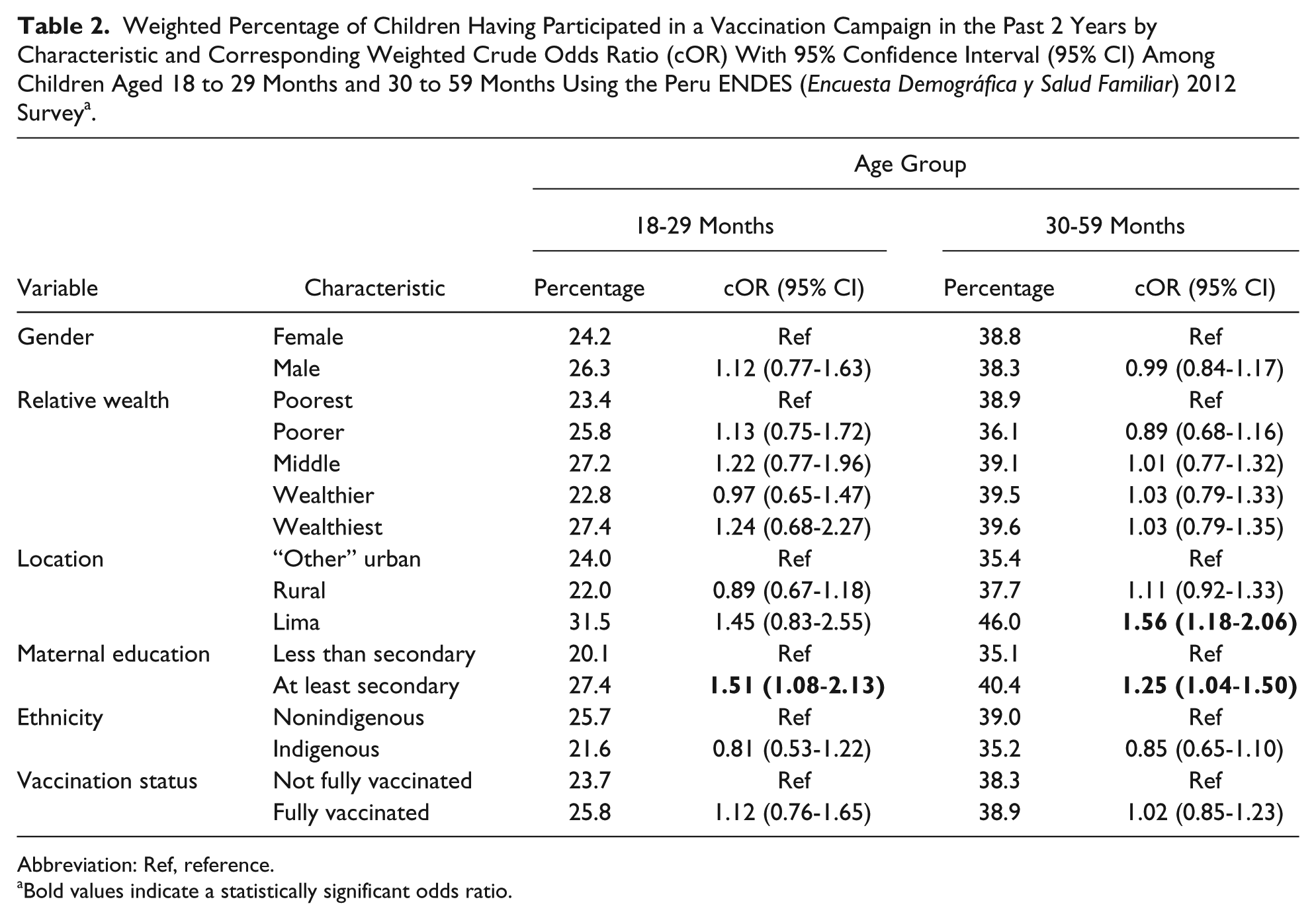
Abbreviation: Ref, reference.
Bold values indicate a statistically significant odds ratio.
For the 18- to 29-month age group, the multivariable analysis detected significant effect modification between relative wealth and indigenous status. None of the wealthiest members of the indigenous group (n = 10) reported participation in vaccination campaigns. However, this group’s small size limits the interpretability of this effect modification. Purposeful selection of variables, using the preset criteria to examine the effect of potential confounders on ORs, revealed no confounding; thus, the final model contained only maternal education as a predictor of campaign participation and was, therefore, a bivariate comparison (see Table 2). The odds of reporting having attended a vaccination campaign was 1.5 times higher among mothers who had secondary education than among mothers who had not (95% CI = 1.08-2.13).
For the 30- to 59-month age group, the multivariable analyses detected no significant interactions between wealth, areas of residence, maternal education, and ethnicity. Only maternal education and place of residence were significantly associated with campaign participation, and purposeful selection of variables revealed no confounding by the other variables. The final multivariable model contained area of residence and maternal education as 2 independently significant predictors of campaign participation. Weighted and adjusted ORs for this model are reported in Table 3. Residence in Lima was associated with campaign attendance when compared with residence in smaller cities. The association between residence in a rural area and campaign participation approached but did not reach statistical significance. The odds of reporting campaign participation were 1.23 times higher (95% CI = 1.02-1.49) among children of mothers with at least a high school education than among children of mothers will lesser education.
Crude and Adjusted Weighted Odds Ratio (95% CI) Estimates of the Association Between Potential Risk Factors and Participation in a Vaccination Campaigns in the Past 2 Years Among Children Aged 30 to 59 Months a .

Abbreviation: CI, confidence interval.
Bold values indicate a statistically significant odds ratio.
The sensitivity analysis resulted in an estimated proportion of participation to a vaccination campaign of 22% in the 30- to 59-month age group. However, estimates of ORs for each factor were nearly identical to those produced in the original analysis.
Discussion
Despite resource targeting and planning of immunization campaigns that are a coordinated multicountry effort, our analysis of DHS data for Peru failed to support that those campaigns preferentially reached populations believed to be at risk for under-immunization.
In the 18- to 29-month-old age group, there was no significant difference in vaccine campaign participation by geographic region. In contrast, among children aged 30 to 59 months, living in Lima was associated with a higher odds of having attended a campaign when compared with living in another urban area. This could have indicated that the campaigns were reaching a targeted population of the Lima poor, but the absence of an effect modification by relative wealth did not support this interpretation. An alternative explanation would be that the structure or design of the campaigns is less effective at reaching those living in smaller cities, as rural areas may be a specific target of campaigns and Lima may have more campaigns owing to its large size.
Several analyses of health indicators have previously examined urban/rural distinctions, because rural populations can be harder to reach with health infrastructure.23-27 Our decision to further divide the urban stratum was based on the wealth differential between Lima and rest of the country, and the nearly 10-fold size differential between Lima and the next largest city in the country. 28 Because wealth is distributed differently in the rural areas, Lima, and other urban areas, relative wealth was separately ranked within each of the 3 areas. This strategy allowed examination of participation in the poorest populations of each area.
In both age groups, higher maternal education was associated with an increased odds of child participation in a vaccination campaign. Indigenous populations and the relative poor in all geographic locations did not have higher odds of participation. These observations could be either due to campaigns not being successful at targeting groups at risk for under-immunization or on very strong differential reporting of campaign participation by more educated mothers.
Conversely, if campaign self-report did not differ based on the mother’s education, the positive association of campaign participation with higher maternal education may be an argument that strengthening the educational system could work synergistically with public health efforts, as mothers who are more educated may better take advantage of campaign opportunities. Maternal education has been shown to be positively associated with receipt of vaccines in other analyses as well, such as Wiysonge’s multilevel analysis of vaccination proportions in sub-Saharan Africa. 16
To address the possibility that a lack of specificity in the survey question regarding campaign participation may have affected the accuracy of responses among mothers of children aged 30 to 59 months, we conducted a sensitivity analysis for this group. It is possible that this question was interpreted in multiple ways by different participants and survey workers, but there is no reason to believe that any of the exposure variables would have affected how the question was interpreted causing a differential misclassification. Assuming nondifferential misclassification, our sensitivity analysis showed that even in the extreme case that all maternal responses reflected a 4-year average reporting period there was almost no change in the results.
The major strengths of this study are the overall size and design of the dataset and the high response proportion for the variables examined. Additionally, because the survey is based on DHS methodology, results could be compared with other surveys either in Peru or other countries. However, this study has some limitations. First, the small number of observations in some subgroups limited our ability to explore effect modification in detail. Also, the timing of vaccine receipt for campaign participants could not be determined (due missing date data). Thus, interpreting results that relate to older children requires some care, since it is unclear whether reports of campaign participation refer to recent or remote participation. Additionally, the cross-sectional design of the study prevents the ability to infer causal relationships. Finally, there is potential for bias because maternal self-report was a factor in both our definition of vaccination status and campaign participation.
Future studies of vaccine delivery, especially in a complex and diverse society such as Peru, could benefit from qualitative investigation barriers to vaccination for marginalized groups. It is likely that these may be radically disparate for those in different settings, such as urban and rural areas, and would benefit from separate investigation and programmatic intervention.
Conclusion
This study provided no conclusive evidence that the immunization campaigns are preferentially reaching their intended target. It may be that campaigns are preventing disparities in a manner not detectable by our current analysis method, or it could be that improved vaccination proportions in the 18- to 29-month age group relative to the 30- to 59-month age group is a result of an improving health infrastructure and is unrelated to campaigns. Consideration should be given to shifting campaign resources to further strengthening the improving health care service delivery infrastructure.
Footnotes
Author Contributions
MTC: Contributed to conception and design; contributed to analysis and interpretation; drafted manuscript; critically revised manuscript; gave final approval; agrees to be accountable for all aspects of work ensuring integrity and accuracy.
HC: Contributed to design; contributed to analysis and interpretation; drafted manuscript; critically revised manuscript; gave final approval; agrees to be accountable for all aspects of work ensuring integrity and accuracy.
DMT: Contributed to conception and design; contributed to analysis and interpretation; critically revised manuscript; gave final approval; agrees to be accountable for all aspects of work ensuring integrity and accuracy.
PMD: Contributed to conception and design; contributed to analysis and interpretation; critically revised manuscript; gave final approval; agrees to be accountable for all aspects of work ensuring integrity and accuracy.
Declaration of Conflicting Interests
The author(s) declared no potential conflicts of interest with respect to the research, authorship, and/or publication of this article.
Funding
The author(s) disclosed receipt of the following financial support for the research, authorship, and/or publication of this article: This project was supported in part by the Health Resources and Services Administration (HRSA) of the US Department of Health and Human Services (HHS) under Grant Number D55HP23210. This information or content and conclusions are those of the author and should not be construed as the official position or policy of, nor should any endorsements be inferred by HRSA, HHS, or the US government.
