



Abstract
This retrospective epidemiological study investigated the relationship between physical fitness testing and locomotive disorder screening results among elementary school children in Japan. The test and screening results of 1033 children from a single elementary school between 2016 and 2018 were examined. Multiple regression analysis was performed for each gender of children of grades third and fourth to generate receiver-operating characteristic curves. Of the 69 children with parent-identified locomotor problems, 29 (42%) had physical fitness test score of mean ± 2 SD. For the standing long jump test in fourth grade girls, the results differed significantly (P < .001; cut-off, 127 cm) for children whose parents did (n = 7) and did not (n = 84) suspect a possible locomotive disorder. Physical fitness testing in combination with school-based screening for locomotive disorders may be useful for identifying and accurately diagnosing these disorders in children.
In Japan, athletes and adults, as well as children, are becoming increasingly interested in playing sports due to rising health consciousness and the scheduled hosting of the 2020 Olympics in Tokyo. In addition, taking a position toward lifelong exercise, The Ministry of Education, Culture, Sports, Science, and Technology in Japan has revised the physical education guidelines for elementary, junior high, and high schools for Japan. 1 More children are participating in sports at school, team sports are becoming more popular, and the relationship between health and sports has improved. It is well established that partaking in regular exercise and health-related activities is beneficial for both mind and body. However, focusing only on improving athletic abilities may result in overuse syndrome, amenorrhea due to excessive weight loss, and other factors such as the ever-increasing prevalence of mental health issues among athletes.2-8
By contrast, in Japan, children who exercise and those who do not are increasingly polarized. According to an exercise habits survey conducted by The Ministry of Education, Culture, Sports, Science, and Technology in Japan in 2018, the percentage of female students in eighth grade who achieved less than 60 minutes of exercise per week (apart from physical education class time) was 19.4%, of which 13.6% did not partake in any exercise activity at all. 9 Such a stark lack of exercise can lead to obesity and pediatric locomotive syndrome.10,11
Locomotive disorders that are problematic in children include calcaneal apophysitis (eg, injury to the inner elbow due to excessive ball throwing), which is known as a type of overuse syndrome.2,5 At the other extreme, weakness of muscles, bones, and ligaments due to lack of exercise 12 is on the rise in Japan and is a major concern because it can prevent normal growth and lower the quality of life. Thus, excessive or too little exercise can lead to pediatric locomotive disorders and poses a future health crisis for growing children. To ensure the healthy development of children, Japan has revised the school health and safety law to grasp the condition of children’s locomotor function and treat them early. This is influenced by the Bone and Joint Japan program, which was implemented in 2014 to identify locomotive disorders in schoolchildren.13,14 From 2016, schools distribute a questionnaire for parents designed to screen for children with potential locomotive disorder, who are then referred for a physical examination.
Although it is well established that early diagnosis and treatment of locomotive disorders is important for healthy development, there are few systematic reports of locomotive examinations among schoolchildren. Although schools conduct physical fitness tests every year.15,16 Because they mainly aim for improvements in individual results, the use of physical fitness tests alone does not provide a full picture of children’s health. The Japan Sports Agency, a national institution, collects and analyzes overall trends and results of physical fitness testing for children.15,16 Currently, physical fitness tests and locomotive examinations are conducted independently. Although the physical examination for locomotive examinations have just begun and there is no accumulation of studies, advancing research toward physical fitness testing will increase the diagnostic accuracy of motor dysfunction and enable early treatment among cohorts of school children.
In this study, we aimed to fill this gap by investigating the relationship between the results of physical fitness testing and locomotive examination screening in a cohort of Japanese elementary schoolchildren. We postulated that the determination of the risk of locomotive disorders using the results of physical fitness testing and locomotive examination screening might be possible. In addition, by combining the results of individual physical fitness testing and locomotive examinations, a set of criteria for objective measures on pediatric locomotive disorders could be established and used to guide safer and more effective exercise practices for children.
Methods
Study Design and Participants
This is an epidemiological research study in which a retrospective study design is employed. Data from a total of 1033 children (aged 6-12 years) who were enrolled in an elementary school in Osaka Prefecture, Japan, were evaluated between 2016 and 2018.
Ethical Considerations
Obtained data comprised the results of exercise examinations and physical fitness test data from annual events related to health and physical education and were completely anonymous. As this was a retrospective review of data, informed consent was not required. However, this study was conducted with the consent of the school principal and ethical approval was obtained from the University Research Ethics Committee. The study was conducted in accordance with the Declaration of Helsinki.
Locomotive Disorder Screening
All children who participated in this study underwent annual locomotive disorder screening at a school event. Every year since 2016, Japanese elementary schools and junior high schools have conducted a questionnaire survey for parents to assess the condition of each child’s locomotor function. For screening, parents were instructed to complete a structured questionnaire 17 designed to identify potential abnormalities in their child’s locomotor function and submit it to the school. This questionnaire is based on the findings of the Public Interest Foundation such as “Bone and Joint Japan” and “School Health Society” as a method of locomotor organ evaluation that can be efficiently performed under time constraints by a school nurse who does not specialize in orthopedics. 18 The questionnaire can be completed by the child’s parents. The school physician followed up by performing a physical examination to check for the presence or absence of any abnormalities highlighted in the questionnaire. Data were collected from current students and graduates who attended a single elementary school from 2016 to 2018.
The screening questionnaire (used in this study questionnaire used in Sakai City, Osaka Prefecture) is routinely delivered in Japanese and has been translated into English for this report (Supplemental Material 1, which shows the English translation of the questionnaire). Of the 1033 schoolchildren, 69 were categorized as having a possible abnormality or disorder based on the screening (screening group), while the remaining 964 were categorized as the healthy group, with no parental indication of suspected disorder or abnormality.
Physical Fitness Test
All Japanese schoolchildren (elementary schools and junior high schools) undergo the annual physical fitness test as a regular school event in the manner prescribed by the Japan Sports Agency. During this test, the following items are measured by gender: grip strength (for measuring muscle strength); sit-ups (for measuring muscle endurance); trunk forward flexion (also known as sitting trunk flexion, for measuring flexibility); side step (for measuring agility); 20-m shuttle run (for measuring cardiopulmonary endurance); 50-m run (for measuring instantaneous power); standing long jump (for measuring instantaneous power); and softball throw (for measuring instantaneous movement).
In this study, data on the results of locomotive disorder screening and physical fitness testing were collected annually, anonymized, and saved at the target school.
Analysis
The results of the physical fitness testing and locomotive disorder screening obtained between 2016 and 2018 were analyzed and compared between the screening group and healthy group. Each year, screening for locomotive disorders are performed from April to May, and physical fitness tests are performed immediately afterward, from the end of May to mid-June, making it unlikely for the physical condition of an individual child to change between the 2.
Statistical Analysis
Among children with a possible locomotive disorder who reported an abnormality at screening between 2016 and 2018, the number of children with scores of 2 standard deviations (SDs) above or below the mean score for a relevant grade (ie, remarkably excellent or inferior), physical fitness test results, and the total number of subjects, were investigated (Supplemental Materials 2 and 3, which show the mean values and SDs of physical fitness tests for third and fourth grade boys and girls, respectively).
Subsequently, a multiple regression analysis (using a stepwise method) of the results of the physical fitness test items was performed for children whose parents indicated a possible abnormality.
Research target: boys and girls in the fourth and third grades.
Objective variable
Children whose parents reported a potentially abnormal locomotor function at screening (with 1 representing the children with possible abnormalities reported and 0 representing the children without possible abnormalities reported: 1 = screening group, 0 = healthy group) were surveyed by gender.
Independent variables
The results of physical fitness test items and Rohrer’s index were the independent variables. In Japan, Rohrer’s index is more commonly used rather than body mass index for school children. We also included it in the independent variables because the body shape is thought to affect the exercise record. 19 Grip strength, trunk forward flexion, standing long jump, 50-m run, and Rohrer’s index; side step and the 20-m shuttle run were not included as independent variables because they are a confounding factor indicating the power of the lower body.
Furthermore, we examined whether there was a difference in the athletic ability of children whose parents reported a possible abnormality or disorder in their children compared to those whose parents did not. This was done by constructing receiver-operating characteristic (ROC) curves with the physical fitness test scores by gender. ROC curves were drawn to determine the sensitivity and the area under the curve (AUC) in order to clarify the cut-off point for each item.
Statistical analysis was performed using the Bell Curve for Windows, version 2.15 through Microsoft Excel for Windows® (Social Survey Research Information Co., Ltd.).
Results
Relationship Between Locomotive Disorder Screening and Fitness Test Results
Table 1 presents the classification of children with a possible locomotive disorder according to their symptoms and grades (Supplemental Material 4, which shows the study flow diagram). Between 2016 and 2018, among the 69 children (Table 1) who had a possible locomotive disorder at screening, 19 (27.5%) had physical fitness test scores that were 2 SD below the mean scores of children in the same grade. Four of these children were in the third grade and 6 were in the fourth grade. Nine were dispersed among other grades (Table 2); of these 9, 2 children were at risk for a locomotive disease as informed by the school physician.
Classification of 69 Children at an Elementary School Between 2016 and 2018 According to Symptoms and Grades Derived From Screening Questionnaire Results.

The figures indicate the number of children who have each condition.
Number of Children With a Possible Locomotive Disorder at Screening and/or Physical Fitness Test Scores 2 SD Below Average.

2 SD below = number of children who reported an abnormality at screening and had scores 2 SD below average.
Of the children whose parents reported locomotor function abnormalities during screening, 11.5% among the 69 children had a record of >2 physical fitness test scores 2 SD below the mean scores. One child had symptoms accompanied by pain, and many children could not squat, had a bent spine, or could not stand on 1 leg for more than 5 seconds. In the 50-m run and standing long jump tests, 8 children had scores 2 SD below the mean scores and were in the third or fourth grade. However, when performing the softball throw and trunk forward flexion, no child had scores 2 SD below the mean.
From 2016 to 2018, among the 69 children with a possible locomotive disorder at screening, 10 (14.5%) had physical fitness test scores 2 SD above the mean compared to others in the same grade (Table 3).
Number of Children With a Possible Locomotive Disorder and/or Physical Fitness Test Scores 2 SD Above Average.

2 SD above = number of children who reported an abnormality at screening and had scores 2 SD above average.
Many children had scores 2 SD above the mean for 1 item of the test. One child had scores 2 SD above the mean for more than 3 items of the test, but no abnormality was observed in the child by the school physician. No child reported symptoms accompanied by pain, indicating that many children could not squat or had a bent spine. Physical fitness tests indicated that 4 of the 10 children had scores 2 SD above the mean for grip strength (representing muscular strength of the whole body). 20
As a consequence, 29 (42.0%) of the 69 children with possible locomotive disorders who reported an abnormality at screening had biased results (scores 2 SD above or below the mean for each grade and for each item of the test). Two children required further treatment by a physician.
Physical Fitness Test Scores of Children With a Possible Locomotive Abnormality at Screening
Multiple regression analysis showed that the scores for the 50-m run and standing long jump were significantly different in the third and fourth graders who showed potential movement disorders at screening (Supplemental Materials 5-8, which show multiple regression analysis results). In boys and girls in the third grade in 2018, a multiple regression analysis of 50-m run results showed significant differences (P < .05) between children whose parents reported a possibility of abnormality and those whose parents did not (Supplemental Materials 5 and 6, which show multiple regression analysis results of the 50-m run in third grade boys and girls). Similarly, among boys and girls in the fourth grade in 2018, multiple regression analysis revealed a significant difference in standing long jump results between children whose parents did and did not report a possibility of abnormality (P < .01) (Supplemental Materials 7 and 8, which show multiple regression analysis results of the standing long jump in fourth grade boys and girls). It is interesting to note that for the fourth grade girls (age ~10 years), Rohrer’s index was also extracted (P < .05) (Supplemental Material 8, which shows multiple regression analysis results of standing long jump in fourth grade girls). Rohrer’s index is one of the indices that indicate body type. It is possible that body type has a certain effect on movement.
The ROC curves for the 50-m run and standing long jump scores for children in the third and fourth grades are shown in Figure 1. Among the third grade boys, there were no significant differences between any of the tests. The analysis of the 50-m run and locomotive disorders of boys revealed a cut-off value of 11.6 seconds, sensitivity (TPF) of 0.50, 1-specificity (FPF) of 0.13, and AUC of 0.625 (Figure 1A). The analysis of the standing long jump and locomotive disorders of boys revealed a cut-off value of 134 cm, TPF of 0.80, FPF of 0.40, and AUC of 0.681 (Figure 1B).
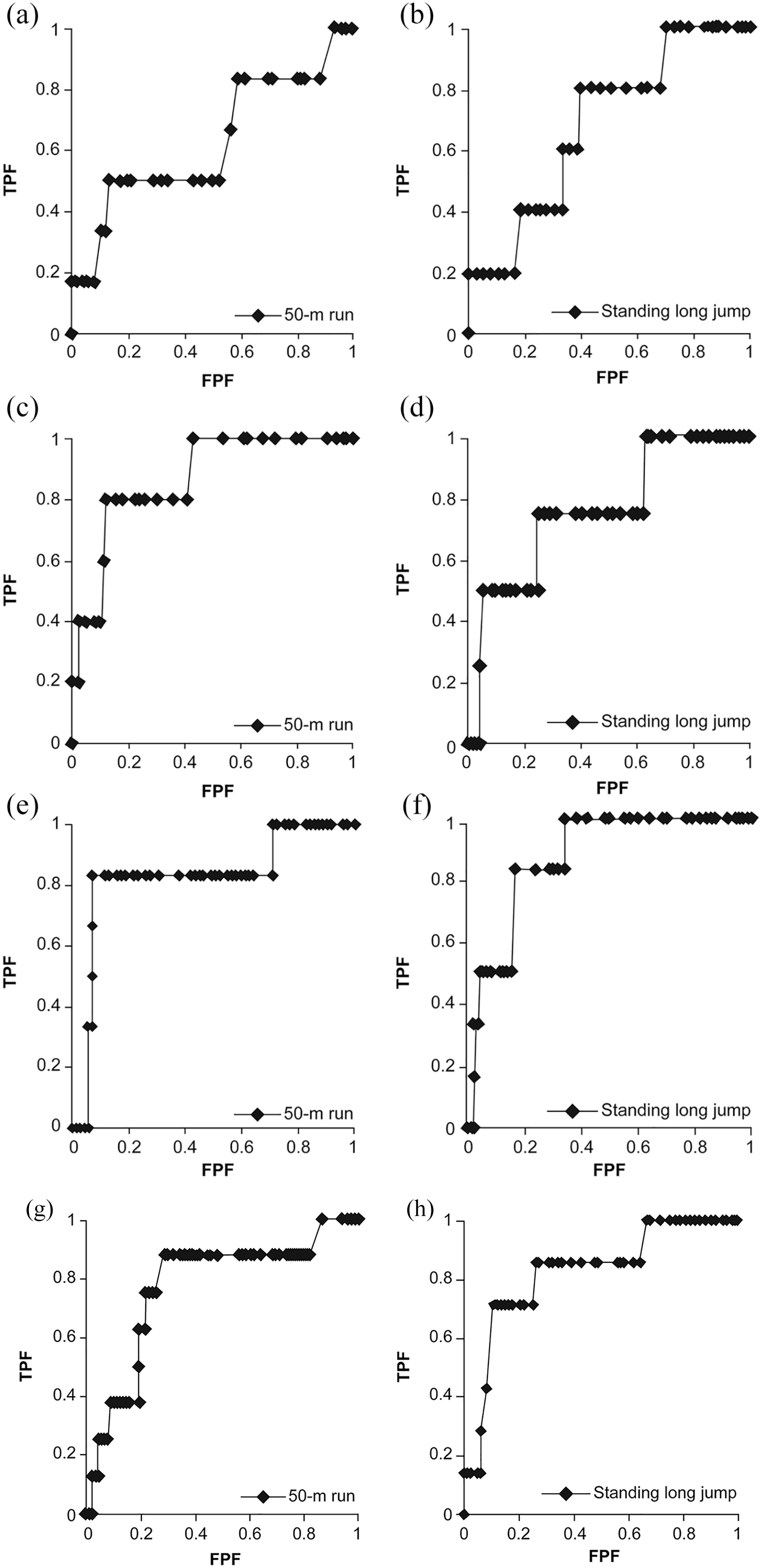
Receiver-operating characteristic (ROC) curves for locomotive disorder screening scores of children in the third grade. (A) The 50-m run and locomotive disorder screening scores of boys (6 of 82 possibly had a locomotive disorder). (B) The standing long jump and locomotive disorder screening scores of boys (5 of 80 possibly had a locomotive disorder). (C) The 50-m run and locomotive disorder screening scores of girls (5 of 93 possibly had a locomotive disorder). (D) The standing long jump and locomotive disorder screening scores of girls in the third grade (4 of 92 possibly had a locomotive disorder). (E) ROC curve of the 50-m run and locomotive disorder screening scores of boys in the fourth grade. There were 6 abnormalities among the 75 children that were screened. (F) ROC curves for locomotive disorder screening scores of children in the fourth grade. The standing long jump and locomotive disorder screening scores of boys (6 of 76 possibly had a locomotive disorder). (G) ROC curves for locomotive disorder screening scores of children in the fourth grade. The 50-m run and locomotive disorder screening scores of girls (8 of 95 possibly had a locomotive disorder). (H) ROC curves for the standing long jump and locomotive disorder screening scores of girls in the fourth grade. There were 7 abnormalities among the 91 children who were screened.
However, among girls in the third grade, the 50-m run and locomotive disorder screening scores were significant (P < .001), and the analysis revealed a cut-off value of 11.3 seconds, TPF of 0.80, FPF of 0.125, and AUC of 0.866 (Figure 1C). For girls in third grade, the standing long jump and locomotive disorder screening scores were not significantly different; the analysis revealed a cut-off value of 123 cm, TPF of 0.75, FPF of 0.25, and AUC of 0.756 (Figure 1D).
For boys in the fourth grade, the 50-m run and locomotive disorder screening scores were significant (P < .01), and the analysis revealed a cut-off value of 10.51 seconds, TPF of 0.833, FPF of 0.725, and AUC of 0.826 (P = .0034) (Figure 1E). In addition, the standing long jump and locomotive disorder screening scores were significant (P < .001) (Figure 1F), and the analysis indicated a cut-off value of 130 cm, TPF of 0.833, FPF of 0.171, and AUC of 0.871.
For girls in the fourth grade, the 50-m run and locomotive disorder screening scores were significant (P < .01) (Figure 1G), and the analysis indicated a cut-off value of 10.4 seconds, TPF of 0.875, FPF of 0.287, and AUC of 0.764. In addition, the standing long jump and locomotive disorder screening scores were significant (P < .001), and the analysis revealed a cut-off value of 127 cm, TPF of 0.875, FPF of 0.262, and AUC of 0.824 (Figure 1H).
Discussion
The results of this retrospective study indicate that children who have extreme physical fitness test results may be at risk of having locomotive disorders. Comparison of the results of the locomotive disorder screening and physical fitness testing indicate that 42% of children had scores that were significantly above or below the mean score of other children in the same grade (14.5% had scores 2 SD above the mean; 27.5% had scores 2 SD below the mean). The results of the ROC curve of the physical fitness tests for children in the third and fourth grades who were at risk for locomotive disorders were shown to be biased. Among children whose parents reported a possible abnormality at screening, many could not adequately perform the 50-m run and standing long jump. Physical fitness test results were significantly inferior to the mean score, which suggested the existence of a locomotive disorder in children whose parents indicated a possible abnormality.
In addition, children who were declared to be having locomotive disorders in the screening may have problems with instantaneous power. For example, some of these children had poor 50-m run and standing long jump results, for which the cut-off points may be suggestive of locomotive disorders. However, no difference was seen with the softball throw, which also measures instantaneous power. Softball throws tend to provide accurate records for children who are experienced at this type of activity, whereas poor results for inexperienced children, thus they do not reflect the children’s overall locomotor condition.
The symptoms of children with a possible locomotive disorder included a bent spine and the inability to squat (1-leg stand could not be performed for more than 5 seconds). However, few symptoms were accompanied by pain. It is not yet entirely clear, but our results suggest that children with excellent physical fitness test results might also have had overuse syndrome. It may be deduced that one possible explanation for their excellent results was the overall muscular strength of the whole body. Our rationale for this is that the ratio of children with high grip strength was high in children with scores 2 SD above the mean score. 20
Limitations and Future Prospects of the Study
The screening rates of parent reporting of abnormalities among elementary schoolchildren in this school in Osaka Prefecture were 2.8% in 2016 and 5.3% in 2018 (declaration by parents). The current study was based on the analysis of data from only one school in Japan, so our results on the relationship between locomotive disorders and physical fitness test records are not yet complete. Because testing for locomotive disorders at schools has only recently been initiated, the implications of this testing must be regarded with caution. In addition, the data analyses were based solely on the reporting of potential conditions revealed by a screening survey. It is also important for parents to screen appropriately.
Youth overuse syndrome is a phenomenon not only in Japan but also other countries, including the US. Sports that are associated with overuse syndrome in the US include baseball, racquet sports, and volleyball, 7 which are also popular sports in Japan. The school-based screening for locomotive disorders is currently being performed only in Japan; therefore, our results cannot be compared easily with those of other countries. The screening questionnaire that was used in this study was written in Japanese and has been translated into English to facilitate sharing of the results and reproduction of the study in other countries.
In conclusion, physical fitness testing combined with school-based screening for locomotive disorders may be useful for identifying and accurately diagnosing locomotive disorders in children. Furthermore, this study showed that evaluation based on locomotive disorder screening and physical fitness testing is an acceptable tool to detect early stages of locomotive disorders. Therefore, for early detection of locomotive disorders in children, it is necessary to utilize physical locomotive disorder screening and physical fitness testing and to have cooperation among school physicians, physiotherapists, families, and schools. Such evaluation would definitely contribute to the healthy development of children.
Supplemental Material
sj-docx-2-bbi-10.10.1177_2333794X211062459 – Supplemental material for Physical Fitness Testing and Screening Reveal a Gateway to Identify Locomotive Disorders: Retrospective Study of a Japanese Elementary School Population
Supplemental material, sj-docx-2-bbi-10.10.1177_2333794X211062459 for Physical Fitness Testing and Screening Reveal a Gateway to Identify Locomotive Disorders: Retrospective Study of a Japanese Elementary School Population by Syuro Ito, Takahiko Fukumoto and Hidetaka Imagita in Global Pediatric Health
Supplemental Material
sj-docx-3-bbi-10.10.1177_2333794X211062459 – Supplemental material for Physical Fitness Testing and Screening Reveal a Gateway to Identify Locomotive Disorders: Retrospective Study of a Japanese Elementary School Population
Supplemental material, sj-docx-3-bbi-10.10.1177_2333794X211062459 for Physical Fitness Testing and Screening Reveal a Gateway to Identify Locomotive Disorders: Retrospective Study of a Japanese Elementary School Population by Syuro Ito, Takahiko Fukumoto and Hidetaka Imagita in Global Pediatric Health
Supplemental Material
sj-docx-5-bbi-10.10.1177_2333794X211062459 – Supplemental material for Physical Fitness Testing and Screening Reveal a Gateway to Identify Locomotive Disorders: Retrospective Study of a Japanese Elementary School Population
Supplemental material, sj-docx-5-bbi-10.10.1177_2333794X211062459 for Physical Fitness Testing and Screening Reveal a Gateway to Identify Locomotive Disorders: Retrospective Study of a Japanese Elementary School Population by Syuro Ito, Takahiko Fukumoto and Hidetaka Imagita in Global Pediatric Health
Supplemental Material
sj-docx-6-bbi-10.10.1177_2333794X211062459 – Supplemental material for Physical Fitness Testing and Screening Reveal a Gateway to Identify Locomotive Disorders: Retrospective Study of a Japanese Elementary School Population
Supplemental material, sj-docx-6-bbi-10.10.1177_2333794X211062459 for Physical Fitness Testing and Screening Reveal a Gateway to Identify Locomotive Disorders: Retrospective Study of a Japanese Elementary School Population by Syuro Ito, Takahiko Fukumoto and Hidetaka Imagita in Global Pediatric Health
Supplemental Material
sj-docx-7-bbi-10.10.1177_2333794X211062459 – Supplemental material for Physical Fitness Testing and Screening Reveal a Gateway to Identify Locomotive Disorders: Retrospective Study of a Japanese Elementary School Population
Supplemental material, sj-docx-7-bbi-10.10.1177_2333794X211062459 for Physical Fitness Testing and Screening Reveal a Gateway to Identify Locomotive Disorders: Retrospective Study of a Japanese Elementary School Population by Syuro Ito, Takahiko Fukumoto and Hidetaka Imagita in Global Pediatric Health
Supplemental Material
sj-docx-8-bbi-10.10.1177_2333794X211062459 – Supplemental material for Physical Fitness Testing and Screening Reveal a Gateway to Identify Locomotive Disorders: Retrospective Study of a Japanese Elementary School Population
Supplemental material, sj-docx-8-bbi-10.10.1177_2333794X211062459 for Physical Fitness Testing and Screening Reveal a Gateway to Identify Locomotive Disorders: Retrospective Study of a Japanese Elementary School Population by Syuro Ito, Takahiko Fukumoto and Hidetaka Imagita in Global Pediatric Health
Supplemental Material
sj-tif-1-bbi-10.10.1177_2333794X211062459 – Supplemental material for Physical Fitness Testing and Screening Reveal a Gateway to Identify Locomotive Disorders: Retrospective Study of a Japanese Elementary School Population
Supplemental material, sj-tif-1-bbi-10.10.1177_2333794X211062459 for Physical Fitness Testing and Screening Reveal a Gateway to Identify Locomotive Disorders: Retrospective Study of a Japanese Elementary School Population by Syuro Ito, Takahiko Fukumoto and Hidetaka Imagita in Global Pediatric Health
Supplemental Material
sj-tif-4-bbi-10.10.1177_2333794X211062459 – Supplemental material for Physical Fitness Testing and Screening Reveal a Gateway to Identify Locomotive Disorders: Retrospective Study of a Japanese Elementary School Population
Supplemental material, sj-tif-4-bbi-10.10.1177_2333794X211062459 for Physical Fitness Testing and Screening Reveal a Gateway to Identify Locomotive Disorders: Retrospective Study of a Japanese Elementary School Population by Syuro Ito, Takahiko Fukumoto and Hidetaka Imagita in Global Pediatric Health
Footnotes
Acknowledgements
We thank the staff of the Institute of Health Sciences, Kio University. We also thank the children, the school nurses, and the principals of the elementary schools in Osaka prefecture for their support during this study. We did not procure any special funds for the study. We would like to thank Michelle Kahmeyer-Gabbe, PhD for language editing of this paper.
Author Contributions
Syuro Ito conceived and designed the study, collected the data, analyzed and interpreted the data, and drafted the manuscript; Takahiko Fukumoto, Syuro Ito, and Hidetaka Imagita revised the manuscript critically for important intellectual content. All authors read and approved the final manuscript.
Declaration of Conflicting Interests
The author(s) declared no potential conflicts of interest with respect to the research, authorship, and/or publication of this article.
Funding
The author(s) received no financial support for the research, authorship, and/or publication of this article.
Ethical Considerations
This study was conducted with the consent of the school principal and ethical approval was obtained from the Kio University Research Ethics Committee (No: H 28-06). The study was conducted in accordance with the Declaration of Helsinki.

Supplemental Material
Supplemental material for this article is available online.
References
Supplementary Material
Please find the following supplemental material available below.
For Open Access articles published under a Creative Commons License, all supplemental material carries the same license as the article it is associated with.
For non-Open Access articles published, all supplemental material carries a non-exclusive license, and permission requests for re-use of supplemental material or any part of supplemental material shall be sent directly to the copyright owner as specified in the copyright notice associated with the article.
